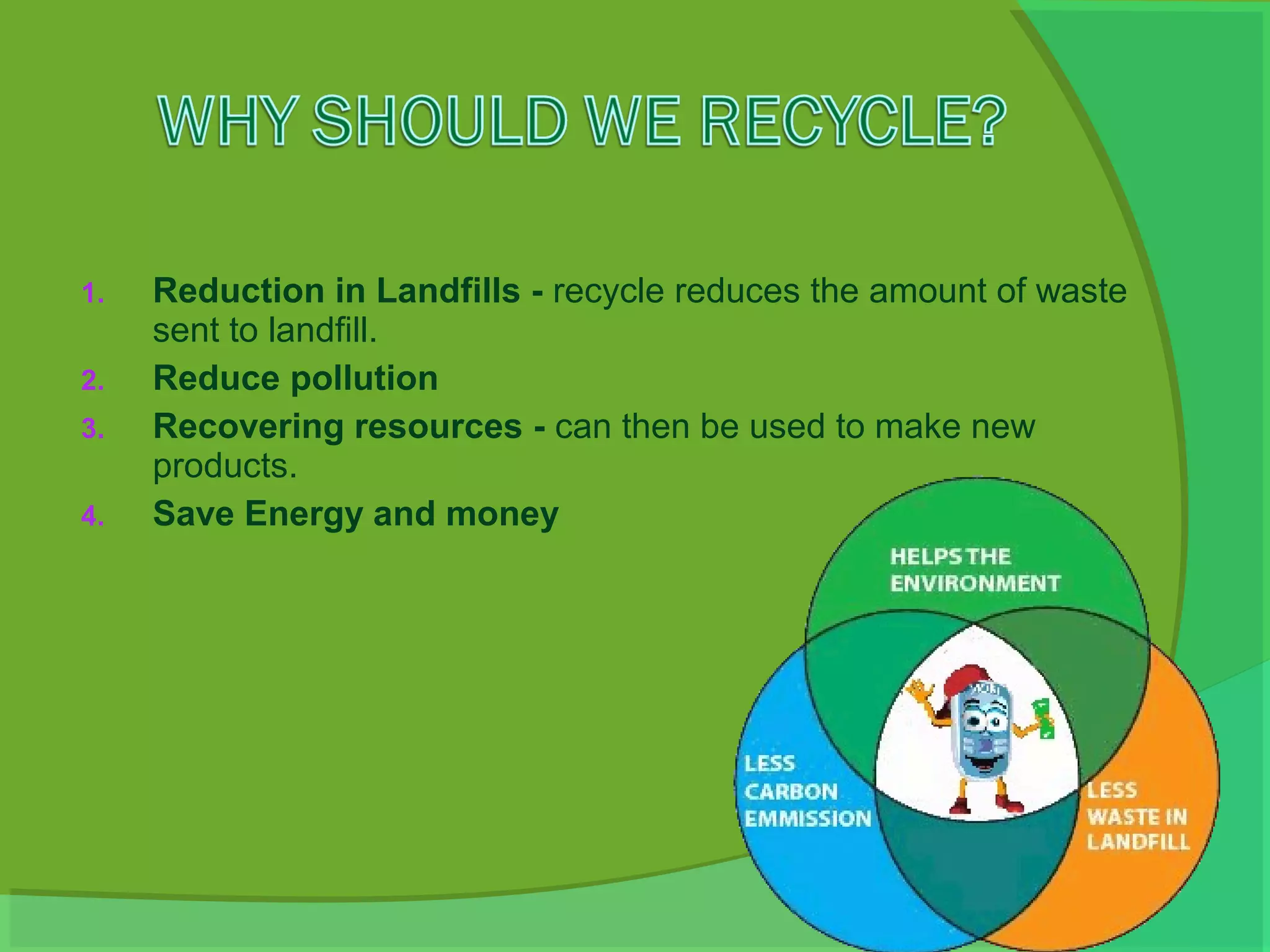
1.   Reduction in Landfills - recycle reduces the amount of waste
     sent to landfill.
2.   Reduce pollution
3.   Recovering resources - can then be used to make new
     products.
4.   Save Energy and money
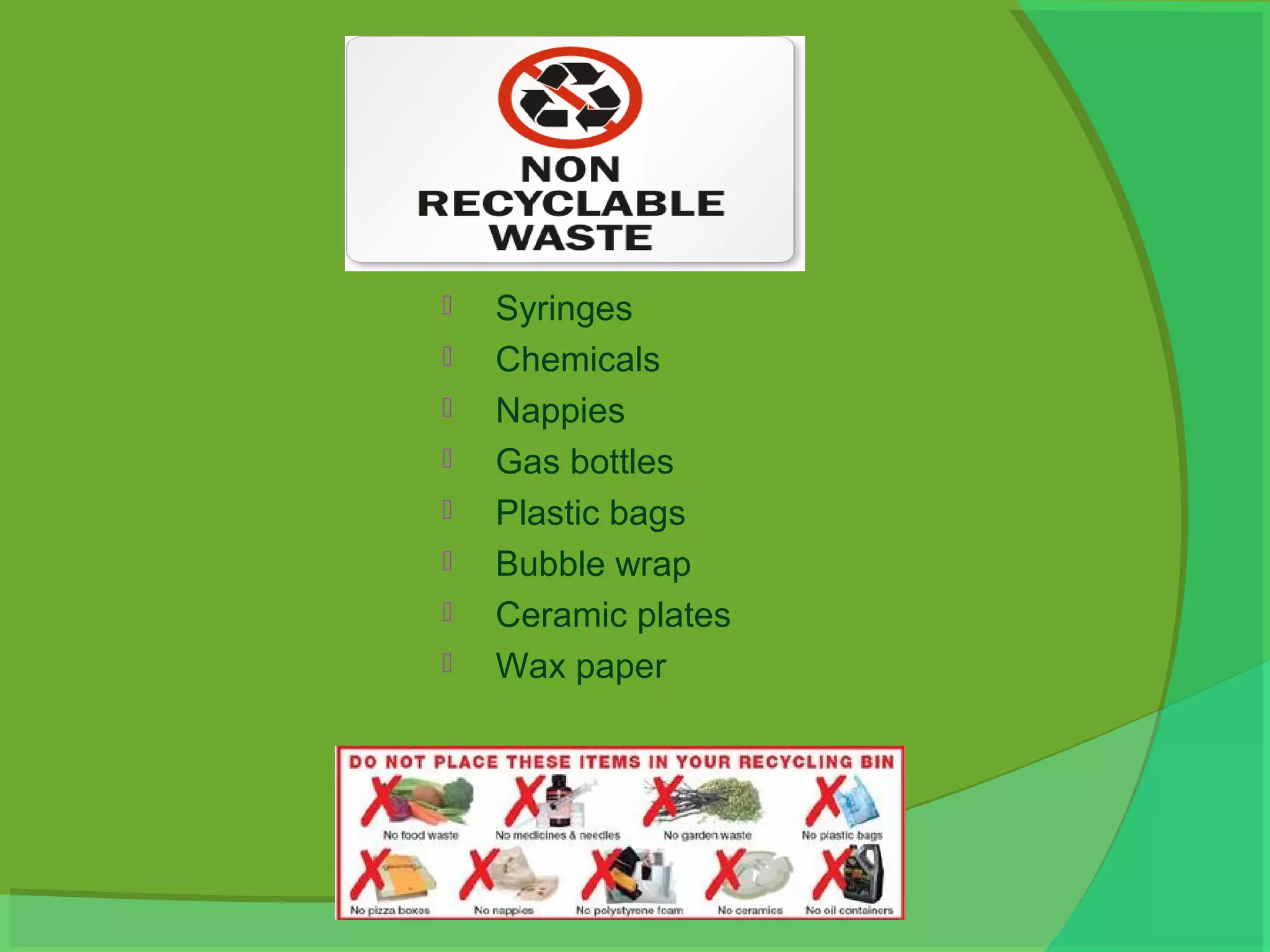
   Syringes
   Chemicals
   Nappies
   Gas bottles
   Plastic bags
   Bubble wrap
   Ceramic plates
   Wax paper
   Did you know that Australia is the second biggest producer of
    rubbish in the world?
   Each person in Australia produces a tone of waste every year.
   But it does not have to be that way if we change the way we
    think about it.
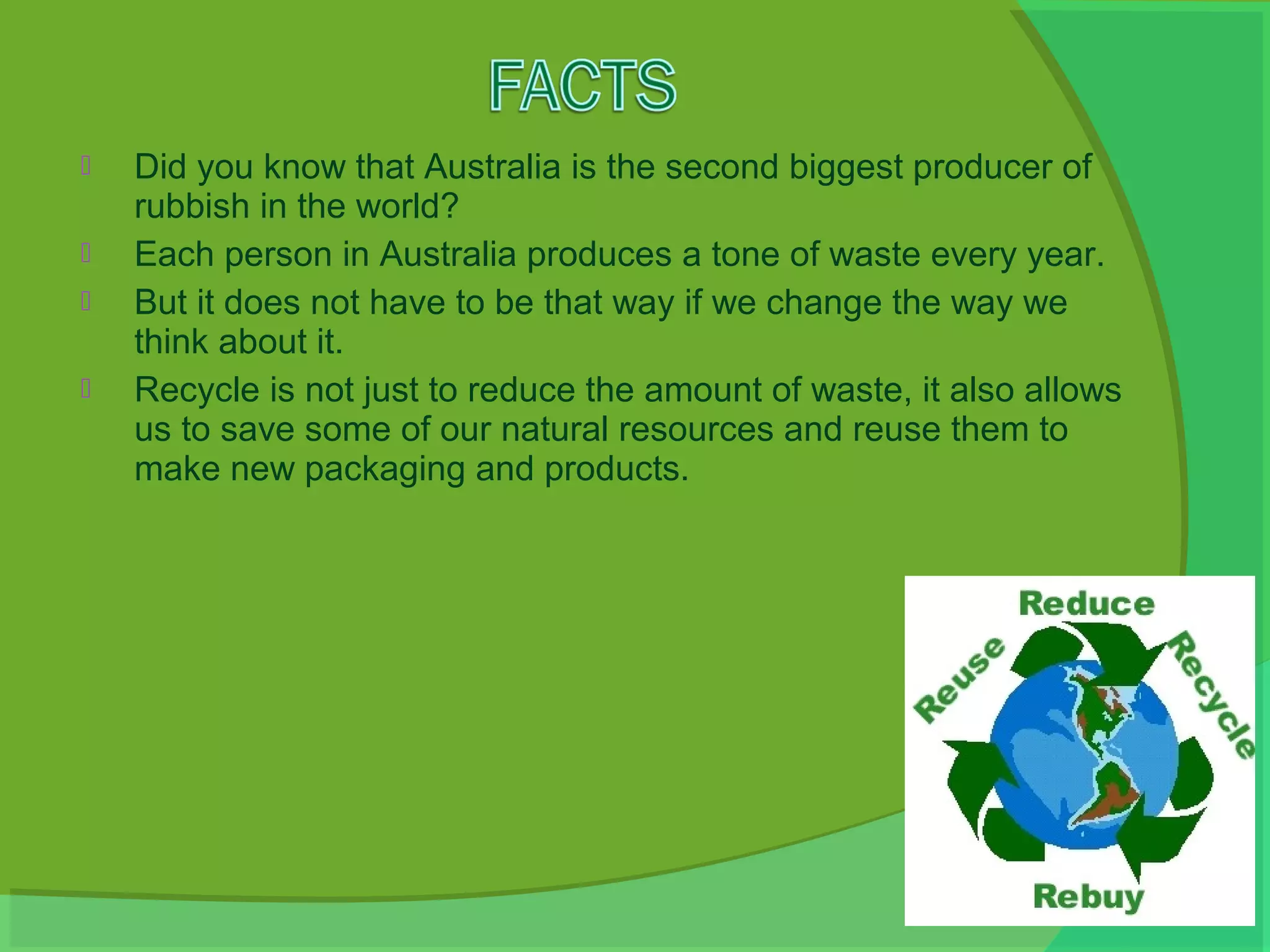
   Recycle is not just to reduce the amount of waste, it also allows
    us to save some of our natural resources and reuse them to
    make new packaging and products.
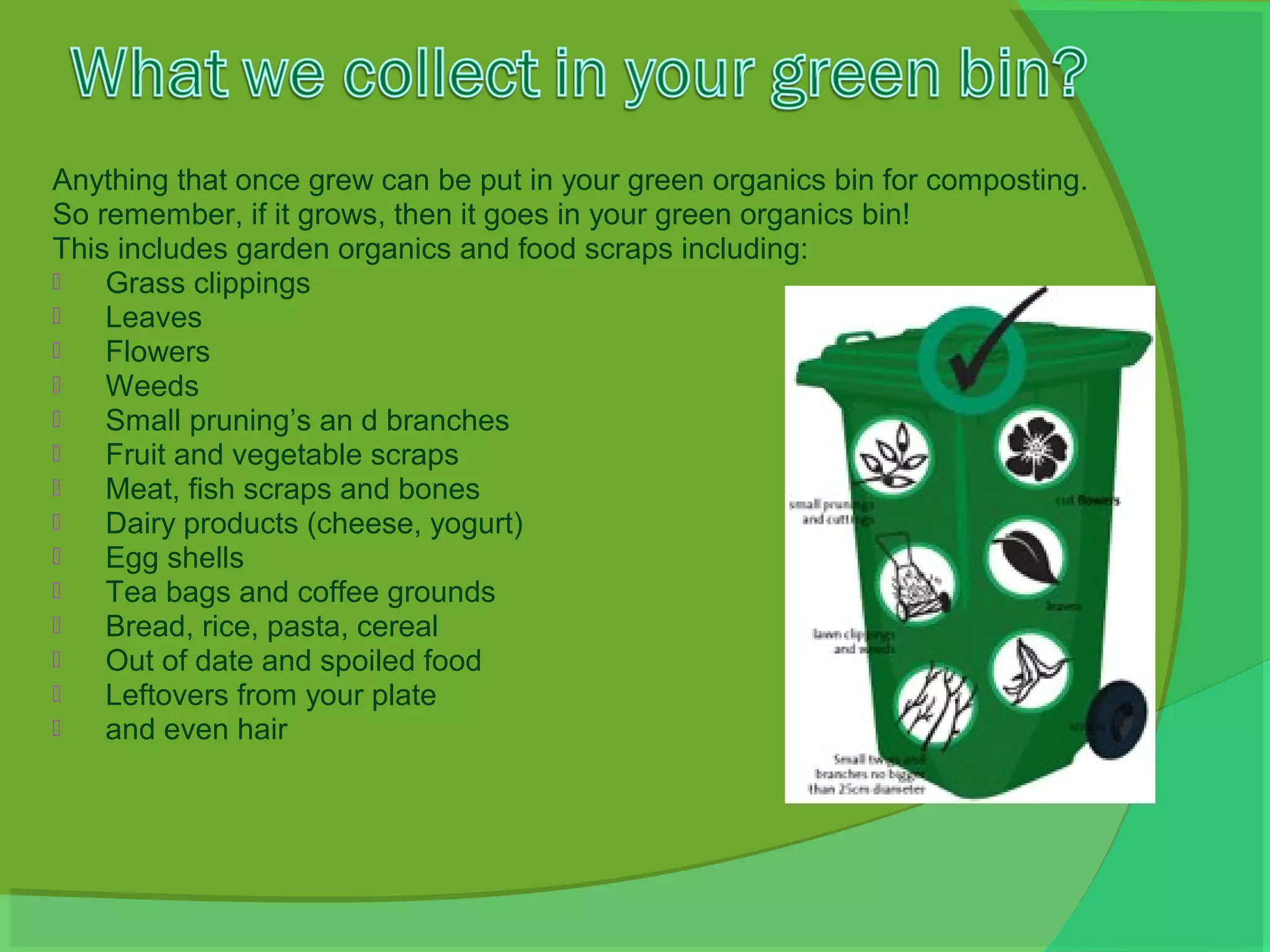
Anything that once grew can be put in your green organics bin for composting.
So remember, if it grows, then it goes in your green organics bin!
This includes garden organics and food scraps including:
   Grass clippings
   Leaves
   Flowers
   Weeds
   Small pruning’s an d branches
   Fruit and vegetable scraps
   Meat, fish scraps and bones
   Dairy products (cheese, yogurt)
   Egg shells
   Tea bags and coffee grounds
   Bread, rice, pasta, cereal
   Out of date and spoiled food
   Leftovers from your plate
   and even hair
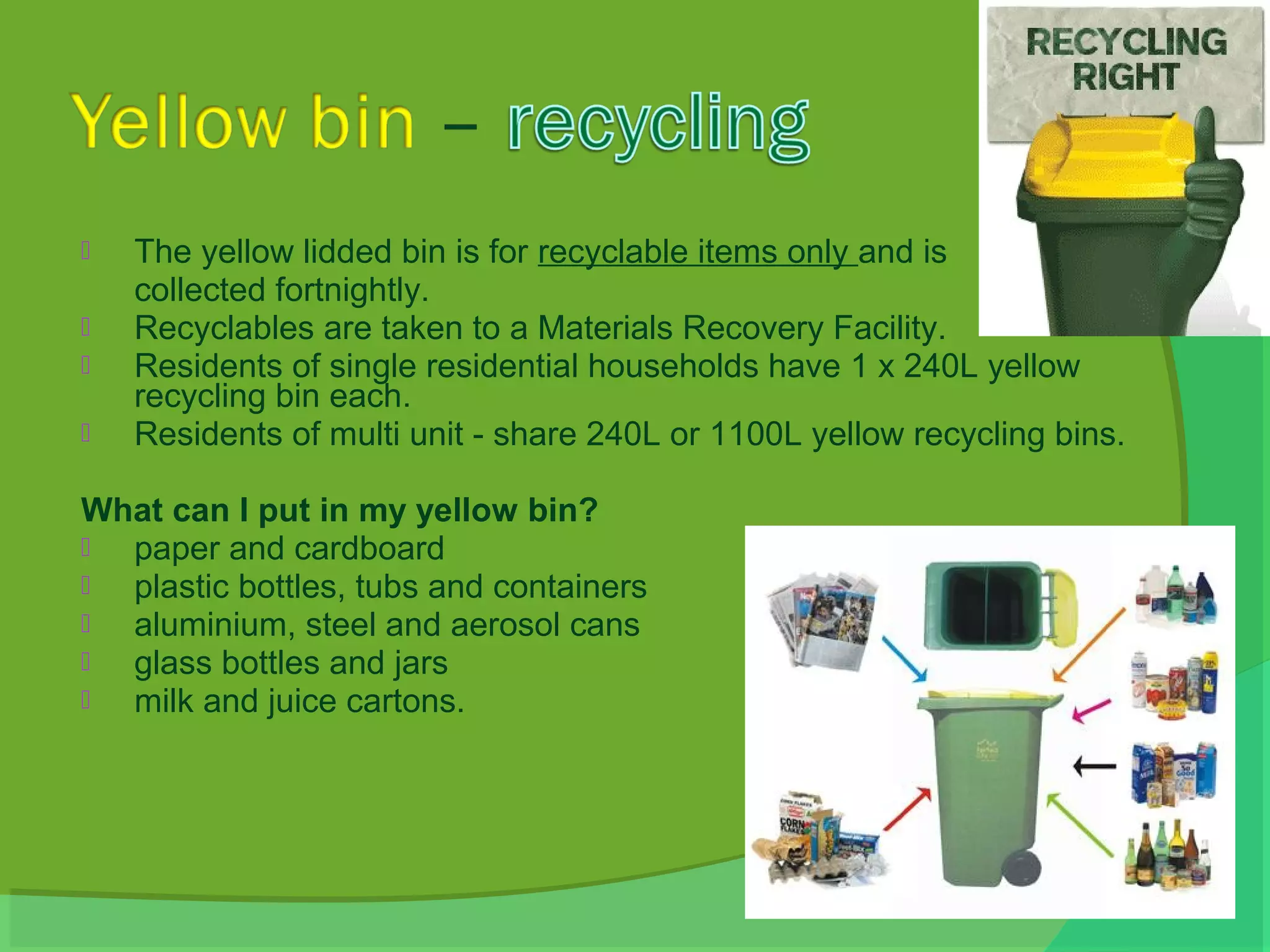
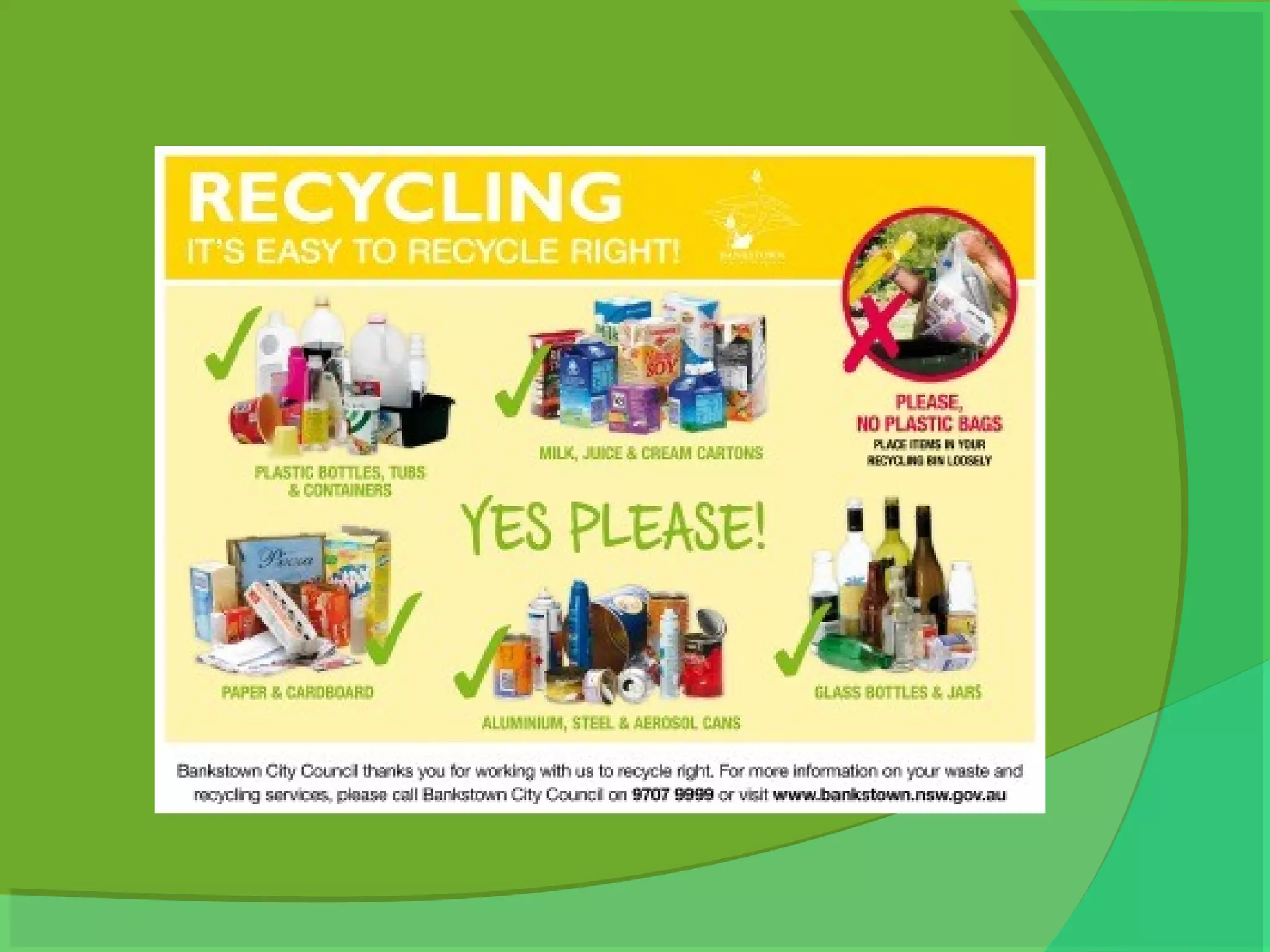
   The yellow lidded bin is for recyclable items only and is
    collected fortnightly.
   Recyclables are taken to a Materials Recovery Facility.
   Residents of single residential households have 1 x 240L yellow
    recycling bin each.
   Residents of multi unit - share 240L or 1100L yellow recycling bins.

What can I put in my yellow bin?
 paper and cardboard
 plastic bottles, tubs and containers
 aluminium, steel and aerosol cans
 glass bottles and jars
 milk and juice cartons.
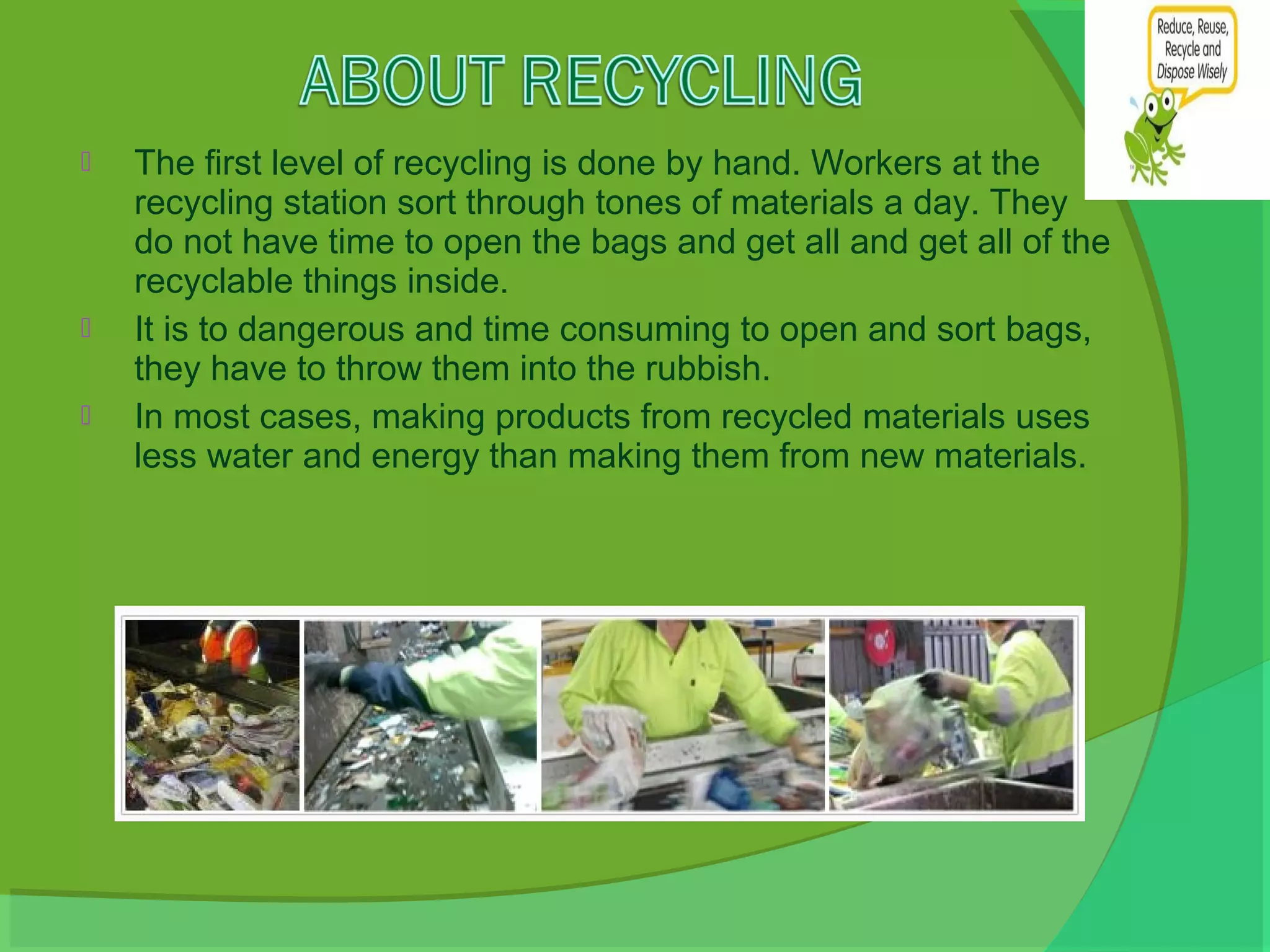
   The first level of recycling is done by hand. Workers at the
    recycling station sort through tones of materials a day. They
    do not have time to open the bags and get all and get all of the
    recyclable things inside.
   It is to dangerous and time consuming to open and sort bags,
    they have to throw them into the rubbish.
   In most cases, making products from recycled materials uses
    less water and energy than making them from new materials.
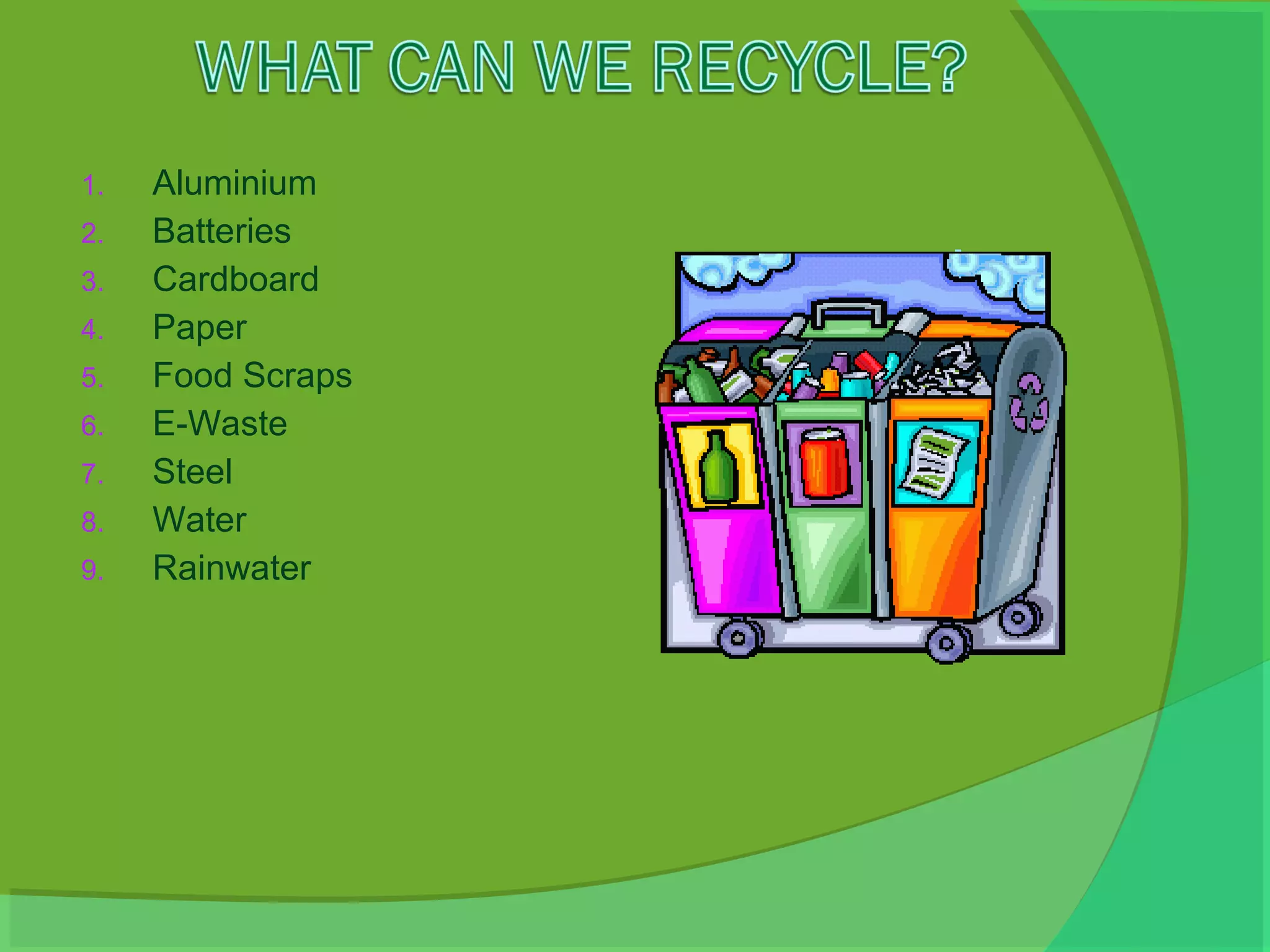
1.   Aluminium
2.   Batteries
3.   Cardboard
4.   Paper
5.   Food Scraps
6.   E-Waste
7.   Steel
8.   Water
9.   Rainwater
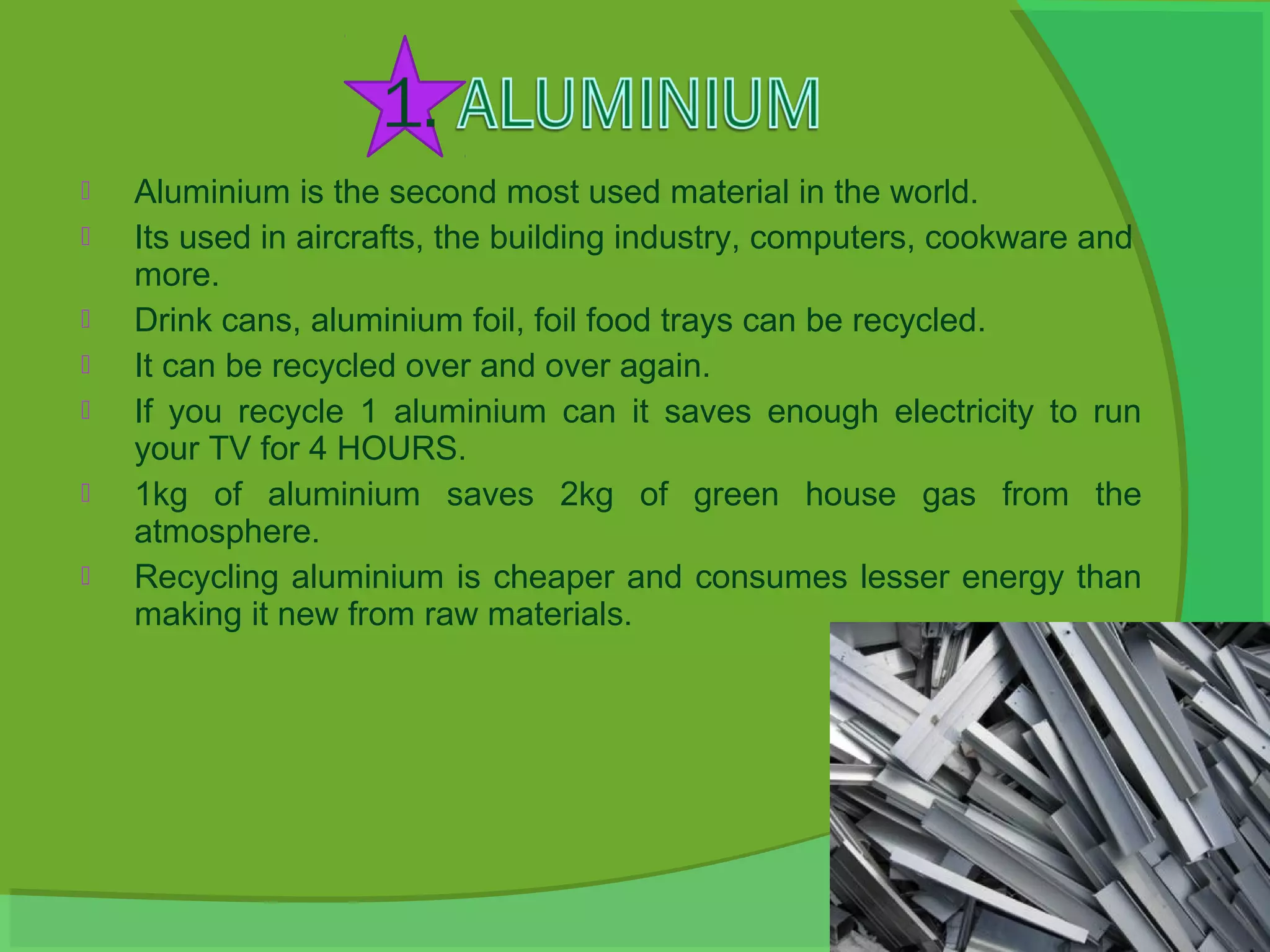
   Aluminium is the second most used material in the world.
   Its used in aircrafts, the building industry, computers, cookware and
    more.
   Drink cans, aluminium foil, foil food trays can be recycled.
   It can be recycled over and over again.
   If you recycle 1 aluminium can it saves enough electricity to run
    your TV for 4 HOURS.
   1kg of aluminium saves 2kg of green house gas from the
    atmosphere.
   Recycling aluminium is cheaper and consumes lesser energy than
    making it new from raw materials.
WHY IS ALUMINIUM RECYCLING GREAT FOR THE
    ENVIRONMENT?
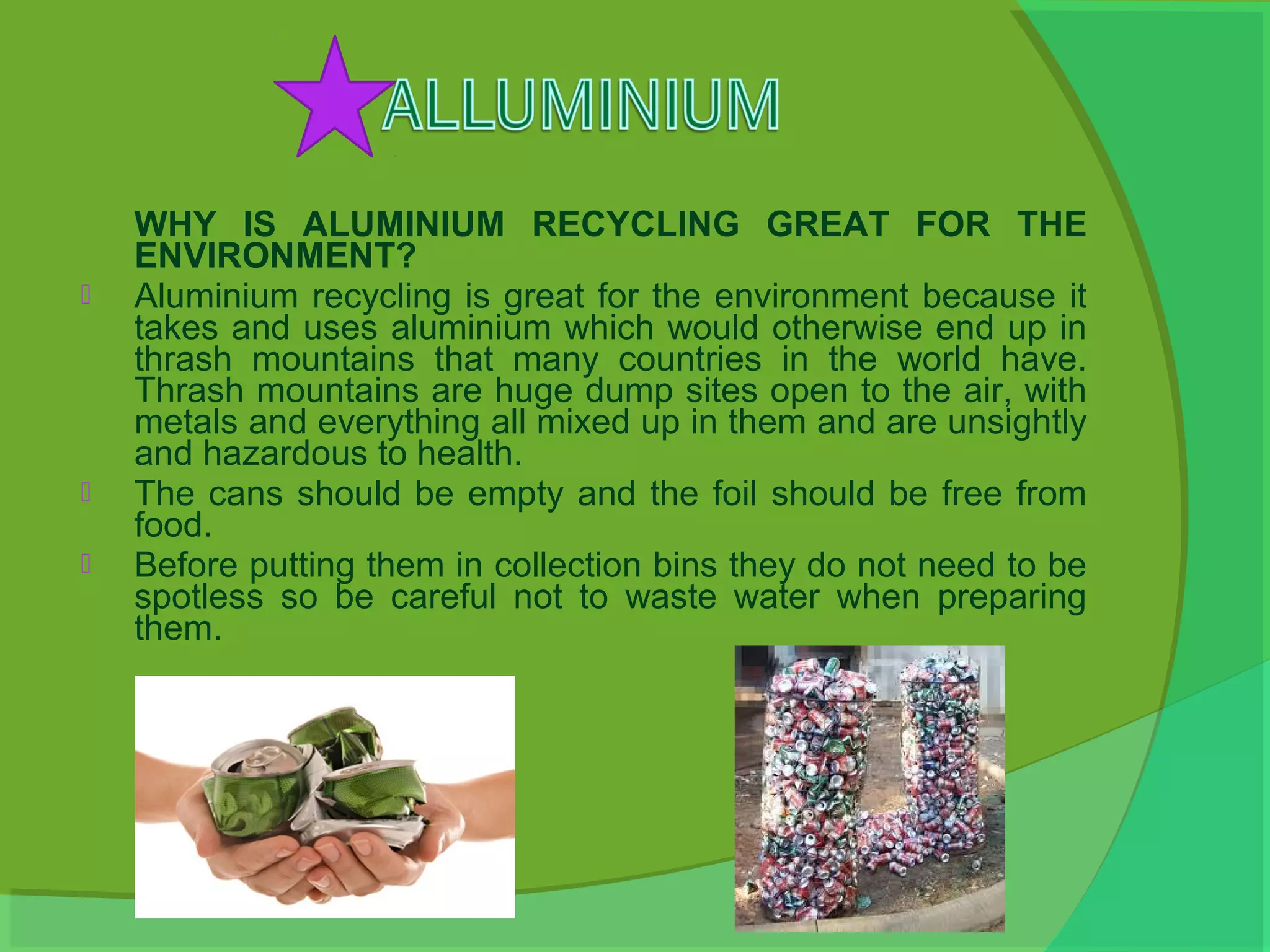
   Aluminium recycling is great for the environment because it
    takes and uses aluminium which would otherwise end up in
    thrash mountains that many countries in the world have.
    Thrash mountains are huge dump sites open to the air, with
    metals and everything all mixed up in them and are unsightly
    and hazardous to health.
   The cans should be empty and the foil should be free from
    food.
   Before putting them in collection bins they do not need to be
    spotless so be careful not to waste water when preparing
    them.
   There are two types of batteries:
  1. the first one is called primary -single use, it is found in
      watches, clocks/watches, toys, smoke alarms, smoke
      controls.
  2. The second one is called secondary-rechargeable
      batteries they are found in mobile phones,
      laptops/computers, cameras, cordless items and more.
  Every year Aussies use 1000 tones of batteries a year.
  To reduce batteries, buy rechargeable ones.
Why should we recycle batteries?
 Batteries contain toxic things like cadmium, mercury, and
   lead which are harmful to the environment.
What happens to batteries ?
 They are sorted into primary and secondary then they are
   sent to the a recycling facility in Australia.
How to reduce your battery waste?

   Buying rechargeable batteries is an important way to reduce battery
    waste.
   Each battery can be recharged up to 1000 times.
   There are many battery rechargers available for eg: Planet Ark
     and Charge 'n' Go.
   It takes less than 15 minutes to recharge.
Battery collections
  Most councils offer regular collections and/or provide drop-off
   locations for hazardous waste.
  Recycling battery components is a complex and expensive
   process due to the chemistry involved.
  Plastics and metals, such as Ferro-nickel, can be recovered and
   recycled. Cadmium, for example, is used to manufacture new
   batteries.
  Drop off the battery when it is completely discharged – if you are not
   sure, cover the poles of the battery with a piece of sticky tape.
Why should we recycle cardboard?
 It is one of the easiest and most environmental materials to recycle
  since the fibre in cardboard has already been processed.
 Therefore making cardboard products from recycled material, saves
  not only trees, but also large amounts of water (up to 99%less) and
  energy (up to 50% less).
 Manufacturing from recycled material also produces up to 90% less by-
  products such as chemical wastes.
 For these reasons, it is important to recycle your cardboard and buy
  paper and cardboard products with recycled content.
 Every time paper is processed the individual fibres become weaker. It
  can be recycled up to 8 times.
 Paper that has been recycled as many times as the fibres will allow is
  turned into compost and breaks down naturally.
 More than 80% of Australia's cardboard packaging is made from
  recycled fibre.
 Cardboard can be recycled with paper and is remade into many
  different kinds of paper products.
 For each kilogram of cardboard recycled, you save up to 1 kilogram of
  greenhouse gases.
 Wax coated cardboard (like some fruit boxes) cannot be recycled.
Reducing cardboard use
 Re-use cardboard boxes where possible before recycling.
We can make:
 Cards
 Boxes
 Packaging
 Photo frames
 Toilet rolls
 Egg cartons.
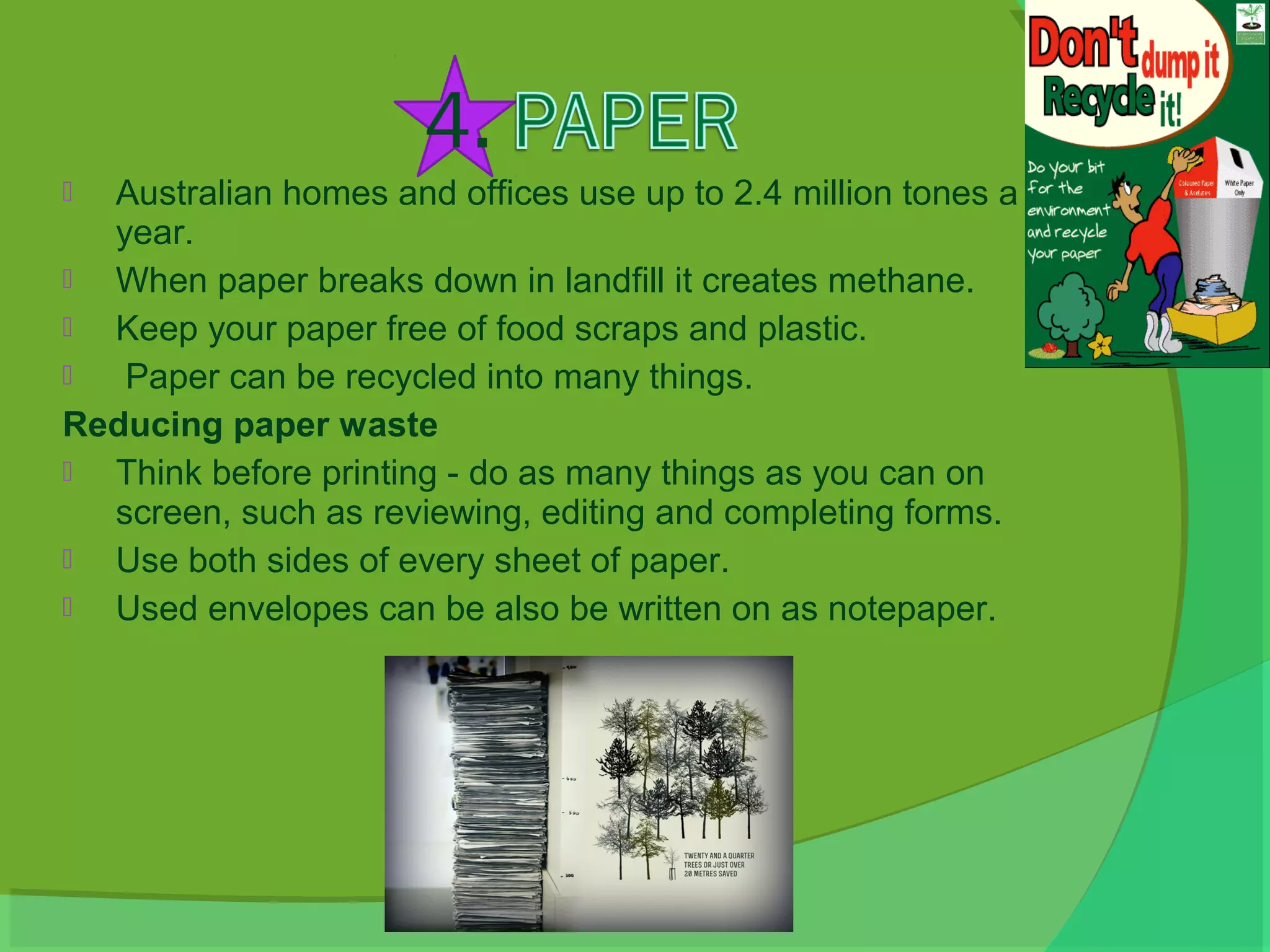
 Australian homes and offices use up to 2.4 million tones a
  year.
 When paper breaks down in landfill it creates methane.
 Keep your paper free of food scraps and plastic.
  Paper can be recycled into many things.
Reducing paper waste
 Think before printing - do as many things as you can on
  screen, such as reviewing, editing and completing forms.
 Use both sides of every sheet of paper.
 Used envelopes can be also be written on as notepaper.
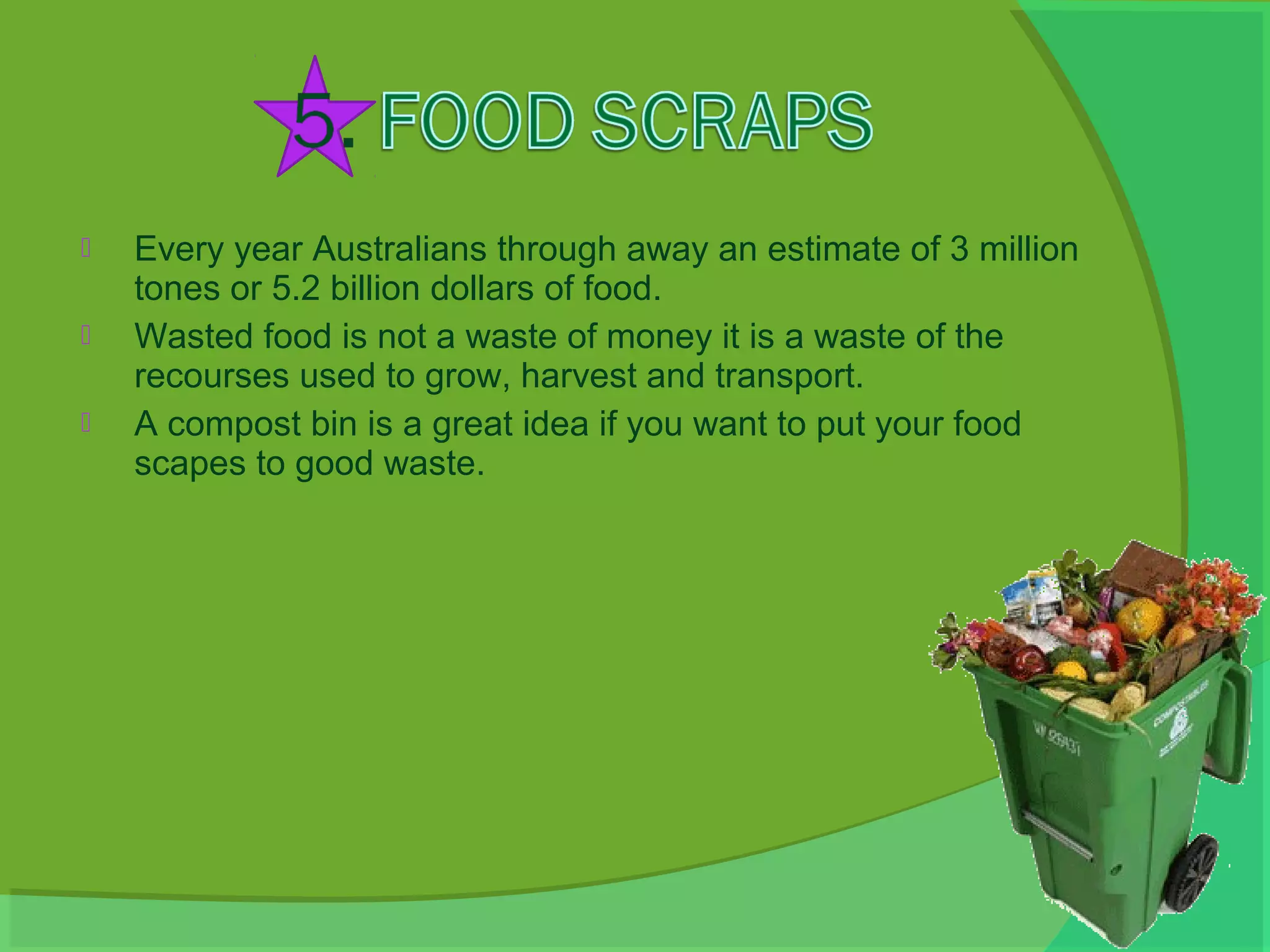
   Every year Australians through away an estimate of 3 million
    tones or 5.2 billion dollars of food.
   Wasted food is not a waste of money it is a waste of the
    recourses used to grow, harvest and transport.
   A compost bin is a great idea if you want to put your food
    scapes to good waste.
   Research by Australian government has shown that most
    households buy too much food, cook too much food, and throw
    away leftovers. With the better organisation, minimising your food
    waste can be easy.
    - Know how much food to cook for each person,
    - Make a shopping list and stick to it,
    - Store your food appropriately to keep it fresher for longer,
    - Think of tasty ways to use your leftovers,
    - Work out a weekly meal plan for your household,
    - Buy some items in bulk.
   Having your own compost bin is a cheap, rewarding way to
    recycle your food scraps and garden cuttings.
   Compost is an excellent soil conditioner that improves soil
    fertility and encourages plant growth.
   Many community gardens run composting and worm farming
    workshops to help you get started.
   Wasted food also wastes the energy, water, money and
    resources used to produce, process, store and transport the
    food.
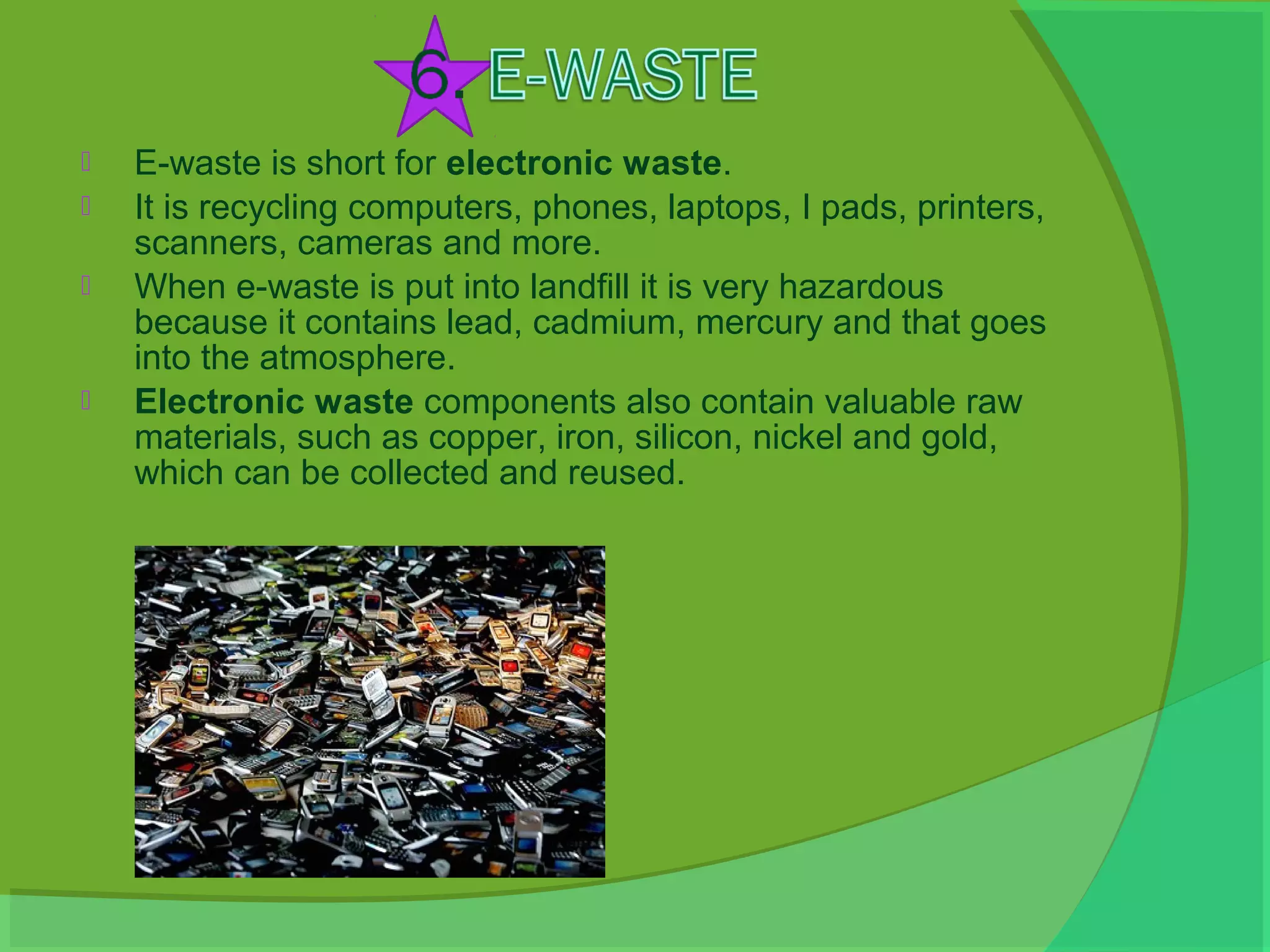
   E-waste is short for electronic waste.
   It is recycling computers, phones, laptops, I pads, printers,
    scanners, cameras and more.
   When e-waste is put into landfill it is very hazardous
    because it contains lead, cadmium, mercury and that goes
    into the atmosphere.
   Electronic waste components also contain valuable raw
    materials, such as copper, iron, silicon, nickel and gold,
    which can be collected and reused.
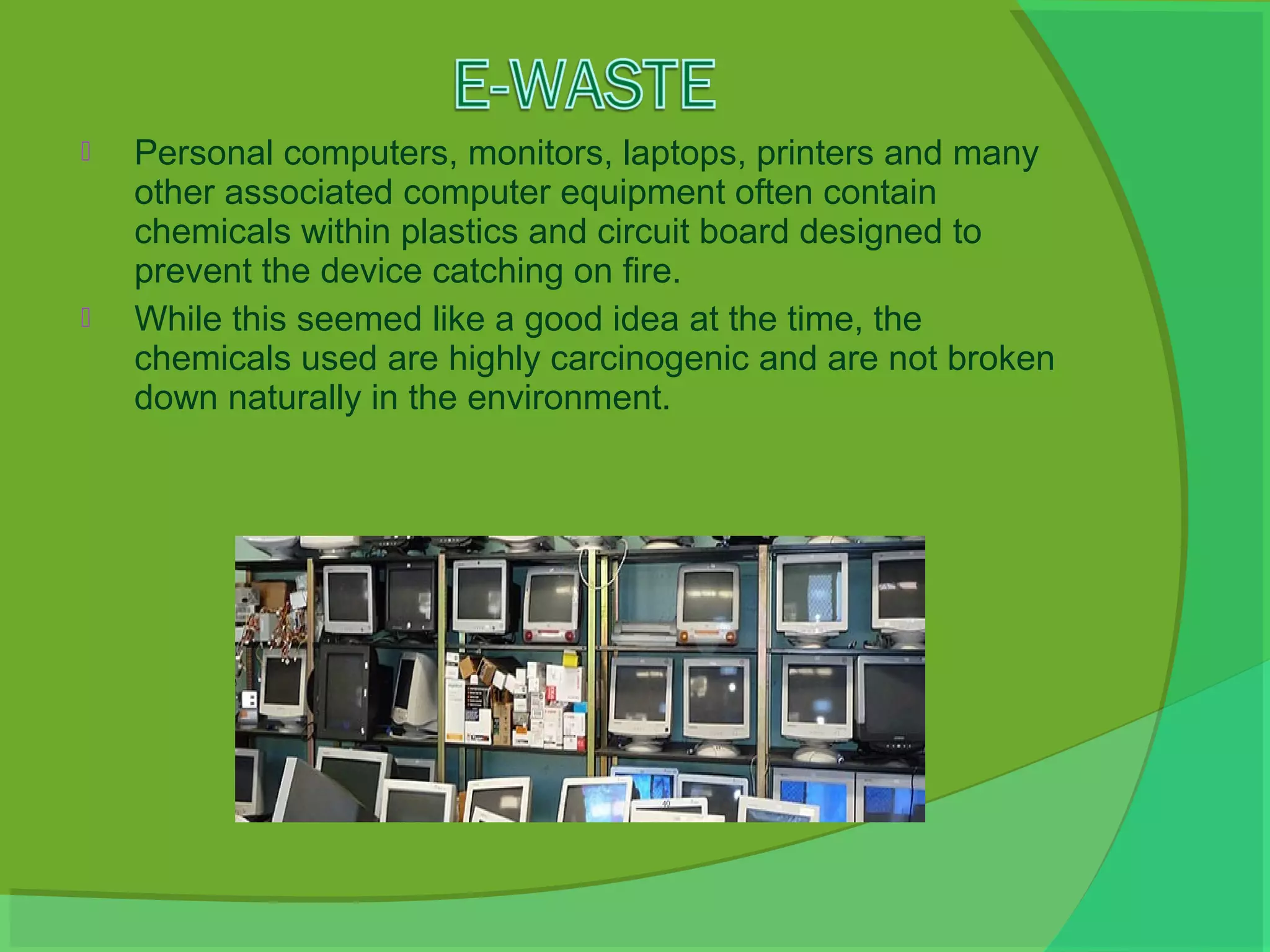
   Personal computers, monitors, laptops, printers and many
    other associated computer equipment often contain
    chemicals within plastics and circuit board designed to
    prevent the device catching on fire.
   While this seemed like a good idea at the time, the
    chemicals used are highly carcinogenic and are not broken
    down naturally in the environment.
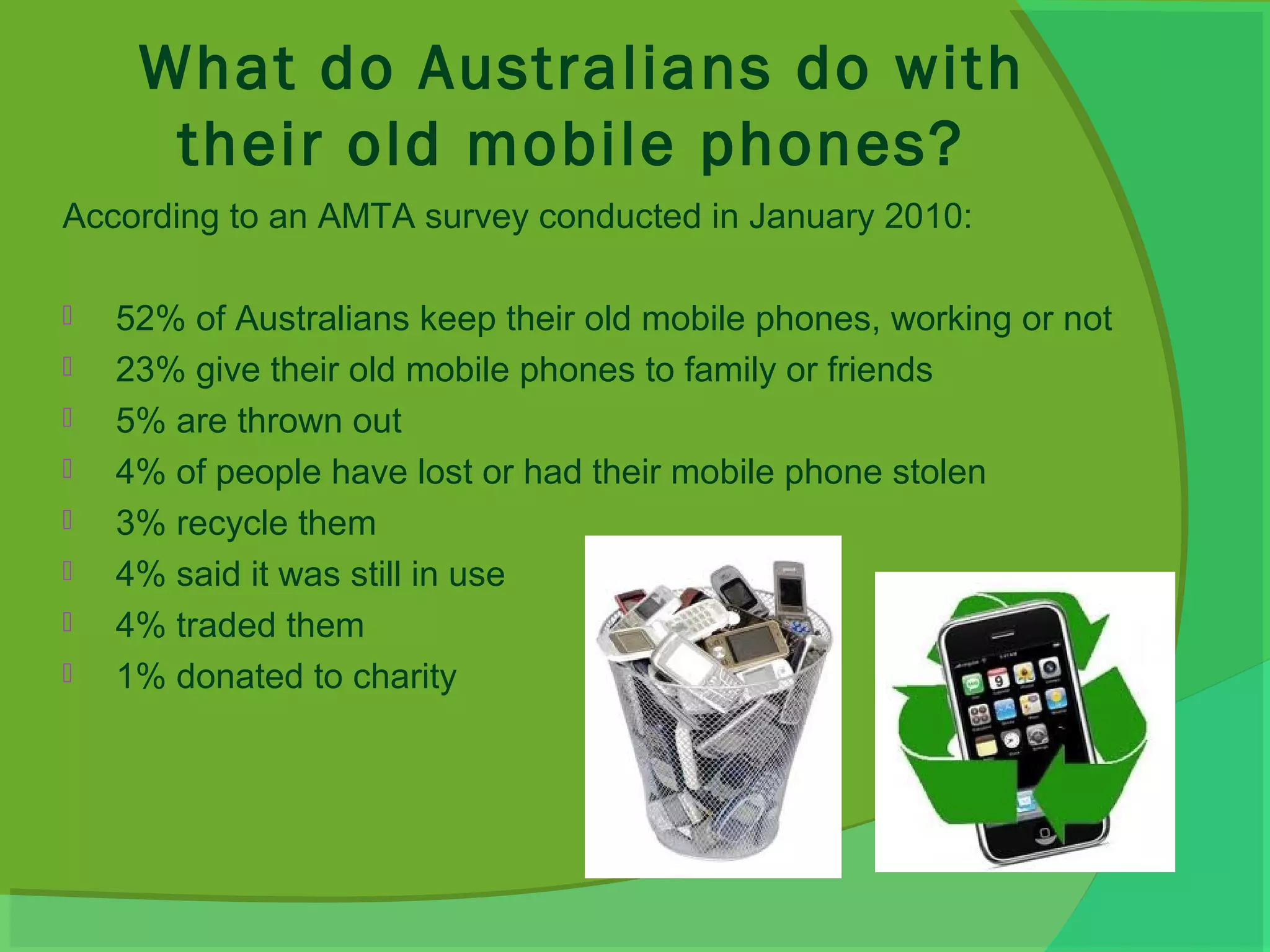
What do Australians do with
      their old mobile phones?
According to an AMTA survey conducted in January 2010:

   52% of Australians keep their old mobile phones, working or not
   23% give their old mobile phones to family or friends
   5% are thrown out
   4% of people have lost or had their mobile phone stolen
   3% recycle them
   4% said it was still in use
   4% traded them
   1% donated to charity
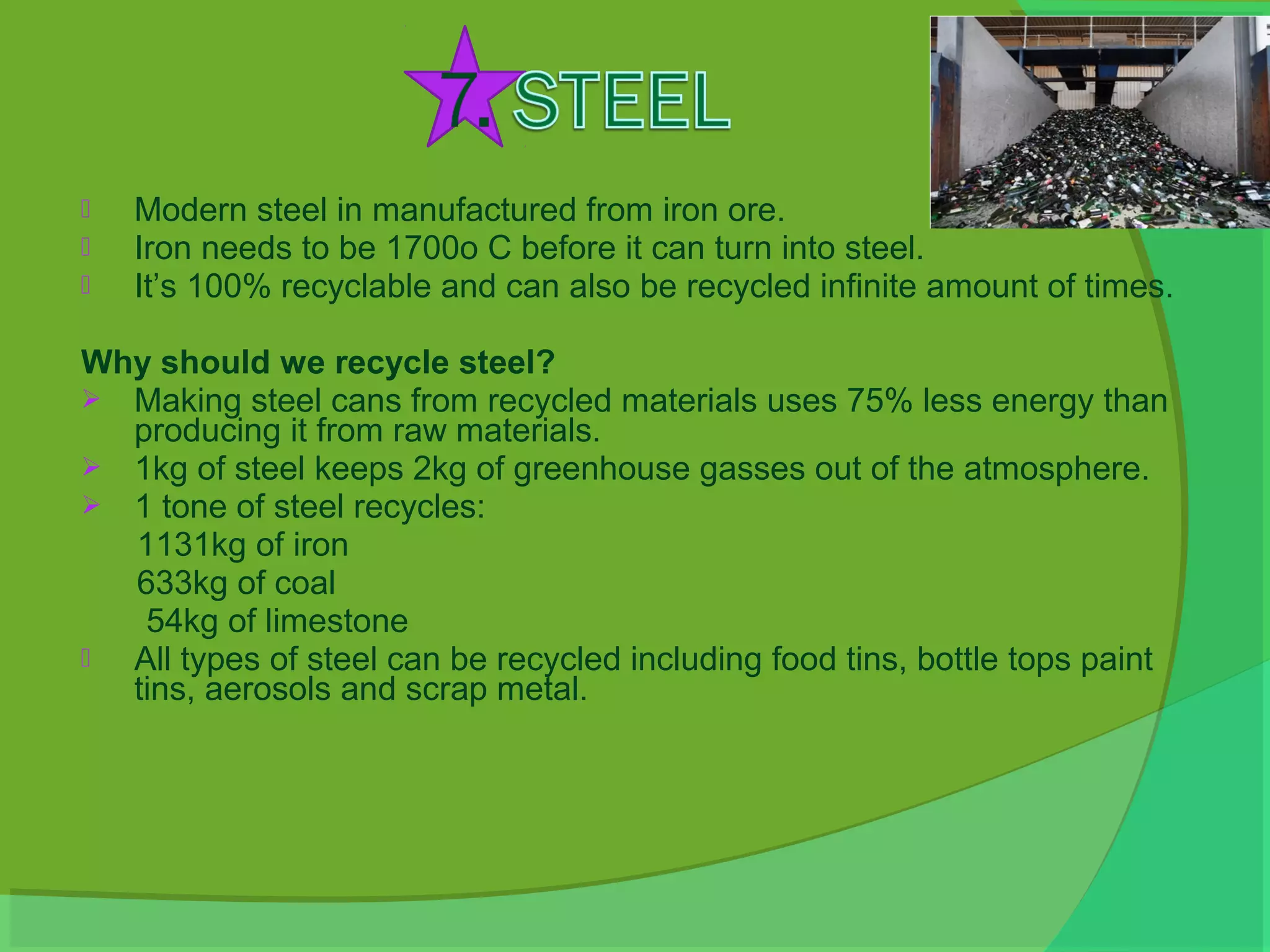
   Modern steel in manufactured from iron ore.
   Iron needs to be 1700o C before it can turn into steel.
   It’s 100% recyclable and can also be recycled infinite amount of times.

Why should we recycle steel?
 Making steel cans from recycled materials uses 75% less energy than
  producing it from raw materials.
 1kg of steel keeps 2kg of greenhouse gasses out of the atmosphere.
 1 tone of steel recycles:
  1131kg of iron
  633kg of coal
   54kg of limestone
 All types of steel can be recycled including food tins, bottle tops paint
  tins, aerosols and scrap metal.
What happens to steel?
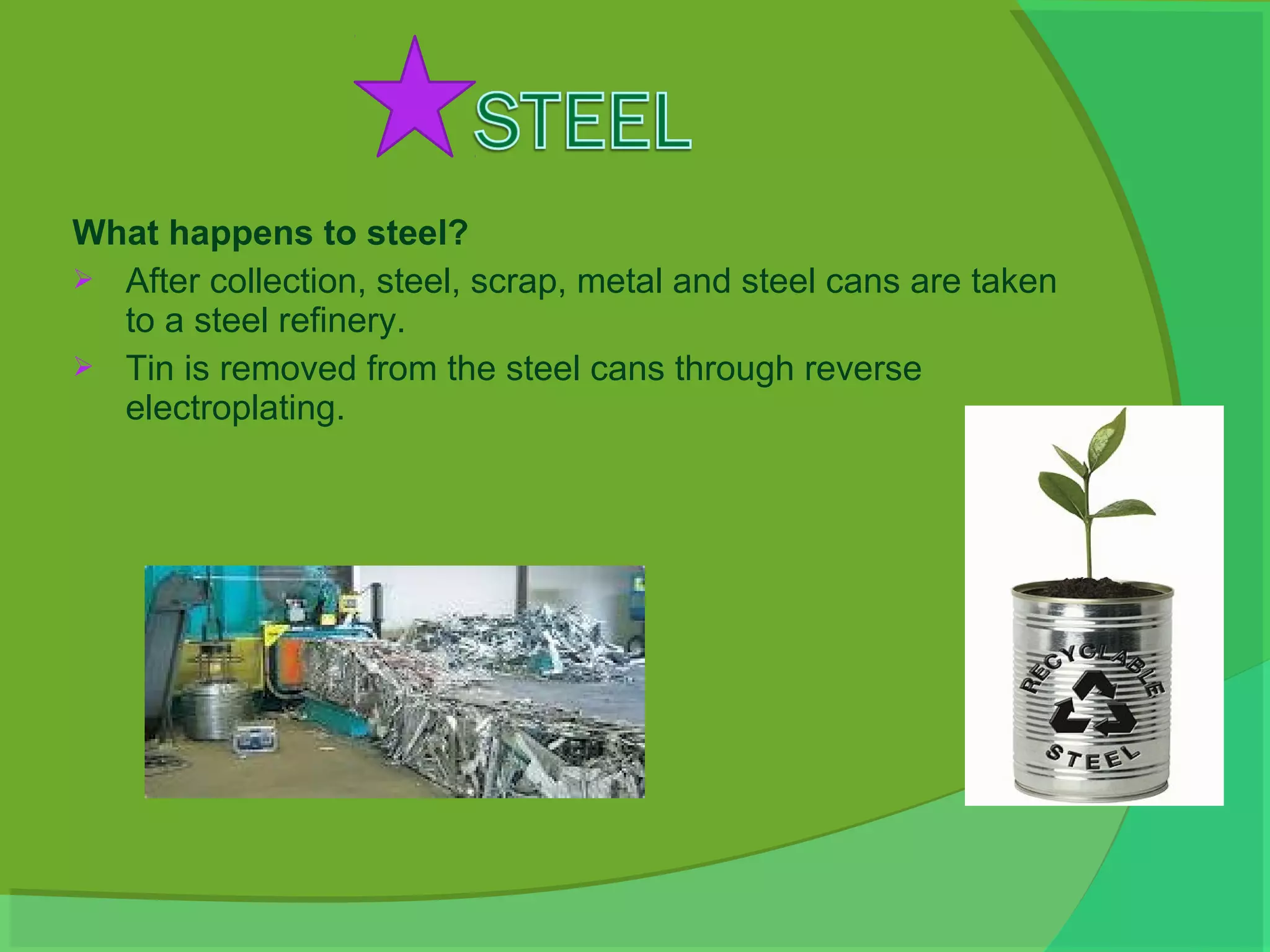
 After collection, steel, scrap, metal and steel cans are taken
  to a steel refinery.
 Tin is removed from the steel cans through reverse
  electroplating.
If we leave a tap running when we clean our teeth, we can waist up to
    5 litres of water a minute.
Only 1 % of the worlds water is fresh and 60% is ground water.
Grey water tanks
   It is not clean enough to drink but we use the water to flush toilets,
    for washing clothes and to water our gardens.
   It can replace up to a third of household water usage.
Rainwater
   It can replace with half of our water supply.
   You need to use less conditioner when you wash with rainwater as
    it is softer than tap water.
   Cardboard (flattened)
   Fluorescent lights
   Electronic waste (computers,
    televisions, printers etc.)
   Household batteries
   Lead acid batteries (cars and
    motorbikes)
   Mobile phones
   Motor oil (up to 20 litres)
   Paper
   Plastic
   Printer cartridges
   Scrap metal

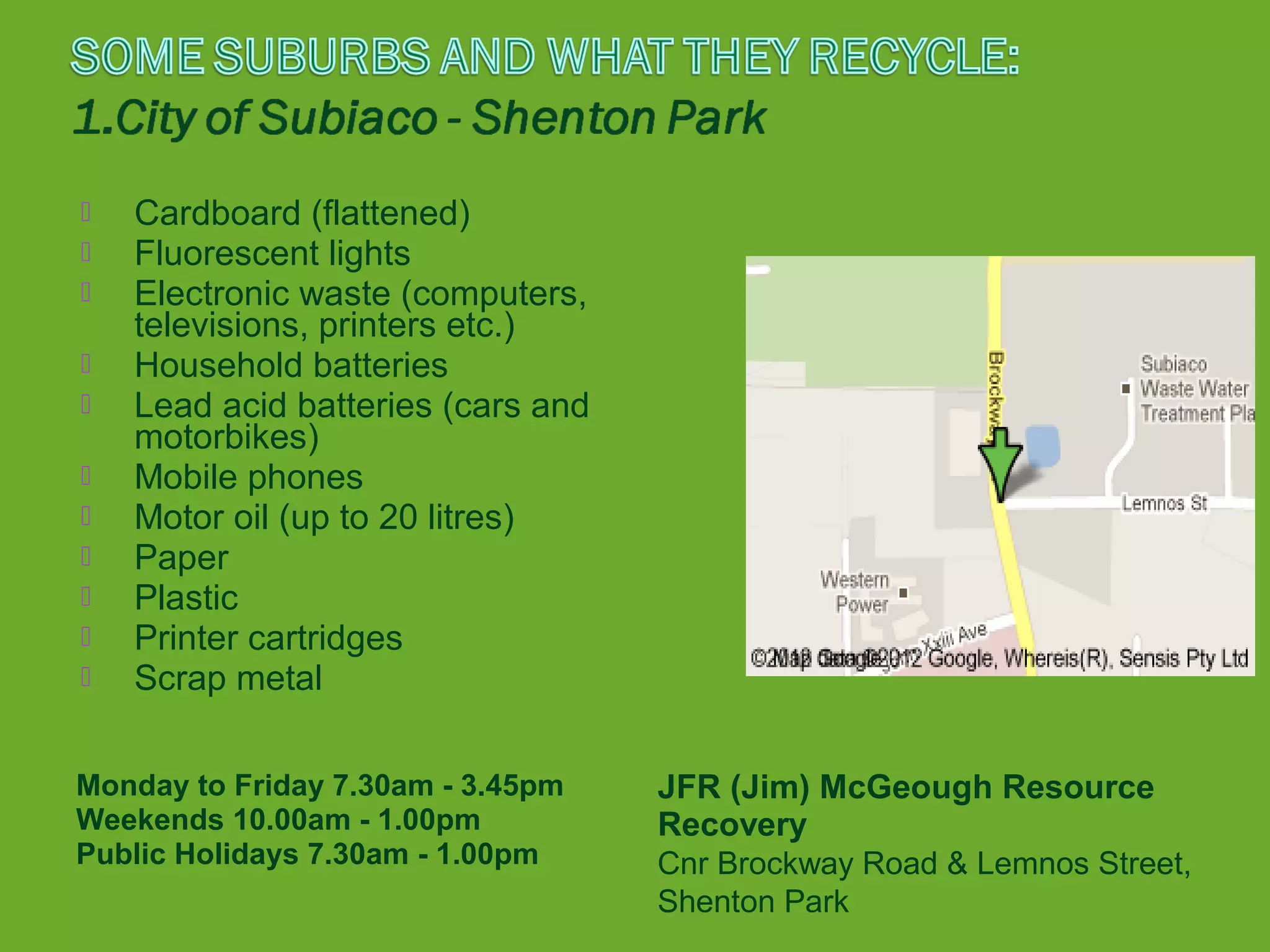
Monday to Friday 7.30am - 3.45pm    JFR (Jim) McGeough Resource
Weekends 10.00am - 1.00pm           Recovery
Public Holidays 7.30am - 1.00pm     Cnr Brockway Road & Lemnos Street,
                                    Shenton Park
City of Stirling Balcatta recycle:
   Scrap metals
   Mixed plastic
   Glass and jags
   Clothing
   Furniture and batteries


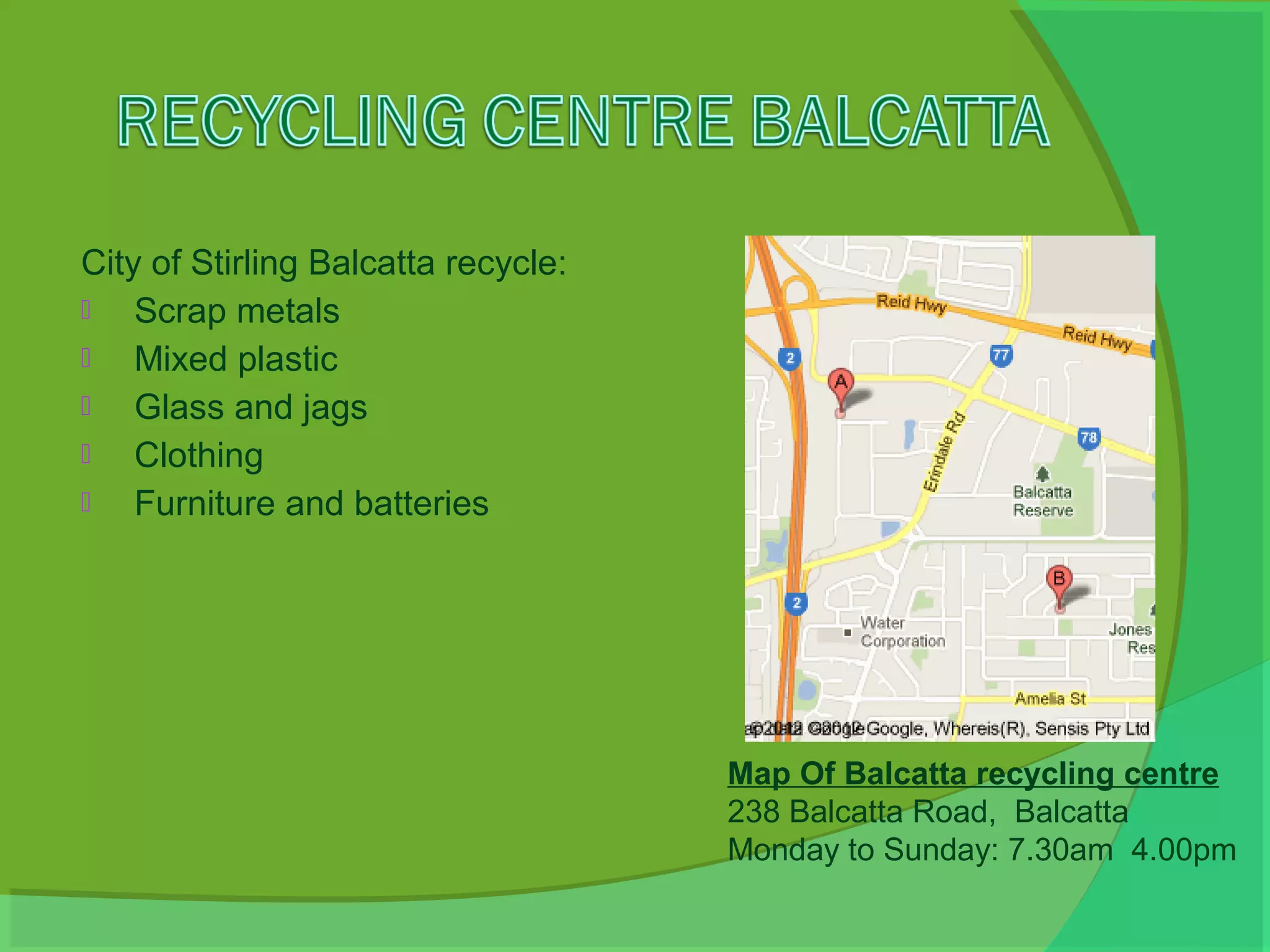
                                     Map Of Balcatta recycling centre
                                     238 Balcatta Road, Balcatta
                                     Monday to Sunday: 7.30am 4.00pm
The following items are accepted:
    Gas Bottles
    Batteries -Vehicle Single Use- Rechargeable
    Glass Bottles and Jars
    Aluminium Cans Aluminium Foil
    Newspapers Magazines Office Paper Pizza Boxes
    Cardboard
    Doors & Window Frames
    Bicycles
    Boats (in good condition)
    Household Furniture (in good condition
    Paint Cans (empty or up to 20litres per visit)
    Pesticides (20 litres per visit) Garden Chemicals
    Oil - Cooking Used Motor
    Computers & Accessories
    Mobile Phones                                       Address:
    E WASTE- printers, cartridges, televisions.         1700 Marmion Avenue Mindarie 6030, WA
                                                         Phone: 9306 6303
This is a fluorescent light recycling.
It is available at all Bunnings warehouses.
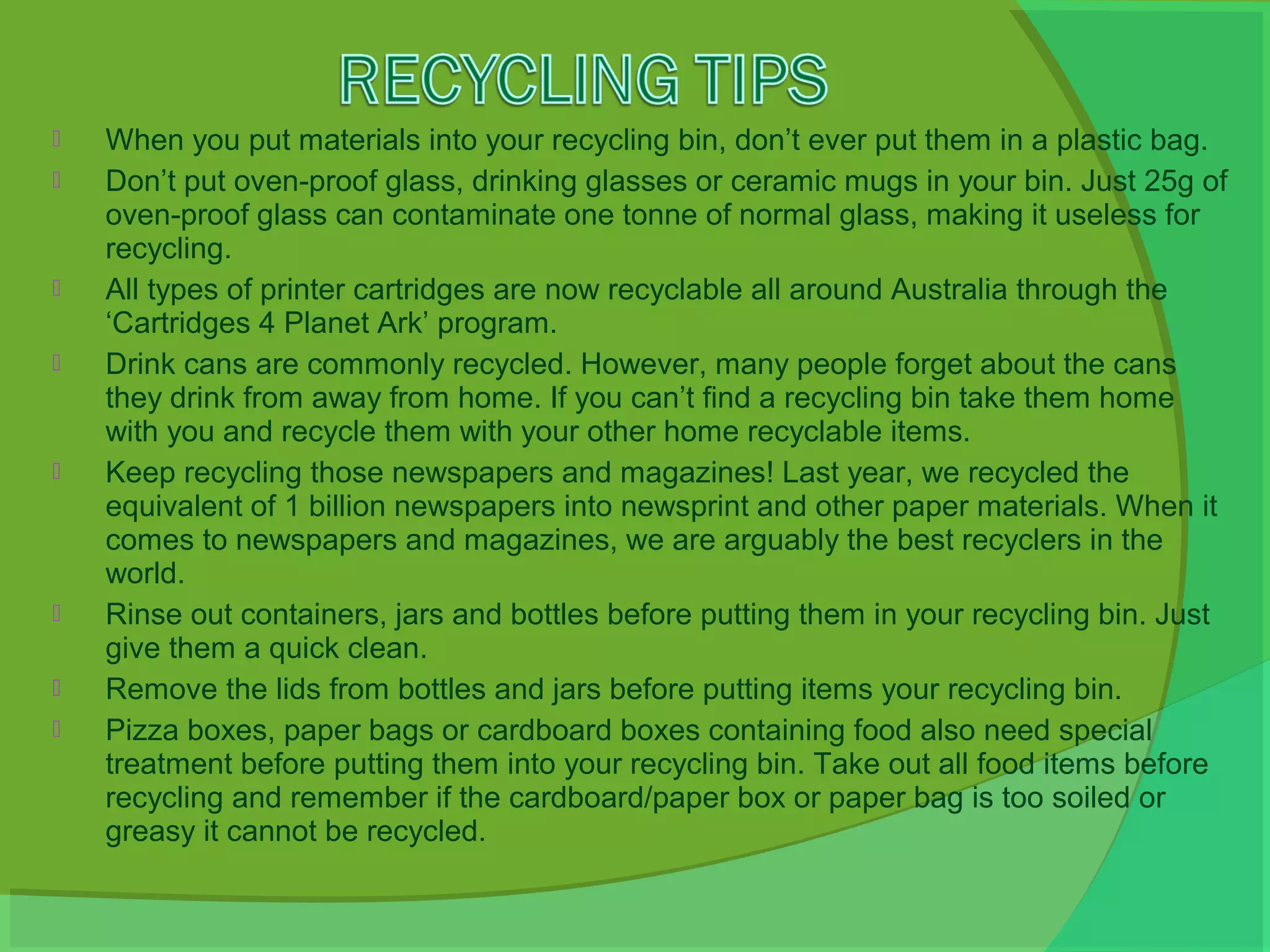
   When you put materials into your recycling bin, don’t ever put them in a plastic bag.
   Don’t put oven-proof glass, drinking glasses or ceramic mugs in your bin. Just 25g of
    oven-proof glass can contaminate one tonne of normal glass, making it useless for
    recycling.
   All types of printer cartridges are now recyclable all around Australia through the
    ‘Cartridges 4 Planet Ark’ program.
   Drink cans are commonly recycled. However, many people forget about the cans
    they drink from away from home. If you can’t find a recycling bin take them home
    with you and recycle them with your other home recyclable items.
   Keep recycling those newspapers and magazines! Last year, we recycled the
    equivalent of 1 billion newspapers into newsprint and other paper materials. When it
    comes to newspapers and magazines, we are arguably the best recyclers in the
    world.
   Rinse out containers, jars and bottles before putting them in your recycling bin. Just
    give them a quick clean.
   Remove the lids from bottles and jars before putting items your recycling bin.
   Pizza boxes, paper bags or cardboard boxes containing food also need special
    treatment before putting them into your recycling bin. Take out all food items before
    recycling and remember if the cardboard/paper box or paper bag is too soiled or
    greasy it cannot be recycled.
    You might be surprise at what rubbish can be turned into.
    It can be turn into:
1.   Glass bottles – a material called fibre glass, this mix of strong glue
     and thin strips of glass can be used to make canoes and boats.
2.   Paper, cards, cotton, leather and wool are made from plants or
     animals.
3.   Material such as metal and plastic do not rot. They remain in landfill
     forever and may cause pollution.
4.   If you recycle 1 plastic bottle you save enough energy to light 60 walt
     light bulb for about up to 6 hours.
5.   It takes 17 trees to make 1tone of paper.
   People don’t wont to put in the extra effort.
   Some people don’t have enough space in their
    houses.
   People are saying that its to time consuming.
   People say it doesn't make a difference.
   People say it’s to hard.
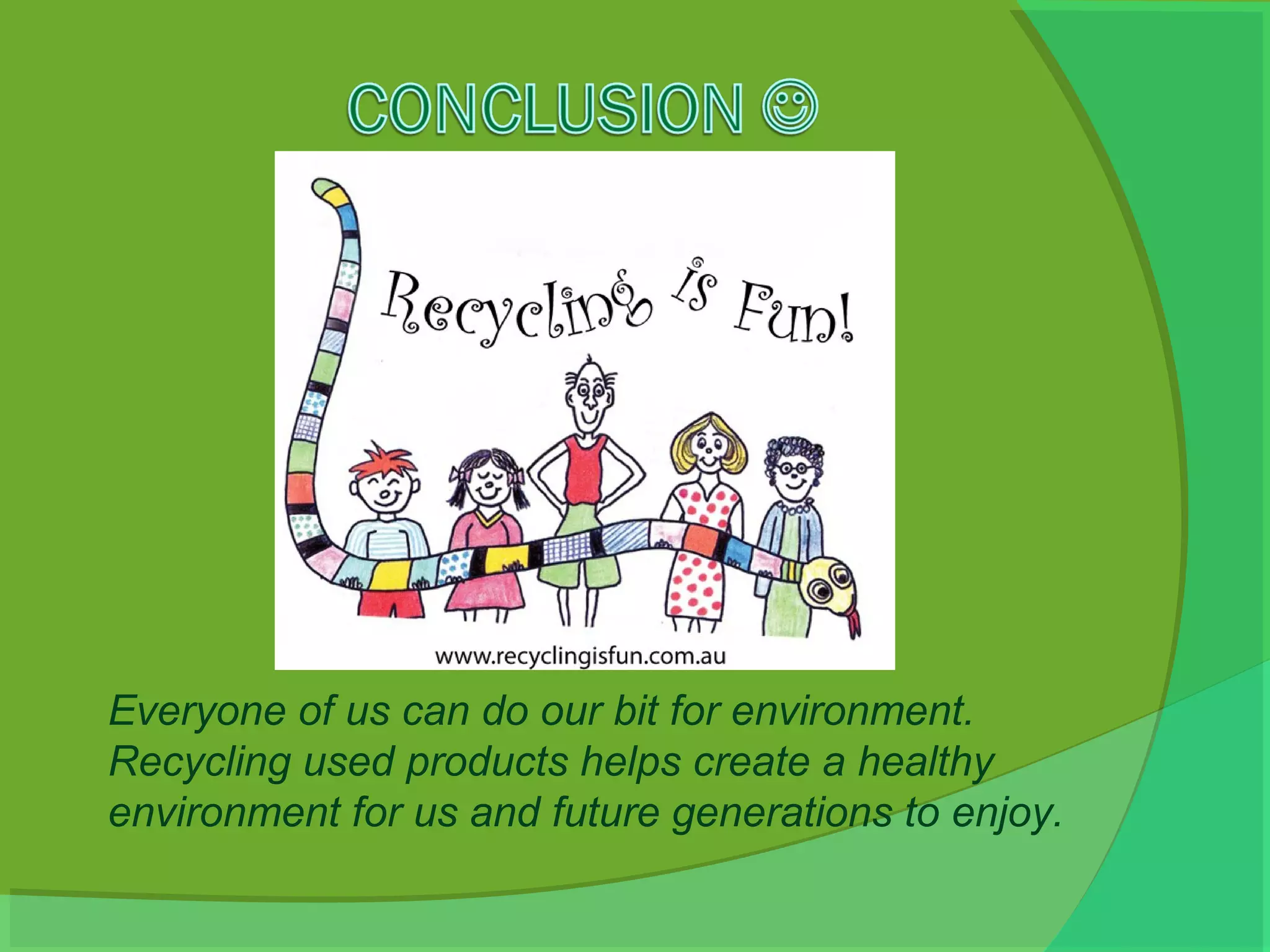
Everyone of us can do our bit for environment.
Recycling used products helps create a healthy
environment for us and future generations to enjoy.
Books:
Powel J.(2008) “What happens when we recycle metal?”, Franklin
    Watts, Franklin Watts Australia,
Powel J.(2008) “What happens when we recycling water? Franklin
    Watts Franklin Watts Australia,
Perini J (2008) “ Environment saving our Planet, Young Reed,
    Chatswood NSW.
Internet research:
   Australian Plantation Products and Paper Industry Council
   Compost for Soils (www.compostforsoils.com.au)
   Recycle At Work WA (recycleatwork.com.au)
   Food Bank (www.foodbank.com.au)
   RecyclingNearYou.com.au
   http://www.mrc.wa.gov.au/tamala-park-operations/refuse---
    recycling.aspx
   http://www.batteryworld.com.au
   Battery World (2010), http:/battreryworld.com.au

Recycling project - Nicole

  • 2.
    1. Reduction in Landfills - recycle reduces the amount of waste sent to landfill. 2. Reduce pollution 3. Recovering resources - can then be used to make new products. 4. Save Energy and money
  • 3.
    Syringes  Chemicals  Nappies  Gas bottles  Plastic bags  Bubble wrap  Ceramic plates  Wax paper
  • 4.
    Did you know that Australia is the second biggest producer of rubbish in the world?  Each person in Australia produces a tone of waste every year.  But it does not have to be that way if we change the way we think about it.  Recycle is not just to reduce the amount of waste, it also allows us to save some of our natural resources and reuse them to make new packaging and products.
  • 6.
    Anything that oncegrew can be put in your green organics bin for composting. So remember, if it grows, then it goes in your green organics bin! This includes garden organics and food scraps including:  Grass clippings  Leaves  Flowers  Weeds  Small pruning’s an d branches  Fruit and vegetable scraps  Meat, fish scraps and bones  Dairy products (cheese, yogurt)  Egg shells  Tea bags and coffee grounds  Bread, rice, pasta, cereal  Out of date and spoiled food  Leftovers from your plate  and even hair
  • 7.
    The yellow lidded bin is for recyclable items only and is collected fortnightly.  Recyclables are taken to a Materials Recovery Facility.  Residents of single residential households have 1 x 240L yellow recycling bin each.  Residents of multi unit - share 240L or 1100L yellow recycling bins. What can I put in my yellow bin?  paper and cardboard  plastic bottles, tubs and containers  aluminium, steel and aerosol cans  glass bottles and jars  milk and juice cartons.
  • 8.
    The first level of recycling is done by hand. Workers at the recycling station sort through tones of materials a day. They do not have time to open the bags and get all and get all of the recyclable things inside.  It is to dangerous and time consuming to open and sort bags, they have to throw them into the rubbish.  In most cases, making products from recycled materials uses less water and energy than making them from new materials.
  • 9.
    1. Aluminium 2. Batteries 3. Cardboard 4. Paper 5. Food Scraps 6. E-Waste 7. Steel 8. Water 9. Rainwater
  • 11.
    Aluminium is the second most used material in the world.  Its used in aircrafts, the building industry, computers, cookware and more.  Drink cans, aluminium foil, foil food trays can be recycled.  It can be recycled over and over again.  If you recycle 1 aluminium can it saves enough electricity to run your TV for 4 HOURS.  1kg of aluminium saves 2kg of green house gas from the atmosphere.  Recycling aluminium is cheaper and consumes lesser energy than making it new from raw materials.
  • 12.
    WHY IS ALUMINIUMRECYCLING GREAT FOR THE ENVIRONMENT?  Aluminium recycling is great for the environment because it takes and uses aluminium which would otherwise end up in thrash mountains that many countries in the world have. Thrash mountains are huge dump sites open to the air, with metals and everything all mixed up in them and are unsightly and hazardous to health.  The cans should be empty and the foil should be free from food.  Before putting them in collection bins they do not need to be spotless so be careful not to waste water when preparing them.
  • 13.
    There are two types of batteries: 1. the first one is called primary -single use, it is found in watches, clocks/watches, toys, smoke alarms, smoke controls. 2. The second one is called secondary-rechargeable batteries they are found in mobile phones, laptops/computers, cameras, cordless items and more.  Every year Aussies use 1000 tones of batteries a year.  To reduce batteries, buy rechargeable ones. Why should we recycle batteries?  Batteries contain toxic things like cadmium, mercury, and lead which are harmful to the environment. What happens to batteries ?  They are sorted into primary and secondary then they are sent to the a recycling facility in Australia.
  • 14.
    How to reduceyour battery waste?  Buying rechargeable batteries is an important way to reduce battery waste.  Each battery can be recharged up to 1000 times.  There are many battery rechargers available for eg: Planet Ark and Charge 'n' Go.  It takes less than 15 minutes to recharge. Battery collections  Most councils offer regular collections and/or provide drop-off locations for hazardous waste.  Recycling battery components is a complex and expensive process due to the chemistry involved.  Plastics and metals, such as Ferro-nickel, can be recovered and recycled. Cadmium, for example, is used to manufacture new batteries.  Drop off the battery when it is completely discharged – if you are not sure, cover the poles of the battery with a piece of sticky tape.
  • 15.
    Why should werecycle cardboard?  It is one of the easiest and most environmental materials to recycle since the fibre in cardboard has already been processed.  Therefore making cardboard products from recycled material, saves not only trees, but also large amounts of water (up to 99%less) and energy (up to 50% less).  Manufacturing from recycled material also produces up to 90% less by- products such as chemical wastes.  For these reasons, it is important to recycle your cardboard and buy paper and cardboard products with recycled content.  Every time paper is processed the individual fibres become weaker. It can be recycled up to 8 times.  Paper that has been recycled as many times as the fibres will allow is turned into compost and breaks down naturally.  More than 80% of Australia's cardboard packaging is made from recycled fibre.  Cardboard can be recycled with paper and is remade into many different kinds of paper products.  For each kilogram of cardboard recycled, you save up to 1 kilogram of greenhouse gases.  Wax coated cardboard (like some fruit boxes) cannot be recycled.
  • 16.
    Reducing cardboard use Re-use cardboard boxes where possible before recycling. We can make:  Cards  Boxes  Packaging  Photo frames  Toilet rolls  Egg cartons.
  • 17.
     Australian homesand offices use up to 2.4 million tones a year.  When paper breaks down in landfill it creates methane.  Keep your paper free of food scraps and plastic.  Paper can be recycled into many things. Reducing paper waste  Think before printing - do as many things as you can on screen, such as reviewing, editing and completing forms.  Use both sides of every sheet of paper.  Used envelopes can be also be written on as notepaper.
  • 18.
    Every year Australians through away an estimate of 3 million tones or 5.2 billion dollars of food.  Wasted food is not a waste of money it is a waste of the recourses used to grow, harvest and transport.  A compost bin is a great idea if you want to put your food scapes to good waste.
  • 19.
    Research by Australian government has shown that most households buy too much food, cook too much food, and throw away leftovers. With the better organisation, minimising your food waste can be easy. - Know how much food to cook for each person, - Make a shopping list and stick to it, - Store your food appropriately to keep it fresher for longer, - Think of tasty ways to use your leftovers, - Work out a weekly meal plan for your household, - Buy some items in bulk.
  • 20.
    Having your own compost bin is a cheap, rewarding way to recycle your food scraps and garden cuttings.  Compost is an excellent soil conditioner that improves soil fertility and encourages plant growth.  Many community gardens run composting and worm farming workshops to help you get started.  Wasted food also wastes the energy, water, money and resources used to produce, process, store and transport the food.
  • 21.
    E-waste is short for electronic waste.  It is recycling computers, phones, laptops, I pads, printers, scanners, cameras and more.  When e-waste is put into landfill it is very hazardous because it contains lead, cadmium, mercury and that goes into the atmosphere.  Electronic waste components also contain valuable raw materials, such as copper, iron, silicon, nickel and gold, which can be collected and reused.
  • 22.
    Personal computers, monitors, laptops, printers and many other associated computer equipment often contain chemicals within plastics and circuit board designed to prevent the device catching on fire.  While this seemed like a good idea at the time, the chemicals used are highly carcinogenic and are not broken down naturally in the environment.
  • 23.
    What do Australiansdo with their old mobile phones? According to an AMTA survey conducted in January 2010:  52% of Australians keep their old mobile phones, working or not  23% give their old mobile phones to family or friends  5% are thrown out  4% of people have lost or had their mobile phone stolen  3% recycle them  4% said it was still in use  4% traded them  1% donated to charity
  • 24.
    Modern steel in manufactured from iron ore.  Iron needs to be 1700o C before it can turn into steel.  It’s 100% recyclable and can also be recycled infinite amount of times. Why should we recycle steel?  Making steel cans from recycled materials uses 75% less energy than producing it from raw materials.  1kg of steel keeps 2kg of greenhouse gasses out of the atmosphere.  1 tone of steel recycles: 1131kg of iron 633kg of coal 54kg of limestone  All types of steel can be recycled including food tins, bottle tops paint tins, aerosols and scrap metal.
  • 25.
    What happens tosteel?  After collection, steel, scrap, metal and steel cans are taken to a steel refinery.  Tin is removed from the steel cans through reverse electroplating.
  • 26.
    If we leavea tap running when we clean our teeth, we can waist up to 5 litres of water a minute. Only 1 % of the worlds water is fresh and 60% is ground water. Grey water tanks  It is not clean enough to drink but we use the water to flush toilets, for washing clothes and to water our gardens.  It can replace up to a third of household water usage. Rainwater  It can replace with half of our water supply.  You need to use less conditioner when you wash with rainwater as it is softer than tap water.
  • 27.
    Cardboard (flattened)  Fluorescent lights  Electronic waste (computers, televisions, printers etc.)  Household batteries  Lead acid batteries (cars and motorbikes)  Mobile phones  Motor oil (up to 20 litres)  Paper  Plastic  Printer cartridges  Scrap metal Monday to Friday 7.30am - 3.45pm JFR (Jim) McGeough Resource Weekends 10.00am - 1.00pm Recovery Public Holidays 7.30am - 1.00pm Cnr Brockway Road & Lemnos Street, Shenton Park
  • 28.
    City of StirlingBalcatta recycle:  Scrap metals  Mixed plastic  Glass and jags  Clothing  Furniture and batteries Map Of Balcatta recycling centre 238 Balcatta Road, Balcatta Monday to Sunday: 7.30am 4.00pm
  • 29.
    The following itemsare accepted:  Gas Bottles  Batteries -Vehicle Single Use- Rechargeable  Glass Bottles and Jars  Aluminium Cans Aluminium Foil  Newspapers Magazines Office Paper Pizza Boxes  Cardboard  Doors & Window Frames  Bicycles  Boats (in good condition)  Household Furniture (in good condition  Paint Cans (empty or up to 20litres per visit)  Pesticides (20 litres per visit) Garden Chemicals  Oil - Cooking Used Motor  Computers & Accessories  Mobile Phones Address:  E WASTE- printers, cartridges, televisions. 1700 Marmion Avenue Mindarie 6030, WA Phone: 9306 6303
  • 31.
    This is afluorescent light recycling. It is available at all Bunnings warehouses.
  • 32.
    When you put materials into your recycling bin, don’t ever put them in a plastic bag.  Don’t put oven-proof glass, drinking glasses or ceramic mugs in your bin. Just 25g of oven-proof glass can contaminate one tonne of normal glass, making it useless for recycling.  All types of printer cartridges are now recyclable all around Australia through the ‘Cartridges 4 Planet Ark’ program.  Drink cans are commonly recycled. However, many people forget about the cans they drink from away from home. If you can’t find a recycling bin take them home with you and recycle them with your other home recyclable items.  Keep recycling those newspapers and magazines! Last year, we recycled the equivalent of 1 billion newspapers into newsprint and other paper materials. When it comes to newspapers and magazines, we are arguably the best recyclers in the world.  Rinse out containers, jars and bottles before putting them in your recycling bin. Just give them a quick clean.  Remove the lids from bottles and jars before putting items your recycling bin.  Pizza boxes, paper bags or cardboard boxes containing food also need special treatment before putting them into your recycling bin. Take out all food items before recycling and remember if the cardboard/paper box or paper bag is too soiled or greasy it cannot be recycled.
  • 33.
    You might be surprise at what rubbish can be turned into.  It can be turn into: 1. Glass bottles – a material called fibre glass, this mix of strong glue and thin strips of glass can be used to make canoes and boats. 2. Paper, cards, cotton, leather and wool are made from plants or animals. 3. Material such as metal and plastic do not rot. They remain in landfill forever and may cause pollution. 4. If you recycle 1 plastic bottle you save enough energy to light 60 walt light bulb for about up to 6 hours. 5. It takes 17 trees to make 1tone of paper.
  • 34.
    People don’t wont to put in the extra effort.  Some people don’t have enough space in their houses.  People are saying that its to time consuming.  People say it doesn't make a difference.  People say it’s to hard.
  • 35.
    Everyone of uscan do our bit for environment. Recycling used products helps create a healthy environment for us and future generations to enjoy.
  • 36.
    Books: Powel J.(2008) “Whathappens when we recycle metal?”, Franklin Watts, Franklin Watts Australia, Powel J.(2008) “What happens when we recycling water? Franklin Watts Franklin Watts Australia, Perini J (2008) “ Environment saving our Planet, Young Reed, Chatswood NSW. Internet research:  Australian Plantation Products and Paper Industry Council  Compost for Soils (www.compostforsoils.com.au)  Recycle At Work WA (recycleatwork.com.au)  Food Bank (www.foodbank.com.au)  RecyclingNearYou.com.au  http://www.mrc.wa.gov.au/tamala-park-operations/refuse--- recycling.aspx  http://www.batteryworld.com.au  Battery World (2010), http:/battreryworld.com.au