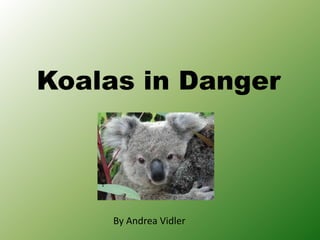
Koalas in Danger


     By Andrea Vidler
Research Questions
 Why the koala was listed as a threatened species by the
  Australian Government in August 2012?
 How can we improve this situation?


Some of the aspects to be investigated are:
 Disease,
 Climate change,
 Human impact.
Basic Koala Facts
 Koalas usually eat eucalypt leaves but some koalas will eat other plants.

 Rarely do koalas have to drink to quench their thirst as eucalypt leaves
  contain a reasonable amount of water.

 The leaves of the eucalypt tree are high in fibre but low in protein.

 Because the eucalypt leaf contains oils and other chemicals, it is inedible
  to some other mammals but the Koala is well adapted to them.

 Koalas sleep in the trees in the day, feed at night and are most active just
  after sun set, therefore making them nocturnal.
Basic Koala Facts
 The breeding season for koalas is summer.

 Female koalas normally give birth to one joey a year.

 A joey usually stays in its mothers pouch for 7 months, then after another
  5 months is completely independent, then usually leaves its birth place at
  18 months.

 Females become sexually mature when they are 2 years old, but males
  mature at 3-4 years of age.

 Koalas are the only tree dwelling marsupial without a tail.
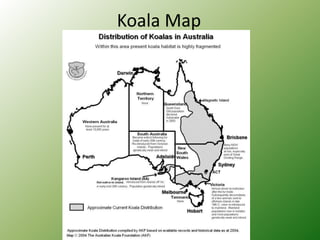
Koala Map
Koalas: Threatened Species
 In August 2012, koalas were announced as a threatened species since
  their population is declining rapidly.
 This is due to habitat loss (most often for urban development), multiple
  diseases, such as chlamydia and leukaemia, getting killed by dogs and
  climate change (too hot and dry, causing dehydration and overheating).
 They are on the threatened species list in NSW, ACT and QLD, but are not
  yet threatened in Victoria.


                                                      SAVE THE
                                                       KOALAS
Diseases
 Disease is one of the problems playing a part in koala numbers dropping
  dramatically.
 Chlamydia is a sexually transferrable disease that stops the koala’s ability
  to reproduce.
 Leukaemia (a type of cancer), other bone marrow disorders and problems
  with their immune system are affecting the koalas.
 It is not known for sure, but a retrovirus may be responsible for some of
  the diseases and other affects in koalas.
 A retrovirus is a virus that penetrates into the host’s DNA and is replicated
  as part of the DNA.
Genetics
 In the 1890s, some healthy joeys were taken to French Island off the coast
  of Victoria
 As this koala population bred, they eventually ran out of food, so they
  were translocated back to the mainland, which repopulated mainland
  Victoria’s koala colony.
 The French Island colony became overpopulated again and female koalas
  were given an implant to affect reproduction but the implants possibly
  had a negative effect on their health.
 Due to inbreeding from the French Island koalas, genetic effects are
  suspected to be reducing the health of the Victorian koalas.
Climate Change
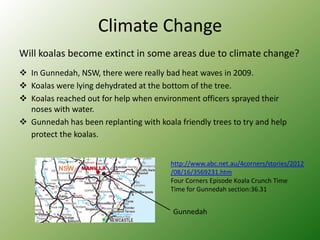
Will koalas become extinct in some areas due to climate change?
 In Gunnedah, NSW, there were really bad heat waves in 2009.
 Koalas were lying dehydrated at the bottom of the tree.
 Koalas reached out for help when environment officers sprayed their
  noses with water.
 Gunnedah has been replanting with koala friendly trees to try and help
  protect the koalas.


                                        http://www.abc.net.au/4corners/stories/2012
                                        /08/16/3569231.htm
                                        Four Corners Episode Koala Crunch Time
                                        Time for Gunnedah section:36.31


                                         Gunnedah
Habitat Loss and Translocation
 Development is major threat to koalas, destroying lots of their habitat.
 On the Gold Coast, koalas are losing their homes (trees) to development
  for houses, roads and shopping centres, as eucalypts are being cut down
  in large numbers.
 Scientists and koala specialists are having to resort to translocating the
  koalas to save them from the bulldozers.
 Translocation is stressful for the koalas and is not always successful, but
  it’s better than leaving them to fend for themselves against the bulldozers.
 Some of the development causing trouble for the koalas was approved
  many years ago, when the koalas weren’t in so much trouble and it can’t
  be stopped now.
 The Queensland State government says the development is ok, but the
  Federal Government says more needs to be done to protect the koalas.
Habitat Loss and Translocation
              (continued)
 Clearing land for mine sites is also affecting koala habitat.
 Some people think that when koalas run away from land clearing, they
  scamper away to safety, but the truth is they usually die.
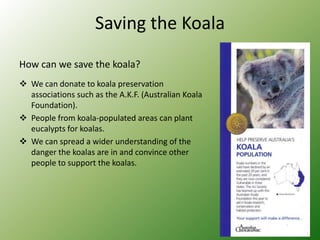
Saving the Koala
How can we save the koala?
 We can donate to koala preservation
  associations such as the A.K.F. (Australian Koala
  Foundation).
 People from koala-populated areas can plant
  eucalypts for koalas.
 We can spread a wider understanding of the
  danger the koalas are in and convince other
  people to support the koalas.
References
 http://wdhq.com.au/oldsite/koalasdistribution.html, accessed 2nd September, no
  update date but map from 2004.
 http://www.fnpw.org.au/plants-a-wildlife/land-mammals/koala , accessed 2nd
  September, updated 2012.
 http://www.abc.net.au/4corners/stories/2012/08/16/3569231.htm, 4 corners
  Episode Koala Crunch Time by Marian Wilkinson and Morag Ramsay, accessed 8th
  September, updated 21 August.
 Pyers, G. (2005) Life Cycles of Australian Animals, Binara Publishing.
 Resnick, J. and Davis, J. (2001) Kolah the Koala, True-to-Life Books.

Koala homework project

  • 1.
    Koalas in Danger By Andrea Vidler
  • 2.
    Research Questions  Whythe koala was listed as a threatened species by the Australian Government in August 2012?  How can we improve this situation? Some of the aspects to be investigated are:  Disease,  Climate change,  Human impact.
  • 3.
    Basic Koala Facts Koalas usually eat eucalypt leaves but some koalas will eat other plants.  Rarely do koalas have to drink to quench their thirst as eucalypt leaves contain a reasonable amount of water.  The leaves of the eucalypt tree are high in fibre but low in protein.  Because the eucalypt leaf contains oils and other chemicals, it is inedible to some other mammals but the Koala is well adapted to them.  Koalas sleep in the trees in the day, feed at night and are most active just after sun set, therefore making them nocturnal.
  • 4.
    Basic Koala Facts The breeding season for koalas is summer.  Female koalas normally give birth to one joey a year.  A joey usually stays in its mothers pouch for 7 months, then after another 5 months is completely independent, then usually leaves its birth place at 18 months.  Females become sexually mature when they are 2 years old, but males mature at 3-4 years of age.  Koalas are the only tree dwelling marsupial without a tail.
  • 5.
  • 6.
    Koalas: Threatened Species In August 2012, koalas were announced as a threatened species since their population is declining rapidly.  This is due to habitat loss (most often for urban development), multiple diseases, such as chlamydia and leukaemia, getting killed by dogs and climate change (too hot and dry, causing dehydration and overheating).  They are on the threatened species list in NSW, ACT and QLD, but are not yet threatened in Victoria. SAVE THE KOALAS
  • 7.
    Diseases  Disease isone of the problems playing a part in koala numbers dropping dramatically.  Chlamydia is a sexually transferrable disease that stops the koala’s ability to reproduce.  Leukaemia (a type of cancer), other bone marrow disorders and problems with their immune system are affecting the koalas.  It is not known for sure, but a retrovirus may be responsible for some of the diseases and other affects in koalas.  A retrovirus is a virus that penetrates into the host’s DNA and is replicated as part of the DNA.
  • 8.
    Genetics  In the1890s, some healthy joeys were taken to French Island off the coast of Victoria  As this koala population bred, they eventually ran out of food, so they were translocated back to the mainland, which repopulated mainland Victoria’s koala colony.  The French Island colony became overpopulated again and female koalas were given an implant to affect reproduction but the implants possibly had a negative effect on their health.  Due to inbreeding from the French Island koalas, genetic effects are suspected to be reducing the health of the Victorian koalas.
  • 9.
    Climate Change Will koalasbecome extinct in some areas due to climate change?  In Gunnedah, NSW, there were really bad heat waves in 2009.  Koalas were lying dehydrated at the bottom of the tree.  Koalas reached out for help when environment officers sprayed their noses with water.  Gunnedah has been replanting with koala friendly trees to try and help protect the koalas. http://www.abc.net.au/4corners/stories/2012 /08/16/3569231.htm Four Corners Episode Koala Crunch Time Time for Gunnedah section:36.31 Gunnedah
  • 10.
    Habitat Loss andTranslocation  Development is major threat to koalas, destroying lots of their habitat.  On the Gold Coast, koalas are losing their homes (trees) to development for houses, roads and shopping centres, as eucalypts are being cut down in large numbers.  Scientists and koala specialists are having to resort to translocating the koalas to save them from the bulldozers.  Translocation is stressful for the koalas and is not always successful, but it’s better than leaving them to fend for themselves against the bulldozers.  Some of the development causing trouble for the koalas was approved many years ago, when the koalas weren’t in so much trouble and it can’t be stopped now.  The Queensland State government says the development is ok, but the Federal Government says more needs to be done to protect the koalas.
  • 11.
    Habitat Loss andTranslocation (continued)  Clearing land for mine sites is also affecting koala habitat.  Some people think that when koalas run away from land clearing, they scamper away to safety, but the truth is they usually die.
  • 12.
    Saving the Koala Howcan we save the koala?  We can donate to koala preservation associations such as the A.K.F. (Australian Koala Foundation).  People from koala-populated areas can plant eucalypts for koalas.  We can spread a wider understanding of the danger the koalas are in and convince other people to support the koalas.
  • 13.
    References  http://wdhq.com.au/oldsite/koalasdistribution.html, accessed2nd September, no update date but map from 2004.  http://www.fnpw.org.au/plants-a-wildlife/land-mammals/koala , accessed 2nd September, updated 2012.  http://www.abc.net.au/4corners/stories/2012/08/16/3569231.htm, 4 corners Episode Koala Crunch Time by Marian Wilkinson and Morag Ramsay, accessed 8th September, updated 21 August.  Pyers, G. (2005) Life Cycles of Australian Animals, Binara Publishing.  Resnick, J. and Davis, J. (2001) Kolah the Koala, True-to-Life Books.