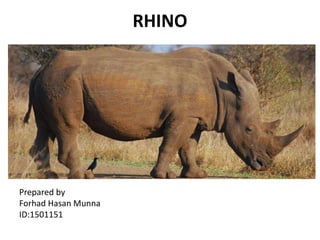
RHINO
Prepared by
Forhad Hasan Munna
ID:1501151
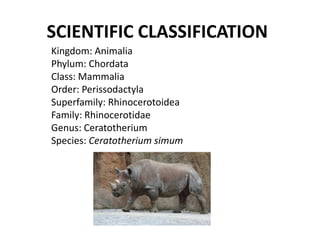
SCIENTIFIC CLASSIFICATION
Kingdom: Animalia
Phylum: Chordata
Class: Mammalia
Order: Perissodactyla
Superfamily: Rhinocerotoidea
Family: Rhinocerotidae
Genus: Ceratotherium
Species: Ceratotherium simum
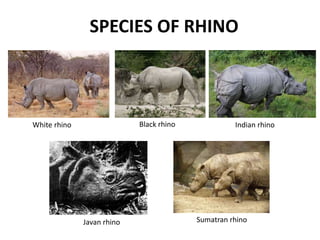
SPECIES OF RHINO
White rhino Black rhino Indian rhino
Javan rhino Sumatran rhino
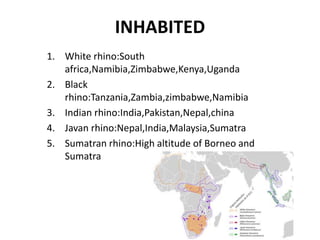
INHABITED
1. White rhino:South
africa,Namibia,Zimbabwe,Kenya,Uganda
2. Black
rhino:Tanzania,Zambia,zimbabwe,Namibia
3. Indian rhino:India,Pakistan,Nepal,china
4. Javan rhino:Nepal,India,Malaysia,Sumatra
5. Sumatran rhino:High altitude of Borneo and
Sumatra
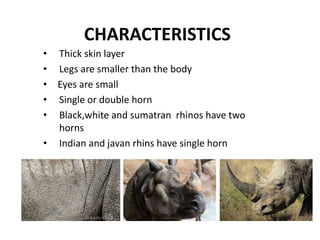
CHARACTERISTICS
• Thick skin layer
• Legs are smaller than the body
• Eyes are small
• Single or double horn
• Black,white and sumatran rhinos have two
horns
• Indian and javan rhins have single horn
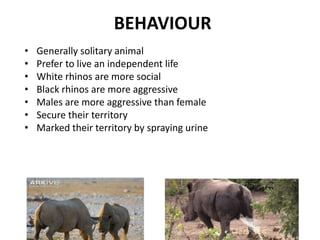
BEHAVIOUR
• Generally solitary animal
• Prefer to live an independent life
• White rhinos are more social
• Black rhinos are more aggressive
• Males are more aggressive than female
• Secure their territory
• Marked their territory by spraying urine
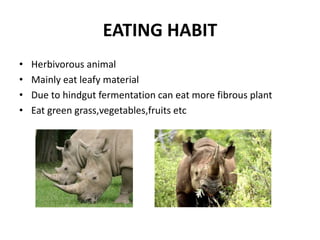
EATING HABIT
• Herbivorous animal
• Mainly eat leafy material
• Due to hindgut fermentation can eat more fibrous plant
• Eat green grass,vegetables,fruits etc
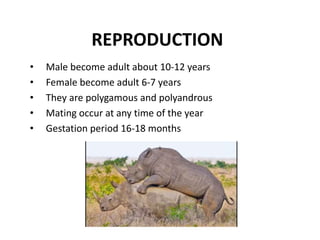
REPRODUCTION
• Male become adult about 10-12 years
• Female become adult 6-7 years
• They are polygamous and polyandrous
• Mating occur at any time of the year
• Gestation period 16-18 months
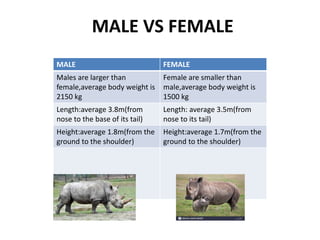
MALE VS FEMALE
MALE FEMALE
Males are larger than
female,average body weight is
2150 kg
Female are smaller than
male,average body weight is
1500 kg
Length:average 3.8m(from
nose to the base of its tail)
Length: average 3.5m(from
nose to its tail)
Height:average 1.8m(from the
ground to the shoulder)
Height:average 1.7m(from the
ground to the shoulder)
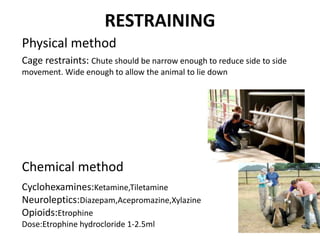
RESTRAINING
Physical method
Cage restraints: Chute should be narrow enough to reduce side to side
movement. Wide enough to allow the animal to lie down
Chemical method
Cyclohexamines:Ketamine,Tiletamine
Neuroleptics:Diazepam,Acepromazine,Xylazine
Opioids:Etrophine
Dose:Etrophine hydrocloride 1-2.5ml
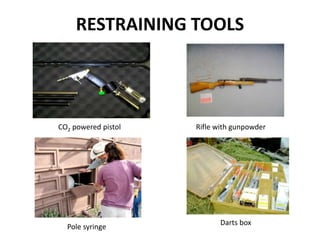
Rifle with gunpowder
CO2 powered pistol
Pole syringe
Darts box
RESTRAINING TOOLS
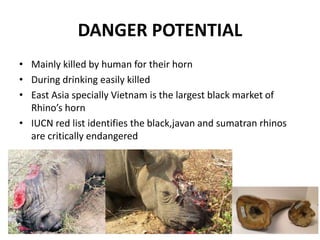
DANGER POTENTIAL
• Mainly killed by human for their horn
• During drinking easily killed
• East Asia specially Vietnam is the largest black market of
Rhino’s horn
• IUCN red list identifies the black,javan and sumatran rhinos
are critically endangered
DISEASES
1.Infectious diseases
Bacterial diseases
I. Tuberculosis (Mycobacterium tuberculosis and M.bovis)
II. Clostridial diseases (clostridium sordelli)
III. Leptospirosis
Viral diseases
I. Encephalomyocarditis (Encephalomyocarditis virus)
Protozoal diseases
I. Theileriasis
Fungal diseases
I. Fungal pneumonia(Aspergillus spp)
2.Non-infectious diseases
I. Gastrointestinal impaction
II. Hemolytic anemia
III. Idiopathic haemorrhagic vasculopathy syndrome(IHVS)
IV. Tissue accumulation of iron
V. Mouth and nasal bleeding polyps
Rhino.pptx

Rhino.pptx

  • 1.
  • 2.
    SCIENTIFIC CLASSIFICATION Kingdom: Animalia Phylum:Chordata Class: Mammalia Order: Perissodactyla Superfamily: Rhinocerotoidea Family: Rhinocerotidae Genus: Ceratotherium Species: Ceratotherium simum
  • 3.
    SPECIES OF RHINO Whiterhino Black rhino Indian rhino Javan rhino Sumatran rhino
  • 4.
    INHABITED 1. White rhino:South africa,Namibia,Zimbabwe,Kenya,Uganda 2.Black rhino:Tanzania,Zambia,zimbabwe,Namibia 3. Indian rhino:India,Pakistan,Nepal,china 4. Javan rhino:Nepal,India,Malaysia,Sumatra 5. Sumatran rhino:High altitude of Borneo and Sumatra
  • 5.
    CHARACTERISTICS • Thick skinlayer • Legs are smaller than the body • Eyes are small • Single or double horn • Black,white and sumatran rhinos have two horns • Indian and javan rhins have single horn
  • 6.
    BEHAVIOUR • Generally solitaryanimal • Prefer to live an independent life • White rhinos are more social • Black rhinos are more aggressive • Males are more aggressive than female • Secure their territory • Marked their territory by spraying urine
  • 7.
    EATING HABIT • Herbivorousanimal • Mainly eat leafy material • Due to hindgut fermentation can eat more fibrous plant • Eat green grass,vegetables,fruits etc
  • 8.
    REPRODUCTION • Male becomeadult about 10-12 years • Female become adult 6-7 years • They are polygamous and polyandrous • Mating occur at any time of the year • Gestation period 16-18 months
  • 9.
    MALE VS FEMALE MALEFEMALE Males are larger than female,average body weight is 2150 kg Female are smaller than male,average body weight is 1500 kg Length:average 3.8m(from nose to the base of its tail) Length: average 3.5m(from nose to its tail) Height:average 1.8m(from the ground to the shoulder) Height:average 1.7m(from the ground to the shoulder)
  • 10.
    RESTRAINING Physical method Cage restraints:Chute should be narrow enough to reduce side to side movement. Wide enough to allow the animal to lie down Chemical method Cyclohexamines:Ketamine,Tiletamine Neuroleptics:Diazepam,Acepromazine,Xylazine Opioids:Etrophine Dose:Etrophine hydrocloride 1-2.5ml
  • 11.
    Rifle with gunpowder CO2powered pistol Pole syringe Darts box RESTRAINING TOOLS
  • 12.
    DANGER POTENTIAL • Mainlykilled by human for their horn • During drinking easily killed • East Asia specially Vietnam is the largest black market of Rhino’s horn • IUCN red list identifies the black,javan and sumatran rhinos are critically endangered
  • 13.
    DISEASES 1.Infectious diseases Bacterial diseases I.Tuberculosis (Mycobacterium tuberculosis and M.bovis) II. Clostridial diseases (clostridium sordelli) III. Leptospirosis Viral diseases I. Encephalomyocarditis (Encephalomyocarditis virus) Protozoal diseases I. Theileriasis Fungal diseases I. Fungal pneumonia(Aspergillus spp)
  • 14.
    2.Non-infectious diseases I. Gastrointestinalimpaction II. Hemolytic anemia III. Idiopathic haemorrhagic vasculopathy syndrome(IHVS) IV. Tissue accumulation of iron V. Mouth and nasal bleeding polyps