Prediction modeling
Maarten van Smeden, Department of Clinical Epidemiology,
Leiden University Medical Center, Leiden, Netherlands
Berlin, Advanced Methods Methods in Health Data Sciences
Jan 16 2020
2
14-Jan-20Insert > Header & footer3
4
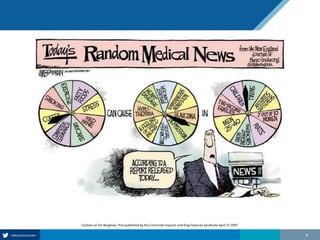
Cartoon of Jim Borgman, first published by the Cincinnati Inquirer and King Features Syndicate April 27 1997
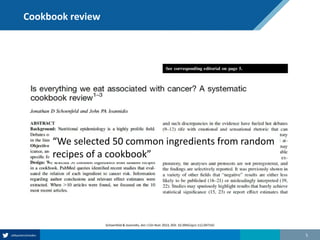
Cookbook review
5
Schoenfeld & Ioannidis, Am J Clin Nutr 2013, DOI: 10.3945/ajcn.112.047142
“We selected 50 common ingredients from random
recipes of a cookbook”
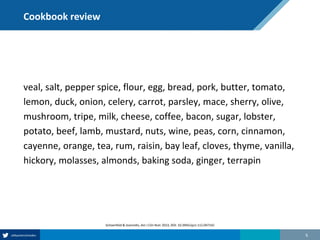
Cookbook review
veal, salt, pepper spice, flour, egg, bread, pork, butter, tomato,
lemon, duck, onion, celery, carrot, parsley, mace, sherry, olive,
mushroom, tripe, milk, cheese, coffee, bacon, sugar, lobster,
potato, beef, lamb, mustard, nuts, wine, peas, corn, cinnamon,
cayenne, orange, tea, rum, raisin, bay leaf, cloves, thyme, vanilla,
hickory, molasses, almonds, baking soda, ginger, terrapin
6
Schoenfeld & Ioannidis, Am J Clin Nutr 2013, DOI: 10.3945/ajcn.112.047142
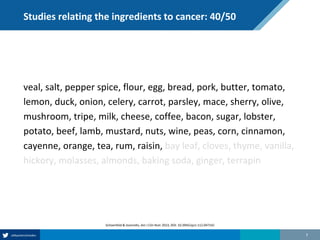
Studies relating the ingredients to cancer: 40/50
veal, salt, pepper spice, flour, egg, bread, pork, butter, tomato,
lemon, duck, onion, celery, carrot, parsley, mace, sherry, olive,
mushroom, tripe, milk, cheese, coffee, bacon, sugar, lobster,
potato, beef, lamb, mustard, nuts, wine, peas, corn, cinnamon,
cayenne, orange, tea, rum, raisin, bay leaf, cloves, thyme, vanilla,
hickory, molasses, almonds, baking soda, ginger, terrapin
7
Schoenfeld & Ioannidis, Am J Clin Nutr 2013, DOI: 10.3945/ajcn.112.047142
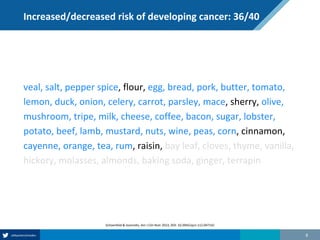
Increased/decreased risk of developing cancer: 36/40
veal, salt, pepper spice, flour, egg, bread, pork, butter, tomato,
lemon, duck, onion, celery, carrot, parsley, mace, sherry, olive,
mushroom, tripe, milk, cheese, coffee, bacon, sugar, lobster,
potato, beef, lamb, mustard, nuts, wine, peas, corn, cinnamon,
cayenne, orange, tea, rum, raisin, bay leaf, cloves, thyme, vanilla,
hickory, molasses, almonds, baking soda, ginger, terrapin
8
Schoenfeld & Ioannidis, Am J Clin Nutr 2013, DOI: 10.3945/ajcn.112.047142
9
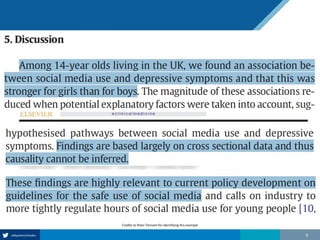
Credits to Peter Tennant for identifying this example
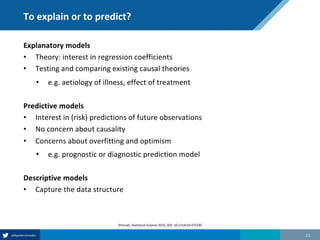
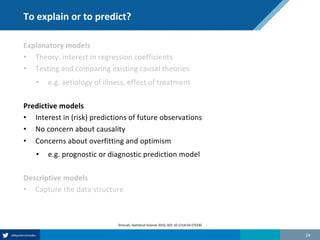
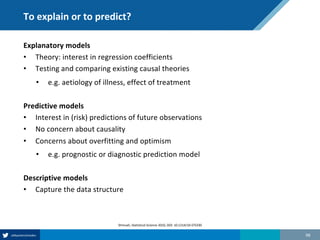
To explain or to predict?
Explanatory models
• Theory: interest in regression coefficients
• Testing and comparing existing causal theories
• e.g. aetiology of illness, effect of treatment
Predictive models
• Interest in (risk) predictions of future observations
• No concern about causality
• Concerns about overfitting and optimism
• e.g. prognostic or diagnostic prediction model
Descriptive models
• Capture the data structure
11
Shmueli, Statistical Science 2010, DOI: 10.1214/10-STS330
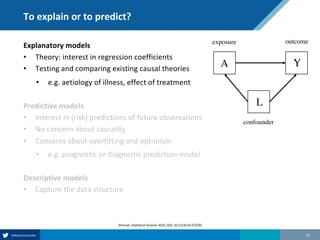
To explain or to predict?
Explanatory models
• Theory: interest in regression coefficients
• Testing and comparing existing causal theories
• e.g. aetiology of illness, effect of treatment
Predictive models
• Interest in (risk) predictions of future observations
• No concern about causality
• Concerns about overfitting and optimism
• e.g. prognostic or diagnostic prediction model
Descriptive models
• Capture the data structure
12
A
L
Y
exposure outcome
confounder
Shmueli, Statistical Science 2010, DOI: 10.1214/10-STS330
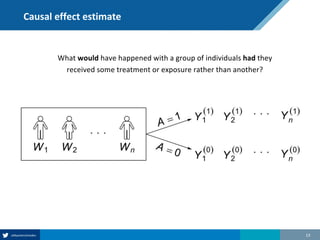
Causal effect estimate
13
What would have happened with a group of individuals had they
received some treatment or exposure rather than another?
Image sources: https://bit.ly/3a9wRMj https://bit.ly/2uEDRQJ
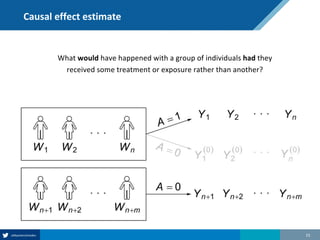
Causal effect estimate
15
What would have happened with a group of individuals had they
received some treatment or exposure rather than another?
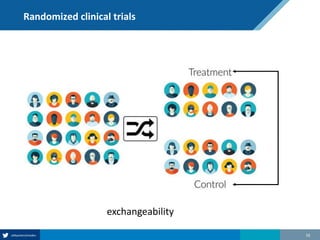
Randomized clinical trials
16
exchangeability
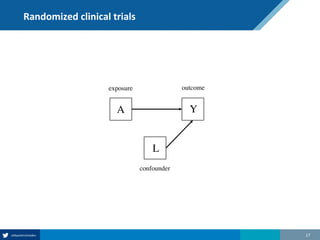
Randomized clinical trials
17
A
L
Y
exposure outcome
confounder
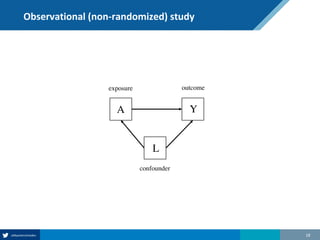
Observational (non-randomized) study
18
A
L
Y
exposure outcome
confounder
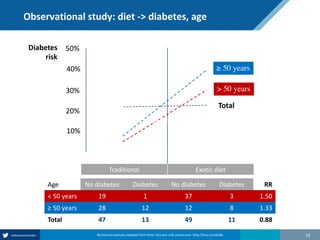
Observational study: diet -> diabetes, age
19
Age No diabetes Diabetes No diabetes Diabetes RR
< 50 years 19 1 37 3 1.50
≥ 50 years 28 12 12 8 1.33
Total 47 13 49 11 0.88
Traditional Exotic diet
50%
40%
30%
20%
10%
≥ 50 years
> 50 years
Total
Diabetes
risk
< 50 years
Numerical example adapted from Peter Tennant with permission: http://tiny.cc/ai6o8y
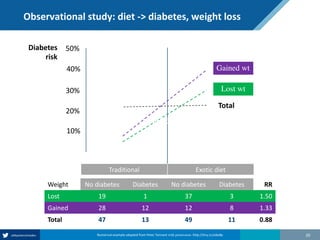
Observational study: diet -> diabetes, weight loss
20
Weight No diabetes Diabetes No diabetes Diabetes RR
Lost 19 1 37 3 1.50
Gained 28 12 12 8 1.33
Total 47 13 49 11 0.88
Traditional Exotic diet
50%
40%
30%
20%
10%
Gained wt
Lost wt
Total
Diabetes
risk
< 50 years
Numerical example adapted from Peter Tennant with permission: http://tiny.cc/ai6o8y
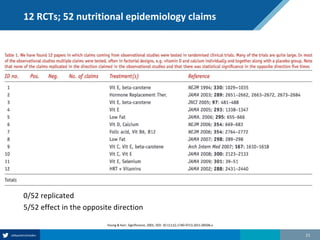
12 RCTs; 52 nutritional epidemiology claims
0/52 replicated
5/52 effect in the opposite direction
21
Young & Karr, Significance, 2001, DOI: 10.1111/j.1740-9713.2011.00506.x
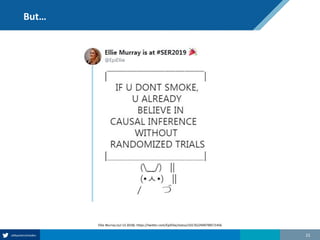
But…
22
Ellie Murray (Jul 13 2018): https://twitter.com/EpiEllie/status/1017622949799571456
23
To explain or to predict?
Explanatory models
• Theory: interest in regression coefficients
• Testing and comparing existing causal theories
• e.g. aetiology of illness, effect of treatment
Predictive models
• Interest in (risk) predictions of future observations
• No concern about causality
• Concerns about overfitting and optimism
• e.g. prognostic or diagnostic prediction model
Descriptive models
• Capture the data structure
24
Shmueli, Statistical Science 2010, DOI: 10.1214/10-STS330
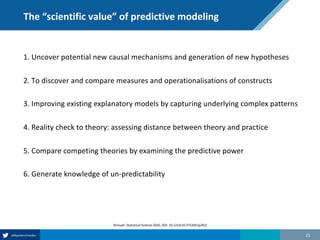
The “scientific value” of predictive modeling
25
1. Uncover potential new causal mechanisms and generation of new hypotheses
2. To discover and compare measures and operationalisations of constructs
3. Improving existing explanatory models by capturing underlying complex patterns
4. Reality check to theory: assessing distance between theory and practice
5. Compare competing theories by examining the predictive power
6. Generate knowledge of un-predictability
Shmueli, Statistical Science 2010, DOI: 10.1214/10-STS330 (p292)
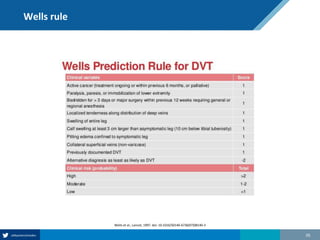
Wells rule
26
Wells et al., Lancet, 1997. doi: 10.1016/S0140-6736(97)08140-3
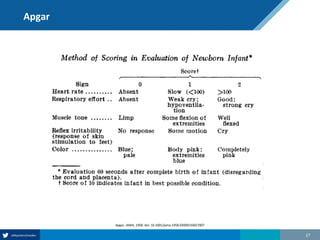
Apgar
27
Apgar, JAMA, 1958. doi: 10.1001/jama.1958.03000150027007
28
Courtesy, Anna Lohmann
29
Courtesy, Anna Lohmann
Prediction
Usual aim: to make accurate predictions
… of a future outcome or presence of a disease
… for an individual patient
… generally based on >1 factor (predictor)
why?
• to inform decision making (about additional testing/treatment)
• for counseling
30
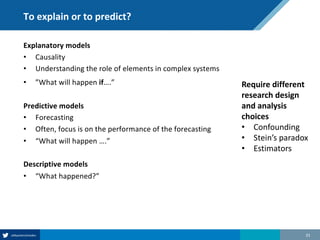
To explain or to predict?
Explanatory models
• Causality
• Understanding the role of elements in complex systems
• ”What will happen if….”
Predictive models
• Forecasting
• Often, focus is on the performance of the forecasting
• “What will happen ….”
Descriptive models
• “What happened?”
31
Require different
research design
and analysis
choices
• Confounding
• Stein’s paradox
• Estimators
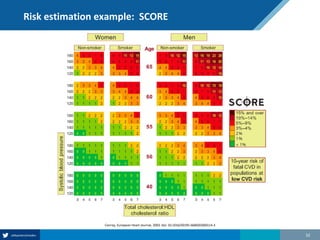
Risk estimation example: SCORE
32
Conroy, European Heart Journal, 2003. doi: 10.1016/S0195-668X(03)00114-3
33
https://apple.co/2s1aWWa
Risk prediction
Risk prediction can be broadly categorized into:
• Diagnostic: risk of a target disease being currently present vs not present
• Prognostic: risk of a certain health state over a certain time period
• Do we need a randomized controlled trial for diagnostic/prognostic prediction?
• Do we need counterfactual thinking?
34
Risk prediction
35
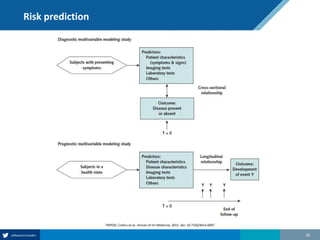
TRIPOD: Collins et al., Annals of Int Medicine, 2015. doi: 10.7326/M14-0697
Risk?
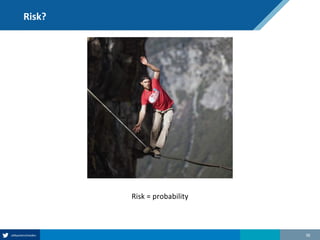
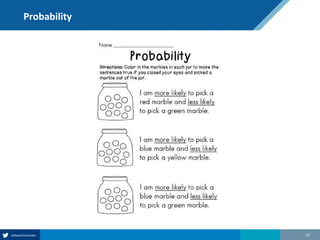
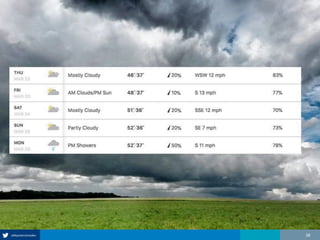
Risk = probability
36
Probability
37
38
39
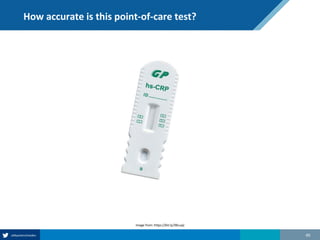
How accurate is this point-of-care test?
40
image from: https://bit.ly/39LuajJ
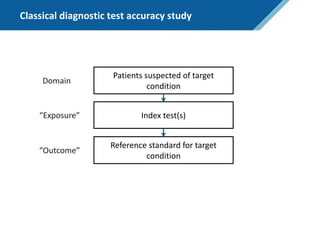
Classical diagnostic test accuracy study
Patients suspected of target
condition
Reference standard for target
condition
Index test(s)
Domain
“Exposure”
“Outcome”
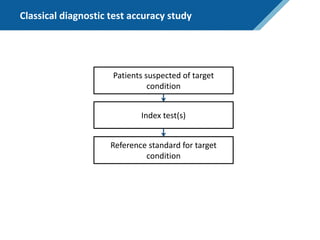
Classical diagnostic test accuracy study
Patients suspected of target
condition
Reference standard for target
condition
Index test(s)
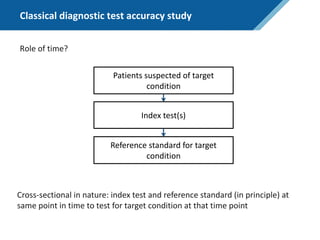
Classical diagnostic test accuracy study
Patients suspected of target
condition
Reference standard for target
condition
Index test(s)
Role of time?
Cross-sectional in nature: index test and reference standard (in principle) at
same point in time to test for target condition at that time point
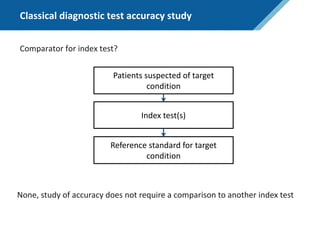
Classical diagnostic test accuracy study
Patients suspected of target
condition
Reference standard for target
condition
Index test(s)
Comparator for index test?
None, study of accuracy does not require a comparison to another index test
Classical diagnostic test accuracy study
Patients suspected of target
condition
Reference standard for target
condition
Index test(s)
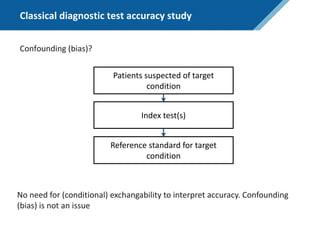
Confounding (bias)?
No need for (conditional) exchangability to interpret accuracy. Confounding
(bias) is not an issue
Classical diagnostic test accuracy study
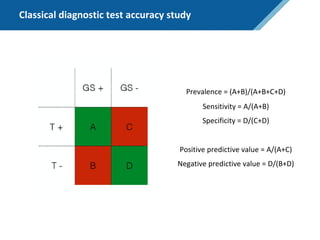
Prevalence = (A+B)/(A+B+C+D)
Sensitivity = A/(A+B)
Specificity = D/(C+D)
Positive predictive value = A/(A+C)
Negative predictive value = D/(B+D)
Probability
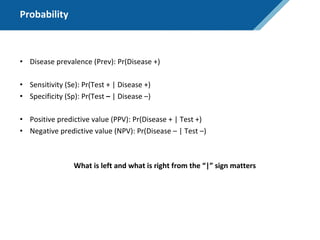
• Disease prevalence (Prev): Pr(Disease +)
• Sensitivity (Se): Pr(Test + | Disease +)
• Specificity (Sp): Pr(Test – | Disease –)
• Positive predictive value (PPV): Pr(Disease + | Test +)
• Negative predictive value (NPV): Pr(Disease – | Test –)
What is left and what is right from the “|” sign matters
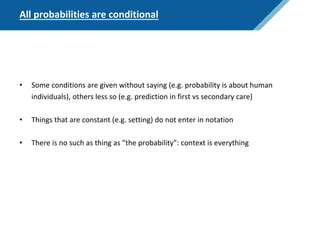
All probabilities are conditional
• Some conditions are given without saying (e.g. probability is about human
individuals), others less so (e.g. prediction in first vs secondary care)
• Things that are constant (e.g. setting) do not enter in notation
• There is no such as thing as ”the probability”: context is everything
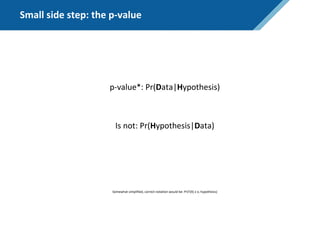
Small side step: the p-value
p-value*: Pr(Data|Hypothesis)
Is not: Pr(Hypothesis|Data)
Somewhat simplified, correct notation would be: Pr(T(X) ≥ x; hypothesis)
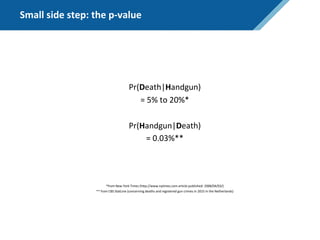
Small side step: the p-value
Pr(Death|Handgun)
= 5% to 20%*
Pr(Handgun|Death)
= 0.03%**
*from New York Times (http://www.nytimes.com article published: 2008/04/03/)
** from CBS StatLine (concerning deaths and registered gun crimes in 2015 in the Netherlands)
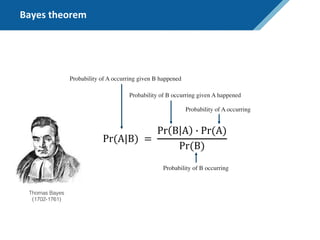
Bayes theorem
Pr(A|B) =
Pr B A ) Pr(A)
Pr(B)
Probability of A occurring given B happened
Probability of B occurring given A happened
Probability of A occurring
Probability of B occurring
Thomas Bayes
(1702-1761)
Bayesville
https://youtu.be/otdaJPVQIgg
In-class exercise – ClearBlue compact pregnancy test
• Calculate Prev, Se, Sp, NPV and PPV
• Re-calculate NPV assuming Prev of 10%, and again with 80%
• Make use of NPV = Sp*(1-Prev)/[(1-Se)*Prev + Sp*(1-Prev)]
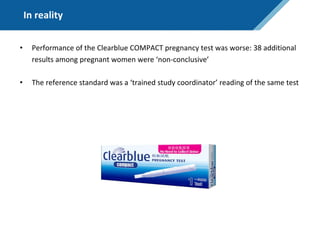
In reality
• Performance of the Clearblue COMPACT pregnancy test was worse: 38 additional
results among pregnant women were ‘non-conclusive’
• The reference standard was a ‘trained study coordinator’ reading of the same test
Diagnostic test is simplest prediction model
• Nowcasting (instead of forecasting)
• Best available prediction of target disease status is test result
• Assuming no other relevant information is available
• Risk prediction (probability) for disease:
• PPV with positive test
• 1-NPV with negative test
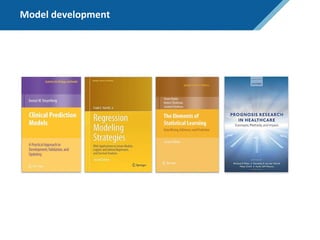
Model development
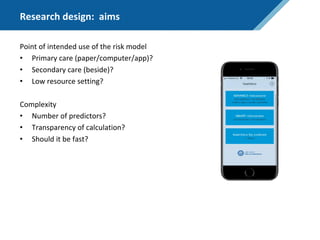
Research design: aims
Point of intended use of the risk model
• Primary care (paper/computer/app)?
• Secondary care (beside)?
• Low resource setting?
Complexity
• Number of predictors?
• Transparency of calculation?
• Should it be fast?
Research design: design of data collection
Prospective cohort study: measurement of predictors at baseline + follow-up until event
occurs (time-horizon)
Alternatives
• Randomized trials?
• Routine care data?
• Case-control?
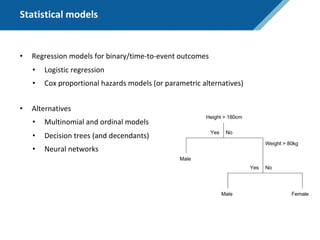
Statistical models
• Regression models for binary/time-to-event outcomes
• Logistic regression
• Cox proportional hazards models (or parametric alternatives)
• Alternatives
• Multinomial and ordinal models
• Decision trees (and decendants)
• Neural networks
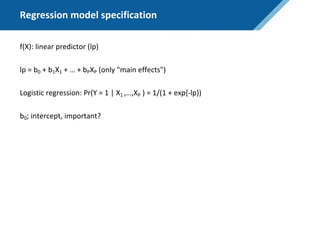
Regression model specification
f(X): linear predictor (lp)
lp = b0 + b1X1 + … + bPXP (only "main effects")
Logistic regression: Pr(Y = 1 | X1 ,…,XP ) = 1/(1 + exp{-lp})
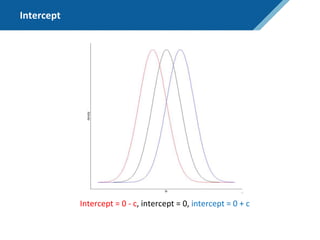
b0; intercept, important?
Intercept
Intercept = 0 - c, intercept = 0, intercept = 0 + c
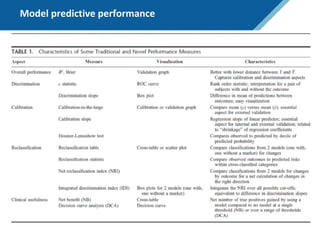
Model predictive performance
Discrimination
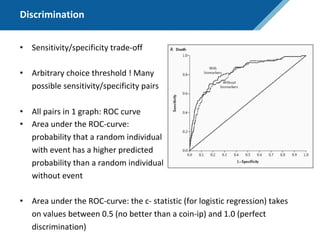
• Sensitivity/specificity trade-off
• Arbitrary choice threshold ! Many
possible sensitivity/specificity pairs
• All pairs in 1 graph: ROC curve
• Area under the ROC-curve:
probability that a random individual
with event has a higher predicted
probability than a random individual
without event
• Area under the ROC-curve: the c- statistic (for logistic regression) takes
on values between 0.5 (no better than a coin-ip) and 1.0 (perfect
discrimination)
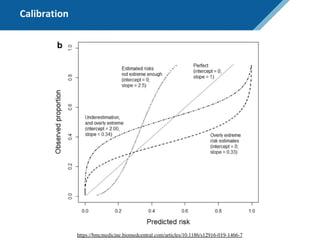
Calibration
https://bmcmedicine.biomedcentral.com/articles/10.1186/s12916-019-1466-7
Optimism
Predictive performance evaluations are too optimistic when estimated on the same data
where the risk prediction model was developed. This is therefore called apparent
performance of the model
Optimism can be large, especially in small datasets and with a large number of predictors
To get a better estimate of the predictive performance (more about this next week):
• Internal validation (same data sample)
• External validation (other data sample)
https://twitter.com/LesGuessing/status/997146590442799105
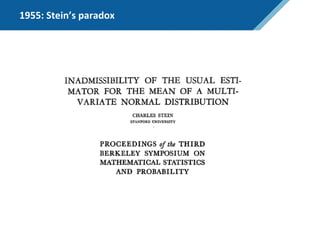
1955: Stein’s paradox
Stein’s paradox in words (rather simplified)
When one has three or more units (say, individuals), and for each unit one can calculate
an average score (say, average blood pressure), then the best guess of future
observations for each unit (say, blood pressure tomorrow) is NOT the average score.
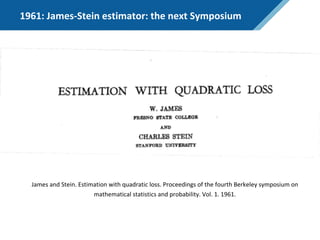
1961: James-Stein estimator: the next Symposium
James and Stein. Estimation with quadratic loss. Proceedings of the fourth Berkeley symposium on
mathematical statistics and probability. Vol. 1. 1961.
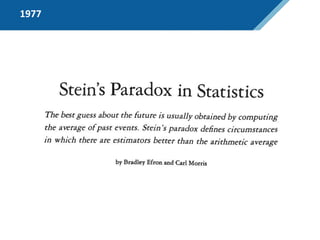
1977
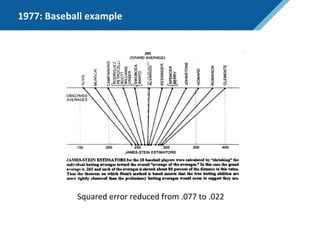
1977: Baseball example
Squared error reduced from .077 to .022
Stein’s paradox
• Probably among the most surprising (and initially doubted) phenomena in statistics
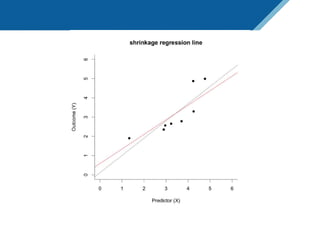
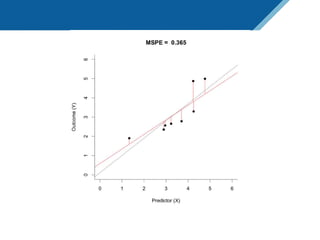
• Now a large “family”: shrinkage estimators reduce prediction variance to an extent
that typically outweighs the bias that is introduced
• Bias/variance trade-off principle has motivated many statistical and machine learning
developments
Expected prediction error = irreducible error + bias2 + variance
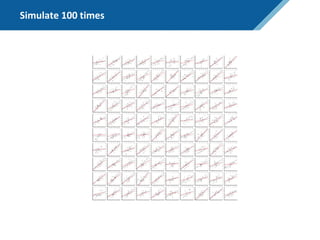
Simulate 100 times
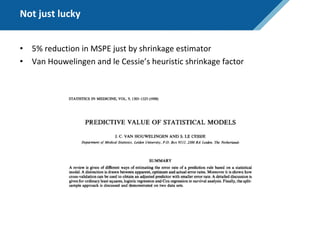
Not just lucky
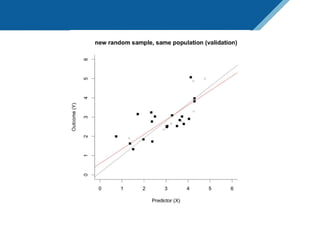
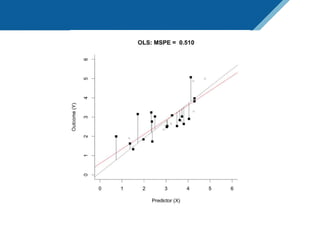
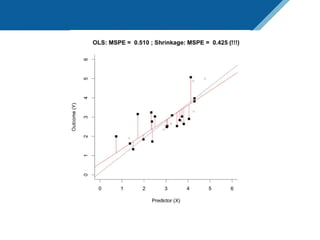
• 5% reduction in MSPE just by shrinkage estimator
• Van Houwelingen and le Cessie’s heuristic shrinkage factor
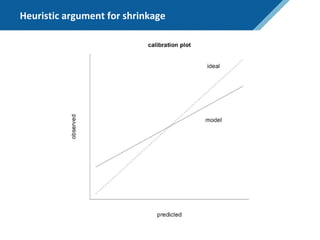
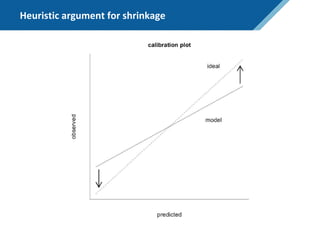
Heuristic argument for shrinkage
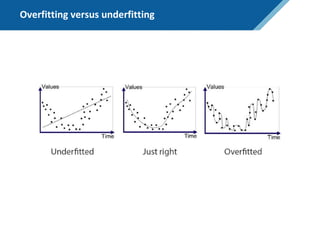
Overfitting
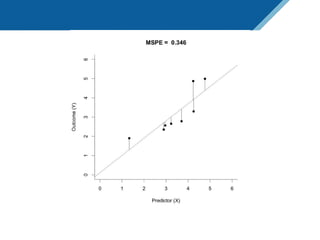
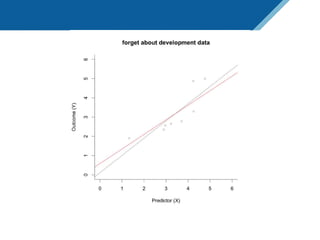
"Idiosyncrasies in the data are fitted rather than generalizable patterns. A
model may hence not be applicable to new patients, even when the setting of
application is very similar to the development setting."
Steyerberg (2009). Clinical Prediction Models.
Overfitting versus underfitting
To avoid overfitting…
Large data (sample size / no. events) and to pre-specify your analyses as much as
possible!
And:
• Be conservative when removing predictor variables
• Apply shrinkage methods
• Correct for optimism
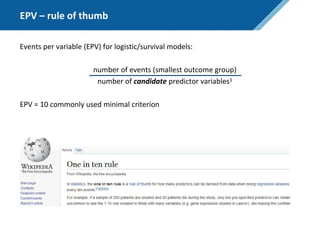
EPV – rule of thumb
Events per variable (EPV) for logistic/survival models:
number of events (smallest outcome group)
number of candidate predictor variables1
EPV = 10 commonly used minimal criterion
EPV – rule of dumb?
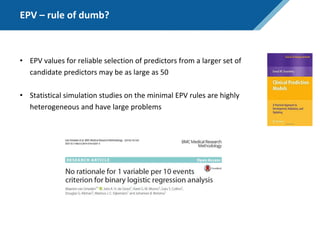
• EPV values for reliable selection of predictors from a larger set of
candidate predictors may be as large as 50
• Statistical simulation studies on the minimal EPV rules are highly
heterogeneous and have large problems
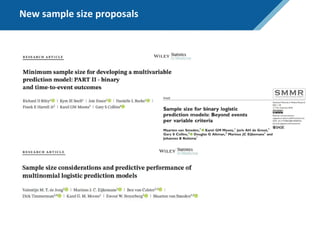
New sample size proposals
Variable selection
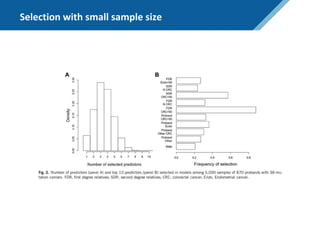
• Selection unstable
• Selection and order of entry often overinterpreted
• Limited power to detect true effects
• Predictive ability suffers, ‘underfitting’
• Risk of false-positive associations
• Multiple testing, ‘overfitting’
• Inference biased
• P-values exaggerated; standard errors too small
• Estimated coefficients biased
• ‘testimation’
Selection with small sample size
Conditional probabilities are at the core of prediction
• Perfect or near-perfect predicting models?
Suspect!
• Proving that a probability model generates a wrong risk prediction?
Difficult!
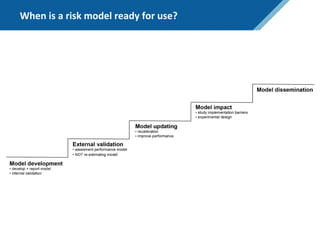
When is a risk model ready for use?
Prediction model landscape
>110 models for prostate cancer (Shariat 2008)
>100 models for Traumatic Brain Injury (Perel 2006)
83 models for stroke (Counsell 2001)
54 models for breast cancer (Altman 2009)
43 models for type 2 diabetes (Collins 2011; Dieren 2012)
31 models for osteoporotic fracture (Steurer 2011)
29 models in reproductive medicine (Leushuis 2009)
26 models for hospital readmission (Kansagara 2011)
>25 models for length of stay in cardiac surgery (Ettema 2010)
>350 models for CVD outcomes (Damen 2016)
• Few prediction models are externally validated
• Predictive performance often poor
97
To explain or to predict?
Explanatory models
• Theory: interest in regression coefficients
• Testing and comparing existing causal theories
• e.g. aetiology of illness, effect of treatment
Predictive models
• Interest in (risk) predictions of future observations
• No concern about causality
• Concerns about overfitting and optimism
• e.g. prognostic or diagnostic prediction model
Descriptive models
• Capture the data structure
98
Shmueli, Statistical Science 2010, DOI: 10.1214/10-STS330
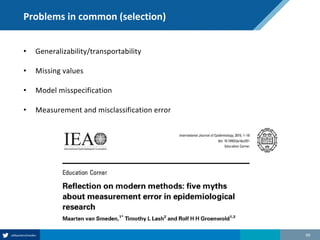
Problems in common (selection)
• Generalizability/transportability
• Missing values
• Model misspecification
• Measurement and misclassification error
99
100
Two hour tutorial to R (free): www.r-tutorial.nl
Repository of open datasets: http://mvansmeden.com/post/opendatarepos/
101

The basics of prediction modeling

  • 1.
    Prediction modeling Maarten vanSmeden, Department of Clinical Epidemiology, Leiden University Medical Center, Leiden, Netherlands Berlin, Advanced Methods Methods in Health Data Sciences Jan 16 2020
  • 2.
  • 3.
  • 4.
    4 Cartoon of JimBorgman, first published by the Cincinnati Inquirer and King Features Syndicate April 27 1997
  • 5.
    Cookbook review 5 Schoenfeld &Ioannidis, Am J Clin Nutr 2013, DOI: 10.3945/ajcn.112.047142 “We selected 50 common ingredients from random recipes of a cookbook”
  • 6.
    Cookbook review veal, salt,pepper spice, flour, egg, bread, pork, butter, tomato, lemon, duck, onion, celery, carrot, parsley, mace, sherry, olive, mushroom, tripe, milk, cheese, coffee, bacon, sugar, lobster, potato, beef, lamb, mustard, nuts, wine, peas, corn, cinnamon, cayenne, orange, tea, rum, raisin, bay leaf, cloves, thyme, vanilla, hickory, molasses, almonds, baking soda, ginger, terrapin 6 Schoenfeld & Ioannidis, Am J Clin Nutr 2013, DOI: 10.3945/ajcn.112.047142
  • 7.
    Studies relating theingredients to cancer: 40/50 veal, salt, pepper spice, flour, egg, bread, pork, butter, tomato, lemon, duck, onion, celery, carrot, parsley, mace, sherry, olive, mushroom, tripe, milk, cheese, coffee, bacon, sugar, lobster, potato, beef, lamb, mustard, nuts, wine, peas, corn, cinnamon, cayenne, orange, tea, rum, raisin, bay leaf, cloves, thyme, vanilla, hickory, molasses, almonds, baking soda, ginger, terrapin 7 Schoenfeld & Ioannidis, Am J Clin Nutr 2013, DOI: 10.3945/ajcn.112.047142
  • 8.
    Increased/decreased risk ofdeveloping cancer: 36/40 veal, salt, pepper spice, flour, egg, bread, pork, butter, tomato, lemon, duck, onion, celery, carrot, parsley, mace, sherry, olive, mushroom, tripe, milk, cheese, coffee, bacon, sugar, lobster, potato, beef, lamb, mustard, nuts, wine, peas, corn, cinnamon, cayenne, orange, tea, rum, raisin, bay leaf, cloves, thyme, vanilla, hickory, molasses, almonds, baking soda, ginger, terrapin 8 Schoenfeld & Ioannidis, Am J Clin Nutr 2013, DOI: 10.3945/ajcn.112.047142
  • 9.
    9 Credits to PeterTennant for identifying this example
  • 11.
    To explain orto predict? Explanatory models • Theory: interest in regression coefficients • Testing and comparing existing causal theories • e.g. aetiology of illness, effect of treatment Predictive models • Interest in (risk) predictions of future observations • No concern about causality • Concerns about overfitting and optimism • e.g. prognostic or diagnostic prediction model Descriptive models • Capture the data structure 11 Shmueli, Statistical Science 2010, DOI: 10.1214/10-STS330
  • 12.
    To explain orto predict? Explanatory models • Theory: interest in regression coefficients • Testing and comparing existing causal theories • e.g. aetiology of illness, effect of treatment Predictive models • Interest in (risk) predictions of future observations • No concern about causality • Concerns about overfitting and optimism • e.g. prognostic or diagnostic prediction model Descriptive models • Capture the data structure 12 A L Y exposure outcome confounder Shmueli, Statistical Science 2010, DOI: 10.1214/10-STS330
  • 13.
    Causal effect estimate 13 Whatwould have happened with a group of individuals had they received some treatment or exposure rather than another?
  • 14.
  • 15.
    Causal effect estimate 15 Whatwould have happened with a group of individuals had they received some treatment or exposure rather than another?
  • 16.
  • 17.
  • 18.
  • 19.
    Observational study: diet-> diabetes, age 19 Age No diabetes Diabetes No diabetes Diabetes RR < 50 years 19 1 37 3 1.50 ≥ 50 years 28 12 12 8 1.33 Total 47 13 49 11 0.88 Traditional Exotic diet 50% 40% 30% 20% 10% ≥ 50 years > 50 years Total Diabetes risk < 50 years Numerical example adapted from Peter Tennant with permission: http://tiny.cc/ai6o8y
  • 20.
    Observational study: diet-> diabetes, weight loss 20 Weight No diabetes Diabetes No diabetes Diabetes RR Lost 19 1 37 3 1.50 Gained 28 12 12 8 1.33 Total 47 13 49 11 0.88 Traditional Exotic diet 50% 40% 30% 20% 10% Gained wt Lost wt Total Diabetes risk < 50 years Numerical example adapted from Peter Tennant with permission: http://tiny.cc/ai6o8y
  • 21.
    12 RCTs; 52nutritional epidemiology claims 0/52 replicated 5/52 effect in the opposite direction 21 Young & Karr, Significance, 2001, DOI: 10.1111/j.1740-9713.2011.00506.x
  • 22.
    But… 22 Ellie Murray (Jul13 2018): https://twitter.com/EpiEllie/status/1017622949799571456
  • 23.
  • 24.
    To explain orto predict? Explanatory models • Theory: interest in regression coefficients • Testing and comparing existing causal theories • e.g. aetiology of illness, effect of treatment Predictive models • Interest in (risk) predictions of future observations • No concern about causality • Concerns about overfitting and optimism • e.g. prognostic or diagnostic prediction model Descriptive models • Capture the data structure 24 Shmueli, Statistical Science 2010, DOI: 10.1214/10-STS330
  • 25.
    The “scientific value”of predictive modeling 25 1. Uncover potential new causal mechanisms and generation of new hypotheses 2. To discover and compare measures and operationalisations of constructs 3. Improving existing explanatory models by capturing underlying complex patterns 4. Reality check to theory: assessing distance between theory and practice 5. Compare competing theories by examining the predictive power 6. Generate knowledge of un-predictability Shmueli, Statistical Science 2010, DOI: 10.1214/10-STS330 (p292)
  • 26.
    Wells rule 26 Wells etal., Lancet, 1997. doi: 10.1016/S0140-6736(97)08140-3
  • 27.
    Apgar 27 Apgar, JAMA, 1958.doi: 10.1001/jama.1958.03000150027007
  • 28.
  • 29.
  • 30.
    Prediction Usual aim: tomake accurate predictions … of a future outcome or presence of a disease … for an individual patient … generally based on >1 factor (predictor) why? • to inform decision making (about additional testing/treatment) • for counseling 30
  • 31.
    To explain orto predict? Explanatory models • Causality • Understanding the role of elements in complex systems • ”What will happen if….” Predictive models • Forecasting • Often, focus is on the performance of the forecasting • “What will happen ….” Descriptive models • “What happened?” 31 Require different research design and analysis choices • Confounding • Stein’s paradox • Estimators
  • 32.
    Risk estimation example:SCORE 32 Conroy, European Heart Journal, 2003. doi: 10.1016/S0195-668X(03)00114-3
  • 33.
  • 34.
    Risk prediction Risk predictioncan be broadly categorized into: • Diagnostic: risk of a target disease being currently present vs not present • Prognostic: risk of a certain health state over a certain time period • Do we need a randomized controlled trial for diagnostic/prognostic prediction? • Do we need counterfactual thinking? 34
  • 35.
    Risk prediction 35 TRIPOD: Collinset al., Annals of Int Medicine, 2015. doi: 10.7326/M14-0697
  • 36.
  • 37.
  • 38.
  • 39.
  • 40.
    How accurate isthis point-of-care test? 40 image from: https://bit.ly/39LuajJ
  • 41.
    Classical diagnostic testaccuracy study Patients suspected of target condition Reference standard for target condition Index test(s) Domain “Exposure” “Outcome”
  • 42.
    Classical diagnostic testaccuracy study Patients suspected of target condition Reference standard for target condition Index test(s)
  • 43.
    Classical diagnostic testaccuracy study Patients suspected of target condition Reference standard for target condition Index test(s) Role of time? Cross-sectional in nature: index test and reference standard (in principle) at same point in time to test for target condition at that time point
  • 44.
    Classical diagnostic testaccuracy study Patients suspected of target condition Reference standard for target condition Index test(s) Comparator for index test? None, study of accuracy does not require a comparison to another index test
  • 45.
    Classical diagnostic testaccuracy study Patients suspected of target condition Reference standard for target condition Index test(s) Confounding (bias)? No need for (conditional) exchangability to interpret accuracy. Confounding (bias) is not an issue
  • 46.
    Classical diagnostic testaccuracy study Prevalence = (A+B)/(A+B+C+D) Sensitivity = A/(A+B) Specificity = D/(C+D) Positive predictive value = A/(A+C) Negative predictive value = D/(B+D)
  • 47.
    Probability • Disease prevalence(Prev): Pr(Disease +) • Sensitivity (Se): Pr(Test + | Disease +) • Specificity (Sp): Pr(Test – | Disease –) • Positive predictive value (PPV): Pr(Disease + | Test +) • Negative predictive value (NPV): Pr(Disease – | Test –) What is left and what is right from the “|” sign matters
  • 48.
    All probabilities areconditional • Some conditions are given without saying (e.g. probability is about human individuals), others less so (e.g. prediction in first vs secondary care) • Things that are constant (e.g. setting) do not enter in notation • There is no such as thing as ”the probability”: context is everything
  • 49.
    Small side step:the p-value p-value*: Pr(Data|Hypothesis) Is not: Pr(Hypothesis|Data) Somewhat simplified, correct notation would be: Pr(T(X) ≥ x; hypothesis)
  • 50.
    Small side step:the p-value Pr(Death|Handgun) = 5% to 20%* Pr(Handgun|Death) = 0.03%** *from New York Times (http://www.nytimes.com article published: 2008/04/03/) ** from CBS StatLine (concerning deaths and registered gun crimes in 2015 in the Netherlands)
  • 51.
    Bayes theorem Pr(A|B) = PrB A ) Pr(A) Pr(B) Probability of A occurring given B happened Probability of B occurring given A happened Probability of A occurring Probability of B occurring Thomas Bayes (1702-1761)
  • 52.
  • 53.
    In-class exercise –ClearBlue compact pregnancy test • Calculate Prev, Se, Sp, NPV and PPV • Re-calculate NPV assuming Prev of 10%, and again with 80% • Make use of NPV = Sp*(1-Prev)/[(1-Se)*Prev + Sp*(1-Prev)]
  • 54.
    In reality • Performanceof the Clearblue COMPACT pregnancy test was worse: 38 additional results among pregnant women were ‘non-conclusive’ • The reference standard was a ‘trained study coordinator’ reading of the same test
  • 55.
    Diagnostic test issimplest prediction model • Nowcasting (instead of forecasting) • Best available prediction of target disease status is test result • Assuming no other relevant information is available • Risk prediction (probability) for disease: • PPV with positive test • 1-NPV with negative test
  • 56.
  • 57.
    Research design: aims Pointof intended use of the risk model • Primary care (paper/computer/app)? • Secondary care (beside)? • Low resource setting? Complexity • Number of predictors? • Transparency of calculation? • Should it be fast?
  • 58.
    Research design: designof data collection Prospective cohort study: measurement of predictors at baseline + follow-up until event occurs (time-horizon) Alternatives • Randomized trials? • Routine care data? • Case-control?
  • 59.
    Statistical models • Regressionmodels for binary/time-to-event outcomes • Logistic regression • Cox proportional hazards models (or parametric alternatives) • Alternatives • Multinomial and ordinal models • Decision trees (and decendants) • Neural networks
  • 60.
    Regression model specification f(X):linear predictor (lp) lp = b0 + b1X1 + … + bPXP (only "main effects") Logistic regression: Pr(Y = 1 | X1 ,…,XP ) = 1/(1 + exp{-lp}) b0; intercept, important?
  • 61.
    Intercept Intercept = 0- c, intercept = 0, intercept = 0 + c
  • 62.
  • 63.
    Discrimination • Sensitivity/specificity trade-off •Arbitrary choice threshold ! Many possible sensitivity/specificity pairs • All pairs in 1 graph: ROC curve • Area under the ROC-curve: probability that a random individual with event has a higher predicted probability than a random individual without event • Area under the ROC-curve: the c- statistic (for logistic regression) takes on values between 0.5 (no better than a coin-ip) and 1.0 (perfect discrimination)
  • 64.
  • 65.
    Optimism Predictive performance evaluationsare too optimistic when estimated on the same data where the risk prediction model was developed. This is therefore called apparent performance of the model Optimism can be large, especially in small datasets and with a large number of predictors To get a better estimate of the predictive performance (more about this next week): • Internal validation (same data sample) • External validation (other data sample)
  • 66.
  • 67.
  • 68.
    Stein’s paradox inwords (rather simplified) When one has three or more units (say, individuals), and for each unit one can calculate an average score (say, average blood pressure), then the best guess of future observations for each unit (say, blood pressure tomorrow) is NOT the average score.
  • 69.
    1961: James-Stein estimator:the next Symposium James and Stein. Estimation with quadratic loss. Proceedings of the fourth Berkeley symposium on mathematical statistics and probability. Vol. 1. 1961.
  • 70.
  • 71.
    1977: Baseball example Squarederror reduced from .077 to .022
  • 72.
    Stein’s paradox • Probablyamong the most surprising (and initially doubted) phenomena in statistics • Now a large “family”: shrinkage estimators reduce prediction variance to an extent that typically outweighs the bias that is introduced • Bias/variance trade-off principle has motivated many statistical and machine learning developments Expected prediction error = irreducible error + bias2 + variance
  • 83.
  • 84.
    Not just lucky •5% reduction in MSPE just by shrinkage estimator • Van Houwelingen and le Cessie’s heuristic shrinkage factor
  • 85.
  • 86.
  • 87.
    Overfitting "Idiosyncrasies in thedata are fitted rather than generalizable patterns. A model may hence not be applicable to new patients, even when the setting of application is very similar to the development setting." Steyerberg (2009). Clinical Prediction Models.
  • 88.
  • 89.
    To avoid overfitting… Largedata (sample size / no. events) and to pre-specify your analyses as much as possible! And: • Be conservative when removing predictor variables • Apply shrinkage methods • Correct for optimism
  • 90.
    EPV – ruleof thumb Events per variable (EPV) for logistic/survival models: number of events (smallest outcome group) number of candidate predictor variables1 EPV = 10 commonly used minimal criterion
  • 91.
    EPV – ruleof dumb? • EPV values for reliable selection of predictors from a larger set of candidate predictors may be as large as 50 • Statistical simulation studies on the minimal EPV rules are highly heterogeneous and have large problems
  • 92.
    New sample sizeproposals
  • 93.
    Variable selection • Selectionunstable • Selection and order of entry often overinterpreted • Limited power to detect true effects • Predictive ability suffers, ‘underfitting’ • Risk of false-positive associations • Multiple testing, ‘overfitting’ • Inference biased • P-values exaggerated; standard errors too small • Estimated coefficients biased • ‘testimation’
  • 94.
  • 95.
    Conditional probabilities areat the core of prediction • Perfect or near-perfect predicting models? Suspect! • Proving that a probability model generates a wrong risk prediction? Difficult!
  • 96.
    When is arisk model ready for use?
  • 97.
    Prediction model landscape >110models for prostate cancer (Shariat 2008) >100 models for Traumatic Brain Injury (Perel 2006) 83 models for stroke (Counsell 2001) 54 models for breast cancer (Altman 2009) 43 models for type 2 diabetes (Collins 2011; Dieren 2012) 31 models for osteoporotic fracture (Steurer 2011) 29 models in reproductive medicine (Leushuis 2009) 26 models for hospital readmission (Kansagara 2011) >25 models for length of stay in cardiac surgery (Ettema 2010) >350 models for CVD outcomes (Damen 2016) • Few prediction models are externally validated • Predictive performance often poor 97
  • 98.
    To explain orto predict? Explanatory models • Theory: interest in regression coefficients • Testing and comparing existing causal theories • e.g. aetiology of illness, effect of treatment Predictive models • Interest in (risk) predictions of future observations • No concern about causality • Concerns about overfitting and optimism • e.g. prognostic or diagnostic prediction model Descriptive models • Capture the data structure 98 Shmueli, Statistical Science 2010, DOI: 10.1214/10-STS330
  • 99.
    Problems in common(selection) • Generalizability/transportability • Missing values • Model misspecification • Measurement and misclassification error 99
  • 100.
  • 101.
    Two hour tutorialto R (free): www.r-tutorial.nl Repository of open datasets: http://mvansmeden.com/post/opendatarepos/ 101