By : Thunyarath Munyukong
Tula, The Mythical beginning #1
   Around AD 1000 Tula took over the
    Heritage of Teotihuacan.
   During the 12th Century the Toltecs
    Migrated and Dispersed, Their
    Domination Over.
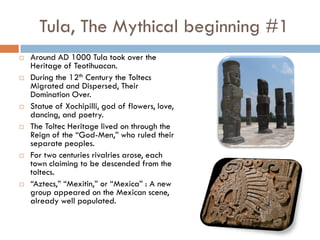
   Statue of Xochipilli, god of flowers, love,
    dancing, and poetry.
   The Toltec Heritage lived on through the
    Reign of the “God-Men,” who ruled their
    separate peoples.
   For two centuries rivalries arose, each
    town claiming to be descended from the
    toltecs.
   “Aztecs,” “Mexitin,” or “Mexica” : A new
    group appeared on the Mexican scene,
    already well populated.
Tula, The Mythical beginning #2
   The term “Aztec,” which was again
    adopted in the 18th century, is now
    generally used to refer to the peoples
    of the Valley of Mexico, starting in the
    15th century.
   Huitzilopochtli, God of war and the sun,
    protected the exodus of the Mexica.
   The Mexica roasted and ate the
    reptiles.
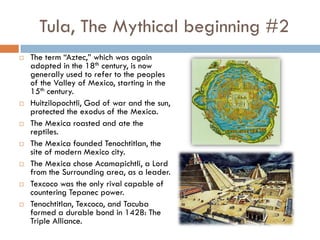
   The Mexica founded Tenochtitlan, the
    site of modern Mexico city.
   The Mexica chose Acamapichtli, a Lord
    from the Surrounding area, as a leader.
   Texcoco was the only rival capable of
    countering Tepanec power.
   Tenochtitlan, Texcoco, and Tacuba
    formed a durable bond in 1428: The
    Triple Alliance.
The Empire Builders
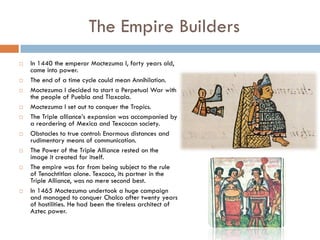
   In 1440 the emperor Moctezuma I, forty years old,
    came into power.
   The end of a time cycle could mean Annihilation.
   Moctezuma I decided to start a Perpetual War with
    the people of Puebla and Tlaxcala.
   Moctezuma I set out to conquer the Tropics.
   The Triple alliance’s expansion was accompanied by
    a reordering of Mexica and Texcocan society.
   Obstacles to true control: Enormous distances and
    rudimentary means of communication.
   The Power of the Triple Alliance rested on the
    image it created for itself.
   The empire was far from being subject to the rule
    of Tenochtitlan alone. Texcoco, its partner in the
    Triple Alliance, was no mere second best.
   In 1465 Moctezuma undertook a huge campaign
    and managed to conquer Chalco after twenty years
    of hostilities. He had been the tireless architect of
    Aztec power.
The Aztecs, Conquering Heroes #1
   In 1472, shortly after Moctezuma’s death,
    his great ally, the poet-king
    Nezahualcoyotl, died in his turn. The Triple
    Alliance, increasingly powerful, passed to a
    series of rulers who extended the limits of
    the Aztec empire through a combination of
    warfare and diplomacy.
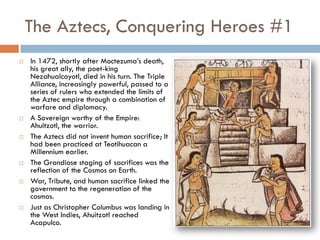
   A Sovereign worthy of the Empire:
    Ahuitzotl, the warrior.
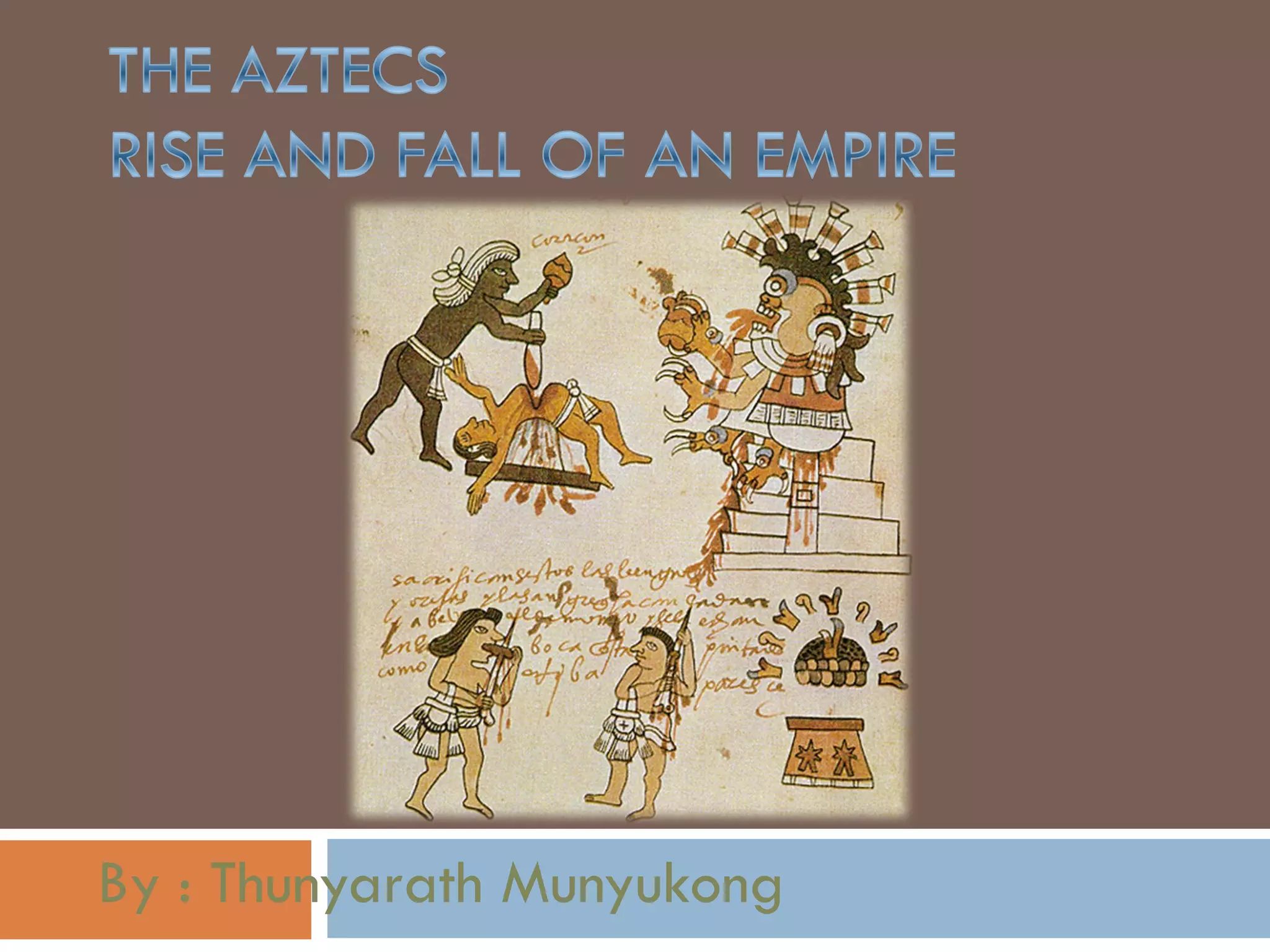
   The Aztecs did not invent human sacrifice; It
    had been practiced at Teotihuacan a
    Millennium earlier.
   The Grandiose staging of sacrifices was the
    reflection of the Cosmos on Earth.
   War, Tribute, and human sacrifice linked the
    government to the regeneration of the
    cosmos.
   Just as Christopher Columbus was landing in
    the West Indies, Ahuitzotl reached
    Acapulco.
The Aztecs, Conquering Heroes #2
   While Ahuitzotl was constantly pushing
    back the empire’s borders, the Valley
    of Mexico prospered.
   Nezahualpilli secured the influence of
    Texcoco with the same talent as his
    father.
   The empire’s size began to cause
    problems.
   In 1503 Moctezuma II succeeded
    Ahuitzotl. Under his reign, power
    became resolutely asolute, and the
    Aztecs unleashed hotilities in a more
    systematic fashion.
   The Aztecs, more determined than
    ever, abandoned the Ideal of the War
    of the Flowers
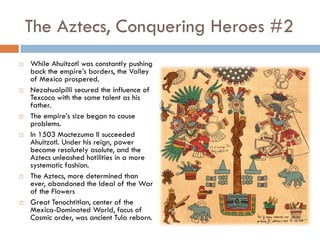
   Great Tenochtitlan, center of the
    Mexica-Dominated World, focus of
    Cosmic order, was ancient Tula reborn.
The Clash Of Two Worlds
   In the first decade of the 16th century, the emperor
    Moctezuma II thought he had become the “master of
    the world.” But his sovereignty remained precarious.
    Moctezuma was fated to bow before a bearded
    white man: Hernan Cortes.
   The presence of Spaniards increased the Anxiety
    provoked by gloomy prophecies.
   In 1519 an expedition left Cuba to Explore the
    Coasts of Mexico. At its head was a thirty-three-
    year-old Spanish Gentleman, Hernan Cortes.
   The Spaniards were received with open arms by the
    Aztecs’ enemies.
   Cortes was eager to meet the master of the Aztec
    world and discover the extent of his wealth and the
    reality of his powers.
   Whether by Calculation or Resignation, Moctezuma
    submitted to his new masters and was betrayed.
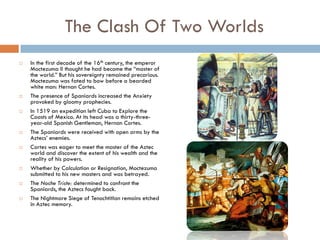
   The Noche Triste: determined to confront the
    Spaniards, the Aztecs fought back.
   The Nightmare Siege of Tenochtitlan remains etched
    in Aztec memory.
From Resistance to Collaboration
   Idolatry-Defined as everything that opposes Christianity-became
    the monster to be overthrown. Recalcitrant Indians were seen as
    Idolaters inspired by the Devil.
   The Arrival of Christianity shook the native societies to their very
    foundations.
   By imposing a uniform system of marriage, the church destroyed
    the traditional practice of alliances throughout the empire.
   Convinced that Christianity meant the overthrow of their system of
    values, the “Idolaters” tried to resist the Spanish Invader.
   The ruling class was renewed , and some people took advantage
    of the opportunity to denounce the Old Aristocracy.
   The fall of Mexico in no way signaled the end of Military
    campaigns for the Aztecs, who found employment in the service of
    the Crown.
   The Church’s education and the Indians’ incredible ability to
    assimilate bore unexpected and remarkable fruit.
   Throughout the 16th Century, the Indian Masses were Devastated by
    the Shock of Conquest: Epidemics, Ruthless Exploitation, and
    Shattered values.
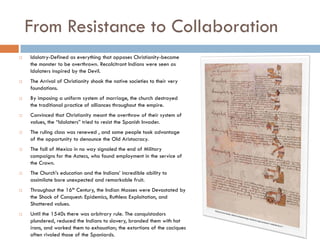
   Until the 1540s there was arbitrary rule. The conquistadors
    plundered, reduced the Indians to slavery, branded them with hot
    irons, and worked them to exhaustion; the extortions of the caciques
    often rivaled those of the Spaniards.
The Aftermath of The Conquest #1
   In the 17th century the indigenous
    society disintegrated, shattered by
    the chaos that struck colonial
    Mexico.
   Population grew rapidly because
    the Spanish immigrants were mostly
    male.
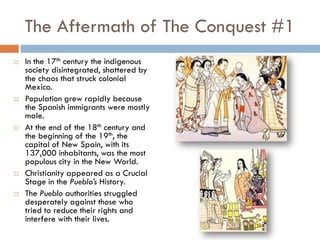
   At the end of the 18th century and
    the beginning of the 19th, the
    capital of New Spain, with its
    137,000 inhabitants, was the most
    populous city in the New World.
   Christianity appeared as a Crucial
    Stage in the Pueblo’s History.
   The Pueblo authorities struggled
    desperately against those who
    tried to reduce their rights and
    interfere with their lives.
The Aftermath of The Conquest #2
   While the Dignitaries forged a new
    community identity, the masses survived in
    a colonial society.
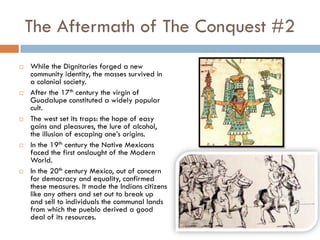
   After the 17th century the virgin of
    Guadalupe constituted a widely popular
    cult.
   The west set its traps: the hope of easy
    gains and pleasures, the lure of alcohol,
    the illusion of escaping one’s origins.
   In the 19th century the Native Mexicans
    faced the first onslaught of the Modern
    World.
   In the 20th century Mexico, out of concern
    for democracy and equality, confirmed
    these measures. It made the Indians citizens
    like any others and set out to break up
    and sell to individuals the communal lands
    from which the pueblo derived a good
    deal of its resources.

The Aztecs

  • 1.
    By : ThunyarathMunyukong
  • 2.
    Tula, The Mythicalbeginning #1  Around AD 1000 Tula took over the Heritage of Teotihuacan.  During the 12th Century the Toltecs Migrated and Dispersed, Their Domination Over.  Statue of Xochipilli, god of flowers, love, dancing, and poetry.  The Toltec Heritage lived on through the Reign of the “God-Men,” who ruled their separate peoples.  For two centuries rivalries arose, each town claiming to be descended from the toltecs.  “Aztecs,” “Mexitin,” or “Mexica” : A new group appeared on the Mexican scene, already well populated.
  • 3.
    Tula, The Mythicalbeginning #2  The term “Aztec,” which was again adopted in the 18th century, is now generally used to refer to the peoples of the Valley of Mexico, starting in the 15th century.  Huitzilopochtli, God of war and the sun, protected the exodus of the Mexica.  The Mexica roasted and ate the reptiles.  The Mexica founded Tenochtitlan, the site of modern Mexico city.  The Mexica chose Acamapichtli, a Lord from the Surrounding area, as a leader.  Texcoco was the only rival capable of countering Tepanec power.  Tenochtitlan, Texcoco, and Tacuba formed a durable bond in 1428: The Triple Alliance.
  • 4.
    The Empire Builders  In 1440 the emperor Moctezuma I, forty years old, came into power.  The end of a time cycle could mean Annihilation.  Moctezuma I decided to start a Perpetual War with the people of Puebla and Tlaxcala.  Moctezuma I set out to conquer the Tropics.  The Triple alliance’s expansion was accompanied by a reordering of Mexica and Texcocan society.  Obstacles to true control: Enormous distances and rudimentary means of communication.  The Power of the Triple Alliance rested on the image it created for itself.  The empire was far from being subject to the rule of Tenochtitlan alone. Texcoco, its partner in the Triple Alliance, was no mere second best.  In 1465 Moctezuma undertook a huge campaign and managed to conquer Chalco after twenty years of hostilities. He had been the tireless architect of Aztec power.
  • 5.
    The Aztecs, ConqueringHeroes #1  In 1472, shortly after Moctezuma’s death, his great ally, the poet-king Nezahualcoyotl, died in his turn. The Triple Alliance, increasingly powerful, passed to a series of rulers who extended the limits of the Aztec empire through a combination of warfare and diplomacy.  A Sovereign worthy of the Empire: Ahuitzotl, the warrior.  The Aztecs did not invent human sacrifice; It had been practiced at Teotihuacan a Millennium earlier.  The Grandiose staging of sacrifices was the reflection of the Cosmos on Earth.  War, Tribute, and human sacrifice linked the government to the regeneration of the cosmos.  Just as Christopher Columbus was landing in the West Indies, Ahuitzotl reached Acapulco.
  • 6.
    The Aztecs, ConqueringHeroes #2  While Ahuitzotl was constantly pushing back the empire’s borders, the Valley of Mexico prospered.  Nezahualpilli secured the influence of Texcoco with the same talent as his father.  The empire’s size began to cause problems.  In 1503 Moctezuma II succeeded Ahuitzotl. Under his reign, power became resolutely asolute, and the Aztecs unleashed hotilities in a more systematic fashion.  The Aztecs, more determined than ever, abandoned the Ideal of the War of the Flowers  Great Tenochtitlan, center of the Mexica-Dominated World, focus of Cosmic order, was ancient Tula reborn.
  • 7.
    The Clash OfTwo Worlds  In the first decade of the 16th century, the emperor Moctezuma II thought he had become the “master of the world.” But his sovereignty remained precarious. Moctezuma was fated to bow before a bearded white man: Hernan Cortes.  The presence of Spaniards increased the Anxiety provoked by gloomy prophecies.  In 1519 an expedition left Cuba to Explore the Coasts of Mexico. At its head was a thirty-three- year-old Spanish Gentleman, Hernan Cortes.  The Spaniards were received with open arms by the Aztecs’ enemies.  Cortes was eager to meet the master of the Aztec world and discover the extent of his wealth and the reality of his powers.  Whether by Calculation or Resignation, Moctezuma submitted to his new masters and was betrayed.  The Noche Triste: determined to confront the Spaniards, the Aztecs fought back.  The Nightmare Siege of Tenochtitlan remains etched in Aztec memory.
  • 8.
    From Resistance toCollaboration  Idolatry-Defined as everything that opposes Christianity-became the monster to be overthrown. Recalcitrant Indians were seen as Idolaters inspired by the Devil.  The Arrival of Christianity shook the native societies to their very foundations.  By imposing a uniform system of marriage, the church destroyed the traditional practice of alliances throughout the empire.  Convinced that Christianity meant the overthrow of their system of values, the “Idolaters” tried to resist the Spanish Invader.  The ruling class was renewed , and some people took advantage of the opportunity to denounce the Old Aristocracy.  The fall of Mexico in no way signaled the end of Military campaigns for the Aztecs, who found employment in the service of the Crown.  The Church’s education and the Indians’ incredible ability to assimilate bore unexpected and remarkable fruit.  Throughout the 16th Century, the Indian Masses were Devastated by the Shock of Conquest: Epidemics, Ruthless Exploitation, and Shattered values.  Until the 1540s there was arbitrary rule. The conquistadors plundered, reduced the Indians to slavery, branded them with hot irons, and worked them to exhaustion; the extortions of the caciques often rivaled those of the Spaniards.
  • 9.
    The Aftermath ofThe Conquest #1  In the 17th century the indigenous society disintegrated, shattered by the chaos that struck colonial Mexico.  Population grew rapidly because the Spanish immigrants were mostly male.  At the end of the 18th century and the beginning of the 19th, the capital of New Spain, with its 137,000 inhabitants, was the most populous city in the New World.  Christianity appeared as a Crucial Stage in the Pueblo’s History.  The Pueblo authorities struggled desperately against those who tried to reduce their rights and interfere with their lives.
  • 10.
    The Aftermath ofThe Conquest #2  While the Dignitaries forged a new community identity, the masses survived in a colonial society.  After the 17th century the virgin of Guadalupe constituted a widely popular cult.  The west set its traps: the hope of easy gains and pleasures, the lure of alcohol, the illusion of escaping one’s origins.  In the 19th century the Native Mexicans faced the first onslaught of the Modern World.  In the 20th century Mexico, out of concern for democracy and equality, confirmed these measures. It made the Indians citizens like any others and set out to break up and sell to individuals the communal lands from which the pueblo derived a good deal of its resources.