AZTECS
AZTECS
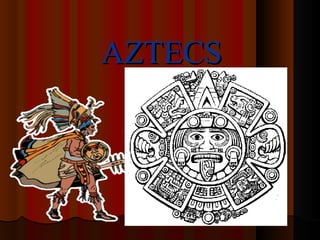
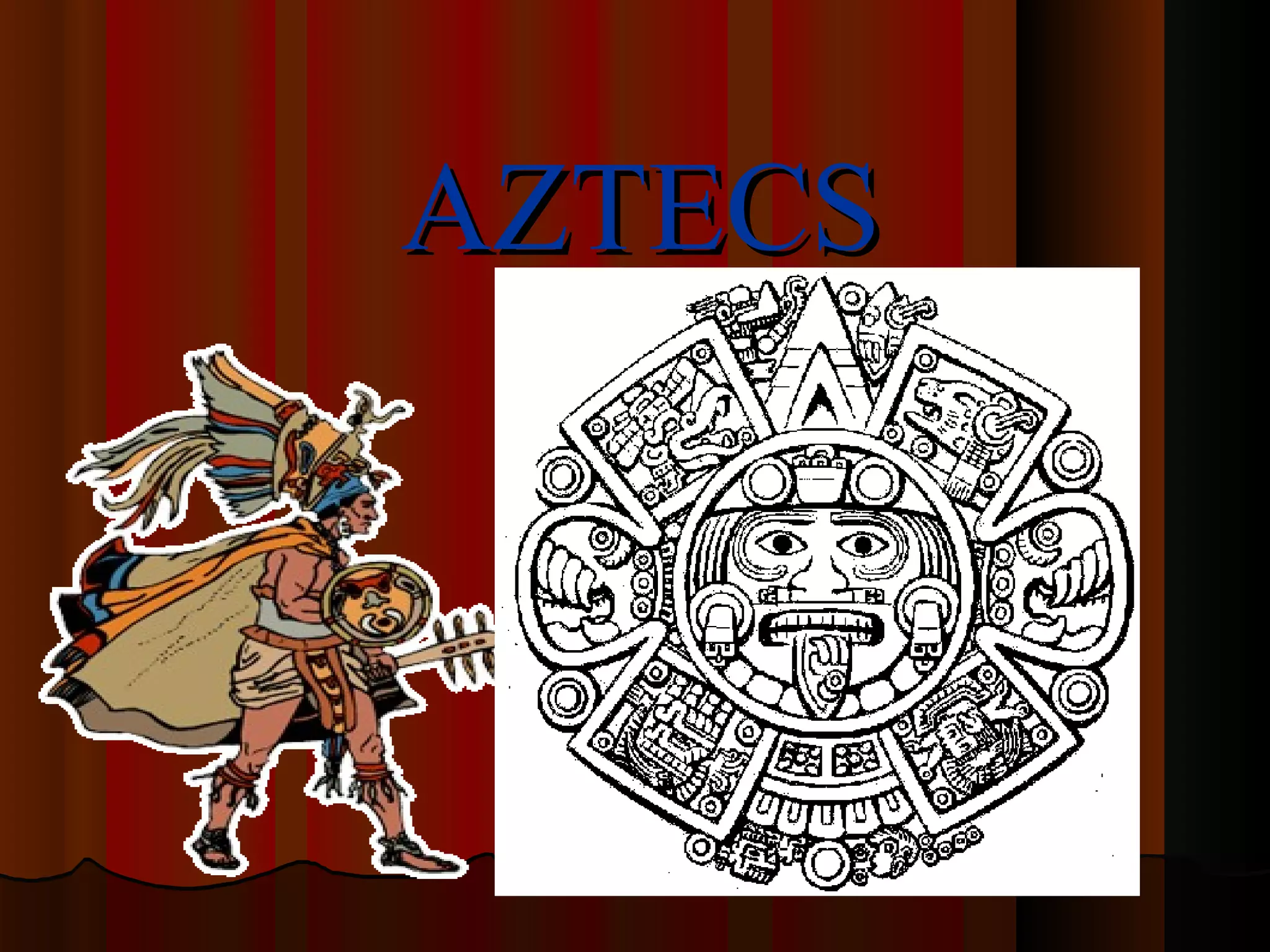
 The Aztec people  were certain ethnic
 groups of central Mexico, particularly
 those groups who spoke the Nahuatl
 language and who dominated large parts
 of Mesoamerica in the 14th, 15th and
 16th centuries, a period referred to as
 the late post-classic period
 in Mesoamerican chronology.
AZTECS
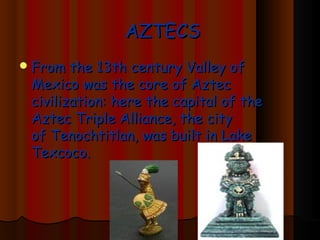
 From  the 13th century Valley of
 Mexico was the core of Aztec
 civilization: here the capital of the
 Aztec Triple Alliance, the city
 of Tenochtitlan, was built in Lake
 Texcoco.
AZTECS
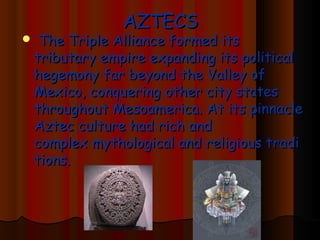
  TheTriple Alliance formed its
 tributary empire expanding its political
 hegemony far beyond the Valley of
 Mexico, conquering other city states
 throughout Mesoamerica. At its pinnacle
 Aztec culture had rich and
 complex mythological and religious tradi
 tions.
AZTECS
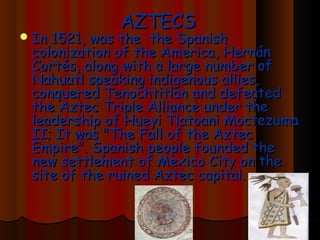
 In1521, was the the Spanish
 colonization of the America, Hernán
 Cortés, along with a large number of
 Nahuatl speaking indigenous allies,
 conquered Tenochtitlan and defeated
 the Aztec Triple Alliance under the
 leadership of Hueyi Tlatoani Moctezuma
 II; It was "The Fall of the Aztec
 Empire". Spanish people founded the
 new settlement of Mexico City on the
 site of the ruined Aztec capital.
AZTEC CULTURE
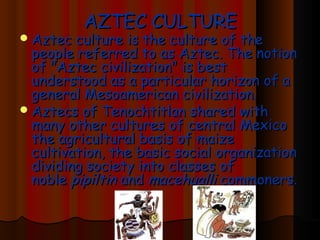
 Aztec  culture is the culture of the
  people referred to as Aztec. The notion
  of "Aztec civilization" is best
  understood as a particular horizon of a
  general Mesoamerican civilization.
 Aztecs of Tenochtitlan shared with
  many other cultures of central Mexico
  the agricultural basis of maize
  cultivation, the basic social organization
  dividing society into classes of
  noble pipiltin and macehualli commoners.
AZTEC CULTURE
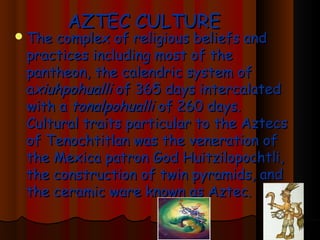
 Thecomplex of religious beliefs and
 practices including most of the
 pantheon, the calendric system of
 axiuhpohualli of 365 days intercalated
 with a tonalpohualli of 260 days.
 Cultural traits particular to the Aztecs
 of Tenochtitlan was the veneration of
 the Mexica patron God Huitzilopochtli,
 the construction of twin pyramids, and
 the ceramic ware known as Aztec.
AZTEC EMPIRE
 The Aztec  empire was a tribute empire
 based in Tenochtitlan, which extended
 its power throughout Mesoamerica in
 the late postclassic period. It
 originated in 1427 as a Triple
 alliance between the
 citystates Tenochtitlan, Texcoco and Tl
 acopan who allied to defeat
 the Tepanec state of Azcapotzalco,
 that had previously dominated theBasin
 of Mexico.
AZTEC EMPIRE
 Soon  Texcoco and Tlacopan became
  junior partners in the alliance which was
  de-facto lead by the Mexica of
  Tenochtitlan
 The empire extended its power by a
  combination of trade and military
  conquest. It was never a true territorial
  empire controlling a territory by large
  military garrisons in conquered
  provinces.
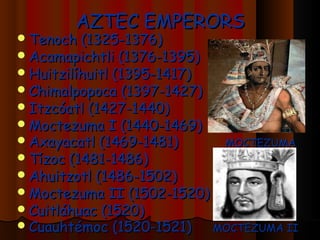
AZTEC EMPERORS
 Tenoch (1325-1376)
 Acamapichtli (1376-1395)
 Huitzilíhuitl (1395-1417)
 Chimalpopoca (1397-1427)
 Itzcóatl (1427-1440)
 Moctezuma I (1440-1469)
 Axayacatl (1469-1481)       MOCTEZUMA
 Tízoc (1481-1486)
 Ahuitzotl (1486-1502)
 Moctezuma   II (1502-1520)
 Cuitláhuac (1520)
 Cuauhtémoc (1520-1521)     MOCTEZUMA II
THE END
  JESÚS VÁZQUEZ LOBATO
ADRIÁN SALAS TROYA 2º ESO C

Aztecs: Adrian y Jesus

  • 1.
  • 2.
    AZTECS  The Aztec people were certain ethnic groups of central Mexico, particularly those groups who spoke the Nahuatl language and who dominated large parts of Mesoamerica in the 14th, 15th and 16th centuries, a period referred to as the late post-classic period in Mesoamerican chronology.
  • 3.
    AZTECS  From the 13th century Valley of Mexico was the core of Aztec civilization: here the capital of the Aztec Triple Alliance, the city of Tenochtitlan, was built in Lake Texcoco.
  • 4.
    AZTECS   TheTriple Allianceformed its tributary empire expanding its political hegemony far beyond the Valley of Mexico, conquering other city states throughout Mesoamerica. At its pinnacle Aztec culture had rich and complex mythological and religious tradi tions.
  • 5.
    AZTECS  In1521, wasthe the Spanish colonization of the America, Hernán Cortés, along with a large number of Nahuatl speaking indigenous allies, conquered Tenochtitlan and defeated the Aztec Triple Alliance under the leadership of Hueyi Tlatoani Moctezuma II; It was "The Fall of the Aztec Empire". Spanish people founded the new settlement of Mexico City on the site of the ruined Aztec capital.
  • 6.
    AZTEC CULTURE  Aztec culture is the culture of the people referred to as Aztec. The notion of "Aztec civilization" is best understood as a particular horizon of a general Mesoamerican civilization.  Aztecs of Tenochtitlan shared with many other cultures of central Mexico the agricultural basis of maize cultivation, the basic social organization dividing society into classes of noble pipiltin and macehualli commoners.
  • 7.
    AZTEC CULTURE  Thecomplexof religious beliefs and practices including most of the pantheon, the calendric system of axiuhpohualli of 365 days intercalated with a tonalpohualli of 260 days. Cultural traits particular to the Aztecs of Tenochtitlan was the veneration of the Mexica patron God Huitzilopochtli, the construction of twin pyramids, and the ceramic ware known as Aztec.
  • 8.
    AZTEC EMPIRE  The Aztec empire was a tribute empire based in Tenochtitlan, which extended its power throughout Mesoamerica in the late postclassic period. It originated in 1427 as a Triple alliance between the citystates Tenochtitlan, Texcoco and Tl acopan who allied to defeat the Tepanec state of Azcapotzalco, that had previously dominated theBasin of Mexico.
  • 9.
    AZTEC EMPIRE  Soon Texcoco and Tlacopan became junior partners in the alliance which was de-facto lead by the Mexica of Tenochtitlan  The empire extended its power by a combination of trade and military conquest. It was never a true territorial empire controlling a territory by large military garrisons in conquered provinces.
  • 10.
    AZTEC EMPERORS  Tenoch (1325-1376) Acamapichtli (1376-1395)  Huitzilíhuitl (1395-1417)  Chimalpopoca (1397-1427)  Itzcóatl (1427-1440)  Moctezuma I (1440-1469)  Axayacatl (1469-1481) MOCTEZUMA  Tízoc (1481-1486)  Ahuitzotl (1486-1502)  Moctezuma II (1502-1520)  Cuitláhuac (1520)  Cuauhtémoc (1520-1521) MOCTEZUMA II
  • 11.
    THE END JESÚS VÁZQUEZ LOBATO ADRIÁN SALAS TROYA 2º ESO C