The Art of Storytelling And
How It Can Help Make A
Better World
Applied Improvisation Network 2015 World Conference
Presented by Jude Treder-Wolff, LCSW, CGP, MT
Lifestage, Inc www.lifestage.org
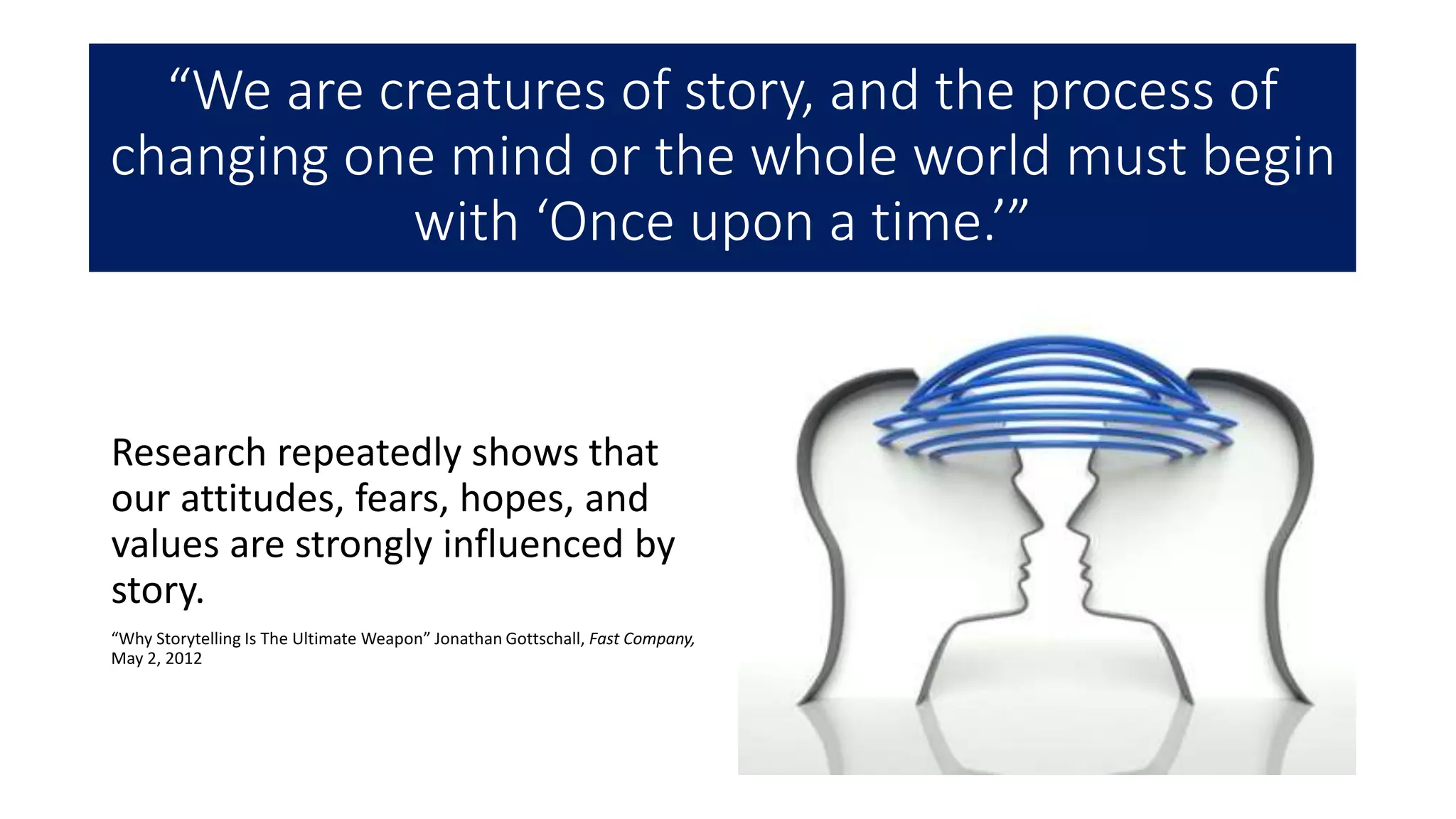
“We are creatures of story, and the process of
changing one mind or the whole world must begin
with ‘Once upon a time.’”
Research repeatedly shows that
our attitudes, fears, hopes, and
values are strongly influenced by
story.
“Why Storytelling Is The Ultimate Weapon” Jonathan Gottschall, Fast Company,
May 2, 2012
Story promotes understanding about the
tensions of change and the evolution of ideas
“Technology is evolving at roughly
10 million times the speed of
natural evolution. For all its glitz
and swagger, technology and the
whole interactive, revved-up
economy that goes with it is
merely an outer casing for outer
selves. And these inner selves,
these primate souls of ours with
their ancient social ways, change
slowly. Or not at all.”
Brian Arthur, “How Fast Is Technology Evolving?” Scientific American (February
1997): 107
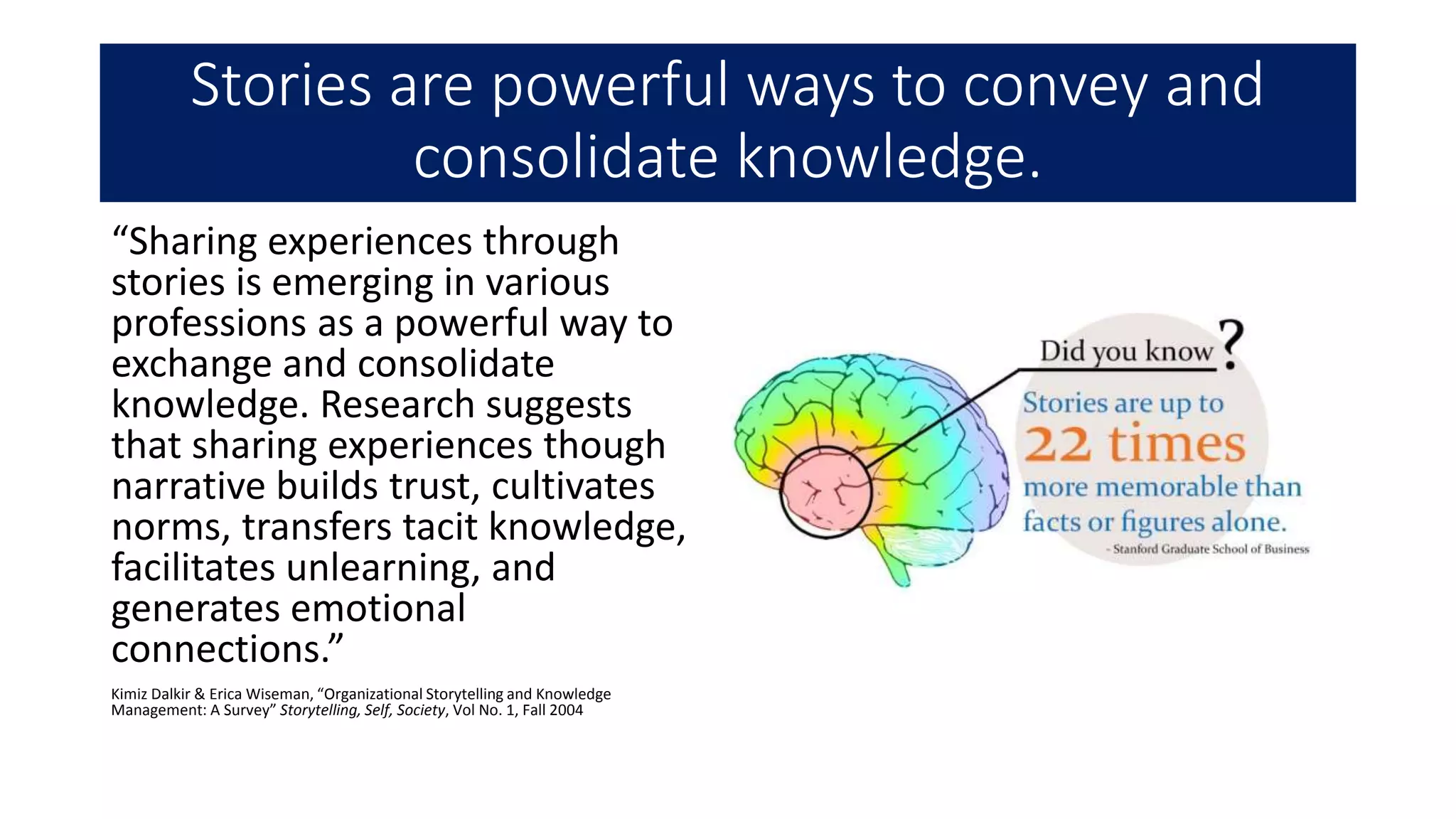
Stories are powerful ways to convey and
consolidate knowledge.
“Sharing experiences through
stories is emerging in various
professions as a powerful way to
exchange and consolidate
knowledge. Research suggests
that sharing experiences though
narrative builds trust, cultivates
norms, transfers tacit knowledge,
facilitates unlearning, and
generates emotional
connections.”
Kimiz Dalkir & Erica Wiseman, “Organizational Storytelling and Knowledge
Management: A Survey” Storytelling, Self, Society, Vol No. 1, Fall 2004
Through story,
information and ideas
ride in on a raft made
of emotional
connection carried
along by a current
called narrative
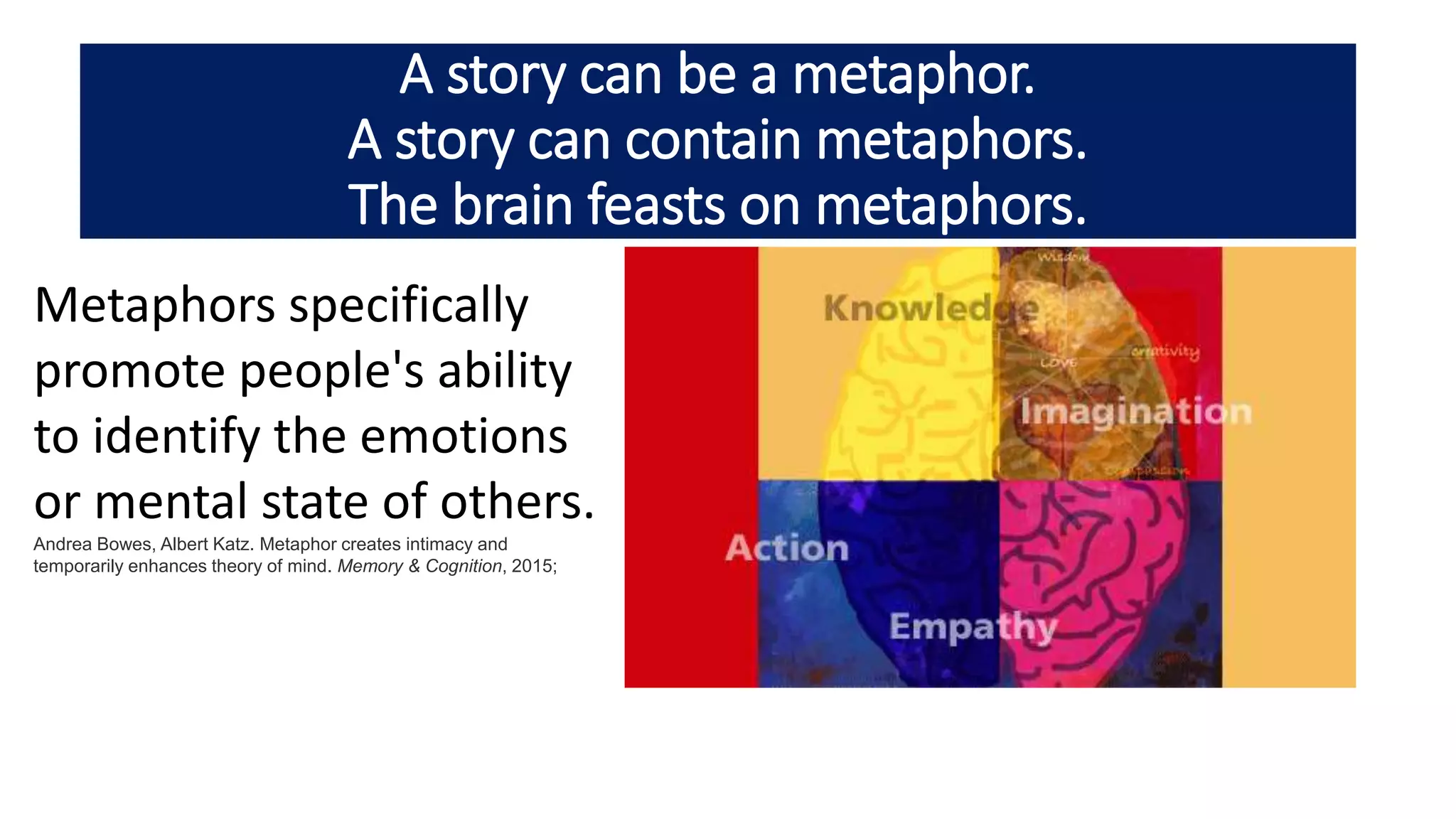
A story can be a metaphor.
A story can contain metaphors.
The brain feasts on metaphors.
Metaphors specifically
promote people's ability
to identify the emotions
or mental state of others.
Andrea Bowes, Albert Katz. Metaphor creates intimacy and
temporarily enhances theory of mind. Memory & Cognition, 2015;
Metaphors engage the
cognitive, imaginative,
emotional and sensory
capacities of the brain
all at once. This
integration enhances
memory and receptivity
to new learning.
Story is the currency of human contact
"Stories the world over are
almost always about people
with problems. Through
stories, we can reap the
benefits of engaging with an
emotional journey without
having to actually go through it
ourselves.”
Jonathan Gottschall, The Storytelling Animal: How Stories Make Us
Human. Houghton Mifflin Harcourt; 2012
“Stories are how you attempt to make sense of
where you've been, where you are and where
you're going.”Kevin Allison, creator and host of RISK! podcast.
"When it comes to
inspiring people to
embrace some strange
new change in behavior,
storytelling isn’t just better
than the other tools. It’s
the only thing that works,“
Nathan Englander, “Stories That Will Plain Curl Your Eyelasher: A Love
Letter To The Moth, The New Yorker, June 14, 2012
Effective stories engage the emotions.
“As new challenges occur, an
adult learner is forced to sharpen
and renew their skills. Leaving old
knowledge behind implies not
only cognitive transformation,
but also an emotional
transformation to accept
changes, differences, and most
fearful, uncertainty.” Brad Shuck, Carlos
Albornoz & Marina Winberg, “Emotions and Their Effect on Adult
Learning: A Constructivist Perspective” Proceedings of the 6th Annual
College Education Research Conference, 2007
Stories work best when they pack an emotional
“punch.” For this to happen, the central character
does not have to be the hero, and endings do not
have to be happy.
“People require some sort
of stressor, some sort of
arousal response in the
brain to have the type of
narrative transportation
where we begin to share
the emotions of the
characters in a story.”
Paul Zak & Jorge Barrazza, “Empathy toward
Strangers Triggers Oxytocin Release and Subsequent
Generosity” Values, Empathy, and Fairness across
Social Barriers: Ann. N.Y. Acad. Sci. 1167: 182–189
(2009).
The classic story structure is most effective
for evoking emotional connection.
“The best stories will always
have an increasing level of
tension, and there exists a type
of universal story structure—one
in which a protagonist faces
some sort of stressful challenge
or conflict—that draws attention
because it’s engaging
emotionally and intellectually.”
Paul Zak & Jorge Barrazza, “Empathy toward Strangers Triggers
Oxytocin Release and Subsequent Generosity” Values, Empathy, and
Fairness across Social Barriers: Ann. N.Y. Acad. Sci. 1167: 182–189
(2009).
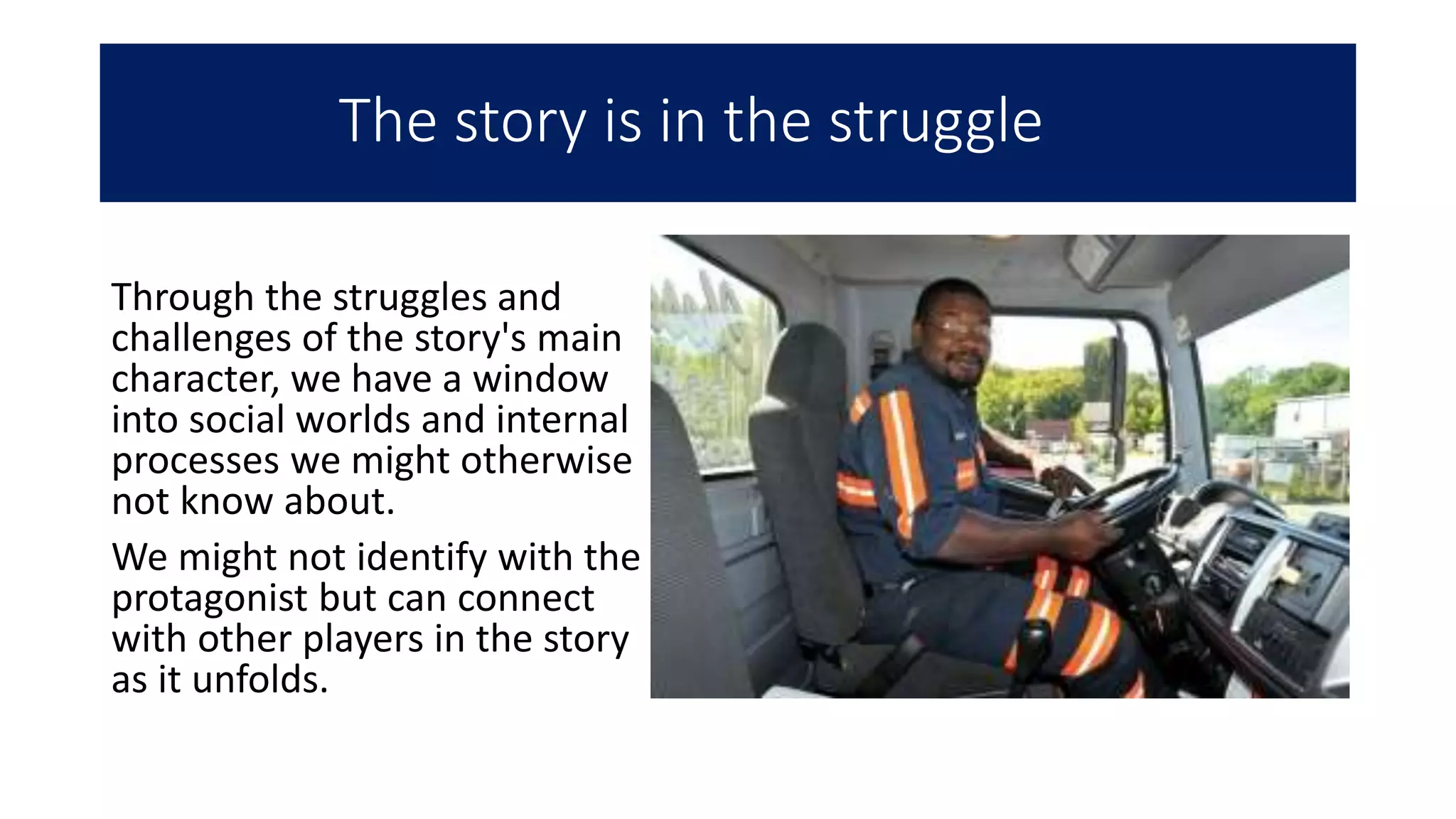
The story is in the struggle
Through the struggles and
challenges of the story's main
character, we have a window
into social worlds and internal
processes we might otherwise
not know about.
We might not identify with the
protagonist but can connect
with other players in the story
as it unfolds.
The classic story structure
1. The Set-up: What is the main
character’s “deal?” Set the scene,
place the audience in a specific
time and place. Include details
about the main character’s state
of mind and most importantly:
what does he/she want?
2. The Inciting Incident:
Something happens to upset the
way things are, that somehow
impacts or challenges the main
character in his/her quest for
what it is he/she wants.
Neuroscience supports the power of using the
classic story structure for enhancing the emotional
impact and delivery of information
3. The Rising Action: The turning
point of the story. As a result of
the inciting incident, choices are
made, actions taken and
consequences endured. The
storyteller heightens tension by
describing the sensory
experiences, the emotions, and
internal process during dramatic
events. Comedy works too.
4. The Falling Action: The direct
effects of the actions taken, the
fall-out from the consequences,
the emotional process as things
begin to level out.
The higher the emotional stakes in the story,
the more impact it has on the listener.
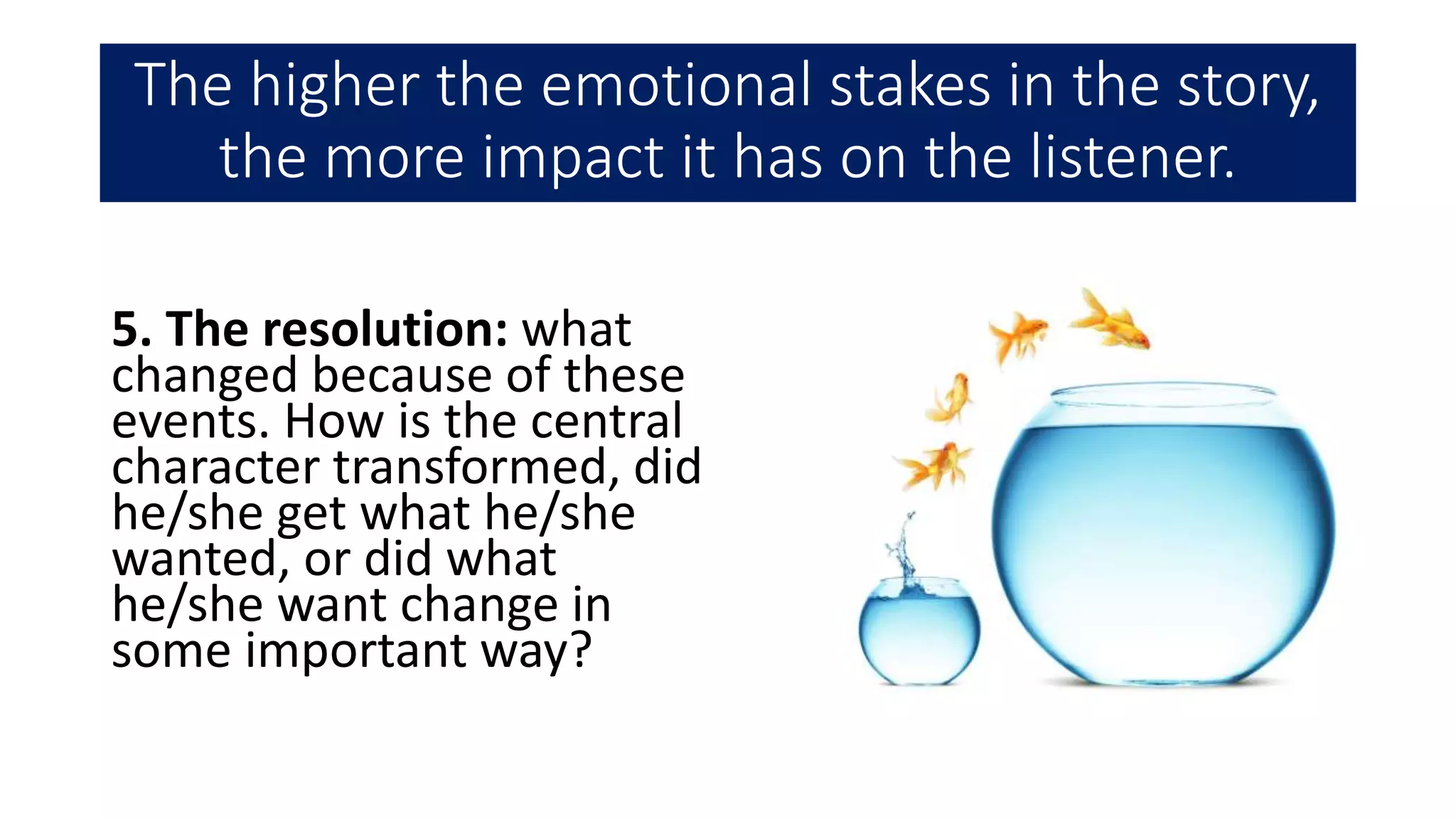
5. The resolution: what
changed because of these
events. How is the central
character transformed, did
he/she get what he/she
wanted, or did what
he/she want change in
some important way?
Data inserted into a narrative is more likely to
be understood and internalized
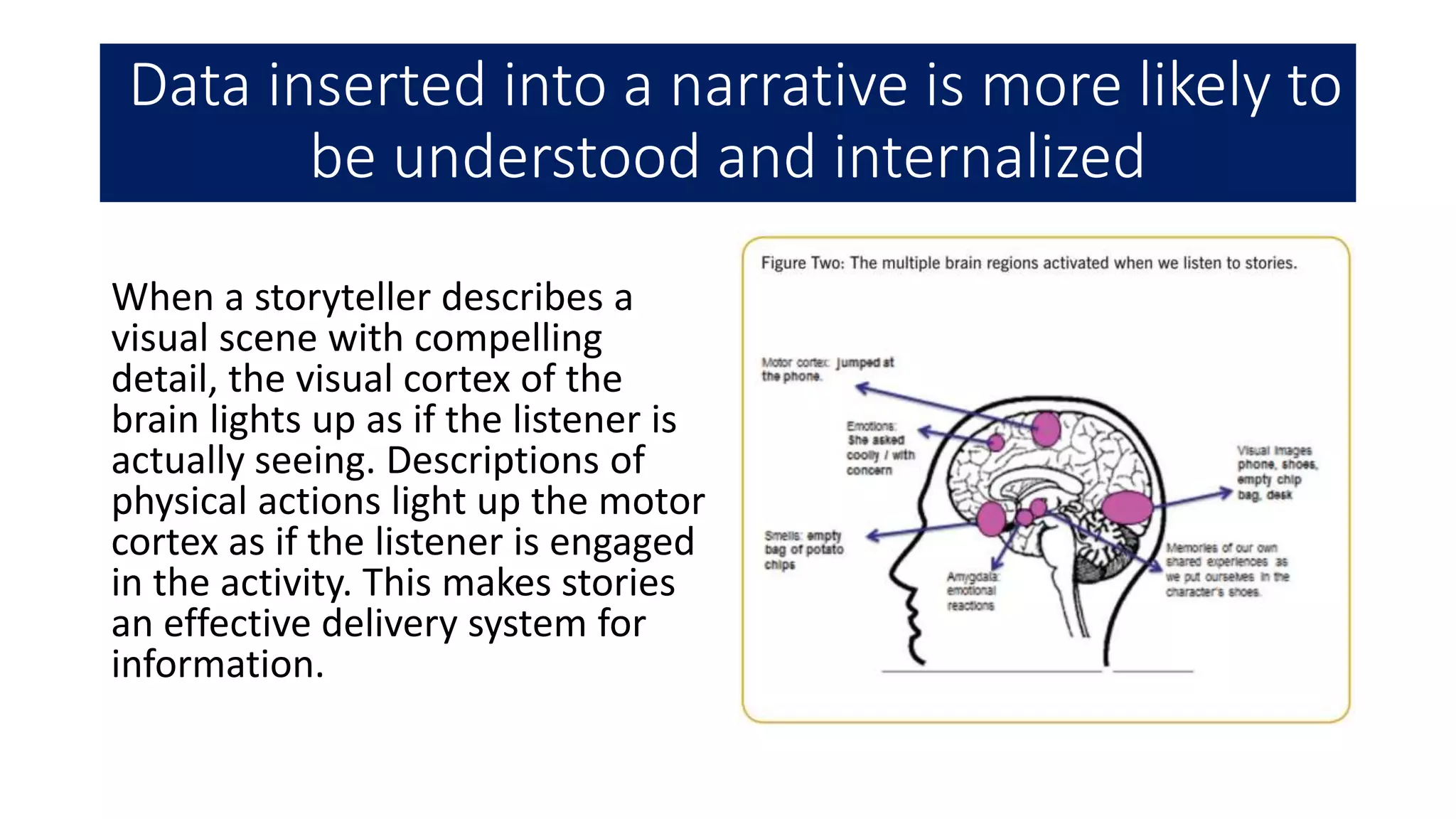
When a storyteller describes a
visual scene with compelling
detail, the visual cortex of the
brain lights up as if the listener is
actually seeing. Descriptions of
physical actions light up the motor
cortex as if the listener is engaged
in the activity. This makes stories
an effective delivery system for
information.
“In a story you not only weave a lot of information
into the telling but you also arouse your listener’s
emotion and energy.”
“Stories fulfill a profound human
need to grasp the patterns of
living – not merely as an
intellectual exercise, but within a
very personal, emotional
experience.” “Storytelling That Moves People” Harvard
Business Review, June, 2003
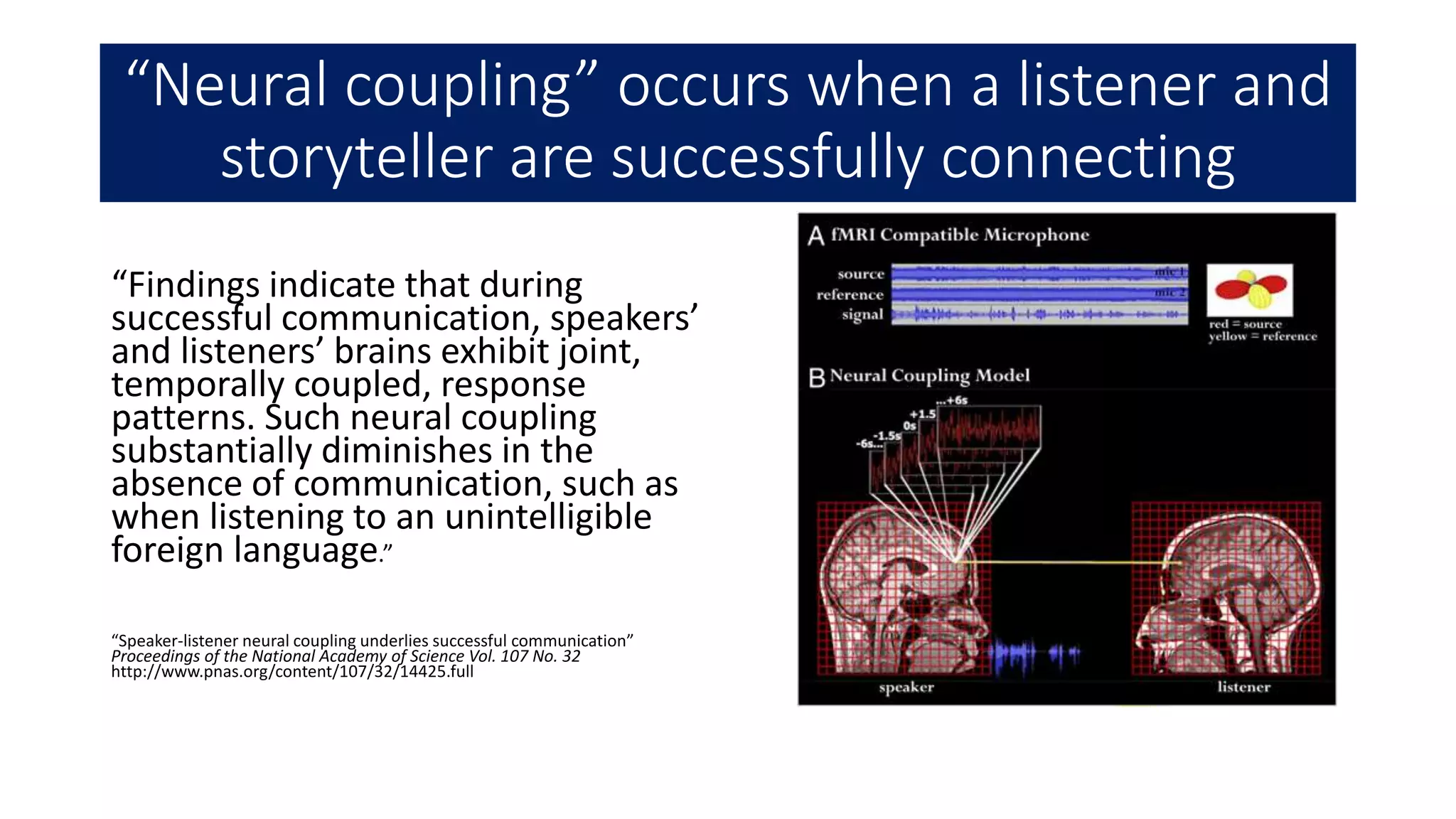
“Neural coupling” occurs when a listener and
storyteller are successfully connecting
“Findings indicate that during
successful communication, speakers’
and listeners’ brains exhibit joint,
temporally coupled, response
patterns. Such neural coupling
substantially diminishes in the
absence of communication, such as
when listening to an unintelligible
foreign language.”
“Speaker-listener neural coupling underlies successful communication”
Proceedings of the National Academy of Science Vol. 107 No. 32
http://www.pnas.org/content/107/32/14425.full
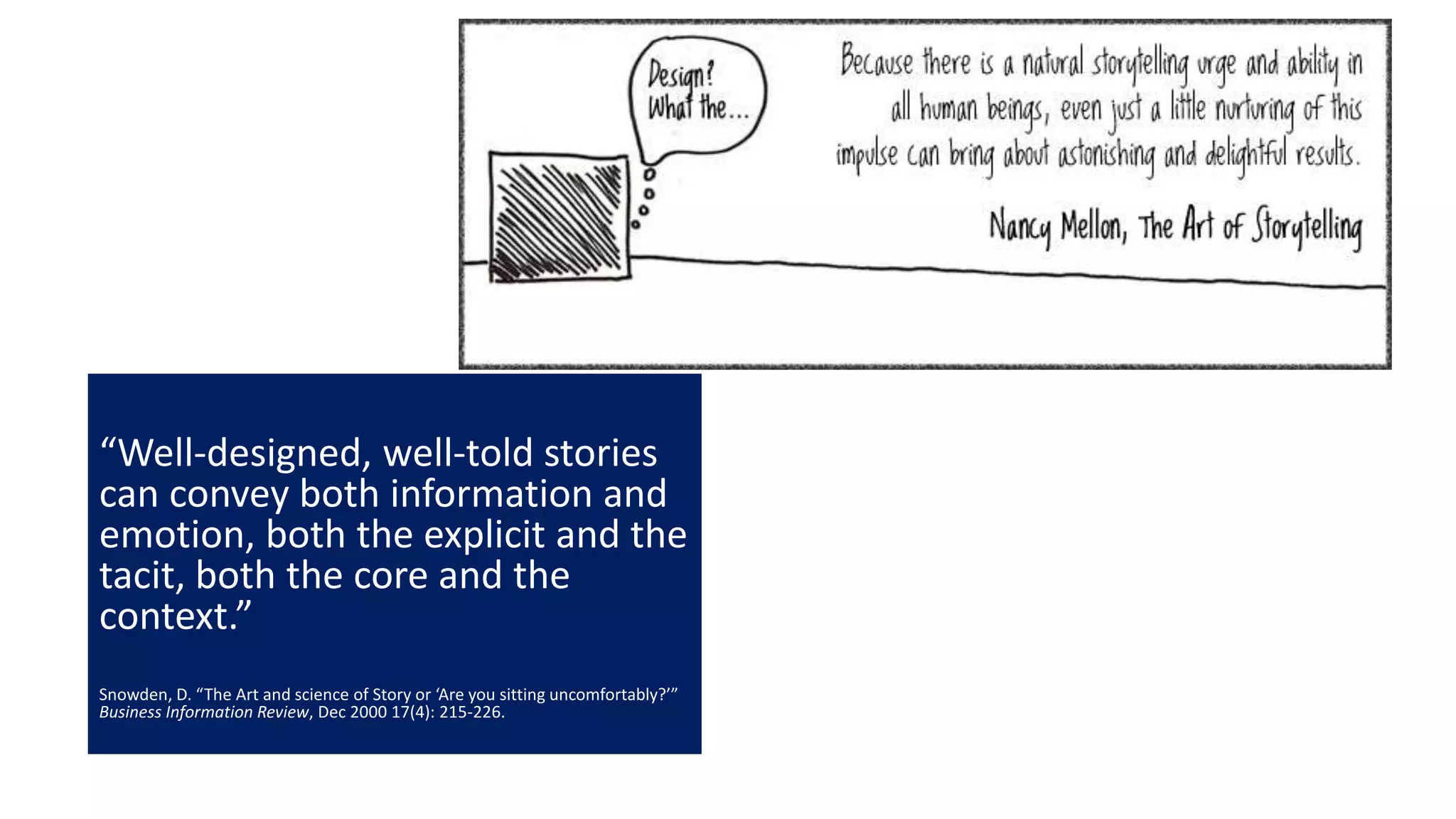
“Well-designed, well-told stories
can convey both information and
emotion, both the explicit and the
tacit, both the core and the
context.”
Snowden, D. “The Art and science of Story or ‘Are you sitting uncomfortably?’”
Business Information Review, Dec 2000 17(4): 215-226.
“Good stories happen to
people who can tell them.” Ira Glass
“A story is about creating what's
possible in the world, about taking
action, not about being a passive
receiver of events. Stories tell you
that you can shape the narrative
of your life. It's a way of being in
the world." Joey Xander, Artistic Director of The Moth
Storytelling podcasts:
www.themoth.org
www.risk-show.com
www.thisamericanlife.org
www.storycorps.org
Storytelling coaching or workshops
The Story Studio: Kevin Allison and his staff provide live classes in NYC
and LA, as well as 1:1 coaching in person or by Skype.
www.thestorystudio.org.
Check out local true storytelling organizations that sponsor slams and
workshops.
More resources and links
“Use Brain Science To Craft A Killer Story” posted August 12, 2015 on www.livesinprogress.net
“Possible Futures: The Emotional Impact Of Stories To Promote Positive Change” posted July 20,
2015 on www.livesinprogress.net.
“Stories Shape Our Thinking and Our Choices-Especially The Ones We Tell Ourselves” posted June
16, 2015 on www.livesinprogress.net.
“Hearing Is Believing: Why We Are Suckers For An Absorbing Story” posted on April 23, 2015 on
www.livesinprogress.net.
"Why Your Brain Loves A Good Story" Harvard Business Review, Oct. 28, 2014
The Power of Personal Storytelling In Design and Innovation” by Soren Petersen on The Huffington
Post 1/10/2015
Lifestage, Inc
• Applied Improvisation workshops
• Story Development workshops and
classes
• Workshop design consultation
• Personal and professional
development
www.livesinprogress.net
www.lifestage.org
www.mostlytruethings.com
496 Smithtown Bypass
Suite 202
Smithtown, NY 11787
631-366-4265

The art of storytelling and how it can help make a better world

  • 1.
    The Art ofStorytelling And How It Can Help Make A Better World Applied Improvisation Network 2015 World Conference Presented by Jude Treder-Wolff, LCSW, CGP, MT Lifestage, Inc www.lifestage.org
  • 3.
    “We are creaturesof story, and the process of changing one mind or the whole world must begin with ‘Once upon a time.’” Research repeatedly shows that our attitudes, fears, hopes, and values are strongly influenced by story. “Why Storytelling Is The Ultimate Weapon” Jonathan Gottschall, Fast Company, May 2, 2012
  • 4.
    Story promotes understandingabout the tensions of change and the evolution of ideas “Technology is evolving at roughly 10 million times the speed of natural evolution. For all its glitz and swagger, technology and the whole interactive, revved-up economy that goes with it is merely an outer casing for outer selves. And these inner selves, these primate souls of ours with their ancient social ways, change slowly. Or not at all.” Brian Arthur, “How Fast Is Technology Evolving?” Scientific American (February 1997): 107
  • 5.
    Stories are powerfulways to convey and consolidate knowledge. “Sharing experiences through stories is emerging in various professions as a powerful way to exchange and consolidate knowledge. Research suggests that sharing experiences though narrative builds trust, cultivates norms, transfers tacit knowledge, facilitates unlearning, and generates emotional connections.” Kimiz Dalkir & Erica Wiseman, “Organizational Storytelling and Knowledge Management: A Survey” Storytelling, Self, Society, Vol No. 1, Fall 2004
  • 6.
    Through story, information andideas ride in on a raft made of emotional connection carried along by a current called narrative
  • 7.
    A story canbe a metaphor. A story can contain metaphors. The brain feasts on metaphors. Metaphors specifically promote people's ability to identify the emotions or mental state of others. Andrea Bowes, Albert Katz. Metaphor creates intimacy and temporarily enhances theory of mind. Memory & Cognition, 2015;
  • 8.
    Metaphors engage the cognitive,imaginative, emotional and sensory capacities of the brain all at once. This integration enhances memory and receptivity to new learning.
  • 9.
    Story is thecurrency of human contact "Stories the world over are almost always about people with problems. Through stories, we can reap the benefits of engaging with an emotional journey without having to actually go through it ourselves.” Jonathan Gottschall, The Storytelling Animal: How Stories Make Us Human. Houghton Mifflin Harcourt; 2012
  • 10.
    “Stories are howyou attempt to make sense of where you've been, where you are and where you're going.”Kevin Allison, creator and host of RISK! podcast. "When it comes to inspiring people to embrace some strange new change in behavior, storytelling isn’t just better than the other tools. It’s the only thing that works,“ Nathan Englander, “Stories That Will Plain Curl Your Eyelasher: A Love Letter To The Moth, The New Yorker, June 14, 2012
  • 11.
    Effective stories engagethe emotions. “As new challenges occur, an adult learner is forced to sharpen and renew their skills. Leaving old knowledge behind implies not only cognitive transformation, but also an emotional transformation to accept changes, differences, and most fearful, uncertainty.” Brad Shuck, Carlos Albornoz & Marina Winberg, “Emotions and Their Effect on Adult Learning: A Constructivist Perspective” Proceedings of the 6th Annual College Education Research Conference, 2007
  • 12.
    Stories work bestwhen they pack an emotional “punch.” For this to happen, the central character does not have to be the hero, and endings do not have to be happy. “People require some sort of stressor, some sort of arousal response in the brain to have the type of narrative transportation where we begin to share the emotions of the characters in a story.” Paul Zak & Jorge Barrazza, “Empathy toward Strangers Triggers Oxytocin Release and Subsequent Generosity” Values, Empathy, and Fairness across Social Barriers: Ann. N.Y. Acad. Sci. 1167: 182–189 (2009).
  • 13.
    The classic storystructure is most effective for evoking emotional connection. “The best stories will always have an increasing level of tension, and there exists a type of universal story structure—one in which a protagonist faces some sort of stressful challenge or conflict—that draws attention because it’s engaging emotionally and intellectually.” Paul Zak & Jorge Barrazza, “Empathy toward Strangers Triggers Oxytocin Release and Subsequent Generosity” Values, Empathy, and Fairness across Social Barriers: Ann. N.Y. Acad. Sci. 1167: 182–189 (2009).
  • 14.
    The story isin the struggle Through the struggles and challenges of the story's main character, we have a window into social worlds and internal processes we might otherwise not know about. We might not identify with the protagonist but can connect with other players in the story as it unfolds.
  • 15.
    The classic storystructure 1. The Set-up: What is the main character’s “deal?” Set the scene, place the audience in a specific time and place. Include details about the main character’s state of mind and most importantly: what does he/she want? 2. The Inciting Incident: Something happens to upset the way things are, that somehow impacts or challenges the main character in his/her quest for what it is he/she wants.
  • 16.
    Neuroscience supports thepower of using the classic story structure for enhancing the emotional impact and delivery of information 3. The Rising Action: The turning point of the story. As a result of the inciting incident, choices are made, actions taken and consequences endured. The storyteller heightens tension by describing the sensory experiences, the emotions, and internal process during dramatic events. Comedy works too. 4. The Falling Action: The direct effects of the actions taken, the fall-out from the consequences, the emotional process as things begin to level out.
  • 17.
    The higher theemotional stakes in the story, the more impact it has on the listener. 5. The resolution: what changed because of these events. How is the central character transformed, did he/she get what he/she wanted, or did what he/she want change in some important way?
  • 18.
    Data inserted intoa narrative is more likely to be understood and internalized When a storyteller describes a visual scene with compelling detail, the visual cortex of the brain lights up as if the listener is actually seeing. Descriptions of physical actions light up the motor cortex as if the listener is engaged in the activity. This makes stories an effective delivery system for information.
  • 19.
    “In a storyyou not only weave a lot of information into the telling but you also arouse your listener’s emotion and energy.” “Stories fulfill a profound human need to grasp the patterns of living – not merely as an intellectual exercise, but within a very personal, emotional experience.” “Storytelling That Moves People” Harvard Business Review, June, 2003
  • 20.
    “Neural coupling” occurswhen a listener and storyteller are successfully connecting “Findings indicate that during successful communication, speakers’ and listeners’ brains exhibit joint, temporally coupled, response patterns. Such neural coupling substantially diminishes in the absence of communication, such as when listening to an unintelligible foreign language.” “Speaker-listener neural coupling underlies successful communication” Proceedings of the National Academy of Science Vol. 107 No. 32 http://www.pnas.org/content/107/32/14425.full
  • 21.
    “Well-designed, well-told stories canconvey both information and emotion, both the explicit and the tacit, both the core and the context.” Snowden, D. “The Art and science of Story or ‘Are you sitting uncomfortably?’” Business Information Review, Dec 2000 17(4): 215-226.
  • 22.
    “Good stories happento people who can tell them.” Ira Glass “A story is about creating what's possible in the world, about taking action, not about being a passive receiver of events. Stories tell you that you can shape the narrative of your life. It's a way of being in the world." Joey Xander, Artistic Director of The Moth Storytelling podcasts: www.themoth.org www.risk-show.com www.thisamericanlife.org www.storycorps.org
  • 23.
    Storytelling coaching orworkshops The Story Studio: Kevin Allison and his staff provide live classes in NYC and LA, as well as 1:1 coaching in person or by Skype. www.thestorystudio.org. Check out local true storytelling organizations that sponsor slams and workshops.
  • 24.
    More resources andlinks “Use Brain Science To Craft A Killer Story” posted August 12, 2015 on www.livesinprogress.net “Possible Futures: The Emotional Impact Of Stories To Promote Positive Change” posted July 20, 2015 on www.livesinprogress.net. “Stories Shape Our Thinking and Our Choices-Especially The Ones We Tell Ourselves” posted June 16, 2015 on www.livesinprogress.net. “Hearing Is Believing: Why We Are Suckers For An Absorbing Story” posted on April 23, 2015 on www.livesinprogress.net. "Why Your Brain Loves A Good Story" Harvard Business Review, Oct. 28, 2014 The Power of Personal Storytelling In Design and Innovation” by Soren Petersen on The Huffington Post 1/10/2015
  • 25.
    Lifestage, Inc • AppliedImprovisation workshops • Story Development workshops and classes • Workshop design consultation • Personal and professional development www.livesinprogress.net www.lifestage.org www.mostlytruethings.com 496 Smithtown Bypass Suite 202 Smithtown, NY 11787 631-366-4265