Sto t n
Basics
Once upon
a time...
Since we can remember,
people...moms, dads, grandparents,
aunts, uncles--that friend that likes
to over-exaggerate even to the
tiniest of details--have been telling
stories to excite, intrigue, convince
or impress their listening audience. 
If you think of it, storytelling is the
most single powerful communication
tool we have that can captivate,
connect emotions, authentically
engage and bond your messaging
with your audience.
So, what makes storytelling so
powerful? People are naturally
drawn to stories.
Humans are emotional/social
creatures
Stories  help us remember 
- Our brains are wired to remember stories.
Stories influence how we decide
- The brain chooses the information it  wants,
then remembers that information.
Stories  unlock empathy in our
brains
- We can see ourselves in a story, we can relate to
them. Many times, emotional connections are
established through stories.
- Storytelling is the language of emotion. Stories
are an effective way to transmit important
information and values from one individual or
community to the next.
Stories link us to our sense of
generosity
- Stories help us to become more empathic,
motivating us to make positive changes in our
life and in others’.
Our brains
love
stories...
How storytelling
influences the brain...
A story activates parts in the 
brain that allows the
listener to turn the story in to
their own ideas and
experience--thanks to a
process called neural
coupling.
Neural Coupling
Listeners will not only
experience the similar
brain activity to each
other, but also to the
speaker.
Mirroring
Dopamine
The brain releases dopamine
into the system when it
experiences an emotionally-
charged event; making it
easier to remember and with
greater accuracy.
Cortex Activity
When processing facts, two
areas of the brain are
activated (Broca's and
Wernicke's area). A well-told
story can engage many
additional areas, including
the motor cortex.
Stories that are personal and emotionally compelling
engage more of the brain and thus are better
remembered than simply stating a set of facts.
Stories are more than simple fairy tales. It turns out, they
actually alter our brains, and can even change the way we think
and act.
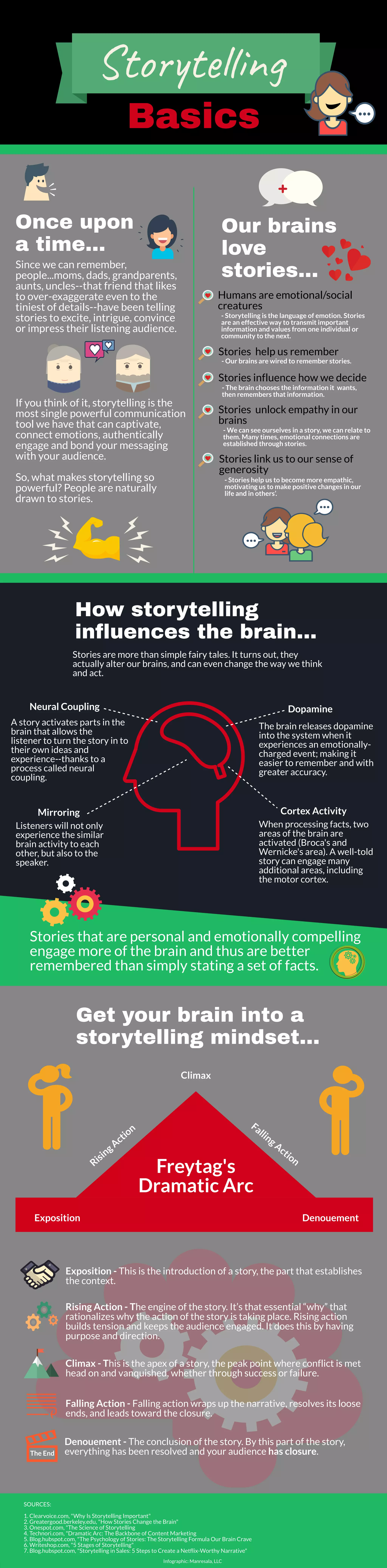
Freytag's
Dramatic Arc
Get your brain into a
storytelling mindset...
Exposition Denouement
RisingAction
Climax
FallingAction
Exposition - This is the introduction of a story, the part that establishes
the context.
Rising Action - The engine of the story. It’s that essential “why” that
rationalizes why the action of the story is taking place. Rising action
builds tension and keeps the audience engaged. It does this by having
purpose and direction.
Climax - This is the apex of a story, the peak point where conflict is met
head on and vanquished, whether through success or failure.
Falling Action - Falling action wraps up the narrative, resolves its loose
ends, and leads toward the closure.
The End
Denouement - The conclusion of the story. By this part of the story,
everything has been resolved and your audience has closure. 
SOURCES: 
1. Clearvoice.com, "Why Is Storytelling Important"
2. Greatergood.berkeley.edu, "How Stories Change the Brain"
3. Onespot.com, "The Science of Storytelling
4. Technori.com, "Dramatic Arc: The Backbone of Content Marketing
5. Blog.hubspot.com, "The Psychology of Stories: The Storytelling Formula Our Brain Crave
6. Writeshop.com, "5 Stages of Storytelling"
7. Blog.hubspot.com, "Storytelling in Sales: 5 Steps to Create a Netflix-Worthy Narrative"
Infographic: Manresala, LLC

Storytelling Basics

  • 1.
    Sto t n Basics Onceupon a time... Since we can remember, people...moms, dads, grandparents, aunts, uncles--that friend that likes to over-exaggerate even to the tiniest of details--have been telling stories to excite, intrigue, convince or impress their listening audience.  If you think of it, storytelling is the most single powerful communication tool we have that can captivate, connect emotions, authentically engage and bond your messaging with your audience. So, what makes storytelling so powerful? People are naturally drawn to stories. Humans are emotional/social creatures Stories  help us remember  - Our brains are wired to remember stories. Stories influence how we decide - The brain chooses the information it  wants, then remembers that information. Stories  unlock empathy in our brains - We can see ourselves in a story, we can relate to them. Many times, emotional connections are established through stories. - Storytelling is the language of emotion. Stories are an effective way to transmit important information and values from one individual or community to the next. Stories link us to our sense of generosity - Stories help us to become more empathic, motivating us to make positive changes in our life and in others’. Our brains love stories... How storytelling influences the brain... A story activates parts in the  brain that allows the listener to turn the story in to their own ideas and experience--thanks to a process called neural coupling. Neural Coupling Listeners will not only experience the similar brain activity to each other, but also to the speaker. Mirroring Dopamine The brain releases dopamine into the system when it experiences an emotionally- charged event; making it easier to remember and with greater accuracy. Cortex Activity When processing facts, two areas of the brain are activated (Broca's and Wernicke's area). A well-told story can engage many additional areas, including the motor cortex. Stories that are personal and emotionally compelling engage more of the brain and thus are better remembered than simply stating a set of facts. Stories are more than simple fairy tales. It turns out, they actually alter our brains, and can even change the way we think and act. Freytag's Dramatic Arc Get your brain into a storytelling mindset... Exposition Denouement RisingAction Climax FallingAction Exposition - This is the introduction of a story, the part that establishes the context. Rising Action - The engine of the story. It’s that essential “why” that rationalizes why the action of the story is taking place. Rising action builds tension and keeps the audience engaged. It does this by having purpose and direction. Climax - This is the apex of a story, the peak point where conflict is met head on and vanquished, whether through success or failure. Falling Action - Falling action wraps up the narrative, resolves its loose ends, and leads toward the closure. The End Denouement - The conclusion of the story. By this part of the story, everything has been resolved and your audience has closure.  SOURCES:  1. Clearvoice.com, "Why Is Storytelling Important" 2. Greatergood.berkeley.edu, "How Stories Change the Brain" 3. Onespot.com, "The Science of Storytelling 4. Technori.com, "Dramatic Arc: The Backbone of Content Marketing 5. Blog.hubspot.com, "The Psychology of Stories: The Storytelling Formula Our Brain Crave 6. Writeshop.com, "5 Stages of Storytelling" 7. Blog.hubspot.com, "Storytelling in Sales: 5 Steps to Create a Netflix-Worthy Narrative" Infographic: Manresala, LLC