Improv
and
Emotional
Intelligence:
BFFs
Lifestage, Inc
www.lifestage.org
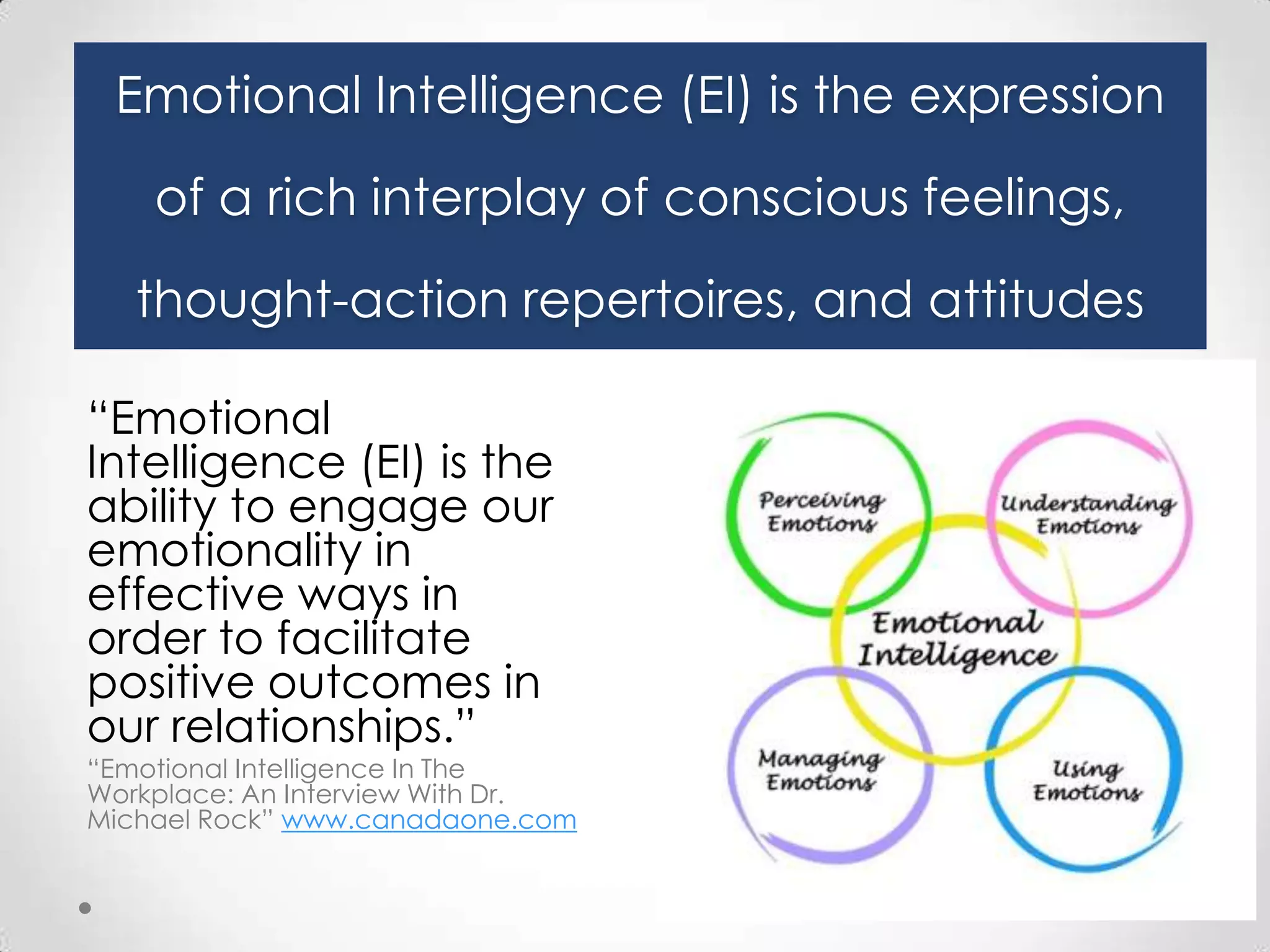
Emotional Intelligence (EI) is the expression
of a rich interplay of conscious feelings,
thought-action repertoires, and attitudes
“Emotional
Intelligence (EI) is the
ability to engage our
emotionality in
effective ways in
order to facilitate
positive outcomes in
our relationships.”

“Emotional Intelligence In The
Workplace: An Interview With Dr.
Michael Rock” www.canadaone.com
Emotional Intelligence
& Applied Improv: BFFS
Emotional Intelligence:
• Deals with the emotional
impact people have on
one another;
• Is a skill and mind set for
becoming aware of and
managing emotions;
• Is a skill and mind set for
navigating fear,
especially fear of
change;

•

Improvisation:
Occurs through
interaction and the
impact people have on
one another moment to
moment;

•

Grows out of emotional
expression and emotional
awareness;

•

Operates out of the basic
tenet “follow the fear”;
Change and uncertainty
are central to the process

•
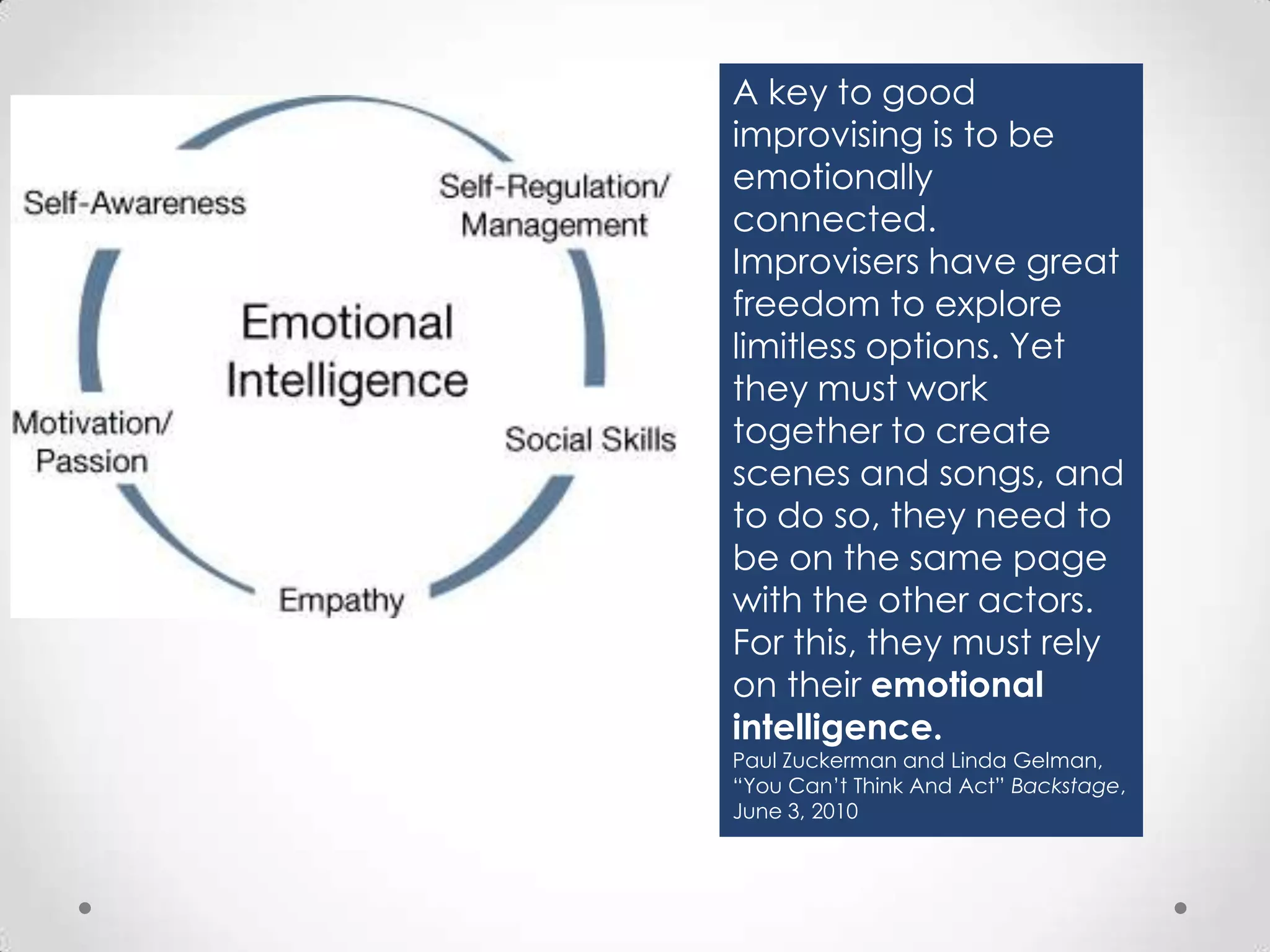
A key to good
improvising is to be
emotionally
connected.
Improvisers have great
freedom to explore
limitless options. Yet
they must work
together to create
scenes and songs, and
to do so, they need to
be on the same page
with the other actors.
For this, they must rely
on their emotional
intelligence.

Paul Zuckerman and Linda Gelman,
“You Can’t Think And Act” Backstage,
June 3, 2010
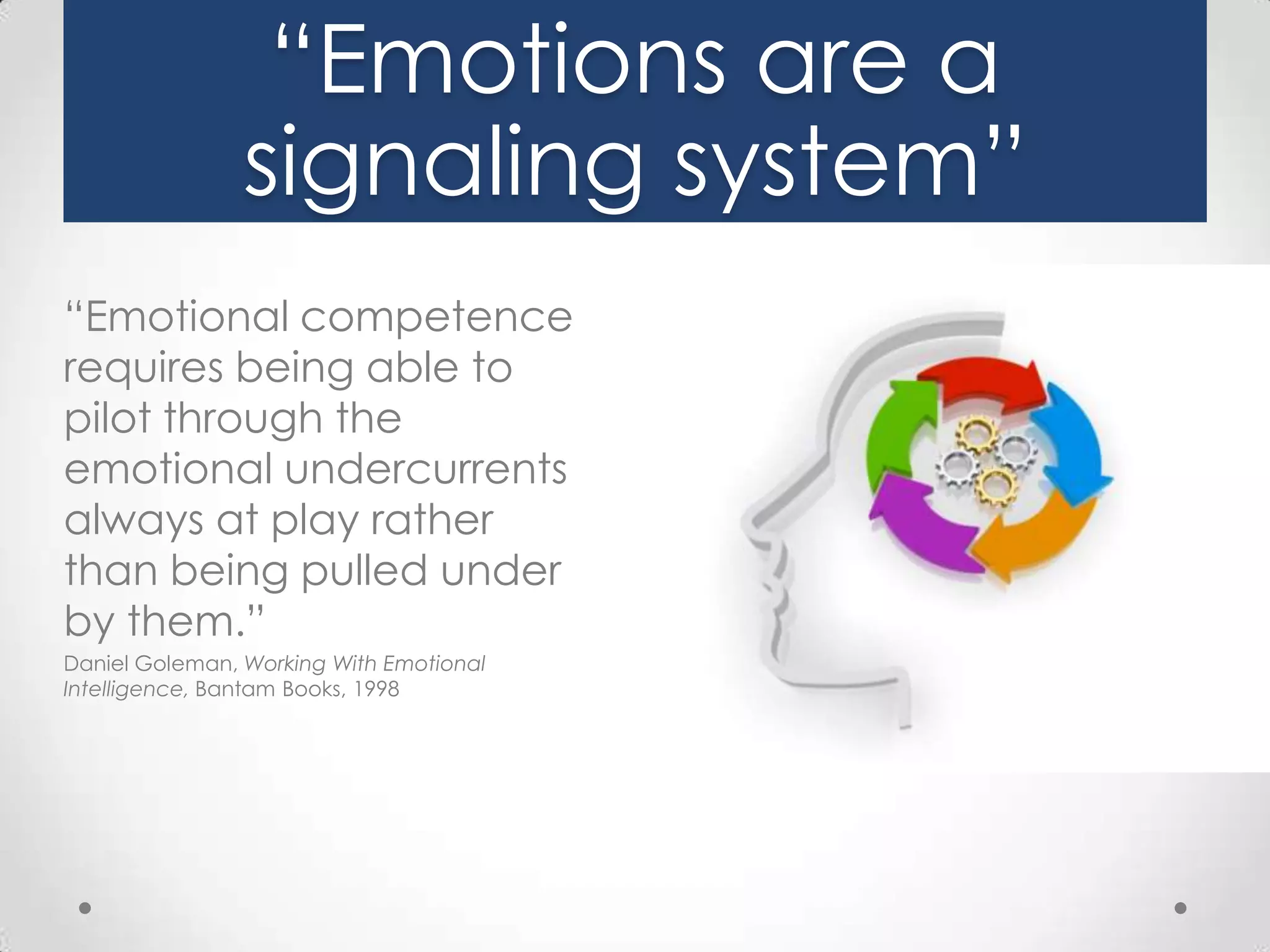
“Emotions are a
signaling system”
“Emotional competence
requires being able to
pilot through the
emotional undercurrents
always at play rather
than being pulled under
by them.”
Daniel Goleman, Working With Emotional
Intelligence, Bantam Books, 1998
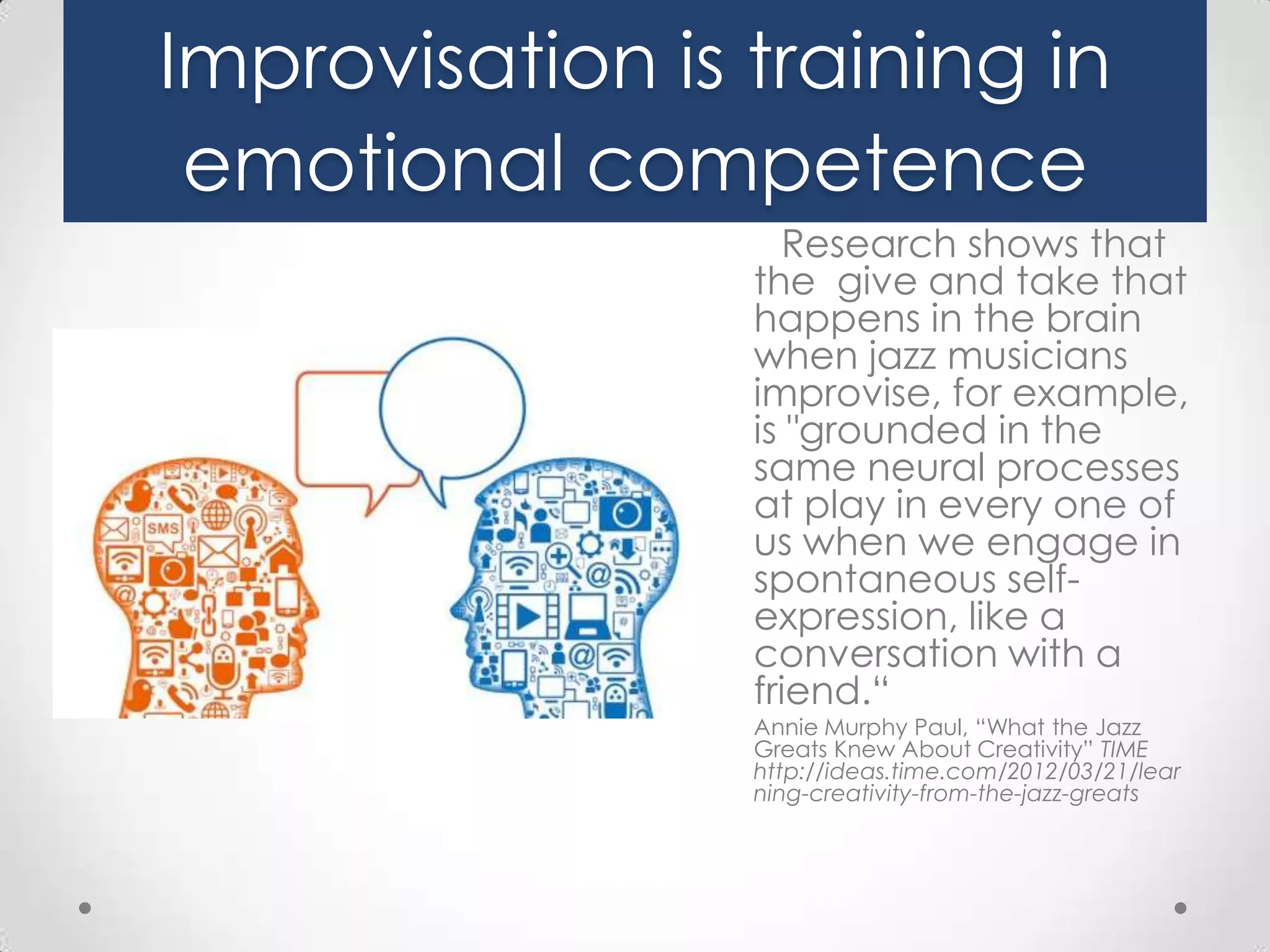
Improvisation is training in
emotional competence
Research shows that
the give and take that
happens in the brain
when jazz musicians
improvise, for example,
is "grounded in the
same neural processes
at play in every one of
us when we engage in
spontaneous selfexpression, like a
conversation with a
friend.“
Annie Murphy Paul, “What the Jazz
Greats Knew About Creativity” TIME
http://ideas.time.com/2012/03/21/lear
ning-creativity-from-the-jazz-greats
Improv experiences promote
deep learning through active
engagement
Using improvisation in education, training or personal
growth settings will:
Stimulate emotions;
Attract attention;
Encourage meaning making;
Have immediate application to real-life situations;
Create lasting memories of lessons learned;
Willdorf, N. “Masters of improvisation,” The Chronicle of Higher Education, 4 2000). 46 (37), p. A12.
Good improv grows out of
emotionally intelligent
interactions
Listen, connect and collaborate;
Make and keep agreements;
Act with generosity of spirit;
Maintain awareness of what others say and do;
Respond to what is happening rather than
imposing ideas;
• Collaboration and co-creation rather than control;
•
•
•
•
•

Patricia Ryan Madson, Improv Wisdom: Don’t Prepare, Just Show Up, Random House, 2005
"More active,
concrete, experiential
methods, such as role
plays, group
discussions, and
simulations, usually
work better than
lecturing or assigned
reading for social and
emotional learning. The
Consortium For Research In Emotional
Intelligence in Organizations

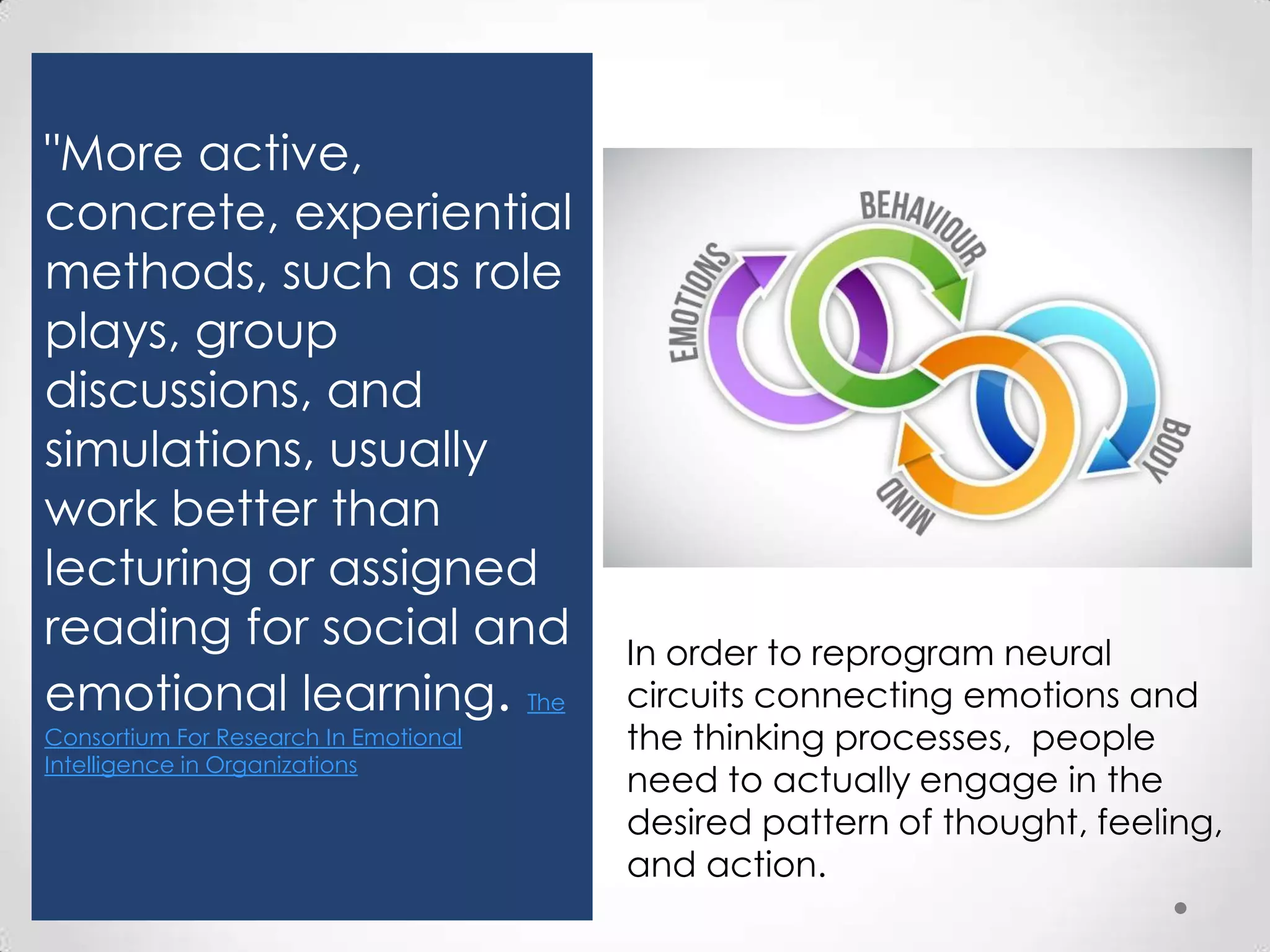
In order to reprogram neural
circuits connecting emotions and
the thinking processes, people
need to actually engage in the
desired pattern of thought, feeling,
and action.
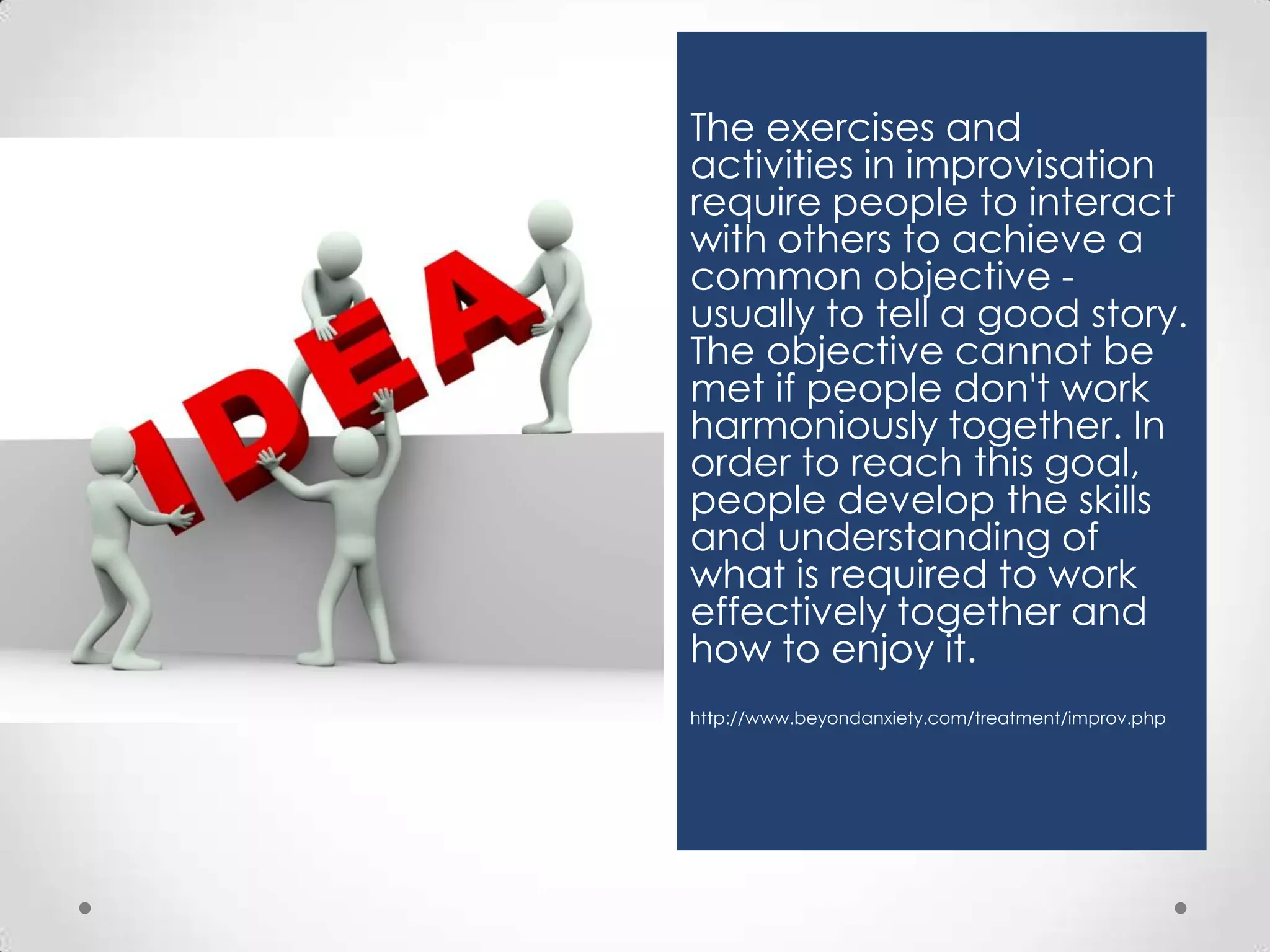
The exercises and
activities in improvisation
require people to interact
with others to achieve a
common objective usually to tell a good story.
The objective cannot be
met if people don't work
harmoniously together. In
order to reach this goal,
people develop the skills
and understanding of
what is required to work
effectively together and
how to enjoy it.
http://www.beyondanxiety.com/treatment/improv.php
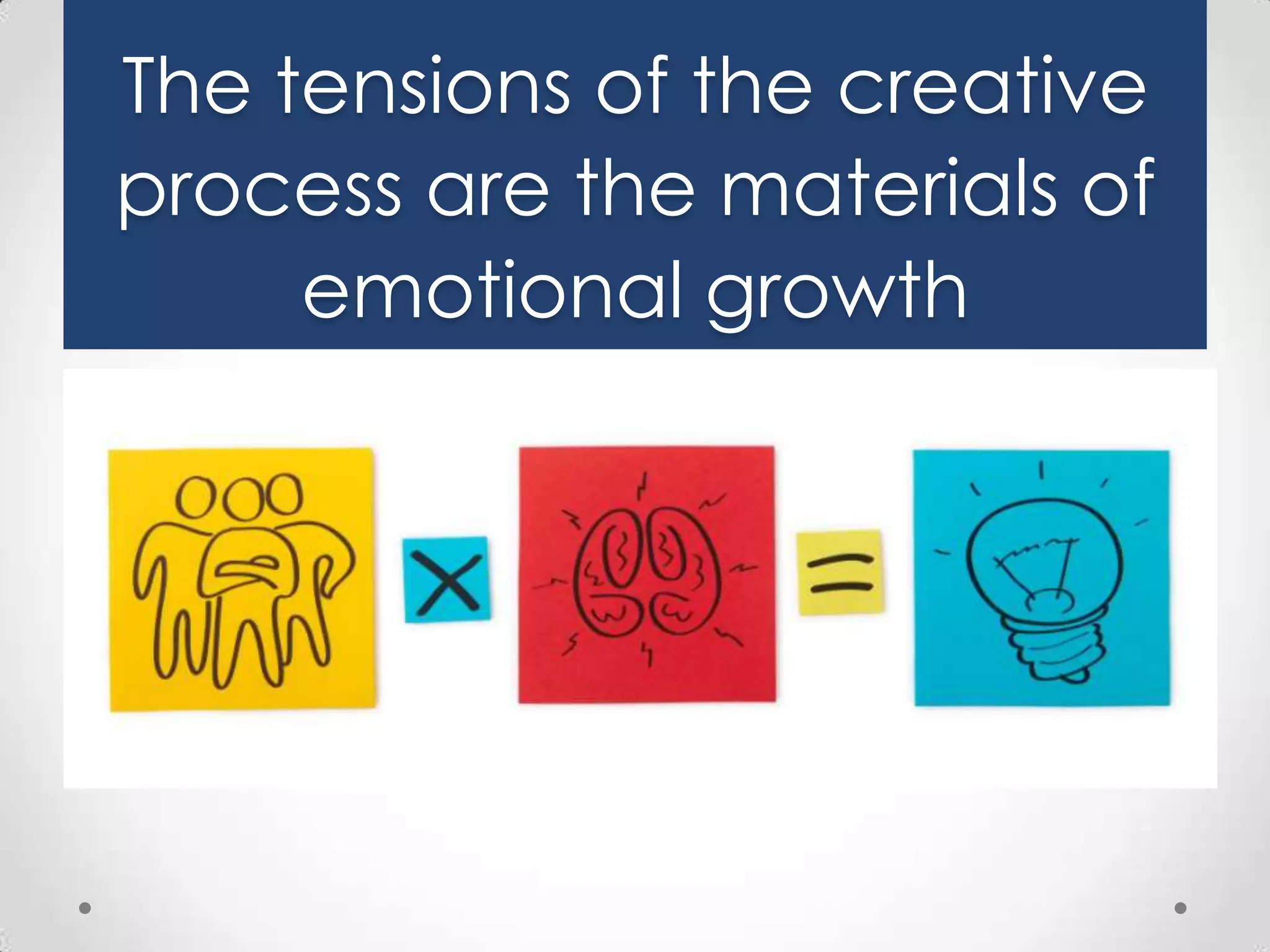
The tensions of the creative
process are the materials of
emotional growth
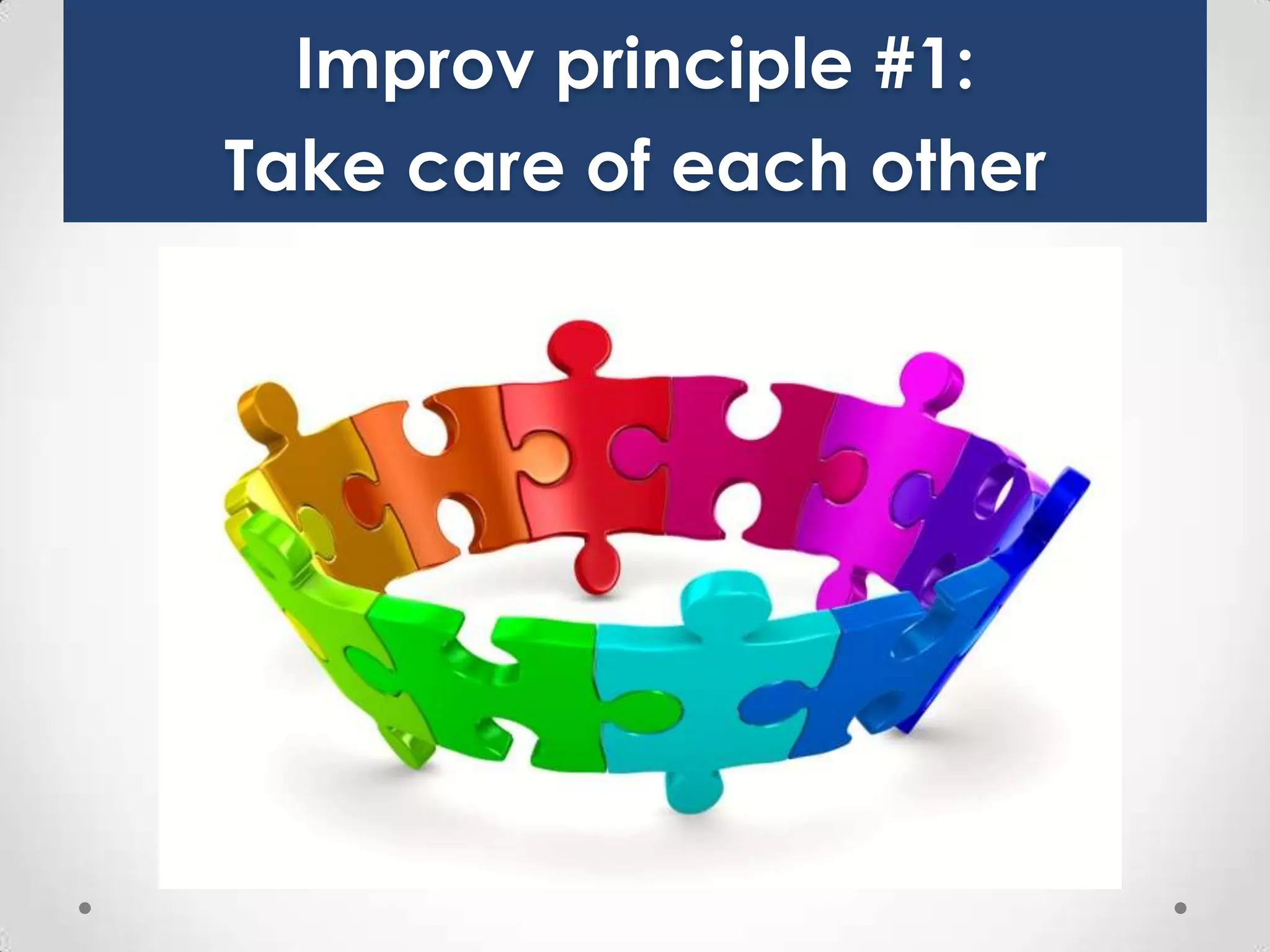
Improv principle #1:
Take care of each other
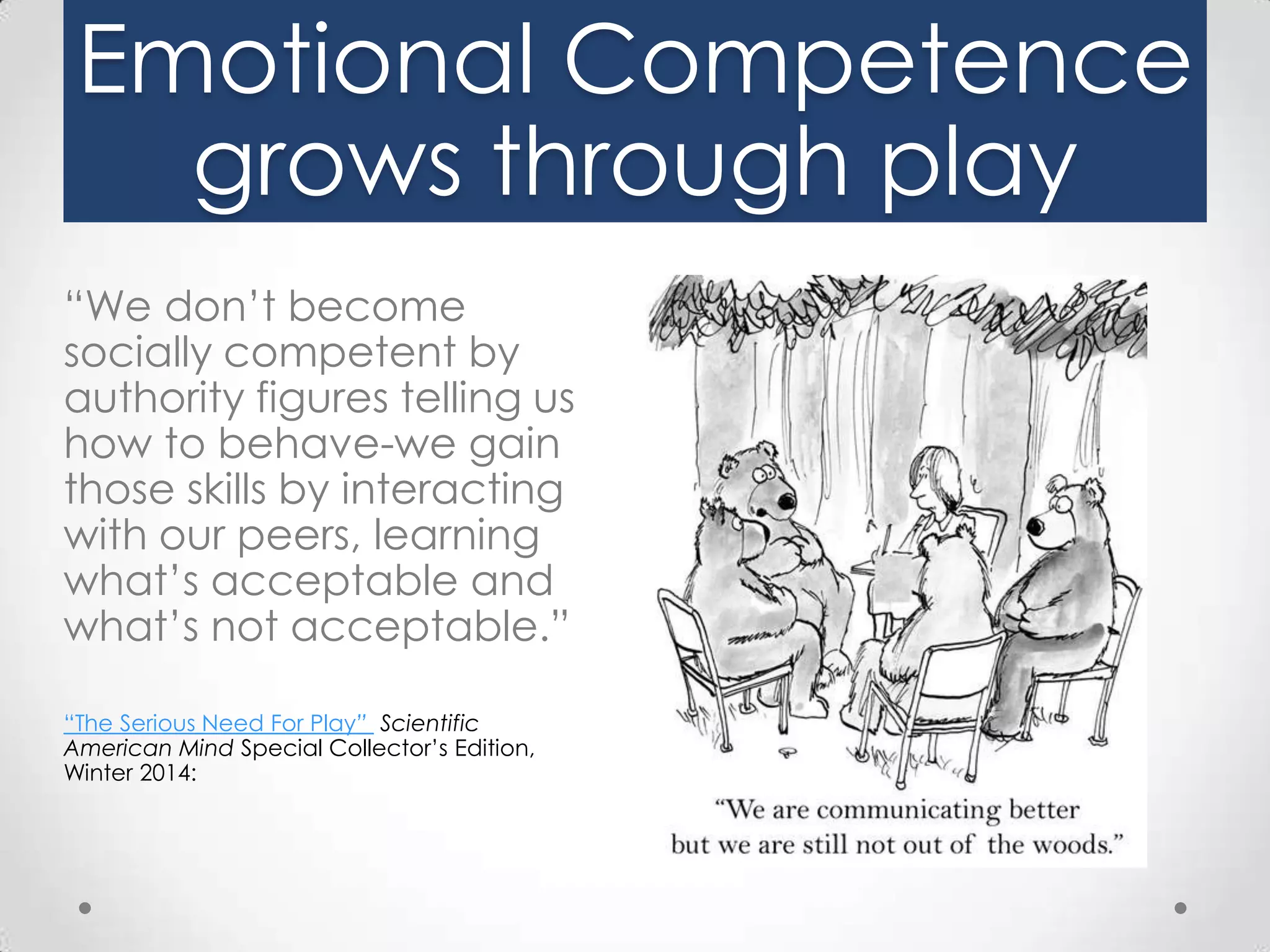
Emotional Competence
grows through play
“We don’t become
socially competent by
authority figures telling us
how to behave-we gain
those skills by interacting
with our peers, learning
what’s acceptable and
what’s not acceptable.”
“The Serious Need For Play” Scientific
American Mind Special Collector’s Edition,
Winter 2014:
“One of the most remarkable of
all human skills is our ability to
flexibly adapt to nearly every
imaginable circumstance. This
ability arises in part from our
capacity to regulate emotions
that are engendered by the
situations we face.”
Kevin N. Ochsner & James J. Gross, “Thinking makes it so: A social cognitive neuroscience approach to
emotion regulation” K. Vohs & R. Baumeister (Eds.), The Handbook of Self-Regulation (2003) Erlbaum: NJ.
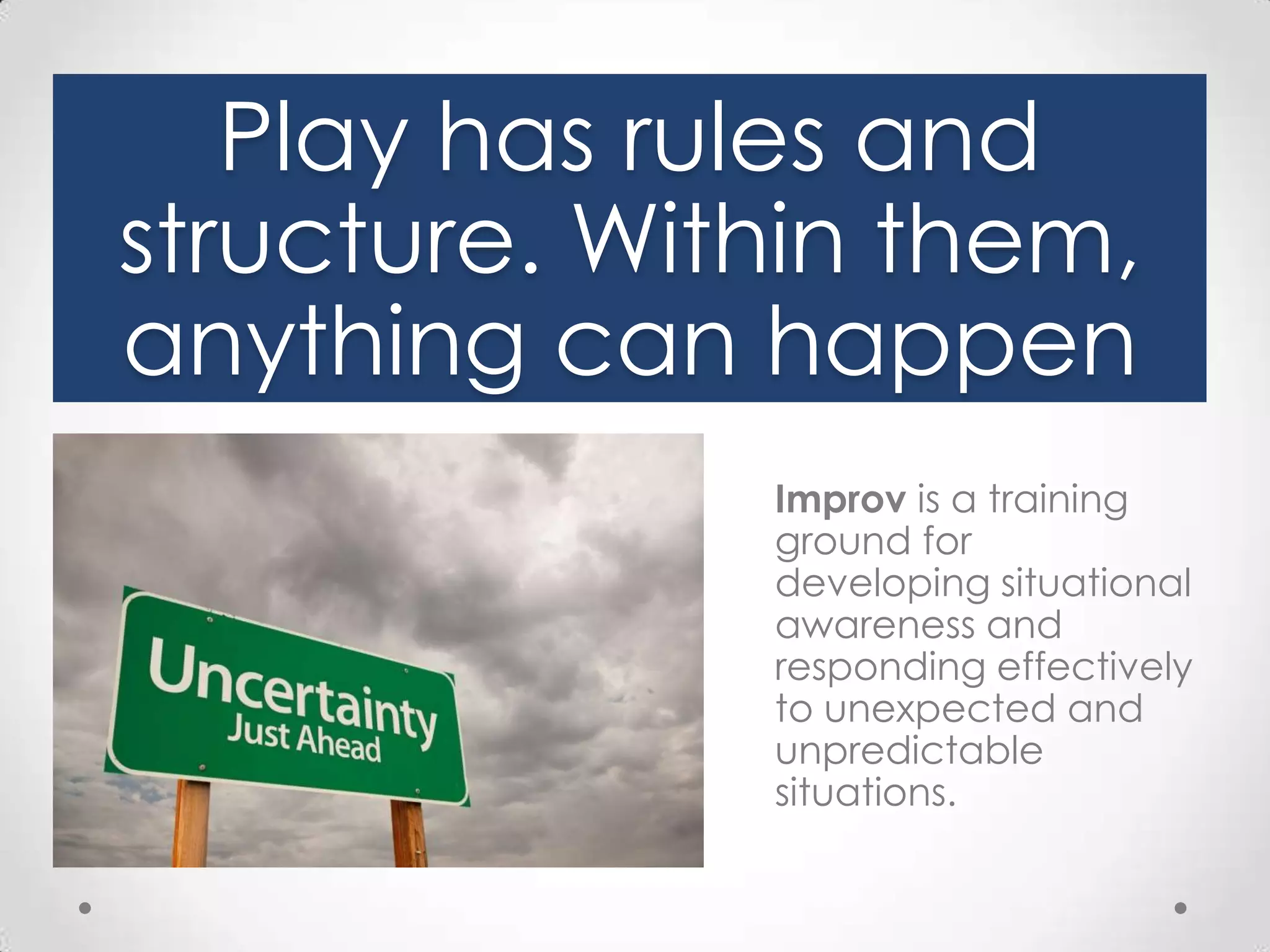
Play has rules and
structure. Within them,
anything can happen
Improv is a training
ground for
developing situational
awareness and
responding effectively
to unexpected and
unpredictable
situations.
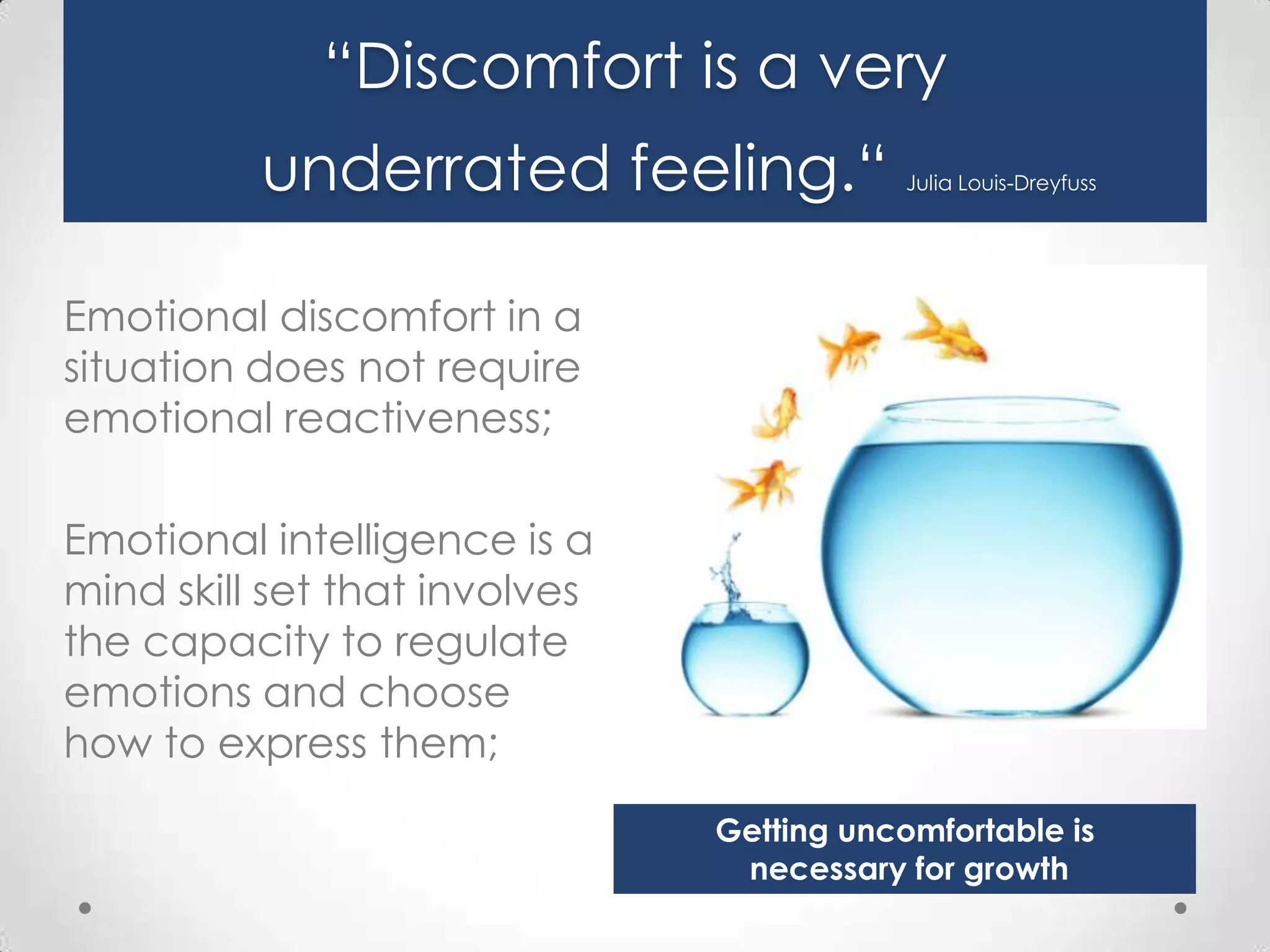
“Discomfort is a very
underrated feeling.“

Julia Louis-Dreyfuss

Emotional discomfort in a
situation does not require
emotional reactiveness;
Emotional intelligence is a
mind skill set that involves
the capacity to regulate
emotions and choose
how to express them;
Getting uncomfortable is
necessary for growth
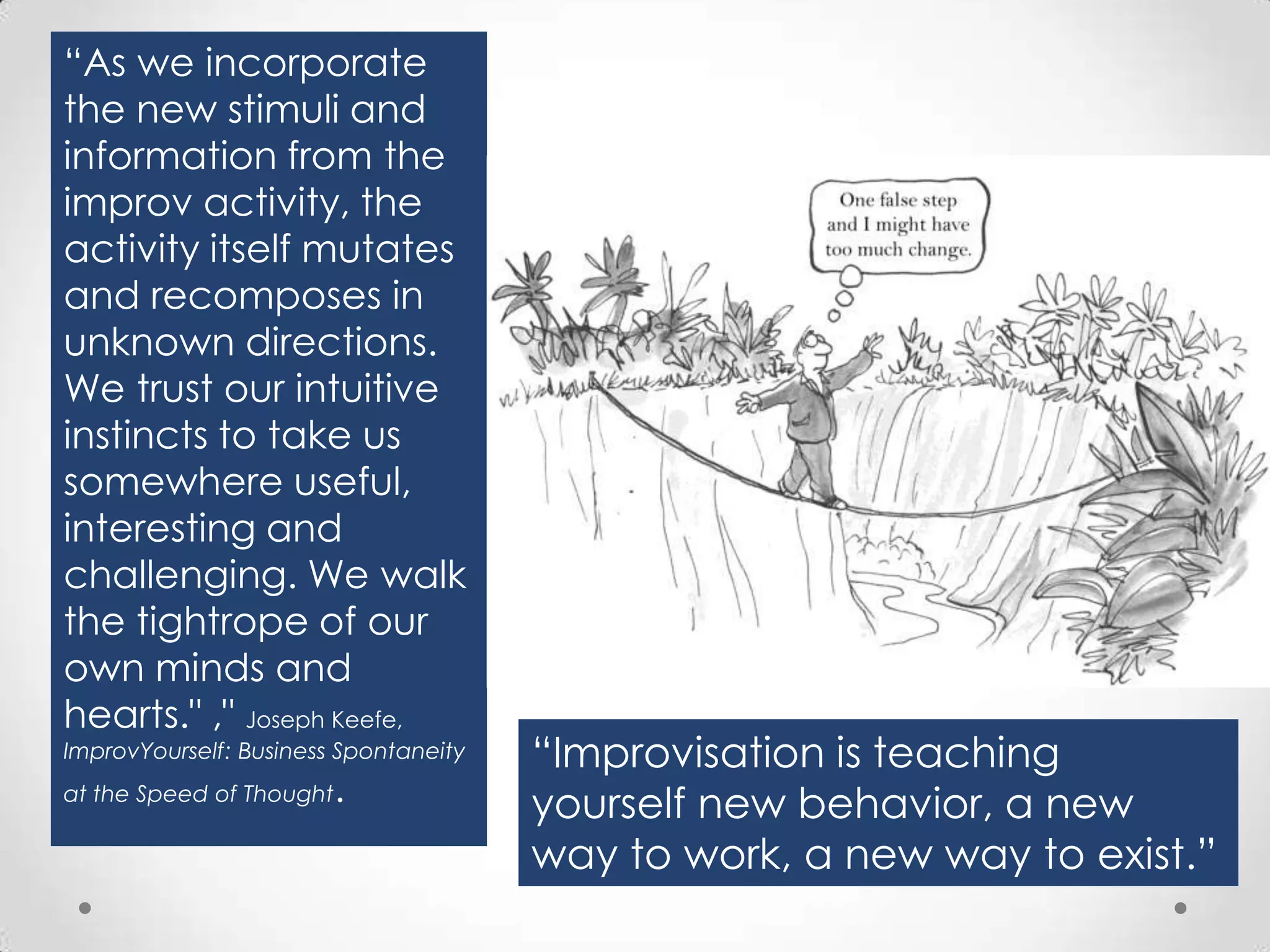
“As we incorporate
the new stimuli and
information from the
improv activity, the
activity itself mutates
and recomposes in
unknown directions.
We trust our intuitive
instincts to take us
somewhere useful,
interesting and
challenging. We walk
the tightrope of our
own minds and
hearts." ," Joseph Keefe,
ImprovYourself: Business Spontaneity
at the Speed of Thought

.

“Improvisation is teaching
yourself new behavior, a new
way to work, a new way to exist.”
Managing the uncertainty and
tensions of change are core
competencies of both emotional
intelligence and improvisation
• Engaging in a creative process with other people;
• Trying new things based on mutual agreement;
• Reflecting on the experience to stabilize the
cognitive shifts that have taken place;
Improv and EI occur
within a framework of
social belonging
“If your sense of belonging and self-esteem have
been thwarted, you’ll try to reconnect. Excluded
people actually become more sensitive to potential
signs of connection, and they tailor their behavior
accordingly. They will pay more attention to social
cues, be more likable, more likely to conform to other
people and more likely to comply with other people’s
requests.” Kirsten Weir, “The Pain of Social Rejection” American Psychological Association,
April 2012, Vol. 43, No. 4

https://www.apa.org/monitor/2012/04/rejection.aspx
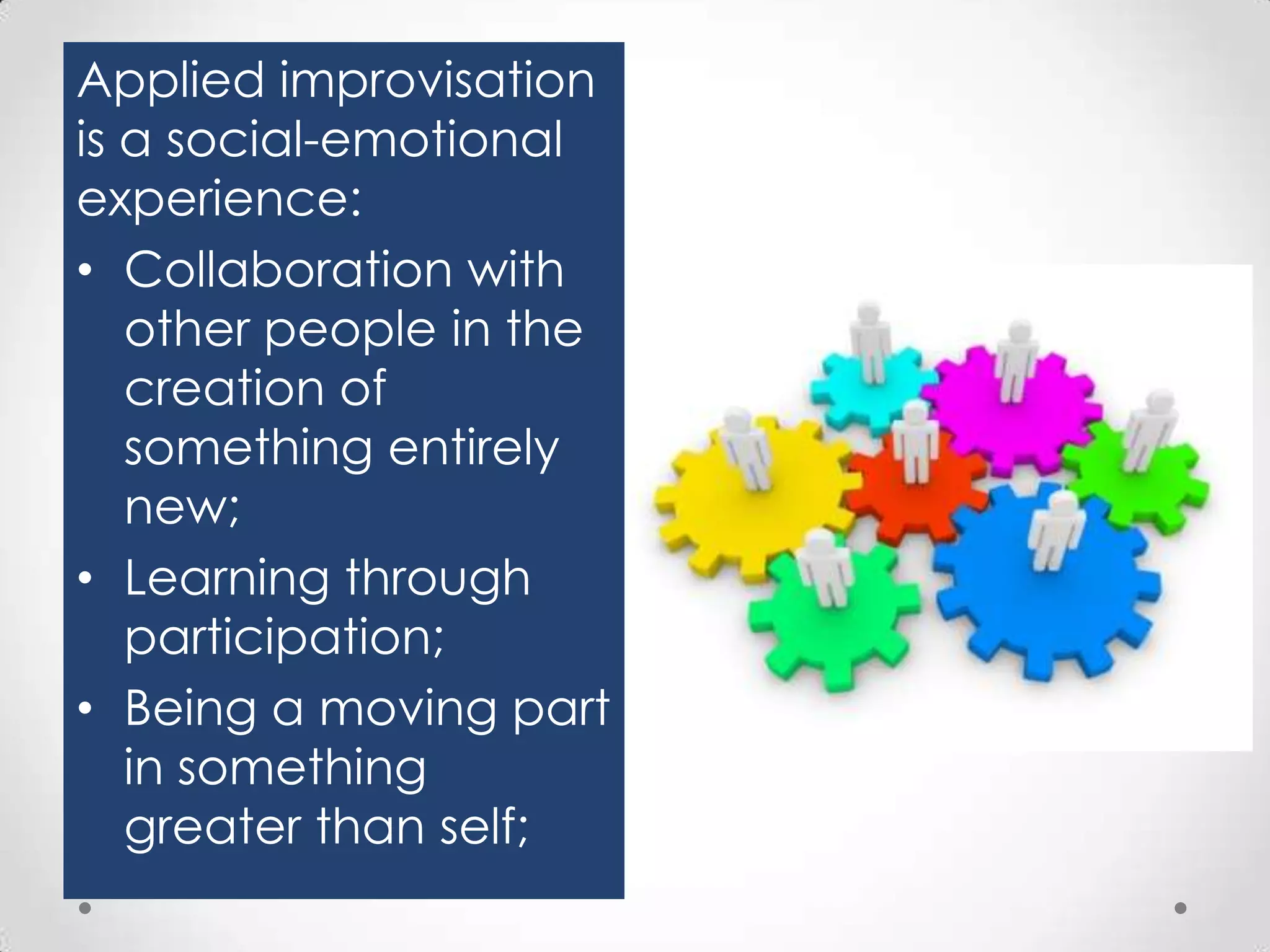
Applied improvisation
is a social-emotional
experience:
• Collaboration with
other people in the
creation of
something entirely
new;
• Learning through
participation;
• Being a moving part
in something
greater than self;
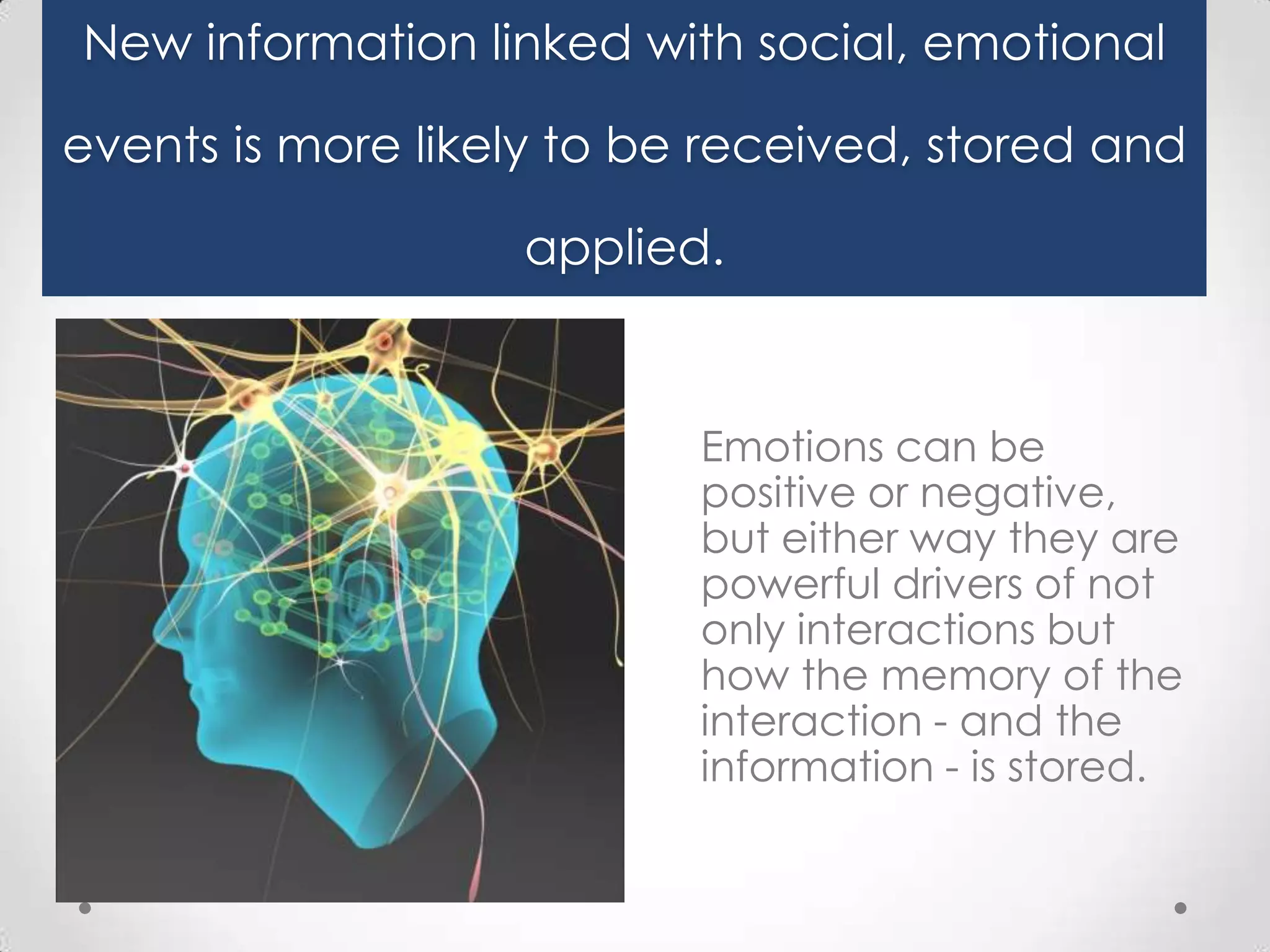
New information linked with social, emotional
events is more likely to be received, stored and
applied.

Emotions can be
positive or negative,
but either way they are
powerful drivers of not
only interactions but
how the memory of the
interaction - and the
information - is stored.
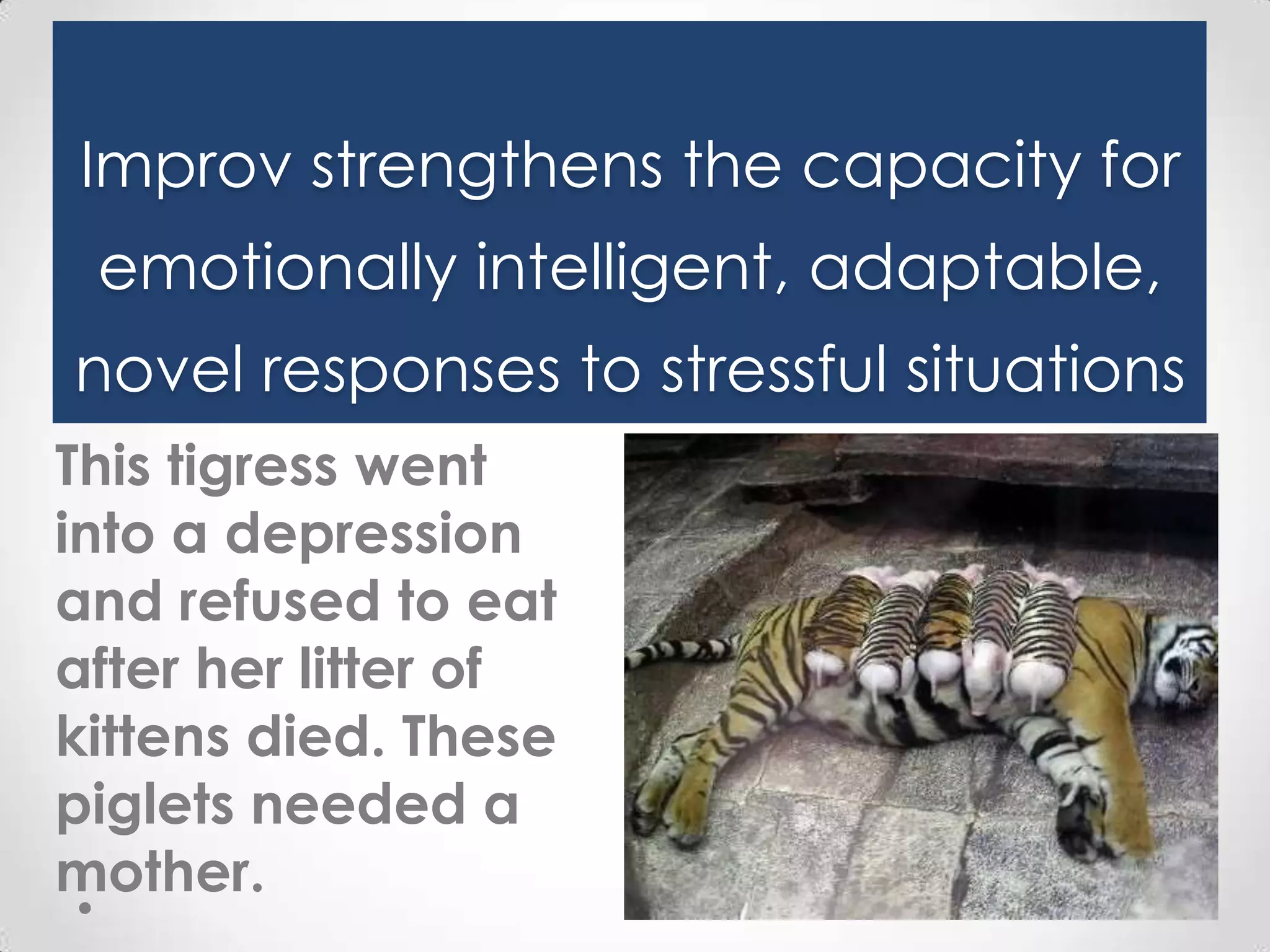
Improv strengthens the capacity for
emotionally intelligent, adaptable,

novel responses to stressful situations
This tigress went
into a depression
and refused to eat
after her litter of
kittens died. These
piglets needed a
mother.
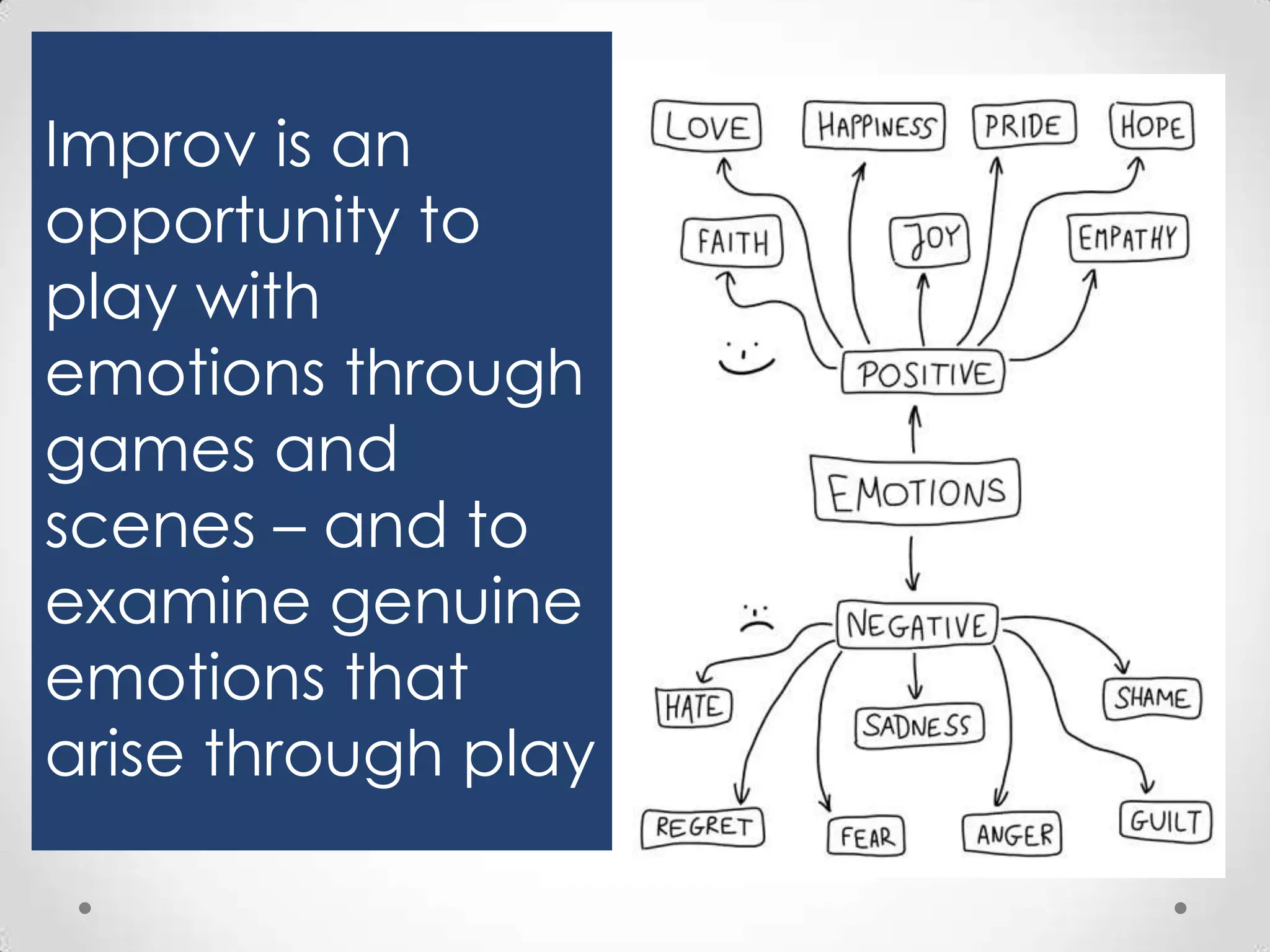
Improv is an
opportunity to
play with
emotions through
games and
scenes – and to
examine genuine
emotions that
arise through play
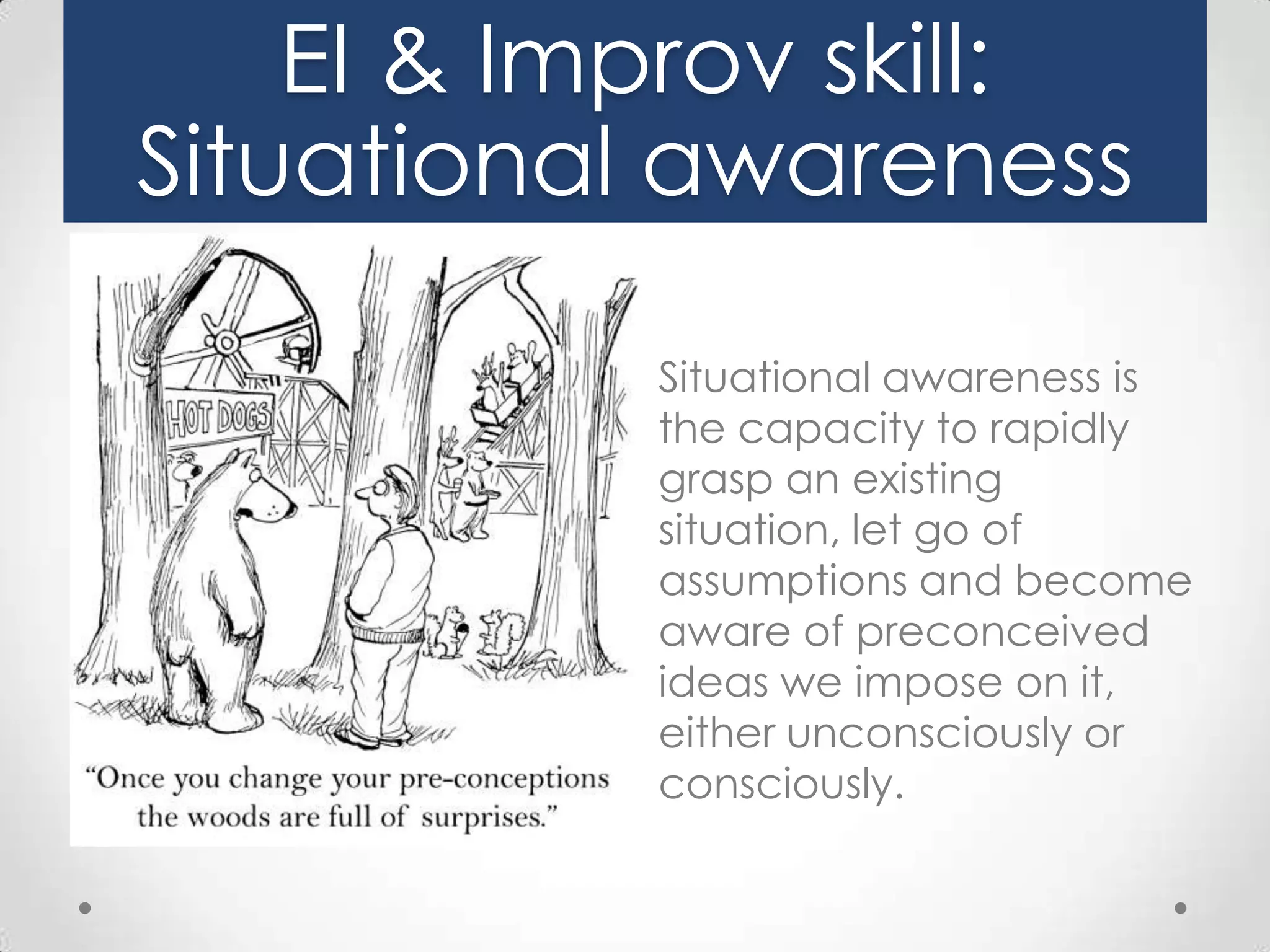
EI & Improv skill:
Situational awareness
Situational awareness is
the capacity to rapidly
grasp an existing
situation, let go of
assumptions and become
aware of preconceived
ideas we impose on it,
either unconsciously or
consciously.
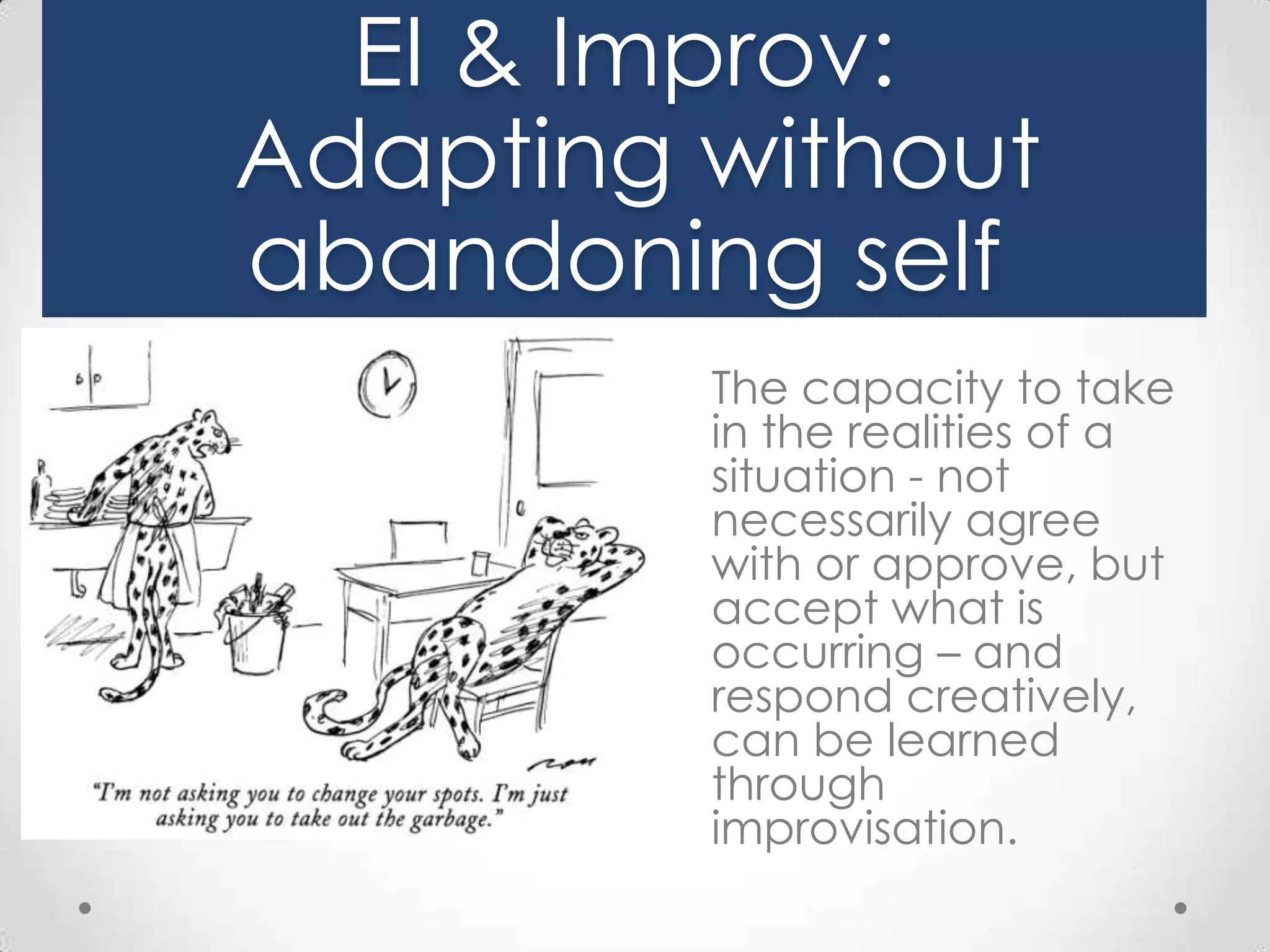
EI & Improv:
Adapting without
abandoning self
The capacity to take
in the realities of a
situation - not
necessarily agree
with or approve, but
accept what is
occurring – and
respond creatively,
can be learned
through
improvisation.
Working at the top
of our intelligence: an improv
principle that parallels EI
Practice specificity;
Connect patterns;
Recognize themes;
Add your own unique wisdom into the mix,
weaving together the personal, political,
and universal for improv that expands ideas;
• Develop individual strengths by focusing on
co-creation;
•
•
•
•
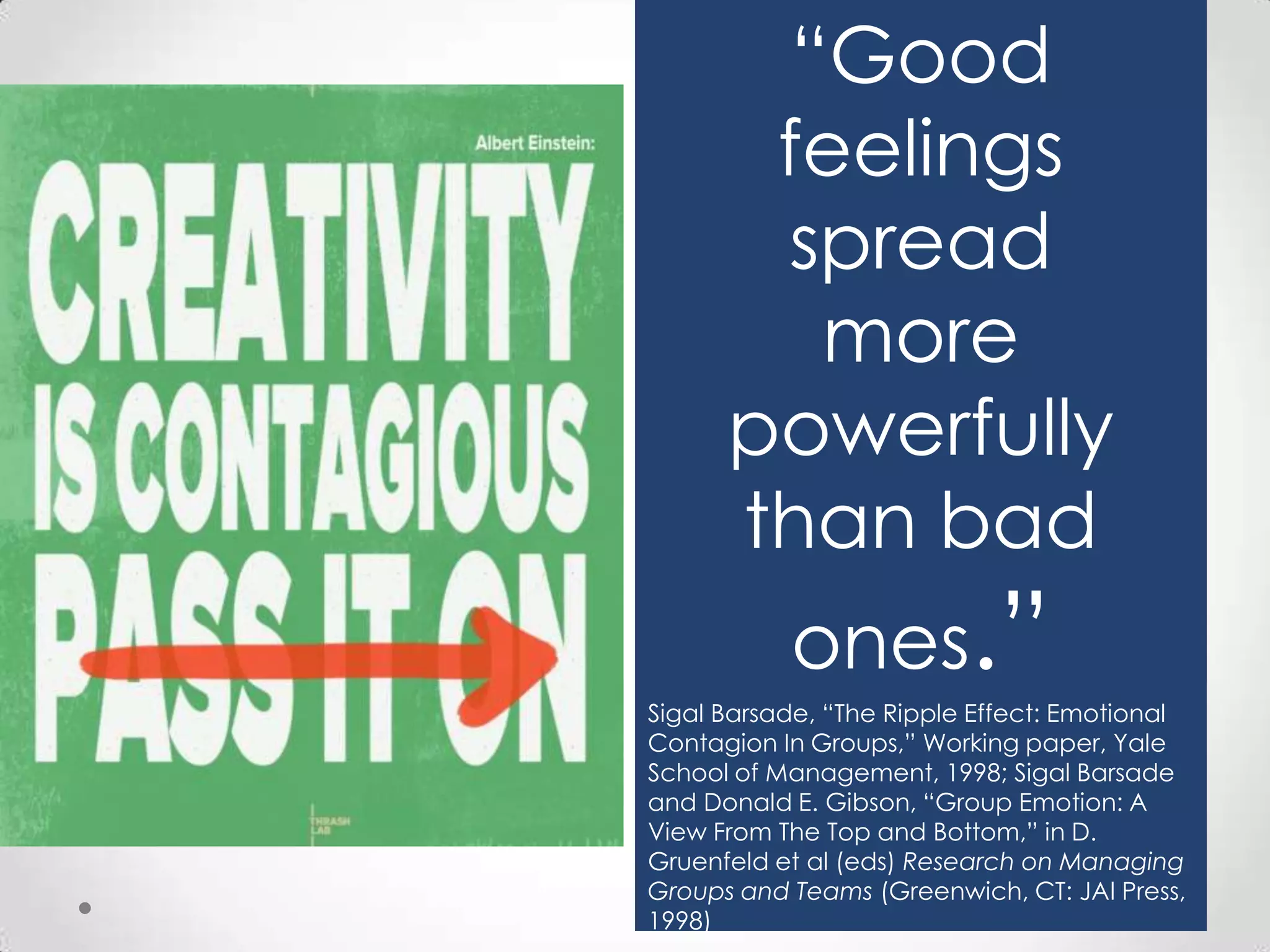
“Good
feelings
spread
more
powerfully
than bad
ones.”

Sigal Barsade, “The Ripple Effect: Emotional
Contagion In Groups,” Working paper, Yale
School of Management, 1998; Sigal Barsade
and Donald E. Gibson, “Group Emotion: A
View From The Top and Bottom,” in D.
Gruenfeld et al (eds) Research on Managing
Groups and Teams (Greenwich, CT: JAI Press,
1998)
Lifestage Trainings:
Creative
Experiential
Evidence-Based
496 Smithtown Bypass
Suite 202
Smithtown, NY 11787
www.lifestage.org

Contact Jude Treder-Wolff,
LCSW, RMT, CGP at 631366-4265 or
bookings@lifestage.org

Why emotional intelligence and improv are bf fs

  • 1.
  • 2.
    Emotional Intelligence (EI)is the expression of a rich interplay of conscious feelings, thought-action repertoires, and attitudes “Emotional Intelligence (EI) is the ability to engage our emotionality in effective ways in order to facilitate positive outcomes in our relationships.” “Emotional Intelligence In The Workplace: An Interview With Dr. Michael Rock” www.canadaone.com
  • 3.
    Emotional Intelligence & AppliedImprov: BFFS Emotional Intelligence: • Deals with the emotional impact people have on one another; • Is a skill and mind set for becoming aware of and managing emotions; • Is a skill and mind set for navigating fear, especially fear of change; • Improvisation: Occurs through interaction and the impact people have on one another moment to moment; • Grows out of emotional expression and emotional awareness; • Operates out of the basic tenet “follow the fear”; Change and uncertainty are central to the process •
  • 4.
    A key togood improvising is to be emotionally connected. Improvisers have great freedom to explore limitless options. Yet they must work together to create scenes and songs, and to do so, they need to be on the same page with the other actors. For this, they must rely on their emotional intelligence. Paul Zuckerman and Linda Gelman, “You Can’t Think And Act” Backstage, June 3, 2010
  • 5.
    “Emotions are a signalingsystem” “Emotional competence requires being able to pilot through the emotional undercurrents always at play rather than being pulled under by them.” Daniel Goleman, Working With Emotional Intelligence, Bantam Books, 1998
  • 6.
    Improvisation is trainingin emotional competence Research shows that the give and take that happens in the brain when jazz musicians improvise, for example, is "grounded in the same neural processes at play in every one of us when we engage in spontaneous selfexpression, like a conversation with a friend.“ Annie Murphy Paul, “What the Jazz Greats Knew About Creativity” TIME http://ideas.time.com/2012/03/21/lear ning-creativity-from-the-jazz-greats
  • 7.
    Improv experiences promote deeplearning through active engagement Using improvisation in education, training or personal growth settings will: Stimulate emotions; Attract attention; Encourage meaning making; Have immediate application to real-life situations; Create lasting memories of lessons learned; Willdorf, N. “Masters of improvisation,” The Chronicle of Higher Education, 4 2000). 46 (37), p. A12.
  • 8.
    Good improv growsout of emotionally intelligent interactions Listen, connect and collaborate; Make and keep agreements; Act with generosity of spirit; Maintain awareness of what others say and do; Respond to what is happening rather than imposing ideas; • Collaboration and co-creation rather than control; • • • • • Patricia Ryan Madson, Improv Wisdom: Don’t Prepare, Just Show Up, Random House, 2005
  • 9.
    "More active, concrete, experiential methods,such as role plays, group discussions, and simulations, usually work better than lecturing or assigned reading for social and emotional learning. The Consortium For Research In Emotional Intelligence in Organizations In order to reprogram neural circuits connecting emotions and the thinking processes, people need to actually engage in the desired pattern of thought, feeling, and action.
  • 10.
    The exercises and activitiesin improvisation require people to interact with others to achieve a common objective usually to tell a good story. The objective cannot be met if people don't work harmoniously together. In order to reach this goal, people develop the skills and understanding of what is required to work effectively together and how to enjoy it. http://www.beyondanxiety.com/treatment/improv.php
  • 11.
    The tensions ofthe creative process are the materials of emotional growth
  • 12.
    Improv principle #1: Takecare of each other
  • 13.
    Emotional Competence grows throughplay “We don’t become socially competent by authority figures telling us how to behave-we gain those skills by interacting with our peers, learning what’s acceptable and what’s not acceptable.” “The Serious Need For Play” Scientific American Mind Special Collector’s Edition, Winter 2014:
  • 14.
    “One of themost remarkable of all human skills is our ability to flexibly adapt to nearly every imaginable circumstance. This ability arises in part from our capacity to regulate emotions that are engendered by the situations we face.” Kevin N. Ochsner & James J. Gross, “Thinking makes it so: A social cognitive neuroscience approach to emotion regulation” K. Vohs & R. Baumeister (Eds.), The Handbook of Self-Regulation (2003) Erlbaum: NJ.
  • 15.
    Play has rulesand structure. Within them, anything can happen Improv is a training ground for developing situational awareness and responding effectively to unexpected and unpredictable situations.
  • 16.
    “Discomfort is avery underrated feeling.“ Julia Louis-Dreyfuss Emotional discomfort in a situation does not require emotional reactiveness; Emotional intelligence is a mind skill set that involves the capacity to regulate emotions and choose how to express them; Getting uncomfortable is necessary for growth
  • 17.
    “As we incorporate thenew stimuli and information from the improv activity, the activity itself mutates and recomposes in unknown directions. We trust our intuitive instincts to take us somewhere useful, interesting and challenging. We walk the tightrope of our own minds and hearts." ," Joseph Keefe, ImprovYourself: Business Spontaneity at the Speed of Thought . “Improvisation is teaching yourself new behavior, a new way to work, a new way to exist.”
  • 18.
    Managing the uncertaintyand tensions of change are core competencies of both emotional intelligence and improvisation • Engaging in a creative process with other people; • Trying new things based on mutual agreement; • Reflecting on the experience to stabilize the cognitive shifts that have taken place;
  • 19.
    Improv and EIoccur within a framework of social belonging “If your sense of belonging and self-esteem have been thwarted, you’ll try to reconnect. Excluded people actually become more sensitive to potential signs of connection, and they tailor their behavior accordingly. They will pay more attention to social cues, be more likable, more likely to conform to other people and more likely to comply with other people’s requests.” Kirsten Weir, “The Pain of Social Rejection” American Psychological Association, April 2012, Vol. 43, No. 4 https://www.apa.org/monitor/2012/04/rejection.aspx
  • 20.
    Applied improvisation is asocial-emotional experience: • Collaboration with other people in the creation of something entirely new; • Learning through participation; • Being a moving part in something greater than self;
  • 21.
    New information linkedwith social, emotional events is more likely to be received, stored and applied. Emotions can be positive or negative, but either way they are powerful drivers of not only interactions but how the memory of the interaction - and the information - is stored.
  • 22.
    Improv strengthens thecapacity for emotionally intelligent, adaptable, novel responses to stressful situations This tigress went into a depression and refused to eat after her litter of kittens died. These piglets needed a mother.
  • 23.
    Improv is an opportunityto play with emotions through games and scenes – and to examine genuine emotions that arise through play
  • 24.
    EI & Improvskill: Situational awareness Situational awareness is the capacity to rapidly grasp an existing situation, let go of assumptions and become aware of preconceived ideas we impose on it, either unconsciously or consciously.
  • 25.
    EI & Improv: Adaptingwithout abandoning self The capacity to take in the realities of a situation - not necessarily agree with or approve, but accept what is occurring – and respond creatively, can be learned through improvisation.
  • 26.
    Working at thetop of our intelligence: an improv principle that parallels EI Practice specificity; Connect patterns; Recognize themes; Add your own unique wisdom into the mix, weaving together the personal, political, and universal for improv that expands ideas; • Develop individual strengths by focusing on co-creation; • • • •
  • 27.
    “Good feelings spread more powerfully than bad ones.” Sigal Barsade,“The Ripple Effect: Emotional Contagion In Groups,” Working paper, Yale School of Management, 1998; Sigal Barsade and Donald E. Gibson, “Group Emotion: A View From The Top and Bottom,” in D. Gruenfeld et al (eds) Research on Managing Groups and Teams (Greenwich, CT: JAI Press, 1998)
  • 28.
    Lifestage Trainings: Creative Experiential Evidence-Based 496 SmithtownBypass Suite 202 Smithtown, NY 11787 www.lifestage.org Contact Jude Treder-Wolff, LCSW, RMT, CGP at 631366-4265 or bookings@lifestage.org