The Future of Classroom Technology
The Apple iPad
Space and Convenience.
What is the need?
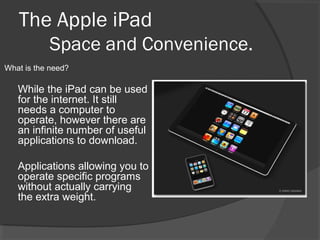
While the iPad can be used
for the internet. It still
needs a computer to
operate, however there are
an infinite number of useful
applications to download.
Applications allowing you to
operate specific programs
without actually carrying
the extra weight.
Research…..
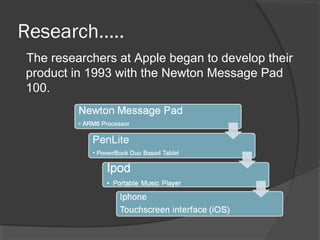
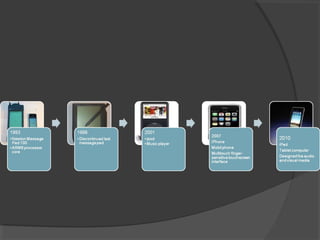
The researchers at Apple began to develop their
product in 1993 with the Newton Message Pad
100.
Development
Problems: Developed before the iPhone,
the project was put on hold when it was
realized that the product would work as
a mobile phone.
Audience: Anyone who likes to keep up
with technology.
Commercialization.
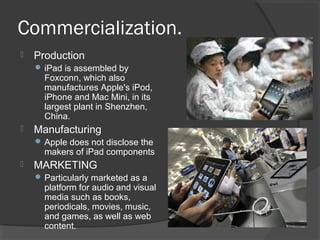
 Production
 iPad is assembled by
Foxconn, which also
manufactures Apple's iPod,
iPhone and Mac Mini, in its
largest plant in Shenzhen,
China.
 Manufacturing
 Apple does not disclose the
makers of iPad components
 MARKETING
 Particularly marketed as a
platform for audio and visual
media such as books,
periodicals, movies, music,
and games, as well as web
content.
A Timeline of Events
 Ipad released on April 3, 2010
 Apple had to push back the start date of
international sales because of the high
demand in the U.S.
 Sales topped 2 million by June 1 2010
 Sold 3million iPads in the first 80 days.
 Profits jumped 78% this year.
 Incompatibility with Flash
A Timeline of Events
 New applications and lower prices expected for 2011
 Walmart began sales of the iPad online Friday the 15th
of
October
 October 28th
Verizon and AT&T will begin selling the iPad
 iPad selling at triple the pace of the iPhone.
 Expected to generate global sales of 12 billion this year.
 By next year worldwide units sold will increase to 55 million
over the current 20 million, and by 2014 figures should reach
208 million. With North America expected to consume 61% of
those sales.
Adopter Categories
How do you label the innovators, from
the early adaptors, the early majority,
late majority, or laggard when there
appears to be an almost immediate
consumption of users for an innovation
before it even turns one? It is with my
best attempt that I will try to categorize
these groups
Adopter Categories
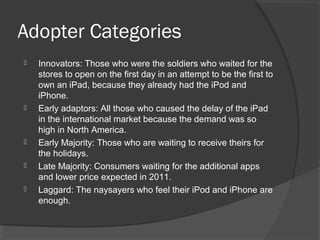
 Innovators: Those who were the soldiers who waited for the
stores to open on the first day in an attempt to be the first to
own an iPad, because they already had the iPod and
iPhone.
 Early adaptors: All those who caused the delay of the iPad
in the international market because the demand was so
high in North America.
 Early Majority: Those who are waiting to receive theirs for
the holidays.
 Late Majority: Consumers waiting for the additional apps
and lower price expected in 2011.
 Laggard: The naysayers who feel their iPod and iPhone are
enough.
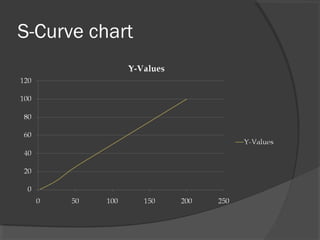
S-Curve
 It is expected that the iPad will have
amazing growth in the next few years, but it
should also be assumed that other
companies will produce their version of the
tablet computer to retrieve sales that were
lost.
 If indications of the first two products (iPod,
and iPhone) are any indication of the future
of iPad. The attempts at producing a
similar products will be met with much
resistance.
S-Curve chart
Why would the decentralized
approach work for the Ipad?
The U.S. Department of Education does not
yet impose uniformity among all schools and
school systems.
Local systems determine the requirements
of their district.
Innovation can be piloted through specific
schools.
Informal evaluation can be provided from
the pilot school and necessary adjustment
made prior to diffusing into districts or
nationally.
It can be adapted locally for the ends of its’
Key Change Agents
As with most of the innovation
that have been adopted
among teachers, the key
innovators will be the teachers
who already tend to learn new
technology quickly when it is
introduced to their schools.
Teachers tend to gravitate
naturally towards
innovations as their
usefulness is demonstrated
by early innovators.
Change Agents as linkers
 Who will facilitate the flow of
innovations?
Teachers
○ Teachers will be able to bring
attention to the need.
○ Teachers have rapport with the
students and parents
○ Teachers have the ability to
analyze problems and
determine alternatives.
○ Teacher know how to motivate
interest.
○ Teachers can stabilize
behaviors through
reinforcement.
○ Teachers create independent
learners
Teachers as Change Agents
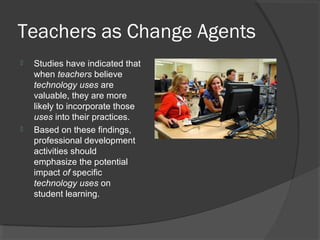
 Studies have indicated that
when teachers believe
technology uses are
valuable, they are more
likely to incorporate those
uses into their practices.
 Based on these findings,
professional development
activities should
emphasize the potential
impact of specific
technology uses on
student learning.
Teachers as Change Agents
 Specifically, research has
shown that access to
technology, a supportive
school culture, and
adequate Time for
teachers to explore
educational use of
technology are essential
for successful technology
integration
A Need for the iPad
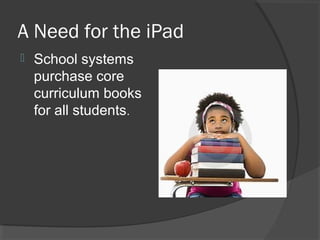
 School systems
purchase core
curriculum books
for all students.
School systems purchase core
curriculum books for all students.
 A typical middle school
student needs a minimum
of four books
 Books need to be
repurchased as material is
updated and curriculum
standards are changed.
 The value of books decline
quickly, but must be
repurchased as new when
more students enroll,
books are lost, stolen, or
damaged.
 Books downloaded
onto the iPad would...
 Save money on the cost of
purchasing material.
 Can be updated with the
most recent versions of the
book instantly.
 Cause less physical strain
on students, who generally
had to carry several large
books
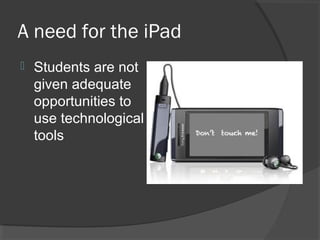
A need for the iPad
 Students are not
given adequate
opportunities to
use technological
tools
Students are not given adequate
opportunities to use these technological
tools.
 Students occasionally
used word processors
and the Internet, and they
rarely used spreadsheet,
presentation, or database
programs in their
learning.
 Ipads could connect
more hands on use of
technology for students.
 The iPad can connect to the
internet and give students
access to functions used on
computers.
 Student could have side by
side access to books, videos,
calculators, voice recorder, or
anything else related to
technology in the classroom.
References
 Danny King
http://www.dailyfinance.com/story/media/apple-ipad-launch-
all-time-most-successful/19665651/ October 2010
 http://www.usatoday.com/tech/products/2010-06-01-ipad-
sales_N.htm June 2010
 Michelle Maisto http://www.eweek.com/c/a/Mobile-and-
Wireless/Apple-iPad-Sales-to-Soar-Limited-Only-by-Lack-
of-Flash-Analysts-134043/ April 2010
 Mandy Rowe
http://www.onlinesocialmedia.net/20101015/tablets-such-
as-ipad-to-reach-sales-figures-of-208m-by-2014/ October
15, 2010
 Don Resinger http://news.cnet.com/8301-13506_3-
20019716-17.html October 15, 2010
Refrences
 Chen, R. (2010). Investigating Models for Preservice
Teachers' Use of Technology to Support Student-Centered
Learning. Computers & Education, 55(1), 32-42. Retrieved
from ERIC database.
 Ottenbreit-Leftwich, A., Glazewski, K., Newby, T., & Ertmer,
P. (2010). Teacher Value Beliefs Associated with Using
Technology: Addressing Professional and Student Needs.
Computers & Education, 55(3), 1321-1335. Retrieved from
ERIC database.

The apple ipad storyboard

  • 1.
    The Future ofClassroom Technology
  • 2.
    The Apple iPad Spaceand Convenience. What is the need? While the iPad can be used for the internet. It still needs a computer to operate, however there are an infinite number of useful applications to download. Applications allowing you to operate specific programs without actually carrying the extra weight.
  • 3.
    Research….. The researchers atApple began to develop their product in 1993 with the Newton Message Pad 100.
  • 4.
    Development Problems: Developed beforethe iPhone, the project was put on hold when it was realized that the product would work as a mobile phone. Audience: Anyone who likes to keep up with technology.
  • 5.
    Commercialization.  Production  iPadis assembled by Foxconn, which also manufactures Apple's iPod, iPhone and Mac Mini, in its largest plant in Shenzhen, China.  Manufacturing  Apple does not disclose the makers of iPad components  MARKETING  Particularly marketed as a platform for audio and visual media such as books, periodicals, movies, music, and games, as well as web content.
  • 6.
    A Timeline ofEvents  Ipad released on April 3, 2010  Apple had to push back the start date of international sales because of the high demand in the U.S.  Sales topped 2 million by June 1 2010  Sold 3million iPads in the first 80 days.  Profits jumped 78% this year.  Incompatibility with Flash
  • 7.
    A Timeline ofEvents  New applications and lower prices expected for 2011  Walmart began sales of the iPad online Friday the 15th of October  October 28th Verizon and AT&T will begin selling the iPad  iPad selling at triple the pace of the iPhone.  Expected to generate global sales of 12 billion this year.  By next year worldwide units sold will increase to 55 million over the current 20 million, and by 2014 figures should reach 208 million. With North America expected to consume 61% of those sales.
  • 10.
    Adopter Categories How doyou label the innovators, from the early adaptors, the early majority, late majority, or laggard when there appears to be an almost immediate consumption of users for an innovation before it even turns one? It is with my best attempt that I will try to categorize these groups
  • 11.
    Adopter Categories  Innovators:Those who were the soldiers who waited for the stores to open on the first day in an attempt to be the first to own an iPad, because they already had the iPod and iPhone.  Early adaptors: All those who caused the delay of the iPad in the international market because the demand was so high in North America.  Early Majority: Those who are waiting to receive theirs for the holidays.  Late Majority: Consumers waiting for the additional apps and lower price expected in 2011.  Laggard: The naysayers who feel their iPod and iPhone are enough.
  • 12.
    S-Curve  It isexpected that the iPad will have amazing growth in the next few years, but it should also be assumed that other companies will produce their version of the tablet computer to retrieve sales that were lost.  If indications of the first two products (iPod, and iPhone) are any indication of the future of iPad. The attempts at producing a similar products will be met with much resistance.
  • 13.
  • 14.
    Why would thedecentralized approach work for the Ipad? The U.S. Department of Education does not yet impose uniformity among all schools and school systems. Local systems determine the requirements of their district. Innovation can be piloted through specific schools. Informal evaluation can be provided from the pilot school and necessary adjustment made prior to diffusing into districts or nationally. It can be adapted locally for the ends of its’
  • 15.
    Key Change Agents Aswith most of the innovation that have been adopted among teachers, the key innovators will be the teachers who already tend to learn new technology quickly when it is introduced to their schools. Teachers tend to gravitate naturally towards innovations as their usefulness is demonstrated by early innovators.
  • 16.
    Change Agents aslinkers  Who will facilitate the flow of innovations? Teachers ○ Teachers will be able to bring attention to the need. ○ Teachers have rapport with the students and parents ○ Teachers have the ability to analyze problems and determine alternatives. ○ Teacher know how to motivate interest. ○ Teachers can stabilize behaviors through reinforcement. ○ Teachers create independent learners
  • 17.
    Teachers as ChangeAgents  Studies have indicated that when teachers believe technology uses are valuable, they are more likely to incorporate those uses into their practices.  Based on these findings, professional development activities should emphasize the potential impact of specific technology uses on student learning.
  • 18.
    Teachers as ChangeAgents  Specifically, research has shown that access to technology, a supportive school culture, and adequate Time for teachers to explore educational use of technology are essential for successful technology integration
  • 19.
    A Need forthe iPad  School systems purchase core curriculum books for all students.
  • 20.
    School systems purchasecore curriculum books for all students.  A typical middle school student needs a minimum of four books  Books need to be repurchased as material is updated and curriculum standards are changed.  The value of books decline quickly, but must be repurchased as new when more students enroll, books are lost, stolen, or damaged.  Books downloaded onto the iPad would...  Save money on the cost of purchasing material.  Can be updated with the most recent versions of the book instantly.  Cause less physical strain on students, who generally had to carry several large books
  • 21.
    A need forthe iPad  Students are not given adequate opportunities to use technological tools
  • 22.
    Students are notgiven adequate opportunities to use these technological tools.  Students occasionally used word processors and the Internet, and they rarely used spreadsheet, presentation, or database programs in their learning.  Ipads could connect more hands on use of technology for students.  The iPad can connect to the internet and give students access to functions used on computers.  Student could have side by side access to books, videos, calculators, voice recorder, or anything else related to technology in the classroom.
  • 23.
    References  Danny King http://www.dailyfinance.com/story/media/apple-ipad-launch- all-time-most-successful/19665651/October 2010  http://www.usatoday.com/tech/products/2010-06-01-ipad- sales_N.htm June 2010  Michelle Maisto http://www.eweek.com/c/a/Mobile-and- Wireless/Apple-iPad-Sales-to-Soar-Limited-Only-by-Lack- of-Flash-Analysts-134043/ April 2010  Mandy Rowe http://www.onlinesocialmedia.net/20101015/tablets-such- as-ipad-to-reach-sales-figures-of-208m-by-2014/ October 15, 2010  Don Resinger http://news.cnet.com/8301-13506_3- 20019716-17.html October 15, 2010
  • 24.
    Refrences  Chen, R.(2010). Investigating Models for Preservice Teachers' Use of Technology to Support Student-Centered Learning. Computers & Education, 55(1), 32-42. Retrieved from ERIC database.  Ottenbreit-Leftwich, A., Glazewski, K., Newby, T., & Ertmer, P. (2010). Teacher Value Beliefs Associated with Using Technology: Addressing Professional and Student Needs. Computers & Education, 55(3), 1321-1335. Retrieved from ERIC database.