

Quick FAQ
How Does Erasure Coding
Protect Data?
How Does Erasure Coding Protect Data?
RAID protects disk drives
Erasure Code protects data
Erasure Code
Data
“Raid6.svg” by CBurnett, DrJolo Licensed under Creative Commons By Attribution-ShareAlike 3.0 (http://creativecommons.org/licenses/by-sa/3.0/), via Wikimedia Commons
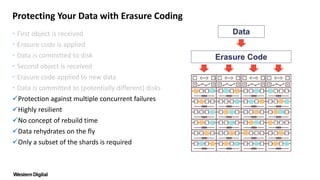
Protecting Your Data with Erasure Coding
• Erasure code is applied
Erasure Code
Data• First object is received
• Data is committed to disk
• Second object is received
• Erasure code applied to new data
• Data is committed to (potentially different) disks
Protection against multiple concurrent failures
Highly resilient
No concept of rebuild time
Data rehydrates on the fly
Only a subset of the shards is required
How Does Erasure Coding Protect Data?
Erasure Coding protects data by breaking it into shards that are parity encoded and then
stored across multiple storage media and locations.
Why you should care
• You can focus on protecting data, not hardware.
• You only need a subset of the shards to rehydrate data.
• You can always access your data. Even with hardware failure, there is no data rebuild time.
• You can protect data at a fraction of the expense and overhead of mirroring/replication*.
*per Western Digital Corporation internal testing: using 3-geo erasure coding requires 1.57x to 1.88x storage capacity compared with 3x required for triple mirroring
Thanks for watching
Clay Ryder
DCS Marketing
itblog.sandisk.com/author/clayryder
© 2017 Western Digital Corporation. All rights reserved. Western Digital and the Western Digital Logo are registered trademarks of Western Digital Corporation
or its affiliates in the U.S. and/or other countries. All other marks are the property of their respective owners.
"Faster Does It" Kevin MacLeod (incompetech.com) — Licensed under Creative Commons: By Attribution 3.0 http://creativecommons.org/licenses/by/3.0/
@WesternDigiDC
SanDisk Data Center Solutions
@BigDataFlash
HGST, a Western Digital brand

How Does Erasure Coding Protect Data?

  • 1.
    Quick FAQ How DoesErasure Coding Protect Data?
  • 2.
    How Does ErasureCoding Protect Data? RAID protects disk drives Erasure Code protects data Erasure Code Data “Raid6.svg” by CBurnett, DrJolo Licensed under Creative Commons By Attribution-ShareAlike 3.0 (http://creativecommons.org/licenses/by-sa/3.0/), via Wikimedia Commons
  • 3.
    Protecting Your Datawith Erasure Coding • Erasure code is applied Erasure Code Data• First object is received • Data is committed to disk • Second object is received • Erasure code applied to new data • Data is committed to (potentially different) disks Protection against multiple concurrent failures Highly resilient No concept of rebuild time Data rehydrates on the fly Only a subset of the shards is required
  • 4.
    How Does ErasureCoding Protect Data? Erasure Coding protects data by breaking it into shards that are parity encoded and then stored across multiple storage media and locations. Why you should care • You can focus on protecting data, not hardware. • You only need a subset of the shards to rehydrate data. • You can always access your data. Even with hardware failure, there is no data rebuild time. • You can protect data at a fraction of the expense and overhead of mirroring/replication*. *per Western Digital Corporation internal testing: using 3-geo erasure coding requires 1.57x to 1.88x storage capacity compared with 3x required for triple mirroring
  • 5.
    Thanks for watching ClayRyder DCS Marketing itblog.sandisk.com/author/clayryder
  • 6.
    © 2017 WesternDigital Corporation. All rights reserved. Western Digital and the Western Digital Logo are registered trademarks of Western Digital Corporation or its affiliates in the U.S. and/or other countries. All other marks are the property of their respective owners. "Faster Does It" Kevin MacLeod (incompetech.com) — Licensed under Creative Commons: By Attribution 3.0 http://creativecommons.org/licenses/by/3.0/ @WesternDigiDC SanDisk Data Center Solutions @BigDataFlash HGST, a Western Digital brand