Flash 101
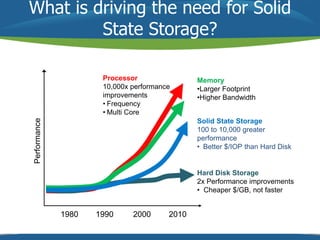
What is driving the need for Solid 
State Storage? 
Processor 
10,000x performance 
improvements 
• Frequency 
• Multi Core 
Memory 
•Larger Footprint 
•Higher Bandwidth 
Hard Disk Storage 
2x Performance improvements 
• Cheaper $/GB, not faster 
1980 
Performance 
1990 2000 2010 
Solid State Storage 
100 to 10,000 greater 
performance 
• Better $/IOP than Hard Disk
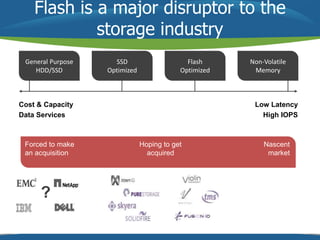
Flash is a major disruptor to the 
storage industry 
General Purpose 
HDD/SSD 
Cost & Capacity 
Data Services 
Low Latency 
High IOPS 
Hoping to get 
acquired 
Forced to make 
an acquisition 
SSD 
Optimized 
Flash 
Optimized 
Non-Volatile 
Memory 
? 
Nascent 
market
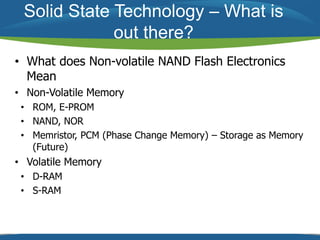
Solid State Technology – What is 
out there? 
• What does Non-volatile NAND Flash Electronics 
Mean 
• Non-Volatile Memory 
• ROM, E-PROM 
• NAND, NOR 
• Memristor, PCM (Phase Change Memory) – Storage as Memory 
(Future) 
• Volatile Memory 
• D-RAM 
• S-RAM
Solid State Technology – Available 
today 
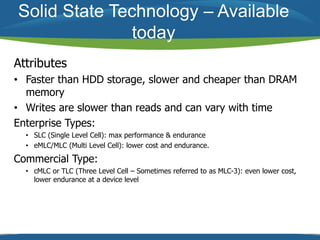
Attributes 
• Faster than HDD storage, slower and cheaper than DRAM 
memory 
• Writes are slower than reads and can vary with time 
Enterprise Types: 
• SLC (Single Level Cell): max performance & endurance 
• eMLC/MLC (Multi Level Cell): lower cost and endurance. 
Commercial Type: 
• cMLC or TLC (Three Level Cell – Sometimes referred to as MLC-3): even lower cost, 
lower endurance at a device level
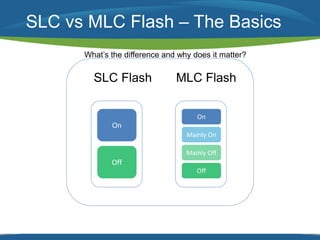
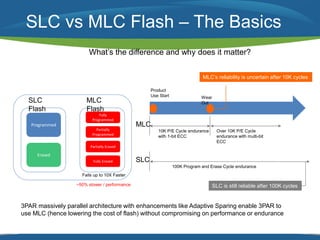
SLC vs MLC Flash – The Basics 
What’s the difference and why does it matter? 
SLC Flash MLC Flash 
On 
Off 
On 
Mainly On 
Mainly Off 
Off
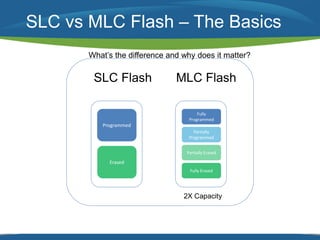
SLC vs MLC Flash – The Basics 
What’s the difference and why does it matter? 
SLC Flash MLC Flash 
Programmed 
Erased 
Fully 
Programmed 
Partially 
Programmed 
Partially Erased 
Fully Erased 
2X Capacity
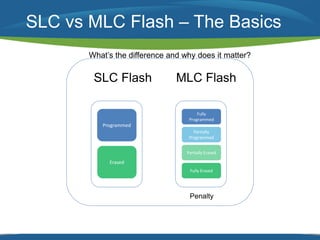
SLC vs MLC Flash – The Basics 
What’s the difference and why does it matter? 
SLC Flash MLC Flash 
Programmed 
Erased 
Fully 
Programmed 
Partially 
Programmed 
Partially Erased 
Fully Erased 
Penalty
SLC vs MLC Flash – The Basics 
What’s the difference and why does it matter? 
SLC 
Flash 
MLC 
Flash 
Programmed 
Erased 
Fully 
Programmed 
Partially 
Programmed 
Partially Erased 
Fully Erased 
Fails up to 10X Faster 
~50% slower / performance 
MLC 
SLC 
MLC’s reliability is uncertain after 10K cycles 
Product 
Use Start Wear 
Out 
10K P/E Cycle endurance 
with 1-bit ECC 
Over 10K P/E Cycle 
endurance with multi-bit 
ECC 
100K Program and Erase Cycle endurance 
SLC is still reliable after 100K cycles 
3PAR massively parallel architecture with enhancements like Adaptive Sparing enable 3PAR to 
use MLC (hence lowering the cost of flash) without compromising on performance or endurance
SLC vs MLC Flash – The Basics 
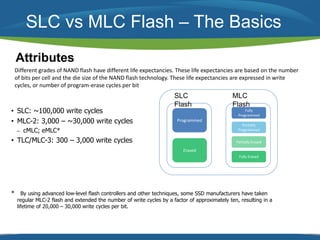
Attributes 
Different grades of NAND flash have different life expectancies. These life expectancies are based on the number 
of bits per cell and the die size of the NAND flash technology. These life expectancies are expressed in write 
cycles, or number of program-erase cycles per bit 
• SLC: ~100,000 write cycles 
• MLC-2: 3,000 – ~30,000 write cycles 
– cMLC; eMLC* 
• TLC/MLC-3: 300 – 3,000 write cycles 
SLC 
Flash 
MLC 
Flash 
Programmed 
Erased 
Fully 
Programmed 
Partially 
Programmed 
Partially Erased 
Fully Erased 
* By using advanced low-level flash controllers and other techniques, some SSD manufacturers have taken 
regular MLC-2 flash and extended the number of write cycles by a factor of approximately ten, resulting in a 
lifetime of 20,000 – 30,000 write cycles per bit.
SLC vs MLC vs TLC Flash – The 
Basics 
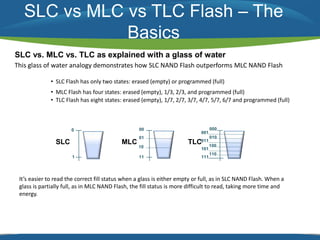
SLC vs. MLC vs. TLC as explained with a glass of water 
This glass of water analogy demonstrates how SLC NAND Flash outperforms MLC NAND Flash 
• SLC Flash has only two states: erased (empty) or programmed (full) 
• MLC Flash has four states: erased (empty), 1/3, 2/3, and programmed (full) 
• TLC Flash has eight states: erased (empty), 1/7, 2/7, 3/7, 4/7, 5/7, 6/7 and programmed (full) 
0 
1 
SLC 
00 
01 
10 
11 
MLC 
000 
001 
011 
101 
TLC 
111 
010 
100 
110 
It’s easier to read the correct fill status when a glass is either empty or full, as in SLC NAND Flash. When a 
glass is partially full, as in MLC NAND Flash, the fill status is more difficult to read, taking more time and 
energy.
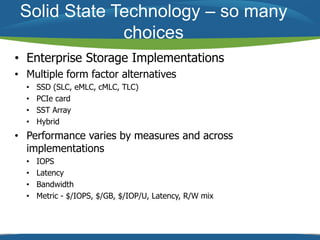
Solid State Technology – so many 
choices 
• Enterprise Storage Implementations 
• Multiple form factor alternatives 
• SSD (SLC, eMLC, cMLC, TLC) 
• PCIe card 
• SST Array 
• Hybrid 
• Performance varies by measures and across 
implementations 
• IOPS 
• Latency 
• Bandwidth 
• Metric - $/IOPS, $/GB, $/IOP/U, Latency, R/W mix
What does the future have in store 
for Flash? 
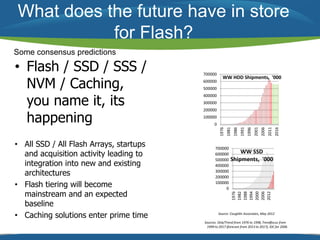
Some consensus predictions 
• Flash / SSD / SSS / 
NVM / Caching, 
you name it, its 
happening 
• All SSD / All Flash Arrays, startups 
and acquisition activity leading to 
integration into new and existing 
architectures 
• Flash tiering will become 
mainstream and an expected 
baseline 
• Caching solutions enter prime time 
700000 
600000 
500000 
400000 
300000 
200000 
100000 
0 
WW HDD Shipments, '000 
1976 
1981 
1986 
1991 
1996 
2001 
2006 
2011 
2016 
700000 
600000 
500000 
400000 
300000 
200000 
100000 
0 
WW SSD 
Shipments, '000 
1976 
1982 
1988 
1994 
2000 
2006 
2012 
Source: Coughlin Associates, May 2012 
Sources: Disk/Trend from 1976 to 1998, Trendfocus from 
1999 to 2017 (forecast from 2013 to 2017), IDC for 2006
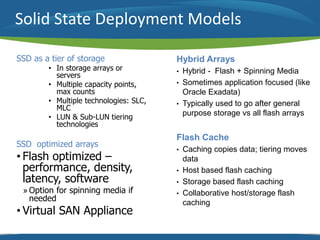
Solid State Deployment Models 
SSD as a tier of storage 
• In storage arrays or 
servers 
• Multiple capacity points, 
max counts 
• Multiple technologies: SLC, 
MLC 
• LUN & Sub-LUN tiering 
technologies 
SSD optimized arrays 
• Flash optimized – 
performance, density, 
latency, software 
» Option for spinning media if 
needed 
• Virtual SAN Appliance 
Hybrid Arrays 
• Hybrid - Flash + Spinning Media 
• Sometimes application focused (like 
Oracle Exadata) 
• Typically used to go after general 
purpose storage vs all flash arrays 
Flash Cache 
• Caching copies data; tiering moves 
data 
• Host based flash caching 
• Storage based flash caching 
• Collaborative host/storage flash 
caching
Thank you! 
Contact Unitiv: www.unitiv.com | info@unitiv.com | 877-621-4212

Flash Storage Technology 101

  • 1.
  • 2.
    What is drivingthe need for Solid State Storage? Processor 10,000x performance improvements • Frequency • Multi Core Memory •Larger Footprint •Higher Bandwidth Hard Disk Storage 2x Performance improvements • Cheaper $/GB, not faster 1980 Performance 1990 2000 2010 Solid State Storage 100 to 10,000 greater performance • Better $/IOP than Hard Disk
  • 3.
    Flash is amajor disruptor to the storage industry General Purpose HDD/SSD Cost & Capacity Data Services Low Latency High IOPS Hoping to get acquired Forced to make an acquisition SSD Optimized Flash Optimized Non-Volatile Memory ? Nascent market
  • 4.
    Solid State Technology– What is out there? • What does Non-volatile NAND Flash Electronics Mean • Non-Volatile Memory • ROM, E-PROM • NAND, NOR • Memristor, PCM (Phase Change Memory) – Storage as Memory (Future) • Volatile Memory • D-RAM • S-RAM
  • 5.
    Solid State Technology– Available today Attributes • Faster than HDD storage, slower and cheaper than DRAM memory • Writes are slower than reads and can vary with time Enterprise Types: • SLC (Single Level Cell): max performance & endurance • eMLC/MLC (Multi Level Cell): lower cost and endurance. Commercial Type: • cMLC or TLC (Three Level Cell – Sometimes referred to as MLC-3): even lower cost, lower endurance at a device level
  • 6.
    SLC vs MLCFlash – The Basics What’s the difference and why does it matter? SLC Flash MLC Flash On Off On Mainly On Mainly Off Off
  • 7.
    SLC vs MLCFlash – The Basics What’s the difference and why does it matter? SLC Flash MLC Flash Programmed Erased Fully Programmed Partially Programmed Partially Erased Fully Erased 2X Capacity
  • 8.
    SLC vs MLCFlash – The Basics What’s the difference and why does it matter? SLC Flash MLC Flash Programmed Erased Fully Programmed Partially Programmed Partially Erased Fully Erased Penalty
  • 9.
    SLC vs MLCFlash – The Basics What’s the difference and why does it matter? SLC Flash MLC Flash Programmed Erased Fully Programmed Partially Programmed Partially Erased Fully Erased Fails up to 10X Faster ~50% slower / performance MLC SLC MLC’s reliability is uncertain after 10K cycles Product Use Start Wear Out 10K P/E Cycle endurance with 1-bit ECC Over 10K P/E Cycle endurance with multi-bit ECC 100K Program and Erase Cycle endurance SLC is still reliable after 100K cycles 3PAR massively parallel architecture with enhancements like Adaptive Sparing enable 3PAR to use MLC (hence lowering the cost of flash) without compromising on performance or endurance
  • 10.
    SLC vs MLCFlash – The Basics Attributes Different grades of NAND flash have different life expectancies. These life expectancies are based on the number of bits per cell and the die size of the NAND flash technology. These life expectancies are expressed in write cycles, or number of program-erase cycles per bit • SLC: ~100,000 write cycles • MLC-2: 3,000 – ~30,000 write cycles – cMLC; eMLC* • TLC/MLC-3: 300 – 3,000 write cycles SLC Flash MLC Flash Programmed Erased Fully Programmed Partially Programmed Partially Erased Fully Erased * By using advanced low-level flash controllers and other techniques, some SSD manufacturers have taken regular MLC-2 flash and extended the number of write cycles by a factor of approximately ten, resulting in a lifetime of 20,000 – 30,000 write cycles per bit.
  • 11.
    SLC vs MLCvs TLC Flash – The Basics SLC vs. MLC vs. TLC as explained with a glass of water This glass of water analogy demonstrates how SLC NAND Flash outperforms MLC NAND Flash • SLC Flash has only two states: erased (empty) or programmed (full) • MLC Flash has four states: erased (empty), 1/3, 2/3, and programmed (full) • TLC Flash has eight states: erased (empty), 1/7, 2/7, 3/7, 4/7, 5/7, 6/7 and programmed (full) 0 1 SLC 00 01 10 11 MLC 000 001 011 101 TLC 111 010 100 110 It’s easier to read the correct fill status when a glass is either empty or full, as in SLC NAND Flash. When a glass is partially full, as in MLC NAND Flash, the fill status is more difficult to read, taking more time and energy.
  • 12.
    Solid State Technology– so many choices • Enterprise Storage Implementations • Multiple form factor alternatives • SSD (SLC, eMLC, cMLC, TLC) • PCIe card • SST Array • Hybrid • Performance varies by measures and across implementations • IOPS • Latency • Bandwidth • Metric - $/IOPS, $/GB, $/IOP/U, Latency, R/W mix
  • 13.
    What does thefuture have in store for Flash? Some consensus predictions • Flash / SSD / SSS / NVM / Caching, you name it, its happening • All SSD / All Flash Arrays, startups and acquisition activity leading to integration into new and existing architectures • Flash tiering will become mainstream and an expected baseline • Caching solutions enter prime time 700000 600000 500000 400000 300000 200000 100000 0 WW HDD Shipments, '000 1976 1981 1986 1991 1996 2001 2006 2011 2016 700000 600000 500000 400000 300000 200000 100000 0 WW SSD Shipments, '000 1976 1982 1988 1994 2000 2006 2012 Source: Coughlin Associates, May 2012 Sources: Disk/Trend from 1976 to 1998, Trendfocus from 1999 to 2017 (forecast from 2013 to 2017), IDC for 2006
  • 14.
    Solid State DeploymentModels SSD as a tier of storage • In storage arrays or servers • Multiple capacity points, max counts • Multiple technologies: SLC, MLC • LUN & Sub-LUN tiering technologies SSD optimized arrays • Flash optimized – performance, density, latency, software » Option for spinning media if needed • Virtual SAN Appliance Hybrid Arrays • Hybrid - Flash + Spinning Media • Sometimes application focused (like Oracle Exadata) • Typically used to go after general purpose storage vs all flash arrays Flash Cache • Caching copies data; tiering moves data • Host based flash caching • Storage based flash caching • Collaborative host/storage flash caching
  • 15.
    Thank you! ContactUnitiv: www.unitiv.com | info@unitiv.com | 877-621-4212

Editor's Notes

  • #4 EMC buys XtremeIO IBM buys Texas Memory Systems NetApp buys CacheIQ SanDisk buys FlashSoft OCZ buys Sanrad
  • #7 SSD Form Factors SSDs can be implemented in several form factors. Although either DRAM or NAND flash could be used for these, NAND flash is the most common type of SSD technology used today. These form factors include:  SSD-specific – Newer form factors specifically designed for SSDs.  Disk drive – Any of the 3.5-inch, 2.5-inch, 1.8-inch, or other sizes of disk drives.  PCIe card – A PCI-Express® card with SSD technology mounted directly on it.  Memory slot – NAND flash can be mounted on 240-pin DIMMs along with a SATA or other storage interface to provide storage in unused DIMM sockets.
  • #11 Flash is erased in blocks, not a word or bit at a time. The blocks are sized by the flash manufacturer in order to balance silicon area (since each erase block carries a fair amount of overhead circuitry) and ease of use. Because of the logic structure of NAND flash, the flash must also be written or read in fairly large pages, typically 1 K to 4 KB. These pages are written from or read to a page buffer, from which individual byte reads or writes are done. Each erase block contains between 32 and 128 pages
  • #13 SSDs are dollars per gigabyte and pennies per IOPS. HDDs are pennies per gigabyte and dollars per IOPS.
  • #15 Mid level enterprise SLC drives together with intelligent tiering software and wide striping lower $/IOP AND $/GB