THE AETA
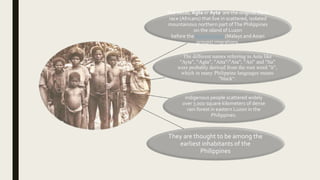
The Aetas, Agta or Ayta are the original black
race (Africans) that live in scattered, isolated
mountainous northern part ofThe Philippines
on the island of Luzon
before the Austronesian (Malays and Asian
groups) migrations.
The different names referring to Aeta like
"Ayta", "Agta", "Atta"/"Ata", "Ati" and "Ita"
were probably derived from the root word "it",
which in many Philippine languages means
"black“.
indigenous people scattered widely
over 7,000 square kilometers of dense
rain forest in eastern Luzon in the
Philippines.
They are thought to be among the
earliest inhabitants of the
Philippines
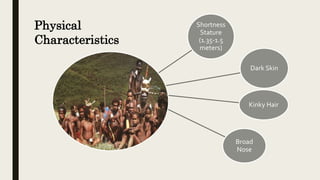
Shortness
Stature
(1.35-1.5
meters)
Dark Skin
Kinky Hair
Broad
Nose
Physical
Characteristics
Agta
or
Aeta
The Agtas grow root crops, rice and vegetables in their
farms. Rice takes time to harvest, so they substitute it
with a boiled root crop called “dugma,” which gives
them a shorter harvest time.
Hunting is another means of subsistence for the Agtas.
They catch running game by spearing them with
pointed sticks called “galud” or by means of pit-traps.
Birds are caught by using slingshots locally known as
“labtik” and traps made from a glue-like sap called
“dikit.”
CULTURE
LANGUAGE
• Mag-indi
• Mag-antsi
• Abellen
• Ambala
• Mariveleño
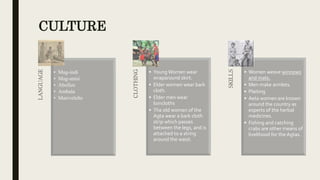
CLOTHING
• Young Women wear
wraparound skirt.
• Elder women wear bark
cloth.
• Elder men wear
loincloths
• The old women of the
Agta wear a bark cloth
strip which passes
between the legs, and is
attached to a string
around the waist.
SKILLS
• Women weave winnows
and mats.
• Men make armlets.
• Plaiting
• Aeta women are known
around the country as
experts of the herbal
medicines.
• Fishing and catching
crabs are other means of
livelihood for the Agtas.
Terms
Baslay- a bow and arrow used for fishing
Banwit-a set of fishing instrument
Boro- a slender bamboo with a few meters of nylon at one end that has a hook where bait is placed
Sulo-a small torch used to attract the fishes and crabs during night-time fishing
Agahid- a net used for catching fishes and crabs
Kawit- a hooked wire used to dislodge crabs from their hiding places
Sagad-a rattan basket where the catch is placed
Bobo- a trap made from split bamboo fastened together with rattan
Alawa- a fishnet for shallow waters during low tide
CULTURE
A traditional form of visual art is
body scarification. Other "decorative
disfigurements" include the chipping of the
teeth.
The Aetas intentionally wound the skin
on their back, arms, breast, legs,
hands, calves and abdomen, and then
they irritate the wounds with fire, lime
and other means to form scars.
Flowers and leaves are used as earplugs
for certain occasions. Girdles, necklaces,
and neckbands of braided rattan
incorporated with wild pig bristles are
frequently worn.
Art
The Aeta have a musical
heritage consisting of
various types of agung
ensembles– ensembles
composed of large
hanging, suspended or
held,
bossed/knobbed gongs
which act as drone
without any
accompanying melodic
instrument.
Music
Religious
Practices
Monotheistic
Believing in one all-powerful character
who rules over the lower entities
The Pinatubo Aeta of Mt. Pinatuba
worship a god called Apo Namalyari.
The Aeta are animists, believing that non-
human forms are spiritual enitities
THE MALAWEG
•25,000Population
•ItawitPrimary
language
•MalawegPrimary
Dialect
•ChristianityPrimary
Religion
Malaweg They are located in sections of Cagayan Valley and Kalinga-apayao
provinces and in the town of Rizal.
Physically, Malauegs have dark complexion, of medium height and with big
body built.
They are known to be quiet, humble, modest, and loyal people.
Agriculture and fishing serves their main economic activities.
are monogamous and still practice the old customs in their way of courtship
and marriage.
Giving birth for a Malaueg mother is also replete with ritual practices. Upon
birth, the child will be wrapped in a clean cloth and placed in a biga-o,
thereafter, it will be pushed towards the door and then the child will be given
a name. Afterwards, the child will be laid beside the mother who is then is
given ampalaya leaf extracts so that the blood sucked inside the mothers
womb is spewed.
Their main crops are lowland rice and corn.

The aeta and malaweg

  • 1.
  • 2.
    The Aetas, Agtaor Ayta are the original black race (Africans) that live in scattered, isolated mountainous northern part ofThe Philippines on the island of Luzon before the Austronesian (Malays and Asian groups) migrations. The different names referring to Aeta like "Ayta", "Agta", "Atta"/"Ata", "Ati" and "Ita" were probably derived from the root word "it", which in many Philippine languages means "black“. indigenous people scattered widely over 7,000 square kilometers of dense rain forest in eastern Luzon in the Philippines. They are thought to be among the earliest inhabitants of the Philippines
  • 3.
  • 4.
    Agta or Aeta The Agtas growroot crops, rice and vegetables in their farms. Rice takes time to harvest, so they substitute it with a boiled root crop called “dugma,” which gives them a shorter harvest time. Hunting is another means of subsistence for the Agtas. They catch running game by spearing them with pointed sticks called “galud” or by means of pit-traps. Birds are caught by using slingshots locally known as “labtik” and traps made from a glue-like sap called “dikit.”
  • 5.
    CULTURE LANGUAGE • Mag-indi • Mag-antsi •Abellen • Ambala • Mariveleño CLOTHING • Young Women wear wraparound skirt. • Elder women wear bark cloth. • Elder men wear loincloths • The old women of the Agta wear a bark cloth strip which passes between the legs, and is attached to a string around the waist. SKILLS • Women weave winnows and mats. • Men make armlets. • Plaiting • Aeta women are known around the country as experts of the herbal medicines. • Fishing and catching crabs are other means of livelihood for the Agtas.
  • 6.
    Terms Baslay- a bowand arrow used for fishing Banwit-a set of fishing instrument Boro- a slender bamboo with a few meters of nylon at one end that has a hook where bait is placed Sulo-a small torch used to attract the fishes and crabs during night-time fishing Agahid- a net used for catching fishes and crabs Kawit- a hooked wire used to dislodge crabs from their hiding places Sagad-a rattan basket where the catch is placed Bobo- a trap made from split bamboo fastened together with rattan Alawa- a fishnet for shallow waters during low tide
  • 7.
    CULTURE A traditional formof visual art is body scarification. Other "decorative disfigurements" include the chipping of the teeth. The Aetas intentionally wound the skin on their back, arms, breast, legs, hands, calves and abdomen, and then they irritate the wounds with fire, lime and other means to form scars. Flowers and leaves are used as earplugs for certain occasions. Girdles, necklaces, and neckbands of braided rattan incorporated with wild pig bristles are frequently worn. Art The Aeta have a musical heritage consisting of various types of agung ensembles– ensembles composed of large hanging, suspended or held, bossed/knobbed gongs which act as drone without any accompanying melodic instrument. Music
  • 8.
    Religious Practices Monotheistic Believing in oneall-powerful character who rules over the lower entities The Pinatubo Aeta of Mt. Pinatuba worship a god called Apo Namalyari. The Aeta are animists, believing that non- human forms are spiritual enitities
  • 9.
  • 10.
  • 11.
    Malaweg They arelocated in sections of Cagayan Valley and Kalinga-apayao provinces and in the town of Rizal. Physically, Malauegs have dark complexion, of medium height and with big body built. They are known to be quiet, humble, modest, and loyal people. Agriculture and fishing serves their main economic activities. are monogamous and still practice the old customs in their way of courtship and marriage. Giving birth for a Malaueg mother is also replete with ritual practices. Upon birth, the child will be wrapped in a clean cloth and placed in a biga-o, thereafter, it will be pushed towards the door and then the child will be given a name. Afterwards, the child will be laid beside the mother who is then is given ampalaya leaf extracts so that the blood sucked inside the mothers womb is spewed. Their main crops are lowland rice and corn.