TRIBES
BUKIDNON
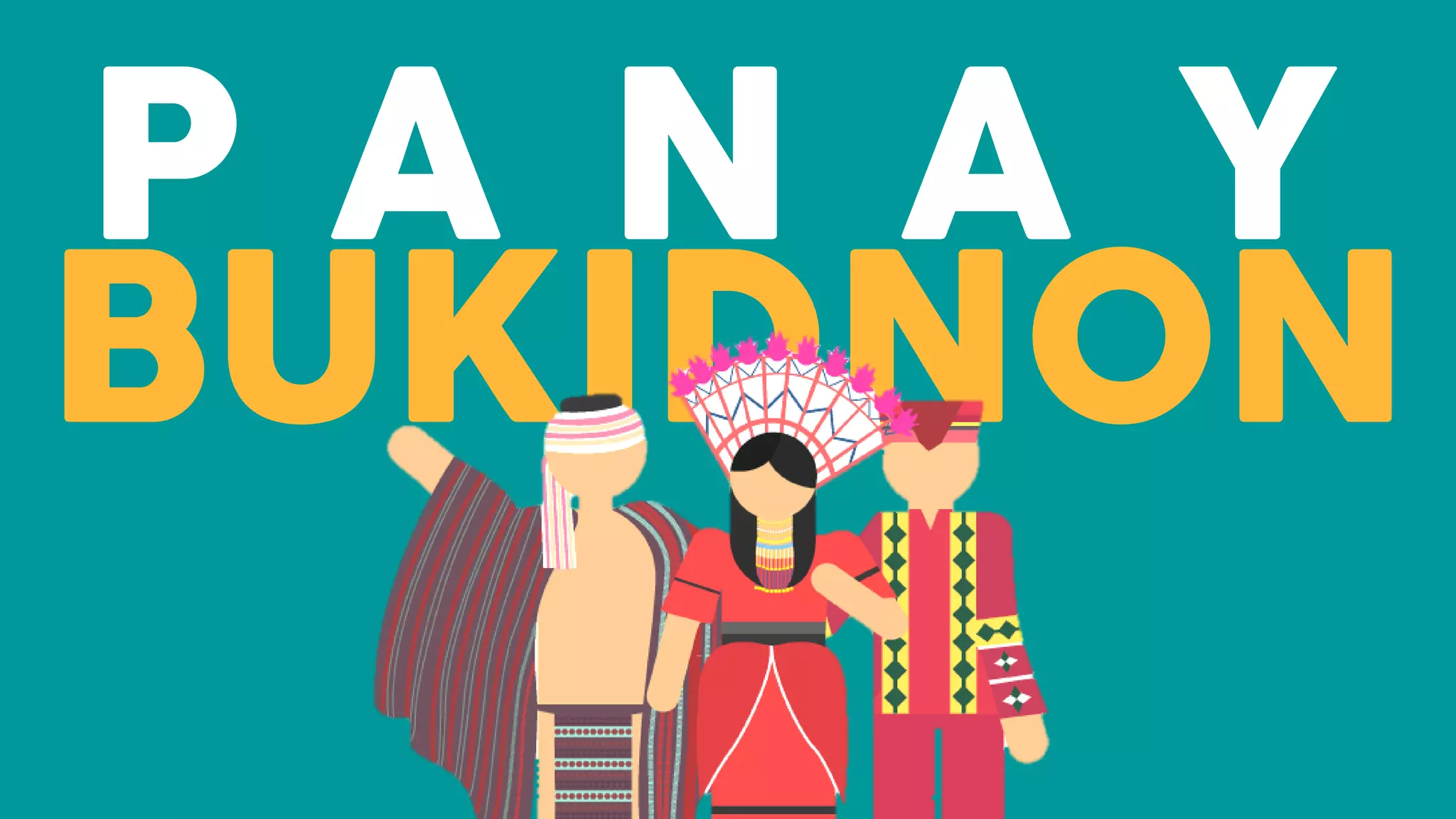
P A N A Y
BUKIDNON
P A N A Y
•
•
•
ALSO KNOWN AS
interior barangays of
the four provinces of
, ,
, and
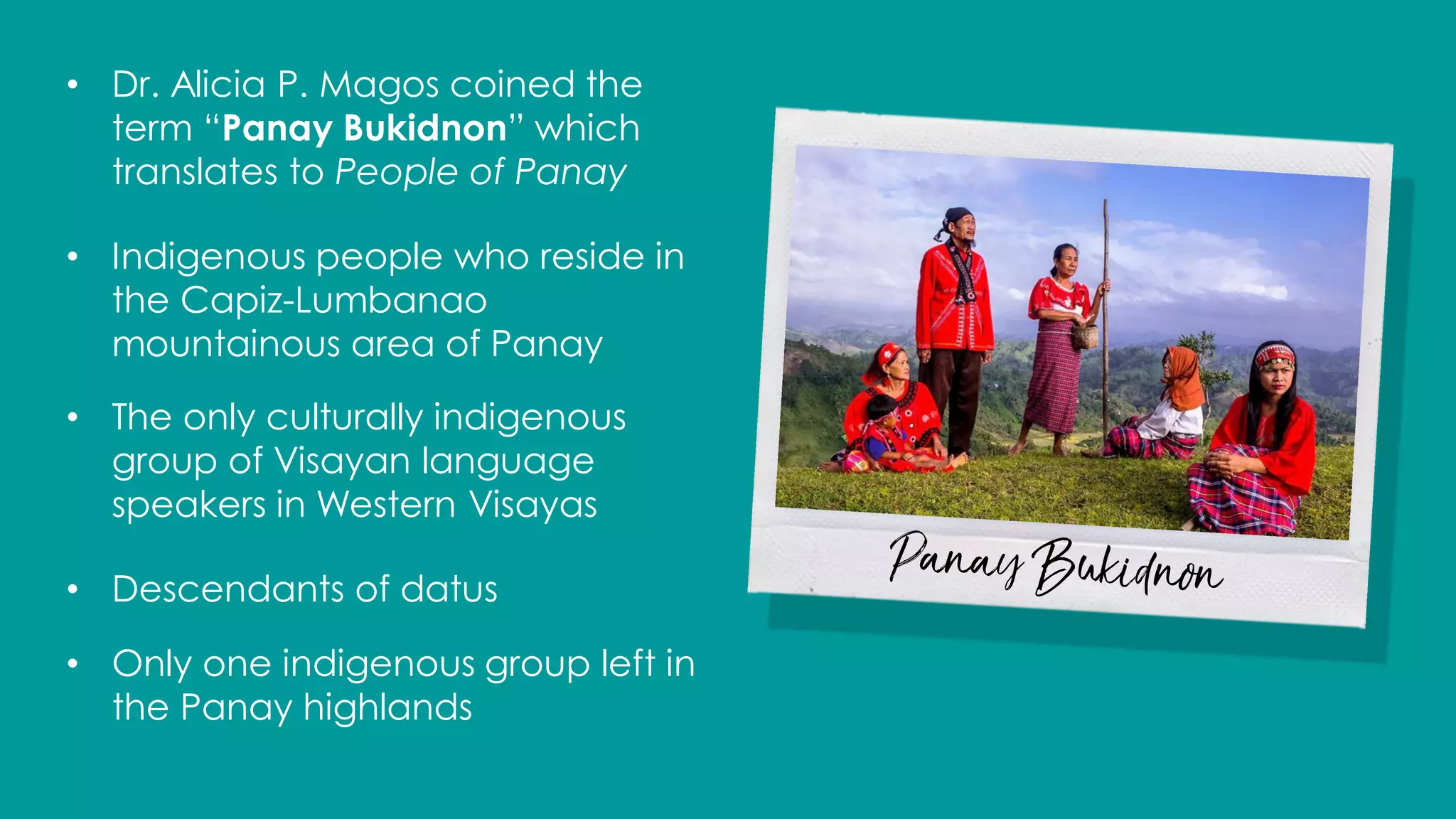
• Indigenous people who reside in
the Capiz-Lumbanao
mountainous area of Panay
• The only culturally indigenous
group of Visayan language
speakers in Western Visayas
• Only one indigenous group left in
the Panay highlands
• Descendants of datus
• Dr. Alicia P. Magos coined the
term “Panay Bukidnon” which
translates to People of Panay
CULTURE
In Panay Bukidnon society, all members care deeply about
the welfare of one’s community.
Require non-family
members to
participate in drink fests,
weddings, religious
celebrations, etc. to
strengthen the
community.
Interaction involves
patterned socio-
ritualistic formalities such as
offering food to the spirits
before starting the feast,
and having the older men
drink or eat first.
The most striking feature of Panay Bukidnon culture is the
persistence of ceremonies in every facet of life.
Ceremonies are associated with the belief that relationships between the living
and the spirits of the dead continue, and environmental spirits have influence
over daily affairs.
Deities and
ancestors inhabit
the upper layer of the
world above us, the
langitnon, and the
world below us, the
idalmunon.
Good and evil
spirits called diwata,
who they communicate
with through the
mediation of the baylan
or medium.
Sacrifices are
given to the
spirits for their good
graces.
Beliefs
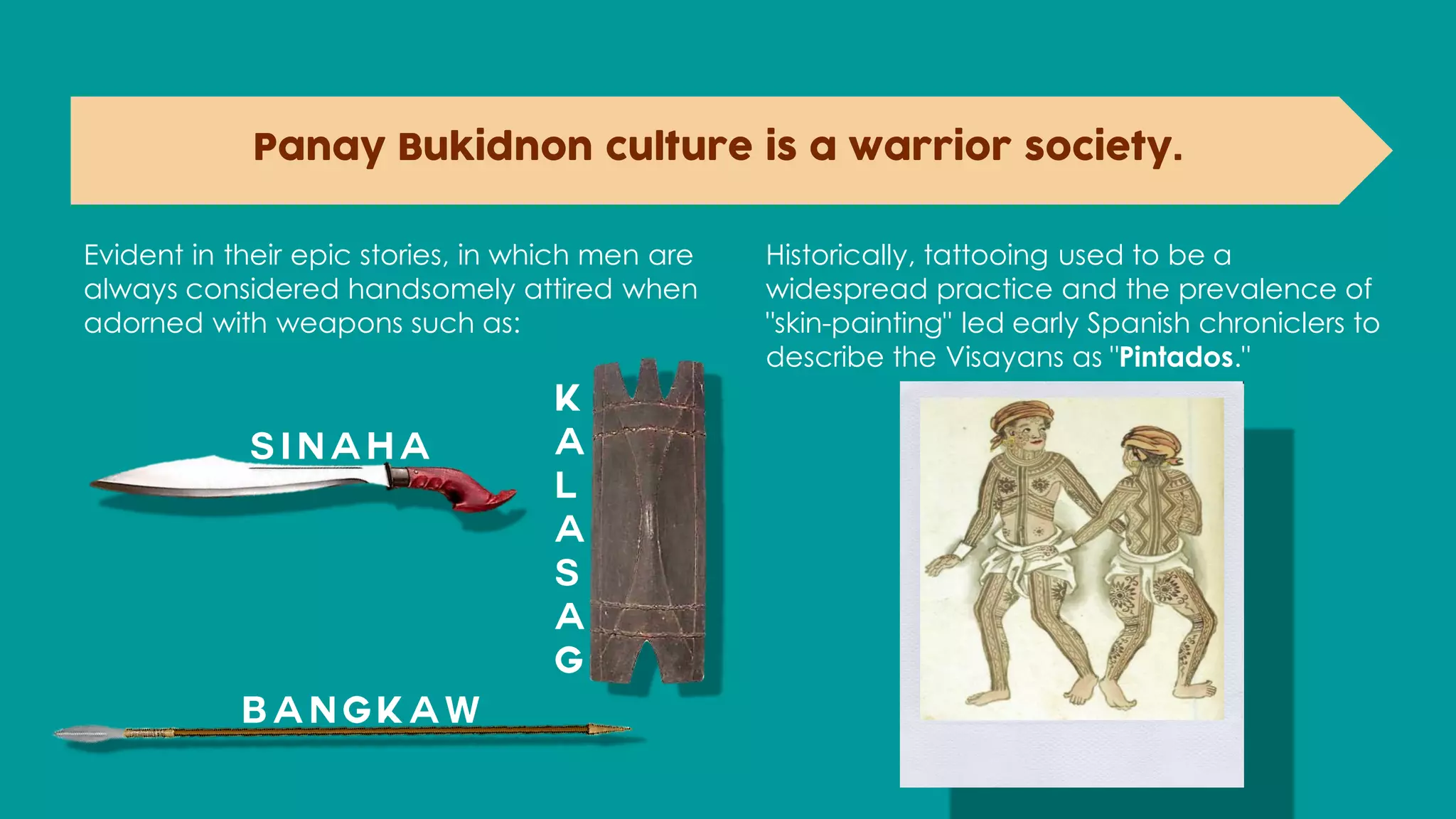
Panay Bukidnon culture is a warrior society.
Evident in their epic stories, in which men are
always considered handsomely attired when
adorned with weapons such as:
Historically, tattooing used to be a
widespread practice and the prevalence of
"skin-painting" led early Spanish chroniclers to
describe the Visayans as "Pintados."
TRADITION
a tradition where the only daughter or the prettiest daughter
of a family of good standing in the community are kept from
the public eye from the day of birth until she becomes a
young woman or maiden
• She is not allowed to be exposed to the sun, to be seen by others,
or made to work. Instead, she bathes in the river at night and
female servants do the work for her.
• Her feet are not allowed to touch the ground, so she is carried in a hammock when she
goes out.
• She learns traditions like Sugidanon, a long verbal narrative containing the epics of Panay.
She also learns folk dances like Binanog.
• When she reaches the right age, she is allowed to be seen in public to lead the tribal
ceremonies and to entertain her fellow tribesmen.
Rosita is the last binukot of the Caballero
family from the Panay Bukidnon tribe in
Iloilo.
She died on July 23, 2017 at the age of
74 after suffering from a gallbladder
rupture.
The family will preserve the traditions and
culture of their tribe amidst Rosita’s
death through a school for living
traditions taught by her husband’s
brother, Frederico Caballero.
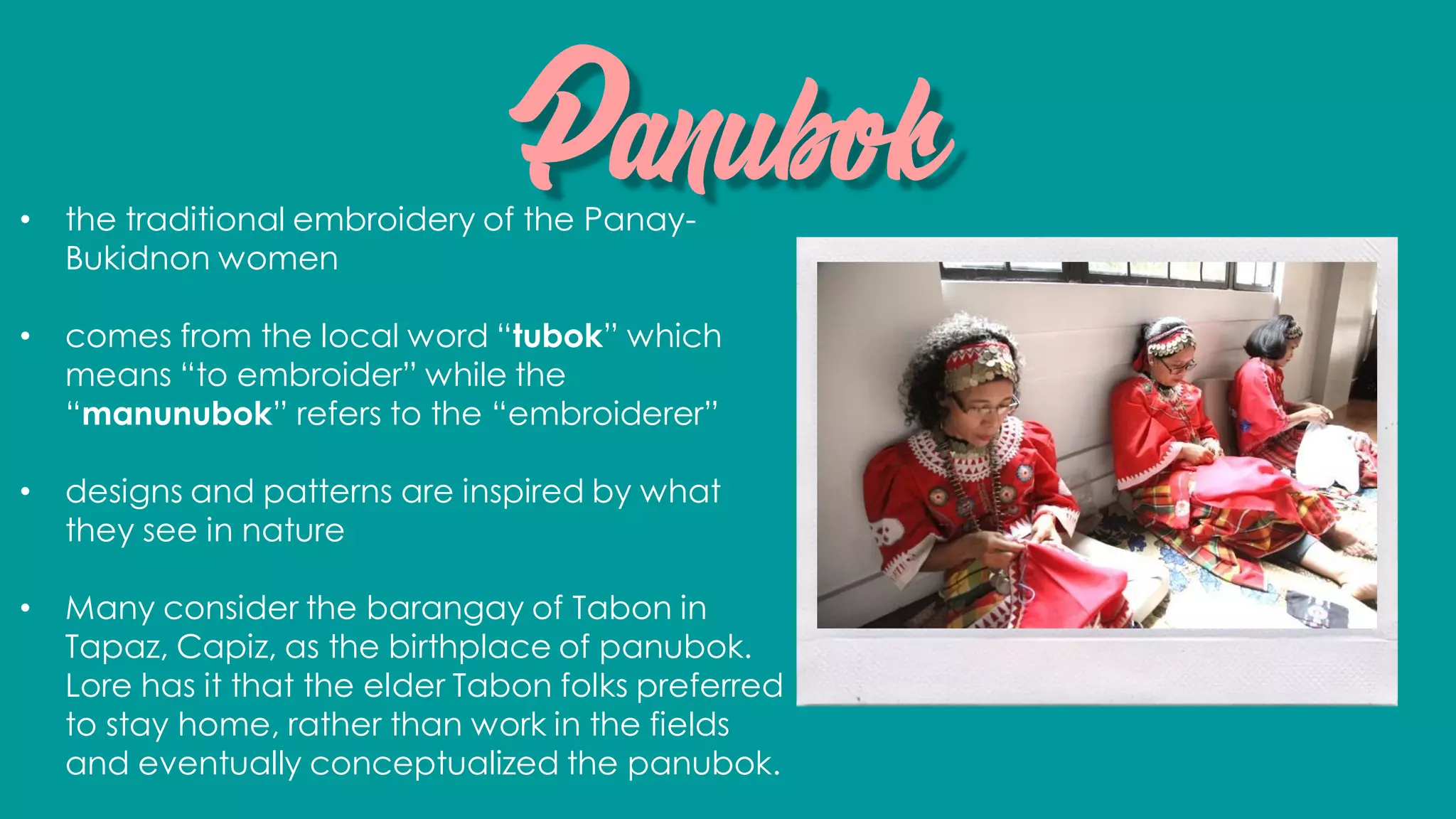
• the traditional embroidery of the Panay-
Bukidnon women
• comes from the local word “tubok” which
means “to embroider” while the
“manunubok” refers to the “embroiderer”
• designs and patterns are inspired by what
they see in nature
• Many consider the barangay of Tabon in
Tapaz, Capiz, as the birthplace of panubok.
Lore has it that the elder Tabon folks preferred
to stay home, rather than work in the fields
and eventually conceptualized the panubok.
music
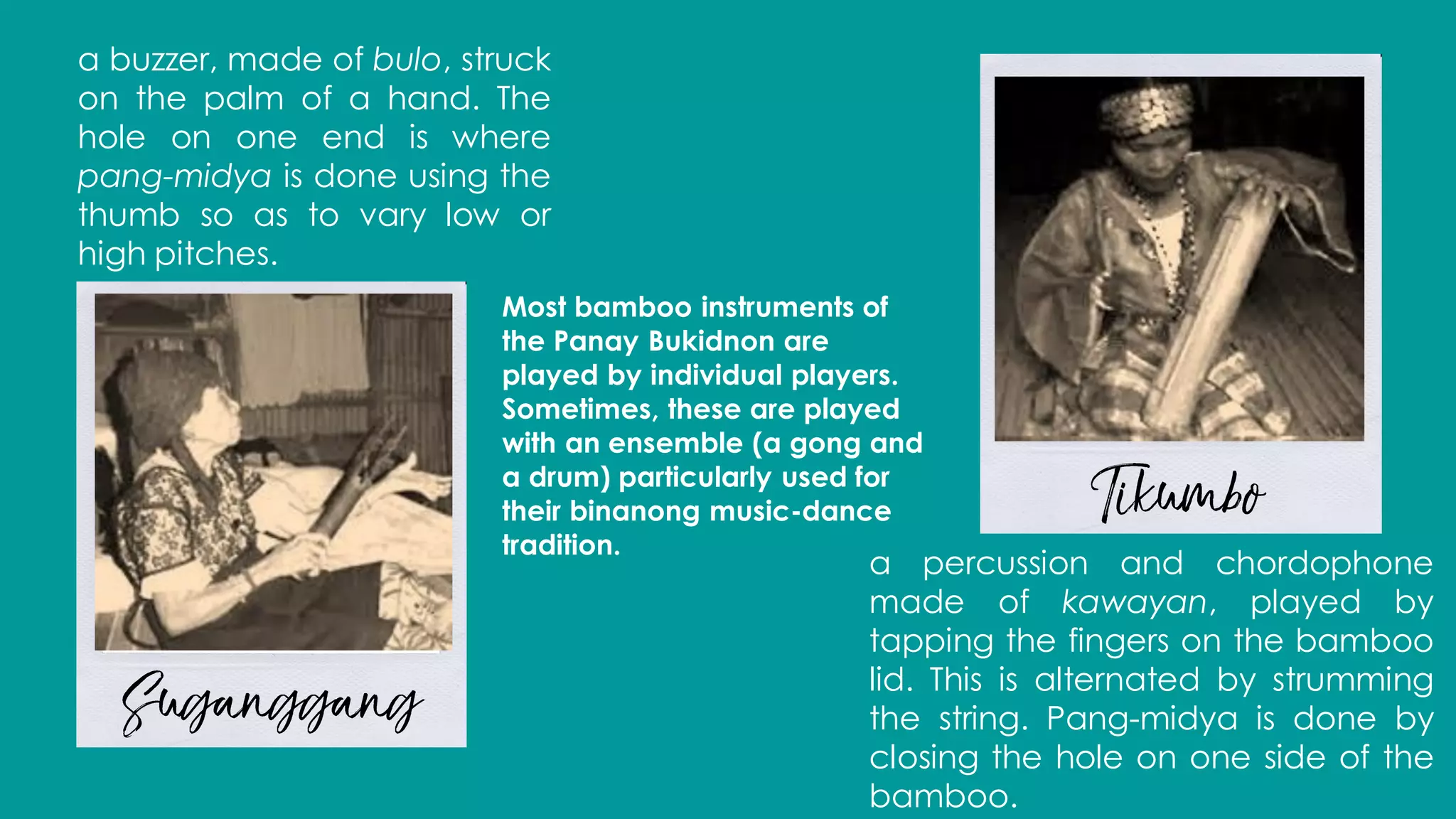
Most bamboo instruments of
the Panay Bukidnon are
played by individual players.
Sometimes, these are played
with an ensemble (a gong and
a drum) particularly used for
their binanong music-dance
tradition.
a percussion and chordophone
made of kawayan, played by
tapping the fingers on the bamboo
lid. This is alternated by strumming
the string. Pang-midya is done by
closing the hole on one side of the
bamboo.
a buzzer, made of bulo, struck
on the palm of a hand. The
hole on one end is where
pang-midya is done using the
thumb so as to vary low or
high pitches.
Bamboo musical instruments
are good sources of sound as
well as a channel for learning
many narratives reflective of
the Panay Bukidnon's lives,
pains, and joys.
a bamboo flute made of
bagakay. Air is blown through
a bamboo opening encircled
by a banana leaf. It is turned
according to pentatonic scale
played on four holes.
a two-stringed bowes instrument
made of bulo. Abaca hemp finely
braided is used as strings. It is
mainly melodic although rhythmic
patterns from words are also
employed.
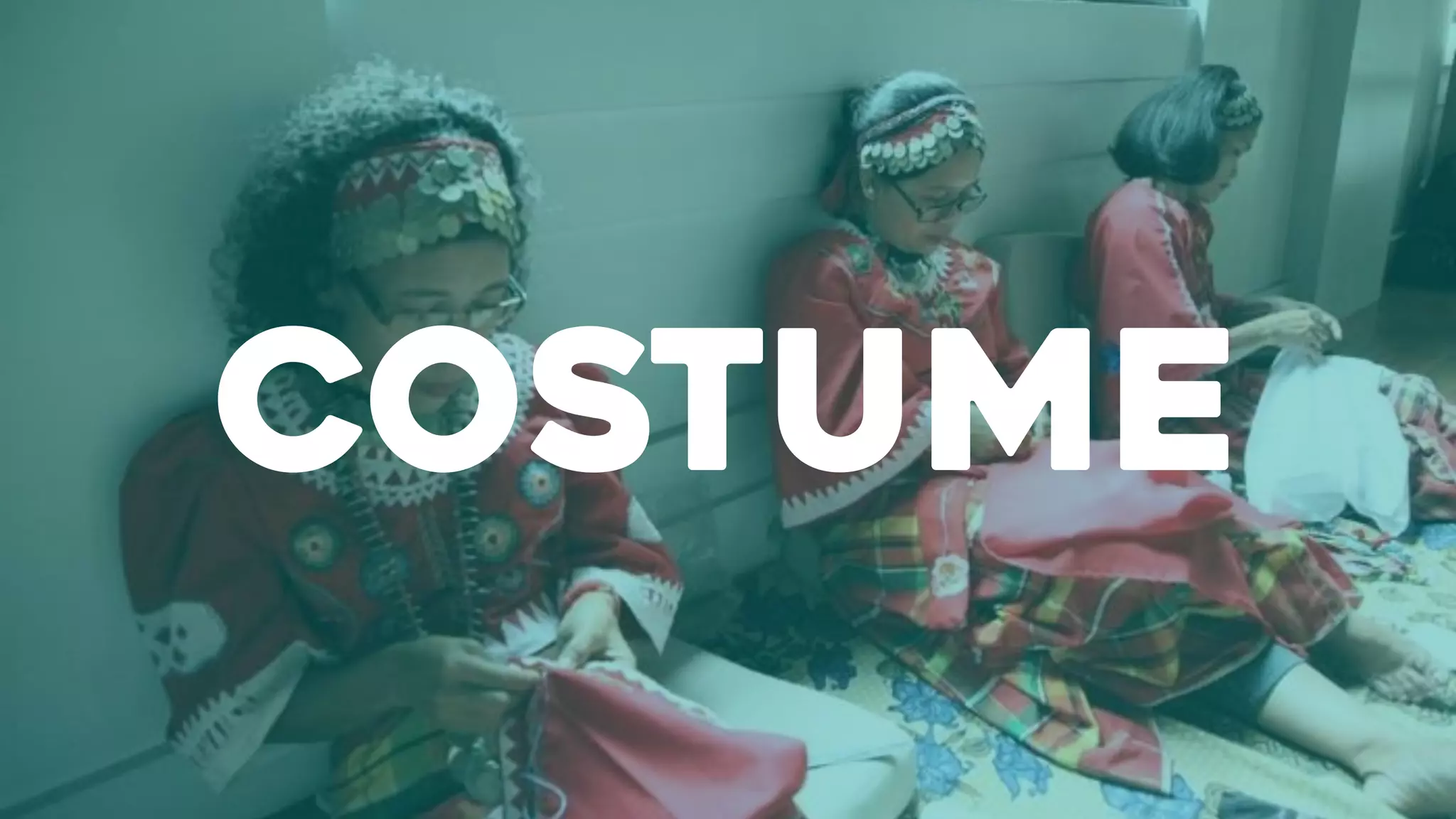
costume
The native costume or traditional fashion is intricately made by the Panay Bukidnon.
The dominant color of the tribe is red and is designed with panubok and adorned
with jewelries.
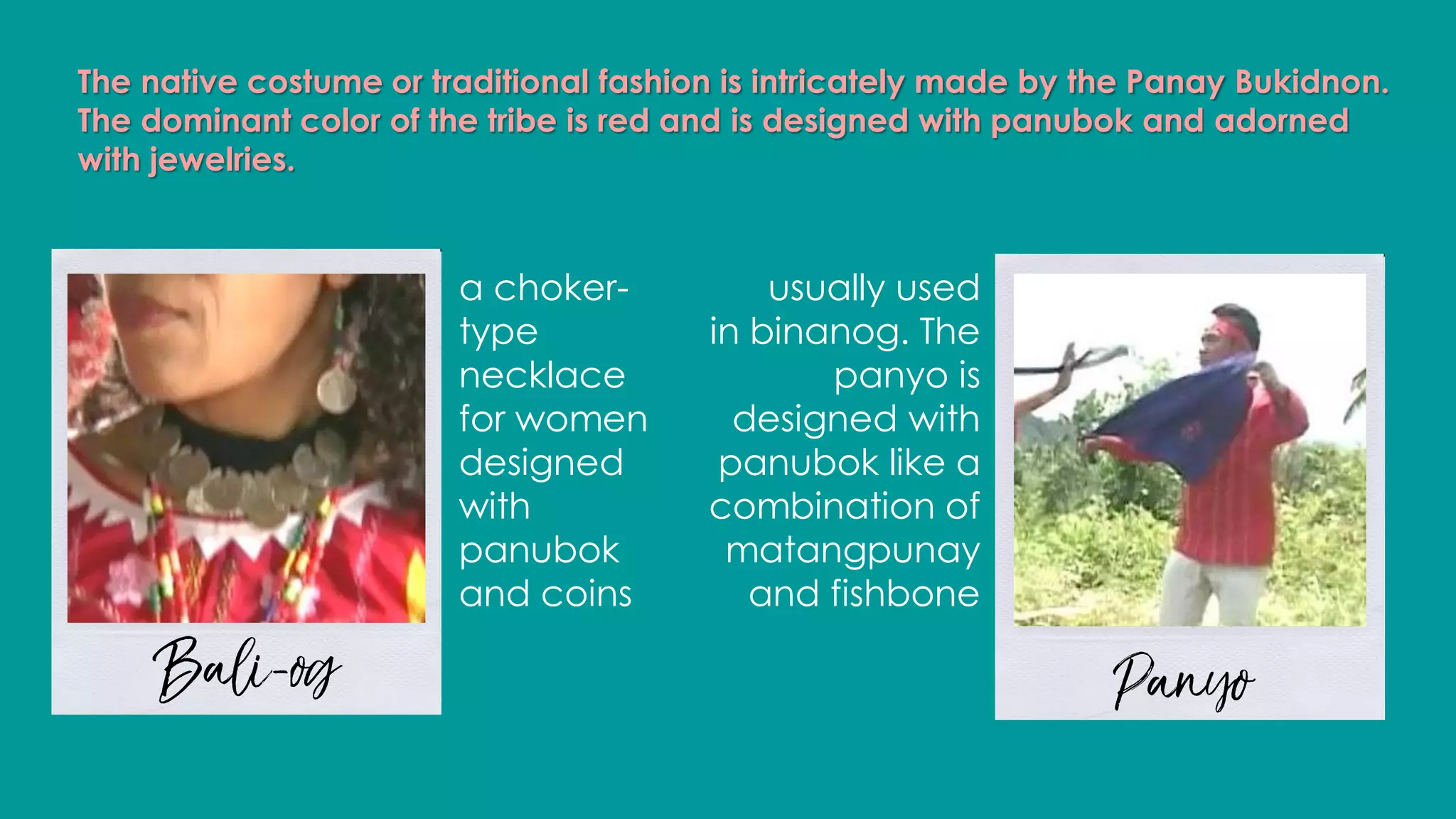
a choker-
type
necklace
for women
designed
with
panubok
and coins
usually used
in binanog. The
panyo is
designed with
panubok like a
combination of
matangpunay
and fishbone
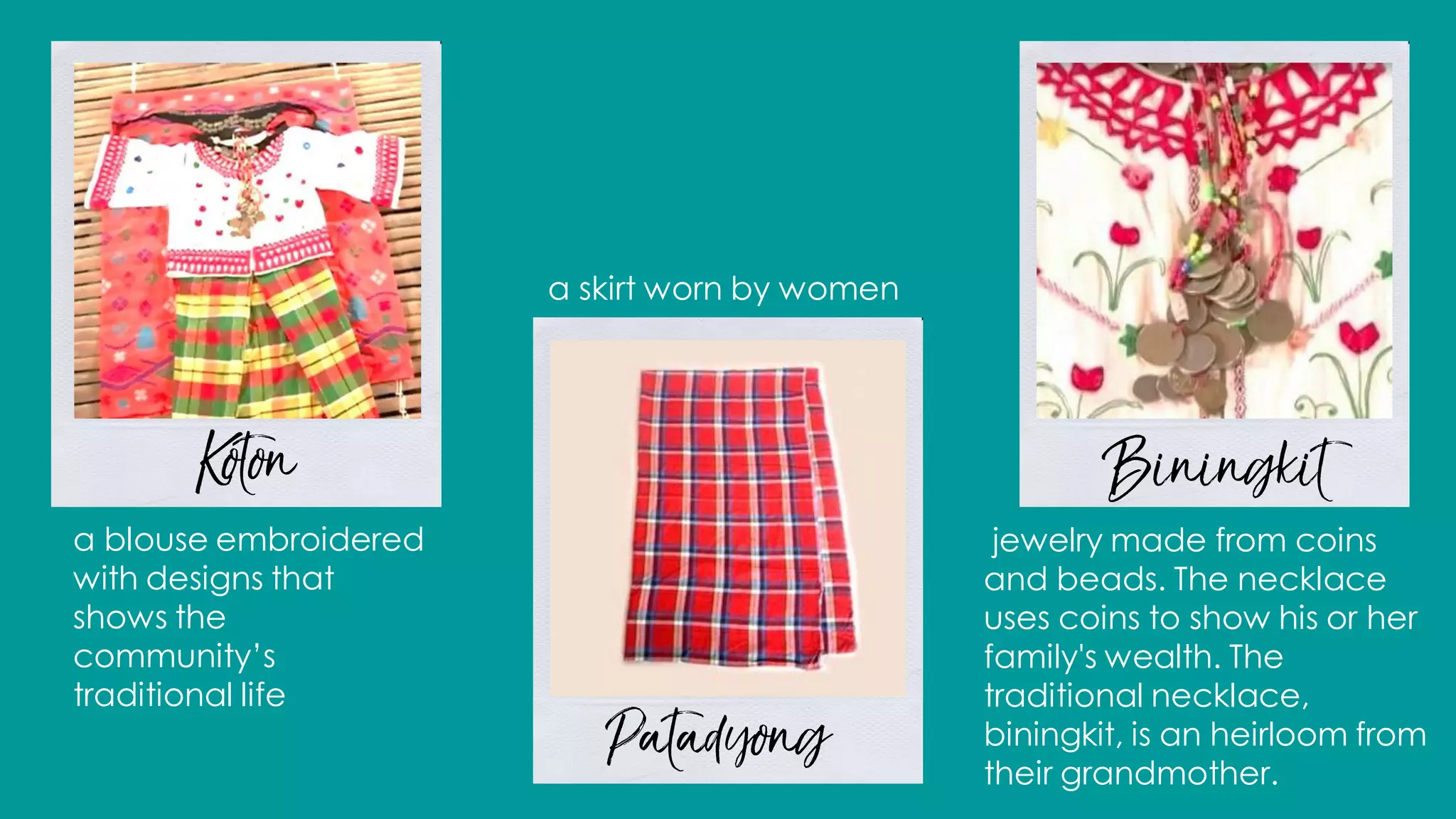
a blouse embroidered
with designs that
shows the
community’s
traditional life
a skirt worn by women
jewelry made from coins
and beads. The necklace
uses coins to show his or her
family's wealth. The
traditional necklace,
biningkit, is an heirloom from
their grandmother.
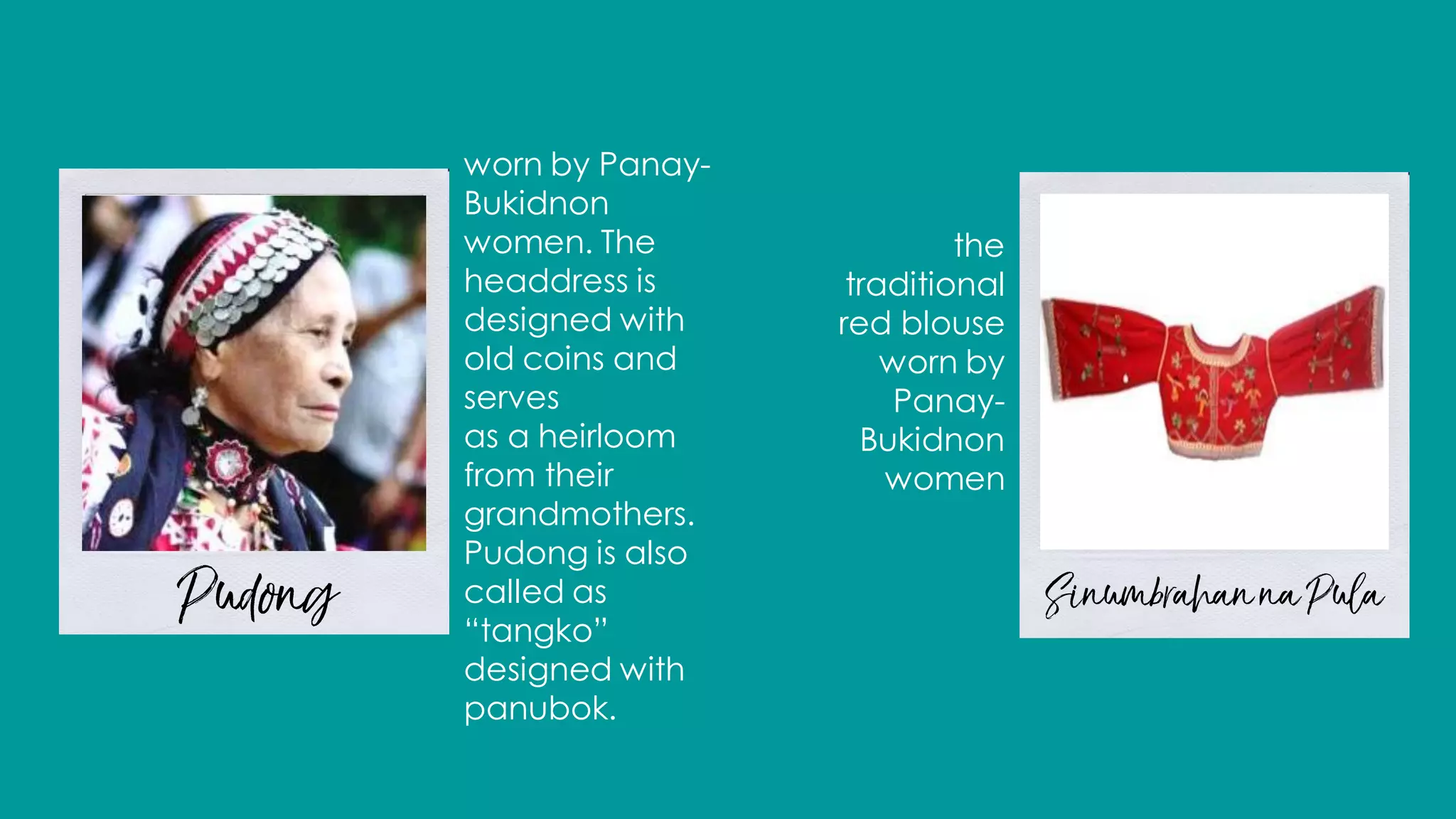
worn by Panay-
Bukidnon
women. The
headdress is
designed with
old coins and
serves
as a heirloom
from their
grandmothers.
Pudong is also
called as
“tangko”
designed with
panubok.
the
traditional
red blouse
worn by
Panay-
Bukidnon
women
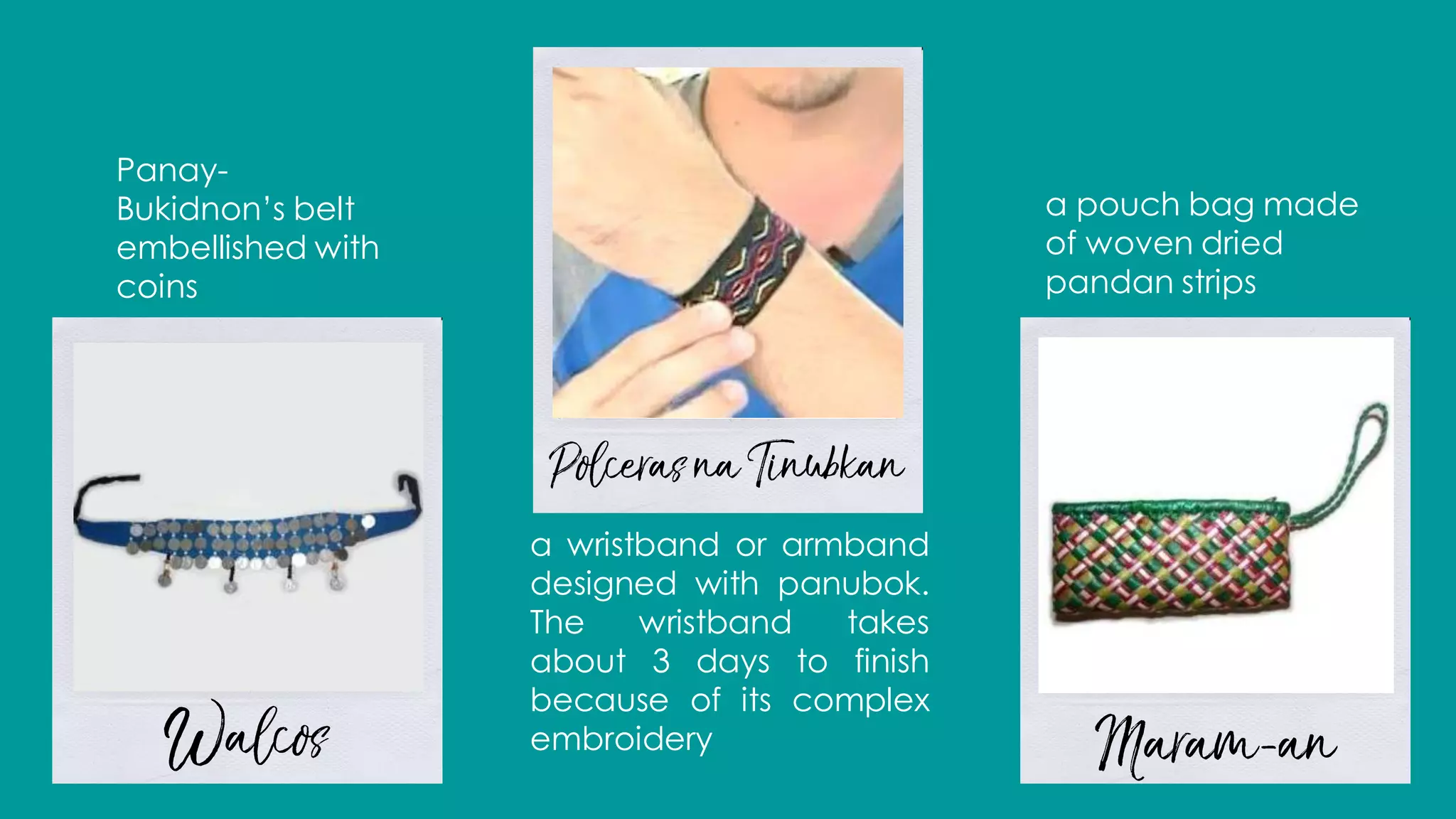
Panay-
Bukidnon’s belt
embellished with
coins
a wristband or armband
designed with panubok.
The wristband takes
about 3 days to finish
because of its complex
embroidery
a pouch bag made
of woven dried
pandan strips
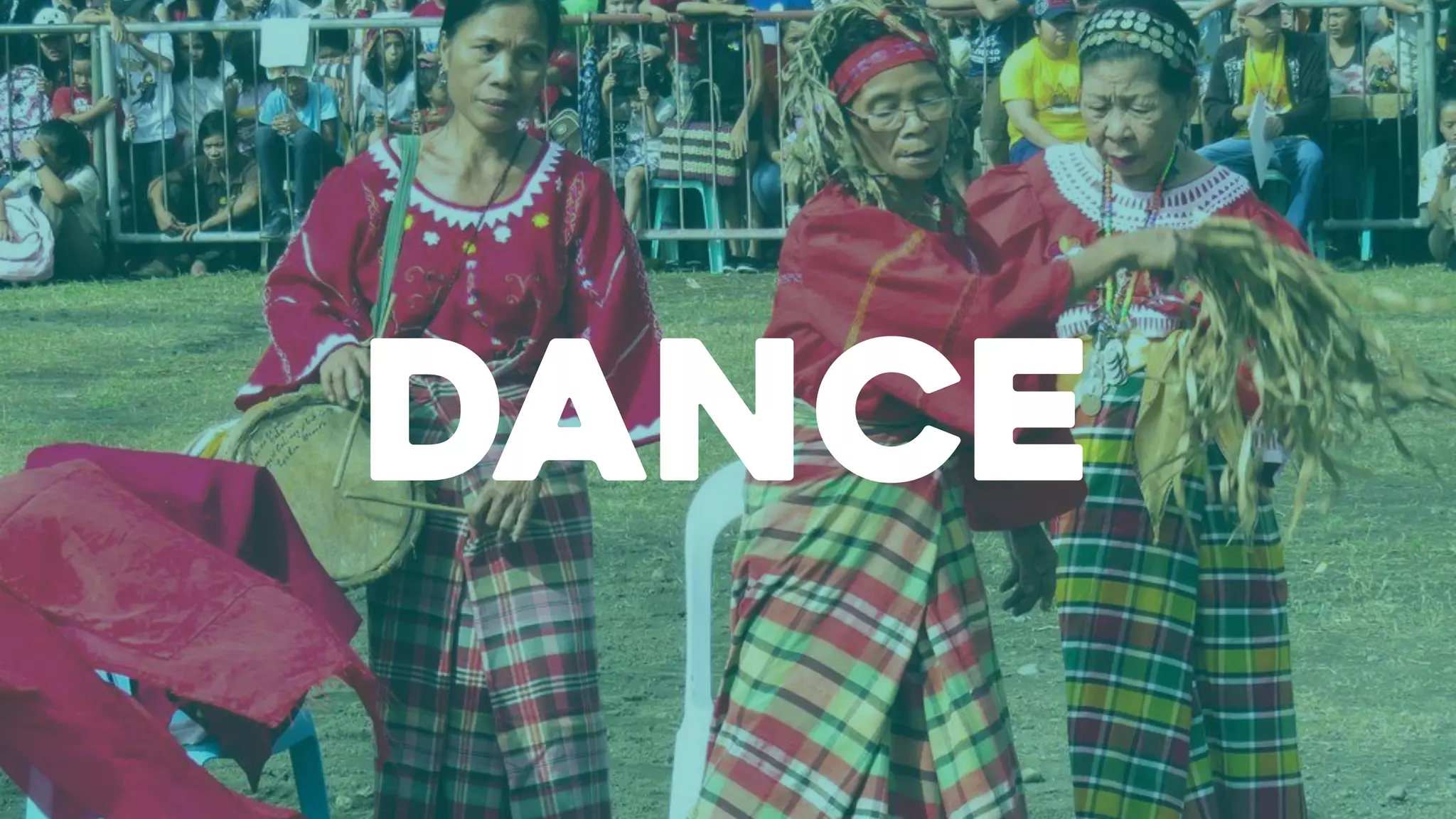
dance
• inspired from the movement of a banog, a Filipino
term for eagle derived from tabanog or kite.
• a courtship dance, it portrays the flight of the bird through
lively choreography with hands and legs
• just like how a male banog follows a female banog, the male
dancer must be observant on the changes of the girl
dancer's steps in order to "pursue" her
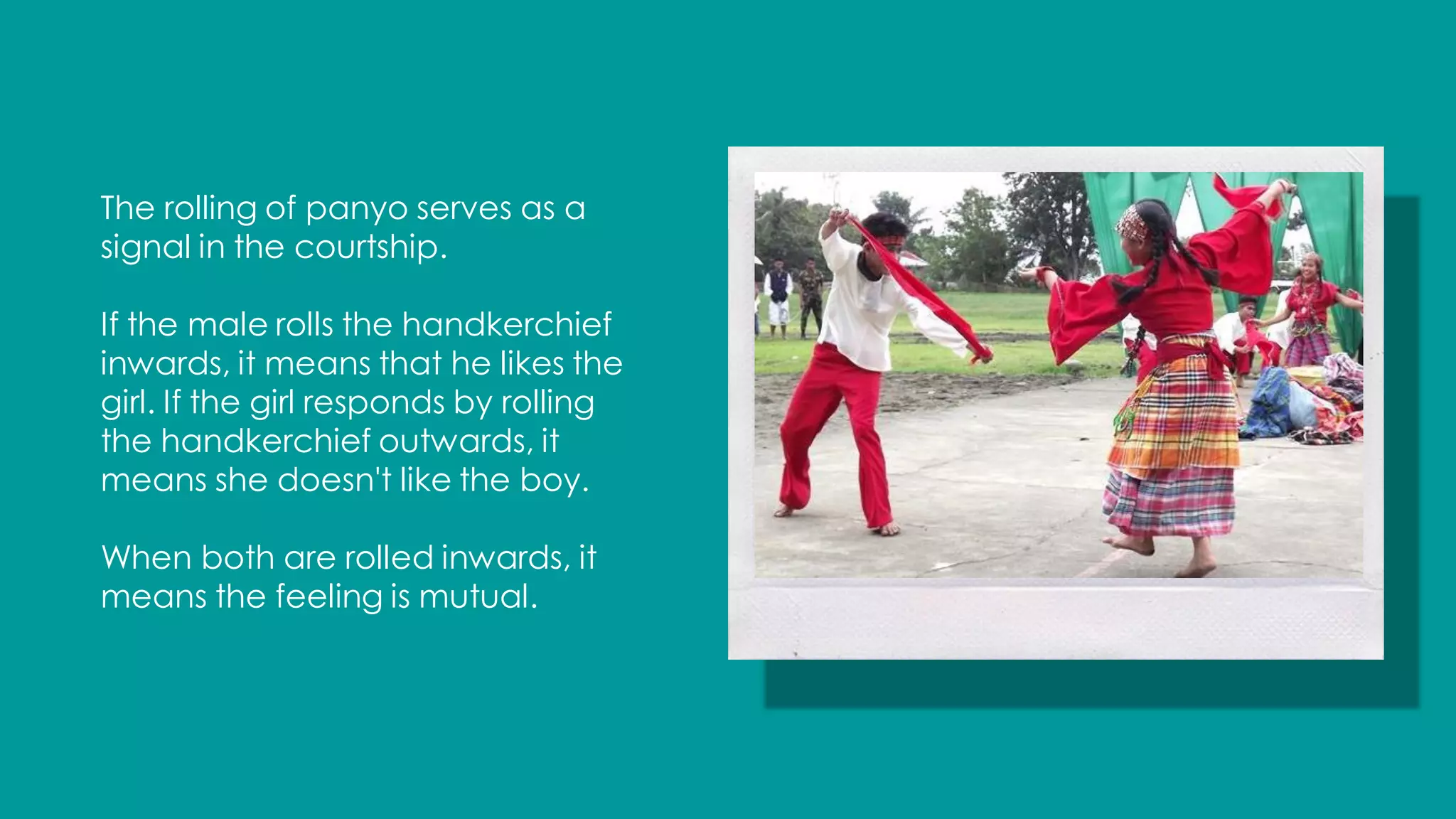
The rolling of panyo serves as a
signal in the courtship.
If the male rolls the handkerchief
inwards, it means that he likes the
girl. If the girl responds by rolling
the handkerchief outwards, it
means she doesn't like the boy.
When both are rolled inwards, it
means the feeling is mutual.
The dance ends
with an enkwentro
or encounter
wherein the girl
will catch the boy
using the
handkerchief.
Visual art
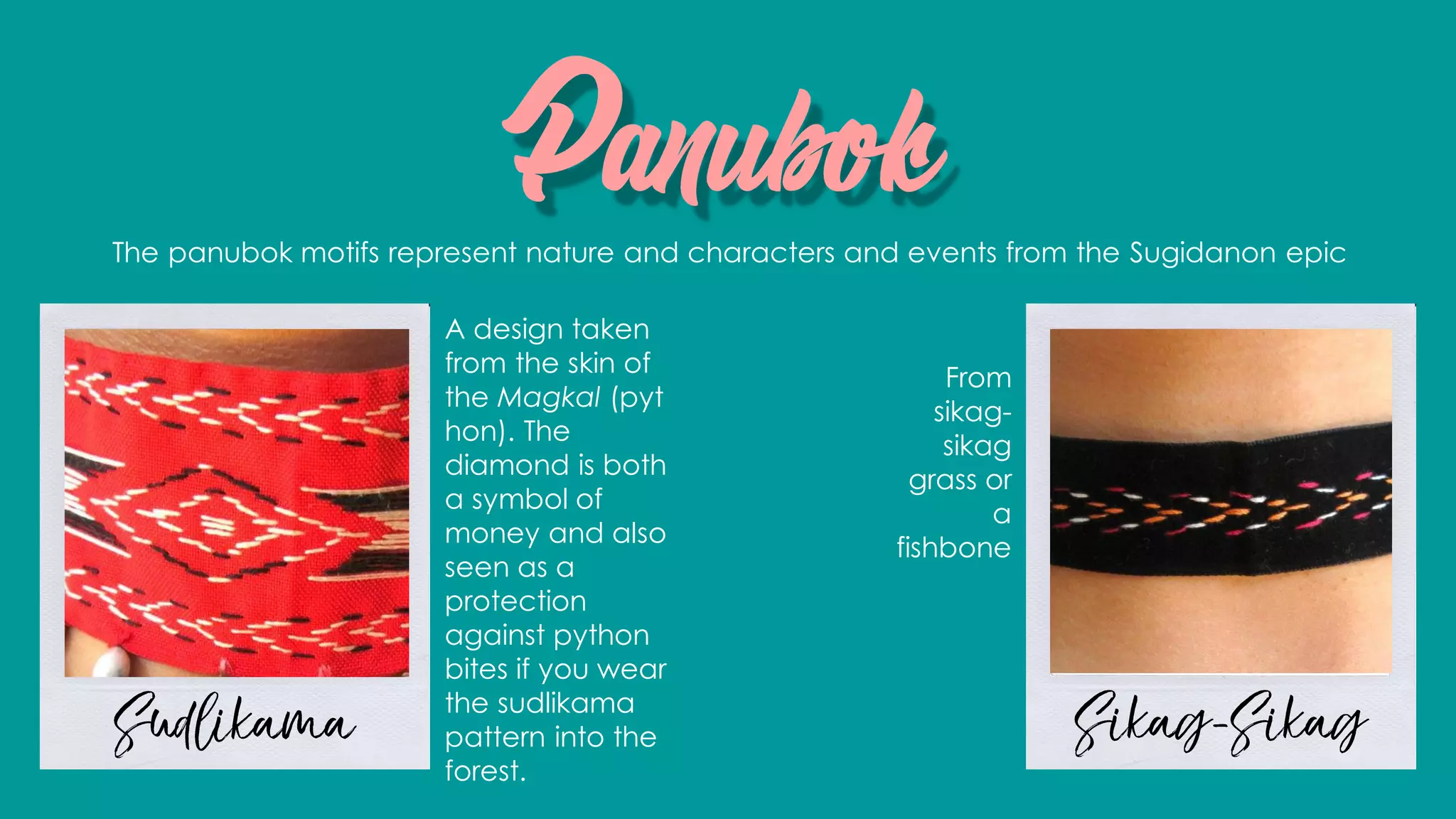
The panubok motifs represent nature and characters and events from the Sugidanon epic
A design taken
from the skin of
the Magkal (pyt
hon). The
diamond is both
a symbol of
money and also
seen as a
protection
against python
bites if you wear
the sudlikama
pattern into the
forest.
From
sikag-
sikag
grass or
a
fishbone
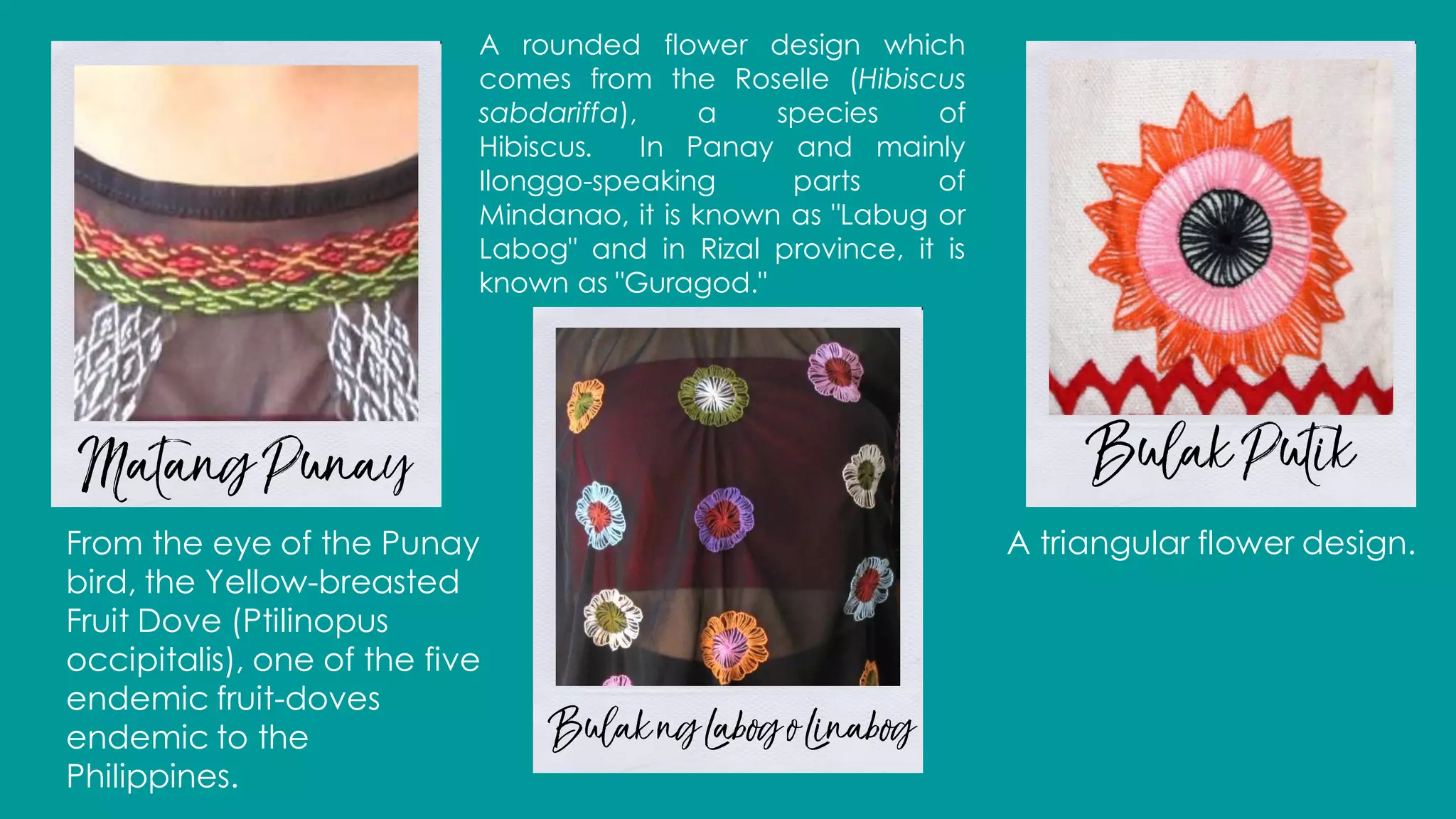
From the eye of the Punay
bird, the Yellow-breasted
Fruit Dove (Ptilinopus
occipitalis), one of the five
endemic fruit-doves
endemic to the
Philippines.
A rounded flower design which
comes from the Roselle (Hibiscus
sabdariffa), a species of
Hibiscus. In Panay and mainly
Ilonggo-speaking parts of
Mindanao, it is known as "Labug or
Labog" and in Rizal province, it is
known as "Guragod."
A triangular flower design.
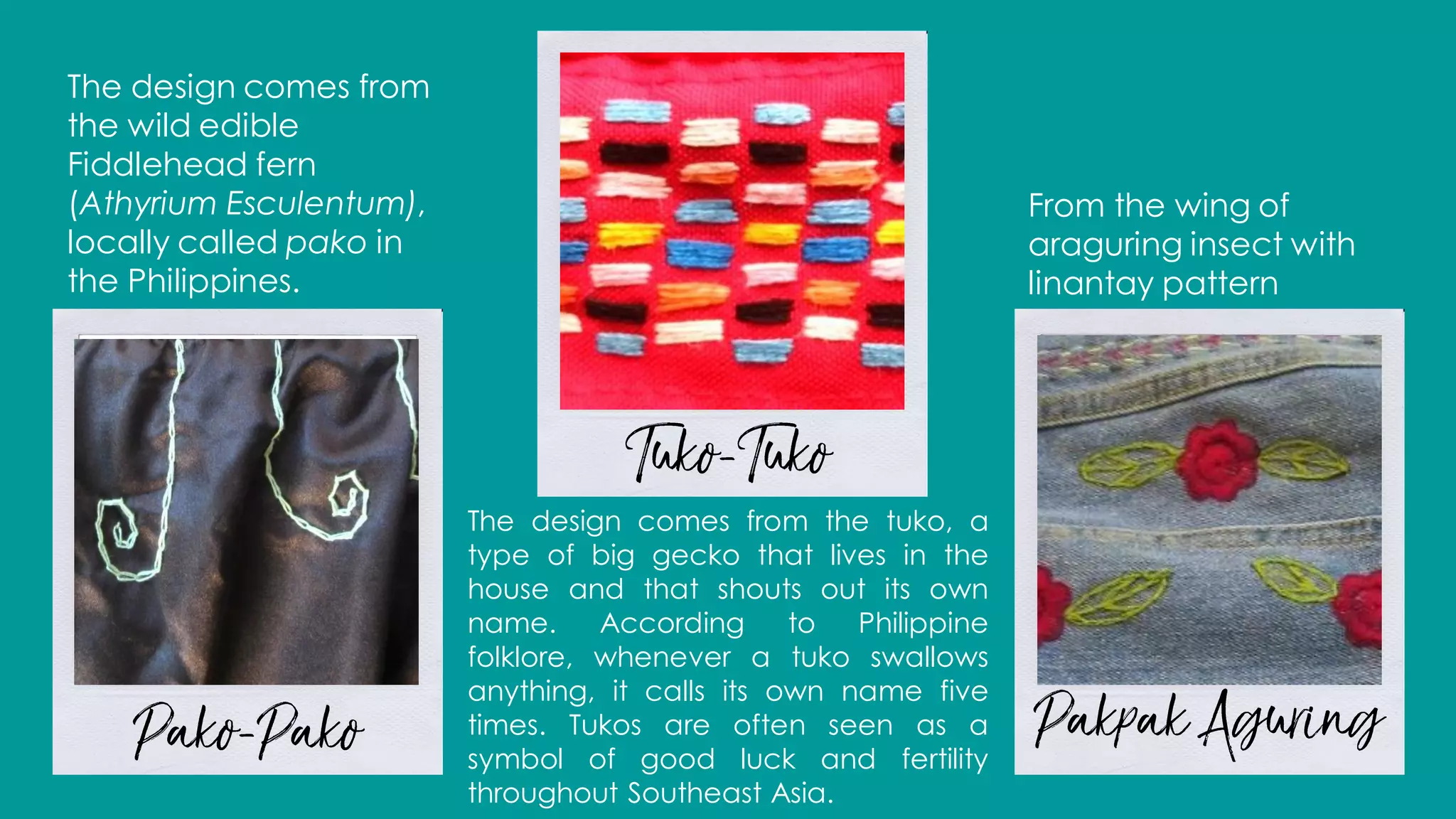
The design comes from
the wild edible
Fiddlehead fern
(Athyrium Esculentum),
locally called pako in
the Philippines.
The design comes from the tuko, a
type of big gecko that lives in the
house and that shouts out its own
name. According to Philippine
folklore, whenever a tuko swallows
anything, it calls its own name five
times. Tukos are often seen as a
symbol of good luck and fertility
throughout Southeast Asia.
From the wing of
araguring insect with
linantay pattern
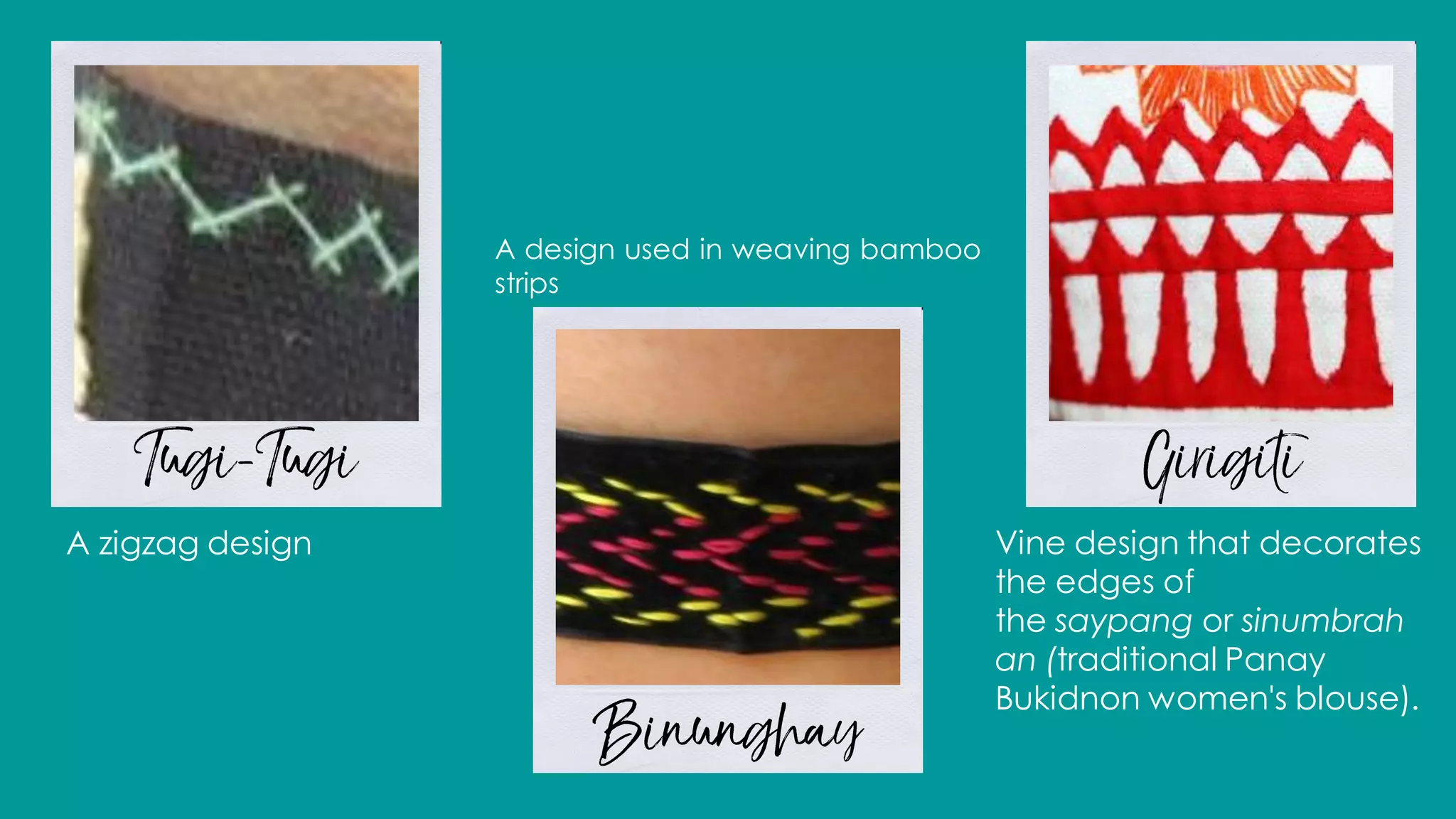
A zigzag design
A design used in weaving bamboo
strips
Vine design that decorates
the edges of
the saypang or sinumbrah
an (traditional Panay
Bukidnon women's blouse).
• https://yourshot.nationalgeographic.com/pho
tos/9662949/
• https://erickaaltamirano.wordpress.com/2013/
12/01/journal-entry-1-the-documentary-film-
gasibod-dai-a-panay-bukidnon/
• http://www.jacobimages.com/2016/01/the-
ati-tumandok-people-of-panay-island
• https://www.aswangproject.com/binukot-
philippines/
• https://newsinfo.inquirer.net/726110/panay-
bukidnons-last-binukot
• https://www.freepik.com
• https://www.flaticon.com/
• http://creativecommons.org/licenses/by/3.0/
• https://twitter.com/govph/status/52198633493
2893696
• https://www.nativeprovince.com/blogs/news/
aeson-baldevia
• https://www.haliya.co/stories/2017/6/23/pana
y-bukidnon-culture
• http://hariragat.blogspot.com/2013/06/weap
ons-for-hari-ragat.html
• https://www.liveauctioneers.com/item/426504
82_a-wooden-shield-kalasag
• https://news.abs-cbn.com/life/08/01/17/last-
secluded-maiden-of-calinog-iloilo-dies-at-74
• https://static1.squarespace.com/static/58fb9
dea20099eb9a71a377c/t/59ac9052f9a61e6ef
128b483/1504481574065/IMG_5823-Copy.jpg
• https://www.rappler.com/move-ph/177261-
binukot-panay-bukidnon-death
• http://www.choosephilippines.com/specials/b
uy-local/3399/proudly-pinoy-panay-bukidnon-
native-costumes
• http://mybeautifuliloilo.blogspot.com/2017/01
/binanog-festival-promoting-cultural.html
• http://mybeautifuliloilo.blogspot.com/2014/01
/binanog-performing-arts-traditions-of.html
SOURCESSOURCES

Panay Bukidnon

  • 1.
  • 2.
  • 3.
    BUKIDNON P A NA Y • • • ALSO KNOWN AS interior barangays of the four provinces of , , , and
  • 4.
    • Indigenous peoplewho reside in the Capiz-Lumbanao mountainous area of Panay • The only culturally indigenous group of Visayan language speakers in Western Visayas • Only one indigenous group left in the Panay highlands • Descendants of datus • Dr. Alicia P. Magos coined the term “Panay Bukidnon” which translates to People of Panay
  • 5.
  • 6.
    In Panay Bukidnonsociety, all members care deeply about the welfare of one’s community. Require non-family members to participate in drink fests, weddings, religious celebrations, etc. to strengthen the community. Interaction involves patterned socio- ritualistic formalities such as offering food to the spirits before starting the feast, and having the older men drink or eat first.
  • 7.
    The most strikingfeature of Panay Bukidnon culture is the persistence of ceremonies in every facet of life. Ceremonies are associated with the belief that relationships between the living and the spirits of the dead continue, and environmental spirits have influence over daily affairs. Deities and ancestors inhabit the upper layer of the world above us, the langitnon, and the world below us, the idalmunon. Good and evil spirits called diwata, who they communicate with through the mediation of the baylan or medium. Sacrifices are given to the spirits for their good graces. Beliefs
  • 8.
    Panay Bukidnon cultureis a warrior society. Evident in their epic stories, in which men are always considered handsomely attired when adorned with weapons such as: Historically, tattooing used to be a widespread practice and the prevalence of "skin-painting" led early Spanish chroniclers to describe the Visayans as "Pintados."
  • 9.
  • 10.
    a tradition wherethe only daughter or the prettiest daughter of a family of good standing in the community are kept from the public eye from the day of birth until she becomes a young woman or maiden • She is not allowed to be exposed to the sun, to be seen by others, or made to work. Instead, she bathes in the river at night and female servants do the work for her. • Her feet are not allowed to touch the ground, so she is carried in a hammock when she goes out. • She learns traditions like Sugidanon, a long verbal narrative containing the epics of Panay. She also learns folk dances like Binanog. • When she reaches the right age, she is allowed to be seen in public to lead the tribal ceremonies and to entertain her fellow tribesmen.
  • 11.
    Rosita is thelast binukot of the Caballero family from the Panay Bukidnon tribe in Iloilo. She died on July 23, 2017 at the age of 74 after suffering from a gallbladder rupture. The family will preserve the traditions and culture of their tribe amidst Rosita’s death through a school for living traditions taught by her husband’s brother, Frederico Caballero.
  • 12.
    • the traditionalembroidery of the Panay- Bukidnon women • comes from the local word “tubok” which means “to embroider” while the “manunubok” refers to the “embroiderer” • designs and patterns are inspired by what they see in nature • Many consider the barangay of Tabon in Tapaz, Capiz, as the birthplace of panubok. Lore has it that the elder Tabon folks preferred to stay home, rather than work in the fields and eventually conceptualized the panubok.
  • 13.
  • 14.
    Most bamboo instrumentsof the Panay Bukidnon are played by individual players. Sometimes, these are played with an ensemble (a gong and a drum) particularly used for their binanong music-dance tradition. a percussion and chordophone made of kawayan, played by tapping the fingers on the bamboo lid. This is alternated by strumming the string. Pang-midya is done by closing the hole on one side of the bamboo. a buzzer, made of bulo, struck on the palm of a hand. The hole on one end is where pang-midya is done using the thumb so as to vary low or high pitches.
  • 15.
    Bamboo musical instruments aregood sources of sound as well as a channel for learning many narratives reflective of the Panay Bukidnon's lives, pains, and joys. a bamboo flute made of bagakay. Air is blown through a bamboo opening encircled by a banana leaf. It is turned according to pentatonic scale played on four holes. a two-stringed bowes instrument made of bulo. Abaca hemp finely braided is used as strings. It is mainly melodic although rhythmic patterns from words are also employed.
  • 16.
  • 17.
    The native costumeor traditional fashion is intricately made by the Panay Bukidnon. The dominant color of the tribe is red and is designed with panubok and adorned with jewelries. a choker- type necklace for women designed with panubok and coins usually used in binanog. The panyo is designed with panubok like a combination of matangpunay and fishbone
  • 18.
    a blouse embroidered withdesigns that shows the community’s traditional life a skirt worn by women jewelry made from coins and beads. The necklace uses coins to show his or her family's wealth. The traditional necklace, biningkit, is an heirloom from their grandmother.
  • 19.
    worn by Panay- Bukidnon women.The headdress is designed with old coins and serves as a heirloom from their grandmothers. Pudong is also called as “tangko” designed with panubok. the traditional red blouse worn by Panay- Bukidnon women
  • 20.
    Panay- Bukidnon’s belt embellished with coins awristband or armband designed with panubok. The wristband takes about 3 days to finish because of its complex embroidery a pouch bag made of woven dried pandan strips
  • 21.
  • 22.
    • inspired fromthe movement of a banog, a Filipino term for eagle derived from tabanog or kite. • a courtship dance, it portrays the flight of the bird through lively choreography with hands and legs • just like how a male banog follows a female banog, the male dancer must be observant on the changes of the girl dancer's steps in order to "pursue" her
  • 23.
    The rolling ofpanyo serves as a signal in the courtship. If the male rolls the handkerchief inwards, it means that he likes the girl. If the girl responds by rolling the handkerchief outwards, it means she doesn't like the boy. When both are rolled inwards, it means the feeling is mutual.
  • 24.
    The dance ends withan enkwentro or encounter wherein the girl will catch the boy using the handkerchief.
  • 25.
  • 26.
    The panubok motifsrepresent nature and characters and events from the Sugidanon epic A design taken from the skin of the Magkal (pyt hon). The diamond is both a symbol of money and also seen as a protection against python bites if you wear the sudlikama pattern into the forest. From sikag- sikag grass or a fishbone
  • 27.
    From the eyeof the Punay bird, the Yellow-breasted Fruit Dove (Ptilinopus occipitalis), one of the five endemic fruit-doves endemic to the Philippines. A rounded flower design which comes from the Roselle (Hibiscus sabdariffa), a species of Hibiscus. In Panay and mainly Ilonggo-speaking parts of Mindanao, it is known as "Labug or Labog" and in Rizal province, it is known as "Guragod." A triangular flower design.
  • 28.
    The design comesfrom the wild edible Fiddlehead fern (Athyrium Esculentum), locally called pako in the Philippines. The design comes from the tuko, a type of big gecko that lives in the house and that shouts out its own name. According to Philippine folklore, whenever a tuko swallows anything, it calls its own name five times. Tukos are often seen as a symbol of good luck and fertility throughout Southeast Asia. From the wing of araguring insect with linantay pattern
  • 29.
    A zigzag design Adesign used in weaving bamboo strips Vine design that decorates the edges of the saypang or sinumbrah an (traditional Panay Bukidnon women's blouse).
  • 30.
    • https://yourshot.nationalgeographic.com/pho tos/9662949/ • https://erickaaltamirano.wordpress.com/2013/ 12/01/journal-entry-1-the-documentary-film- gasibod-dai-a-panay-bukidnon/ •http://www.jacobimages.com/2016/01/the- ati-tumandok-people-of-panay-island • https://www.aswangproject.com/binukot- philippines/ • https://newsinfo.inquirer.net/726110/panay- bukidnons-last-binukot • https://www.freepik.com • https://www.flaticon.com/ • http://creativecommons.org/licenses/by/3.0/ • https://twitter.com/govph/status/52198633493 2893696 • https://www.nativeprovince.com/blogs/news/ aeson-baldevia • https://www.haliya.co/stories/2017/6/23/pana y-bukidnon-culture • http://hariragat.blogspot.com/2013/06/weap ons-for-hari-ragat.html • https://www.liveauctioneers.com/item/426504 82_a-wooden-shield-kalasag • https://news.abs-cbn.com/life/08/01/17/last- secluded-maiden-of-calinog-iloilo-dies-at-74 • https://static1.squarespace.com/static/58fb9 dea20099eb9a71a377c/t/59ac9052f9a61e6ef 128b483/1504481574065/IMG_5823-Copy.jpg • https://www.rappler.com/move-ph/177261- binukot-panay-bukidnon-death • http://www.choosephilippines.com/specials/b uy-local/3399/proudly-pinoy-panay-bukidnon- native-costumes • http://mybeautifuliloilo.blogspot.com/2017/01 /binanog-festival-promoting-cultural.html • http://mybeautifuliloilo.blogspot.com/2014/01 /binanog-performing-arts-traditions-of.html SOURCESSOURCES