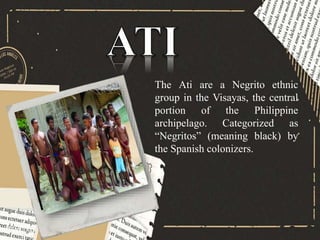
The Ati are a Negrito ethnic
group in the Visayas, the central
portion of the Philippine
archipelago. Categorized as
“Negritos” (meaning black) by
the Spanish colonizers.
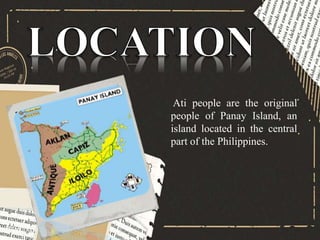
Ati people are the original
people of Panay Island, an
island located in the central
part of the Philippines.
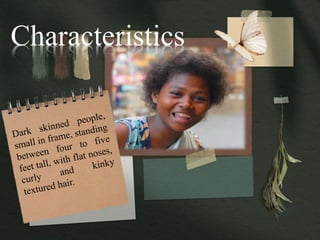
Characteristics
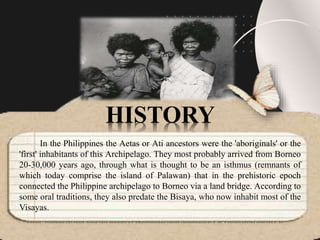
In the Philippines the Aetas or Ati ancestors were the 'aboriginals' or the
'first' inhabitants of this Archipelago. They most probably arrived from Borneo
20-30,000 years ago, through what is thought to be an isthmus (remnants of
which today comprise the island of Palawan) that in the prehistoric epoch
connected the Philippine archipelago to Borneo via a land bridge. According to
some oral traditions, they also predate the Bisaya, who now inhabit most of the
Visayas.
HISTORY
Beliefs, Cultural and
Traditional Practices of Ati
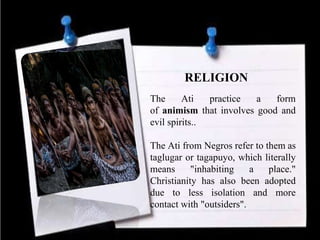
RELIGION
The Ati practice a form
of animism that involves good and
evil spirits..
The Ati from Negros refer to them as
taglugar or tagapuyo, which literally
means "inhabiting a place."
Christianity has also been adopted
due to less isolation and more
contact with "outsiders".
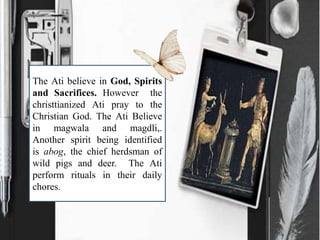
The Ati believe in God, Spirits
and Sacrifices. However the
christtianized Ati pray to the
Christian God. The Ati Believe
in magwala and magdli,.
Another spirit being identified
is abog, the chief herdsman of
wild pigs and deer. The Ati
perform rituals in their daily
chores.
Medicine Practices
Ati are known in Panay as
practitioners of herbal medicine.
Locals often seek their help in
removing leeches from a person's
body.
Hunting
Fishing
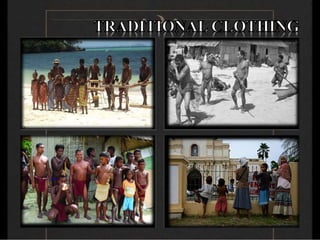
Wraparound skirts
Loincloths
Jewelry is simple in nature.
Some jewelry objects involve
plants such as flowers, while
others use animal bones;
particularly the teeth of pigs.
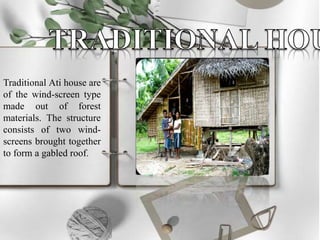
Traditional Ati house are
of the wind-screen type
made out of forest
materials. The structure
consists of two wind-
screens brought together
to form a gabled roof.
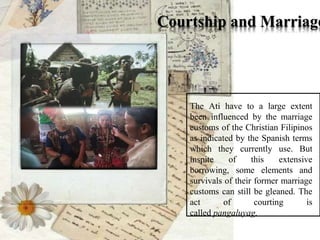
Courtship and Marriage
The Ati have to a large extent
been influenced by the marriage
customs of the Christian Filipinos
as indicated by the Spanish terms
which they currently use. But
inspite of this extensive
borrowing, some elements and
survivals of their former marriage
customs can still be gleaned. The
act of courting is
called pangaluyag.
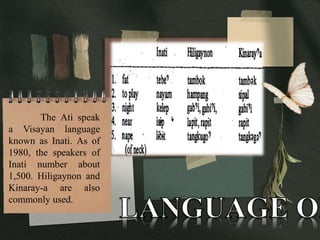
The Ati speak
a Visayan language
known as Inati. As of
1980, the speakers of
Inati number about
1,500. Hiligaynon and
Kinaray-a are also
commonly used.
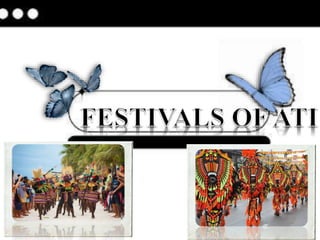
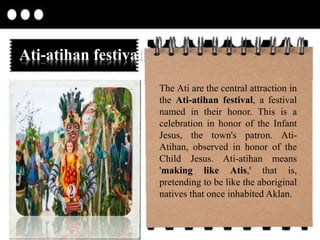
Ati-atihan festival
The Ati are the central attraction in
the Ati-atihan festival, a festival
named in their honor. This is a
celebration in honor of the Infant
Jesus, the town's patron. Ati-
Atihan, observed in honor of the
Child Jesus. Ati-atihan means
'making like Atis,' that is,
pretending to be like the aboriginal
natives that once inhabited Aklan.
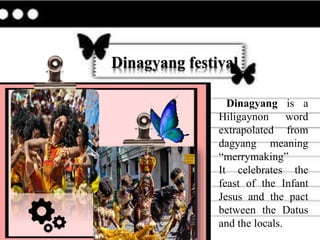
Dinagyang festival
Dinagyang is a
Hiligaynon word
extrapolated from
dagyang meaning
“merrymaking”
It celebrates the
feast of the Infant
Jesus and the pact
between the Datus
and the locals.
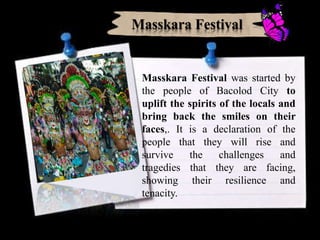
Masskara Festival was started by
the people of Bacolod City to
uplift the spirits of the locals and
bring back the smiles on their
faces,. It is a declaration of the
people that they will rise and
survive the challenges and
tragedies that they are facing,
showing their resilience and
tenacity.
Masskara Festival
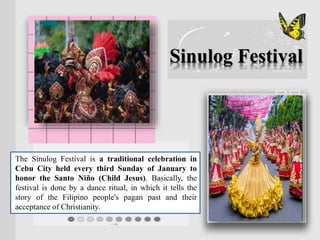
The Sinulog Festival is a traditional celebration in
Cebu City held every third Sunday of January to
honor the Santo Niño (Child Jesus). Basically, the
festival is done by a dance ritual, in which it tells the
story of the Filipino people's pagan past and their
acceptance of Christianity.
Sinulog Festival
ATI TRIBE

ATI TRIBE

  • 2.
    The Ati area Negrito ethnic group in the Visayas, the central portion of the Philippine archipelago. Categorized as “Negritos” (meaning black) by the Spanish colonizers.
  • 3.
    Ati people arethe original people of Panay Island, an island located in the central part of the Philippines.
  • 4.
  • 6.
    In the Philippinesthe Aetas or Ati ancestors were the 'aboriginals' or the 'first' inhabitants of this Archipelago. They most probably arrived from Borneo 20-30,000 years ago, through what is thought to be an isthmus (remnants of which today comprise the island of Palawan) that in the prehistoric epoch connected the Philippine archipelago to Borneo via a land bridge. According to some oral traditions, they also predate the Bisaya, who now inhabit most of the Visayas. HISTORY
  • 7.
  • 8.
    RELIGION The Ati practicea form of animism that involves good and evil spirits.. The Ati from Negros refer to them as taglugar or tagapuyo, which literally means "inhabiting a place." Christianity has also been adopted due to less isolation and more contact with "outsiders".
  • 9.
    The Ati believein God, Spirits and Sacrifices. However the christtianized Ati pray to the Christian God. The Ati Believe in magwala and magdli,. Another spirit being identified is abog, the chief herdsman of wild pigs and deer. The Ati perform rituals in their daily chores.
  • 10.
    Medicine Practices Ati areknown in Panay as practitioners of herbal medicine. Locals often seek their help in removing leeches from a person's body.
  • 11.
  • 13.
  • 14.
    Jewelry is simplein nature. Some jewelry objects involve plants such as flowers, while others use animal bones; particularly the teeth of pigs.
  • 15.
    Traditional Ati houseare of the wind-screen type made out of forest materials. The structure consists of two wind- screens brought together to form a gabled roof.
  • 16.
    Courtship and Marriage TheAti have to a large extent been influenced by the marriage customs of the Christian Filipinos as indicated by the Spanish terms which they currently use. But inspite of this extensive borrowing, some elements and survivals of their former marriage customs can still be gleaned. The act of courting is called pangaluyag.
  • 17.
    The Ati speak aVisayan language known as Inati. As of 1980, the speakers of Inati number about 1,500. Hiligaynon and Kinaray-a are also commonly used.
  • 19.
    Ati-atihan festival The Atiare the central attraction in the Ati-atihan festival, a festival named in their honor. This is a celebration in honor of the Infant Jesus, the town's patron. Ati- Atihan, observed in honor of the Child Jesus. Ati-atihan means 'making like Atis,' that is, pretending to be like the aboriginal natives that once inhabited Aklan.
  • 20.
    Dinagyang festival Dinagyang isa Hiligaynon word extrapolated from dagyang meaning “merrymaking” It celebrates the feast of the Infant Jesus and the pact between the Datus and the locals.
  • 21.
    Masskara Festival wasstarted by the people of Bacolod City to uplift the spirits of the locals and bring back the smiles on their faces,. It is a declaration of the people that they will rise and survive the challenges and tragedies that they are facing, showing their resilience and tenacity. Masskara Festival
  • 22.
    The Sinulog Festivalis a traditional celebration in Cebu City held every third Sunday of January to honor the Santo Niño (Child Jesus). Basically, the festival is done by a dance ritual, in which it tells the story of the Filipino people's pagan past and their acceptance of Christianity. Sinulog Festival