The Adolescent Brain
Learning Strategies & Teaching Tips
The Adolescent Brain
Learning Strategies & Teaching Tips
Student: Rasjido, Mónica Leonor
Teacher: Laura Orellana
Subject: Didáctica Especial II
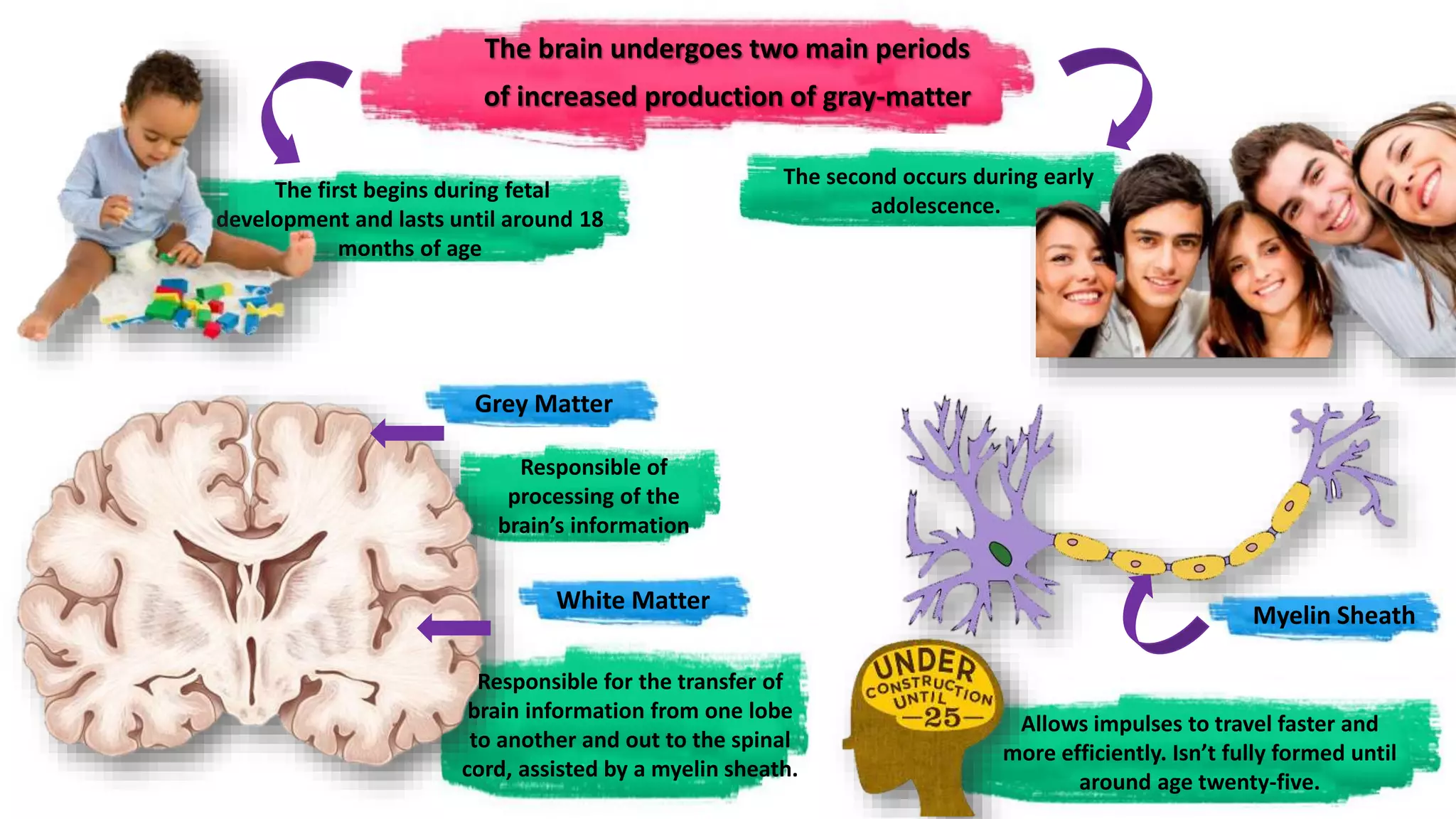
The brain undergoes two main periods
of increased production of gray-matter
The first begins during fetal
development and lasts until around 18
months of age
The second occurs during early
adolescence.
Grey Matter
Responsible of
processing of the
brain’s information
Responsible for the transfer of
brain information from one lobe
to another and out to the spinal
cord, assisted by a myelin sheath.
Myelin Sheath
Allows impulses to travel faster and
more efficiently. Isn’t fully formed until
around age twenty-five.
White Matter
Frontal Lobe
Temporal Lobe
Reasoning, problem solving, short term
memory, planning and executing behavior,
language, motor function, social mirroring,
judgment, and impulse control.
The last area of the brain
to be myelinated
Until the F.L has matured, other
parts are used for language
development and decision making
Because of the involvement of other parts,
adolescents tend to lack impulse control, have more
irrational behaviors, make decisions based on their
feelings rather than logical thought processing.
All of these characteristics affect
their ability to learn.
Two factors strongly influence whether the
brain pays attention to a piece of information
If the information has meaning
If the information causes an
emotional response
Learning is a process of building
neural networks in the brain.
Networks are formed in
three different ways
Concrete experiences, symbolic
learning, and abstract learning
Without concrete experiences,
symbolic and abstract learning have
little or no meaning
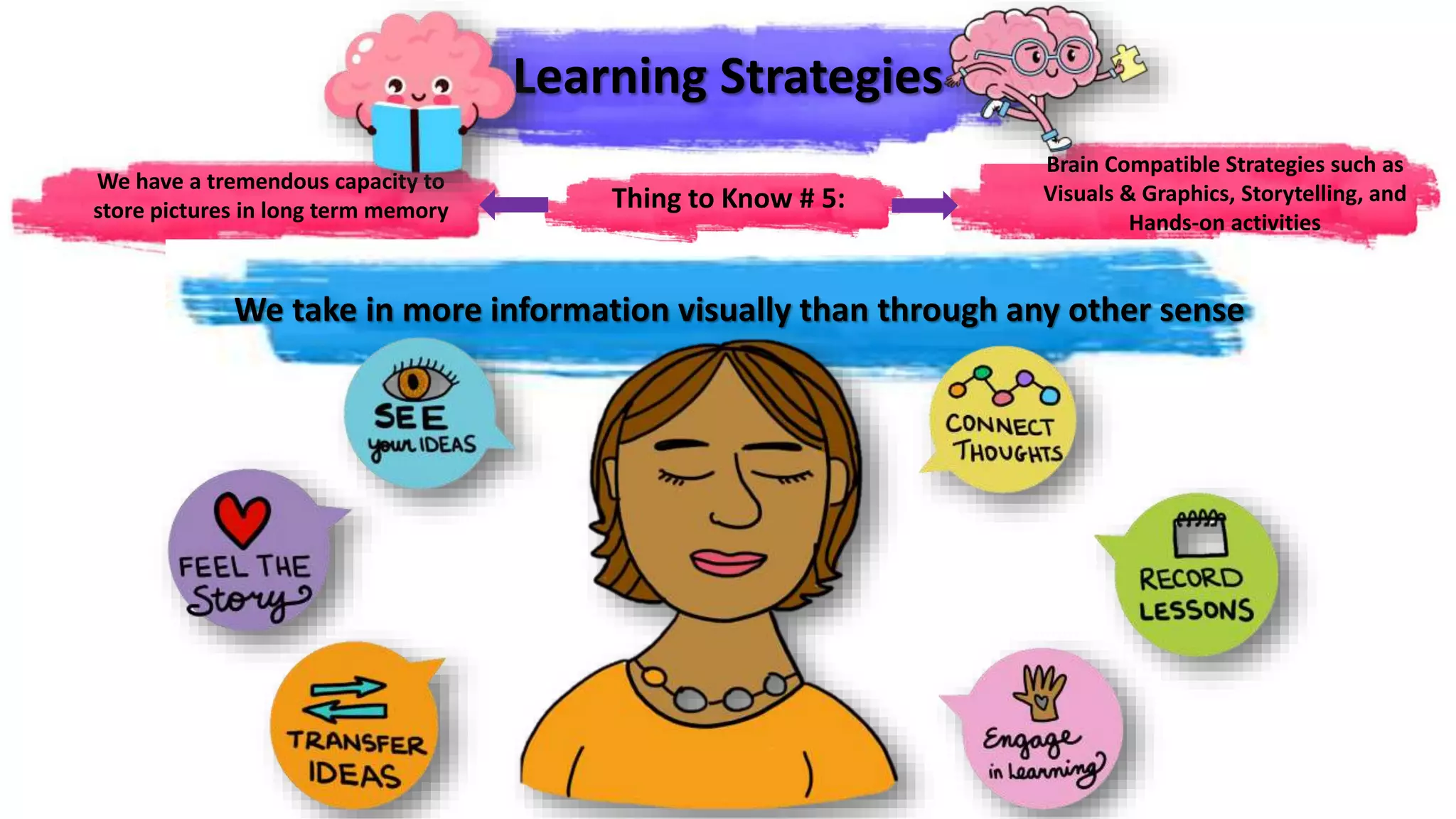
Learning Strategies
We take in more information visually than through any other sense
Thing to Know # 5:
We have a tremendous capacity to
store pictures in long term memory
Brain Compatible Strategies such as
Visuals & Graphics, Storytelling, and
Hands-on activities
What is Visual learning Style?
The visual learning style means that people need to see information to learn
it, and this "seeing" takes many forms from spatial awareness, photographic
memory, color/tone, brightness/contrast, and other visual information.
Strengths of Visual Learners
Instinctively follows directions
Easily visualizes objects
Is an excellent organizer
Has a strong sense of color
Can envision imagery easily
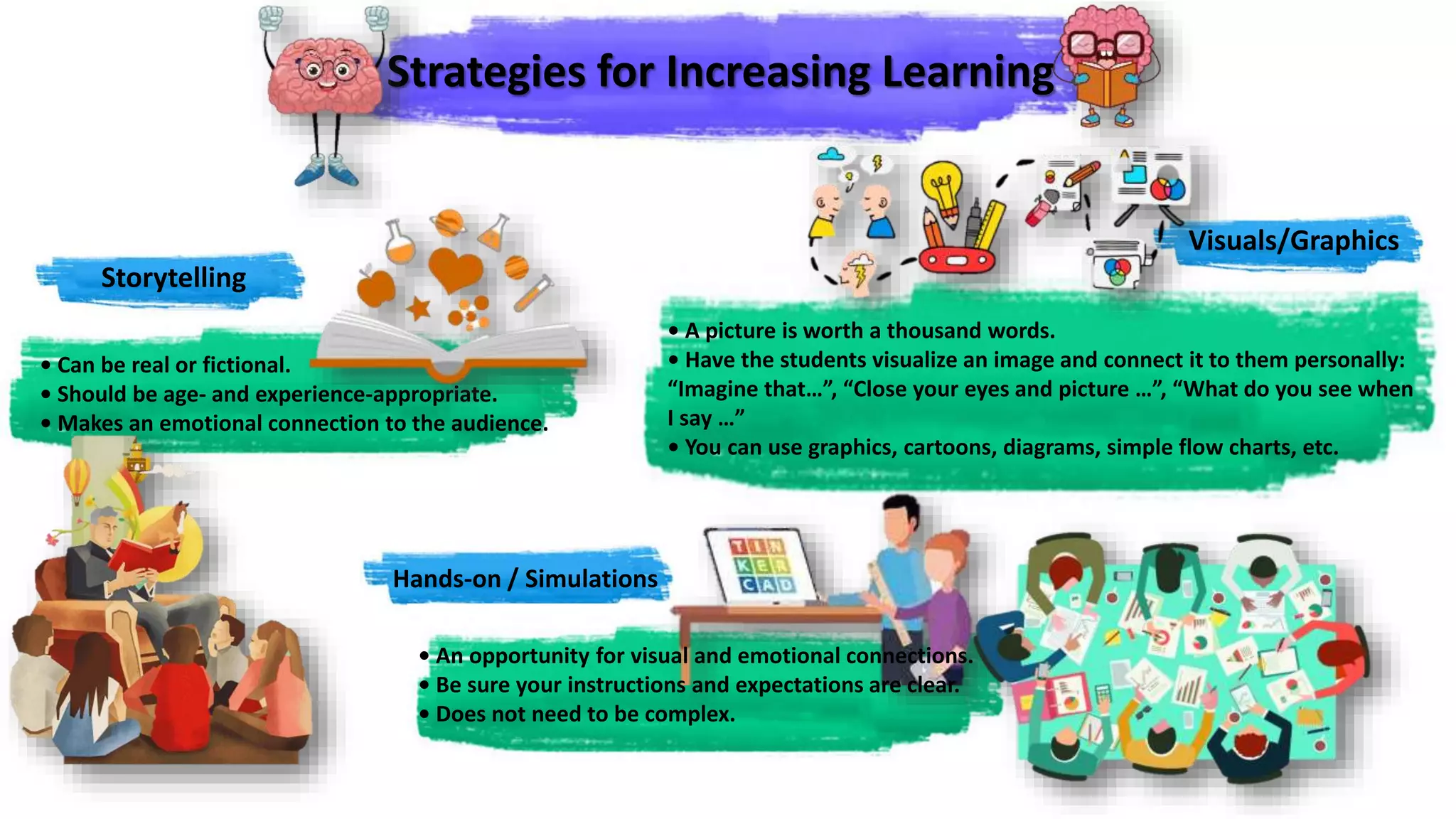
Strategies for Increasing Learning
• Can be real or fictional.
• Should be age- and experience-appropriate.
• Makes an emotional connection to the audience.
Storytelling
Visuals/Graphics
• A picture is worth a thousand words.
• Have the students visualize an image and connect it to them personally:
“Imagine that…”, “Close your eyes and picture …”, “What do you see when
I say …”
• You can use graphics, cartoons, diagrams, simple flow charts, etc.
Hands-on / Simulations
• An opportunity for visual and emotional connections.
• Be sure your instructions and expectations are clear.
• Does not need to be complex.
Activities/Ideas to Teach Visual
Learners
Write down new vocabulary
Making a habit of writing down new
words and adding a few quick context
clues (e.g., putting the part of speech
in brackets or underling the stressed
syllable) will help.
Use the whiteboard efficiently
Designate roles to certain areas of the
board and using colors to organize
information during the lesson.
Use charts and graphs
• Venn Diagrams (to make comparisons
and contrasts).
• Timelines (to represent the tenses, or a
series of events).
• Story or Essay Planners (to guide students
through the steps necessary to complete
these tasks).
• Charts to list word families (add columns
for verb, adjective, adverb, noun and fill
in all that apply as words come up.
Add symbols and
movement to flashcards
When teaching vocabulary with
flashcards, visual cues really help
your learners. For example,
“yummy” when we talk about an
ice-cream.
Play flashcard games
Make students stand up and move, or interact with
these cards in pairs or small groups will help visual
learners.
Experiment with realia
Use slide shows/videos Choose a clip containing a dialogue between
two people, A and B. In pairs, each student
must remember one side of the dialogue.
For a light-hearted activity, show your students a
clip with the sound off. Tell them they will work
in pairs to create a script that dubs the clip.
Choose songs from different films and genres.
Students write down what they think is the genre of
the film and what is happening in the scene in
question. Students compare their thoughts with a
partner
Real life items make new concepts easier to remember (fruits and
vegetables) and provide a practical, visual cue to draw from in real life (think
maps, brochures, business cards, advertisements, packaging, menus, and
photos).
Thanks for your attention!
Rasjido, Mónica Leonor
Thanks for your attention!

The Adolescent Brain - Visual Learners

  • 1.
    The Adolescent Brain LearningStrategies & Teaching Tips The Adolescent Brain Learning Strategies & Teaching Tips Student: Rasjido, Mónica Leonor Teacher: Laura Orellana Subject: Didáctica Especial II
  • 2.
    The brain undergoestwo main periods of increased production of gray-matter The first begins during fetal development and lasts until around 18 months of age The second occurs during early adolescence. Grey Matter Responsible of processing of the brain’s information Responsible for the transfer of brain information from one lobe to another and out to the spinal cord, assisted by a myelin sheath. Myelin Sheath Allows impulses to travel faster and more efficiently. Isn’t fully formed until around age twenty-five. White Matter
  • 3.
    Frontal Lobe Temporal Lobe Reasoning,problem solving, short term memory, planning and executing behavior, language, motor function, social mirroring, judgment, and impulse control. The last area of the brain to be myelinated Until the F.L has matured, other parts are used for language development and decision making Because of the involvement of other parts, adolescents tend to lack impulse control, have more irrational behaviors, make decisions based on their feelings rather than logical thought processing. All of these characteristics affect their ability to learn.
  • 4.
    Two factors stronglyinfluence whether the brain pays attention to a piece of information If the information has meaning If the information causes an emotional response Learning is a process of building neural networks in the brain. Networks are formed in three different ways Concrete experiences, symbolic learning, and abstract learning Without concrete experiences, symbolic and abstract learning have little or no meaning
  • 5.
    Learning Strategies We takein more information visually than through any other sense Thing to Know # 5: We have a tremendous capacity to store pictures in long term memory Brain Compatible Strategies such as Visuals & Graphics, Storytelling, and Hands-on activities
  • 6.
    What is Visuallearning Style? The visual learning style means that people need to see information to learn it, and this "seeing" takes many forms from spatial awareness, photographic memory, color/tone, brightness/contrast, and other visual information. Strengths of Visual Learners Instinctively follows directions Easily visualizes objects Is an excellent organizer Has a strong sense of color Can envision imagery easily
  • 7.
    Strategies for IncreasingLearning • Can be real or fictional. • Should be age- and experience-appropriate. • Makes an emotional connection to the audience. Storytelling Visuals/Graphics • A picture is worth a thousand words. • Have the students visualize an image and connect it to them personally: “Imagine that…”, “Close your eyes and picture …”, “What do you see when I say …” • You can use graphics, cartoons, diagrams, simple flow charts, etc. Hands-on / Simulations • An opportunity for visual and emotional connections. • Be sure your instructions and expectations are clear. • Does not need to be complex.
  • 8.
    Activities/Ideas to TeachVisual Learners Write down new vocabulary Making a habit of writing down new words and adding a few quick context clues (e.g., putting the part of speech in brackets or underling the stressed syllable) will help. Use the whiteboard efficiently Designate roles to certain areas of the board and using colors to organize information during the lesson. Use charts and graphs • Venn Diagrams (to make comparisons and contrasts). • Timelines (to represent the tenses, or a series of events). • Story or Essay Planners (to guide students through the steps necessary to complete these tasks). • Charts to list word families (add columns for verb, adjective, adverb, noun and fill in all that apply as words come up. Add symbols and movement to flashcards When teaching vocabulary with flashcards, visual cues really help your learners. For example, “yummy” when we talk about an ice-cream.
  • 9.
    Play flashcard games Makestudents stand up and move, or interact with these cards in pairs or small groups will help visual learners. Experiment with realia Use slide shows/videos Choose a clip containing a dialogue between two people, A and B. In pairs, each student must remember one side of the dialogue. For a light-hearted activity, show your students a clip with the sound off. Tell them they will work in pairs to create a script that dubs the clip. Choose songs from different films and genres. Students write down what they think is the genre of the film and what is happening in the scene in question. Students compare their thoughts with a partner Real life items make new concepts easier to remember (fruits and vegetables) and provide a practical, visual cue to draw from in real life (think maps, brochures, business cards, advertisements, packaging, menus, and photos).
  • 10.
    Thanks for yourattention! Rasjido, Mónica Leonor Thanks for your attention!