Learning Styles Mrs. DeBall AVID Coordinator December 2007
Outcome: Ability to determine different learning styles Determine if you have a dominant learning style Identify common classroom activities & how they relate to different learning styles Develop strategies to compensate when your learning style is not being addressed
DO NOTs: Blame your teacher if your learning style is not being addressed INSTEAD: Learn to cope & make learning meaningful for YOU!
QuickWrite In your AVID NB: Write for 4 minutes about the following questions: What does it mean to “learn how to learn?” What skills help us to be better learners? What do we need to learn about ourselves to make us better learners?
What makes it easy or difficult to learn?
This leads us to: What is a learning style?
What is YOUR learning style? So, what did you come up with?
So, what is what? Let's talk about specifics... Take CN in your AVID NB on all learning styles
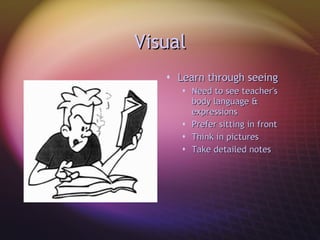
Visual Learn through seeing Need to see teacher's body language & expressions Prefer sitting in front Think in pictures Take detailed notes
Auditory Learn through listening Learn best:  Verbal lectures, discussions, talking things through Written information may have little meaning until it is heard benefit from reading text aloud
Tactile / Kinesthetic Learn through , moving, doing and touching...  Learn best through a hands-on approach Actively explore physical world around them Find it hard to sit still for long periods May become distracted by their need for activity and exploration
Individual Learner prefers to work alone
Group Learner prefers to work in a group of people
Oral Learner prefers to talk about findings/answers
Written Learner prefers to write out answers, rather than discussing
Now that you know what your learning style is... How does this impact your learning? How can you use this information in the classroom? What do you think  this means? Write down as a QuickWrite...
Get into groups… Find people who share your learning style… Select one person to be the recorder Select one person to be the reporter Answer the following questions on the paper provided: What strategies can teachers use to help us as visual/ auditory/tactile learners? What learning situations are particularly challenging for us? What learning situations are particularly easy for us? What strategies can we use to take responsibility for our learning?
Report out: Make a poster, elect an Artist (or 2) to create it;  Reporter, be ready!
Who's going first to share your group's poster?
In your learning style group: look @ your classroom observations...
Choose one: Choose one activity to focus on, from what you all observed in classes How is this a challenge for our learning style? List three strategies to compensate/overcome on a  NEW  poster

Learning Styles

  • 1.
    Learning Styles Mrs.DeBall AVID Coordinator December 2007
  • 2.
    Outcome: Ability todetermine different learning styles Determine if you have a dominant learning style Identify common classroom activities & how they relate to different learning styles Develop strategies to compensate when your learning style is not being addressed
  • 3.
    DO NOTs: Blameyour teacher if your learning style is not being addressed INSTEAD: Learn to cope & make learning meaningful for YOU!
  • 4.
    QuickWrite In yourAVID NB: Write for 4 minutes about the following questions: What does it mean to “learn how to learn?” What skills help us to be better learners? What do we need to learn about ourselves to make us better learners?
  • 5.
    What makes iteasy or difficult to learn?
  • 6.
    This leads usto: What is a learning style?
  • 7.
    What is YOURlearning style? So, what did you come up with?
  • 8.
    So, what iswhat? Let's talk about specifics... Take CN in your AVID NB on all learning styles
  • 9.
    Visual Learn throughseeing Need to see teacher's body language & expressions Prefer sitting in front Think in pictures Take detailed notes
  • 10.
    Auditory Learn throughlistening Learn best: Verbal lectures, discussions, talking things through Written information may have little meaning until it is heard benefit from reading text aloud
  • 11.
    Tactile / KinestheticLearn through , moving, doing and touching... Learn best through a hands-on approach Actively explore physical world around them Find it hard to sit still for long periods May become distracted by their need for activity and exploration
  • 12.
  • 13.
    Group Learner prefersto work in a group of people
  • 14.
    Oral Learner prefersto talk about findings/answers
  • 15.
    Written Learner prefersto write out answers, rather than discussing
  • 16.
    Now that youknow what your learning style is... How does this impact your learning? How can you use this information in the classroom? What do you think this means? Write down as a QuickWrite...
  • 17.
    Get into groups…Find people who share your learning style… Select one person to be the recorder Select one person to be the reporter Answer the following questions on the paper provided: What strategies can teachers use to help us as visual/ auditory/tactile learners? What learning situations are particularly challenging for us? What learning situations are particularly easy for us? What strategies can we use to take responsibility for our learning?
  • 18.
    Report out: Makea poster, elect an Artist (or 2) to create it; Reporter, be ready!
  • 19.
    Who's going firstto share your group's poster?
  • 20.
    In your learningstyle group: look @ your classroom observations...
  • 21.
    Choose one: Chooseone activity to focus on, from what you all observed in classes How is this a challenge for our learning style? List three strategies to compensate/overcome on a NEW poster