Towards a Digital Museum
Questions Has our audience changed as a result of technological changes?  Have our organizations changed as a result of technological changes?  How does a museum shift its shape to maintain connections to a virtual audience?
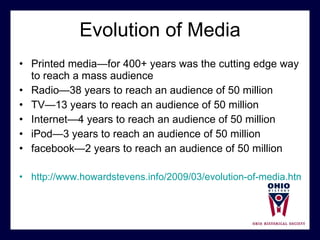
Evolution of Media Printed media—for 400+ years was the cutting edge way to reach a mass audience Radio—38 years to reach an audience of 50 million TV—13 years to reach an audience of 50 million Internet—4 years to reach an audience of 50 million  iPod—3 years to reach an audience of 50 million facebook—2 years to reach an audience of 50 million  http://www.howardstevens.info/2009/03/evolution-of-media.html
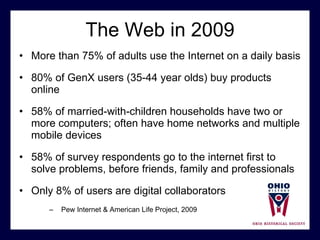
The Web in 2009 More than 75% of adults use the Internet on a daily basis 80% of GenX users (35-44 year olds) buy products online 58% of married-with-children households have two or more computers; often have home networks and multiple mobile devices 58% of survey respondents go to the internet first to solve problems, before friends, family and professionals  Only 8% of users are digital collaborators Pew Internet & American Life Project, 2009
The Experience Economy Memorable Goods and services are props Not static Personal Active Invoke a sense of emotion Authentic B. Joseph Pine and James Gilmore,  Harvard Business Review  http://lopeztoledo.files.wordpress.com/2008/10/experience_economy.pdf Authenticity: What Consumers Really Want
What does this mean for museums?  Tourism is not a sustainable business model for most historic sites Sustainability comes through relevance to your communities/audiences Attendance figures are not the most valid measure of the positive value and impact of the historic site experience Innovation, experimentation, collaboration and a broad sharing of the resulting information are essential to achieving historic sites sustainability on a broad scale “ The Kykuit II Summit: The Sustainability of Historic  Sites”  Vogt, J.D., HISTORY NEWS, v 62, 2007
What do we do about it? Share authority Shift from a temple to a forum Outreach and Inreach Let audiences reach into our organizations on their terms Connect with niche audiences  Chris Anderson’s  Long Tail Shift resources Financial, staff Collaborate History organizations are not competing  with one another
History is about  stories David Thelen 39% or Americans have hobbies related to the past (genealogy, antiques, reenactors) Family is most important past (above US history) for 2/3 of Americans Have to connect to people on an individual level (layered experiences) Most trusted sources: grandmothers, museums http://chnm.gmu.edu/survey/afterdave.html
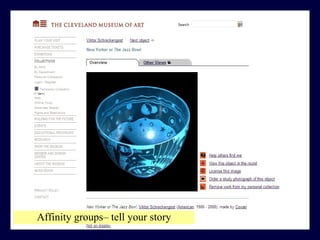
Affinity groups– tell your story
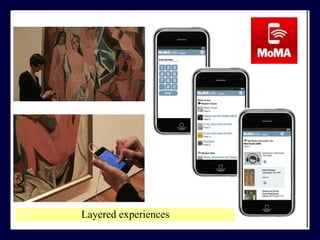
RFID Layered experiences
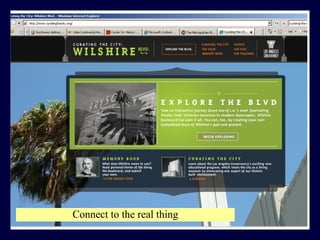
http://www.curatingthecity.org/ Connect to the real thing
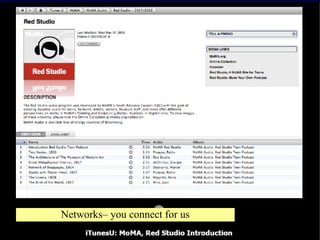
Networks– you connect for us
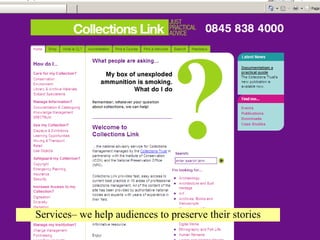
Services– we help audiences to preserve their stories
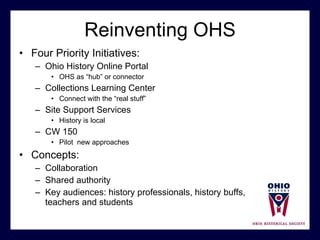
Reinventing OHS Four Priority Initiatives:  Ohio History Online Portal OHS as “hub” or connector Collections Learning Center Connect with the “real stuff”  Site Support Services History is local  CW 150 Pilot  new approaches Concepts:  Collaboration Shared authority Key audiences: history professionals, history buffs,  teachers and students
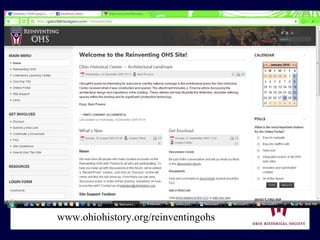
www.ohiohistory.org/reinventingohs
[email_address] #digitalangela  (614) 297-2576

That Camp2010 downloadable

  • 1.
  • 2.
    Questions Has ouraudience changed as a result of technological changes? Have our organizations changed as a result of technological changes? How does a museum shift its shape to maintain connections to a virtual audience?
  • 3.
    Evolution of MediaPrinted media—for 400+ years was the cutting edge way to reach a mass audience Radio—38 years to reach an audience of 50 million TV—13 years to reach an audience of 50 million Internet—4 years to reach an audience of 50 million iPod—3 years to reach an audience of 50 million facebook—2 years to reach an audience of 50 million http://www.howardstevens.info/2009/03/evolution-of-media.html
  • 4.
    The Web in2009 More than 75% of adults use the Internet on a daily basis 80% of GenX users (35-44 year olds) buy products online 58% of married-with-children households have two or more computers; often have home networks and multiple mobile devices 58% of survey respondents go to the internet first to solve problems, before friends, family and professionals Only 8% of users are digital collaborators Pew Internet & American Life Project, 2009
  • 5.
    The Experience EconomyMemorable Goods and services are props Not static Personal Active Invoke a sense of emotion Authentic B. Joseph Pine and James Gilmore, Harvard Business Review http://lopeztoledo.files.wordpress.com/2008/10/experience_economy.pdf Authenticity: What Consumers Really Want
  • 6.
    What does thismean for museums? Tourism is not a sustainable business model for most historic sites Sustainability comes through relevance to your communities/audiences Attendance figures are not the most valid measure of the positive value and impact of the historic site experience Innovation, experimentation, collaboration and a broad sharing of the resulting information are essential to achieving historic sites sustainability on a broad scale “ The Kykuit II Summit: The Sustainability of Historic Sites” Vogt, J.D., HISTORY NEWS, v 62, 2007
  • 7.
    What do wedo about it? Share authority Shift from a temple to a forum Outreach and Inreach Let audiences reach into our organizations on their terms Connect with niche audiences Chris Anderson’s Long Tail Shift resources Financial, staff Collaborate History organizations are not competing with one another
  • 8.
    History is about stories David Thelen 39% or Americans have hobbies related to the past (genealogy, antiques, reenactors) Family is most important past (above US history) for 2/3 of Americans Have to connect to people on an individual level (layered experiences) Most trusted sources: grandmothers, museums http://chnm.gmu.edu/survey/afterdave.html
  • 9.
  • 10.
  • 11.
  • 12.
  • 13.
    Services– we helpaudiences to preserve their stories
  • 14.
    Reinventing OHS FourPriority Initiatives: Ohio History Online Portal OHS as “hub” or connector Collections Learning Center Connect with the “real stuff” Site Support Services History is local CW 150 Pilot new approaches Concepts: Collaboration Shared authority Key audiences: history professionals, history buffs, teachers and students
  • 15.
  • 16.

Editor's Notes

  • #5 Here is what we know about web users today. While we tend to think of young people as power-users, the audience for the web is much more broad. In fact, the center of web activity is GenX’ers who are starting families and have kids that are power-power users. We also know some things about how people use the web. It is becoming a trusted source of information (not all sites of course, but it is a place to start.) However, only 8% of users in all categories are “digital collaborators”. These are the people that are ahead of the trends and are the early adopters for a given social group. These are the people we need to reach.
  • #10 The site incorporates Web 2.0 technology by asking users to “Help others find me” as well as different views of the object. Users can also order study prints or even license the image. Scrolling down below the object is a link to hear the artist talk about the piece.
  • #11 While important for collection management, Barcoding and RFID technologies can also be used to develop end-user connections. In this case, the MoMA uses codes (based on the barcode) to develop podcasts that users can view on their iPod. The same technology that makes this possible in the museum can also be used online.
  • #12 Connecting the City: Wilkshire Blvd. won a Muse Award from the American Association of Museums in 2007. The project focuses on a particular area and allows users to find their own way through the site.
  • #13 An interesting aspect of the MoMA project is that the podcasts were created by MoMA’s “Red Studio” group, a teen affiliate group.
  • #14 For Outreach, we can interact much more closely with other historical societies, libraries and museums. Another aspect of this is allowing insitututions to put their own content on the portal. (Service-based fee model). Winner, Best of the Web 2007 Collections Link http://www.collectionslink.org.uk Managed by MDA in partnership with Institute of Conservation and The National Preservation Office. As users submit questions, they are dynamically linked on to the front page. Links on the left connect librarians and museum professionals with resources.