

How social can news get?SoCon11  February 5, 2011Kennesaw State University, Georgia Lee Rainie: Director, Pew Internet ProjectEmail: Lrainie@pewinternet.org
Networked individualsWeaker boundaries for small, tight-knit groupsMore connectivityMore personal autonomy
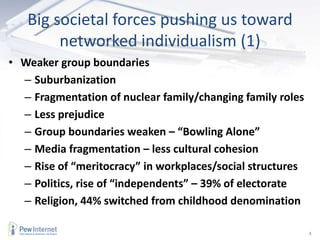
4Big societal forces pushing us toward networked individualism (1)Weaker group boundariesSuburbanizationFragmentation of nuclear family/changing family roles Less prejudiceGroup boundaries weaken – “Bowling Alone” Media fragmentation – less cultural cohesionRise of “meritocracy” in workplaces/social structuresPolitics, rise of “independents” – 39% of electorateReligion, 44% switched from childhood denomination
Big societal forces pushing us toward networked individualism (2)Spreading connectivityTravel Technology Trade
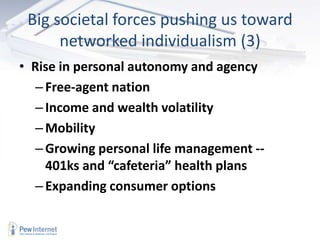
Big societal forces pushing us toward networked individualism (3)Rise in personal autonomy and agencyFree-agent nationIncome and wealth volatilityMobilityGrowing personal life management -- 401ks and “cafeteria” health plansExpanding consumer options
1 - Internet and Broadband Revolution7
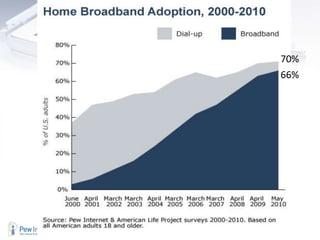
70% 66%
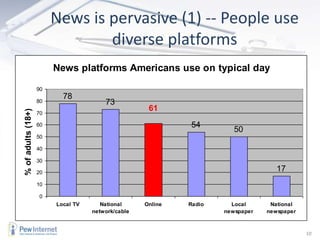
News is pervasive (1) -- People use diverse platforms10
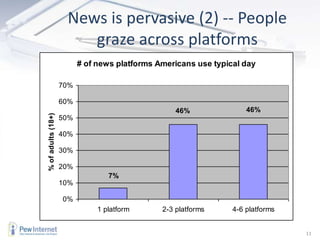
News is pervasive (2) -- People graze across platforms 11
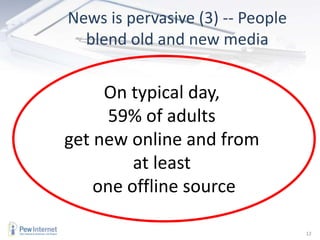
News is pervasive (3) -- People blend old and new mediaOn typical day, 59% of adults get new online and from at least one offline source12
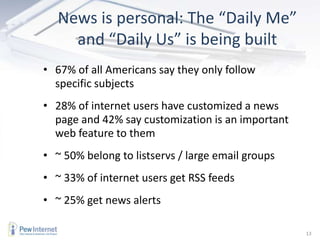
News is personal: The “Daily Me” and “Daily Us” is being built 67% of all Americans say they only follow specific subjects28% of internet users have customized a news page and 42% say customization is an important web feature to them~ 50% belong to listservs / large email groups~ 33% of internet users get RSS feeds~ 25% get news alerts13
VelocityvVolumeValenceRelevanceVibranceVoicesVariety
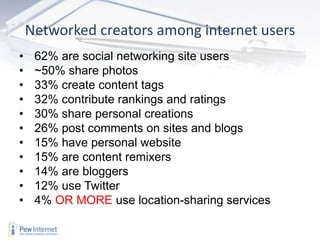
Networked creators among internet users 62% are social networking site users
 ~50% share photos
 33% create content tags
 32% contribute rankings and ratings
 30% share personal creations
 26% post comments on sites and blogs
 15% have personal website
 15% are content remixers
 14% are bloggers
 12% use Twitter
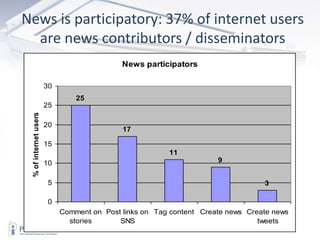
 4% OR MORE use location-sharing servicesNews is participatory: 37% of internet users are news contributors / disseminators
2 - Wireless Connectivity Revolution17
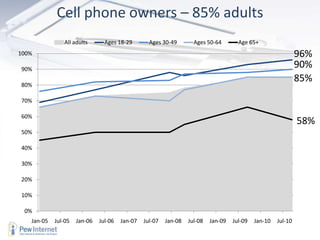
Cell phone owners – 85% adults96% 90% 85% 58%
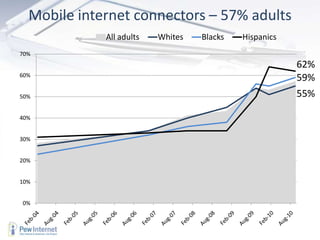
Mobile internet connectors – 57% adults62% 59% 55%
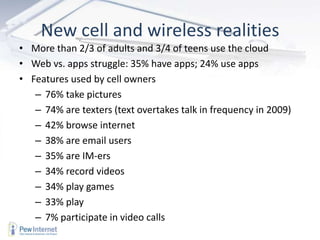
New cell and wireless realitiesMore than 2/3 of adults and 3/4 of teens use the cloudWeb vs. apps struggle: 35% have apps; 24% use appsFeatures used by cell owners76% take pictures74% are texters (text overtakes talk in frequency in 2009)42% browse internet38% are email users35% are IM-ers34% record videos34% play games33% play 7% participate in video calls
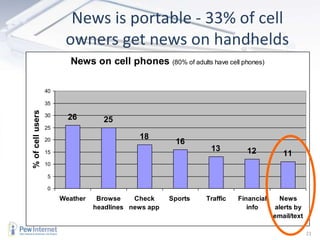
News is portable - 33% of cell owners get news on handhelds21
3 - Social Networking Revolution22

2011 2.5.11 - kennesaw -- social news

  • 1.
    How social cannews get?SoCon11 February 5, 2011Kennesaw State University, Georgia Lee Rainie: Director, Pew Internet ProjectEmail: Lrainie@pewinternet.org
  • 3.
    Networked individualsWeaker boundariesfor small, tight-knit groupsMore connectivityMore personal autonomy
  • 4.
    4Big societal forcespushing us toward networked individualism (1)Weaker group boundariesSuburbanizationFragmentation of nuclear family/changing family roles Less prejudiceGroup boundaries weaken – “Bowling Alone” Media fragmentation – less cultural cohesionRise of “meritocracy” in workplaces/social structuresPolitics, rise of “independents” – 39% of electorateReligion, 44% switched from childhood denomination
  • 5.
    Big societal forcespushing us toward networked individualism (2)Spreading connectivityTravel Technology Trade
  • 6.
    Big societal forcespushing us toward networked individualism (3)Rise in personal autonomy and agencyFree-agent nationIncome and wealth volatilityMobilityGrowing personal life management -- 401ks and “cafeteria” health plansExpanding consumer options
  • 7.
    1 - Internetand Broadband Revolution7
  • 9.
  • 10.
    News is pervasive(1) -- People use diverse platforms10
  • 11.
    News is pervasive(2) -- People graze across platforms 11
  • 12.
    News is pervasive(3) -- People blend old and new mediaOn typical day, 59% of adults get new online and from at least one offline source12
  • 13.
    News is personal:The “Daily Me” and “Daily Us” is being built 67% of all Americans say they only follow specific subjects28% of internet users have customized a news page and 42% say customization is an important web feature to them~ 50% belong to listservs / large email groups~ 33% of internet users get RSS feeds~ 25% get news alerts13
  • 14.
  • 15.
    Networked creators amonginternet users 62% are social networking site users
  • 16.
  • 17.
    33% createcontent tags
  • 18.
    32% contributerankings and ratings
  • 19.
    30% sharepersonal creations
  • 20.
    26% postcomments on sites and blogs
  • 21.
    15% havepersonal website
  • 22.
    15% arecontent remixers
  • 23.
    14% arebloggers
  • 24.
    12% useTwitter
  • 25.
    4% ORMORE use location-sharing servicesNews is participatory: 37% of internet users are news contributors / disseminators
  • 26.
    2 - WirelessConnectivity Revolution17
  • 27.
    Cell phone owners– 85% adults96% 90% 85% 58%
  • 28.
    Mobile internet connectors– 57% adults62% 59% 55%
  • 29.
    New cell andwireless realitiesMore than 2/3 of adults and 3/4 of teens use the cloudWeb vs. apps struggle: 35% have apps; 24% use appsFeatures used by cell owners76% take pictures74% are texters (text overtakes talk in frequency in 2009)42% browse internet38% are email users35% are IM-ers34% record videos34% play games33% play 7% participate in video calls
  • 30.
    News is portable- 33% of cell owners get news on handhelds21
  • 31.
    3 - SocialNetworking Revolution22

Editor's Notes

  • #2 Title: How social can it get?Subject: Lee Rainie, Director of the Pew Internet Project, will discuss the Project’s latest findings and go through trends in social media use in the last five years of the Project’s data. He will explore how the turn to pervasive, participatory, personal, and portable content changes the way consumers and producers behave and think in this digital, mobile age.  
  • #10 Rise of broadband at home was transformative – internet becomes a central info and communications hub in the home after the switch from dial-up. People do more stuff online; privilege the internet over other info sources in many cases; report better outcomes from internet use, and, most importantly become content creators. Two thirds of adults and 80% of teens are content creators. This is the big change the internet has introduced to media landscape. Probably take a minute to say this.
  • #16 This is the way Pew Internet measures content creation….
  • #19 Quick rundown of growth of cell ownership – 30 seconds
  • #20 Rundown of mobile connectivityCell phones – 39% of cell owners Laptops – 87% of laptop ownersOverall that adds up to 57% of adults
  • #21 Quick reference to growth of the cloudQuick review of Nielson Mobile – Pew data on apps usageQuick review of cell features used by ownersLess than a minute
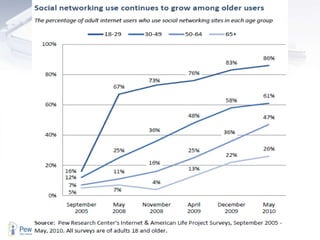
  • #24 Quick rundown of our data on rise of social networking. This amplifies long term trends dating to 20th century in technology, new social roles, workforce structure, politics and culture. Right now, 48% of American adults use social networking sites and fastest growth is taking place in the 50+ age cohort
  • #26 In the challenging new media ecosystem – as more information comes at them from more sources at ever-greater speeds – people cope with the change by relying more and more on their social networks. There are three important ways they do that.The first is that they rely on their networks to act as their “alert” system – sentries. We hear from more and more people who begin and end their days by checking in with their social networks to see what’s new, what’s worth viewing, what’s most enjoyable in media spaces.
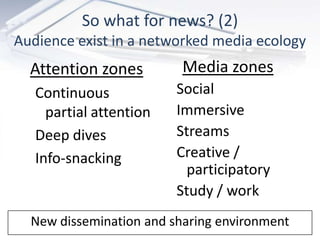
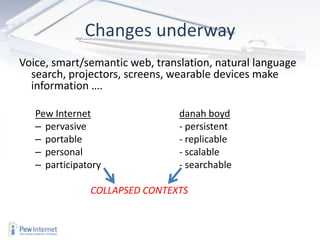
  • #27 Most importantly, mobile connectivity changes people’s sense of time and their allocation of attention to media. They can exist in three separate zones of attention depending on their circumstances, frame of mind, and needs.Continuous partial attention / multitasking – perpetually interruptable and interruptingDeep dives – the rise of amateur experts who can find out anything about subjects that matter to them. The special case is health research. Info-snacking – this is particularly enabled by mobile because it allows people to get little info-hits when they are in transactional situations or when they have “micro-boredom” to kill Mobile also adds to the number of media zones that people can inhabit, again, reflecting their circumstances, frame of mind, and needsSocial zone – what are my friends doing; telling them what I’m doing: highly interactive and involves disclosure of interests of the moment – direct cues about where attention and intentions are focused – people take direction from the people in their social networks about what to examineImmersive zone – 1) gaming and 2) couch potato space – less interruptable and less interested in being interrupted, more attentive to media and more disrupted (unhappily) by interventionsStreams – this is the zone people are in when they want to “catch up” with news or developments. Similar to the social zone, but more open to media inputs from organizations …. Checking for “headlines” of all kinds …. Less annoyed at relevant commercial information – indeed “networked information” is a hallmark of this zoneCreative / participatory zone – this is the place where people create content to share online…. They comment on / rank /rate the media they’ve experienced; they remix it at times. Commercial messaging is part of the play and participation environment. This is “conversational” space for commercial messaging and there are opportunities and dangers. This is where the most engaged customers are: they can be evangelists OR provocateurs, depending on their mood and the way they encounter brands.