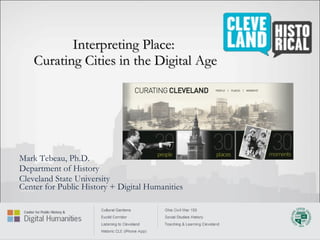
Interpreting Place:  Curating Cities in the Digital Age Mark Tebeau, Ph.D. Department of History Cleveland State University Center for Public History + Digital Humanities
Curating the City City as Living Museum Cleveland Cultural Gardens Cleveland Regional Oral History Collection Walking Tours & Community Conversations & Radio Euclid Corridor History Kiosks Digital history on the Street Cleveland Memory Cleveland Digital Commons Teaching & Learning Cleveland Community-based exhibits & Posters Ohio Civil War 150 th  Centennial Re-Imagining Cleveland Curating Cleveland Cleveland Historical
Place Matters What is Place Italo Calvino:  Invisible Cities What is place? Landscape & Human Stories Lived by People Layered Meaning How is it made? Landscape & Narrative History: social, cultural, politics & economy Interpretive Layers By collaborative conversation—process  Can it become vehicle for public history/teacher training? Can it be made in conjunction with the community? More recently, can place be represented digitally?
Theorizing Digital Physicality of space & place Interpretation (vs. description) Interactivity (vs. didacticism) Technology: craft, technique, tinkering Project architecture as knowledge infrastructure CMS & Platform: Open Source Design shapes expression of content Disciplinary Best Practices Matter
Digital Practice Curating the city interpretive and collaborative Community-based partnerships Commitment-based partnerships Students, teachers, cultural organizations, and non-governmental organizations Best practices PROCESS based
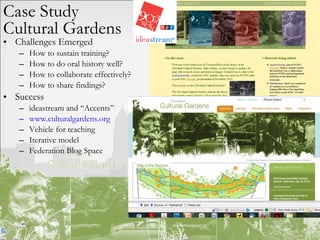
Challenges Emerged How to sustain training? How to do oral history well? How to collaborate effectively? How to share findings? Success ideastream and “Accents” www.culturalgardens.org Vehicle for teaching  Iterative model Federation Blog Space Case Study Cultural Gardens
Case Studies: Cleveland Oral History Euclid Corridor Kiosks Collecting Oral History w/Students Cultural Gardens Tremont Oral History (Walking Tour) Slavic Village (Church Talks) Shaker Heights (Community Publication) NPS (Community Programming) Collect with Community Partners Community-based Process CSU—Intellectual Leadership CSU—Facilitation, Processing, and Archiving CSU—Interviewing Partner—Identify Interviews Partner—Interviewing, Facilitation, and Processing Programmatic Goals & Outcomes Collaborative Programming
Case Study: Teaching & Learning Cleveland Omeka Archive for History Teaching Public History Training: Exhibit Building Community Building: Exhibits/Posters Lessons Sandbox Process Oriented Community wants Interpretation Sustainability Human Connections Critical Training (hist. thinking difficult) OK to FAIL Collect Analytics Building iteratively
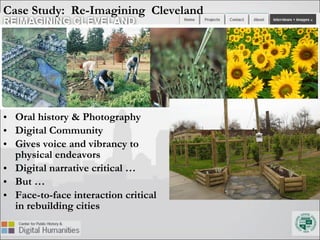
Oral history & Photography Digital Community Gives voice and vibrancy to physical endeavors Digital narrative critical … But … Face-to-face interaction critical in rebuilding cities  Case Study:  Re-Imagining  Cleveland
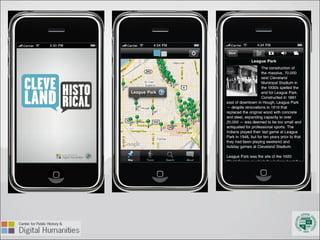
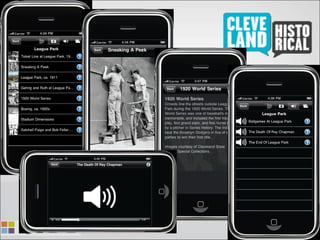
Case Study: Mobile  Stories—interpretive and experiential narratives Geo-located  Layered and Multimedia: text, image, sound, video Standards-based database  (Omeka--Library & W3) Social media (Facebook & Twitter); v2 iPhone & Android v2; Tablets v3 QR/NFC v. 2.5 Tours (V1, mods w/V2 & V3) Meta interpretive Thematic, tours as learning Enhance human-led tours Games & badges  Site-based scavenger hunts Tour badges Neighborhood badges


Site Architecture Content Creativity Community Collaboration Cloud Architecture as collaboration
Case Study:  Technology & Best Practice Not just geo-location Layered and Multimedia: text, image, sound, video Oral History iMovies Collaborative Content Creation (Teachers, Students, Community) Standards-based database  (Omeka--Library & W3) Extensible, sharable, iterative, future-oriented Social media (Facebook & Twitter); v2 Web presence & Multi-platform Engage the landscape
Case Study: Interpretation Not just geo-location Layered and Multimedia: text, image, sound, video Collaborative Content Creation (Teachers, Students, Community) Engage the landscape Tours (V1, mods w/V2 & V3) Meta interpretive As playlists Thematic, tours as learning Enhance human-led tours QR/NFC v. 2.5
Case Study: Interactivity Games & badges  scavenger hunts QR/NFC functionality Tour badges Neighborhood badges Content-creator badges Tour Creation Tour Playlists
Connecting People & Place Technology only a tool Best practice builds documentary legacies Process & Collaboration Build Place Remade iteratively over time… Information architecture should be a best practice Physicality—Mobile Matters Interpretation Interactivity
The End Mobile Historical Extensible across country Available for you Partner badges and/or unique identities Open-Source Hosted  CHNM collaboration, as part of Omeka ecosystem Where Next?
Mobile Teaching & Learning Students develop stories/sites Students collect oral histories Students create and organize tours Students learn digital platforms and humanities Applicable to graduate students, undergrads, K-12 teachers, K-12 students, and community members Community also able to create content, making CSU agent for history learning Model of engaged learning Provides model for teaching/learning in digital age Significant community benefit Establishes  a model digital community Scalable and extensible to any landscape or learning environment using geocoding, QR codes, and/or OAI standards In digital humanities such publishing/research platforms represent scholarship Re-imagines public history, digital storytelling, community role in history, and historical research
Digital Humanities Scholarship Curating the City Re-imagines public history, digital storytelling, community role in history, and historical research  As a new mode and model for exhibition publishing Developing new forms of storytelling Tours represent a new conception of knowledge Establishes Cleveland as a model digital history community Scalable and extensible to any landscape or learning environment using geocoding, QR codes, and/or OAI standards New tool for community development and community building New tool for social science research Network analysis
Research: Open Source Revolution Open-source replacing proprietary model in public  and  private sector Open-source represents efficiencies  Open-source empowers individuals and communities Open-source builds relationships
Engaged Learning Developed by CSU students (hist. dept. undergrads & grads) Used by students (Local History, Public History, Urban History) Used by the community (Clev. Heights, Shaker, Gordon Square, Lakewood, Ohio City/West Side Market, scholarly research on Sacred Landmarks) Teaching tool (CSU w/ESCCC, approx. 40 regional teachers) Carries CSU brand (could carry more prominently …) Cleveland as a Digital History Museum  Potential Connect regional cultural infrastructure  Imagine Cleveland Historical/Omeka as open-source backbone for cultural interpretation in OneCleveland Network Common teaching tool Community development tool Social science research  Interpret Ohio Digital Public History publishing platform, used globally
Research: Omeka Infrastructure What is Omeka? Content management Standards-based Archive Publishing Standards based Why Omeka?  http://www.foundhistory.org/2010/09/01/omeka-and-its-peers/ Corporation for Digital Scholarship http://www.digitalscholar.org/   Omeka.net http://www.omeka.net/
Developing Mobile Historical

Curating place

  • 1.
    Interpreting Place: Curating Cities in the Digital Age Mark Tebeau, Ph.D. Department of History Cleveland State University Center for Public History + Digital Humanities
  • 2.
    Curating the CityCity as Living Museum Cleveland Cultural Gardens Cleveland Regional Oral History Collection Walking Tours & Community Conversations & Radio Euclid Corridor History Kiosks Digital history on the Street Cleveland Memory Cleveland Digital Commons Teaching & Learning Cleveland Community-based exhibits & Posters Ohio Civil War 150 th Centennial Re-Imagining Cleveland Curating Cleveland Cleveland Historical
  • 3.
    Place Matters Whatis Place Italo Calvino: Invisible Cities What is place? Landscape & Human Stories Lived by People Layered Meaning How is it made? Landscape & Narrative History: social, cultural, politics & economy Interpretive Layers By collaborative conversation—process Can it become vehicle for public history/teacher training? Can it be made in conjunction with the community? More recently, can place be represented digitally?
  • 4.
    Theorizing Digital Physicalityof space & place Interpretation (vs. description) Interactivity (vs. didacticism) Technology: craft, technique, tinkering Project architecture as knowledge infrastructure CMS & Platform: Open Source Design shapes expression of content Disciplinary Best Practices Matter
  • 5.
    Digital Practice Curatingthe city interpretive and collaborative Community-based partnerships Commitment-based partnerships Students, teachers, cultural organizations, and non-governmental organizations Best practices PROCESS based
  • 6.
    Challenges Emerged Howto sustain training? How to do oral history well? How to collaborate effectively? How to share findings? Success ideastream and “Accents” www.culturalgardens.org Vehicle for teaching Iterative model Federation Blog Space Case Study Cultural Gardens
  • 7.
    Case Studies: ClevelandOral History Euclid Corridor Kiosks Collecting Oral History w/Students Cultural Gardens Tremont Oral History (Walking Tour) Slavic Village (Church Talks) Shaker Heights (Community Publication) NPS (Community Programming) Collect with Community Partners Community-based Process CSU—Intellectual Leadership CSU—Facilitation, Processing, and Archiving CSU—Interviewing Partner—Identify Interviews Partner—Interviewing, Facilitation, and Processing Programmatic Goals & Outcomes Collaborative Programming
  • 8.
    Case Study: Teaching& Learning Cleveland Omeka Archive for History Teaching Public History Training: Exhibit Building Community Building: Exhibits/Posters Lessons Sandbox Process Oriented Community wants Interpretation Sustainability Human Connections Critical Training (hist. thinking difficult) OK to FAIL Collect Analytics Building iteratively
  • 9.
    Oral history &Photography Digital Community Gives voice and vibrancy to physical endeavors Digital narrative critical … But … Face-to-face interaction critical in rebuilding cities Case Study: Re-Imagining Cleveland
  • 10.
    Case Study: Mobile Stories—interpretive and experiential narratives Geo-located Layered and Multimedia: text, image, sound, video Standards-based database (Omeka--Library & W3) Social media (Facebook & Twitter); v2 iPhone & Android v2; Tablets v3 QR/NFC v. 2.5 Tours (V1, mods w/V2 & V3) Meta interpretive Thematic, tours as learning Enhance human-led tours Games & badges Site-based scavenger hunts Tour badges Neighborhood badges
  • 11.
  • 12.
  • 13.
  • 14.
    Site Architecture ContentCreativity Community Collaboration Cloud Architecture as collaboration
  • 15.
    Case Study: Technology & Best Practice Not just geo-location Layered and Multimedia: text, image, sound, video Oral History iMovies Collaborative Content Creation (Teachers, Students, Community) Standards-based database (Omeka--Library & W3) Extensible, sharable, iterative, future-oriented Social media (Facebook & Twitter); v2 Web presence & Multi-platform Engage the landscape
  • 16.
    Case Study: InterpretationNot just geo-location Layered and Multimedia: text, image, sound, video Collaborative Content Creation (Teachers, Students, Community) Engage the landscape Tours (V1, mods w/V2 & V3) Meta interpretive As playlists Thematic, tours as learning Enhance human-led tours QR/NFC v. 2.5
  • 17.
    Case Study: InteractivityGames & badges scavenger hunts QR/NFC functionality Tour badges Neighborhood badges Content-creator badges Tour Creation Tour Playlists
  • 18.
    Connecting People &Place Technology only a tool Best practice builds documentary legacies Process & Collaboration Build Place Remade iteratively over time… Information architecture should be a best practice Physicality—Mobile Matters Interpretation Interactivity
  • 19.
    The End MobileHistorical Extensible across country Available for you Partner badges and/or unique identities Open-Source Hosted CHNM collaboration, as part of Omeka ecosystem Where Next?
  • 20.
    Mobile Teaching &Learning Students develop stories/sites Students collect oral histories Students create and organize tours Students learn digital platforms and humanities Applicable to graduate students, undergrads, K-12 teachers, K-12 students, and community members Community also able to create content, making CSU agent for history learning Model of engaged learning Provides model for teaching/learning in digital age Significant community benefit Establishes a model digital community Scalable and extensible to any landscape or learning environment using geocoding, QR codes, and/or OAI standards In digital humanities such publishing/research platforms represent scholarship Re-imagines public history, digital storytelling, community role in history, and historical research
  • 21.
    Digital Humanities ScholarshipCurating the City Re-imagines public history, digital storytelling, community role in history, and historical research As a new mode and model for exhibition publishing Developing new forms of storytelling Tours represent a new conception of knowledge Establishes Cleveland as a model digital history community Scalable and extensible to any landscape or learning environment using geocoding, QR codes, and/or OAI standards New tool for community development and community building New tool for social science research Network analysis
  • 22.
    Research: Open SourceRevolution Open-source replacing proprietary model in public and private sector Open-source represents efficiencies Open-source empowers individuals and communities Open-source builds relationships
  • 23.
    Engaged Learning Developedby CSU students (hist. dept. undergrads & grads) Used by students (Local History, Public History, Urban History) Used by the community (Clev. Heights, Shaker, Gordon Square, Lakewood, Ohio City/West Side Market, scholarly research on Sacred Landmarks) Teaching tool (CSU w/ESCCC, approx. 40 regional teachers) Carries CSU brand (could carry more prominently …) Cleveland as a Digital History Museum Potential Connect regional cultural infrastructure Imagine Cleveland Historical/Omeka as open-source backbone for cultural interpretation in OneCleveland Network Common teaching tool Community development tool Social science research Interpret Ohio Digital Public History publishing platform, used globally
  • 24.
    Research: Omeka InfrastructureWhat is Omeka? Content management Standards-based Archive Publishing Standards based Why Omeka? http://www.foundhistory.org/2010/09/01/omeka-and-its-peers/ Corporation for Digital Scholarship http://www.digitalscholar.org/ Omeka.net http://www.omeka.net/
  • 25.

Editor's Notes

  • #2 Contact Information: Mark Tebeau, Ph.D. Associate Professor Department of History Director, Center for Public History and Digital Humanities Cleveland State University Rhodes Tower 1860 East 22nd Street Cleveland, OH 44115 (216) 687-3937 (phone) (216) 687-5592 (fax) [email_address] <http://www.csudigitalhumanities.org/> <http://urbanhumanist.org/> <http://marktebeau.com/> <http://www.culturalgardens.org/> Taipei Municipal University, June 4, 2010 Mark Tebeau, Making Place in a Digital Age
  • #3 I founded and direct the Center for Public History + Digital Humanities at Cleveland State University. Cleveland State has about 16,000 students, almost evenly split between graduate and undergraduate students. My academic home is the History Department, we have about 200 graduate and undergraduate students at any time, with students training for a broad range of careers including those in public history and teaching. The mission of the center is to transform the city of Cleveland, Northern Ohio and the region around the Great Lakes, and Ohio into an interactive learning laboratory for students, teachers, schoolchildren, and communities. Our focus is especially on the history of landscape and people, seeking to better understand our region as a historical place. Initially, we focused on public history and oral history, but transformed the scope of our work to the digital humanities over the past couple years, recognizing that technology was rapidly changing the outlines of research, teaching, and public engagement with history. We have sought to embrace these changes through a number of projects that have evolved slowly and in a cumulative fashion. Our work began simply with audio stories for public radio, a website, then an ambitious oral history project, followed by history kiosks located on the streets, and then more digitally focused work that emphasizes building community and teaching history through exploring the boundaries of scholarship and theory in the digital humanities. Today, I will use my experience to speak with you about how we are seeking to remake place in Cleveland. How I, as an urban historian, am seeking to curate a city, to create a living museum. As we have developed an approach to curating cities digitally, we have considered a number of different traditions of understanding place: Writing, Art, photography, maps, artifacts, film, and oral history … in their own ways, each has influenced our approach to understanding place digitally. I will now consider them, very briefly, in order. Through our work, we are seeking to transform scholarly understandings of place, refine how digital humanists deploy digital tools in public projects, and remake Cleveland as a dynamic city, colored by its history as a distinctive place. Taipei Municipal University, June 4, 2010 Mark Tebeau, Making Place in a Digital Age
  • #4 In what I believe to be one of the most important novels of the twentieth century, Invisible Cities , Italo Calvino reimagines landscape and place. He argues that place is embodied in the “ relationships between the measurements of its space and the events of its past: the height of a lamppost and the distance from the ground of the usurper’s swaying feet. . . the height of that railing and the leap of the adulterer who climbed over it at dawn. . . . The city . . . does not tell its past, but contains it like the lines of a hand, written in the corners of streets, the gratings of windows, the banisters of the steps, the antennae of the lightning rods, the poles of the flags, every segment marked in turn with scratches, indentations, scrolls.” Most fundamentally, Calvino views cities and places as being made by experience, by conversation, and interactions. One of the central tensions is being the Lares & Penates, the Roman Gods of landscape and of people. This tension between landscape and people can serve as a metaphor for place and frames this talk. Place is landscape: it is geography and the built environment, including the vernacular Place is human: it is people and their culture, society, and economic imprint Place is historic: it is the accumulation of layers of human interaction with landscape Place is not fixed; it is dynamic Of all historical concepts, place is perhaps the most complex to understand, and it is the one that I want to explore today. I want to ask whether the new era of digital scholarship extends our ability to understand, to experience, to interpret place. I will argue that digital humanists offer to us tools for making place and for making sense of place that help us to appreciate place in new, though not entirely different ways. Taipei Municipal University, June 4, 2010 Mark Tebeau, Making Place in a Digital Age
  • #9 In recent years, historians have emphasized critical thinking skills, something that Sam Wineburg calls “Historical Thinking.” Historical thinking is a problem-based approach to learning history that trains students to think critically by using primary source materials. Historical thinking emphasizes reading and analyzing primary sources in light of the broader historical and social context that produced the materials. We believe that by getting students deeply involved in working with primary source materials in Teaching & Learning Cleveland, we are encouraging historical thinking. We ask students to make historical choices about primary source materials, to place them in archives, and to provide context for those materials as they describe them and develop metadata for them. Also, we ask students to build exhibitions that require them to interpret primary materials and to organize them in a bigger historical argument. As they build a collection and develop exhibitions, they acquire historical knowledge and critical thinking skills. Of equal importance, they make their knowledge visible and public, which contributes to the broader understanding of history. They also learn to use the internet critically, as producers of knowledge rather than as unthinking members of a social network or passive consumers of information. This is how we teach public history and how we train future teachers. June 3, 2010 Mark Tebeau, Making Place in a Digital Age Taipei Municipal University, June 4, 2010
  • #16 216 999 4117