A N D R E W T R E V I N O
U N I V E R S I T Y O F C O L O R A D O
D P T C A N D I D A T E
C L A S S O F 2 0 1 6 D
Test of Gross Motor
Development – 2nd Edition
Overview
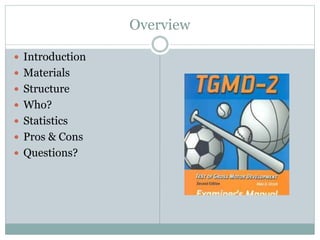
 Introduction
 Materials
 Structure
 Who?
 Statistics
 Pros & Cons
 Questions?
Introduction
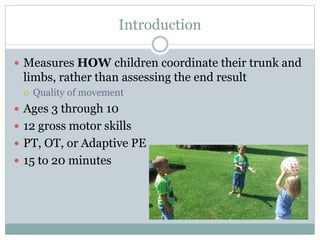
 Measures HOW children coordinate their trunk and
limbs, rather than assessing the end result
 Quality of movement
 Ages 3 through 10
 12 gross motor skills
 PT, OT, or Adaptive PE
 15 to 20 minutes
Materials
 8 to 10-inch playground
ball
 4-inch lightweight ball
 Basketball
 Tennis Ball
 Soccer Ball
 Softball
 4- to 5-inch beanbag
 Tape
 2 Traffic Cones
 Plastic Bat
 Batting Tee
Structure: Subtests**
 Locomotor
 Run
 Gallop
 Hop
 Skip
 Horizontal jump
 Slide
 Object Control
 Two-hand strike of a
stationary ball
 One-hand forehand strike
of self-bounced ball
 One –hand stationary
dribble
 Two-hand catch
 Kick a stationary ball
 Overhand Throw
 Underhand Throw
**TGMD-3 tasks
Structure: Scoring
 Each gross motor skill (12) includes a list of specific
performance criteria
 Represent a mature pattern of the skill
 If done correctly – score of 1
 If done incorrectly – score of 0
 2 Trials
 Subtest Raw Score (60) Subtest Standard Score
Gross Motor Quotient Percentile Ranks and Age
Equivalents
Who?
 Ages 3 to 10
 Kindergarten through 4th grade
 Cerebral Palsy
 Developmental Coordination Disorder
 Visual Impairment
 Autism Spectrum Disorder
 GMFCS level I-IV
Statistics
 Good Internal Consistency (alpha = 0.71-0.72) Houwen, 2007
 If alpha is too high, the items are almost redundant
 If alpha is too low, the items are very broad and
essentially unrelated
 High Inter-rater, Intra-rater, and Test-Retest
Reliability (ICC = 0.82-0.95) Houwen, 2007
 High Correlation between object control subtest
and the ball skills subtest of the Movement ABC
Pros Cons
 Focus on quality of
movement
 Developmental Skills
 School Participation
 Time to administer
 Group testing
 Easy to score
 Amount of equipment
 Novel tasks
 Cultural Differences
Pros & Cons
Questions?
 Capio CM, Sit CH, Abernethy B. Fundamental movement skills testing in children with cerebral palsy.
Disabil Rehabil. 2011;33(25-26):2519-28.
 Cools W, Martelaer KD, Samaey C, Andries C. Movement skill assessment of typically developing
preschool children: a review of seven movement skill assessment tools. J Sports Sci Med.
2009;8(2):154-68.
 Houwen S, Visscher C, Hartman E, Lemmink KAPM. Gross motor skills and sports participation of
children with visual impairments. Res Q Exerc Sport 2007;78:16–23.
 Niemeijer AS, Smits-Engelsman BCM, Schoemaker MM. Neuromotor task training for children with
developmental coordination disorder: a controlled trial. Dev Med Child Neurol 2007;49:406–411.
 Simons J, Daly D, Theodorou F, Caron C, Andoniadou E. Validity and reliability of the TGMD-2 in 7-
10-year-old Flemish children with intellectual disability. Adapt Phys Activ Q 2008;25:71–82.
 Staples KL, Reid G. Fundamental movement skills and autism spectrum disorders. J Autism Dev
Disord 2010;40: 209–217.
 Sun SH, Sun HL, Zhu YC, Huang LC, Hsieh YL. Concurrent validity of Preschooler Gross Motor
Quality Scale with Test of Gross Motor Development-2. Res Dev Disabil. 2011;32(3):1163-8.

TGMD 2

  • 1.
    A N DR E W T R E V I N O U N I V E R S I T Y O F C O L O R A D O D P T C A N D I D A T E C L A S S O F 2 0 1 6 D Test of Gross Motor Development – 2nd Edition
  • 2.
    Overview  Introduction  Materials Structure  Who?  Statistics  Pros & Cons  Questions?
  • 3.
    Introduction  Measures HOWchildren coordinate their trunk and limbs, rather than assessing the end result  Quality of movement  Ages 3 through 10  12 gross motor skills  PT, OT, or Adaptive PE  15 to 20 minutes
  • 4.
    Materials  8 to10-inch playground ball  4-inch lightweight ball  Basketball  Tennis Ball  Soccer Ball  Softball  4- to 5-inch beanbag  Tape  2 Traffic Cones  Plastic Bat  Batting Tee
  • 5.
    Structure: Subtests**  Locomotor Run  Gallop  Hop  Skip  Horizontal jump  Slide  Object Control  Two-hand strike of a stationary ball  One-hand forehand strike of self-bounced ball  One –hand stationary dribble  Two-hand catch  Kick a stationary ball  Overhand Throw  Underhand Throw **TGMD-3 tasks
  • 6.
    Structure: Scoring  Eachgross motor skill (12) includes a list of specific performance criteria  Represent a mature pattern of the skill  If done correctly – score of 1  If done incorrectly – score of 0  2 Trials  Subtest Raw Score (60) Subtest Standard Score Gross Motor Quotient Percentile Ranks and Age Equivalents
  • 7.
    Who?  Ages 3to 10  Kindergarten through 4th grade  Cerebral Palsy  Developmental Coordination Disorder  Visual Impairment  Autism Spectrum Disorder  GMFCS level I-IV
  • 8.
    Statistics  Good InternalConsistency (alpha = 0.71-0.72) Houwen, 2007  If alpha is too high, the items are almost redundant  If alpha is too low, the items are very broad and essentially unrelated  High Inter-rater, Intra-rater, and Test-Retest Reliability (ICC = 0.82-0.95) Houwen, 2007  High Correlation between object control subtest and the ball skills subtest of the Movement ABC
  • 9.
    Pros Cons  Focuson quality of movement  Developmental Skills  School Participation  Time to administer  Group testing  Easy to score  Amount of equipment  Novel tasks  Cultural Differences Pros & Cons
  • 10.
    Questions?  Capio CM,Sit CH, Abernethy B. Fundamental movement skills testing in children with cerebral palsy. Disabil Rehabil. 2011;33(25-26):2519-28.  Cools W, Martelaer KD, Samaey C, Andries C. Movement skill assessment of typically developing preschool children: a review of seven movement skill assessment tools. J Sports Sci Med. 2009;8(2):154-68.  Houwen S, Visscher C, Hartman E, Lemmink KAPM. Gross motor skills and sports participation of children with visual impairments. Res Q Exerc Sport 2007;78:16–23.  Niemeijer AS, Smits-Engelsman BCM, Schoemaker MM. Neuromotor task training for children with developmental coordination disorder: a controlled trial. Dev Med Child Neurol 2007;49:406–411.  Simons J, Daly D, Theodorou F, Caron C, Andoniadou E. Validity and reliability of the TGMD-2 in 7- 10-year-old Flemish children with intellectual disability. Adapt Phys Activ Q 2008;25:71–82.  Staples KL, Reid G. Fundamental movement skills and autism spectrum disorders. J Autism Dev Disord 2010;40: 209–217.  Sun SH, Sun HL, Zhu YC, Huang LC, Hsieh YL. Concurrent validity of Preschooler Gross Motor Quality Scale with Test of Gross Motor Development-2. Res Dev Disabil. 2011;32(3):1163-8.

Editor's Notes

  • #2 Karen informed me that they are putting out a 3rd edition very soon!!
  • #7 Gross Motor Quotient – Composite of the two subtests
  • #8 K to 4 – based on National Association for Sport and Physical Education References included
  • #9 The correlation statistic is not consistent among other studies conducted with different populations MORE STUDIES NEED TO BE DONE
  • #10 Cultural differences – concept of swinging a bat and hitting a ball off a tee, throwing a ball overhand, etc.