Can a cross-curricular
PE intervention improve
Fundamental Movement
Skills, Physical Activity
and Weight Status for
Reception Children?
Presented by Noel Sritharan
M00466867 – SES3360
Background
 Child Obesity continues to rise, nearly 1 in 10 reception children (age 4-5
year olds) classed as obese in 2013/14 (Lifestyles Statistics Team, 2015)
 Recent update shows an increase to more than 1 in 5 reception children in
2014/15 (Health & Social Care Information Centre, 2016)
 Recommended daily moderate to vigorous physical activity, 5-7 year olds
between 2008 and 2012:
 24% to 14% for boys
 23% to 8% for girls (The health and social care information centre, 2012)
Background (continued)
 Fundamental movement skills (FMS) have been linked to Physical activity and
more recently Weight status (Bryant et al. 2014b, O’Brien et al. 2015)
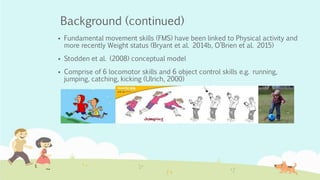
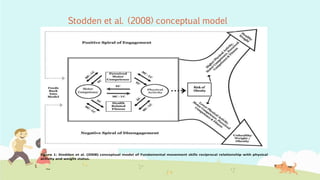
 Stodden et al. (2008) conceptual model
 Comprise of 6 locomotor skills and 6 object control skills e.g. running,
jumping, catching, kicking (Ulrich, 2000)
Background (continued)
 Gender differences are apparent (Vandaele et al. 2011; Bryant et al. 2014a)
 FMS mastery can be achieved by age 6 (Vandaele et al. 2011)
 Interventions are needed for reception children (Lai et al. 2014; Foulkes et al.
2015)
 A cross-curricular approach (Dudley et al. 2011; Dotterweich et al. 2012)
Research Aim
 Compare FMS, physical activity and weight status before and after a cross-
curricular intervention.
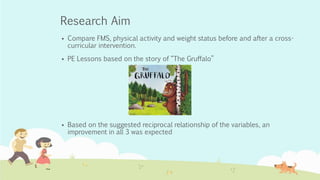
 PE Lessons based on the story of “The Gruffalo”
 Based on the suggested reciprocal relationship of the variables, an
improvement in all 3 was expected
Method
 Intervention school and a control school, 60 students each school
Pre and post testing involving:
 FMS testing using the TGMD-2 to assess FMS mastery (Ulrich 2000)
 Physical activity for 7 day after FMS testing using accelerometers
 Weight Status via BMI (Kg/m2
) and Cole et al's. (2007) reference curves
Data Analysis:
 Repeated measures ANOVA, inter and intra-rater reliability (Jones et al.
2010)
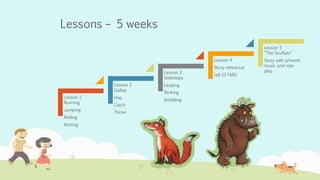
Lessons – 5 weeks
Lesson 1
Running
Jumping
Rolling
Kicking
Lesson 2
Gallop
Hop
Catch
Throw
Lesson 3
Sidesteps
Leaping
Striking
Dribbling
Lesson 4
Story rehearsal
(all 12 FMS)
Lesson 5
“The Gruffalo”
Story with artwork,
music and role-
play
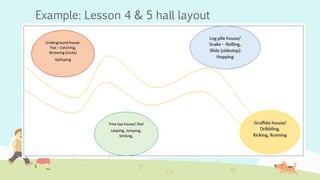
Example: Lesson 4 & 5 hall layout
Results
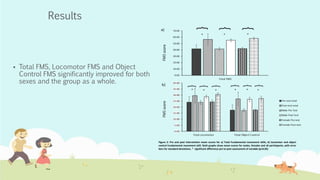
 Total FMS, Locomotor FMS and Object
Control FMS significantly improved for both
sexes and the group as a whole.
Figure 2: Pre and post intervention mean scores for a) Total Fundamental movement skills, b) locomotor and object
control Fundamental movement skill. Both graphs show mean scores for males, females and all participants, with error
bars for standard deviations. * significant difference pre to post assessment of variable (p<0.05)
Results – (continued)
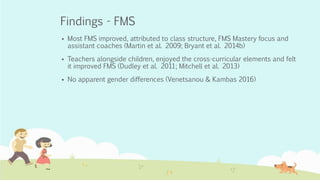
 Weekday Moderate, moderate to vigorous and vigorous physical activity
significantly increased, for the group as a whole and males but not females.
 Weekend physical activity and weight status was not significantly different
Findings - FMS
 Most FMS improved, attributed to class structure, FMS Mastery focus and
assistant coaches (Martin et al. 2009; Bryant et al. 2014b)
 Teachers alongside children, enjoyed the cross-curricular elements and felt
it improved FMS (Dudley et al. 2011; Mitchell et al. 2013)
 No apparent gender differences (Venetsanou & Kambas 2016)
Findings – Physical activity
 Strengthens the link between FMS and physical activity (Stodden et al.
2008, Bryant et al. 2014b)
 No significant differences for female physical activity attributed to lower
watch adherence, sample size and length of intervention (Cohen et al.
2015)
 Time of year and concerns with outdoor play may also play a factor into
weekend and female activity (Cliff et al. 2009; Dotterweich et al. 2012),
Findings – Weight status
 Attributed to the length of the intervention and lack of follow ups, following
post-testing (Cliff et al. 2011)
Further Limitations
 Lack of a control school (Goodway & Branta 2003)
 No follow ups were done to see lasting effect or a revert to bassline
(Goodway & Branta 2003; Dudley et al. 2011; Lai et al. 2014)
Recommendations and future research
 Cross-curricular intervention could act as a template (Dudley et al. 2011;
Cohen et al. 2015)
 Year long interventions with follow ups (Dudley et al. 2011; Lai et al. 2014).
 Multiple school samples to see true effects (Dudley et al. 2011)
 PE specialists and teachers can tailor interventions (Bryant et al. 2014a;
Cliff et al. 2011; Mitchell et al. 2013)
References
 Bryant, E.S., Duncan, M.J. & Birch, S.L., 2014a. Fundamental movement skills and weight status in British
primary school children. European Journal of Sport Science, 14(7), pp.730–736.
 Bryant, E. et al., 2014b. Prediction of habitual physical activity level and weight status from fundamental
movement skill level. Journal of sports sciences, 32(19), pp.1775–1782.
 Cliff, D.P. et al., 2009. Relationships between fundamental movement skills and objectively measured
physical activity in preschool children. Pediatric exercise science, 21(4), pp.436–449.
 Cliff, D.P. et al., 2011. Movement skills and physical activity in obese children: Randomized controlled
trial. Medicine and Science in Sports and Exercise, 43(1), pp.90–100.
 Cohen, K.E. et al., 2015. Physical activity and skills intervention: SCORES cluster randomized controlled
trial. Medicine and Science in Sports and Exercise, 47(4), pp.765–774.
 Cole, T.J. et al., 2007. Body mass index cut offs to define thinness in children and adolescents:
international survey. BMJ (Clinical research ed.), 335(7612), p.194.
 Dotterweich, A.R., Greene, A. & Blosser, D., 2012. Using Innovative Playgrounds and Cross-Curricular
Design to Increase Physical Activity. Journal of Physical Education, Recreation & Dance, 83(5), pp.47–55.
 Dudley, D. et al., 2011. A systematic review of the effectiveness of physical education and school sport
interventions targeting physical activity, movement skills and enjoyment of physical activity. European
Physical Education Review, 17(3), pp.353–378.
 Foulkes, J.D. et al., 2015. Fundamental Movement Skills of Preschool Children in Northwest England.
Perceptual and Motor Skills, 121(1), pp.260–283.
References
 Goodway, J.D. & Branta, C.F., 2003. Influence of a motor skill intervention on fundamental motor skill
development of disadvantaged preschool children. Research quarterly for exercise and sport, 74(1),
pp.36–46.
 Jones, R.A. et al., 2010. Perceived and actual competence among overweight and non-overweight
children. Journal of Science and Medicine in Sport, 13(6), pp.589–596.
 Lai, S.K. et al., 2014. Do school-based interventions focusing on physical activity, fitness, or fundamental
movement skill competency produce a sustained impact in these outcomes in children and adolescents?
A systematic review of follow-up studies. Sports Medicine, 44(1), pp.67–79.
 Mitchell, B. et al., 2013. Improvement of fundamental movement skills through support and mentorship of
class room teachers. Obesity Research and Clinical Practice, 7(3), pp.e230–e234.
 O’Brien, W., Belton, S. & Issartel, J., 2015. The relationship between adolescents’ physical activity,
fundamental movement skills and weight status. Journal of Sports Sciences, (December), pp.1–9.
 Stodden, D.F. et al., 2008. A Developmental Perspective on the Role of Motor Skill Competence in
Physical Activity: An Emergent Relationship. Quest, 60(2), pp.290–306.
 Ulrich, D. A., 2000. Test of gross motor development-2. Austin: Prod-Ed
 Venetsanou, F. & Kambas, A., 2016. Motor Proficiency in Young Children: A Closer Look at Potential
Gender Differences. SAGE Open, 6(1), pp.1–10.
 Williams, H.G. et al., 2008. Motor skill performance and physical activity in preschool children. Obesity
(Silver Spring, Md.), 16(6), pp.1421–1426.
Thank you for listening.
Question time.
Stodden et al. (2008) conceptual model
Figure 1: Stodden et al. (2008) conceptual model of Fundamental movement skills reciprocal relationship with physical
activity and weight status.
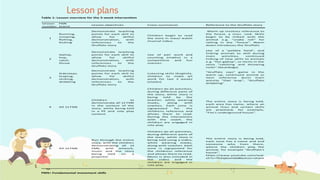
Lesson plans
Table 1: Lesson overview for the 5-week intervention
FMS= Fundamental movement skills
Lesson
number
FMS
learnt
Lesson objectives Cross-curriculum Reference to the Gruffalo story
1
Running,
Jumping,
Rolling,
Kicking
Demonstrate teaching
points for each skill to
allow for skilful
demonstration, with
references to the
Gruffalo story
Children begin to read
the story in class/ watch
musical video.
Warm up involves reference to
the forest, a river, rock. Skills
begin to be linked with the
animal e.g. "snake roll" for
rolling in the "forest". Warm
down introduces the Gruffalo
2
Gallop,
hop,
catch,
throw
Demonstrate teaching
points for each skill to
allow for skilful
demonstration, with
references to the
Gruffalo story
Use of pair work and
counting (maths) in a
competitive and fun
manner.
Use of a "pebble field", and
linking animals to skill during
main activities, continued
linking of new skills to animals
e.g. "fox-gallop", or items in the
story "catching and throwing
rocks" (beanbags)
3
Sidesteps,
leaping,
striking,
dribbling
Demonstrate teaching
points for each skill to
allow for skilful
demonstration, with
references to the
Gruffalo story
Listening skills (English),
children to make art
work for last 2 weeks
(masks)
"Gruffalo says" game in the
warm up, continued animal or
item reference durin main
activity "Owl leap", "Gruffalo
dribbling"
4 All 12 FMS
Children to
demonstrate all 12 FMS
in the context of the
story, while being told
in a PE and role play
context.
Children do all activities,
during different parts of
the story, while story is
being told by the
teacher, while wearing
masks, along with
coaches. Each zone is
signposted for the
childrens reference and
allows them to read.
During the interactions
with the coach, the
children are engaged in
role play.
The entire story is being told,
each area has name, where an
animal lives and certain skills
are practised, for example,
"Fox's underground house".
5 All 12 FMS
Run through the entire
story, with the children
demonstrating all 12
FMS, with artwork,
music and the story
being told on a
projector
Children do all activities,
during different parts of
the story, while story is
being told using a video,
while wearing masks,
along with coaches. Each
zone is signposted for
the childrens reference
and allows them to read.
Music is also included in
the video and the
children are engaged in
role play.
The entire story is being told,
each zone has a name and and
someone who lives there,
where the children play the
animal, for example "Gruffalo's
house".
https://www.youtube.com/wat
ch?v=ThZqDoJi5S0#action=share
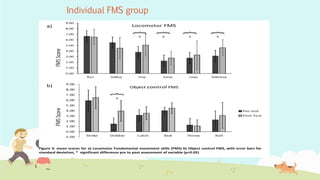
Individual FMS group
Figure 3: mean scores for a) Locomotor Fundamental movement skills (FMS) b) Object control FMS, with error bars for
standard deviation, * significant difference pre to post assessment of variable (p<0.05)
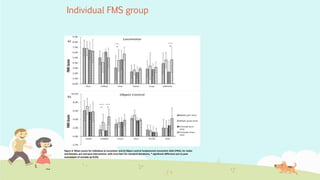
Individual FMS group
Figure 4: Mean scores for Individual a) Locomotor and b) Object control fundamental movement skills (FMS), for males
and females, pre and post intervention, with error bars for standard deviations, * significant difference pre to post
assessment of variable (p<0.05)

Conference presentation

  • 1.
    Can a cross-curricular PEintervention improve Fundamental Movement Skills, Physical Activity and Weight Status for Reception Children? Presented by Noel Sritharan M00466867 – SES3360
  • 2.
    Background  Child Obesitycontinues to rise, nearly 1 in 10 reception children (age 4-5 year olds) classed as obese in 2013/14 (Lifestyles Statistics Team, 2015)  Recent update shows an increase to more than 1 in 5 reception children in 2014/15 (Health & Social Care Information Centre, 2016)  Recommended daily moderate to vigorous physical activity, 5-7 year olds between 2008 and 2012:  24% to 14% for boys  23% to 8% for girls (The health and social care information centre, 2012)
  • 3.
    Background (continued)  Fundamentalmovement skills (FMS) have been linked to Physical activity and more recently Weight status (Bryant et al. 2014b, O’Brien et al. 2015)  Stodden et al. (2008) conceptual model  Comprise of 6 locomotor skills and 6 object control skills e.g. running, jumping, catching, kicking (Ulrich, 2000)
  • 4.
    Background (continued)  Genderdifferences are apparent (Vandaele et al. 2011; Bryant et al. 2014a)  FMS mastery can be achieved by age 6 (Vandaele et al. 2011)  Interventions are needed for reception children (Lai et al. 2014; Foulkes et al. 2015)  A cross-curricular approach (Dudley et al. 2011; Dotterweich et al. 2012)
  • 5.
    Research Aim  CompareFMS, physical activity and weight status before and after a cross- curricular intervention.  PE Lessons based on the story of “The Gruffalo”  Based on the suggested reciprocal relationship of the variables, an improvement in all 3 was expected
  • 6.
    Method  Intervention schooland a control school, 60 students each school Pre and post testing involving:  FMS testing using the TGMD-2 to assess FMS mastery (Ulrich 2000)  Physical activity for 7 day after FMS testing using accelerometers  Weight Status via BMI (Kg/m2 ) and Cole et al's. (2007) reference curves Data Analysis:  Repeated measures ANOVA, inter and intra-rater reliability (Jones et al. 2010)
  • 7.
    Lessons – 5weeks Lesson 1 Running Jumping Rolling Kicking Lesson 2 Gallop Hop Catch Throw Lesson 3 Sidesteps Leaping Striking Dribbling Lesson 4 Story rehearsal (all 12 FMS) Lesson 5 “The Gruffalo” Story with artwork, music and role- play
  • 8.
    Example: Lesson 4& 5 hall layout
  • 9.
    Results  Total FMS,Locomotor FMS and Object Control FMS significantly improved for both sexes and the group as a whole. Figure 2: Pre and post intervention mean scores for a) Total Fundamental movement skills, b) locomotor and object control Fundamental movement skill. Both graphs show mean scores for males, females and all participants, with error bars for standard deviations. * significant difference pre to post assessment of variable (p<0.05)
  • 10.
    Results – (continued) Weekday Moderate, moderate to vigorous and vigorous physical activity significantly increased, for the group as a whole and males but not females.  Weekend physical activity and weight status was not significantly different
  • 11.
    Findings - FMS Most FMS improved, attributed to class structure, FMS Mastery focus and assistant coaches (Martin et al. 2009; Bryant et al. 2014b)  Teachers alongside children, enjoyed the cross-curricular elements and felt it improved FMS (Dudley et al. 2011; Mitchell et al. 2013)  No apparent gender differences (Venetsanou & Kambas 2016)
  • 12.
    Findings – Physicalactivity  Strengthens the link between FMS and physical activity (Stodden et al. 2008, Bryant et al. 2014b)  No significant differences for female physical activity attributed to lower watch adherence, sample size and length of intervention (Cohen et al. 2015)  Time of year and concerns with outdoor play may also play a factor into weekend and female activity (Cliff et al. 2009; Dotterweich et al. 2012),
  • 13.
    Findings – Weightstatus  Attributed to the length of the intervention and lack of follow ups, following post-testing (Cliff et al. 2011)
  • 14.
    Further Limitations  Lackof a control school (Goodway & Branta 2003)  No follow ups were done to see lasting effect or a revert to bassline (Goodway & Branta 2003; Dudley et al. 2011; Lai et al. 2014)
  • 15.
    Recommendations and futureresearch  Cross-curricular intervention could act as a template (Dudley et al. 2011; Cohen et al. 2015)  Year long interventions with follow ups (Dudley et al. 2011; Lai et al. 2014).  Multiple school samples to see true effects (Dudley et al. 2011)  PE specialists and teachers can tailor interventions (Bryant et al. 2014a; Cliff et al. 2011; Mitchell et al. 2013)
  • 16.
    References  Bryant, E.S.,Duncan, M.J. & Birch, S.L., 2014a. Fundamental movement skills and weight status in British primary school children. European Journal of Sport Science, 14(7), pp.730–736.  Bryant, E. et al., 2014b. Prediction of habitual physical activity level and weight status from fundamental movement skill level. Journal of sports sciences, 32(19), pp.1775–1782.  Cliff, D.P. et al., 2009. Relationships between fundamental movement skills and objectively measured physical activity in preschool children. Pediatric exercise science, 21(4), pp.436–449.  Cliff, D.P. et al., 2011. Movement skills and physical activity in obese children: Randomized controlled trial. Medicine and Science in Sports and Exercise, 43(1), pp.90–100.  Cohen, K.E. et al., 2015. Physical activity and skills intervention: SCORES cluster randomized controlled trial. Medicine and Science in Sports and Exercise, 47(4), pp.765–774.  Cole, T.J. et al., 2007. Body mass index cut offs to define thinness in children and adolescents: international survey. BMJ (Clinical research ed.), 335(7612), p.194.  Dotterweich, A.R., Greene, A. & Blosser, D., 2012. Using Innovative Playgrounds and Cross-Curricular Design to Increase Physical Activity. Journal of Physical Education, Recreation & Dance, 83(5), pp.47–55.  Dudley, D. et al., 2011. A systematic review of the effectiveness of physical education and school sport interventions targeting physical activity, movement skills and enjoyment of physical activity. European Physical Education Review, 17(3), pp.353–378.  Foulkes, J.D. et al., 2015. Fundamental Movement Skills of Preschool Children in Northwest England. Perceptual and Motor Skills, 121(1), pp.260–283.
  • 17.
    References  Goodway, J.D.& Branta, C.F., 2003. Influence of a motor skill intervention on fundamental motor skill development of disadvantaged preschool children. Research quarterly for exercise and sport, 74(1), pp.36–46.  Jones, R.A. et al., 2010. Perceived and actual competence among overweight and non-overweight children. Journal of Science and Medicine in Sport, 13(6), pp.589–596.  Lai, S.K. et al., 2014. Do school-based interventions focusing on physical activity, fitness, or fundamental movement skill competency produce a sustained impact in these outcomes in children and adolescents? A systematic review of follow-up studies. Sports Medicine, 44(1), pp.67–79.  Mitchell, B. et al., 2013. Improvement of fundamental movement skills through support and mentorship of class room teachers. Obesity Research and Clinical Practice, 7(3), pp.e230–e234.  O’Brien, W., Belton, S. & Issartel, J., 2015. The relationship between adolescents’ physical activity, fundamental movement skills and weight status. Journal of Sports Sciences, (December), pp.1–9.  Stodden, D.F. et al., 2008. A Developmental Perspective on the Role of Motor Skill Competence in Physical Activity: An Emergent Relationship. Quest, 60(2), pp.290–306.  Ulrich, D. A., 2000. Test of gross motor development-2. Austin: Prod-Ed  Venetsanou, F. & Kambas, A., 2016. Motor Proficiency in Young Children: A Closer Look at Potential Gender Differences. SAGE Open, 6(1), pp.1–10.  Williams, H.G. et al., 2008. Motor skill performance and physical activity in preschool children. Obesity (Silver Spring, Md.), 16(6), pp.1421–1426.
  • 18.
    Thank you forlistening. Question time.
  • 20.
    Stodden et al.(2008) conceptual model Figure 1: Stodden et al. (2008) conceptual model of Fundamental movement skills reciprocal relationship with physical activity and weight status.
  • 21.
    Lesson plans Table 1:Lesson overview for the 5-week intervention FMS= Fundamental movement skills Lesson number FMS learnt Lesson objectives Cross-curriculum Reference to the Gruffalo story 1 Running, Jumping, Rolling, Kicking Demonstrate teaching points for each skill to allow for skilful demonstration, with references to the Gruffalo story Children begin to read the story in class/ watch musical video. Warm up involves reference to the forest, a river, rock. Skills begin to be linked with the animal e.g. "snake roll" for rolling in the "forest". Warm down introduces the Gruffalo 2 Gallop, hop, catch, throw Demonstrate teaching points for each skill to allow for skilful demonstration, with references to the Gruffalo story Use of pair work and counting (maths) in a competitive and fun manner. Use of a "pebble field", and linking animals to skill during main activities, continued linking of new skills to animals e.g. "fox-gallop", or items in the story "catching and throwing rocks" (beanbags) 3 Sidesteps, leaping, striking, dribbling Demonstrate teaching points for each skill to allow for skilful demonstration, with references to the Gruffalo story Listening skills (English), children to make art work for last 2 weeks (masks) "Gruffalo says" game in the warm up, continued animal or item reference durin main activity "Owl leap", "Gruffalo dribbling" 4 All 12 FMS Children to demonstrate all 12 FMS in the context of the story, while being told in a PE and role play context. Children do all activities, during different parts of the story, while story is being told by the teacher, while wearing masks, along with coaches. Each zone is signposted for the childrens reference and allows them to read. During the interactions with the coach, the children are engaged in role play. The entire story is being told, each area has name, where an animal lives and certain skills are practised, for example, "Fox's underground house". 5 All 12 FMS Run through the entire story, with the children demonstrating all 12 FMS, with artwork, music and the story being told on a projector Children do all activities, during different parts of the story, while story is being told using a video, while wearing masks, along with coaches. Each zone is signposted for the childrens reference and allows them to read. Music is also included in the video and the children are engaged in role play. The entire story is being told, each zone has a name and and someone who lives there, where the children play the animal, for example "Gruffalo's house". https://www.youtube.com/wat ch?v=ThZqDoJi5S0#action=share
  • 22.
    Individual FMS group Figure3: mean scores for a) Locomotor Fundamental movement skills (FMS) b) Object control FMS, with error bars for standard deviation, * significant difference pre to post assessment of variable (p<0.05)
  • 23.
    Individual FMS group Figure4: Mean scores for Individual a) Locomotor and b) Object control fundamental movement skills (FMS), for males and females, pre and post intervention, with error bars for standard deviations, * significant difference pre to post assessment of variable (p<0.05)

Editor's Notes

  • #3 Recommended daily mvpa of 60 minutes – mod talk comfortably New PA data has not been taken since the 2012 statistics (same figures in the latest statistics Interventions are needed to address low mastery and improve PA & WS
  • #4 Recommended daily mvpa of 60 minutes – mod talk comfortably New PA data has not been taken since the 2012 statistics (same figures in the latest statistics Boys ball sports girls balance activities Read Vandaele paper Interventions are needed to address low mastery and improve PA & WS Cross curricular improves other aspects such as reading, music, art and performance. Teachers typically carry out PE and this will be immersed given the whole school is involved and PE is integrated into the entire curriculum.
  • #5 Recommended daily mvpa of 60 minutes – mod talk comfortably New PA data has not been taken since the 2012 statistics (same figures in the latest statistics Boys ball sports girls balance activities Read Vandaele paper Interventions are needed to address low mastery and improve PA & WS Cross curricular improves other aspects such as reading, music, art and performance. Teachers typically carry out PE and this will be immersed given the whole school is involved and PE is integrated into the entire curriculum.
  • #7 Locomotor recorded Sagittal plane, Object control in the coronal plane Accelerometers measure intensity and duration (in minutes) of activity (sedentary, light, moderate, Vig)
  • #8 5 week Intervention, 45 minute lessons Links Lesson 2 involved pair work and counting; pebble field/ “fox gallop” Lesson 5 children wore masks, youtube video had a “rap” with music telling the story, while coaches, teachers and students role played different characters, while doing FMS.
  • #12 There was a significant improvement for group hop, jump, sidestep and leap, male hop and female sidestep, the dribble for males, females and the group as a whole 1 coach with PE expertise for each skill in small groups, Use of signs, masks, artwork, reading and music reception children are an ideal intervention group due to process orientation of TGMD-2 and can learn FMS quickly (Vandaele)
  • #13 improved FMS and moderate to vigorous physical activity link (Cliff et al. 2009) Discuss cliff et al. 2009 study
  • #15 reception children are an ideal intervention group due to process orientation of TGMD-2 (sample size intervention length) for physical activity in particular Lesson plans created over time, in consultation with professionals (Goodway & Branta 2003; Cohen et al. 2015)
  • #16 Cross curricular interventions have been shown to be successful at improving FMS and PA (check cohen and Dudley study)