Improving the motor
coordination of children with
Developmental Coordination
  Disorder using Soft Play
        Equipment
          Lois Addy
        Senior Lecturer
Terminology
• Clumsy child syndrome
• Dyspraxia
• Sensory integrative dysfunction
• Minimal brain dysfunction
• Perceptual-motor disorder
• Motor learning difficulties
• Congenital maladroit
• Developmental apraxia
• Minimal cerebral palsy
• Executive apraxia
• Deficit of attention, motor and perception (DAMP)
  Gillberg (1996)
• Developmental Coordination Disorder (DCD)
Definition of DCD
‘Performance in daily living activities
  that require motor coordination is
        substantially below that
    expected, given the person’s
  chronological age and measured
             intelligence.’

             DSM-IV (2000)
Revised criterion A
Observed poor performance in (culturally
exposed) fundamental motor skills evident
in a variety of environments
– Walking        Reaching & grasping
– Running        Object manipulation
– Hopping        Object propulsion
– Skipping       Object reception
– Climbing
Top-down
       The physical task-centred
              approach
Teaches a specific skill without emphasising
the underlying processes.


The skill is sub-divided, instructed, and
rehearsed until it has been mastered.
2. Bottom-up
    Process-orientated approach
Identifies the underlying processes involved in
acquiring a specific skill; and then focuses on
developing these skills to provide the foundation
from which other skills are built.

The process-orientated approach is based on the
premise that age-appropriate reflexes, postural
reactions, and perceptuo-motor abilities all underlie
functional motor skills and conceptual development
(Pless and Carlsson, 2000).
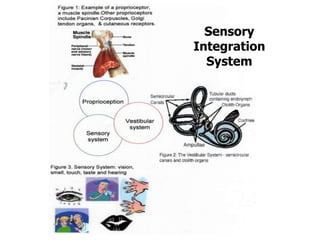
Sensory
      Sensory
Integration
    Integration
  System
      System
Evidence
Bundy, A. C., Shia, S., Long Qi, L., & Miller, L.J. (2007). How does sensory
processing affect play? American Journal of Occupational Therapy. 61, 201-208.

Kaufman L B, Schilling D L (2007) Implementation of a Strength Training Program
for a 5-Year-Old Child With Poor Body Awareness and Developmental Coordination
Disorder. Physical Therapy. 87 (4), 455-467

Miller, L.J., Schoen, S.A., James, K. & Schaaf, R.C. (2007). Lessons learned: A
pilot study of occupational therapy effectiveness for children with
sensory modulation disorder. American Journal of Occupational
Therapy, 61, 161-169.

Parham, L. D., Cohn, E. S., Spitzer, S., Koomar, J. A., Miller, L. J., Burke, J. P., et
al. (2007). Fidelity in sensory integration intervention research. American Journal of
Occupational Therapy, 61, 216–227.
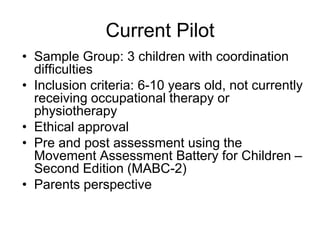
Current Pilot
• Sample Group: 3 children with coordination
  difficulties
• Inclusion criteria: 6-10 years old, not currently
  receiving occupational therapy or
  physiotherapy
• Ethical approval
• Pre and post assessment using the
  Movement Assessment Battery for Children –
  Second Edition (MABC-2)
• Parents perspective
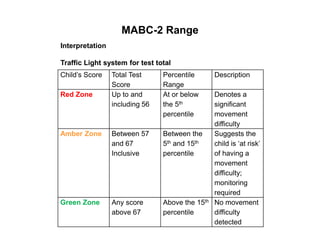
MABC-2 Range
Interpretation

Traffic Light system for test total
Child’s Score    Total Test     Percentile       Description
                 Score          Range
Red Zone         Up to and      At or below      Denotes a
                 including 56   the 5th          significant
                                percentile       movement
                                                 difficulty
Amber Zone       Between 57     Between the      Suggests the
                 and 67         5th and 15th     child is ‘at risk’
                 Inclusive      percentile       of having a
                                                 movement
                                                 difficulty;
                                                 monitoring
                                                 required
Green Zone       Any score      Above the 15th   No movement
                 above 67       percentile       difficulty
                                                 detected
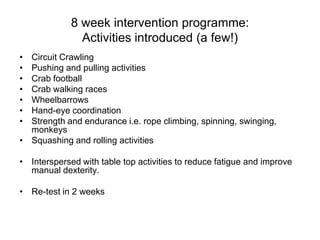
8 week intervention programme:
               Activities introduced (a few!)
• Circuit Crawling
• Pushing and pulling activities
• Crab football
• Crab walking races
• Wheelbarrows
• Hand-eye coordination
• Strength and endurance i.e. rope climbing, spinning, swinging,
  monkeys
• Squashing and rolling activities

• Interspersed with table top activities to reduce fatigue and improve
  manual dexterity.

• Re-test in 2 weeks

Lois Addy Presentation- Improving the motor coordination of children with DCD using Soft Play Equipment

  • 1.
    Improving the motor coordinationof children with Developmental Coordination Disorder using Soft Play Equipment Lois Addy Senior Lecturer
  • 2.
    Terminology • Clumsy childsyndrome • Dyspraxia • Sensory integrative dysfunction • Minimal brain dysfunction • Perceptual-motor disorder • Motor learning difficulties • Congenital maladroit • Developmental apraxia • Minimal cerebral palsy • Executive apraxia • Deficit of attention, motor and perception (DAMP) Gillberg (1996) • Developmental Coordination Disorder (DCD)
  • 3.
    Definition of DCD ‘Performancein daily living activities that require motor coordination is substantially below that expected, given the person’s chronological age and measured intelligence.’ DSM-IV (2000)
  • 4.
    Revised criterion A Observedpoor performance in (culturally exposed) fundamental motor skills evident in a variety of environments – Walking Reaching & grasping – Running Object manipulation – Hopping Object propulsion – Skipping Object reception – Climbing
  • 5.
    Top-down The physical task-centred approach Teaches a specific skill without emphasising the underlying processes. The skill is sub-divided, instructed, and rehearsed until it has been mastered.
  • 6.
    2. Bottom-up Process-orientated approach Identifies the underlying processes involved in acquiring a specific skill; and then focuses on developing these skills to provide the foundation from which other skills are built. The process-orientated approach is based on the premise that age-appropriate reflexes, postural reactions, and perceptuo-motor abilities all underlie functional motor skills and conceptual development (Pless and Carlsson, 2000).
  • 7.
    Sensory Sensory Integration Integration System System
  • 8.
    Evidence Bundy, A. C.,Shia, S., Long Qi, L., & Miller, L.J. (2007). How does sensory processing affect play? American Journal of Occupational Therapy. 61, 201-208. Kaufman L B, Schilling D L (2007) Implementation of a Strength Training Program for a 5-Year-Old Child With Poor Body Awareness and Developmental Coordination Disorder. Physical Therapy. 87 (4), 455-467 Miller, L.J., Schoen, S.A., James, K. & Schaaf, R.C. (2007). Lessons learned: A pilot study of occupational therapy effectiveness for children with sensory modulation disorder. American Journal of Occupational Therapy, 61, 161-169. Parham, L. D., Cohn, E. S., Spitzer, S., Koomar, J. A., Miller, L. J., Burke, J. P., et al. (2007). Fidelity in sensory integration intervention research. American Journal of Occupational Therapy, 61, 216–227.
  • 9.
    Current Pilot • SampleGroup: 3 children with coordination difficulties • Inclusion criteria: 6-10 years old, not currently receiving occupational therapy or physiotherapy • Ethical approval • Pre and post assessment using the Movement Assessment Battery for Children – Second Edition (MABC-2) • Parents perspective
  • 10.
    MABC-2 Range Interpretation Traffic Lightsystem for test total Child’s Score Total Test Percentile Description Score Range Red Zone Up to and At or below Denotes a including 56 the 5th significant percentile movement difficulty Amber Zone Between 57 Between the Suggests the and 67 5th and 15th child is ‘at risk’ Inclusive percentile of having a movement difficulty; monitoring required Green Zone Any score Above the 15th No movement above 67 percentile difficulty detected
  • 11.
    8 week interventionprogramme: Activities introduced (a few!) • Circuit Crawling • Pushing and pulling activities • Crab football • Crab walking races • Wheelbarrows • Hand-eye coordination • Strength and endurance i.e. rope climbing, spinning, swinging, monkeys • Squashing and rolling activities • Interspersed with table top activities to reduce fatigue and improve manual dexterity. • Re-test in 2 weeks