Faculty of HealthSciences
Department of Human Movement Sciences
Movement
intervention in
children
Dr A Kholvadia
HMBV480
2.
Introduction to MovementInterventions
• Movement interventions help children develop the foundational skills
they need for active and healthy lives. These go beyond sports—
they include any purposeful movement to enhance development.
• Structured activities designed to develop motor skills and fitness in
children.
• Essential for supporting physical, cognitive, emotional, and social
development.
• Interventions may be school-based, therapeutic, or play-focused.
3.
Rationale for EarlyIntervention
• Children who are confident movers are more likely to remain active
into adulthood. The earlier we intervene, the better the outcomes in
physical and psychosocial health.
• Motor competence in early childhood predicts long-term physical
activity.
• Early interventions reduce risk for obesity, metabolic syndrome, and
low confidence.
• Key development window: ages 3–10, when brain plasticity and
social learning are high.
4.
Types of MovementInterventions
Different children benefit from different interventions. The most effective
programs are those that combine several types to address whole-child
development.
• Fundamental Movement Skills (FMS): e.g., running, throwing, balancing.
• Coordination Programs: improve motor planning, rhythm, and agility.
• Strength & Stability Training: develops postural control, muscular endurance.
• School-based Programs: curriculum-aligned, often embedded in PE or
breaktime.
5.
Coordination Programs
Focus: Enhancingmotor planning, timing, rhythm, and agility.
• Often used for children with Developmental Coordination Disorder (DCD) or general clumsiness.
• These programs target neuromotor pathways and help refine movement control and sequencing.
• Great for improving handwriting readiness, classroom functioning, and sport participation.
Coordination Activities Might Include:
• Ladder drills (e.g., in-out foot patterns).
• Rhythmic clapping and skipping games.
• Ball dribbling patterns, balancing a beanbag while walking, or playing Simon Says with movement
sequences.
6.
Strength & StabilityTraining
Goal: To improve postural control, core strength, and muscular endurance.
• Vital for children who fatigue easily, have poor trunk control, or difficulty sitting upright in
class.
• Often overlooked in children, yet crucial for injury prevention and body mechanics.
• Can be integrated into fun and functional games.
Activities Might Include:
• Animal walks (bear crawls, crab walks, frog jumps).
• Yoga poses like plank, bridge, or downward dog.
• Tug-of-war or partner-resistance games using body weight.
7.
School-Based Programs
Structure: Movementintegrated into the school curriculum, PE lessons, or recess.
• Ideal for population-level impact, especially in under-resourced communities.
• Can be led by teachers, trained staff, or biokineticists.
• Should be inclusive, culturally sensitive, and age-appropriate.
Examples:
• 10-minute “brain break” movement bursts during class.
• Circuit activities during PE focused on FMS.
• After-school movement clubs or play-based health education.
8.
Pedagogical Approaches toFMS
Researchers, Tompsett et al., (2017) supports combining direct
instruction with exploratory play. Children learn best when they’re
supported to succeed in ways that are meaningful to them.
• Direct Instruction: Clear demonstration and guided repetition.
• Exploratory Play: Child-led discovery fosters creativity.
• Mastery Climate: Emphasizes effort and individual progress.
• Multisensory Tools: Use of visuals, music, tactile aids.
9.
Evidence of Effectiveness
•Improves cardiovascular fitness, strength, and endurance (Hui et al., 2024).
• Enhances motor competence and coordination (Han et al., 2018).
• Lowers insulin resistance and metabolic risks (Guinhouya et al., 2011).
• Boosts confidence, social skills, and school performance (Bremer & Cairney,
2018).
These interventions don’t just make kids better movers—they make them
healthier and more engaged. The data is strong across countries and
contexts.
10.
What’s the biggestchallenge to implementing movement
interventions in SA schools?
• A) Lack of time
• B) Lack of space
• C) Lack of teacher training
• D) Cultural barriers
• E) Other
11.
School-Based Interventions
• InSouth Africa, many schools lack PE infrastructure. But even
short, well-designed games in the classroom can make a huge
difference when done consistently.
• Implementation: Through PE, classroom movement breaks, after-
school clubs.
• Challenges: Overloaded curricula, lack of training, poor facilities.
• Solutions: Simple, inclusive games; teacher training; local
partnerships.
12.
Designing a MovementIntervention
• A good movement program evolves with the child. The goal isn’t
perfection—it's progress, confidence, and consistent
engagement.
• Assess baseline skills (e.g., TGMD-3, MABC-2).
• Set SMART goals (specific, measurable, achievable, relevant,
time-bound).
• Choose activities appropriate for age and ability.
• Track progress and adapt the program regularly.
13.
“What’s one strategyyou could use to make movement fun and
inclusive for ALL children?”
14.
Considerations for SpecialPopulations
• We must meet children where they are—physically, emotionally, and
contextually. Movement is a right, not a privilege.
• Overweight children: Low-impact, non-competitive activities build
confidence.
• Developmental delays: Repetitive, scaffolded tasks with visual cues.
• Rural/low-resource settings: No-equipment activities, parent education.
• Cultural adaptation: Use language and examples that reflect the child’s
world.
15.
Physical Literacy &Assessment
• Physical literacy = movement competence + confidence +
motivation.
• Assessment tools: PLAYbasic, CAPL-2, TGMD-3, MABC-2.
• Assess multiple domains: physical, cognitive, social, emotional.
• A physically literate child is not just skilled, but enthusiastic
about movement. Assessments help us identify what support
they need to get there.
16.
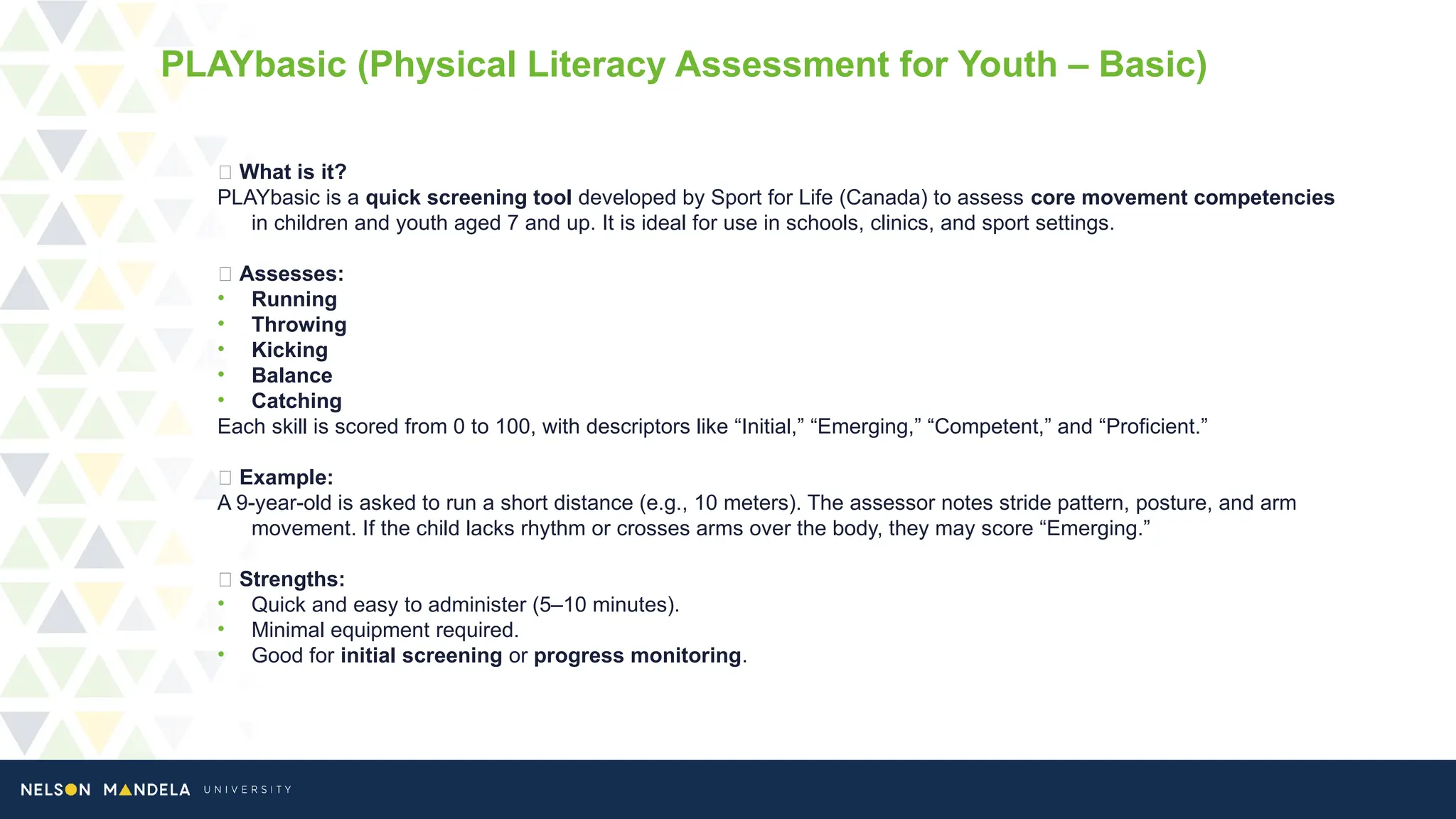
PLAYbasic (Physical LiteracyAssessment for Youth – Basic)
🔹 What is it?
PLAYbasic is a quick screening tool developed by Sport for Life (Canada) to assess core movement competencies
in children and youth aged 7 and up. It is ideal for use in schools, clinics, and sport settings.
🔹 Assesses:
• Running
• Throwing
• Kicking
• Balance
• Catching
Each skill is scored from 0 to 100, with descriptors like “Initial,” “Emerging,” “Competent,” and “Proficient.”
🔹 Example:
A 9-year-old is asked to run a short distance (e.g., 10 meters). The assessor notes stride pattern, posture, and arm
movement. If the child lacks rhythm or crosses arms over the body, they may score “Emerging.”
🔹 Strengths:
• Quick and easy to administer (5–10 minutes).
• Minimal equipment required.
• Good for initial screening or progress monitoring.
17.
CAPL-2 (Canadian Assessmentof Physical Literacy – Second Edition)
🔹 What is it?
CAPL-2 is a comprehensive, multidimensional tool that assesses physical literacy in children aged 8–12 years.
It includes physical, cognitive, motivational, and behavioral elements.
🔹 Assesses:
• Physical Competence: PACER test, sit-and-reach, handgrip, plank hold.
• Daily Behavior: Pedometer steps or self-report physical activity.
• Motivation and Confidence: Questionnaire assessing enjoyment and perceived ability.
• Knowledge and Understanding: Multiple-choice quiz on movement and health.
🔹 Example:
During the plank hold, a student’s core stability is measured. If they maintain correct posture for 30+ seconds, they
score highly for core endurance.
🔹 Strengths:
• Holistic – includes physical, psychological, and behavioral components.
• Evidence-based and validated across settings.
• Useful for longitudinal tracking in school or research contexts.
18.
TGMD-3 (Test ofGross Motor Development – 3rd Edition)
🔹 What is it?
TGMD-3 is a standardized tool for assessing gross motor skill development in children aged 3–10
years. It’s widely used by biokineticists, therapists, and educators.
🔹 Assesses:
• Locomotor Skills: Running, hopping, leaping, skipping, sliding, galloping.
• Ball Skills (Object Control): Throwing, catching, kicking, striking, dribbling, rolling.
Each skill is broken into performance criteria (e.g., arms bent, foot placement) scored 0 or 1.
🔹 Example:
For “Hopping,” a child is scored on their ability to lift the non-support foot, maintain balance, and land
softly. If all are done correctly for 3 out of 4 trials, they score full marks.
🔹 Strengths:
• Allows fine-grained observation of movement mechanics.
• Excellent for identifying specific skill deficits.
• Useful in planning targeted interventions.
19.
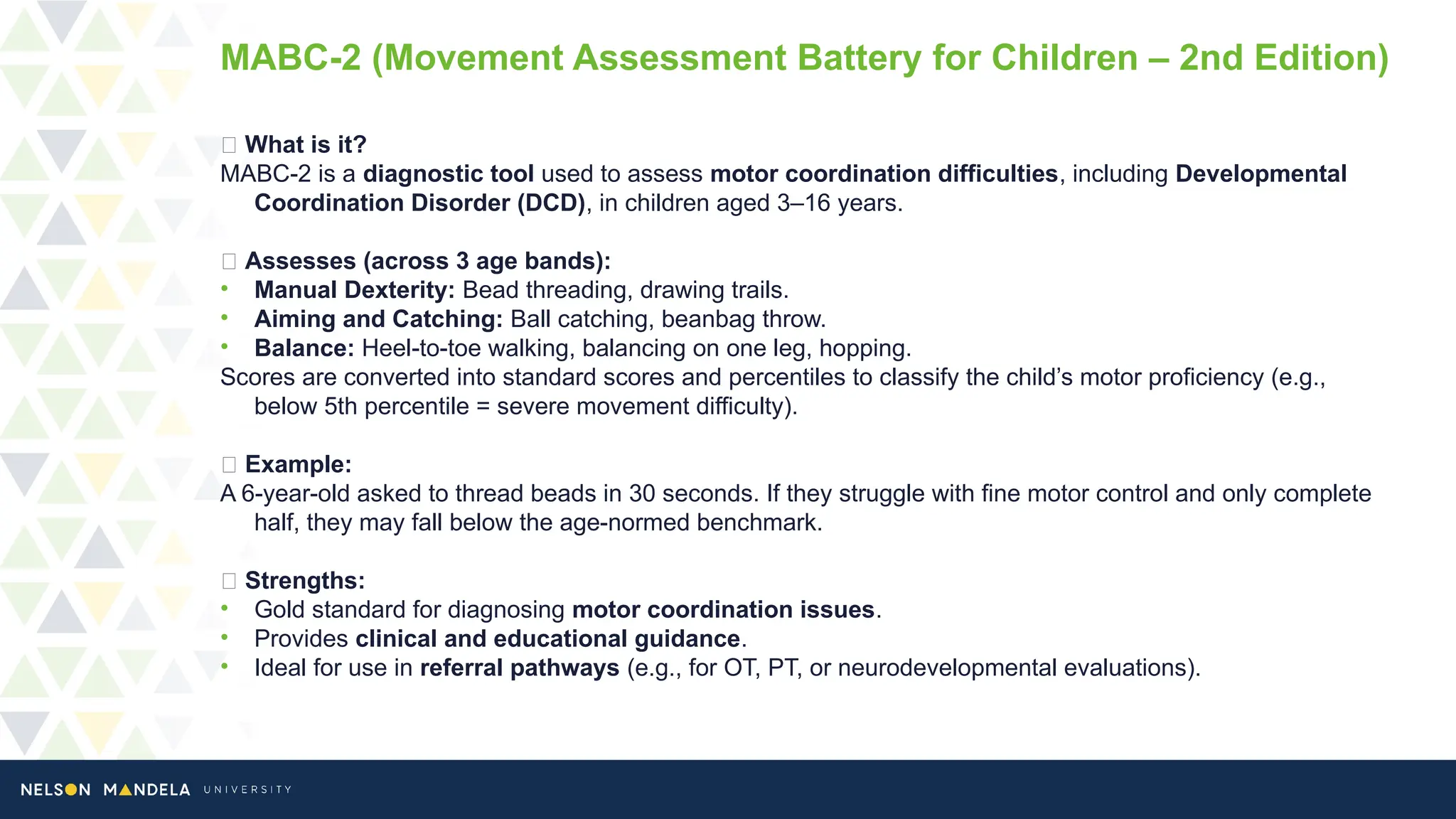
MABC-2 (Movement AssessmentBattery for Children – 2nd Edition)
🔹 What is it?
MABC-2 is a diagnostic tool used to assess motor coordination difficulties, including Developmental
Coordination Disorder (DCD), in children aged 3–16 years.
🔹 Assesses (across 3 age bands):
• Manual Dexterity: Bead threading, drawing trails.
• Aiming and Catching: Ball catching, beanbag throw.
• Balance: Heel-to-toe walking, balancing on one leg, hopping.
Scores are converted into standard scores and percentiles to classify the child’s motor proficiency (e.g.,
below 5th percentile = severe movement difficulty).
🔹 Example:
A 6-year-old asked to thread beads in 30 seconds. If they struggle with fine motor control and only complete
half, they may fall below the age-normed benchmark.
🔹 Strengths:
• Gold standard for diagnosing motor coordination issues.
• Provides clinical and educational guidance.
• Ideal for use in referral pathways (e.g., for OT, PT, or neurodevelopmental evaluations).
21.
South African Context
•PE delivery is inconsistent across provinces and income groups.
• Children in townships and rural areas face space and safety
barriers.
• Healthy Active Kids SA (2022): Only 1 in 3 children meet physical
activity guidelines.
• While global evidence is important, we must contextualize. In SA,
issues of inequality, safety, and basic access still prevent many
children from moving freely.
22.
Role of theBiokineticist
• You are not just a movement specialist—you’re a change-
maker. Biokineticists play a growing role in education and public
health spaces.
• Conduct assessments and identify delays early.
• Design inclusive movement programs.
• Support schools and community health efforts.
• Advocate for physical activity as a core health right.
23.
Group Activity –Design a Program
Scenario: Design a 4-week movement intervention for Grade 2
learners in a low-resource school.
Include:
• 3 developmental goals
• Weekly schedule with 4 activities
• Inclusion strategy (e.g. for children with DCD)
• Family or community engagement approach
24.
Case Study –Motor Delay in Grade R
Case: Thabo (6 years old) struggles with balance, avoids group
games, fatigues quickly.
Tasks:
• Identify 3 red flags
• Choose an assessment tool
• Propose 2 activities to improve his FMS
• How will you track his progress?
25.
Thabo represents manychildren you will work with. Focus on what you can do within
the school and family setting to make movement a safe, enjoyable part of his day.
26.
Write down onething you will do differently when
working with children after today’s lecture.