TRANSPORTATION    
                         FOR  THE  NATION  
                                                            
                 STRATEGIC  PLAN                            


                                                 PRODUCED  FOR  

                        The  US  Department  of  Transportation  
                           Geospatial  Information  Officer  
                                                 March  2011  
                                                        
                                             DRAFT Final
                                                       V8


     This  document  was  produced  by  Koniag  Technology  Solutions  (KTS)  and  Applied  Geographics,  Inc.  
            (AppGeo)  under  contract  to  the  United  States  Department  of  Transportation  (USDOT).  


                                        [This  page  intentionally  left  blank]  


USDOT  TFTN  Strategic  Plan  v8                                                     May  2011  
Koniag  Technology  Solutions  |  Applied  Geographics,  Inc.                                      1  
Table  of  Contents  
  
Executive  Summary   ...........................................................................................................................4  
                  .
1        Current  Situation  ........................................................................................................................6  
      1.1       Background  ...................................................................................................................................  6  
      1.2       Widespread  Demand  For  Nationwide  Road  Centerlines  ..............................................................  7  
      1.3       Existing  Status  Of  Nationwide  Road  Centerlines  ........................................................................  10  
      1.4       How  Are  Road  Centerline  Data  Currently  Created?  ...................................................................  14  
      1.5       Strengths  &  Weaknesses  Of  Current  Situation  ...........................................................................  19  
      1.6       Opportunities  &  Challenges  ........................................................................................................  20  
2        Vision  &  Goals  ..........................................................................................................................  
                                                                                                                                                     22  
      2.1       Strategic  Goal  ..............................................................................................................................  22  
      2.2       Vision  ...........................................................................................................................................  22  
      2.3       Programmatic  Goals  ....................................................................................................................  24  
      2.4       Next  Steps  ...................................................................................................................................  32  
      2.5       Monitoring  &  Measuring  Progress  ..............................................................................................  33  
3        Requirements  ...........................................................................................................................  
                                                                                                                                                  35  
      3.1       Organizational  Needs  ..................................................................................................................  35  
      3.2       Executive  Support  .......................................................................................................................  36  
      3.3       Staffing  ........................................................................................................................................  37  
      3.4       Costs  ............................................................................................................................................  38  
      3.5       Assessing  Risk  ..............................................................................................................................  38  
4        Implementation  Overview  ........................................................................................................  
                                                                                                                                           40  
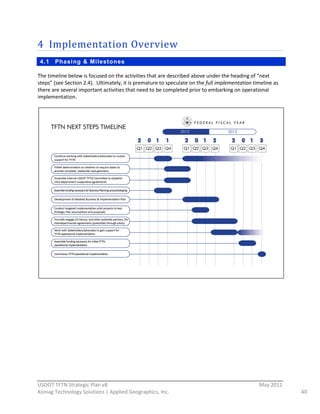
      4.1       Phasing  &  Milestones   .................................................................................................................  40  
                                      .
Appendices  ......................................................................................................................................  
                                                                                                                                                  41  
      Appendix  1:  Strategic  Planning  Methodology  .........................................................................................  42  


USDOT  TFTN  Strategic  Plan  v8                                                                                                                        May  2011  
Koniag  Technology  Solutions  |  Applied  Geographics,  Inc.                                                                                                               2  


                                        [This  page  intentionally  left  blank]  


USDOT  TFTN  Strategic  Plan  v8                                                     May  2011  
Koniag  Technology  Solutions  |  Applied  Geographics,  Inc.                                      3  
Executive  Summary  
Background  
The  notion  of  Transportation  for  the  Nation  (TFTN)  was  originally  put  forth  in  a  2008  “Issues  Brief”  from  
the  National  States  Geographic  Information  Council  (NSGIC).    In  that  brief,  NSGIC  noted  the  fundamental  
nature  of  transportation  data  which  is  universally  utilized  by  geospatial  practitioners  and  also  the  fact  
that  there  is  redundancy  and  at  least  three  overlapping  efforts  that  create  nationwide  transportation  
data  sets.  These  inefficiencies  cost  taxpayers  millions  of  dollars.    Under  the  Office  of  Management  and  
Budget’s  Circular  A-­‐16,  the  US  Department  of  Transportation  (USDOT)  was  designated  as  the  framework  
“theme  leader”  for  transportation  data  sets.    This  study  emanates  from  USDOT  investigating  whether  a  
TFTN  program  could  help  the  agency  meet  its  own  internal  business  needs,  fulfill  its  Circular  A-­‐16  
responsibilities  and  help  the  country  more  efficiently  provide  transportation  data  that  is  widely  
demanded  for  activities  such  as:  
         Transportation  system  planning  and  management  
         E911  dispatching  
         Postal  and  delivery  services  
         Consumer-­‐based  navigation  systems  

Vision  &  Goals  
This  study  puts  forward  a  simple  and  direct  strategic  goal:  
  
                Commence  the  development  of  comprehensive,  publicly  available,  
                nationwide  transportation  data  sets.    Ultimately,  Transportation  for  the  
                Nation  (TFTN)  will  encompass  data  sets  covering  multiple  modes  of  
  
                transportation,  however,  the  initial  focus  will  be  on  producing  a  road  
                centerline  data  set  that  includes  all  types  of  roads,  both  public  and  private.  
                The  initial  TFTN  data  set  will  include  consistent,  current,  high  quality  road  
                centerline  data  for  the  entire  country.  
                
Fundamental  to  a  TFTN  program  is  that  all  resulting  data  will  be  widely  available  and  in  the  public  
domain.      

General  Approach  
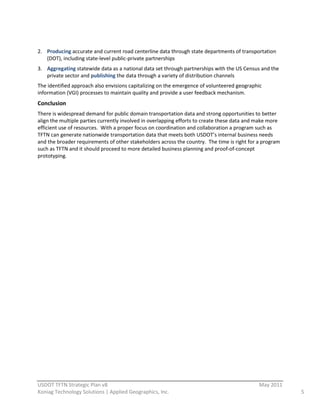
The  approach  for  TFTN  identified  in  this  
study  involves  the  coordinated  efforts  of  
number  of  organizations  across  three  
core  elements  required  for  the  
production  and  maintenance  of  TFTN:  

1. Catalyzing  the  development  of  
   standardized  road  centerline  data  
   through  USDOT’s  Highway  
   Performance  and  Measurement  
   System  (HPMS)  program                                                 


USDOT  TFTN  Strategic  Plan  v8                                                                                  May  2011  
Koniag  Technology  Solutions  |  Applied  Geographics,  Inc.                                                                   4  
 
2. Producing  accurate  and  current  road  centerline  data  through  state  departments  of  transportation  
   (DOT),  including  state-­‐level  public-­‐private  partnerships  
3. Aggregating  statewide  data  as  a  national  data  set  through  partnerships  with  the  US  Census  and  the  
   private  sector  and  publishing  the  data  through  a  variety  of  distribution  channels  
The  identified  approach  also  envisions  capitalizing  on  the  emergence  of  volunteered  geographic  
information  (VGI)  processes  to  maintain  quality  and  provide  a  user  feedback  mechanism.  
Conclusion  
There  is  widespread  demand  for  public  domain  transportation  data  and  strong  opportunities  to  better  
align  the  multiple  parties  currently  involved  in  overlapping  efforts  to  create  these  data  and  make  more  
efficient  use  of  resources.    With  a  proper  focus  on  coordination  and  collaboration  a  program  such  as  
TFTN  can  generate  nationwide  transportation  data  that  meets  both  USDOT’s  internal  business  needs  
and  the  broader  requirements  of  other  stakeholders  across  the  country.    The  time  is  right  for  a  program  
such  as  TFTN  and  it  should  proceed  to  more  detailed  business  planning  and  proof-­‐of-­‐concept  
prototyping.  


USDOT  TFTN  Strategic  Plan  v8                                                                              May  2011  
Koniag  Technology  Solutions  |  Applied  Geographics,  Inc.                                                                5  
1 Current  Situation  
     1.1    Background

Transportation  for  the  Nation  (TFTN)  is  the  term  originally  applied  by  the  National  States  Geographic  
Information  Council  (NSGIC)  to  the  initiative  needed  to  build  a  nationally  shared  transportation  data  set  
that  would  support  diverse  stakeholders  and  be  publicly  available.    It  was  formally  announced  as  a  
priority  item  on  the  NSGIC  Advocacy  Agenda  in  an  Issues  Brief  in  2008,  with  the  following  vision  for  the  
future:  
  
                   “The  federal  government  will  coordinate  development  of  a  seamless  
                   nationwide  dataset  of  addressable  roads  that  is  built  in  a  
                   collaborative  and  shared  environment.”    

In  essence,  NSGIC  was  giving  a  fresh  voice  to  a  longstanding  national  goal,  to  build  a  national  
transportation  data  set  as  a  “framework”  layer  or  theme  within  the  National  Spatial  Data  Infrastructure  
(NSDI),  which  is  a  notion  that  goes  back  decades.    In  1990,  Office  of  Management  and  Budget  (OMB)  
Circular  A-­‐16  on  the  “Coordination  of  Geographic  Information  and  Related  Spatial  Data  Activities,”  called  
for  the  creation  of  the  Federal  Geographic  Data  Committee  (FGDC),  and  for  the  “development  of  a  
national  digital  spatial  information  resource,  linked  by  criteria  and  standards  that  will  enable  sharing  and  
efficient  transfer  of  spatial  data  between  producers  and  users.”  This  national  resource  was  defined  in  
Executive  Order  12906  (1994)  to  be  the  NSDI,  with  FGDC  responsible  for  coordinating  across  federal  
agencies  and  other  stakeholders  to  make  NSDI  real.    


OMB  A-­‐16  was  revised  in  2002,  to  include  a  list  of  lead  federal  agencies  for  the  data  themes  identified  
for  NSDI.    The  “Transportation”  theme  was  assigned  to  the  Department  of  Transportation,  Bureau  of  
Transportation  Statistics,  and  defined  as  follows:  


                   “Transportation  data  are  used  to  model  the  geographic  locations,  
                   interconnectedness,  and  characteristics  of  the  transportation  system  within  
                   the  United  States.  The  transportation  system  includes  both  physical  and  
                   non-­‐physical  components  representing  all  modes  of  travel  that  allow  the  
                   movement  of  goods  and  people  between  locations.”    (Appendix  E,  OMB  
                   Circular  A-­‐16  Revised,  2002)  


USDOT  TFTN  Strategic  Plan  v8                                                                                    May  2011  
Koniag  Technology  Solutions  |  Applied  Geographics,  Inc.                                                                     6  
The  role  of  Theme  Leader  was  given  greater  definition  when  OMB  Circular  A-­‐16  Supplemental  
Guidance  was  issued  in  late  2010.    The  term  “National  Geospatial  Data  Asset”  (NGDA)  was  
introduced  to  apply  to  themes,  which  are  further  subdivided  into  data  sets.    This  fits  the  TFTN  
outlook  going  forward,  as  all  modes,  and  the  intermodal  connections  between,  them  are  eventually  
addressed  as  part  of  a  logical  grouping  of  NGDA  data  sets  belonging  to  the  Transportation  Theme.    A  
portfolio  management  approach  can  then  be  applied  to  investment  alternatives  within  each  theme,  
as  envisioned  by  OMB.  


It  is  a  TFTN  objective  that  the  program’s  data  be  distributed  freely,  as  a  public  domain  asset,  for  the  
benefit  of  all  stakeholders.    Fundamentally,  the  geographic  data  contemplated  for  TFTN  will  
communicate  knowledge  of  our  nation’s  road  network,  thereby  promoting  innovation,  commerce,  
informed  public  discourse,  basic  research,  and  sharing  within  open  communities  of  interest.  


 1.2     Widespread Demand For Nationw ide Road Centerlines

Road  centerline  data  are  one  of  the  most  widely  used  geospatial  information  products  in  modern  
society.  Some  pervasive  applications  include:  on-­‐board  vehicle  navigation,  E-­‐911  dispatching  and  
emergency  vehicle  routing,  census  enumeration,  postal  and  delivery  services,  disaster  response  and  
relief  efforts,  tax  collection,  mapping  accidents,  asset  inventories,  map  directions  on  smart  phones,    and  
other  location-­‐based  systems.  

In  addition  to  the  general  uses  of  road  centerlines  outlined  above,  transportation  professionals  utilize  
road  centerlines  extensively  for  explicit  transportation  planning  and  management  activities.      These  
activities  include:  highway  safety  involving  issues  like  road  geometry  and  guardrail  placement;  intelligent  
transportation  system  planning;  congestion  management;  environmental  issues  such  as  wetlands  and  
air  quality  along  rights-­‐of-­‐way;  and  highway  performance  issues  to  gauge  the  health  and  usability  of  the  
transportation  system.      

Given  the  diverse  transportation  specific  and  general  uses  of  road  centerline  data  there  are  many  
different  types  of  data  content  that  can  make  up  a  road  centerline  data  set.  

              Different  users  have  a  varying  needs  for  specific  content  and  characteristics,  such  as:  
                  Basic  geometry  and  naming  
                  Basic  attributes,  e.g.,  functional  class  
                  Enhanced  cartographic  display  and  labeling/annotation  
                  Addressing  and  geocoding  support  

                                                          
USDOT  TFTN  Strategic  Plan  v8                                                                                    May  2011  
Koniag  Technology  Solutions  |  Applied  Geographics,  Inc.                                                                     7  
Boundary  delineation  
                                                         Linear  referencing  methods/systems  (LRM/LRS)  
                                                         Routability  (e.g.,  network  connectivity;  speed  limits;  lane  and  turn  restrictions;  etc.)  
                                                         Integration  with  image/photo  catalogs  
                                                         High  positional  accuracy  
                                                         High  update  frequency  
                                                         Compatibility  with  real-­‐time  data  feeds  
  
A  great  deal  of  duplication  of  effort  is  evident  across  Federal  agencies  and  other  levels  of  government.    
Nationwide  programs  that  collect  and  integrate  transportation  geospatial  data  from  local,  state,  regional  
and  federal  sources  –  or  acquire  such  data  from  commercial  sources  -­‐-­‐  are  usually  done  with  a  single  
purpose,  rather  than  a  multi-­‐purpose  use,  in  mind.  Several  commercial  data  providers  as  well  as  
government  agencies  have  built  transportation  data  sets  for  different  use  cases.  In  the  absence  of  an  
effective  and  organized  national  program,  and  without  incentives  and  insistence  to  cooperate,  each  
level  of  government  perpetuates  and  duplicates  independent  efforts  by  creating  these  data  primarily  to  
meet  their  own,  specific  and  solitary  mission  requirements.  This  practice  leads  to  duplicate  spending,  
wasted  taxpayer  dollars  and  inefficient  government.  

The  transportation  data  needs  of  Federal  agencies  was  the  subject  of  a  survey  and  summit  meeting  
titled  Geospatial  Transportation  Data  Needs  for  Federal  Agencies  sponsored  by  US  Census  Bureau  in  
October,  2009.  Fourteen  Federal  agencies  responded  to  the  detailed  survey  on  specific  requirements.    A  
key  recommendation  emanating  from  that  meeting  was  the  notion  of  creating  a  single  data  set,  flexible  
enough  to  meet  federal  agency  needs  as  they  change  over  time  and  usable  by  all  participating  federal  
agencies:  

                                           Existing  road  centerline  initiatives  and  independent  spending  from  Federal  agencies  include,  
                                           but  are  not  limited  to:  
                                                         The  National  Map  from  Department  of  the  Interior,  US  Geological  Survey  (USGS)  who  
                                                         has  licensed  TomTom 1  road  data  for  producing  printable  topographic  maps  

                                                         TIGER  from  the  Department  of  Commerce,  Census  Bureau  who  has  built  TIGER  from  
                                                         local  sources  for  census  enumeration  and  demographic  applications,  license-­‐free  

                                                         HSIP  from  the  National  Geospatial  Intelligence  Agency  (NGA)  who  has  licensed  
                                                         NAVSTREETS  commercial  data  from  Navteq  for  use  by  both  federal  and  state  agencies  
                                                         engaged  in  emergency  management  

                                                                                                                      
1
    TomTom  was  formerly  known  as  TeleAtlas  
                                                          
USDOT  TFTN  Strategic  Plan  v8                                                                                                                      May  2011  
Koniag  Technology  Solutions  |  Applied  Geographics,  Inc.                                                                                                       8  
The  FCC  who  licensed  commercial,  nationwide  street  centerline  data  to  support  
                    geocoding  

                    The  National  Transportation  Atlas  Database  (NTAD)  distributed  by  USDOT  that  contains  
                    information  on  road  networks  and  associated  infrastructure.    

                    In  addition  some  agencies  such  as  USGS,  Census,  and  NGA  are  looking  at  
                    OpenStreetMap  (OSM)  and  other  volunteered  geographic  information  alternatives  as  
                    means  of  supplementing  their  road  centerline  requirements.    

In  addition  to  national  road  centerline  programs,  the  USDOT  has  many  internal  business  requirements  
for  road  centerlines.    These  include  but  are  not  limited  to:  

               The  Federal  Highway  Administration’s  (FHWA)  Highway  Performance  Monitoring  System  
               (HPMS),  which  covers  all  public  roads  that  are  eligible  for  Federal-­‐aid  highway  funds,  
               including  the  National  Highway  System.  
                    Detailed  HPMS-­‐specific  attributes  are  collected  for  all  roads  eligible  for  Federal-­‐aid  
                    Annual  HPMS  reporting  required  by  states  
                    FHWA  works  with  states  to  develop  basic  standards  
                    Enables  states  to  utilize  FHWA  funding  for  creation  and  maintenance  of  inventory  
                    States  develop  their  own  plans  and  data  management  strategies  
                    FHWA  facilitates  information  exchange  on  state  “best  practices”  
                    Includes  the  submission  of  road  geometry  
                    FHWA  provides  the  States  information  from  Federal  agencies  on  Federally-­‐owned  public  
                    roads  within  their  State  boundaries  
                    States  provide  an  authoritative  source  of  information  about  all  public  roads  within  their  
                    boundaries  

               USDOT  Safety  for  accident  mapping  
                  Large  emphasis  on  reducing  fatalities  from  accidents  
                  Requires  information  for  all  roads,  not  just  Federal-­‐aid  roads  

               FHWA  Asset  Management  for  bridges  

While  current  Federal  government  expenditures  on  road  centerlines  are  not  precisely  known,  they  are  
estimated  to  be  many  tens  of  millions  of  dollars  per  year.    Getting  a  better  estimate  of  this  figure  is  
recommended  as  part  of  the  business  planning  effort  associated  with  TFTN  and  will  be  an  important  
component  of  demonstrating  the  overall  business  case.  
                                                          
USDOT  TFTN  Strategic  Plan  v8                                                                                      May  2011  
Koniag  Technology  Solutions  |  Applied  Geographics,  Inc.                                                                       9  
1.3   Existing Status Of Nationw ide Road Centerlines

At  one  of  the  workshops  during  the  TFTN  strategic  planning  process,  a  strong  recommendation  was  
made  to  consider  the  time  dimension  as  alternatives  are  evaluated.    Specifically,  the  planning  team  was  
asked  to  distinguish  existing  short-­‐term  alternatives  from  long-­‐range  developmental  alternatives.  The  
three  existing  sources  of  nationwide  road  centerline  data  described  below  are  available  as  alternatives  
for  the  short-­‐term,  while  a  fully  built-­‐out  TFTN  (as  described  in  Section  2)  should  be  strongly  considered  
for  the  long-­‐term.  

           1. US  Census  TIGER  Data  
           2. Commercial  Data  Providers  
                 NAVTEQ  
                 TomTom  
           3. Volunteered  Geographic  Information  
                 OpenStreetMap  (OSM)  
                 Esri’s  Community  Base  Maps  (CBM)  

Each  of  these  three  existing  sources  of  information  has  distinct  advantages  and  disadvantages.    These  
“pros”  and  “cons”  serve  as  a  useful  baseline  for  the  long  term  planning  of  TFTN.  


1.3.1 US Census TIGER Data
PROS  
               TIGER  is  a  mature  product  that  is  already  in  the  public  domain  
               Data  can  be  used  for  nationwide  geocoding  purposes  
               Provides  a  comprehensive,  nationwide  road  centerline  inventory  including  private  roads  and  
               high  quality  in  rural  areas  
               Many  users  depend  on  it  for  a  variety  of  applications,  including:      
                           Base  map  geometry  
                           Access  to  US  Census  Bureau  statistical  information  
                           National  broadband  mapping  efforts  aggregate  broadband  availability  data  to  
                           Census  Geography  
               Significant  improvements  in  latest,  2010  TIGER  files  
                           Positional  accuracy  improved  (7.6  meter)  
                           Substantial  input  from  local  sources  incorporated  
                                                          
USDOT  TFTN  Strategic  Plan  v8                                                                                    May  2011  
Koniag  Technology  Solutions  |  Applied  Geographics,  Inc.                                                                      10  
Added  2.5  million  updates  based  on  2010  Census  field  operations  
                                           Planning  for  more  frequent  updates  (depending  on  funding)  

                                             
CONS  
                                           TIGER  did  not  meet  requirements  for  nationwide  roads  in  The  National  Map  (TNM)  as  
                                           defined  by  USGS 2  
                                                                        Positional/Horizontal  accuracy  
                                                                        Depictions  of  interchanges  and  dual-­‐carriageways  
                                                                        Attributes  to  support  high-­‐quality  cartography  
                                           Costs  to  retrofit  TIGER  were  prohibitive  for  use  in  TNM,  in  the  opinion  of  USGS  
                                           USGS  replaced  TIGER  with  TomTom  data  (but  is  working  with  Census  to  resolve  issues,  and  
                                           might  eventually  go  back  to  TIGER)  
                                                                        Commercial  data  was  competitively  priced,  but  licensed  for  restricted  use  
                                           While  Census  Bureau  became  a  transportation  data  provider  by  default  and  necessity,  they  
                                           are  Census  domain  experts  and  are  more  of  a  transportation  data  integrator,  in  principle.  In  
                                           addition,  the  Census  Bureau  is  a  user  of  roads,  railroads  and  other  transportation  
                                           centerlines.    They  are  used  for  orientation  of  field  staff  during  censuses  and  surveys,  
                                           geocoding  addresses  to  census  blocks,  address  range  determinations  and  delineation  of  
                                           statistical  and  administrative  boundaries.    The  collection  of  housing  unit  locations  required  a  
                                           shift  in  accuracy  requirements  from  a  relative  approach  to  a  highly  accurate  positional  
                                           approach  using  GPS  technology  and  high  resolution  imagery.    Thus,  transportation  is  neither  
                                           the  US  Census  Bureau’s  line  of  business,  nor  their  OMB  A-­‐16  Theme  responsibility  and  TIGER  
                                           is  not  designed  as  a  transportation  data  set  (e.g.,  its  integrated  topological  structure  
                                           contains  many  nodes  not  related  to  a  transportation  network).  
                                           Data  maintenance:    Census  road  centerline  data  maintenance  schedule  does  not  meet  the  
                                           more  frequent  needs  for  current  road  centerline  data,  such  as  E-­‐911  and  local  needs.  
  

1.3.2 Commercial Roads
PROS  
                                           NAVTEQ  and  TomTom  are  considered  industry  leaders  and  have  developed  customer-­‐driven  
                                           markets  and  business  processes  to  sustain  nationwide  road  centerline  data  sets  for  on-­‐
                                           board  navigation  and  other  popular  applications.      


2
         The  US  Census  Bureau  has  provided  outreach  to  the  USGS  and  is  working  with  USGS  on  efforts  to  address  these  deficiencies.  
         In  addition,  it  should  be  recognized  that  while  these  deficiencies  exist  they  are  not  necessarily  systemic  and  some  a  present  
         in  <10%  of  situations.  
                                                          
USDOT  TFTN  Strategic  Plan  v8                                                                                                                               May  2011  
Koniag  Technology  Solutions  |  Applied  Geographics,  Inc.                                                                                                                11  
They  have  existing  data  that  meets  some  of  the  basic  requirements  of  TFTN,  and  at  least  one  
              of  them  has  expressed  willingness  to  let  their  data  matriculate  into  the  public  domain  as  
              part  of  a  TFTN  arrangement.    The  specifics  of  any  such    offer  must  be  fully  fleshed  out  and  
              meet  with  federal  agency  mission  requirements.  
              Both  companies  have  people  and  other  resources  dedicated  to  ongoing  map  updating,  and  
              are  driven  by  business  imperatives  and  competitive  pressures  to  strive  for  the  most  accurate  
              and  current  data  possible.      
              In  urban  areas,  their  data  tends  to  be  well  regarded,  for  the  most  part.    Rural  data  tends  to  
              have  lower  quality  and  reliability.  
              There  are  scenarios  where  such  companies  could  license  their  data  to  the  Federal  
              government  for  unrestricted  use,  with  some  limitations  on  the  content,  particularly  in  terms  
              of  attributes.      
              They  have  also  shown  willingness  to  engage  in  public/private  partnerships  to  ensure  that  
              they  capture  data  from  authoritative  local  sources,  as  well  as  their  own  compilation  efforts  
              and  unique  data  acquisition  methods.    There  are  several  examples,  including  one  
              documented  below  in  the  case  studies  (see  Section  1.4.1),  of  states  pursuing  public/private  
              partnerships  with  these  companies.  
              The  cost  of  acquiring  existing  commercial  data  is  less  than  building  equivalent  road  data  
              from  scratch.  
                
CONS  
              Because  there  are  fewer  customers  for  their  data  in  rural  areas,  it  is  generally  believed  that  
              their  road  coverage  in  such  areas  is  weak  compared  to  other  alternatives.      
              If  a  public/private  partnership  was  pursued  on  a  nationwide  basis  the  lag  between  when  the  
              data  are  licensed  and  when  they  matriculate  into  the  public  domain  could  be  as  long  as  12-­‐
              24  months.  
              The  role  of  the  government  and  associated  public  interests  is  limited  to  contractual  
              arrangements  and/or  regulation.  
                
1.3.3 Volunteered Geogr aphic Information (VGI)
The  notion  of  Volunteered  Geographic  Information  can  take  a  wide  variety  of  forms.  Examples  of  VGI  
roads  data  range  from  OpenStreetMap  as  a  nationwide  initiative  with  direct  editing  by  volunteers  to  
Esri’s  Community  Base  Map  program  which  provides  tiles  that  include  roads  data  “volunteered”  by  
authoritative  sources  for  select  metropolitan  areas  within  the  USA.  For  the  purpose  of  the  pros  and  cons  
described  below,  a  “direct  editing”  program  such  as  OSM  is  most  relevant.  


USDOT  TFTN  Strategic  Plan  v8                                                                                    May  2011  
Koniag  Technology  Solutions  |  Applied  Geographics,  Inc.                                                                     12  
PROS  
               Crowd-­‐sourced  
               Free  of  cost  for  use  
               In  the  US,  was  seeded  with  TIGER  data  (and  there  is  consideration  of  re-­‐seeding  with  the  
               greatly  improved  2010  TIGER  data)  
               Anyone  with  a  location-­‐aware  device  can  participate  
               Tremendous  developer  support  for  add-­‐on  applications  
               Used  by  MapQuest  
                 
CONS  
               Crowd  sourced  and  dependent  upon  the  interests  of  volunteers  to  update  
               Variable  and  inconsistent  participation  thereby  resulting  in  non-­‐uniform  quality  and  
               coverage.  
               Not  necessarily  authoritative  source  
               Unclear  where  liabilities  might  lie  
               Licensing  agreement  issues  need  to  be  further  clarified  
               Does  not  adhere  to  an  accuracy  standard  
                 
                 
1.3.4 Summar y of Existing Approaches for Nationw ide Centerlines
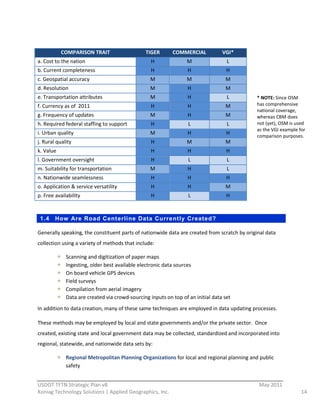
The  table  below  provides  a  comparison  of  various  traits  across  the  three  major,  existing  nationwide  data  
sets  -­‐-­‐  i.e.  TIGER,  Commercial,  and  Volunteered  Geographic  Information  (VGI)  as  represented  by  
OpenStreetMap.    The  comparison  traits  are  not  weighted  for  relative  importance  in  this  version,  and  the  
ratings  of  high  (H),  medium  (M)  and  low  (L)  are  strictly  subjective,  based  on  professional  opinion  and  
stakeholder  feedback.    It  should  be  noted  that  “high”  is  not  always  a  positive  quality,  depending  on  the  
trait.      
  
The  table  is  intended  to  serve  as  a  baseline  for  future  analysis  and  refinement;  both  the  traits  and  the  
methodology  for  comparison  should  be  further  refined  and  developed  as  part  of  a  more  detailed  
Business  Plan.    This  type  of  comparison  table  is  designed  to  be  helpful  in  assessing  and  weighing  specific  
TFTN  alternatives,  including  some  that  are  not  considered  in  this  version  of  the  table.      


USDOT  TFTN  Strategic  Plan  v8                                                                                   May  2011  
Koniag  Technology  Solutions  |  Applied  Geographics,  Inc.                                                                    13  
 
              COMPARISON  TRAIT                           TIGER         COMMERCIAL                VGI*  
a.  Cost  to  the  nation                                    H                  M                    L  
b.  Current  completeness                                    H                  H                    H  
c.  Geospatial  accuracy                                    M                   M                   M  
d.  Resolution                                              M                   H                   M  
e.  Transportation  attributes                              M                   H                    L      *  NOTE:  Since  OSM  
f.  Currency  as  of    2011                                 H                  H                   M       has  comprehensive  
                                                                                                            national  coverage,  
g.  Frequency  of  updates                                  M                   H                   M       whereas  CBM  does  
h.  Required  federal  staffing  to  support                 H                  L                    L      not  (yet),  OSM  is  used  
                                                                                                            as  the  VGI  example  for  
i.  Urban  quality                                          M                   H                    H  
                                                                                                            comparison  purposes.  
j.  Rural  quality                                           H                  M                   M  
                                                                                                              
k.  Value                                                    H                  H                    H  
l.  Government  oversight                                    H                  L                    L  
m.  Suitability  for  transportation                        M                   H                    L  
n.  Nationwide  seamlessness                                 H                  H                    H  
o.  Application  &  service  versatility                     H                  H                   M  
p.  Free  availability                                       H                  L                    H  
  

     1.4   How Are Road Cent erline Data Currently Created?

Generally  speaking,  the  constituent  parts  of  nationwide  data  are  created  from  scratch  by  original  data  
collection  using  a  variety  of  methods  that  include:  

                Scanning  and  digitization  of  paper  maps  
                Ingesting,  older  best  available  electronic  data  sources  
                On  board  vehicle  GPS  devices  
                Field  surveys  
                Compilation  from  aerial  imagery  
                Data  are  created  via  crowd-­‐sourcing  inputs  on  top  of  an  initial  data  set  
In  addition  to  data  creation,  many  of  these  same  techniques  are  employed  in  data  updating  processes.  

These  methods  may  be  employed  by  local  and  state  governments  and/or  the  private  sector.    Once  
created,  existing  state  and  local  government  data  may  be  collected,  standardized  and  incorporated  into  
regional,  statewide,  and  nationwide  data  sets  by:  

                Regional  Metropolitan  Planning  Organizations  for  local  and  regional  planning  and  public  
                safety  
                                                          
USDOT  TFTN  Strategic  Plan  v8                                                                                 May  2011  
Koniag  Technology  Solutions  |  Applied  Geographics,  Inc.                                                                        14  
Statewide  road  centerlines  for  State  DOT,  statewide  GIS  and  Public  Safety  
              Private  sector  companies  such  as  NAVTEQ  and  TomTom  
              TIGER  from  US  Census  Bureau  
              The  National  Map  from  US  Geological  Survey  (USGS)  
              Volunteer  developed  OpenStreetMap  (OSM)  
                
1.4.1 Statew ide Road Inventories
States  DOTs  and/or  state  GIS  programs  are  increasingly  creating  statewide  road  inventories.    Such  
inventories  can  be  incorporated  into  nationwide  data  sets.    There  are  several  models  and  emerging  best  
practices  for  statewide  road  inventory  creation.    The  following  sections  provide  several  case  studies  on  
different  approaches,  including:  

              Activate  local/county  government  to  contribute  
              Public/private  partnership  
              State  DOT  led  efforts  
              State  GIS  Office  collaborative  efforts  

1.4.1.1 Activate  Local/County  Government  To  Contribute  
         Ohio:  Example  of  County  Collaboration  on  Statewide  Street  Centerlines  

              The  Location  Based  Response  System  (LBRS)  is  a  partnership  between  state  and  local  
              government  to  develop  highly-­‐accurate  (+/-­‐  1M),  field-­‐verified  street  centerlines  and  
              address  point  locations  for  the  entire  state.    
              The  state  has  developed  a  set  of  standards  and  provides  financial  incentive  to  counties  that  
              participate  and  contracts  with  the  county  through  a  Memorandum  of  Agreement  (MOA)  to  
              provide  funds  upon  successful  completion  of  a  data  collection  and  maintenance  system  
              meeting  LBRS  requirements.  

This  effort  has  resulted  in  the  successful  collaboration  of  many  organizations  working  together  to  
provide  accurate  centerline  data  throughout  the  state.    The  data  are  then  available  for  use  by  both  
emergency  response  organizations  and  state  and  local  geospatial  programs.  

1.4.1.2 Public-­‐Private  Partnership  
         New  York:  Example  of  a  Public-­‐Private  Partnership  to  Create  a  Multi-­‐purpose  Centerline  with  
         Involvement  from  State  GIS  Office  


USDOT  TFTN  Strategic  Plan  v8                                                                                May  2011  
Koniag  Technology  Solutions  |  Applied  Geographics,  Inc.                                                                 15  
In  the  late  1990s,  New  York  State  launched  a  statewide  base  mapping  program  utilizing  GIS.  
             Until  this  point,  the  New  York  DOT/DMV  maintained  their  road  data  in  both  paper  maps  and  
             legacy  CAD  systems.      

             Existing  road  data  needed  to  be  upgraded  to  conform  to  the  new  state  standard  which  at  
             the  time  adhered  to  a  limited  set  of  established  standards  focused  mainly  on  Federal  
             program  regulations  such  as  the  Federal  Highway  Administration’s  Highway  Performance  
             Monitoring  System  (HPMS).    
             The  original  contract  to  develop  the  data,  awarded  in  2001  to  TomTom  (who  went  by  GDT  at  
             the  time),  allowed  the  state  to  own  whatever  was  built.    In  2008,  TomTom’s  contract  ended  
             and  NAVTEQ  was  awarded  a  contract  to  continue  to  update  and  maintain  the  street  data.  

             Program  has  now  developed/licensed  a  single,  statewide  street  centerline  layer.    These  data  
             are  available  to  other  agencies  that  are  able  to  consume  them  to  support  multiple  
             applications.    In  addition,  county  and  local  government  GIS/Transportation  initiatives  are  
             also  provided  access  to  these  data.  

             A  web  portal  where  counties  can  upload/download  data  has  been  created.  Submitted  data  
             are  verified  and  incorporated  in  to  the  working  set  and  then  disseminated  back  to  State  and  
             other  entities  such  as  NAVTEQ.  

1.4.1.3 State  DOT   
         Kentucky:  Linkage  of  the  Transportation  Centerline  to  HPMS,  other  route-­‐dependent  datasets  
         and  E-­‐911  

             In  the  late  1990’s  the  Kentucky  State  Public  Centerline  project  was  originally  conceived  by  
             the  Kentucky  Department  of  Transportation  (KDOT)  as  a  way  to  derive  better  statistical  
             information  and  analytical  products  from  all  of  the  centerline  data  for  the  State.    KDOT  
             realized  very  early  on  that  there  was  a  need  to  move  the  State’s  geospatial  data  
             infrastructure  in  to  a  geographic  information  system  (GIS)  powered  by  a  data  model  
             compiled  entirely  by  linearly  referenced  and  routable  data.    

             Tremendous  effort  was  put  forth  to  contract  with  Area  Development  Districts  (ADDs)  from  
             around  the  State  to  gain  proper  funding  and  the  momentum  needed  to  move  forward  with  
             the  project  to  collect  all  the  centerline  data  from  around  the  state.    

             These  data  became  the  foundation  data  layer  that  could  be  used  by  other  agencies  within  
             the  state,  the  Federal  Highway  Administration  (FHWA)  as  well  as  the  general  public.  These  
             data  and  related  activities  cover  original  GPS  collection,  data  dissemination,  a  recurring  
             update  cycle,  population  of  the  statewide  E-­‐911  repository  and  linkages  between  other  data  
             sources.    The  versatility  and  quality  of  these  data  would  not  have  been  possible  without  a  
             high  level  of  collaboration  between  all  stakeholders  within  the  State.  

                                                          
USDOT  TFTN  Strategic  Plan  v8                                                                              May  2011  
Koniag  Technology  Solutions  |  Applied  Geographics,  Inc.                                                               16  
The  resulting  efforts  have  made  for  seamless  submission  to  HPMS  and  help  to  enhance  its  
              performance  and  accuracy  


1.4.1.4 State  GIS  Office  
         Michigan:  Example  of  a  State  GIS  Office  Assisting  the  Michigan  DOT  

              The  Michigan  State  GIS  office  is  currently  undergoing  an  effort  called  the  Transportation  
              Data  Stewardship  Enhancement  Plan.  This  initiative  has  been  accomplished  under  a  project  
              funded  as  part  of  the  National  Spatial  Data  Infrastructure  (NSDI),  Cooperative  Agreement  
              Program  (CAP)  Category  5.    The  CAP  grant  program  is  administered  by  the  Federal  
              Geographic  Data  Committee  (FGDC)  housed  within  the  U.S.  Geological  Survey  (USGS).    

              The  Enhancement  Plan  defines  a  framework  and  specific  initiatives  to  enhance  and  expand  
              the  Michigan  Geographic  Framework  (MGF)  transportation  data  themes  through  building  an  
              environment  that  encourages  broad  participation  through  shared  responsibility,  shared  
              costs,  shared  benefits,  and  shared  control.  

              The  program  utilizes  five  full  time  staff  members  who  work  constantly  to  maintain  the  data  
              through  the  use  of  standardized  models  and  systematic  workflows  from  the  county  level  up  
              to  the  State.  These  workflows  help  to  identify  changes  in  the  road  system  and  reduce  the  
              amount  of  error  in  the  final  data  set.    Because  of  the  strict  nature  and  use  of  the  State  data  
              model,  it  has  been  reported  that  the  State’s  submission  to  HPMS  has  had  no  errors  over  the  
              past  several  years.    
              The  Michigan  State  GIS  office  has  assembled  a  robust  and  accurate  road  centerline  that  
              covers  a  majority  of  the  State.    These  data  meet  the  business  requirements  and  accuracy  
              standards  for  Michigan  DOT.  The  data  are  also  wholly  owned  by  the  State  and  freely  
              disseminated  without  any  vendor  licensing  restrictions  or  reliance  on  external  partnerships.  
                             

1.4.2 Regional & Inter state Road Invent ories
In  addition  to  state-­‐specific  efforts,  there  have  been  initiatives  that  take  a  multi-­‐state  regional  approach,  
or  an  intra-­‐state  regional  approach.      The  examples  profiled  in  this  section  include:  

I-­‐95  Corridor:  Example  of  Multi-­‐state  Data  Assemblage  Challenges  

              In  support  of  the  I-­‐95  Corridor  Coalition,  Cambridge  Systematics  is  coordinating  the  
              development  of  a  Corridor-­‐wide  information  system  that  consolidates  existing  state  
              roadway  network  databases  into  a  single  multi-­‐state  roadway  network  to  guide  regional  
              transportation  planning  and  emergency  management  efforts.    


USDOT  TFTN  Strategic  Plan  v8                                                                                    May  2011  
Koniag  Technology  Solutions  |  Applied  Geographics,  Inc.                                                                       17  
The  consolidated  road  network  is  comprised  of  the  ‘best  publicly-­‐available’  road  centerline  
             databases  from  each  of  the  16  states  and  the  District  of  Columbia,  who  are  members  of  the  
             I-­‐95  Corridor  Coalition.  The  individual  state  roadway  databases  are  ‘stitched  together’  at  the  
             state  borders  to  form  a  topologically  integrated  network  that  can  be  used  both  for  network  
             analysis  and  for  overlaying  other  data  of  interest,  such  as  crashes,  traffic,  roadway  
             conditions,  and  planned  improvements.    

             Many  variations  in  data  contents  and  consistency  for  road  datasets  were  encountered  from  
             state-­‐to-­‐state;  but  generally,  useful  and  reasonably  accurate  road  features  were  available  to  
             produce  a  public  domain  road  network  for  the  corridor  that  met  the  requirements  of  the  
             project.  

             Doing  this  once  was  the  “easy  part”;  the  “hard  part”  is  doing  this  on  a  regular,  repeatable  
             basis  to  keep  the  road  network  updated  and  current.  

             Looking  back  project  participants  observed  that  an  alternative  approach  using  a  stripped  
             down  commercial  roadway  centerline  network  as  a  framework  might  have  been  easier.    
             Such  an  approach  would  have  relieved  integration  requirements,  and  improved  the  
             consistency  and  convenience  of  updates.    The  challenge  with  such  an  approach  would  have  
             been  ensuring  and  maintaining  public  domain  accessibility,  with  no  license  restrictions  to  
             inhibit  use.  

Washington  Pooled  Funds:  Example  of  a  Multi-­‐state,  Regional  Effort  

             The  Washington  State  Transportation  Framework  project  (WA-­‐Trans)  is  an  exemplary  
             project  for  cooperation  and  partnership  across  all  levels  of  government,  including  8  federal  
             agencies,  7  states,  14  Washington  State  agencies,  23  counties,  10  cities,  9  tribal  
             governments,  and  20  other  private  and  public  entities,  to  build  a  framework  transportation  
             data  layer.  

             The  primary  goal  of  this  project  is  to  build  a  statewide  transportation  database  using  a  
             continuously  evolving  and  improving  collaborative  effort.  WA-­‐Trans  has  been  working  in  
             cooperation  with  six  other  state  departments  of  transportation  to  develop  computer-­‐based  
             tools  that  facilitate  transportation  data  sharing  and  integration.  The  computer-­‐based  tools  
             portion  of  the  project  has  been  financed  with  federal  funds,  specifically  Transportation  
             Pooled  Funds  (TPF).  

             The  WA-­‐Trans  program  has  shown  that  a  successful  framework  data  program  can  be  
             executed  at  the  state  level  in  which  data  can  be  collected  from  a  local  level,  integrated  at  a  
             state  level,  and  shared  to  all  project  participants  while  saving  money  and  benefiting  the  
             users  at  all  levels  of  government.    In  addition,  having  individual  states  coordinate  with  the  
             local  government  agencies  within  their  states  is  a  model  that  has  been  successful  and  is  a  
             model  that  can  be  reproduced  and  expanded  to  create  a  national  framework  data  set.  
                                                          
USDOT  TFTN  Strategic  Plan  v8                                                                                   May  2011  
Koniag  Technology  Solutions  |  Applied  Geographics,  Inc.                                                                    18  
The  incorporation  of  addressing  into  the  WA-­‐Trans  program  has  proven  that  this  collection  
              of  data  plays  a  vital  role  in  a  Statewide  Transportation  Framework  and  addressing  should  be  
              part  of  a  national  program  to  fully  engage  local  government.  Finally,  it  is  critical  to  a  state  
              and/or  a  national  program  to  have  adequate  funding  for  not  only  infrastructure,  tools,  
              staffing  and  data,  but  also  for  outreach  and  communication  efforts.  

Northern  Virginia  Regional  Routable  Road  Centerline  

              The  Data  Collection  and  Analysis  project  consisted  of  five  jurisdictions  in  the  Northern  
              Virginia  area,  which  are  all  Public  Safety  Answering  Points  (PSAP),  as  well  as  the  Virginia  
              Information  Technology  Agency  (VITA)  and  the  Virginia  Department  of  Transportation  
              (VDOT).    All  partners  worked  in  active  collaboration  to  develop  a  routable  centerline  data  
              standard  and  data  set  usable  by  computer-­‐aided  dispatch  (CAD)  systems.    

              The  purpose  of  this  project  is  to  enhance  Virginia  Geographic  Information  Network  (VGIN)  
              road  centerline  (RCL)  to  create  a  regional  data  set  capable  of  supporting  routing,  geocoding,  
              and  persistent  updates  to  local  911  map  systems.  It  will  allow  for  design,  development,  
              updating,  and  population  of  an  enhanced  RCL  which  will  fully  support  each  individual  CAD  
              system  for  data  outside  their  own  jurisdiction,  while  not  forcing  them  to  change  the  data  
              model  currently  used  in  CAD.    

              The  VGIN  RCL  project  is  considered  a  huge  local  success  because  of  the  communication  and  
              handshaking  that  occurs  between  the  counties  and  the  state  DOT.  This  is  an  ongoing  project  
              that  will  eventually  have  a  seamless  flow  from  participating  cities  and  counties  up  to  the  
              state  and  then  back  again  to  complete  the  round  trip.  Additional  work  on  the  project  
              includes  the  development  of  maintenance  tools  and  the  integration  of  regional  data  into  
              CAD  systems.  

 1.5    Strengt hs & Weaknesses Of Current Si tuation

1.5.1 Strengt hs

              Clear  data  theme  responsibility  for  USDOT  in  OMB  A-­‐16  and  need  for  increased  
              collaboration  across  Federal  agencies  on  geospatial  data  coordination.  

              Common  interest  across  Federal  agencies  in  a  single  data  set  for  road  centerlines  for  the  
              nation,  for  all  roads.  

              Widespread  support  across  diverse  stakeholders  for  the  TFTN  concept.  

            Availability  of  practical,  operational  models  and  best  practices  for  statewide  road  
            inventories.    Key  best  practices  include  collaborative  approaches  involving  counties  and  also  
            a  multi-­‐purpose  outlook  that  involves  transportation  interests  as  well  as  other  key  
            stakeholders  such  as  the  911  community.  
                                                              
USDOT  TFTN  Strategic  Plan  v8                                                                               May  2011  
Koniag  Technology  Solutions  |  Applied  Geographics,  Inc.                                                                     19  
Availability  of  several  distinct  alternatives  to  meet  TFTN  requirements  
          
1.5.2 Weaknesses

             Duplication  of  effort  and  spending  at  the  federal  level  

             The  total  amount  of  money  currently  being  spent  on  road  centerlines  is  unknown  

             Federal  data  set  maintenance  schedules  not  frequent  enough  for  many  local,  regional  and  
             state  uses.  

             State  led  road  centerline  efforts  inconsistent  across  the  country  and  can  include  duplication  
             of  effort  and  spending  

             Traditional  state  DOT  data  use  does  not  consider  locality  needs  for  addressing  and  public  
             safety  
             Accuracy  and  completeness  challenges  for  rural  area  data  sets  
                    Particularly  problematic  for  public  safety  use  where  accurate  addressing  is  required  
                      Private  sector  data  strong  in  high  demand  urban  areas  but  weaker  in  low  demand  
                      rural  areas  

 1.6    Opportunities & Challenges

1.6.1 Opportunities

             Recognition  within  USDOT  that  nationwide  roads,  not  just  Federal-­‐aid  roads,  are  a  business  
             requirement,  for  example:  
                      Mapping  and  displaying  accident  locations  for  Safety  applications  
                      Mapping  and  displaying  asset  inventories  (e.g.  bridges)  

             Increasing  recognition  by  state  DOTs  that  statewide  road  inventories  are  important  and  
             valuable  for  meeting  mission  requirements,  especially  in  the  context  of  HPMS,  Bridge  
             Inventory,  and  Safety  applications  

             Next  Generation  911  (NG911)  is  a  potential  driver  for  improved  road  centerline  and  address  
             data  quality  

             Momentum  from  data.gov  and  other  initiatives  to  encourage  open  and  transparent  
             government  and  freely  available  and  free-­‐flowing  government  data  


USDOT  TFTN  Strategic  Plan  v8                                                                             May  2011  
Koniag  Technology  Solutions  |  Applied  Geographics,  Inc.                                                              20  
 
1.6.2 Challenges

             Road  data  changes  frequently  and  needs  regular  update,  for  instance  annual,  to  keep  
             current  

             Interagency/intergovernmental  collaboration  and  the  coordination  of  funding  across  
             agencies  requires  new  relationships,  agreements,  and  approaches    

             The  pace  of  change  in  government  tends  to  be  slow,  while  the  pace  of  change  amongst  
             commercial  companies  and  private  citizens  can  be  very  fast,  especially  when  it  comes  to  
             adopting  new  technology  and  innovative  applications.    Accelerating  change  in  government  
             practices  is  a  particular  challenge,  and  bureaucratic  resistance  to  change  tends  to  be  high.  
             Inadequate  funding  to  address  requirements  and  achieve  desirable  outcomes  


USDOT  TFTN  Strategic  Plan  v8                                                                              May  2011  
Koniag  Technology  Solutions  |  Applied  Geographics,  Inc.                                                               21  
2 Vision  &  Goals  
     2.1   Strategic Goal

The  overarching  strategic  goal  for  Transportation  for  the  Nation  is  to:  
  
               Commence  the  development  of  comprehensive,  publicly  available,  
  
               nationwide  transportation  data  sets.    Ultimately,  Transportation  for  
               the  Nation  (TFTN)  will  encompass  data  sets  covering  multiple  modes  of  
               transportation,  however,  the  initial  focus  will  be  on  producing  a  road  
               centerline  data  set  that  includes  all  types  of  roads,  both  public  and  
               private.  The  initial  TFTN  data  set  will  include  consistent,  current,  high  
               quality  road  centerline  data  for  the  entire  country.  


     2.2   Vision

Given  the  complexity  of  roads  data  and  the  extremely  wide  variety  of  uses  for  such  data  (see  Section  
1.2),  it  is  recognized  that  Transportation  for  the  Nation  by  itself  cannot  meet  the  needs  of  all  road  data  
consumers.    However,  in  light  of  the  large  amounts  of  existing,  overlapping  effort  (see  Section  1.3)  
aimed  at  creating  road  data,  TFTN  does  aim  to  establish  shared  baseline  geometry  and  basic  attribute  
content  that  can  be  utilized  by  and  built  on  by  specific  constituencies  and  users.  The  creation  of  TFTN  
should  reduce  redundancy  in  road  data  creation  and  maintenance  thereby  conserving  resources  that  
may  enable  investments  in  data  quality  improvement,  data  updating  and  value  added  complements  to  
the  baseline.  
  
2.2.1 The Common Baseli ne
Transportation  for  the  Nation  will  provide  a  common  foundation  that  can  be  built  on  by  a  variety  of  
public  and  private  sector  organizations.    In  order  to  limit  complexity  and  facilitate  rapid  and  efficient  
development,  the  common  baseline  should  be  as  simple  as  possible.  In  this  manner  it  can  provide  a  
lowest  common  denominator  for  the  wide  variety  of  road  data  uses.    Potentially,  the  common  baseline  
for  TFTN  could  be  as  simple  as:  

              Road  centerline  geometry  for  all  roads,  plus  
              Basic  road  centerline  attributes  that  might  include:  
                            Persistent  Road  ID  number  
                            Road  name  

                                                          
USDOT  TFTN  Strategic  Plan  v8                                                                                   May  2011  
Koniag  Technology  Solutions  |  Applied  Geographics,  Inc.                                                                    22  
Road  functional  classification  
                                                        Road  status  (e.g.,  open/closed  to  public  traffic 3)  
                                           Address  range  that  can  be  used  for  location  finding  and  to  facilitate  vehicle  routing  on  road  
                                           centerline  network  
It  should  be  noted  that  there  are  varying  opinions  on  whether,  or  not  address  ranges  should  be  included  
in  the  common  baseline.    Given  the  fact  that  the  original  NSGIC  vision  for  TFTN  included  addressing  and  
given  that  TIGER,  OSM  and  commercial  centerline  data  sources  include  addressing,  it  is  recommended  
that  addressing  be  part  of  the  common  baseline.  

In  addition,  it  should  be  noted  that  while  USDOT  has  a  program  orientation  that  can  be  focused  on  
“public  roads”  or  “public  mileage”  there  are  classes  of  “private  roads”  that  fulfill  important  public  
functions,  or  require  emergency  response  and  thus  belong  in  TFTN.    Examples  include  roads  on  
university  campuses  and  ring  roads  associated  with  shopping  malls.    These  types  of  roads  need  to  be  
considered  in  the  detailed  planning  that  would  follow  this  strategic  plan.  
  

2.2.2 Value- Added Additions to the Baseline
If  a  common  baseline  was  in  place,  a  wide  variety  of  stakeholders  could  build  on  this  baseline  to  create  
more  advanced  data  sets  that  would  meet  specific  business  requirements.    Important  examples  of  value  
added  additions  to  a  TFTN  baseline  that  were  identified  in  this  study  include:  

                                           Linear  referencing  systems  (LRS)  that  can  be  used  –  most  often  by  state  and  local  
                                           Departments  of  Transportation  –  for  the  assignment  of  locations  and  attributes  along  a  road  
                                           centerline  network  

                                           Additional  road  attributes  that  can  be  used  to  track  business  data  associated  with  roads.    
                                           Examples  include  pavement  condition,  speed  limits,  lanes  and  parking.  

                                           Enhanced  cartographic  display  for  variable  road  symbology,  scale  dependent  labeling  and  
                                           the  placement  of  highway  shields  

                                           Coding  to  identify  road  segments  that  constitute  political,  administrative  or  census  
                                           boundaries  
                                           Advanced  network  topology  and  attributes  to  enable  robust  vehicle  routing  including  turn  
                                           restrictions,  vehicle  restrictions,  one-­‐way  streets  and  the  integration  of  real-­‐time  traffic  
                                           feeds.  


3
         For  example,  some  US  Forest  Service  roads  are  never  open  to  the  public.  
                                                          
USDOT  TFTN  Strategic  Plan  v8                                                                                                              May  2011  
Koniag  Technology  Solutions  |  Applied  Geographics,  Inc.                                                                                               23  
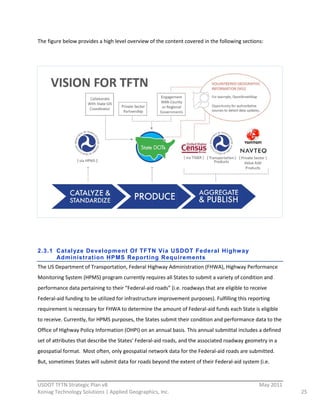
One  stakeholder  from  the  private  sector  used  the  analogy  of  a  fully  featured  road  centerline  being  a  
“hamburger  with  special  sauce  and  fixings.”    Using  this  analogy,  and  as  illustrated  below,  TFTN  would  
comprise  the  beef  patty  and  any  number  of  additional  condiments  could  be  piled  on  top  by  consumers  
of  the  burger/data.  


 2.3    Programmatic Goals

Developing  a  resource  such  as  TFTN  is  not  a  simple  task  and  will  involve  the  coordinated  efforts  of  
number  of  organizations.    The  programmatic  goals  described  below  identify  the  stakeholders  that  will  
have  integral  roles  in  three  core  elements  of  producing  and  maintaining  TFTN:  

         4. Catalyzing  the  development  of  standardized  road  centerline  data  
         5. Producing  accurate  and  current  road  centerline  data  
         6. Aggregating  and  publishing  statewide  data  as  a  national  data  set  

                                                          
USDOT  TFTN  Strategic  Plan  v8                                                                                 May  2011  
Koniag  Technology  Solutions  |  Applied  Geographics,  Inc.                                                                  24  
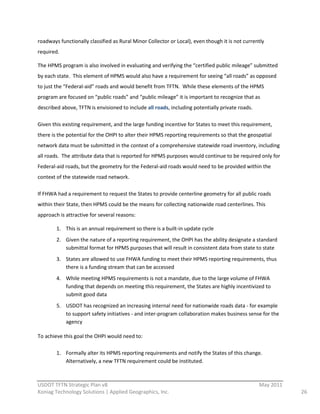
The  figure  below  provides  a  high  level  overview  of  the  content  covered  in  the  following  sections:  


2.3.1 Catal yze Developm ent Of TFTN Vi a USDO T Federal Highw ay
      Administration HPMS Reporting Requirements
The  US  Department  of  Transportation,  Federal  Highway  Administration  (FHWA),  Highway  Performance  
Monitoring  System  (HPMS)  program  currently  requires  all  States  to  submit  a  variety  of  condition  and  
performance  data  pertaining  to  their  “Federal-­‐aid  roads”  (i.e.  roadways  that  are  eligible  to  receive  
Federal-­‐aid  funding  to  be  utilized  for  infrastructure  improvement  purposes).  Fulfilling  this  reporting  
requirement  is  necessary  for  FHWA  to  determine  the  amount  of  Federal-­‐aid  funds  each  State  is  eligible  
to  receive.  Currently,  for  HPMS  purposes,  the  States  submit  their  condition  and  performance  data  to  the  
Office  of  Highway  Policy  Information  (OHPI)  on  an  annual  basis.  This  annual  submittal  includes  a  defined  
set  of  attributes  that  describe  the  States’  Federal-­‐aid  roads,  and  the  associated  roadway  geometry  in  a  
geospatial  format.    Most  often,  only  geospatial  network  data  for  the  Federal-­‐aid  roads  are  submitted.    
But,  sometimes  States  will  submit  data  for  roads  beyond  the  extent  of  their  Federal-­‐aid  system  (i.e.  

                                                          
USDOT  TFTN  Strategic  Plan  v8                                                                                 May  2011  
Koniag  Technology  Solutions  |  Applied  Geographics,  Inc.                                                                  25  
roadways  functionally  classified  as  Rural  Minor  Collector  or  Local),  even  though  it  is  not  currently  
required.  

The  HPMS  program  is  also  involved  in  evaluating  and  verifying  the  “certified  public  mileage”  submitted  
by  each  state.    This  element  of  HPMS  would  also  have  a  requirement  for  seeing  “all  roads”  as  opposed  
to  just  the  “Federal-­‐aid”  roads  and  would  benefit  from  TFTN.    While  these  elements  of  the  HPMS  
program  are  focused  on  “public  roads”  and  “public  mileage”  it  is  important  to  recognize  that  as  
described  above,  TFTN  is  envisioned  to  include  all  roads,  including  potentially  private  roads.      

Given  this  existing  requirement,  and  the  large  funding  incentive  for  States  to  meet  this  requirement,  
there  is  the  potential  for  the  OHPI  to  alter  their  HPMS  reporting  requirements  so  that  the  geospatial  
network  data  must  be  submitted  in  the  context  of  a  comprehensive  statewide  road  inventory,  including  
all  roads.    The  attribute  data  that  is  reported  for  HPMS  purposes  would  continue  to  be  required  only  for  
Federal-­‐aid  roads,  but  the  geometry  for  the  Federal-­‐aid  roads  would  need  to  be  provided  within  the  
context  of  the  statewide  road  network.  

If  FHWA  had  a  requirement  to  request  the  States  to  provide  centerline  geometry  for  all  public  roads  
within  their  State,  then  HPMS  could  be  the  means  for  collecting  nationwide  road  centerlines.  This  
approach  is  attractive  for  several  reasons:  

         1. This  is  an  annual  requirement  so  there  is  a  built-­‐in  update  cycle  
         2. Given  the  nature  of  a  reporting  requirement,  the  OHPI  has  the  ability  designate  a  standard  
            submittal  format  for  HPMS  purposes  that  will  result  in  consistent  data  from  state  to  state  
         3. States  are  allowed  to  use  FHWA  funding  to  meet  their  HPMS  reporting  requirements,  thus  
            there  is  a  funding  stream  that  can  be  accessed  
         4. While  meeting  HPMS  requirements  is  not  a  mandate,  due  to  the  large  volume  of  FHWA  
            funding  that  depends  on  meeting  this  requirement,  the  States  are  highly  incentivized  to  
            submit  good  data  
         5. USDOT  has  recognized  an  increasing  internal  need  for  nationwide  roads  data  -­‐  for  example  
            to  support  safety  initiatives  -­‐  and  inter-­‐program  collaboration  makes  business  sense  for  the  
            agency  

To  achieve  this  goal  the  OHPI  would  need  to:  

         1. Formally  alter  its  HPMS  reporting  requirements  and  notify  the  States  of  this  change.  
            Alternatively,  a  new  TFTN  requirement  could  be  instituted.  

                                                          
USDOT  TFTN  Strategic  Plan  v8                                                                                   May  2011  
Koniag  Technology  Solutions  |  Applied  Geographics,  Inc.                                                                    26  
2. Identify  a  standard  format  and  accuracy  guidelines  for  the  submittal  of  comprehensive  
                               statewide  geospatial  networks  consisting  of  geometry  for  all  roads.    Such  a  standard  would  
                               likely  be  developed  in  close  consultation  with  all  State  DOTs,  but  more  importantly  the  
                               heavily  impacted  State  DOTs.  

                             3. Institute  a  data  acceptance  regime  that  would  include  validating  that  the  standard  was  
                                properly  met  by  states  
                                                                                         

2.3.2 Support States in Developi ng Stat ew ide Inventori es
While  the  OHPI  would  identify  standards  and  guidelines  for  content,  formats  and  accuracy  for  HPMS  
purposes,  it  would  be  up  to  States  to  determine  the  best  method  for  meeting  the  annual  submittal  
requirements.    As  described  above  in  the  case  studies  (see  Section  2.4.1),  States  that  already  have  
statewide  road  inventories  have  established  a  variety  of  “best  practices”  that  have  proven  to  be  
effective.  

Best  practices  for  statewide  road  inventories  include  the  following,  and  a  state  may  pursue  a  strategy  
that  implements  more  than  one  of  these  approaches  in  combination:  

                            Activating  and  supporting  county-­‐based  data  contributions:  in  essence,  the  state  establishes  
                            the  statewide  inventory  by  collecting  and  aggregating  county  data  

                            Partnering  with  private  sector  firms:  states  establish  collaborative  or  contract  relationships  
                            with  the  private  sector  to  create  a  statewide  road  data  set  

                            Coordinating  state  DOT  efforts  with  state  E911  and  NG911  efforts:  states  build  active,  multi-­‐
                            agency  alliances  that  co-­‐fund  road  centerline  creation  

                            Collaboration  between  state  DOTs  and  state  GIS  offices:  state  GIS  offices  assist  state  DOTs  in  
                            assembling  the  statewide  centerline  in  GIS  format  

A  survey  on  state  DOT  road  networks  was  conducted  by  the  American  Association  of  State  Highway  and  
Transportation  Officials  (AASHTO)  in  2011.    The  results  indicated  that  approximately  75%  of  the  states  
who  responded  (46  responses  in  total)  included  all  public  routes  plus  local  streets  in  their  road  network  
geometry 4.    These  data  could  provide  a  valuable  input  to  TFTN;  and  for  those  states  that  do  not  include  
all  roads,  TFTN  could  be  an  incentive  to  achieve  complete  coverage.    Currently,  there  is  very  little  


4
      See  http://www.gis-­‐t.org  and  click  on  the  link  for  “State  Summary”  
                                                          
USDOT  TFTN  Strategic  Plan  v8                                                                                                 May  2011  
Koniag  Technology  Solutions  |  Applied  Geographics,  Inc.                                                                                  27  
independent  verification  of  the  completeness  or  accuracy  of  these  networks,  but  TFTN  could  lead  to  
increased  use  and  scrutiny  of  these  data.  

In  addition,  the  states  may  experiment  with  and  potentially  take  advantage  of  volunteered  geographic  
information  (VGI)  technologies  to  assist  in  the  development  of,  or  quality  control  of  statewide  road  
inventories.    Ultimately,  this  type  of  “crowd  sourcing”  approach  engages  the  public  in  reviewing  and  
improving  the  statewide  inventory.    While  less  developed  in  the  US,  initiatives  such  as  OpenStreetMap,  
particularly  in  European  countries,  have  clearly  shown  that  these  kinds  of  approaches  are  viable  for  the  
large  scale  production  and  dissemination  of  road  centerline  data.  While  VGI  is  not  an  authoritative  
source  by  itself,  it  is  a  tool  and  technique  that  authoritative  data  managers  can  take  advantage  of  to  
improve  their  own  products.  

Another  option  that  exists  is  that  the  USDOT  may  choose  to  establish  a  partnership  with  a  private  sector  
firm  that  could  supply  nationwide  data  if  minimum  standards  of  accuracy  and  currency  for  all  
geographies  (i.e.  rural)  were  achievable.    If  this  was  the  case,  then  the  USDOT  would  be  in  a  position  to  
offer  these  data  to  states  that  do  not  yet  have  statewide  street  inventories  as  a  “starter  kit.”    This  type  
of  partnership  would  need  to  be  different  than  a  conventional  licensing  agreement  due  to  the  objective  
of  having  statewide  road  inventories  and  TFTN  remain  in  the  public  domain.  

The  USGS’s  National  Hydrography  Dataset  (NHD),  a  component  of  The  National  Map  (TNM),  provides  a  
positive  example  of  this  type  Federal-­‐State  collaboration  based  on  local  data  stewardship  and  federal  
coordination.    Under  the  NHD  program,  USGS  provides  guidance,  and  at  times  funding,  to  states  to  
produce  and  maintain  high  quality  hydrography  (i.e.,  surface  water)  data  at  a  state  level  that  can  then  
be  integrated  into  a  national  data  set.  
  

2.3.3 Aggr egate State-level Data Into Nationw ide Map & Publish Data To
      Stakeholder s
Once  the  States  submit  their  statewide  road  inventories  to  the  OHPI  for  HPMS  purposes,  the  needs  of  
that  program  are  fulfilled.    The  HPMS  program  has  a  state-­‐by-­‐state  outlook  and  does  not  currently  
require  a  nationwide  data  set  to  fulfill  its  own  business  needs.    Thus,  once  HPMS  catalyzes  the  
development  of  state-­‐based  data  other  activity  is  required  to  knit  the  50  state  data  sets  into  a  seamless,  
nationwide  quilt.  


USDOT  TFTN  Strategic  Plan  v8                                                                                     May  2011  
Koniag  Technology  Solutions  |  Applied  Geographics,  Inc.                                                                      28  
2.3.3.1 Data  Aggreg ation  

Once  the  OHPI  collects  the  annual  statewide  inventory  for  HPMS  purposes,  some  other  entity  within  
USDOT  such  as  Safety  or  the  Research  and  Innovative  Technology  Administration  (RITA),  or  a  partner  
agency  will  need  to  perform  the  work  of  assembling  the  nationwide  data  set.    The  following  describes  
the  basic  steps  that  will  need  to  be  followed:  

         1. Individual  state  contributions  will  need  to  be  assessed  for  quality  and  conformance  to  the  
            data  submittal  guidelines/standards  

         2. Each  state  data  set  will  need  to  be  compared  to  the  data  sets  from  its  neighboring  states  to  
            identify,  and  rectify  potential  edge  issues.    Edge  issues  need  to  be  resolved  so  that  roads  
            that  cross  state  lines  properly  match  on  both  side  of  the  border  so  that  nationwide  routing  
            can  take  place  across  the  country.  
         3. It  is  possible  that  state  inventories  may  initially  be  missing  certain  types  of  roads,  
            particularly  roads  that  are  managed  by  Federal  agencies,  such  as  the  USDA  Forest  Service  
            (USFS)  and  the  DOI  Bureau  of  Land  Management  (BLM).    If  needed,  and  for  an  interim  
            period  the  entity  that  is  aggregating  and  assembling  TFTN  would  have  to  work  with  the  
            USDOT  Federal  Lands  Highway  Office  and  potentially  the  USDA  and  DOI  directly  so  that  the  
            best  federal  roads  data  can  be  integrated  into  TFTN.    Over  time,  federal  agency  road  
            improvements  can  be  returned  to  state  DOTs  and  this  type  of  workflow  should  help  reduce  
            the  potentially  redundant  efforts  of  state  and  federal  agencies  to  map  these  same  roads.  

There  are  three  main  options  for  identifying  an  entity  to  do  this  work:  

         1. The  US  Census  has  existing  expertise  and  capacity  in  performing  this  type  of  data  
            aggregation  and  integration  as  part  of  their  TIGER  program.    The  TIGER  program  is  
            responsible  for  creating  a  nationwide  data  set  that  houses  US  Census  information,  including  
            the  geographic  representation  of  Census  geographical  units  such  as  blocks,  block  groups  and  
            tracts.    Since  roads  are  integral  to  identifying  Census  geography,  the  TIGER  file  contains  a  
            nationwide  road  data  set.  Thus,  US  Census  could  perform  a  data  aggregation  function  on  
            behalf  of  TFTN  based  on  raw,  but  consistent  statewide  data  provided  by  USDOT  and  
            emanating  from  HPMS  submittals.    Since  the  Census  already  has  a  large  geography  unit  that  
            performs  this  type  of  work,  this  might  prove  the  most  cost  effective  option.    Significantly,  if  
            TFTN  can  prove  to  meet  the  needs  of  Census,  there  are  significant  opportunities  for  cost  
            savings  since  the  Census  spends  significant  resources  on  collecting  the  road  centerlines  that  
            are  currently  included  in  TIGER.    Using  this  option  would  also  involve  workflow  changes  on  
            the  part  of  the  US  Census  Bureau  since  current  practice  involves  communicating  with  
            multiple  levels  of  government,  not  just  the  states.  

         2. The  USDOT  could  assign  to,  or  develop  this  function  via  FHWA  or  another  program.    For  
            instance,  the  Safety  program  has  a  business  requirement  for  nationwide  roads  data  and  
                                                          
USDOT  TFTN  Strategic  Plan  v8                                                                                May  2011  
Koniag  Technology  Solutions  |  Applied  Geographics,  Inc.                                                                  29  
they  could  potentially  build  the  capacity  to  integrate  HPMS  statewide  inventories  into  a  
              nationwide  data  set.  

         3. The  USDOT  could  enter  into  a  comprehensive  partnership  with  one  of  the  private  sector  
            nationwide  data  providers.    Under  this  model,  USDOT  would  recognize  the  extensive  
            existing,  nationwide  data  that  exists  in  the  private  sector  as  well  as  the  private  sector’s  
            extensive  workforce  that  is  aimed  at  keeping  it  current  (e.g.,  fleets  of  GPS  enabled  vehicles).    
            With  this  model  the  USDOT  would  provide  the  private  sector  firm  access  to  the  statewide  
            road  inventories  collected  through  HPMS  and  the  firm  would  incorporate  changes  that  
            come  from  the  authoritative,  state  data  sets  into  the  nationwide  product.    In  addition,  the  
            private  sector  firm  would  add  the  HPMS  attributes  onto  the  nationwide  data  set.    Such  an  
            agreement  would  be  involved  and  far  different  from  a  simple  licensing  agreement.    At  a  
            minimum,  such  an  agreement  would  need  to  cover  the  following:  

                        The  completed  data  set  would  need  to  be  publicly  available.  

                        Data  would  potentially  need  to  be  made  available  to  state  DOTs  to  act  as  a  “starter  
                        kit”  and  substrate  for  statewide  road  inventories,  when  states  do  not  yet  have  a  
                        complete  statewide  network  (see  Section  2.3.2  above).  

                        The  firm  would  need  to  be  responsible  for  significant,  annual  data  integration  and  
                        standardization  work  involving  the  incorporation  of  updated  geometric  information  
                        and  HPMS  attributes  from  statewide  road  inventories.  

The  firm  would  be  free  to  incorporate  the  public  domain  version  of  the  data  into  their  own,  proprietary  
“value  added”  data  sets.  

2.3.3.2 Data  Publication  
To  fulfill  the  vision  and  full  potential  of  TFTN,  once  the  nationwide  data  set  is  assembled  it  needs  to  be  
published  and  made  available  to  governmental  agencies,  industry  and  the  general  public.    In  this  
manner,  these  entities  can  begin  building  on  TFTN  and  adding  specific,  additional  value  such  as  full  
routability,  advanced  attributes,  addresses  and  LRS.    Ideally,  the  TFTN  product  will  be  made  available  
through  a  variety  of  media,  including:  

              Published  web  services  and  APIs  
              Data  download  
              Physical  media  (e.g.  DVDs)  

Once  again,  the  easiest  mode  of  publication  might  be  through  the  US  Census  and  their  well  established  
TIGER  product.    Over  the  past  two  decades  Census  has  proven  that  it  is  capable  of  both  producing  and  
distributing  such  a  product  and  maintains  an  infrastructure  for  producing  and  disseminating  it.  
                                                              
USDOT  TFTN  Strategic  Plan  v8                                                                            May  2011  
Koniag  Technology  Solutions  |  Applied  Geographics,  Inc.                                                                     30  
In  addition  to  Census,  it  can  be  expected  that  other  entities  will  publish  products  that  are  based-­‐on  or  
derived  from  TFTN.    Examples  include:  

               USDOT  expects  to  assemble  and  publish  “transportation  oriented”  data  products  using  TFTN  
               data.    Such  products  include  the  National  Transportation  Atlas  Database  (NTAD)  which  could  
               use  the  common  baseline  geometry  and  attributes  in  association  with  more  detailed  
               transportation  attributes  and  geospatial  data  on  other  modes  of  transportation  and  transit.  

               Companies  in  the  private  sector  may  harvest  (in  whole,  or  in  part)  TFTN  baseline  geometry  
               to  seed  their  own  products  which  could  include  a  variety  of  “value  added”  data  elements  to  
               enable  capabilities  such  as  a  fully  routable  road  data  for  commercial  navigation  systems  

As  with  the  state  data  producers,  TFTN  data  publishers  may  choose  to  take  advantage  of  VGI/crowd  
sourcing  technologies  to  gain  consumer  input  on  data  quality  and  the  need  for  data  update.  

Regardless  of  how  TFTN  ends  up  being  created  and  published,  it  is  important  to  consider  appropriate  
licensing  models,  even  while  it  is  planned  to  be  in  the  public  domain.    For  instance,  Open  Source  
Software  is  not  license-­‐free,  rather  there  are  a  variety  of  “open  source  licenses”  such  as  the  Gnu  General  
Public  License  (GPL)  that  may  be  applied.    Toward  that  end,  in  2004,  the  National  Research  Council  
(NRC)  of  the  National  Academies  published  a  book,  Licensing  Geographic  Data  and  Services.    This  
publication  is  directly  relevant  to  licensing  considerations  that  may  come  up  as  TFTN  comes  into  being.    
The  publication  is  filled  with  good  examples  and  advice,  including  the  observation  that  licensing  data  is  
not  mutually  exclusive  with  unlimited  rights  to  distribute  the  subject  data.    At  the  same  time,  it  is  
important  to  understand  that  licensing  is  not  necessarily  a  requirement  and  government  data  sets  such  
as  TIGER  are  distributed  license-­‐free.      

2.3.4 Keeping TFTN Curr ent: data update and maintenance
It  is  important  to  acknowledge  that  TFTN  is  not  envisioned  as  a  onetime  effort.    Given  continual  changes  
in  roads  across  the  country  it  is  critical  that  there  be  a  mechanism  to  regularly  update  TFTN.    Indeed,  
one  of  the  advantages  of  proposing  the  HPMS  program  as  a  catalyst  for  TFTN  is  the  fact  that  HPMS  
involves  annual  submittals  of  data  to  USDOT.    These  annual  submittals  would  provide  a  recurring  
mechanism  to  update  TFTN.    While  many  individual  states  and  counties  keep  their  road  data  more  
current  on  a  more  frequent  basis  (e.g.,  monthly),  given  the  nationwide  scope  of  TFTN  setting  an  annual  
update  target  is  a  reasonable  starting  place.    States  and  other  levels  of  government  would  continue  
their  current  practices  and  would  not  need  to  match  TFTN’s  update  cycle.  Rather,  they  would  simply  
provide  an  annual  snapshot  of  their  state’s  data  as  part  of  their  HPMS  submittal.  
                                                          
USDOT  TFTN  Strategic  Plan  v8                                                                                    May  2011  
Koniag  Technology  Solutions  |  Applied  Geographics,  Inc.                                                                     31  
After  all  HPMS  submittals  are  received,  the  general  workflow  outlined  above  in  Sections  2.3.2  and  2.3.3  
would  be  replicated  to  produce  a  new  nationwide  data  set.    Over  time,  and  with  greater  experience  
reducing  the  update  cycle  (e.g.,  to  bi-­‐annually)  could  be  explored.  


 2.4     Next St eps

Transportation  for  the  Nation  has  been  a  concept  for  at  least  the  past  five  years.    With  this  strategic  
planning  effort,  it  is  beginning  to  take  on  a  more  tangible  shape.    The  programmatic  goals  recommended  
above  provide  a  realistic  path  for  this  resource  to  come  into  being.    As  such,  the  most  important  next  
steps  are  focused  on  continuing  to  build  support  and  advocacy  for  the  concept  and  filling  in  further  
planning  details  to  move  closer  to  actual  implementation.  

              Continue  working  with  stakeholders  and  advocates  to  sustain  support  for  the  
              development  of  TFTN.    Existing  supporters  should  be  called  on  to  educate  other  
              stakeholders  and  to  advocate  the  federal  government  to  move  forward.    Existing  interested  
              parties  and  advocates  include,  but  are  not  limited  to:  
                   Existing  project  Executive  Steering  Committee  and  At  Large  Committee  
                   The  National  States  Geographic  Information  Council  (NSGIC)  community  
                   The  GIS-­‐T/AASHTO  community  

              Determine  if  FHWA  has  a  requirement  for  States  to  provide  centerline  geometries  for  all  
              roads  within  their  State.  Once  this  determination  is  made  then  a  timeline  can  be  
              established  and  additional  planning  details  can  begin  to  be  fleshed  out.    Key  near-­‐term  
              activities  would  include:  
                        HPMS  outreach  to  appropriate    state  DOT  and  state  GIS  Coordinators  to  develop  
                        information  that  will  help  the  program  implement  potential  new  requirements.  
                               A  key  initial  question  to  answer  will  be  determining  what  constitutes  the  
                               common  baseline  for  both  geographic  data  and  attributes  

                        Identifying  opportunities  for  “pilot  projects”  at  the  state  level.    For  instance,  
                        identifying  states  that  already  have  good,  statewide  road  inventories  and  working  
                        with  them  to  develop  an  HPMS  submittal  with  detailed  HMPS  attributes  delivered  
                        on  top  of  the  statewide  data.  

              Commence  creation  of  a  TFTN  Business  Plan.  A  business  plan  will  be  critical  to  help  answer  
              the  following  questions:  

                   1. What  is  the  business  case  for  pursuing  TFTN?  What  are  the  costs,  benefits  and  rates  
                      of  return  (ROI)?    What  are  the  resultant  priorities  and  decision  factors  based  on  the  
                      business  case?  
                                                          
USDOT  TFTN  Strategic  Plan  v8                                                                                    May  2011  
Koniag  Technology  Solutions  |  Applied  Geographics,  Inc.                                                                     32  
2. What  are  the  specific  roles  of  agency  participants?  What  is  the  level  of  
                      interest/willingness  to  participate?  
                   3. What  are  the  details  of  the  programmatic  goals  described  above?  What  is  a  feasible  
                      timeline  for  moving  forward?  
                   4. How  would  intergovernmental  agreements  work?    How  might  public-­‐private  
                      partnerships  be  formed?  
                   5. What  does  the  implementation  path  look  like?  

              Begin  formally  engaging  US  Census  and  other  federal  partners  such  as  USDA  or  DOI  on  
              interdepartmental  cooperative  agreements  and/or  pilot  projects.  With  the  completion  of  
              the  2010  nationwide,  decennial  census,  the  timing  may  be  particularly  good  for  engaging  
              the  US  Census  Bureau.  

 2.5     Monitoring & Measuring Progress

Given  the  current  governmental  fiscal  situation,  it  can  be  expected  that  the  development  of  TFTN  will  
unfold  incrementally  and  over  time.  Realistically,  it  may  take  5-­‐10  years  for  a  sustainable,  fully  
operational  TFTN  data  set  to  come  into  being.  Approaches  such  as  more  aggressive  partnering  with  the  
private  sector  have  the  potential  to  expedite  the  timeline  due  to  the  existing  capacity  of  the  nationwide  
data  providers.    The  following  outlines  some  potential  metrics  for  measuring  progress:  

         1. Determine  whether  a  return  on  investment  is  being  realized.    One  key  element  of  a  TFTN  
            business  plan  would  be  an  effort  to  identify  current  federal  expenditures  on  road  centerline  
            data.    These  expenditures  would  include  both  direct  costs  of  producing  data  –  for  example,  
            Census  road  expenditures  to  support  TIGER  –  as  well  as  the  cumulative  licensing  
            expenditures  of  federal  agencies  that  obtain  road  centerlines  from  commercial  sources.    As  
            TFTN  becomes  available,  it  can  be  expected  that  some  of  these  expenses  should  be  reduced,  
            or  eliminated  all  together.  Reductions  in  federal  expenses  for  road  centerline  data  would  be  
            a  significant  indicator  of  progress,  even  if  there  were  new  costs  that  might  offset  some  of  
            those  savings.  

         2. Review  state  road  inventory  efforts  to  catalog  current  activity  and  monitor  complete  
            statewide  inventories  that  come  on-­‐line.    As  described  above,  statewide  road  inventories  
            are  a  key  component  of  TFTN.  This  study  identified  a  small  number  of  successful,  existing  
            efforts  in  the  form  of  case  studies.    This  work  should  be  broadened  to  fully  catalog  the  
            status  of  statewide  road  initiatives  in  all  50  states.    Once  this  baseline  is  created,  it  can  be  
            updated  on  an  annual  basis  to  track  state  level  progress  in  creating  high  quality,  complete  
            road  inventories.  


USDOT  TFTN  Strategic  Plan  v8                                                                                       May  2011  
Koniag  Technology  Solutions  |  Applied  Geographics,  Inc.                                                                        33  
3. Work  with  the  US  Census  Bureau  to  identify  TIGER  2020  data  content  that  may  emanate  
            from  TFTN  catalyzed  activity.    If  USDOT  and  the  Census  Bureau  collaborate  to  produce  
            TFTN,  with  Census  taking  on  the  role  of  data  aggregation  and  publication  via  their  existing  
            TIGER  product,  then  it  will  be  important  to  compare  how  production  of  the  2020  TIGER  data  
            compared  with  the  2010  effort.  Since  the  Census  Bureau  also  produces  annual  versions  of  
            TIGER  to  support  the  annual  American  Community  Survey,  the  annual  Population  Estimates  
            Program  and  other  current  surveys  there  are  also  other  nearer-­‐term  opportunities  to  assess  
            how  TFTN  may  be  providing  benefits.    It  is  presumed  that  TFTN  would  be  able  to  assist  
            Census  in  producing  the  2020  products  (and  interim  surveys)  by  ensuring  that  high  quality  
            statewide  data  are  more  readily  available.    The  2020  Census  provides  an  opportunity  to  
            track  the  progress  that  is  made  both  in  building  TFTN  and  in  integrating  the  result  data  into  
            Census  Bureau  workflows  for  producing  new  TIGER  data.  


USDOT  TFTN  Strategic  Plan  v8                                                                               May  2011  
Koniag  Technology  Solutions  |  Applied  Geographics,  Inc.                                                                 34  
3 Requirements  
 3.1    Organizational Needs

One  of  the  most  important  near-­‐term  objectives  of  a  TFTN  initiative  will  be  navigating  the  path  from  a  
“study  phase”  into  an  “implementation  phase.”    With  implementation,  some  of  the  informal  committees  
that  have  been  established  will  need  to  be  formalized.    Similarly,  some  of  the  informal  organizational  
relationships  and  partnerships  that  have  been  explored  will  need  to  be  formalized  as  agreements  and  
commitments.    The  following  describes  several  of  these  organizational  requirements  and  opportunities.  

         There  is  a  need  to  establish  potentially  several  TFTN  Steering  Committees  that  would  be  
         focused  on  different  sets  of  issues:  

              1. USDOT  Steering  Committee:    It  is  critical  that  USDOT  remain  committed  to  a  single,  
                 consolidated,  nationwide  street  centerline  data.    This  means  that  all  units  and  
                 administrations  within  USDOT  need  to  be  informed  of  the  initiative  and  have  an  
                 opportunity  to  participate  in  shaping  the  product.    As  outlined  above,  at  a  minimum  the  
                 HPMS  and  Safety  programs  are  extremely  interested.    In  addition,  the  Research  and  
                 Innovative  Technology  Administration  which  houses  the  GIO,  The  National  911  Program  
                 (within  the  National  Highway  Traffic  Safety  Administration)  and  Asset  Management  are  
                 key  users  and  stakeholders.    USDOT  needs  to  “lead  by  example”  in  terms  of  getting  
                 multiple,  independent  entities  to  collaborate  on  a  group  effort.  

              2. Federal  Agency  Steering  Committee:  A  good  deal  of  the  return  on  investment  of  TFTN  
                 will  originate  from  all  Federal  agencies  using  this  resource,  both  as  end-­‐users  and  as  an  
                 aid  in  maintaining  federal  roads  data  such  as  that  maintained  by  the  USDA  Forest  
                 Service.    Other  Federal  agencies,  such  as  Census  have  been  identified  as  potentially  
                 being  key,  active  participants  in  creating  TFTN.    Again,  this  means  that  all  federal  
                 agencies  need  to  be  informed  of  the  initiative  and  have  an  opportunity  to  participate  in  
                 shaping  the  product.    This  initiative  literally  hinges  on  the  ability  of  large  federal  
                 agencies  to  effectively  collaborate  with  one  another  and  a  steering  committee  will  be  an  
                 important  tool  towards  meeting  that  goal.  

              3. Broad-­‐based  Stakeholder  Advisory  Committee  that  includes  local,  regional,  state,  
                 federal,  and  private  sector  representation:  It  is  anticipated  that  at  least  three  levels  of  
                 government  –  local/county,  state  and  federal  and  tribal  governments  –  will  be  involved  
                 in  the  production  of  TFTN,  and  it  is  anticipated  to  be  used  widely  by  the  private  sector  
                 and  general  public.    As  such,  this  advisory  committee  will  serve  as  a  structured  forum  for  
                 sharing  progress  and  obtaining  ongoing  input  and  ideas  for  strengthening  the  program.  


USDOT  TFTN  Strategic  Plan  v8                                                                                 May  2011  
Koniag  Technology  Solutions  |  Applied  Geographics,  Inc.                                                                  35  
4. Leverage  FGDC  Transportation  Sub-­‐committee  expertise:  The  FGDC  has  established  a  
                 Transportation  Subcommittee  that  has  been  more  or  less  active  depending  on  priorities.    
                 In  light  of  the  Circular  A-­‐16  nature  of  USDOT’s  involvement  in  TFTN,  and  USDOT’s  role  as  
                 the  lead  agency  of  this  subcommittee,  this  existing  forum  should  be  kept  abreast  of  
                 developments.    When  possible,  this  committee  has  the  potential  leverage  the  deep  
                 transportation  expertise  of  its  membership  to  addressing  TFTN  issues.  

              5. Seek  guidance  from,  and  report  progress  to  the  National  Geospatial  Advisory  Council  
                 (NGAC):  The  NGAC  has  an  active  interest  in  the  NSDI  and  in  how  federal  agencies  are  
                 carrying  out  their  OMB  A-­‐16  data  theme  stewardship  responsibilities.  As  such,  NGAC  has  
                 solicited  two  briefings  on  the  TFTN  strategic  planning  effort  and  it  is  assumed  that  
                 progress  reporting  to,  and  seeking  guidance  from  NGAC  will  continue.  

         There  is  a  similar  need  to  establish  at  least  two  formal  inter-­‐departmental  agreements  that  are  
         necessary  to  initiate  TFTN.  The  precise  nature  of  the  agreement  (e.g.  Memoranda  of  
         Understanding)  will  be  determined  at  a  later  time.  

              1. Between  USDOT  HPMS  and  USDOT  Safety  and  others  such  as  Intelligent  Transportation  
                 Systems  (ITS)  to  arrive  at  a  mechanism  for  co-­‐funding  the  TFTN  effort  where  there  is  a  
                 shared,  mutual  interest.    Progress  will  be  hampered  until  there  is  some  ability  to  fund  
                 the  next  phases  of  this  effort  such  as  the  Business  Plan  describe  above.  

              2. Between  USDOT  and  US  Census  to  fully  explore  the  potential  for  a  collaborative  
                 arrangement  for  producing  and  publishing  TFTN.    Initial  activities  would  likely  focus  on  
                 identifying  small  scale  pilot  projects  that  would  test  the  technical  premises  of  TFTN  and  
                 could  be  pursued  in  tandem.  

 3.2     Executi ve Support

The  TFTN  effort  will  result  in  a  fundamental  alteration  in  how  the  federal  government  approaches  
creating  and  sharing  road  centerline  data.    In  addition,  the  strategic  vision  requires  significant  levels  of  
both  interdepartmental  and  intergovernmental  collaboration  and  cooperation.    Executing  these  types  of  
changes  and  building  productive  partnerships  will  require  senior  level  executive  support.    Indeed,  this  
strategic  planning  effort  is  largely  aimed  at  generating  the  information  necessary  to  explain  the  
initiative,  and  its  benefits  to  an  executive  audience.    Specific  examples  of  key  executive  support  that  
must  be  solicited  and  built  include:  

         Within  the  USDOT:    
            1. FHWA  executive  leadership  that  can  make  the  determination  that  statewide  road  
                inventories  should  be  required  from  states  
                                                          
USDOT  TFTN  Strategic  Plan  v8                                                                    May  2011  
Koniag  Technology  Solutions  |  Applied  Geographics,  Inc.                                                                   36  
2. Safety  Administration  which  has  a  significant  need  for  nationwide  roads  data  and  is  in  a  
                 position  to  potentially  provide  funding  

              3. RITA  which  houses  the  USDOT  GIO  and  has  initiated  the  planning  for  TFTN  

         Within  other  federal  agencies:    

              4. US  Census  Bureau:  who  is  envisioned  to  be  a  significant  partner  in  the  aggregation  of  
                 statewide  inventories  into  a  national  data  set.  

              5. USGS  and  FGDC:  who  are  currently  involved  in  overseeing  the  development  of  the  NSDI  
                 and  the  implementation  of  OMB  Circular  A-­‐16  and  the  emerging  National  Geospatial  
                 Platform.    Ideally,  executives  within  OMB  itself  would  also  be  briefed  on  TFTN.  

              6. USDA  and  USFS:  who  are  currently  the  stewards  of  significant  road  data  sets  covering  
                 the  national  forest  system.  

Having  executives  understand  the  TFTN  initiative  and  the  critical  role  of  partnerships  will  be  integral  to  
establishing  those  partnerships  and  the  funding  that  is  necessary  for  the  overall  success  of  the  effort.  


 3.3     Staffing

As  described  throughout  this  report,  a  great  deal  of  the  effort  involved  in  TFTN  would  be  carried  out  by  
existing  programs  and  personnel  that  are  involved  in  road  inventories  and  road  data  both  within  USDOT  
and  other  federal  agencies,  such  as  the  US  Census.    In  addition,  the  largest  amount  of  actual  effort  is  
most  likely  to  occur  within  the  state  DOTs  and/or  private  sector  partners  that  will  physically  produce  the  
underlying  data  in  the  context  of  statewide  inventories.  

At  present,  the  USDOT  GIO  has  served  as  the  project  manager  for  TFTN  strategic  planning.    As  the  
program  potentially  gains  traction  and  transitions  into  detailed  planning,  prototyping  and  then  
implementation  there  will  likely  be  a  need  for  a  fulltime  TFTN  project  manager  within  USDOT.  

Later,  and  during  potential  implementation  there  may  be  a  need  to  identify  additional  tasks  that  may  be  
carried  out  by  existing  personnel  within  both  USDOT  and  US  Census.    For  example,  HPMS  personnel  may  
be  required  to  receive  and  review  statewide  road  inventory  data  submitted  by  the  states.    Similarly,  
existing  US  Census  personnel  may  be  redirected  from  other  TIGER  tasks  to  the  assembly  of  nationwide  
roads  data  from  a  collection  of  statewide  road  inventories.  


USDOT  TFTN  Strategic  Plan  v8                                                                                   May  2011  
Koniag  Technology  Solutions  |  Applied  Geographics,  Inc.                                                                    37  
Ultimately,  a  fuller  picture  of  required  staffing  will  emerge  following  the  completion  of  a  TFTN  Business  
Plan  and  a  more  detailed  implementation  plan.  


     3.4   Costs

It  is  not  yet  possible  to  determine  the  overall  costs  for  implementing  TFTN.    Ultimately,  the  completion  
of  the  Business  Plan  will  identify  the  specific  tasks  and  levels  of  effort  necessary  to  carry  out  this  type  of  
program  based  on  a  set  of  assumptions.  Thus,  the  major  near  term  costs  outlined  below  are  to  fund  the  
development  of  the  Business  Plan  and  near-­‐term  prototyping  of  technological  and  data  development  
approaches.  

                                                ITEM                                                     COST  
               Development  of  detailed  TFTN  Business  Plan                                           $250,000  
               Development  of  prototypes  in  association  with  partners                              $200,000  
  

     3.5   Assessing Risk

There  are  three  significant  risks  that  will  need  to  be  considered  and  managed  in  forming  an  effective  
TFTN  program:  

       1. Inadequate  federal  interagency  collaboration:  In  many  ways,  this  strategic  plan  hinges  on  the  
          ability  of  independent  governmental  programs  being  able  to  work  together  for  increased  
          efficiencies.    This  includes  collaboration  both  for  independent  programs  within  the  USDOT  as  
          well  as  for  USDOT  working  in  association  with  other  federal  departments/bureaus  such  as  US  
          Census.    Such  collaborations  are  not  commonplace  and  given  the  size  of  federal  agencies  are  not  
          easy  to  achieve.    If  such  collaboration  is  not  possible,  then  the  proposed  model  for  TFTN  will  
          have  a  difficult  time  succeeding.    However,  it  is  fair  to  observe  that  collaboration  and  
          cooperation  on  geospatial  matters  is  one  of  the  core  principles  behind  OMB  Circular  A-­‐16.    The  
          federal  government  should  build  needed  data  once,  and  then  use  it  many  times  across  the  
          entire  government.    If  the  well  planned  collaboration  that  is  envisioned  for  TFTN  does  not  
          materialize,  then  it  is  reasonable  to  wonder  whether  the  promise  of  Circular  A-­‐16  can  ever  be  
          carried  out  within  the  current  environment.  

       2. Government  moves  too  slowly:  As  documented  in  this  report  there  are  several  active  efforts  
          that  are  constructing  nationwide  roads  data.    These  efforts  will  not  stop  due  to  the  fact  that  
          planning  for  TFTN  is  underway,  and  the  public  perception  is  that  they  are  gaining  momentum  as  
          a  function  of  their  widespread  adoption  and  use  by  consumers  as  well  as  public  and  private  
          organizations.    If  it  takes  too  long  for  TFTN  to  come  into  being  as  an  authoritative,  publicly  


USDOT  TFTN  Strategic  Plan  v8                                                                                       May  2011  
Koniag  Technology  Solutions  |  Applied  Geographics,  Inc.                                                                         38  
available  nationwide  resource  then  there  is  a  risk  the  other  efforts  from  the  private  or  non-­‐
         profit  sectors  –  such  as  OpenStreetMap  -­‐  may  take  further  root  and  supersede  the  TFTN  vision.  

    3. It  is  too  difficult  to  identify  a  single  product  that  meets  a  wide  diversity  of  needs:  The  data  
       within  TFTN  are  envisioned  to  be  a  common  baseline  framework  of  shared  geometry  and  basic  
       attributes  that  can  underpin  a  wide  variety  of  products.    As  described  in  the  report,  additional  
       content  such  as  linear  referencing  systems,  advanced  cartography,  census  boundaries,  
       addressing  and  imagery  can  be  constructed  on  top  of  the  TFTN  baseline.    There  is  some  risk  that  
       it  will  be  too  difficult  for  a  diversity  of  stakeholders  to  come  to  consensus  agreement  on  what  
       should  be  included  in  the  common  baseline  framework.    Absent  such  agreement,  there  is  a  risk  
       that  certain  stakeholders  may  conclude  that  TFTN  will  not  be  useful  to  them.    As  such,  
       identifying  the  common  baseline  content  is  one  of  the  key  questions  that  needs  to  be  addressed  
       in  the  detailed  TFTN  Business  Plan.  


USDOT  TFTN  Strategic  Plan  v8                                                                              May  2011  
Koniag  Technology  Solutions  |  Applied  Geographics,  Inc.                                                               39  
4 Implementation  Overview  
     4.1   Phasi ng & Milestones

The  timeline  below  is  focused  on  the  activities  that  are  described  above  under  the  heading  of  “next  
steps”  (see  Section  2.4).    Ultimately,  it  is  premature  to  speculate  on  the  full  implementation  timeline  as  
there  are  several  important  activities  that  need  to  be  completed  prior  to  embarking  on  operational  
implementation.  


USDOT  TFTN  Strategic  Plan  v8                                                                                 May  2011  
Koniag  Technology  Solutions  |  Applied  Geographics,  Inc.                                                                  40  
Appendices  
Appendix  1:  Strategic  Planning  Methodology  


USDOT  TFTN  Strategic  Plan  v8                                    May  2011  
Koniag  Technology  Solutions  |  Applied  Geographics,  Inc.                     41  
Appendix 1: Strategic Planning Methodology

1 Project Governance
There  are  four  distinct  governing  bodies  involved  with  the  Transportation  for  the  Nation  imitative.  The  
bodies  consist  of  a  strong  cross  section  of  Federal  Stakeholder,  Non-­‐Federal  Government  Agencies  and  
Private  Firms  with  expertise  in  the  transportation  sector.    

    1. Project  Management:  USDOT  Research  &  Innovative  Technology  Administration  

              Advisory  input  from  NSGIC  

    2. Consulting  Team:  Koniag  Technology  Services  (KTS)  &  AppGeo  

    3. Executive  Steering  Committee:  Membership  includes:  

              Steve  Lewis,  USDOT,  Research  and  Innovative  Technology  Administration    
              Timothy  Trainor,  U.S.  Census  Bureau    
              Dave  Blackstone,  Ohio  Department  of  Transportation    
              Randall  Johnson,  MetroGIS,  St  Paul  Minnesota    
              Dan  Widner,  VA  Information  Technologies  Agency/VA  Geographic  Information  Network    
              Don  Cooke,  Esri    
              Tom  Roff,  USDOT,  Federal  Highway  Administration  

At-­‐Large  Steering  Committee:  Please  see  http://www.tftn.org/about/steering-­‐commitee/  for  a  
complete  listing  of  the  37  members  of  this  group.  

2 Stakeholder Outreach
Throughout  the  strategic  planning  process,  numerous  
presentations  were  given  at  conferences  and  direct  
stakeholder  interviews  were  held  in  order  to  solicit  as  
much  input  and  feedback  from  the  stakeholder  
community  as  possible.  The  following  list  represents  
some  of  the  key  events  where  the  TFTN  strategic  plan  
was  presented.  The  complete  list  can  be  found  on  the  
project  website  http://www.tftn.org.  

2010-­‐2011  CONFERENCE  &  MEETING  
WORKSHOPS/PRESENTATIONS  
         GIS-­‐T  -­‐  April  2010,  March  2011  

                                                          
USDOT  TFTN  Strategic  Plan  v8                                                                             May  2011  
Koniag  Technology  Solutions  |  Applied  Geographics,  Inc.                                                              42  
National  States  Geographic  Information  Council  (NSGIC)  Mid-­‐Year  Meeting:  2010  &  2011  
         NSGIC  Annual  Meeting,  September,  2010  
         URISA  GIS  Pro  –  October,  2010  
         Esri  Federal  User  Conference  -­‐  January,  2010  
         Esri  International  User  Conference    -­‐  July,  2010  
         National  Geospatial  Advisory  Council  (NGAC)  –  September,  2010  and  March,  2011  
         National  Association  of  Regional  Councils  (NARC)  –  September,  2010  
         Transportation  Research  Board  Meeting  (TRB)  –  January,  2011  
  
STAKEHOLDER  INTERVIEWS  
         USDOT  
                   HPMS  
                   Safety  
                   Asset  Management  
                   Intelligent  Transportation  Systems  
         American  Association  of  State  Highway  and  
         Transportation  Officials  (AASHTO)  
         United  States  Census  Bureau  
         United  States  Geological  Survey  (USGS)  
         Federal  Commerce  Commission  (FCC)  
         Transportation  Research  Board  (TRB)  
         United  State  Department  of  Agriculture  (USDA)  
         United  States  Forest  Service  (USFS)  
         I-­‐95  Corridor  Coalition  
         Fairfax  County,  VA  and  Loudon  County,  VA  
         National  Emergency  Numbers  Association  (NENA)  
  
3 Anal ysis & Repor t Aut horing

         Developed  vision  iteratively  through  conference  workshops  and  steering  committee  reports  and  
         presentations  

         Vision  was  vetted  and  reviewed  with  stakeholders  and  steering  committees  

         Development  of  a  draft  outline  
           
         Production  of  the  draft  final  report  
                Review  and  comment  by  Executive  Committee  
                Final  publication  to  the  web-­‐site  
                                                          
USDOT  TFTN  Strategic  Plan  v8                                                                      May  2011  
Koniag  Technology  Solutions  |  Applied  Geographics,  Inc.                                                       43  

TFTN Strategic Plan Final Draft

  • 1.
    TRANSPORTATION     FOR  THE  NATION     STRATEGIC  PLAN         PRODUCED  FOR   The  US  Department  of  Transportation   Geospatial  Information  Officer   March  2011     DRAFT Final V8             This  document  was  produced  by  Koniag  Technology  Solutions  (KTS)  and  Applied  Geographics,  Inc.   (AppGeo)  under  contract  to  the  United  States  Department  of  Transportation  (USDOT).  
  • 2.
                            [This  page  intentionally  left  blank]         USDOT  TFTN  Strategic  Plan  v8 May  2011   Koniag  Technology  Solutions  |  Applied  Geographics,  Inc.       1  
  • 3.
    Table  of  Contents    Executive  Summary   ...........................................................................................................................4   . 1   Current  Situation  ........................................................................................................................6   1.1   Background  ...................................................................................................................................  6   1.2   Widespread  Demand  For  Nationwide  Road  Centerlines  ..............................................................  7   1.3   Existing  Status  Of  Nationwide  Road  Centerlines  ........................................................................  10   1.4   How  Are  Road  Centerline  Data  Currently  Created?  ...................................................................  14   1.5   Strengths  &  Weaknesses  Of  Current  Situation  ...........................................................................  19   1.6   Opportunities  &  Challenges  ........................................................................................................  20   2   Vision  &  Goals  ..........................................................................................................................   22   2.1   Strategic  Goal  ..............................................................................................................................  22   2.2   Vision  ...........................................................................................................................................  22   2.3   Programmatic  Goals  ....................................................................................................................  24   2.4   Next  Steps  ...................................................................................................................................  32   2.5   Monitoring  &  Measuring  Progress  ..............................................................................................  33   3   Requirements  ...........................................................................................................................   35   3.1   Organizational  Needs  ..................................................................................................................  35   3.2   Executive  Support  .......................................................................................................................  36   3.3   Staffing  ........................................................................................................................................  37   3.4   Costs  ............................................................................................................................................  38   3.5   Assessing  Risk  ..............................................................................................................................  38   4   Implementation  Overview  ........................................................................................................   40   4.1   Phasing  &  Milestones   .................................................................................................................  40   . Appendices  ......................................................................................................................................   41   Appendix  1:  Strategic  Planning  Methodology  .........................................................................................  42           USDOT  TFTN  Strategic  Plan  v8 May  2011   Koniag  Technology  Solutions  |  Applied  Geographics,  Inc.       2  
  • 4.
                      [This  page  intentionally  left  blank]         USDOT  TFTN  Strategic  Plan  v8 May  2011   Koniag  Technology  Solutions  |  Applied  Geographics,  Inc.       3  
  • 5.
    Executive  Summary   Background  The  notion  of  Transportation  for  the  Nation  (TFTN)  was  originally  put  forth  in  a  2008  “Issues  Brief”  from   the  National  States  Geographic  Information  Council  (NSGIC).    In  that  brief,  NSGIC  noted  the  fundamental   nature  of  transportation  data  which  is  universally  utilized  by  geospatial  practitioners  and  also  the  fact   that  there  is  redundancy  and  at  least  three  overlapping  efforts  that  create  nationwide  transportation   data  sets.  These  inefficiencies  cost  taxpayers  millions  of  dollars.    Under  the  Office  of  Management  and   Budget’s  Circular  A-­‐16,  the  US  Department  of  Transportation  (USDOT)  was  designated  as  the  framework   “theme  leader”  for  transportation  data  sets.    This  study  emanates  from  USDOT  investigating  whether  a   TFTN  program  could  help  the  agency  meet  its  own  internal  business  needs,  fulfill  its  Circular  A-­‐16   responsibilities  and  help  the  country  more  efficiently  provide  transportation  data  that  is  widely   demanded  for  activities  such  as:   Transportation  system  planning  and  management   E911  dispatching   Postal  and  delivery  services   Consumer-­‐based  navigation  systems   Vision  &  Goals   This  study  puts  forward  a  simple  and  direct  strategic  goal:     Commence  the  development  of  comprehensive,  publicly  available,     nationwide  transportation  data  sets.    Ultimately,  Transportation  for  the   Nation  (TFTN)  will  encompass  data  sets  covering  multiple  modes  of     transportation,  however,  the  initial  focus  will  be  on  producing  a  road     centerline  data  set  that  includes  all  types  of  roads,  both  public  and  private.   The  initial  TFTN  data  set  will  include  consistent,  current,  high  quality  road     centerline  data  for  the  entire  country.     Fundamental  to  a  TFTN  program  is  that  all  resulting  data  will  be  widely  available  and  in  the  public   domain.       General  Approach   The  approach  for  TFTN  identified  in  this   study  involves  the  coordinated  efforts  of   number  of  organizations  across  three   core  elements  required  for  the   production  and  maintenance  of  TFTN:   1. Catalyzing  the  development  of   standardized  road  centerline  data   through  USDOT’s  Highway   Performance  and  Measurement   System  (HPMS)  program       USDOT  TFTN  Strategic  Plan  v8 May  2011   Koniag  Technology  Solutions  |  Applied  Geographics,  Inc.       4  
  • 6.
      2. Producing  accurate and  current  road  centerline  data  through  state  departments  of  transportation   (DOT),  including  state-­‐level  public-­‐private  partnerships   3. Aggregating  statewide  data  as  a  national  data  set  through  partnerships  with  the  US  Census  and  the   private  sector  and  publishing  the  data  through  a  variety  of  distribution  channels   The  identified  approach  also  envisions  capitalizing  on  the  emergence  of  volunteered  geographic   information  (VGI)  processes  to  maintain  quality  and  provide  a  user  feedback  mechanism.   Conclusion   There  is  widespread  demand  for  public  domain  transportation  data  and  strong  opportunities  to  better   align  the  multiple  parties  currently  involved  in  overlapping  efforts  to  create  these  data  and  make  more   efficient  use  of  resources.    With  a  proper  focus  on  coordination  and  collaboration  a  program  such  as   TFTN  can  generate  nationwide  transportation  data  that  meets  both  USDOT’s  internal  business  needs   and  the  broader  requirements  of  other  stakeholders  across  the  country.    The  time  is  right  for  a  program   such  as  TFTN  and  it  should  proceed  to  more  detailed  business  planning  and  proof-­‐of-­‐concept   prototyping.           USDOT  TFTN  Strategic  Plan  v8 May  2011   Koniag  Technology  Solutions  |  Applied  Geographics,  Inc.       5  
  • 7.
    1 Current  Situation  1.1 Background Transportation  for  the  Nation  (TFTN)  is  the  term  originally  applied  by  the  National  States  Geographic   Information  Council  (NSGIC)  to  the  initiative  needed  to  build  a  nationally  shared  transportation  data  set   that  would  support  diverse  stakeholders  and  be  publicly  available.    It  was  formally  announced  as  a   priority  item  on  the  NSGIC  Advocacy  Agenda  in  an  Issues  Brief  in  2008,  with  the  following  vision  for  the   future:     “The  federal  government  will  coordinate  development  of  a  seamless   nationwide  dataset  of  addressable  roads  that  is  built  in  a   collaborative  and  shared  environment.”     In  essence,  NSGIC  was  giving  a  fresh  voice  to  a  longstanding  national  goal,  to  build  a  national   transportation  data  set  as  a  “framework”  layer  or  theme  within  the  National  Spatial  Data  Infrastructure   (NSDI),  which  is  a  notion  that  goes  back  decades.    In  1990,  Office  of  Management  and  Budget  (OMB)   Circular  A-­‐16  on  the  “Coordination  of  Geographic  Information  and  Related  Spatial  Data  Activities,”  called   for  the  creation  of  the  Federal  Geographic  Data  Committee  (FGDC),  and  for  the  “development  of  a   national  digital  spatial  information  resource,  linked  by  criteria  and  standards  that  will  enable  sharing  and   efficient  transfer  of  spatial  data  between  producers  and  users.”  This  national  resource  was  defined  in   Executive  Order  12906  (1994)  to  be  the  NSDI,  with  FGDC  responsible  for  coordinating  across  federal   agencies  and  other  stakeholders  to  make  NSDI  real.     OMB  A-­‐16  was  revised  in  2002,  to  include  a  list  of  lead  federal  agencies  for  the  data  themes  identified   for  NSDI.    The  “Transportation”  theme  was  assigned  to  the  Department  of  Transportation,  Bureau  of   Transportation  Statistics,  and  defined  as  follows:   “Transportation  data  are  used  to  model  the  geographic  locations,   interconnectedness,  and  characteristics  of  the  transportation  system  within   the  United  States.  The  transportation  system  includes  both  physical  and   non-­‐physical  components  representing  all  modes  of  travel  that  allow  the   movement  of  goods  and  people  between  locations.”    (Appendix  E,  OMB   Circular  A-­‐16  Revised,  2002)     USDOT  TFTN  Strategic  Plan  v8 May  2011   Koniag  Technology  Solutions  |  Applied  Geographics,  Inc.       6  
  • 8.
    The  role  of Theme  Leader  was  given  greater  definition  when  OMB  Circular  A-­‐16  Supplemental   Guidance  was  issued  in  late  2010.    The  term  “National  Geospatial  Data  Asset”  (NGDA)  was   introduced  to  apply  to  themes,  which  are  further  subdivided  into  data  sets.    This  fits  the  TFTN   outlook  going  forward,  as  all  modes,  and  the  intermodal  connections  between,  them  are  eventually   addressed  as  part  of  a  logical  grouping  of  NGDA  data  sets  belonging  to  the  Transportation  Theme.    A   portfolio  management  approach  can  then  be  applied  to  investment  alternatives  within  each  theme,   as  envisioned  by  OMB.   It  is  a  TFTN  objective  that  the  program’s  data  be  distributed  freely,  as  a  public  domain  asset,  for  the   benefit  of  all  stakeholders.    Fundamentally,  the  geographic  data  contemplated  for  TFTN  will   communicate  knowledge  of  our  nation’s  road  network,  thereby  promoting  innovation,  commerce,   informed  public  discourse,  basic  research,  and  sharing  within  open  communities  of  interest.   1.2 Widespread Demand For Nationw ide Road Centerlines Road  centerline  data  are  one  of  the  most  widely  used  geospatial  information  products  in  modern   society.  Some  pervasive  applications  include:  on-­‐board  vehicle  navigation,  E-­‐911  dispatching  and   emergency  vehicle  routing,  census  enumeration,  postal  and  delivery  services,  disaster  response  and   relief  efforts,  tax  collection,  mapping  accidents,  asset  inventories,  map  directions  on  smart  phones,    and   other  location-­‐based  systems.   In  addition  to  the  general  uses  of  road  centerlines  outlined  above,  transportation  professionals  utilize   road  centerlines  extensively  for  explicit  transportation  planning  and  management  activities.      These   activities  include:  highway  safety  involving  issues  like  road  geometry  and  guardrail  placement;  intelligent   transportation  system  planning;  congestion  management;  environmental  issues  such  as  wetlands  and   air  quality  along  rights-­‐of-­‐way;  and  highway  performance  issues  to  gauge  the  health  and  usability  of  the   transportation  system.       Given  the  diverse  transportation  specific  and  general  uses  of  road  centerline  data  there  are  many   different  types  of  data  content  that  can  make  up  a  road  centerline  data  set.   Different  users  have  a  varying  needs  for  specific  content  and  characteristics,  such  as:   Basic  geometry  and  naming   Basic  attributes,  e.g.,  functional  class   Enhanced  cartographic  display  and  labeling/annotation   Addressing  and  geocoding  support     USDOT  TFTN  Strategic  Plan  v8 May  2011   Koniag  Technology  Solutions  |  Applied  Geographics,  Inc.       7  
  • 9.
    Boundary  delineation   Linear  referencing  methods/systems  (LRM/LRS)   Routability  (e.g.,  network  connectivity;  speed  limits;  lane  and  turn  restrictions;  etc.)   Integration  with  image/photo  catalogs   High  positional  accuracy   High  update  frequency   Compatibility  with  real-­‐time  data  feeds     A  great  deal  of  duplication  of  effort  is  evident  across  Federal  agencies  and  other  levels  of  government.     Nationwide  programs  that  collect  and  integrate  transportation  geospatial  data  from  local,  state,  regional   and  federal  sources  –  or  acquire  such  data  from  commercial  sources  -­‐-­‐  are  usually  done  with  a  single   purpose,  rather  than  a  multi-­‐purpose  use,  in  mind.  Several  commercial  data  providers  as  well  as   government  agencies  have  built  transportation  data  sets  for  different  use  cases.  In  the  absence  of  an   effective  and  organized  national  program,  and  without  incentives  and  insistence  to  cooperate,  each   level  of  government  perpetuates  and  duplicates  independent  efforts  by  creating  these  data  primarily  to   meet  their  own,  specific  and  solitary  mission  requirements.  This  practice  leads  to  duplicate  spending,   wasted  taxpayer  dollars  and  inefficient  government.   The  transportation  data  needs  of  Federal  agencies  was  the  subject  of  a  survey  and  summit  meeting   titled  Geospatial  Transportation  Data  Needs  for  Federal  Agencies  sponsored  by  US  Census  Bureau  in   October,  2009.  Fourteen  Federal  agencies  responded  to  the  detailed  survey  on  specific  requirements.    A   key  recommendation  emanating  from  that  meeting  was  the  notion  of  creating  a  single  data  set,  flexible   enough  to  meet  federal  agency  needs  as  they  change  over  time  and  usable  by  all  participating  federal   agencies:   Existing  road  centerline  initiatives  and  independent  spending  from  Federal  agencies  include,   but  are  not  limited  to:   The  National  Map  from  Department  of  the  Interior,  US  Geological  Survey  (USGS)  who   has  licensed  TomTom 1  road  data  for  producing  printable  topographic  maps   TIGER  from  the  Department  of  Commerce,  Census  Bureau  who  has  built  TIGER  from   local  sources  for  census  enumeration  and  demographic  applications,  license-­‐free   HSIP  from  the  National  Geospatial  Intelligence  Agency  (NGA)  who  has  licensed   NAVSTREETS  commercial  data  from  Navteq  for  use  by  both  federal  and  state  agencies   engaged  in  emergency  management                                                                                                                         1  TomTom  was  formerly  known  as  TeleAtlas     USDOT  TFTN  Strategic  Plan  v8 May  2011   Koniag  Technology  Solutions  |  Applied  Geographics,  Inc.       8  
  • 10.
    The  FCC  who licensed  commercial,  nationwide  street  centerline  data  to  support   geocoding   The  National  Transportation  Atlas  Database  (NTAD)  distributed  by  USDOT  that  contains   information  on  road  networks  and  associated  infrastructure.     In  addition  some  agencies  such  as  USGS,  Census,  and  NGA  are  looking  at   OpenStreetMap  (OSM)  and  other  volunteered  geographic  information  alternatives  as   means  of  supplementing  their  road  centerline  requirements.     In  addition  to  national  road  centerline  programs,  the  USDOT  has  many  internal  business  requirements   for  road  centerlines.    These  include  but  are  not  limited  to:   The  Federal  Highway  Administration’s  (FHWA)  Highway  Performance  Monitoring  System   (HPMS),  which  covers  all  public  roads  that  are  eligible  for  Federal-­‐aid  highway  funds,   including  the  National  Highway  System.   Detailed  HPMS-­‐specific  attributes  are  collected  for  all  roads  eligible  for  Federal-­‐aid   Annual  HPMS  reporting  required  by  states   FHWA  works  with  states  to  develop  basic  standards   Enables  states  to  utilize  FHWA  funding  for  creation  and  maintenance  of  inventory   States  develop  their  own  plans  and  data  management  strategies   FHWA  facilitates  information  exchange  on  state  “best  practices”   Includes  the  submission  of  road  geometry   FHWA  provides  the  States  information  from  Federal  agencies  on  Federally-­‐owned  public   roads  within  their  State  boundaries   States  provide  an  authoritative  source  of  information  about  all  public  roads  within  their   boundaries   USDOT  Safety  for  accident  mapping   Large  emphasis  on  reducing  fatalities  from  accidents   Requires  information  for  all  roads,  not  just  Federal-­‐aid  roads   FHWA  Asset  Management  for  bridges   While  current  Federal  government  expenditures  on  road  centerlines  are  not  precisely  known,  they  are   estimated  to  be  many  tens  of  millions  of  dollars  per  year.    Getting  a  better  estimate  of  this  figure  is   recommended  as  part  of  the  business  planning  effort  associated  with  TFTN  and  will  be  an  important   component  of  demonstrating  the  overall  business  case.     USDOT  TFTN  Strategic  Plan  v8 May  2011   Koniag  Technology  Solutions  |  Applied  Geographics,  Inc.       9  
  • 11.
    1.3 Existing Status Of Nationw ide Road Centerlines At  one  of  the  workshops  during  the  TFTN  strategic  planning  process,  a  strong  recommendation  was   made  to  consider  the  time  dimension  as  alternatives  are  evaluated.    Specifically,  the  planning  team  was   asked  to  distinguish  existing  short-­‐term  alternatives  from  long-­‐range  developmental  alternatives.  The   three  existing  sources  of  nationwide  road  centerline  data  described  below  are  available  as  alternatives   for  the  short-­‐term,  while  a  fully  built-­‐out  TFTN  (as  described  in  Section  2)  should  be  strongly  considered   for  the  long-­‐term.   1. US  Census  TIGER  Data   2. Commercial  Data  Providers   NAVTEQ   TomTom   3. Volunteered  Geographic  Information   OpenStreetMap  (OSM)   Esri’s  Community  Base  Maps  (CBM)   Each  of  these  three  existing  sources  of  information  has  distinct  advantages  and  disadvantages.    These   “pros”  and  “cons”  serve  as  a  useful  baseline  for  the  long  term  planning  of  TFTN.     1.3.1 US Census TIGER Data PROS   TIGER  is  a  mature  product  that  is  already  in  the  public  domain   Data  can  be  used  for  nationwide  geocoding  purposes   Provides  a  comprehensive,  nationwide  road  centerline  inventory  including  private  roads  and   high  quality  in  rural  areas   Many  users  depend  on  it  for  a  variety  of  applications,  including:       Base  map  geometry   Access  to  US  Census  Bureau  statistical  information   National  broadband  mapping  efforts  aggregate  broadband  availability  data  to   Census  Geography   Significant  improvements  in  latest,  2010  TIGER  files   Positional  accuracy  improved  (7.6  meter)   Substantial  input  from  local  sources  incorporated     USDOT  TFTN  Strategic  Plan  v8 May  2011   Koniag  Technology  Solutions  |  Applied  Geographics,  Inc.       10  
  • 12.
    Added  2.5  million updates  based  on  2010  Census  field  operations   Planning  for  more  frequent  updates  (depending  on  funding)     CONS   TIGER  did  not  meet  requirements  for  nationwide  roads  in  The  National  Map  (TNM)  as   defined  by  USGS 2   Positional/Horizontal  accuracy   Depictions  of  interchanges  and  dual-­‐carriageways   Attributes  to  support  high-­‐quality  cartography   Costs  to  retrofit  TIGER  were  prohibitive  for  use  in  TNM,  in  the  opinion  of  USGS   USGS  replaced  TIGER  with  TomTom  data  (but  is  working  with  Census  to  resolve  issues,  and   might  eventually  go  back  to  TIGER)   Commercial  data  was  competitively  priced,  but  licensed  for  restricted  use   While  Census  Bureau  became  a  transportation  data  provider  by  default  and  necessity,  they   are  Census  domain  experts  and  are  more  of  a  transportation  data  integrator,  in  principle.  In   addition,  the  Census  Bureau  is  a  user  of  roads,  railroads  and  other  transportation   centerlines.    They  are  used  for  orientation  of  field  staff  during  censuses  and  surveys,   geocoding  addresses  to  census  blocks,  address  range  determinations  and  delineation  of   statistical  and  administrative  boundaries.    The  collection  of  housing  unit  locations  required  a   shift  in  accuracy  requirements  from  a  relative  approach  to  a  highly  accurate  positional   approach  using  GPS  technology  and  high  resolution  imagery.    Thus,  transportation  is  neither   the  US  Census  Bureau’s  line  of  business,  nor  their  OMB  A-­‐16  Theme  responsibility  and  TIGER   is  not  designed  as  a  transportation  data  set  (e.g.,  its  integrated  topological  structure   contains  many  nodes  not  related  to  a  transportation  network).   Data  maintenance:    Census  road  centerline  data  maintenance  schedule  does  not  meet  the   more  frequent  needs  for  current  road  centerline  data,  such  as  E-­‐911  and  local  needs.     1.3.2 Commercial Roads PROS   NAVTEQ  and  TomTom  are  considered  industry  leaders  and  have  developed  customer-­‐driven   markets  and  business  processes  to  sustain  nationwide  road  centerline  data  sets  for  on-­‐ board  navigation  and  other  popular  applications.                                                                                                                             2    The  US  Census  Bureau  has  provided  outreach  to  the  USGS  and  is  working  with  USGS  on  efforts  to  address  these  deficiencies.   In  addition,  it  should  be  recognized  that  while  these  deficiencies  exist  they  are  not  necessarily  systemic  and  some  a  present   in  <10%  of  situations.     USDOT  TFTN  Strategic  Plan  v8 May  2011   Koniag  Technology  Solutions  |  Applied  Geographics,  Inc.       11  
  • 13.
    They  have  existing data  that  meets  some  of  the  basic  requirements  of  TFTN,  and  at  least  one   of  them  has  expressed  willingness  to  let  their  data  matriculate  into  the  public  domain  as   part  of  a  TFTN  arrangement.    The  specifics  of  any  such    offer  must  be  fully  fleshed  out  and   meet  with  federal  agency  mission  requirements.   Both  companies  have  people  and  other  resources  dedicated  to  ongoing  map  updating,  and   are  driven  by  business  imperatives  and  competitive  pressures  to  strive  for  the  most  accurate   and  current  data  possible.       In  urban  areas,  their  data  tends  to  be  well  regarded,  for  the  most  part.    Rural  data  tends  to   have  lower  quality  and  reliability.   There  are  scenarios  where  such  companies  could  license  their  data  to  the  Federal   government  for  unrestricted  use,  with  some  limitations  on  the  content,  particularly  in  terms   of  attributes.       They  have  also  shown  willingness  to  engage  in  public/private  partnerships  to  ensure  that   they  capture  data  from  authoritative  local  sources,  as  well  as  their  own  compilation  efforts   and  unique  data  acquisition  methods.    There  are  several  examples,  including  one   documented  below  in  the  case  studies  (see  Section  1.4.1),  of  states  pursuing  public/private   partnerships  with  these  companies.   The  cost  of  acquiring  existing  commercial  data  is  less  than  building  equivalent  road  data   from  scratch.     CONS   Because  there  are  fewer  customers  for  their  data  in  rural  areas,  it  is  generally  believed  that   their  road  coverage  in  such  areas  is  weak  compared  to  other  alternatives.       If  a  public/private  partnership  was  pursued  on  a  nationwide  basis  the  lag  between  when  the   data  are  licensed  and  when  they  matriculate  into  the  public  domain  could  be  as  long  as  12-­‐ 24  months.   The  role  of  the  government  and  associated  public  interests  is  limited  to  contractual   arrangements  and/or  regulation.     1.3.3 Volunteered Geogr aphic Information (VGI) The  notion  of  Volunteered  Geographic  Information  can  take  a  wide  variety  of  forms.  Examples  of  VGI   roads  data  range  from  OpenStreetMap  as  a  nationwide  initiative  with  direct  editing  by  volunteers  to   Esri’s  Community  Base  Map  program  which  provides  tiles  that  include  roads  data  “volunteered”  by   authoritative  sources  for  select  metropolitan  areas  within  the  USA.  For  the  purpose  of  the  pros  and  cons   described  below,  a  “direct  editing”  program  such  as  OSM  is  most  relevant.     USDOT  TFTN  Strategic  Plan  v8 May  2011   Koniag  Technology  Solutions  |  Applied  Geographics,  Inc.       12  
  • 14.
    PROS   Crowd-­‐sourced   Free  of  cost  for  use   In  the  US,  was  seeded  with  TIGER  data  (and  there  is  consideration  of  re-­‐seeding  with  the   greatly  improved  2010  TIGER  data)   Anyone  with  a  location-­‐aware  device  can  participate   Tremendous  developer  support  for  add-­‐on  applications   Used  by  MapQuest     CONS   Crowd  sourced  and  dependent  upon  the  interests  of  volunteers  to  update   Variable  and  inconsistent  participation  thereby  resulting  in  non-­‐uniform  quality  and   coverage.   Not  necessarily  authoritative  source   Unclear  where  liabilities  might  lie   Licensing  agreement  issues  need  to  be  further  clarified   Does  not  adhere  to  an  accuracy  standard       1.3.4 Summar y of Existing Approaches for Nationw ide Centerlines The  table  below  provides  a  comparison  of  various  traits  across  the  three  major,  existing  nationwide  data   sets  -­‐-­‐  i.e.  TIGER,  Commercial,  and  Volunteered  Geographic  Information  (VGI)  as  represented  by   OpenStreetMap.    The  comparison  traits  are  not  weighted  for  relative  importance  in  this  version,  and  the   ratings  of  high  (H),  medium  (M)  and  low  (L)  are  strictly  subjective,  based  on  professional  opinion  and   stakeholder  feedback.    It  should  be  noted  that  “high”  is  not  always  a  positive  quality,  depending  on  the   trait.         The  table  is  intended  to  serve  as  a  baseline  for  future  analysis  and  refinement;  both  the  traits  and  the   methodology  for  comparison  should  be  further  refined  and  developed  as  part  of  a  more  detailed   Business  Plan.    This  type  of  comparison  table  is  designed  to  be  helpful  in  assessing  and  weighing  specific   TFTN  alternatives,  including  some  that  are  not  considered  in  this  version  of  the  table.             USDOT  TFTN  Strategic  Plan  v8 May  2011   Koniag  Technology  Solutions  |  Applied  Geographics,  Inc.       13  
  • 15.
      COMPARISON  TRAIT   TIGER   COMMERCIAL   VGI*   a.  Cost  to  the  nation   H   M   L   b.  Current  completeness   H   H   H   c.  Geospatial  accuracy   M   M   M   d.  Resolution   M   H   M   e.  Transportation  attributes   M   H   L   *  NOTE:  Since  OSM   f.  Currency  as  of    2011   H   H   M   has  comprehensive   national  coverage,   g.  Frequency  of  updates   M   H   M   whereas  CBM  does   h.  Required  federal  staffing  to  support   H   L   L   not  (yet),  OSM  is  used   as  the  VGI  example  for   i.  Urban  quality   M   H   H   comparison  purposes.   j.  Rural  quality   H   M   M     k.  Value   H   H   H   l.  Government  oversight   H   L   L   m.  Suitability  for  transportation   M   H   L   n.  Nationwide  seamlessness   H   H   H   o.  Application  &  service  versatility   H   H   M   p.  Free  availability   H   L   H     1.4 How Are Road Cent erline Data Currently Created? Generally  speaking,  the  constituent  parts  of  nationwide  data  are  created  from  scratch  by  original  data   collection  using  a  variety  of  methods  that  include:   Scanning  and  digitization  of  paper  maps   Ingesting,  older  best  available  electronic  data  sources   On  board  vehicle  GPS  devices   Field  surveys   Compilation  from  aerial  imagery   Data  are  created  via  crowd-­‐sourcing  inputs  on  top  of  an  initial  data  set   In  addition  to  data  creation,  many  of  these  same  techniques  are  employed  in  data  updating  processes.   These  methods  may  be  employed  by  local  and  state  governments  and/or  the  private  sector.    Once   created,  existing  state  and  local  government  data  may  be  collected,  standardized  and  incorporated  into   regional,  statewide,  and  nationwide  data  sets  by:   Regional  Metropolitan  Planning  Organizations  for  local  and  regional  planning  and  public   safety     USDOT  TFTN  Strategic  Plan  v8 May  2011   Koniag  Technology  Solutions  |  Applied  Geographics,  Inc.       14  
  • 16.
    Statewide  road  centerlines for  State  DOT,  statewide  GIS  and  Public  Safety   Private  sector  companies  such  as  NAVTEQ  and  TomTom   TIGER  from  US  Census  Bureau   The  National  Map  from  US  Geological  Survey  (USGS)   Volunteer  developed  OpenStreetMap  (OSM)     1.4.1 Statew ide Road Inventories States  DOTs  and/or  state  GIS  programs  are  increasingly  creating  statewide  road  inventories.    Such   inventories  can  be  incorporated  into  nationwide  data  sets.    There  are  several  models  and  emerging  best   practices  for  statewide  road  inventory  creation.    The  following  sections  provide  several  case  studies  on   different  approaches,  including:   Activate  local/county  government  to  contribute   Public/private  partnership   State  DOT  led  efforts   State  GIS  Office  collaborative  efforts   1.4.1.1 Activate  Local/County  Government  To  Contribute   Ohio:  Example  of  County  Collaboration  on  Statewide  Street  Centerlines   The  Location  Based  Response  System  (LBRS)  is  a  partnership  between  state  and  local   government  to  develop  highly-­‐accurate  (+/-­‐  1M),  field-­‐verified  street  centerlines  and   address  point  locations  for  the  entire  state.     The  state  has  developed  a  set  of  standards  and  provides  financial  incentive  to  counties  that   participate  and  contracts  with  the  county  through  a  Memorandum  of  Agreement  (MOA)  to   provide  funds  upon  successful  completion  of  a  data  collection  and  maintenance  system   meeting  LBRS  requirements.   This  effort  has  resulted  in  the  successful  collaboration  of  many  organizations  working  together  to   provide  accurate  centerline  data  throughout  the  state.    The  data  are  then  available  for  use  by  both   emergency  response  organizations  and  state  and  local  geospatial  programs.   1.4.1.2 Public-­‐Private  Partnership   New  York:  Example  of  a  Public-­‐Private  Partnership  to  Create  a  Multi-­‐purpose  Centerline  with   Involvement  from  State  GIS  Office     USDOT  TFTN  Strategic  Plan  v8 May  2011   Koniag  Technology  Solutions  |  Applied  Geographics,  Inc.       15  
  • 17.
    In  the  late 1990s,  New  York  State  launched  a  statewide  base  mapping  program  utilizing  GIS.   Until  this  point,  the  New  York  DOT/DMV  maintained  their  road  data  in  both  paper  maps  and   legacy  CAD  systems.       Existing  road  data  needed  to  be  upgraded  to  conform  to  the  new  state  standard  which  at   the  time  adhered  to  a  limited  set  of  established  standards  focused  mainly  on  Federal   program  regulations  such  as  the  Federal  Highway  Administration’s  Highway  Performance   Monitoring  System  (HPMS).     The  original  contract  to  develop  the  data,  awarded  in  2001  to  TomTom  (who  went  by  GDT  at   the  time),  allowed  the  state  to  own  whatever  was  built.    In  2008,  TomTom’s  contract  ended   and  NAVTEQ  was  awarded  a  contract  to  continue  to  update  and  maintain  the  street  data.   Program  has  now  developed/licensed  a  single,  statewide  street  centerline  layer.    These  data   are  available  to  other  agencies  that  are  able  to  consume  them  to  support  multiple   applications.    In  addition,  county  and  local  government  GIS/Transportation  initiatives  are   also  provided  access  to  these  data.   A  web  portal  where  counties  can  upload/download  data  has  been  created.  Submitted  data   are  verified  and  incorporated  in  to  the  working  set  and  then  disseminated  back  to  State  and   other  entities  such  as  NAVTEQ.   1.4.1.3 State  DOT   Kentucky:  Linkage  of  the  Transportation  Centerline  to  HPMS,  other  route-­‐dependent  datasets   and  E-­‐911   In  the  late  1990’s  the  Kentucky  State  Public  Centerline  project  was  originally  conceived  by   the  Kentucky  Department  of  Transportation  (KDOT)  as  a  way  to  derive  better  statistical   information  and  analytical  products  from  all  of  the  centerline  data  for  the  State.    KDOT   realized  very  early  on  that  there  was  a  need  to  move  the  State’s  geospatial  data   infrastructure  in  to  a  geographic  information  system  (GIS)  powered  by  a  data  model   compiled  entirely  by  linearly  referenced  and  routable  data.     Tremendous  effort  was  put  forth  to  contract  with  Area  Development  Districts  (ADDs)  from   around  the  State  to  gain  proper  funding  and  the  momentum  needed  to  move  forward  with   the  project  to  collect  all  the  centerline  data  from  around  the  state.     These  data  became  the  foundation  data  layer  that  could  be  used  by  other  agencies  within   the  state,  the  Federal  Highway  Administration  (FHWA)  as  well  as  the  general  public.  These   data  and  related  activities  cover  original  GPS  collection,  data  dissemination,  a  recurring   update  cycle,  population  of  the  statewide  E-­‐911  repository  and  linkages  between  other  data   sources.    The  versatility  and  quality  of  these  data  would  not  have  been  possible  without  a   high  level  of  collaboration  between  all  stakeholders  within  the  State.     USDOT  TFTN  Strategic  Plan  v8 May  2011   Koniag  Technology  Solutions  |  Applied  Geographics,  Inc.       16  
  • 18.
    The  resulting  efforts have  made  for  seamless  submission  to  HPMS  and  help  to  enhance  its   performance  and  accuracy     1.4.1.4 State  GIS  Office   Michigan:  Example  of  a  State  GIS  Office  Assisting  the  Michigan  DOT   The  Michigan  State  GIS  office  is  currently  undergoing  an  effort  called  the  Transportation   Data  Stewardship  Enhancement  Plan.  This  initiative  has  been  accomplished  under  a  project   funded  as  part  of  the  National  Spatial  Data  Infrastructure  (NSDI),  Cooperative  Agreement   Program  (CAP)  Category  5.    The  CAP  grant  program  is  administered  by  the  Federal   Geographic  Data  Committee  (FGDC)  housed  within  the  U.S.  Geological  Survey  (USGS).     The  Enhancement  Plan  defines  a  framework  and  specific  initiatives  to  enhance  and  expand   the  Michigan  Geographic  Framework  (MGF)  transportation  data  themes  through  building  an   environment  that  encourages  broad  participation  through  shared  responsibility,  shared   costs,  shared  benefits,  and  shared  control.   The  program  utilizes  five  full  time  staff  members  who  work  constantly  to  maintain  the  data   through  the  use  of  standardized  models  and  systematic  workflows  from  the  county  level  up   to  the  State.  These  workflows  help  to  identify  changes  in  the  road  system  and  reduce  the   amount  of  error  in  the  final  data  set.    Because  of  the  strict  nature  and  use  of  the  State  data   model,  it  has  been  reported  that  the  State’s  submission  to  HPMS  has  had  no  errors  over  the   past  several  years.     The  Michigan  State  GIS  office  has  assembled  a  robust  and  accurate  road  centerline  that   covers  a  majority  of  the  State.    These  data  meet  the  business  requirements  and  accuracy   standards  for  Michigan  DOT.  The  data  are  also  wholly  owned  by  the  State  and  freely   disseminated  without  any  vendor  licensing  restrictions  or  reliance  on  external  partnerships.     1.4.2 Regional & Inter state Road Invent ories In  addition  to  state-­‐specific  efforts,  there  have  been  initiatives  that  take  a  multi-­‐state  regional  approach,   or  an  intra-­‐state  regional  approach.      The  examples  profiled  in  this  section  include:   I-­‐95  Corridor:  Example  of  Multi-­‐state  Data  Assemblage  Challenges   In  support  of  the  I-­‐95  Corridor  Coalition,  Cambridge  Systematics  is  coordinating  the   development  of  a  Corridor-­‐wide  information  system  that  consolidates  existing  state   roadway  network  databases  into  a  single  multi-­‐state  roadway  network  to  guide  regional   transportation  planning  and  emergency  management  efforts.       USDOT  TFTN  Strategic  Plan  v8 May  2011   Koniag  Technology  Solutions  |  Applied  Geographics,  Inc.       17  
  • 19.
    The  consolidated  road network  is  comprised  of  the  ‘best  publicly-­‐available’  road  centerline   databases  from  each  of  the  16  states  and  the  District  of  Columbia,  who  are  members  of  the   I-­‐95  Corridor  Coalition.  The  individual  state  roadway  databases  are  ‘stitched  together’  at  the   state  borders  to  form  a  topologically  integrated  network  that  can  be  used  both  for  network   analysis  and  for  overlaying  other  data  of  interest,  such  as  crashes,  traffic,  roadway   conditions,  and  planned  improvements.     Many  variations  in  data  contents  and  consistency  for  road  datasets  were  encountered  from   state-­‐to-­‐state;  but  generally,  useful  and  reasonably  accurate  road  features  were  available  to   produce  a  public  domain  road  network  for  the  corridor  that  met  the  requirements  of  the   project.   Doing  this  once  was  the  “easy  part”;  the  “hard  part”  is  doing  this  on  a  regular,  repeatable   basis  to  keep  the  road  network  updated  and  current.   Looking  back  project  participants  observed  that  an  alternative  approach  using  a  stripped   down  commercial  roadway  centerline  network  as  a  framework  might  have  been  easier.     Such  an  approach  would  have  relieved  integration  requirements,  and  improved  the   consistency  and  convenience  of  updates.    The  challenge  with  such  an  approach  would  have   been  ensuring  and  maintaining  public  domain  accessibility,  with  no  license  restrictions  to   inhibit  use.   Washington  Pooled  Funds:  Example  of  a  Multi-­‐state,  Regional  Effort   The  Washington  State  Transportation  Framework  project  (WA-­‐Trans)  is  an  exemplary   project  for  cooperation  and  partnership  across  all  levels  of  government,  including  8  federal   agencies,  7  states,  14  Washington  State  agencies,  23  counties,  10  cities,  9  tribal   governments,  and  20  other  private  and  public  entities,  to  build  a  framework  transportation   data  layer.   The  primary  goal  of  this  project  is  to  build  a  statewide  transportation  database  using  a   continuously  evolving  and  improving  collaborative  effort.  WA-­‐Trans  has  been  working  in   cooperation  with  six  other  state  departments  of  transportation  to  develop  computer-­‐based   tools  that  facilitate  transportation  data  sharing  and  integration.  The  computer-­‐based  tools   portion  of  the  project  has  been  financed  with  federal  funds,  specifically  Transportation   Pooled  Funds  (TPF).   The  WA-­‐Trans  program  has  shown  that  a  successful  framework  data  program  can  be   executed  at  the  state  level  in  which  data  can  be  collected  from  a  local  level,  integrated  at  a   state  level,  and  shared  to  all  project  participants  while  saving  money  and  benefiting  the   users  at  all  levels  of  government.    In  addition,  having  individual  states  coordinate  with  the   local  government  agencies  within  their  states  is  a  model  that  has  been  successful  and  is  a   model  that  can  be  reproduced  and  expanded  to  create  a  national  framework  data  set.     USDOT  TFTN  Strategic  Plan  v8 May  2011   Koniag  Technology  Solutions  |  Applied  Geographics,  Inc.       18  
  • 20.
    The  incorporation  of addressing  into  the  WA-­‐Trans  program  has  proven  that  this  collection   of  data  plays  a  vital  role  in  a  Statewide  Transportation  Framework  and  addressing  should  be   part  of  a  national  program  to  fully  engage  local  government.  Finally,  it  is  critical  to  a  state   and/or  a  national  program  to  have  adequate  funding  for  not  only  infrastructure,  tools,   staffing  and  data,  but  also  for  outreach  and  communication  efforts.   Northern  Virginia  Regional  Routable  Road  Centerline   The  Data  Collection  and  Analysis  project  consisted  of  five  jurisdictions  in  the  Northern   Virginia  area,  which  are  all  Public  Safety  Answering  Points  (PSAP),  as  well  as  the  Virginia   Information  Technology  Agency  (VITA)  and  the  Virginia  Department  of  Transportation   (VDOT).    All  partners  worked  in  active  collaboration  to  develop  a  routable  centerline  data   standard  and  data  set  usable  by  computer-­‐aided  dispatch  (CAD)  systems.     The  purpose  of  this  project  is  to  enhance  Virginia  Geographic  Information  Network  (VGIN)   road  centerline  (RCL)  to  create  a  regional  data  set  capable  of  supporting  routing,  geocoding,   and  persistent  updates  to  local  911  map  systems.  It  will  allow  for  design,  development,   updating,  and  population  of  an  enhanced  RCL  which  will  fully  support  each  individual  CAD   system  for  data  outside  their  own  jurisdiction,  while  not  forcing  them  to  change  the  data   model  currently  used  in  CAD.     The  VGIN  RCL  project  is  considered  a  huge  local  success  because  of  the  communication  and   handshaking  that  occurs  between  the  counties  and  the  state  DOT.  This  is  an  ongoing  project   that  will  eventually  have  a  seamless  flow  from  participating  cities  and  counties  up  to  the   state  and  then  back  again  to  complete  the  round  trip.  Additional  work  on  the  project   includes  the  development  of  maintenance  tools  and  the  integration  of  regional  data  into   CAD  systems.   1.5 Strengt hs & Weaknesses Of Current Si tuation 1.5.1 Strengt hs Clear  data  theme  responsibility  for  USDOT  in  OMB  A-­‐16  and  need  for  increased   collaboration  across  Federal  agencies  on  geospatial  data  coordination.   Common  interest  across  Federal  agencies  in  a  single  data  set  for  road  centerlines  for  the   nation,  for  all  roads.   Widespread  support  across  diverse  stakeholders  for  the  TFTN  concept.   Availability  of  practical,  operational  models  and  best  practices  for  statewide  road   inventories.    Key  best  practices  include  collaborative  approaches  involving  counties  and  also   a  multi-­‐purpose  outlook  that  involves  transportation  interests  as  well  as  other  key   stakeholders  such  as  the  911  community.     USDOT  TFTN  Strategic  Plan  v8 May  2011   Koniag  Technology  Solutions  |  Applied  Geographics,  Inc.       19  
  • 21.
    Availability  of  several distinct  alternatives  to  meet  TFTN  requirements     1.5.2 Weaknesses Duplication  of  effort  and  spending  at  the  federal  level   The  total  amount  of  money  currently  being  spent  on  road  centerlines  is  unknown   Federal  data  set  maintenance  schedules  not  frequent  enough  for  many  local,  regional  and   state  uses.   State  led  road  centerline  efforts  inconsistent  across  the  country  and  can  include  duplication   of  effort  and  spending   Traditional  state  DOT  data  use  does  not  consider  locality  needs  for  addressing  and  public   safety   Accuracy  and  completeness  challenges  for  rural  area  data  sets   Particularly  problematic  for  public  safety  use  where  accurate  addressing  is  required   Private  sector  data  strong  in  high  demand  urban  areas  but  weaker  in  low  demand   rural  areas   1.6 Opportunities & Challenges 1.6.1 Opportunities Recognition  within  USDOT  that  nationwide  roads,  not  just  Federal-­‐aid  roads,  are  a  business   requirement,  for  example:   Mapping  and  displaying  accident  locations  for  Safety  applications   Mapping  and  displaying  asset  inventories  (e.g.  bridges)   Increasing  recognition  by  state  DOTs  that  statewide  road  inventories  are  important  and   valuable  for  meeting  mission  requirements,  especially  in  the  context  of  HPMS,  Bridge   Inventory,  and  Safety  applications   Next  Generation  911  (NG911)  is  a  potential  driver  for  improved  road  centerline  and  address   data  quality   Momentum  from  data.gov  and  other  initiatives  to  encourage  open  and  transparent   government  and  freely  available  and  free-­‐flowing  government  data         USDOT  TFTN  Strategic  Plan  v8 May  2011   Koniag  Technology  Solutions  |  Applied  Geographics,  Inc.       20  
  • 22.
      1.6.2 Challenges Road  data  changes  frequently  and  needs  regular  update,  for  instance  annual,  to  keep   current   Interagency/intergovernmental  collaboration  and  the  coordination  of  funding  across   agencies  requires  new  relationships,  agreements,  and  approaches     The  pace  of  change  in  government  tends  to  be  slow,  while  the  pace  of  change  amongst   commercial  companies  and  private  citizens  can  be  very  fast,  especially  when  it  comes  to   adopting  new  technology  and  innovative  applications.    Accelerating  change  in  government   practices  is  a  particular  challenge,  and  bureaucratic  resistance  to  change  tends  to  be  high.   Inadequate  funding  to  address  requirements  and  achieve  desirable  outcomes         USDOT  TFTN  Strategic  Plan  v8 May  2011   Koniag  Technology  Solutions  |  Applied  Geographics,  Inc.       21  
  • 23.
    2 Vision  & Goals   2.1 Strategic Goal The  overarching  strategic  goal  for  Transportation  for  the  Nation  is  to:     Commence  the  development  of  comprehensive,  publicly  available,     nationwide  transportation  data  sets.    Ultimately,  Transportation  for     the  Nation  (TFTN)  will  encompass  data  sets  covering  multiple  modes  of     transportation,  however,  the  initial  focus  will  be  on  producing  a  road   centerline  data  set  that  includes  all  types  of  roads,  both  public  and     private.  The  initial  TFTN  data  set  will  include  consistent,  current,  high     quality  road  centerline  data  for  the  entire  country.       2.2 Vision Given  the  complexity  of  roads  data  and  the  extremely  wide  variety  of  uses  for  such  data  (see  Section   1.2),  it  is  recognized  that  Transportation  for  the  Nation  by  itself  cannot  meet  the  needs  of  all  road  data   consumers.    However,  in  light  of  the  large  amounts  of  existing,  overlapping  effort  (see  Section  1.3)   aimed  at  creating  road  data,  TFTN  does  aim  to  establish  shared  baseline  geometry  and  basic  attribute   content  that  can  be  utilized  by  and  built  on  by  specific  constituencies  and  users.  The  creation  of  TFTN   should  reduce  redundancy  in  road  data  creation  and  maintenance  thereby  conserving  resources  that   may  enable  investments  in  data  quality  improvement,  data  updating  and  value  added  complements  to   the  baseline.     2.2.1 The Common Baseli ne Transportation  for  the  Nation  will  provide  a  common  foundation  that  can  be  built  on  by  a  variety  of   public  and  private  sector  organizations.    In  order  to  limit  complexity  and  facilitate  rapid  and  efficient   development,  the  common  baseline  should  be  as  simple  as  possible.  In  this  manner  it  can  provide  a   lowest  common  denominator  for  the  wide  variety  of  road  data  uses.    Potentially,  the  common  baseline   for  TFTN  could  be  as  simple  as:   Road  centerline  geometry  for  all  roads,  plus   Basic  road  centerline  attributes  that  might  include:   Persistent  Road  ID  number   Road  name     USDOT  TFTN  Strategic  Plan  v8 May  2011   Koniag  Technology  Solutions  |  Applied  Geographics,  Inc.       22  
  • 24.
    Road  functional  classification  Road  status  (e.g.,  open/closed  to  public  traffic 3)   Address  range  that  can  be  used  for  location  finding  and  to  facilitate  vehicle  routing  on  road   centerline  network   It  should  be  noted  that  there  are  varying  opinions  on  whether,  or  not  address  ranges  should  be  included   in  the  common  baseline.    Given  the  fact  that  the  original  NSGIC  vision  for  TFTN  included  addressing  and   given  that  TIGER,  OSM  and  commercial  centerline  data  sources  include  addressing,  it  is  recommended   that  addressing  be  part  of  the  common  baseline.   In  addition,  it  should  be  noted  that  while  USDOT  has  a  program  orientation  that  can  be  focused  on   “public  roads”  or  “public  mileage”  there  are  classes  of  “private  roads”  that  fulfill  important  public   functions,  or  require  emergency  response  and  thus  belong  in  TFTN.    Examples  include  roads  on   university  campuses  and  ring  roads  associated  with  shopping  malls.    These  types  of  roads  need  to  be   considered  in  the  detailed  planning  that  would  follow  this  strategic  plan.     2.2.2 Value- Added Additions to the Baseline If  a  common  baseline  was  in  place,  a  wide  variety  of  stakeholders  could  build  on  this  baseline  to  create   more  advanced  data  sets  that  would  meet  specific  business  requirements.    Important  examples  of  value   added  additions  to  a  TFTN  baseline  that  were  identified  in  this  study  include:   Linear  referencing  systems  (LRS)  that  can  be  used  –  most  often  by  state  and  local   Departments  of  Transportation  –  for  the  assignment  of  locations  and  attributes  along  a  road   centerline  network   Additional  road  attributes  that  can  be  used  to  track  business  data  associated  with  roads.     Examples  include  pavement  condition,  speed  limits,  lanes  and  parking.   Enhanced  cartographic  display  for  variable  road  symbology,  scale  dependent  labeling  and   the  placement  of  highway  shields   Coding  to  identify  road  segments  that  constitute  political,  administrative  or  census   boundaries   Advanced  network  topology  and  attributes  to  enable  robust  vehicle  routing  including  turn   restrictions,  vehicle  restrictions,  one-­‐way  streets  and  the  integration  of  real-­‐time  traffic   feeds.                                                                                                                         3    For  example,  some  US  Forest  Service  roads  are  never  open  to  the  public.     USDOT  TFTN  Strategic  Plan  v8 May  2011   Koniag  Technology  Solutions  |  Applied  Geographics,  Inc.       23  
  • 25.
    One  stakeholder  from the  private  sector  used  the  analogy  of  a  fully  featured  road  centerline  being  a   “hamburger  with  special  sauce  and  fixings.”    Using  this  analogy,  and  as  illustrated  below,  TFTN  would   comprise  the  beef  patty  and  any  number  of  additional  condiments  could  be  piled  on  top  by  consumers   of  the  burger/data.     2.3 Programmatic Goals Developing  a  resource  such  as  TFTN  is  not  a  simple  task  and  will  involve  the  coordinated  efforts  of   number  of  organizations.    The  programmatic  goals  described  below  identify  the  stakeholders  that  will   have  integral  roles  in  three  core  elements  of  producing  and  maintaining  TFTN:   4. Catalyzing  the  development  of  standardized  road  centerline  data   5. Producing  accurate  and  current  road  centerline  data   6. Aggregating  and  publishing  statewide  data  as  a  national  data  set     USDOT  TFTN  Strategic  Plan  v8 May  2011   Koniag  Technology  Solutions  |  Applied  Geographics,  Inc.       24  
  • 26.
    The  figure  below provides  a  high  level  overview  of  the  content  covered  in  the  following  sections:         2.3.1 Catal yze Developm ent Of TFTN Vi a USDO T Federal Highw ay Administration HPMS Reporting Requirements The  US  Department  of  Transportation,  Federal  Highway  Administration  (FHWA),  Highway  Performance   Monitoring  System  (HPMS)  program  currently  requires  all  States  to  submit  a  variety  of  condition  and   performance  data  pertaining  to  their  “Federal-­‐aid  roads”  (i.e.  roadways  that  are  eligible  to  receive   Federal-­‐aid  funding  to  be  utilized  for  infrastructure  improvement  purposes).  Fulfilling  this  reporting   requirement  is  necessary  for  FHWA  to  determine  the  amount  of  Federal-­‐aid  funds  each  State  is  eligible   to  receive.  Currently,  for  HPMS  purposes,  the  States  submit  their  condition  and  performance  data  to  the   Office  of  Highway  Policy  Information  (OHPI)  on  an  annual  basis.  This  annual  submittal  includes  a  defined   set  of  attributes  that  describe  the  States’  Federal-­‐aid  roads,  and  the  associated  roadway  geometry  in  a   geospatial  format.    Most  often,  only  geospatial  network  data  for  the  Federal-­‐aid  roads  are  submitted.     But,  sometimes  States  will  submit  data  for  roads  beyond  the  extent  of  their  Federal-­‐aid  system  (i.e.     USDOT  TFTN  Strategic  Plan  v8 May  2011   Koniag  Technology  Solutions  |  Applied  Geographics,  Inc.       25  
  • 27.
    roadways  functionally  classified as  Rural  Minor  Collector  or  Local),  even  though  it  is  not  currently   required.   The  HPMS  program  is  also  involved  in  evaluating  and  verifying  the  “certified  public  mileage”  submitted   by  each  state.    This  element  of  HPMS  would  also  have  a  requirement  for  seeing  “all  roads”  as  opposed   to  just  the  “Federal-­‐aid”  roads  and  would  benefit  from  TFTN.    While  these  elements  of  the  HPMS   program  are  focused  on  “public  roads”  and  “public  mileage”  it  is  important  to  recognize  that  as   described  above,  TFTN  is  envisioned  to  include  all  roads,  including  potentially  private  roads.       Given  this  existing  requirement,  and  the  large  funding  incentive  for  States  to  meet  this  requirement,   there  is  the  potential  for  the  OHPI  to  alter  their  HPMS  reporting  requirements  so  that  the  geospatial   network  data  must  be  submitted  in  the  context  of  a  comprehensive  statewide  road  inventory,  including   all  roads.    The  attribute  data  that  is  reported  for  HPMS  purposes  would  continue  to  be  required  only  for   Federal-­‐aid  roads,  but  the  geometry  for  the  Federal-­‐aid  roads  would  need  to  be  provided  within  the   context  of  the  statewide  road  network.   If  FHWA  had  a  requirement  to  request  the  States  to  provide  centerline  geometry  for  all  public  roads   within  their  State,  then  HPMS  could  be  the  means  for  collecting  nationwide  road  centerlines.  This   approach  is  attractive  for  several  reasons:   1. This  is  an  annual  requirement  so  there  is  a  built-­‐in  update  cycle   2. Given  the  nature  of  a  reporting  requirement,  the  OHPI  has  the  ability  designate  a  standard   submittal  format  for  HPMS  purposes  that  will  result  in  consistent  data  from  state  to  state   3. States  are  allowed  to  use  FHWA  funding  to  meet  their  HPMS  reporting  requirements,  thus   there  is  a  funding  stream  that  can  be  accessed   4. While  meeting  HPMS  requirements  is  not  a  mandate,  due  to  the  large  volume  of  FHWA   funding  that  depends  on  meeting  this  requirement,  the  States  are  highly  incentivized  to   submit  good  data   5. USDOT  has  recognized  an  increasing  internal  need  for  nationwide  roads  data  -­‐  for  example   to  support  safety  initiatives  -­‐  and  inter-­‐program  collaboration  makes  business  sense  for  the   agency   To  achieve  this  goal  the  OHPI  would  need  to:   1. Formally  alter  its  HPMS  reporting  requirements  and  notify  the  States  of  this  change.   Alternatively,  a  new  TFTN  requirement  could  be  instituted.     USDOT  TFTN  Strategic  Plan  v8 May  2011   Koniag  Technology  Solutions  |  Applied  Geographics,  Inc.       26  
  • 28.
    2. Identify  a standard  format  and  accuracy  guidelines  for  the  submittal  of  comprehensive   statewide  geospatial  networks  consisting  of  geometry  for  all  roads.    Such  a  standard  would   likely  be  developed  in  close  consultation  with  all  State  DOTs,  but  more  importantly  the   heavily  impacted  State  DOTs.   3. Institute  a  data  acceptance  regime  that  would  include  validating  that  the  standard  was   properly  met  by  states     2.3.2 Support States in Developi ng Stat ew ide Inventori es While  the  OHPI  would  identify  standards  and  guidelines  for  content,  formats  and  accuracy  for  HPMS   purposes,  it  would  be  up  to  States  to  determine  the  best  method  for  meeting  the  annual  submittal   requirements.    As  described  above  in  the  case  studies  (see  Section  2.4.1),  States  that  already  have   statewide  road  inventories  have  established  a  variety  of  “best  practices”  that  have  proven  to  be   effective.   Best  practices  for  statewide  road  inventories  include  the  following,  and  a  state  may  pursue  a  strategy   that  implements  more  than  one  of  these  approaches  in  combination:   Activating  and  supporting  county-­‐based  data  contributions:  in  essence,  the  state  establishes   the  statewide  inventory  by  collecting  and  aggregating  county  data   Partnering  with  private  sector  firms:  states  establish  collaborative  or  contract  relationships   with  the  private  sector  to  create  a  statewide  road  data  set   Coordinating  state  DOT  efforts  with  state  E911  and  NG911  efforts:  states  build  active,  multi-­‐ agency  alliances  that  co-­‐fund  road  centerline  creation   Collaboration  between  state  DOTs  and  state  GIS  offices:  state  GIS  offices  assist  state  DOTs  in   assembling  the  statewide  centerline  in  GIS  format   A  survey  on  state  DOT  road  networks  was  conducted  by  the  American  Association  of  State  Highway  and   Transportation  Officials  (AASHTO)  in  2011.    The  results  indicated  that  approximately  75%  of  the  states   who  responded  (46  responses  in  total)  included  all  public  routes  plus  local  streets  in  their  road  network   geometry 4.    These  data  could  provide  a  valuable  input  to  TFTN;  and  for  those  states  that  do  not  include   all  roads,  TFTN  could  be  an  incentive  to  achieve  complete  coverage.    Currently,  there  is  very  little                                                                                                                         4    See  http://www.gis-­‐t.org  and  click  on  the  link  for  “State  Summary”     USDOT  TFTN  Strategic  Plan  v8 May  2011   Koniag  Technology  Solutions  |  Applied  Geographics,  Inc.       27  
  • 29.
    independent  verification  of the  completeness  or  accuracy  of  these  networks,  but  TFTN  could  lead  to   increased  use  and  scrutiny  of  these  data.   In  addition,  the  states  may  experiment  with  and  potentially  take  advantage  of  volunteered  geographic   information  (VGI)  technologies  to  assist  in  the  development  of,  or  quality  control  of  statewide  road   inventories.    Ultimately,  this  type  of  “crowd  sourcing”  approach  engages  the  public  in  reviewing  and   improving  the  statewide  inventory.    While  less  developed  in  the  US,  initiatives  such  as  OpenStreetMap,   particularly  in  European  countries,  have  clearly  shown  that  these  kinds  of  approaches  are  viable  for  the   large  scale  production  and  dissemination  of  road  centerline  data.  While  VGI  is  not  an  authoritative   source  by  itself,  it  is  a  tool  and  technique  that  authoritative  data  managers  can  take  advantage  of  to   improve  their  own  products.   Another  option  that  exists  is  that  the  USDOT  may  choose  to  establish  a  partnership  with  a  private  sector   firm  that  could  supply  nationwide  data  if  minimum  standards  of  accuracy  and  currency  for  all   geographies  (i.e.  rural)  were  achievable.    If  this  was  the  case,  then  the  USDOT  would  be  in  a  position  to   offer  these  data  to  states  that  do  not  yet  have  statewide  street  inventories  as  a  “starter  kit.”    This  type   of  partnership  would  need  to  be  different  than  a  conventional  licensing  agreement  due  to  the  objective   of  having  statewide  road  inventories  and  TFTN  remain  in  the  public  domain.   The  USGS’s  National  Hydrography  Dataset  (NHD),  a  component  of  The  National  Map  (TNM),  provides  a   positive  example  of  this  type  Federal-­‐State  collaboration  based  on  local  data  stewardship  and  federal   coordination.    Under  the  NHD  program,  USGS  provides  guidance,  and  at  times  funding,  to  states  to   produce  and  maintain  high  quality  hydrography  (i.e.,  surface  water)  data  at  a  state  level  that  can  then   be  integrated  into  a  national  data  set.     2.3.3 Aggr egate State-level Data Into Nationw ide Map & Publish Data To Stakeholder s Once  the  States  submit  their  statewide  road  inventories  to  the  OHPI  for  HPMS  purposes,  the  needs  of   that  program  are  fulfilled.    The  HPMS  program  has  a  state-­‐by-­‐state  outlook  and  does  not  currently   require  a  nationwide  data  set  to  fulfill  its  own  business  needs.    Thus,  once  HPMS  catalyzes  the   development  of  state-­‐based  data  other  activity  is  required  to  knit  the  50  state  data  sets  into  a  seamless,   nationwide  quilt.       USDOT  TFTN  Strategic  Plan  v8 May  2011   Koniag  Technology  Solutions  |  Applied  Geographics,  Inc.       28  
  • 30.
    2.3.3.1 Data  Aggregation   Once  the  OHPI  collects  the  annual  statewide  inventory  for  HPMS  purposes,  some  other  entity  within   USDOT  such  as  Safety  or  the  Research  and  Innovative  Technology  Administration  (RITA),  or  a  partner   agency  will  need  to  perform  the  work  of  assembling  the  nationwide  data  set.    The  following  describes   the  basic  steps  that  will  need  to  be  followed:   1. Individual  state  contributions  will  need  to  be  assessed  for  quality  and  conformance  to  the   data  submittal  guidelines/standards   2. Each  state  data  set  will  need  to  be  compared  to  the  data  sets  from  its  neighboring  states  to   identify,  and  rectify  potential  edge  issues.    Edge  issues  need  to  be  resolved  so  that  roads   that  cross  state  lines  properly  match  on  both  side  of  the  border  so  that  nationwide  routing   can  take  place  across  the  country.   3. It  is  possible  that  state  inventories  may  initially  be  missing  certain  types  of  roads,   particularly  roads  that  are  managed  by  Federal  agencies,  such  as  the  USDA  Forest  Service   (USFS)  and  the  DOI  Bureau  of  Land  Management  (BLM).    If  needed,  and  for  an  interim   period  the  entity  that  is  aggregating  and  assembling  TFTN  would  have  to  work  with  the   USDOT  Federal  Lands  Highway  Office  and  potentially  the  USDA  and  DOI  directly  so  that  the   best  federal  roads  data  can  be  integrated  into  TFTN.    Over  time,  federal  agency  road   improvements  can  be  returned  to  state  DOTs  and  this  type  of  workflow  should  help  reduce   the  potentially  redundant  efforts  of  state  and  federal  agencies  to  map  these  same  roads.   There  are  three  main  options  for  identifying  an  entity  to  do  this  work:   1. The  US  Census  has  existing  expertise  and  capacity  in  performing  this  type  of  data   aggregation  and  integration  as  part  of  their  TIGER  program.    The  TIGER  program  is   responsible  for  creating  a  nationwide  data  set  that  houses  US  Census  information,  including   the  geographic  representation  of  Census  geographical  units  such  as  blocks,  block  groups  and   tracts.    Since  roads  are  integral  to  identifying  Census  geography,  the  TIGER  file  contains  a   nationwide  road  data  set.  Thus,  US  Census  could  perform  a  data  aggregation  function  on   behalf  of  TFTN  based  on  raw,  but  consistent  statewide  data  provided  by  USDOT  and   emanating  from  HPMS  submittals.    Since  the  Census  already  has  a  large  geography  unit  that   performs  this  type  of  work,  this  might  prove  the  most  cost  effective  option.    Significantly,  if   TFTN  can  prove  to  meet  the  needs  of  Census,  there  are  significant  opportunities  for  cost   savings  since  the  Census  spends  significant  resources  on  collecting  the  road  centerlines  that   are  currently  included  in  TIGER.    Using  this  option  would  also  involve  workflow  changes  on   the  part  of  the  US  Census  Bureau  since  current  practice  involves  communicating  with   multiple  levels  of  government,  not  just  the  states.   2. The  USDOT  could  assign  to,  or  develop  this  function  via  FHWA  or  another  program.    For   instance,  the  Safety  program  has  a  business  requirement  for  nationwide  roads  data  and     USDOT  TFTN  Strategic  Plan  v8 May  2011   Koniag  Technology  Solutions  |  Applied  Geographics,  Inc.       29  
  • 31.
    they  could  potentially build  the  capacity  to  integrate  HPMS  statewide  inventories  into  a   nationwide  data  set.   3. The  USDOT  could  enter  into  a  comprehensive  partnership  with  one  of  the  private  sector   nationwide  data  providers.    Under  this  model,  USDOT  would  recognize  the  extensive   existing,  nationwide  data  that  exists  in  the  private  sector  as  well  as  the  private  sector’s   extensive  workforce  that  is  aimed  at  keeping  it  current  (e.g.,  fleets  of  GPS  enabled  vehicles).     With  this  model  the  USDOT  would  provide  the  private  sector  firm  access  to  the  statewide   road  inventories  collected  through  HPMS  and  the  firm  would  incorporate  changes  that   come  from  the  authoritative,  state  data  sets  into  the  nationwide  product.    In  addition,  the   private  sector  firm  would  add  the  HPMS  attributes  onto  the  nationwide  data  set.    Such  an   agreement  would  be  involved  and  far  different  from  a  simple  licensing  agreement.    At  a   minimum,  such  an  agreement  would  need  to  cover  the  following:   The  completed  data  set  would  need  to  be  publicly  available.   Data  would  potentially  need  to  be  made  available  to  state  DOTs  to  act  as  a  “starter   kit”  and  substrate  for  statewide  road  inventories,  when  states  do  not  yet  have  a   complete  statewide  network  (see  Section  2.3.2  above).   The  firm  would  need  to  be  responsible  for  significant,  annual  data  integration  and   standardization  work  involving  the  incorporation  of  updated  geometric  information   and  HPMS  attributes  from  statewide  road  inventories.   The  firm  would  be  free  to  incorporate  the  public  domain  version  of  the  data  into  their  own,  proprietary   “value  added”  data  sets.   2.3.3.2 Data  Publication   To  fulfill  the  vision  and  full  potential  of  TFTN,  once  the  nationwide  data  set  is  assembled  it  needs  to  be   published  and  made  available  to  governmental  agencies,  industry  and  the  general  public.    In  this   manner,  these  entities  can  begin  building  on  TFTN  and  adding  specific,  additional  value  such  as  full   routability,  advanced  attributes,  addresses  and  LRS.    Ideally,  the  TFTN  product  will  be  made  available   through  a  variety  of  media,  including:   Published  web  services  and  APIs   Data  download   Physical  media  (e.g.  DVDs)   Once  again,  the  easiest  mode  of  publication  might  be  through  the  US  Census  and  their  well  established   TIGER  product.    Over  the  past  two  decades  Census  has  proven  that  it  is  capable  of  both  producing  and   distributing  such  a  product  and  maintains  an  infrastructure  for  producing  and  disseminating  it.     USDOT  TFTN  Strategic  Plan  v8 May  2011   Koniag  Technology  Solutions  |  Applied  Geographics,  Inc.       30  
  • 32.
    In  addition  to Census,  it  can  be  expected  that  other  entities  will  publish  products  that  are  based-­‐on  or   derived  from  TFTN.    Examples  include:   USDOT  expects  to  assemble  and  publish  “transportation  oriented”  data  products  using  TFTN   data.    Such  products  include  the  National  Transportation  Atlas  Database  (NTAD)  which  could   use  the  common  baseline  geometry  and  attributes  in  association  with  more  detailed   transportation  attributes  and  geospatial  data  on  other  modes  of  transportation  and  transit.   Companies  in  the  private  sector  may  harvest  (in  whole,  or  in  part)  TFTN  baseline  geometry   to  seed  their  own  products  which  could  include  a  variety  of  “value  added”  data  elements  to   enable  capabilities  such  as  a  fully  routable  road  data  for  commercial  navigation  systems   As  with  the  state  data  producers,  TFTN  data  publishers  may  choose  to  take  advantage  of  VGI/crowd   sourcing  technologies  to  gain  consumer  input  on  data  quality  and  the  need  for  data  update.   Regardless  of  how  TFTN  ends  up  being  created  and  published,  it  is  important  to  consider  appropriate   licensing  models,  even  while  it  is  planned  to  be  in  the  public  domain.    For  instance,  Open  Source   Software  is  not  license-­‐free,  rather  there  are  a  variety  of  “open  source  licenses”  such  as  the  Gnu  General   Public  License  (GPL)  that  may  be  applied.    Toward  that  end,  in  2004,  the  National  Research  Council   (NRC)  of  the  National  Academies  published  a  book,  Licensing  Geographic  Data  and  Services.    This   publication  is  directly  relevant  to  licensing  considerations  that  may  come  up  as  TFTN  comes  into  being.     The  publication  is  filled  with  good  examples  and  advice,  including  the  observation  that  licensing  data  is   not  mutually  exclusive  with  unlimited  rights  to  distribute  the  subject  data.    At  the  same  time,  it  is   important  to  understand  that  licensing  is  not  necessarily  a  requirement  and  government  data  sets  such   as  TIGER  are  distributed  license-­‐free.       2.3.4 Keeping TFTN Curr ent: data update and maintenance It  is  important  to  acknowledge  that  TFTN  is  not  envisioned  as  a  onetime  effort.    Given  continual  changes   in  roads  across  the  country  it  is  critical  that  there  be  a  mechanism  to  regularly  update  TFTN.    Indeed,   one  of  the  advantages  of  proposing  the  HPMS  program  as  a  catalyst  for  TFTN  is  the  fact  that  HPMS   involves  annual  submittals  of  data  to  USDOT.    These  annual  submittals  would  provide  a  recurring   mechanism  to  update  TFTN.    While  many  individual  states  and  counties  keep  their  road  data  more   current  on  a  more  frequent  basis  (e.g.,  monthly),  given  the  nationwide  scope  of  TFTN  setting  an  annual   update  target  is  a  reasonable  starting  place.    States  and  other  levels  of  government  would  continue   their  current  practices  and  would  not  need  to  match  TFTN’s  update  cycle.  Rather,  they  would  simply   provide  an  annual  snapshot  of  their  state’s  data  as  part  of  their  HPMS  submittal.     USDOT  TFTN  Strategic  Plan  v8 May  2011   Koniag  Technology  Solutions  |  Applied  Geographics,  Inc.       31  
  • 33.
    After  all  HPMS submittals  are  received,  the  general  workflow  outlined  above  in  Sections  2.3.2  and  2.3.3   would  be  replicated  to  produce  a  new  nationwide  data  set.    Over  time,  and  with  greater  experience   reducing  the  update  cycle  (e.g.,  to  bi-­‐annually)  could  be  explored.   2.4 Next St eps Transportation  for  the  Nation  has  been  a  concept  for  at  least  the  past  five  years.    With  this  strategic   planning  effort,  it  is  beginning  to  take  on  a  more  tangible  shape.    The  programmatic  goals  recommended   above  provide  a  realistic  path  for  this  resource  to  come  into  being.    As  such,  the  most  important  next   steps  are  focused  on  continuing  to  build  support  and  advocacy  for  the  concept  and  filling  in  further   planning  details  to  move  closer  to  actual  implementation.   Continue  working  with  stakeholders  and  advocates  to  sustain  support  for  the   development  of  TFTN.    Existing  supporters  should  be  called  on  to  educate  other   stakeholders  and  to  advocate  the  federal  government  to  move  forward.    Existing  interested   parties  and  advocates  include,  but  are  not  limited  to:   Existing  project  Executive  Steering  Committee  and  At  Large  Committee   The  National  States  Geographic  Information  Council  (NSGIC)  community   The  GIS-­‐T/AASHTO  community   Determine  if  FHWA  has  a  requirement  for  States  to  provide  centerline  geometries  for  all   roads  within  their  State.  Once  this  determination  is  made  then  a  timeline  can  be   established  and  additional  planning  details  can  begin  to  be  fleshed  out.    Key  near-­‐term   activities  would  include:   HPMS  outreach  to  appropriate    state  DOT  and  state  GIS  Coordinators  to  develop   information  that  will  help  the  program  implement  potential  new  requirements.   A  key  initial  question  to  answer  will  be  determining  what  constitutes  the   common  baseline  for  both  geographic  data  and  attributes   Identifying  opportunities  for  “pilot  projects”  at  the  state  level.    For  instance,   identifying  states  that  already  have  good,  statewide  road  inventories  and  working   with  them  to  develop  an  HPMS  submittal  with  detailed  HMPS  attributes  delivered   on  top  of  the  statewide  data.   Commence  creation  of  a  TFTN  Business  Plan.  A  business  plan  will  be  critical  to  help  answer   the  following  questions:   1. What  is  the  business  case  for  pursuing  TFTN?  What  are  the  costs,  benefits  and  rates   of  return  (ROI)?    What  are  the  resultant  priorities  and  decision  factors  based  on  the   business  case?     USDOT  TFTN  Strategic  Plan  v8 May  2011   Koniag  Technology  Solutions  |  Applied  Geographics,  Inc.       32  
  • 34.
    2. What  are the  specific  roles  of  agency  participants?  What  is  the  level  of   interest/willingness  to  participate?   3. What  are  the  details  of  the  programmatic  goals  described  above?  What  is  a  feasible   timeline  for  moving  forward?   4. How  would  intergovernmental  agreements  work?    How  might  public-­‐private   partnerships  be  formed?   5. What  does  the  implementation  path  look  like?   Begin  formally  engaging  US  Census  and  other  federal  partners  such  as  USDA  or  DOI  on   interdepartmental  cooperative  agreements  and/or  pilot  projects.  With  the  completion  of   the  2010  nationwide,  decennial  census,  the  timing  may  be  particularly  good  for  engaging   the  US  Census  Bureau.   2.5 Monitoring & Measuring Progress Given  the  current  governmental  fiscal  situation,  it  can  be  expected  that  the  development  of  TFTN  will   unfold  incrementally  and  over  time.  Realistically,  it  may  take  5-­‐10  years  for  a  sustainable,  fully   operational  TFTN  data  set  to  come  into  being.  Approaches  such  as  more  aggressive  partnering  with  the   private  sector  have  the  potential  to  expedite  the  timeline  due  to  the  existing  capacity  of  the  nationwide   data  providers.    The  following  outlines  some  potential  metrics  for  measuring  progress:   1. Determine  whether  a  return  on  investment  is  being  realized.    One  key  element  of  a  TFTN   business  plan  would  be  an  effort  to  identify  current  federal  expenditures  on  road  centerline   data.    These  expenditures  would  include  both  direct  costs  of  producing  data  –  for  example,   Census  road  expenditures  to  support  TIGER  –  as  well  as  the  cumulative  licensing   expenditures  of  federal  agencies  that  obtain  road  centerlines  from  commercial  sources.    As   TFTN  becomes  available,  it  can  be  expected  that  some  of  these  expenses  should  be  reduced,   or  eliminated  all  together.  Reductions  in  federal  expenses  for  road  centerline  data  would  be   a  significant  indicator  of  progress,  even  if  there  were  new  costs  that  might  offset  some  of   those  savings.   2. Review  state  road  inventory  efforts  to  catalog  current  activity  and  monitor  complete   statewide  inventories  that  come  on-­‐line.    As  described  above,  statewide  road  inventories   are  a  key  component  of  TFTN.  This  study  identified  a  small  number  of  successful,  existing   efforts  in  the  form  of  case  studies.    This  work  should  be  broadened  to  fully  catalog  the   status  of  statewide  road  initiatives  in  all  50  states.    Once  this  baseline  is  created,  it  can  be   updated  on  an  annual  basis  to  track  state  level  progress  in  creating  high  quality,  complete   road  inventories.     USDOT  TFTN  Strategic  Plan  v8 May  2011   Koniag  Technology  Solutions  |  Applied  Geographics,  Inc.       33  
  • 35.
    3. Work  with the  US  Census  Bureau  to  identify  TIGER  2020  data  content  that  may  emanate   from  TFTN  catalyzed  activity.    If  USDOT  and  the  Census  Bureau  collaborate  to  produce   TFTN,  with  Census  taking  on  the  role  of  data  aggregation  and  publication  via  their  existing   TIGER  product,  then  it  will  be  important  to  compare  how  production  of  the  2020  TIGER  data   compared  with  the  2010  effort.  Since  the  Census  Bureau  also  produces  annual  versions  of   TIGER  to  support  the  annual  American  Community  Survey,  the  annual  Population  Estimates   Program  and  other  current  surveys  there  are  also  other  nearer-­‐term  opportunities  to  assess   how  TFTN  may  be  providing  benefits.    It  is  presumed  that  TFTN  would  be  able  to  assist   Census  in  producing  the  2020  products  (and  interim  surveys)  by  ensuring  that  high  quality   statewide  data  are  more  readily  available.    The  2020  Census  provides  an  opportunity  to   track  the  progress  that  is  made  both  in  building  TFTN  and  in  integrating  the  result  data  into   Census  Bureau  workflows  for  producing  new  TIGER  data.         USDOT  TFTN  Strategic  Plan  v8 May  2011   Koniag  Technology  Solutions  |  Applied  Geographics,  Inc.       34  
  • 36.
    3 Requirements   3.1 Organizational Needs One  of  the  most  important  near-­‐term  objectives  of  a  TFTN  initiative  will  be  navigating  the  path  from  a   “study  phase”  into  an  “implementation  phase.”    With  implementation,  some  of  the  informal  committees   that  have  been  established  will  need  to  be  formalized.    Similarly,  some  of  the  informal  organizational   relationships  and  partnerships  that  have  been  explored  will  need  to  be  formalized  as  agreements  and   commitments.    The  following  describes  several  of  these  organizational  requirements  and  opportunities.   There  is  a  need  to  establish  potentially  several  TFTN  Steering  Committees  that  would  be   focused  on  different  sets  of  issues:   1. USDOT  Steering  Committee:    It  is  critical  that  USDOT  remain  committed  to  a  single,   consolidated,  nationwide  street  centerline  data.    This  means  that  all  units  and   administrations  within  USDOT  need  to  be  informed  of  the  initiative  and  have  an   opportunity  to  participate  in  shaping  the  product.    As  outlined  above,  at  a  minimum  the   HPMS  and  Safety  programs  are  extremely  interested.    In  addition,  the  Research  and   Innovative  Technology  Administration  which  houses  the  GIO,  The  National  911  Program   (within  the  National  Highway  Traffic  Safety  Administration)  and  Asset  Management  are   key  users  and  stakeholders.    USDOT  needs  to  “lead  by  example”  in  terms  of  getting   multiple,  independent  entities  to  collaborate  on  a  group  effort.   2. Federal  Agency  Steering  Committee:  A  good  deal  of  the  return  on  investment  of  TFTN   will  originate  from  all  Federal  agencies  using  this  resource,  both  as  end-­‐users  and  as  an   aid  in  maintaining  federal  roads  data  such  as  that  maintained  by  the  USDA  Forest   Service.    Other  Federal  agencies,  such  as  Census  have  been  identified  as  potentially   being  key,  active  participants  in  creating  TFTN.    Again,  this  means  that  all  federal   agencies  need  to  be  informed  of  the  initiative  and  have  an  opportunity  to  participate  in   shaping  the  product.    This  initiative  literally  hinges  on  the  ability  of  large  federal   agencies  to  effectively  collaborate  with  one  another  and  a  steering  committee  will  be  an   important  tool  towards  meeting  that  goal.   3. Broad-­‐based  Stakeholder  Advisory  Committee  that  includes  local,  regional,  state,   federal,  and  private  sector  representation:  It  is  anticipated  that  at  least  three  levels  of   government  –  local/county,  state  and  federal  and  tribal  governments  –  will  be  involved   in  the  production  of  TFTN,  and  it  is  anticipated  to  be  used  widely  by  the  private  sector   and  general  public.    As  such,  this  advisory  committee  will  serve  as  a  structured  forum  for   sharing  progress  and  obtaining  ongoing  input  and  ideas  for  strengthening  the  program.     USDOT  TFTN  Strategic  Plan  v8 May  2011   Koniag  Technology  Solutions  |  Applied  Geographics,  Inc.       35  
  • 37.
    4. Leverage  FGDC Transportation  Sub-­‐committee  expertise:  The  FGDC  has  established  a   Transportation  Subcommittee  that  has  been  more  or  less  active  depending  on  priorities.     In  light  of  the  Circular  A-­‐16  nature  of  USDOT’s  involvement  in  TFTN,  and  USDOT’s  role  as   the  lead  agency  of  this  subcommittee,  this  existing  forum  should  be  kept  abreast  of   developments.    When  possible,  this  committee  has  the  potential  leverage  the  deep   transportation  expertise  of  its  membership  to  addressing  TFTN  issues.   5. Seek  guidance  from,  and  report  progress  to  the  National  Geospatial  Advisory  Council   (NGAC):  The  NGAC  has  an  active  interest  in  the  NSDI  and  in  how  federal  agencies  are   carrying  out  their  OMB  A-­‐16  data  theme  stewardship  responsibilities.  As  such,  NGAC  has   solicited  two  briefings  on  the  TFTN  strategic  planning  effort  and  it  is  assumed  that   progress  reporting  to,  and  seeking  guidance  from  NGAC  will  continue.   There  is  a  similar  need  to  establish  at  least  two  formal  inter-­‐departmental  agreements  that  are   necessary  to  initiate  TFTN.  The  precise  nature  of  the  agreement  (e.g.  Memoranda  of   Understanding)  will  be  determined  at  a  later  time.   1. Between  USDOT  HPMS  and  USDOT  Safety  and  others  such  as  Intelligent  Transportation   Systems  (ITS)  to  arrive  at  a  mechanism  for  co-­‐funding  the  TFTN  effort  where  there  is  a   shared,  mutual  interest.    Progress  will  be  hampered  until  there  is  some  ability  to  fund   the  next  phases  of  this  effort  such  as  the  Business  Plan  describe  above.   2. Between  USDOT  and  US  Census  to  fully  explore  the  potential  for  a  collaborative   arrangement  for  producing  and  publishing  TFTN.    Initial  activities  would  likely  focus  on   identifying  small  scale  pilot  projects  that  would  test  the  technical  premises  of  TFTN  and   could  be  pursued  in  tandem.   3.2 Executi ve Support The  TFTN  effort  will  result  in  a  fundamental  alteration  in  how  the  federal  government  approaches   creating  and  sharing  road  centerline  data.    In  addition,  the  strategic  vision  requires  significant  levels  of   both  interdepartmental  and  intergovernmental  collaboration  and  cooperation.    Executing  these  types  of   changes  and  building  productive  partnerships  will  require  senior  level  executive  support.    Indeed,  this   strategic  planning  effort  is  largely  aimed  at  generating  the  information  necessary  to  explain  the   initiative,  and  its  benefits  to  an  executive  audience.    Specific  examples  of  key  executive  support  that   must  be  solicited  and  built  include:   Within  the  USDOT:     1. FHWA  executive  leadership  that  can  make  the  determination  that  statewide  road   inventories  should  be  required  from  states     USDOT  TFTN  Strategic  Plan  v8 May  2011   Koniag  Technology  Solutions  |  Applied  Geographics,  Inc.       36  
  • 38.
    2. Safety  Administration which  has  a  significant  need  for  nationwide  roads  data  and  is  in  a   position  to  potentially  provide  funding   3. RITA  which  houses  the  USDOT  GIO  and  has  initiated  the  planning  for  TFTN   Within  other  federal  agencies:     4. US  Census  Bureau:  who  is  envisioned  to  be  a  significant  partner  in  the  aggregation  of   statewide  inventories  into  a  national  data  set.   5. USGS  and  FGDC:  who  are  currently  involved  in  overseeing  the  development  of  the  NSDI   and  the  implementation  of  OMB  Circular  A-­‐16  and  the  emerging  National  Geospatial   Platform.    Ideally,  executives  within  OMB  itself  would  also  be  briefed  on  TFTN.   6. USDA  and  USFS:  who  are  currently  the  stewards  of  significant  road  data  sets  covering   the  national  forest  system.   Having  executives  understand  the  TFTN  initiative  and  the  critical  role  of  partnerships  will  be  integral  to   establishing  those  partnerships  and  the  funding  that  is  necessary  for  the  overall  success  of  the  effort.   3.3 Staffing As  described  throughout  this  report,  a  great  deal  of  the  effort  involved  in  TFTN  would  be  carried  out  by   existing  programs  and  personnel  that  are  involved  in  road  inventories  and  road  data  both  within  USDOT   and  other  federal  agencies,  such  as  the  US  Census.    In  addition,  the  largest  amount  of  actual  effort  is   most  likely  to  occur  within  the  state  DOTs  and/or  private  sector  partners  that  will  physically  produce  the   underlying  data  in  the  context  of  statewide  inventories.   At  present,  the  USDOT  GIO  has  served  as  the  project  manager  for  TFTN  strategic  planning.    As  the   program  potentially  gains  traction  and  transitions  into  detailed  planning,  prototyping  and  then   implementation  there  will  likely  be  a  need  for  a  fulltime  TFTN  project  manager  within  USDOT.   Later,  and  during  potential  implementation  there  may  be  a  need  to  identify  additional  tasks  that  may  be   carried  out  by  existing  personnel  within  both  USDOT  and  US  Census.    For  example,  HPMS  personnel  may   be  required  to  receive  and  review  statewide  road  inventory  data  submitted  by  the  states.    Similarly,   existing  US  Census  personnel  may  be  redirected  from  other  TIGER  tasks  to  the  assembly  of  nationwide   roads  data  from  a  collection  of  statewide  road  inventories.     USDOT  TFTN  Strategic  Plan  v8 May  2011   Koniag  Technology  Solutions  |  Applied  Geographics,  Inc.       37  
  • 39.
    Ultimately,  a  fuller picture  of  required  staffing  will  emerge  following  the  completion  of  a  TFTN  Business   Plan  and  a  more  detailed  implementation  plan.   3.4 Costs It  is  not  yet  possible  to  determine  the  overall  costs  for  implementing  TFTN.    Ultimately,  the  completion   of  the  Business  Plan  will  identify  the  specific  tasks  and  levels  of  effort  necessary  to  carry  out  this  type  of   program  based  on  a  set  of  assumptions.  Thus,  the  major  near  term  costs  outlined  below  are  to  fund  the   development  of  the  Business  Plan  and  near-­‐term  prototyping  of  technological  and  data  development   approaches.   ITEM   COST   Development  of  detailed  TFTN  Business  Plan   $250,000   Development  of  prototypes  in  association  with  partners   $200,000     3.5 Assessing Risk There  are  three  significant  risks  that  will  need  to  be  considered  and  managed  in  forming  an  effective   TFTN  program:   1. Inadequate  federal  interagency  collaboration:  In  many  ways,  this  strategic  plan  hinges  on  the   ability  of  independent  governmental  programs  being  able  to  work  together  for  increased   efficiencies.    This  includes  collaboration  both  for  independent  programs  within  the  USDOT  as   well  as  for  USDOT  working  in  association  with  other  federal  departments/bureaus  such  as  US   Census.    Such  collaborations  are  not  commonplace  and  given  the  size  of  federal  agencies  are  not   easy  to  achieve.    If  such  collaboration  is  not  possible,  then  the  proposed  model  for  TFTN  will   have  a  difficult  time  succeeding.    However,  it  is  fair  to  observe  that  collaboration  and   cooperation  on  geospatial  matters  is  one  of  the  core  principles  behind  OMB  Circular  A-­‐16.    The   federal  government  should  build  needed  data  once,  and  then  use  it  many  times  across  the   entire  government.    If  the  well  planned  collaboration  that  is  envisioned  for  TFTN  does  not   materialize,  then  it  is  reasonable  to  wonder  whether  the  promise  of  Circular  A-­‐16  can  ever  be   carried  out  within  the  current  environment.   2. Government  moves  too  slowly:  As  documented  in  this  report  there  are  several  active  efforts   that  are  constructing  nationwide  roads  data.    These  efforts  will  not  stop  due  to  the  fact  that   planning  for  TFTN  is  underway,  and  the  public  perception  is  that  they  are  gaining  momentum  as   a  function  of  their  widespread  adoption  and  use  by  consumers  as  well  as  public  and  private   organizations.    If  it  takes  too  long  for  TFTN  to  come  into  being  as  an  authoritative,  publicly     USDOT  TFTN  Strategic  Plan  v8 May  2011   Koniag  Technology  Solutions  |  Applied  Geographics,  Inc.       38  
  • 40.
    available  nationwide  resource then  there  is  a  risk  the  other  efforts  from  the  private  or  non-­‐ profit  sectors  –  such  as  OpenStreetMap  -­‐  may  take  further  root  and  supersede  the  TFTN  vision.   3. It  is  too  difficult  to  identify  a  single  product  that  meets  a  wide  diversity  of  needs:  The  data   within  TFTN  are  envisioned  to  be  a  common  baseline  framework  of  shared  geometry  and  basic   attributes  that  can  underpin  a  wide  variety  of  products.    As  described  in  the  report,  additional   content  such  as  linear  referencing  systems,  advanced  cartography,  census  boundaries,   addressing  and  imagery  can  be  constructed  on  top  of  the  TFTN  baseline.    There  is  some  risk  that   it  will  be  too  difficult  for  a  diversity  of  stakeholders  to  come  to  consensus  agreement  on  what   should  be  included  in  the  common  baseline  framework.    Absent  such  agreement,  there  is  a  risk   that  certain  stakeholders  may  conclude  that  TFTN  will  not  be  useful  to  them.    As  such,   identifying  the  common  baseline  content  is  one  of  the  key  questions  that  needs  to  be  addressed   in  the  detailed  TFTN  Business  Plan.         USDOT  TFTN  Strategic  Plan  v8 May  2011   Koniag  Technology  Solutions  |  Applied  Geographics,  Inc.       39  
  • 41.
    4 Implementation  Overview  4.1 Phasi ng & Milestones The  timeline  below  is  focused  on  the  activities  that  are  described  above  under  the  heading  of  “next   steps”  (see  Section  2.4).    Ultimately,  it  is  premature  to  speculate  on  the  full  implementation  timeline  as   there  are  several  important  activities  that  need  to  be  completed  prior  to  embarking  on  operational   implementation.         USDOT  TFTN  Strategic  Plan  v8 May  2011   Koniag  Technology  Solutions  |  Applied  Geographics,  Inc.       40  
  • 42.
    Appendices   Appendix  1: Strategic  Planning  Methodology         USDOT  TFTN  Strategic  Plan  v8 May  2011   Koniag  Technology  Solutions  |  Applied  Geographics,  Inc.       41  
  • 43.
    Appendix 1: StrategicPlanning Methodology 1 Project Governance There  are  four  distinct  governing  bodies  involved  with  the  Transportation  for  the  Nation  imitative.  The   bodies  consist  of  a  strong  cross  section  of  Federal  Stakeholder,  Non-­‐Federal  Government  Agencies  and   Private  Firms  with  expertise  in  the  transportation  sector.     1. Project  Management:  USDOT  Research  &  Innovative  Technology  Administration   Advisory  input  from  NSGIC   2. Consulting  Team:  Koniag  Technology  Services  (KTS)  &  AppGeo   3. Executive  Steering  Committee:  Membership  includes:   Steve  Lewis,  USDOT,  Research  and  Innovative  Technology  Administration     Timothy  Trainor,  U.S.  Census  Bureau     Dave  Blackstone,  Ohio  Department  of  Transportation     Randall  Johnson,  MetroGIS,  St  Paul  Minnesota     Dan  Widner,  VA  Information  Technologies  Agency/VA  Geographic  Information  Network     Don  Cooke,  Esri     Tom  Roff,  USDOT,  Federal  Highway  Administration   At-­‐Large  Steering  Committee:  Please  see  http://www.tftn.org/about/steering-­‐commitee/  for  a   complete  listing  of  the  37  members  of  this  group.   2 Stakeholder Outreach Throughout  the  strategic  planning  process,  numerous   presentations  were  given  at  conferences  and  direct   stakeholder  interviews  were  held  in  order  to  solicit  as   much  input  and  feedback  from  the  stakeholder   community  as  possible.  The  following  list  represents   some  of  the  key  events  where  the  TFTN  strategic  plan   was  presented.  The  complete  list  can  be  found  on  the   project  website  http://www.tftn.org.   2010-­‐2011  CONFERENCE  &  MEETING   WORKSHOPS/PRESENTATIONS   GIS-­‐T  -­‐  April  2010,  March  2011     USDOT  TFTN  Strategic  Plan  v8 May  2011   Koniag  Technology  Solutions  |  Applied  Geographics,  Inc.       42  
  • 44.
    National  States  Geographic Information  Council  (NSGIC)  Mid-­‐Year  Meeting:  2010  &  2011   NSGIC  Annual  Meeting,  September,  2010   URISA  GIS  Pro  –  October,  2010   Esri  Federal  User  Conference  -­‐  January,  2010   Esri  International  User  Conference    -­‐  July,  2010   National  Geospatial  Advisory  Council  (NGAC)  –  September,  2010  and  March,  2011   National  Association  of  Regional  Councils  (NARC)  –  September,  2010   Transportation  Research  Board  Meeting  (TRB)  –  January,  2011     STAKEHOLDER  INTERVIEWS   USDOT   HPMS   Safety   Asset  Management   Intelligent  Transportation  Systems   American  Association  of  State  Highway  and   Transportation  Officials  (AASHTO)   United  States  Census  Bureau   United  States  Geological  Survey  (USGS)   Federal  Commerce  Commission  (FCC)   Transportation  Research  Board  (TRB)   United  State  Department  of  Agriculture  (USDA)   United  States  Forest  Service  (USFS)   I-­‐95  Corridor  Coalition   Fairfax  County,  VA  and  Loudon  County,  VA   National  Emergency  Numbers  Association  (NENA)     3 Anal ysis & Repor t Aut horing Developed  vision  iteratively  through  conference  workshops  and  steering  committee  reports  and   presentations   Vision  was  vetted  and  reviewed  with  stakeholders  and  steering  committees   Development  of  a  draft  outline     Production  of  the  draft  final  report   Review  and  comment  by  Executive  Committee   Final  publication  to  the  web-­‐site     USDOT  TFTN  Strategic  Plan  v8 May  2011   Koniag  Technology  Solutions  |  Applied  Geographics,  Inc.       43