Strategic Planning for Transportation for the Nation (TFTN)Steve LewisGeospatial Information Officer, USDOTDirector, Office of Geospatial Information Systems, USDOT/RITA/BTSApril 19, 2011
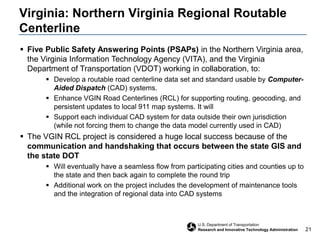
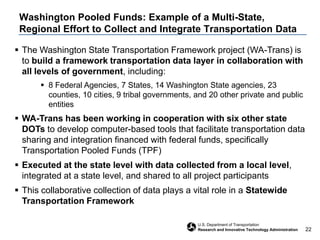
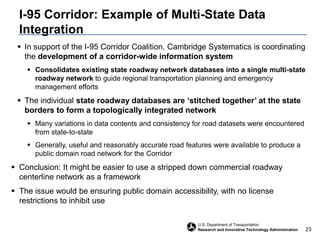
BackgroundInfluenced by several different efforts:In 2008, an “issues brief” by NSGIC called for the creation of TFTNOMB Circular A-16 identifies the USDOT as the “lead agency” for the “transportation theme” of the National Spatial Data Infrastructure (NSDI).  Emerging USDOT data requirements for geospatial data for all roads, such as accident reporting for enhanced safety and bridge inventory.Aligned with several initiatives such the emerging federal Geospatial Platform concept. - one element of the “geospatial portfolio”
TFTN Concept“Creation and maintenance of high-quality, nationwide transportation data that is in the public domain”An initial focus on street centerlines, but eventually multi-modalNationwide data spanning all states and territoriesAll roads, not just Federally funded roadsProvides a common geometric baselineRoad namingPersistent segment ID numberingAdvanced functionality is built  on top of baselineData is in the public domain and readily shareable
Project GovernanceUSDOT/RITA Project ManagementAdvisory input from NSGICConsulting Team: KTS & AppGeoSteering CommitteeExecutive Members (7)At-Large Members (36)Project Website:  http://www.tftn.org/
Strategic Planning Effort – What We DidIdentify and engage stakeholders Define requirements, challenges and opportunitiesDocument progress already madeExisting DatasetsBest PracticesNew IdeasExplore implementation issuesEvaluate funding  sources
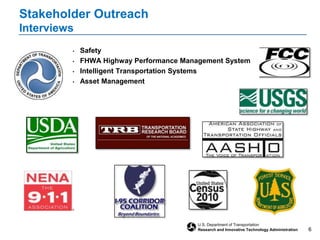
Stakeholder OutreachInterviewsSafety
FHWA Highway Performance Management System
Intelligent Transportation Systems
Asset ManagementStakeholder OutreachPresentations & Workshops
Trends from the Workshops and InterviewsNear Unanimous SupportAll of those interviewed and most of those who attended the workshops have indicated their support for this effortLearned of a number of similar efforts underway that benefit from TFTNSafety could be a key to the success of TFTNUSDOT goal to greatly reduce the number of fatal accidentsA geospatial representation of ALL ROADS is needed to meet many of the USDOTs Safety InitiativesA geospatial representation of ALL ROADS is needed for emergency responseLots of federal money for safety initiatives
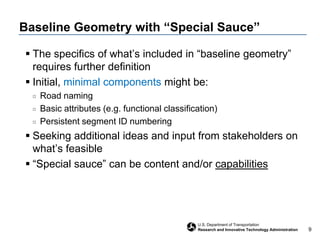
Baseline Geometry with “Special Sauce”The specifics of what’s included in “baseline geometry” requires further definitionInitial, minimal components might be:Road namingBasic attributes (e.g. functional classification)Persistent segment ID numberingSeeking additional ideas and input from stakeholders on what’s feasible
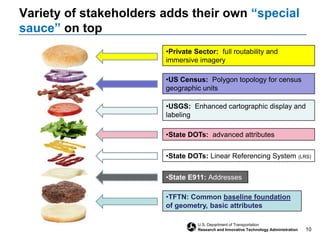
“Special sauce” can be content and/or capabilitiesVariety of stakeholders adds their own “special sauce” on topPrivate Sector:  full routability and immersive imageryUS Census:  Polygon topology for census geographic unitsUSGS:  Enhanced cartographic display and labelingState DOTs:  advanced attributesState DOTs: Linear Referencing System (LRS)State E911: AddressesTFTN: Common baseline foundation of geometry, basic attributes
Existing Nationwide Road CenterlinesThe following three alternatives were examined in terms of pros and cons:US Census TIGER DataCommercial Data ProvidersNAVTEQTomTomVolunteered Geographic Information (VGI)OpenStreetMap (OSM)ESRI’s Community Base Maps (ECBM)ALL ARE LESS THAN IDEAL FOR TFTN “AS IS”
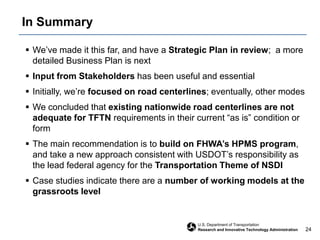
The Model for TFTN - HPMSFHWA reporting requirements for the Highway Performance Monitoring System (HPMS) include the submission of a geospatial network of all Federal-aid roads by each State DOTCurrent reporting requirements for the HPMS could be expanded to require all roadsDetailed HPMS attributes would continue to be provided for only Federal-aid roadsAnnual nature of HPMS reporting provides a data update mechanismUSDOT works with states to develop basic standardsReporting requirement would enable states to utilize FHWA funding for creation and maintenance of inventory
Obstacles Associated With This ModelFHWA has to change the HPMS Reporting Requirements to include all roads in the geospatial submissionStates are not required to work with neighbors for connectivityNo USDOT resources currently available for aggregation, assembly and publication of a nationwide data setThe level of quality/accuracy varies from State to StateAlthough there is general agreement that the state DOTs are the authoritative source for street centerlines for their respective jurisdictions, there is very little independent verification of their accuracy
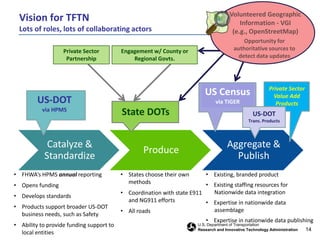
Volunteered Geographic  Information - VGI (e.g., OpenStreetMap)Vision for TFTNLots of roles, lots of collaborating actorsProduceAggregate & PublishCatalyze &StandardizeOpportunity for authoritative sources to detect data updatesPrivate Sector PartnershipEngagement w/ County or Regional Govts.US-DOTvia HPMSUS Censusvia TIGERUS-DOTTrans. ProductsState DOTsPrivate Sector Value Add ProductsFHWA’s HPMS annualreporting
Opens funding
Develops standards
Products support broader US-DOT business needs, such as Safety
Ability to provide funding support to local entities
Existing, branded product
Existing staffing resources for        Nationwide data integration
Expertise in nationwide data       assemblage
Expertise in nationwide data publishing
States choose their own methods
Coordination with state E911 and NG911 efforts

Lewis TFTN FGDC

  • 1.
    Strategic Planning forTransportation for the Nation (TFTN)Steve LewisGeospatial Information Officer, USDOTDirector, Office of Geospatial Information Systems, USDOT/RITA/BTSApril 19, 2011
  • 2.
    BackgroundInfluenced by severaldifferent efforts:In 2008, an “issues brief” by NSGIC called for the creation of TFTNOMB Circular A-16 identifies the USDOT as the “lead agency” for the “transportation theme” of the National Spatial Data Infrastructure (NSDI). Emerging USDOT data requirements for geospatial data for all roads, such as accident reporting for enhanced safety and bridge inventory.Aligned with several initiatives such the emerging federal Geospatial Platform concept. - one element of the “geospatial portfolio”
  • 3.
    TFTN Concept“Creation andmaintenance of high-quality, nationwide transportation data that is in the public domain”An initial focus on street centerlines, but eventually multi-modalNationwide data spanning all states and territoriesAll roads, not just Federally funded roadsProvides a common geometric baselineRoad namingPersistent segment ID numberingAdvanced functionality is built on top of baselineData is in the public domain and readily shareable
  • 4.
    Project GovernanceUSDOT/RITA ProjectManagementAdvisory input from NSGICConsulting Team: KTS & AppGeoSteering CommitteeExecutive Members (7)At-Large Members (36)Project Website: http://www.tftn.org/
  • 5.
    Strategic Planning Effort– What We DidIdentify and engage stakeholders Define requirements, challenges and opportunitiesDocument progress already madeExisting DatasetsBest PracticesNew IdeasExplore implementation issuesEvaluate funding sources
  • 6.
  • 7.
    FHWA Highway PerformanceManagement System
  • 8.
  • 9.
  • 10.
    Trends from theWorkshops and InterviewsNear Unanimous SupportAll of those interviewed and most of those who attended the workshops have indicated their support for this effortLearned of a number of similar efforts underway that benefit from TFTNSafety could be a key to the success of TFTNUSDOT goal to greatly reduce the number of fatal accidentsA geospatial representation of ALL ROADS is needed to meet many of the USDOTs Safety InitiativesA geospatial representation of ALL ROADS is needed for emergency responseLots of federal money for safety initiatives
  • 11.
    Baseline Geometry with“Special Sauce”The specifics of what’s included in “baseline geometry” requires further definitionInitial, minimal components might be:Road namingBasic attributes (e.g. functional classification)Persistent segment ID numberingSeeking additional ideas and input from stakeholders on what’s feasible
  • 12.
    “Special sauce” canbe content and/or capabilitiesVariety of stakeholders adds their own “special sauce” on topPrivate Sector: full routability and immersive imageryUS Census: Polygon topology for census geographic unitsUSGS: Enhanced cartographic display and labelingState DOTs: advanced attributesState DOTs: Linear Referencing System (LRS)State E911: AddressesTFTN: Common baseline foundation of geometry, basic attributes
  • 13.
    Existing Nationwide RoadCenterlinesThe following three alternatives were examined in terms of pros and cons:US Census TIGER DataCommercial Data ProvidersNAVTEQTomTomVolunteered Geographic Information (VGI)OpenStreetMap (OSM)ESRI’s Community Base Maps (ECBM)ALL ARE LESS THAN IDEAL FOR TFTN “AS IS”
  • 14.
    The Model forTFTN - HPMSFHWA reporting requirements for the Highway Performance Monitoring System (HPMS) include the submission of a geospatial network of all Federal-aid roads by each State DOTCurrent reporting requirements for the HPMS could be expanded to require all roadsDetailed HPMS attributes would continue to be provided for only Federal-aid roadsAnnual nature of HPMS reporting provides a data update mechanismUSDOT works with states to develop basic standardsReporting requirement would enable states to utilize FHWA funding for creation and maintenance of inventory
  • 15.
    Obstacles Associated WithThis ModelFHWA has to change the HPMS Reporting Requirements to include all roads in the geospatial submissionStates are not required to work with neighbors for connectivityNo USDOT resources currently available for aggregation, assembly and publication of a nationwide data setThe level of quality/accuracy varies from State to StateAlthough there is general agreement that the state DOTs are the authoritative source for street centerlines for their respective jurisdictions, there is very little independent verification of their accuracy
  • 16.
    Volunteered Geographic Information - VGI (e.g., OpenStreetMap)Vision for TFTNLots of roles, lots of collaborating actorsProduceAggregate & PublishCatalyze &StandardizeOpportunity for authoritative sources to detect data updatesPrivate Sector PartnershipEngagement w/ County or Regional Govts.US-DOTvia HPMSUS Censusvia TIGERUS-DOTTrans. ProductsState DOTsPrivate Sector Value Add ProductsFHWA’s HPMS annualreporting
  • 17.
  • 18.
  • 19.
    Products support broaderUS-DOT business needs, such as Safety
  • 20.
    Ability to providefunding support to local entities
  • 21.
  • 22.
    Existing staffing resourcesfor Nationwide data integration
  • 23.
  • 24.
  • 25.
  • 26.
    Coordination with stateE911 and NG911 efforts

Editor's Notes

  • #6 Identify and engage stakeholders -All levels of government-Private Sector-Citizens (e.g. OpenStreetMap community)