How Does Textrank Work? 
Andrew Koo - Insight Data Science
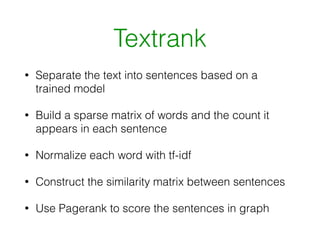
Textrank 
• Separate the text into sentences based on a 
trained model 
• Build a sparse matrix of words and the count it 
appears in each sentence 
• Normalize each word with tf-idf 
• Construct the similarity matrix between sentences 
• Use Pagerank to score the sentences in graph
1. Separate the Text into Sentences 
• Apply PunktSentenceTokenizer from the Python 
NLTK Library 
“Hi world! Hello 
world! This is 
Andrew.” 
[“Hi world!”, “Hello 
world!”, “This is 
Andrew.”]
2. Build a sparse matrix of words and 
the count it appears in each sentence 
[“Hi world!”, “Hello 
world!”, “This is 
Andrew.”] 
(Sen , word) Count 
(0 , 2) 
(0 , 5) 
(1 , 5) 
(1 , 1) 
(2 , 4) 
(2 , 3) 
(2 , 0) 
1 
1 
1 
1 
1 
1 
1
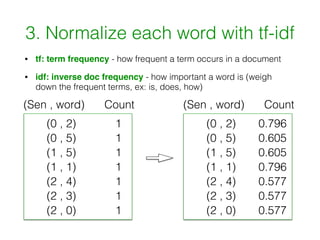
3. Normalize each word with tf-idf 
• tf: term frequency - how frequent a term occurs in a document 
• idf: inverse doc frequency - how important a word is (weigh 
down the frequent terms, ex: is, does, how) 
(Sen , word) Count 
(0 , 2) 
(0 , 5) 
(1 , 5) 
(1 , 1) 
(2 , 4) 
(2 , 3) 
(2 , 0) 
1 
1 
1 
1 
1 
1 
1 
(Sen , word) Count 
(0 , 2) 
(0 , 5) 
(1 , 5) 
(1 , 1) 
(2 , 4) 
(2 , 3) 
(2 , 0) 
0.796 
0.605 
0.605 
0.796 
0.577 
0.577 
0.577
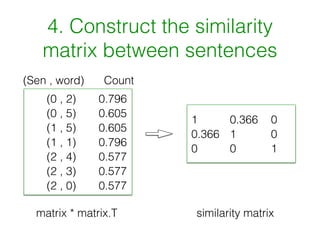
4. Construct the similarity 
matrix between sentences 
(Sen , word) Count 
(0 , 2) 
(0 , 5) 
(1 , 5) 
(1 , 1) 
(2 , 4) 
(2 , 3) 
(2 , 0) 
0.796 
0.605 
0.605 
0.796 
0.577 
0.577 
0.577 
1 
0.366 
0 
0.366 
1 
0 
0 
0 
1 
matrix * matrix.T similarity matrix
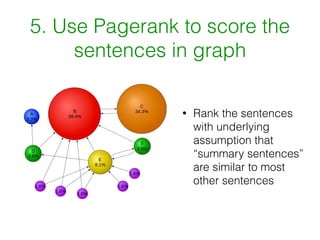
5. Use Pagerank to score the 
sentences in graph 
• Rank the sentences 
with underlying 
assumption that 
“summary sentences” 
are similar to most 
other sentences

Textrank algorithm

  • 1.
    How Does TextrankWork? Andrew Koo - Insight Data Science
  • 2.
    Textrank • Separatethe text into sentences based on a trained model • Build a sparse matrix of words and the count it appears in each sentence • Normalize each word with tf-idf • Construct the similarity matrix between sentences • Use Pagerank to score the sentences in graph
  • 3.
    1. Separate theText into Sentences • Apply PunktSentenceTokenizer from the Python NLTK Library “Hi world! Hello world! This is Andrew.” [“Hi world!”, “Hello world!”, “This is Andrew.”]
  • 4.
    2. Build asparse matrix of words and the count it appears in each sentence [“Hi world!”, “Hello world!”, “This is Andrew.”] (Sen , word) Count (0 , 2) (0 , 5) (1 , 5) (1 , 1) (2 , 4) (2 , 3) (2 , 0) 1 1 1 1 1 1 1
  • 5.
    3. Normalize eachword with tf-idf • tf: term frequency - how frequent a term occurs in a document • idf: inverse doc frequency - how important a word is (weigh down the frequent terms, ex: is, does, how) (Sen , word) Count (0 , 2) (0 , 5) (1 , 5) (1 , 1) (2 , 4) (2 , 3) (2 , 0) 1 1 1 1 1 1 1 (Sen , word) Count (0 , 2) (0 , 5) (1 , 5) (1 , 1) (2 , 4) (2 , 3) (2 , 0) 0.796 0.605 0.605 0.796 0.577 0.577 0.577
  • 6.
    4. Construct thesimilarity matrix between sentences (Sen , word) Count (0 , 2) (0 , 5) (1 , 5) (1 , 1) (2 , 4) (2 , 3) (2 , 0) 0.796 0.605 0.605 0.796 0.577 0.577 0.577 1 0.366 0 0.366 1 0 0 0 1 matrix * matrix.T similarity matrix
  • 7.
    5. Use Pagerankto score the sentences in graph • Rank the sentences with underlying assumption that “summary sentences” are similar to most other sentences