

www.entrepreneurindia.cowww.entrepreneurindia.co
Textile Processing
with Effluent
Treatment
(Sizing, Combined Effluent, Primary Treatment,
Woollen Textile, Color Removal, Melt Spinning,
Dry Spinning, Textile Fibres, Wool Fulling,
Printing Process, Weaving of Synthetic Yarns and
Blends, Fabric Defects and Value Loss, Pirn
Winding, Polyester Blended Fabrics)
www.entrepreneurindia.co
Introduction
A textile or cloth is a flexible material consisting of
a network of natural or artificial fibres (yarn or
thread). Yarn is produced by spinning raw fibres of
wool, flax, cotton, hemp, or other material to
produce long strands. Textiles are formed by
weaving, knitting, crocheting, knotting, or felting.
www.entrepreneurindia.co
The words fabric and cloth are used in textile
assembly trades (such as tailoring and
dressmaking) as synonyms for textile. However,
there are subtle differences in these terms in
specialized usage. Textile refers to any material
made of interlacing fibres. A fabric is a material
made through weaving, knitting, spreading,
crocheting, or bonding that may be used in
production of further goods (garments, etc.).
www.entrepreneurindia.co
Cloth may be used synonymously with fabric but is
often a finished piece of fabric used for a specific
purpose (e.g., table cloth).
Textile manufacturing is a major industry, it is
based in the conversion of three types of fibre into
yarn, then fabric, then textiles. These are then
fabricated into clothes or other artefacts. Cotton
remains the most important natural fibre, so is
treated in depth.
www.entrepreneurindia.co
There are many variable processes available at the
weaving and fabric forming stages coupled with
the complexities of the finishing and colouration
processes to the production of wide ranges of
products. Certain other fiber properties increase
its value and desirability in its intended end use
but are not necessary properties essential to make
a textile fiber. Such secondary properties include
moisture absorption characteristics, fiber
resiliency, abrasion resistance, density, luster,
chemical resistance, thermal characteristics, and
flammability.
www.entrepreneurindia.co
Some primary properties of textile fibers are: fiber
length to width ratio, fiber uniformity, fiber
strength and flexibility, fiber extensibility and
elasticity, and fiber cohesiveness. Some, mostly
larger, firms operate in the organized sector where
firms must comply with numerous government
labour and tax regulations. Most firms, however,
operate in the small scale unorganized sector
where regulations are less stringent and more
easily evaded. The textile industry occupies a
unique place in our country.
www.entrepreneurindia.co
One of the earliest to come into existence in India,
it accounts for 14% of the total Industrial
production, contributes to nearly 20% of the total
exports. Being the largest foreign exchange
earner, it accounts for more than 5 per cent of
GDP.
www.entrepreneurindia.co
Market Outlook
The Indian textiles industry, currently estimated at
around US$ 108 billion, is expected to reach US$
223 billion by 2021. The industry is the second
largest employer after agriculture, providing
employment to over 45 million people directly and
60 million people indirectly.
www.entrepreneurindia.co
The Indian Textile Industry contributes
approximately 5 per cent to India’s Gross Domestic
Product (GDP), and 14 per cent to overall Index of
Industrial Production (IIP).
The growth implies domestic sales to rise to US$
315 billion from currently US$ 68 billion. At the
same time, exports are implied to increase to US$
185 billion from approximately US$ 41 billion
currently.
www.entrepreneurindia.co
Indian exports of locally made retail and lifestyle
products grew at a compound annual growth rate
(CAGR) of 10 per cent from 2013 to 2016, mainly
led by bedding bath and home decor products and
textiles.
www.entrepreneurindia.co
India’s Textile Market
www.entrepreneurindia.co
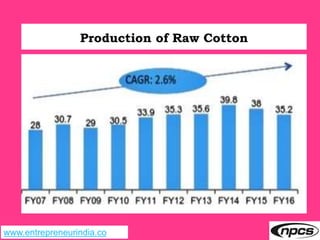
Production of raw cotton in India grew from 28
million bales in FY07 to 38 million bales in FY15
and further increased to 35.2 million bales in
FY16.
www.entrepreneurindia.co
Production of Raw Cotton
www.entrepreneurindia.co
Textile Exports
www.entrepreneurindia.co
India's Textile Market Size (USD Billion)
www.entrepreneurindia.co
Table of Contents
1.Characteristics of Cotton Textile Processing
 Characteristics of Effluents
 Sizing (Slashing)
 Desizing
 Scouring
 Bleaching
 Mercerizing
 Dyeing
 Printing
 Final Finishing
www.entrepreneurindia.co
 Combined Effluent
 Treatment
 Desizing
 Scouring
 Bleaching
 Mercerizing
 Dyeing
 Printing
 Combined Effluent
 Primary Treatment
 Secondary Treatment
 Tertiary Treatment
www.entrepreneurindia.co
2. Characteristics and Treatment of Synthetic
Textiles Processing Effluents
 Processes, Volume and Characteristics of
Effluents
 Treatment
3. Characteristics and Treatment of Woollen
Textile Processing Effluents
 Processes, Sources and Characteristics of
Effluents
www.entrepreneurindia.co
 Raw Wool Scouring
 Weaving & Finishing Operations
 Characteristics of Scouring Effluents
 Characteristics of Effluents from Weaving &
 Finishing Operations
 Effects of Effluents
 Treatment of Wool Processing Effluents
 Primary Treatment
 Secondary Treatment
 Tertiary Treatment
 Recovery of Valuable Materials from Woollen
 Processing Effluent
www.entrepreneurindia.co
4. Color Removal
5. Recovery and Reuse of waste Water
6. Conservation and Reuse of Water
7. Melt Spinning
 Associated Apparatus
 Spinneret Assembly producing Plug Flow
 Multifilamentary Yarns of Uniform Quality
www.entrepreneurindia.co
 Filament Manufacturing Device of Small Height
 Filaments and Fibers Having Discontinuous
Cavities
 Spinning Pack Filter
 Polyesters
 Highly Oriented Undrawn Yarn
 Multifunctional Chain Branches
 Transfer System Between Melt Source and
Spinning Position
 Enhanced Dyeability and Thermal Stability by
 High Speed Spinning
 Deep-Dyeing Textured Yarn Spun at High Speed
 High Speed Production of Preoriented Yarn
 Vinyl Copolymer to Reduce Pilling
www.entrepreneurindia.co
 Anti-Pilling Filaments with High Tenacity and
 low Knot Tenacity
 Low carboxyl Polyester Fibers Using Alkali
 Metal salt as catalyst
 Antistatic Polyether-Polyester Block Copolymer
 Process for Textured Yarn
 C-Shaped Filaments
 Nylons
 Polycaproamide Reacted with Cyclic
Tetracarboxylic
 Acid Dianhydride
 Polypyrrolidone with Alkylamines for Improved
 Extrudability
 Nylon 66 Spinning Process
www.entrepreneurindia.co
 Magnesium Oxide Incorporated into
Polycaprolactam
 Trilobal Filaments
 High Speed Spinning of Polyamides
 Acrylics
 Acrylonitrile/Styrene/Isobutylene Copolymer
Needing
 No After-Stretch
 Extrusion of a Single Phase Melt of
Polyacrylonitrile
 and Water
 Other Polymers
 Polyethylene Oxide Monofilament
www.entrepreneurindia.co
 Nylon Modified Phenolic Resin Fiber
 Nonwoven Webs
 Reinforced Matting
 Webs of Continuous Thermoplastic Filaments
 Continuous Production of Tubular Modular
Filter Elements
 Bonded, Low Density Matting
 Wet Lay Process
 Coatings and Finishes
 Fiber Finishes
 Stabilized Silicone Oil Coating for Melt Spinning
Nozzles
www.entrepreneurindia.co
8. Dry Spinning
 Acrylics and Modacrylics
 Bifilar Acrylic Fibers
 Modacrylics with Improved Coloristic Properties
 Removal or Residual Solvent
 Cellulosics
 Manufacture of Viscose Filaments
 Cellulose spun into Ammonia Atmosphere
 Other Polymers
www.entrepreneurindia.co
 Polypyrrolidone
Halogenated Aromatic Polyesters
Flame Retardant Melamine
Protein Fibers
Associated Apparatus
Dry Spinning Pack Assembly
Static Mixing Apparatus
www.entrepreneurindia.co
9. Wet Spinning
 Acrylics and Modacrylics
 Reduction of Voids in Wet-Spun Acrylic Fibers
 Acrylic Fibers Free from Delustering
 Improved Hot/Wet Properties
 Flame-Retardant Acrylics
 Modacryl Filaments with Permanent Brilliance
and
 Transparence
 Cellulose and Starch
 Rayon Fibers Containing Starch
 Continuous Process for Viscose Yarn
www.entrepreneurindia.co
 Water-Insensitive Starch Fibers
 Polyamides and Other Nitrogen-containing
Polymers
 Production Arylamides with Recovery of Amide
Solvent
 Air Gage Arylamide Spinning Process
 Reduced Salt Content in Arylamide Fibers
 Neutralization of Polyamide Spin Dope
 Fibers from Anisotropic Dopes of Aromatic
Polymers
www.entrepreneurindia.co
 Arylene Oxadiazole/Arylene N-Alkylhdrazide
 Copolymer Fibers
 Aromatic Oxadizole Polymers and Copolymers
 Vinyls
 Recovery and Recycle of Salt Solution in Vinyl
Polymer
 Spinning
 Lithium Halides as Solvents for
Polyhydroxymethylene
www.entrepreneurindia.co
10. Computers in Textile Manufacturing
 Computer - Aided Design (CAD) systems
 Computer - aided manufacturing
 Computer - aided design
 Computer - aided process planning
 Mechatronics and information engineering
 Computer - Aided Logistic Support (CALS)
 Development of LAN system
 Network controller
www.entrepreneurindia.co
11. The Properties of Textile Fibres
 Important properties of fibres
 Fibre shape and strength of yarns
 Fibre extensibility
 Softness
 Plasticity and thermoplasticity
 Lustre
 Fibre density
 Solubility in various solvents
 Affinity for dyes
 Fibre structure
 The special properties of synthetic fibres
www.entrepreneurindia.co
12. Basic Aspects of Textile Fibres
 Filament and staple
 Yarn
 Fabrics
 Woven fabrics
 Knitted fabrics
 Lace and net fabrics
 Braided fabrics
 Felt fabrics
 Bonded fibre fabrics
 Textile mills
 Woven textile fabrics
www.entrepreneurindia.co
 Cotton
 Wool
 Silk
 Rayon
 Acetate
 Nylon
 Vinyon
 Mohair
 Linen
 Glass fibres
 Dacron
 Orlon
 Vicara
 Yarns for weaving
www.entrepreneurindia.co
13. Structure and Properties of Textile Fibres
 Fibre structure
 Properties of synthetic fibres
14. Textile Weaving
 Plain Weave
 Twill Weaves
 Effect and flush
 Satin Weaves
 Basket and rib weaves
 Weave Combinations
www.entrepreneurindia.co
 Face and back of fibres
 Knitted Fabrics
 Colouring
 Braiding
 Lace
 Nonwoven fabrics
 Bonded Fabrics
 Automatic weaving machine
 3-D weaving processes
www.entrepreneurindia.co
15. Textile Wet Processes
 Cotton Textiles
 Sizing (Slashing)
 Desizing
 Scouring
 Bleaching
 Mercerizing
 Dyeing
 Printing
www.entrepreneurindia.co
 Finishing
 Synthetic Textiles
 Wool Processing
 Wool Scouring
 Wool fulling
 Wool Carbonizing
 Water Usage
 Data Processing Block
www.entrepreneurindia.co
16. Printing Processes
 Fixation
 Fixation with Vapor of Organic Solvent
 Dyestuffs for Methylene Chloride Fixation
Processes
 Improved Fixation of Reactive Dyes on Cellulose
Fibers
 Treatments of Cellulosics
 Crosspadding or Overprinting Impregnated
Cellulose
 Materials
 Basic Dyes and Simultaneous Crosslinking
www.entrepreneurindia.co
 Printing and Simultaneous Finishing
 Other Treatments
 Addition of Lactone for pH Adjustments
 Sodium Hydrosulfite Aftertreatment of Aromatic
 Polyesters
 Improved Pretreatment and Aftertreatment for
Optimum
 Handle
 Aftertreatment with Surfactant and
Reductonate
 Coloration of Aromatic Polyester or Cellulose
Triacetate
 Special effects
www.entrepreneurindia.co
 Continuous Process for Two-Color Effect on
Blends
 Double-Surface Multicolor Printed Cloth
 Double Face Printing of Polyester Fabrics
 Well - Defined Multicolor Patterns on Porous
Substrates
 Polymer - Printed Fabric Having Differential
Dyeing
 Characteristic
 Acid Dye Mixture for Differential-Dyeing Nylons
 Spotted Effect on Synthetic Fiber Materials
 Resist Printing Polyesters with Acid Dyes
 Discharge Effects on Prints with Disperse Dyes
www.entrepreneurindia.co
 Reserve Effects in Multicolor Printing
 Relief Printing to Simulate Animal Skins
 Camouflage Dyeings and Prints on Synthetics
and Blends
 Photographic Techniques
 Continuous Repetitive Patterns on Piled Fabrics
 Impregnation with Leuco Ester of Vat Dyestuff
 Other Processes
 Continuous Process for Optical Brightening and
Printing
 Continuous Dyeing and Printing of Piece Goods
 Printing Heavy Pile Fabrics with Powder
Preparations
www.entrepreneurindia.co
 Improved Alignment of Printed Patterns
 Uniform Heat-Setting of Continuous Synthetic
Filament
 Groups
 Voluminous Substrate Rolled Up with Foamed
Dye
 Continuous Printing Process by Direct Liquid
Film
 Transfer
 Method for Printing and Flocking
Simultaneously
 Sprayed Carriers for Continuous Print Fixation
www.entrepreneurindia.co
17. Weaving of Synthetic Yarns And Blends
 Introduction
 Polyester Blended Fabrics
 Sizing
 Pirn Winding
 Weaving
 Weaving of Multifilament Yarns
 Commonly Used Multifilament Fabrics
 Warping
 Sizing
 Monofilament Fabrics
www.entrepreneurindia.co
18. Weaving of Certain Commercial Fabrics
 Introduction
 Weaving of Poplin
 Wrap preparation
 Weaving
 Denim
 Dyeing and Sizing Processes
 Tyre Cord Fabric
 Yarn and Fabric Particulars
 Production Flow for Tyre Cord Fabric
 Weaving
www.entrepreneurindia.co
 Weaving of Tapes
 Tubular Cloth
 Weaving of Aramide (Kevlar) yarns
 Characteristics of Aramides
 Ranges of Application of Kevlar Fibres
 Basic Requirements
 Warping
 Sizing
 Weavin
www.entrepreneurindia.co
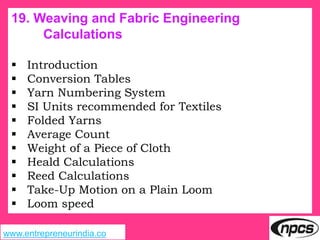
19. Weaving and Fabric Engineering
Calculations
 Introduction
 Conversion Tables
 Yarn Numbering System
 SI Units recommended for Textiles
 Folded Yarns
 Average Count
 Weight of a Piece of Cloth
 Heald Calculations
 Reed Calculations
 Take-Up Motion on a Plain Loom
 Loom speed
www.entrepreneurindia.co
 Production of Looms
 Efficiency
 Shuttle Movement
 Accelerating force of Sley
 Calculation on shuttleless weaving Machines
Example 33
 Fractional Cover and Cover Factor
 Diameter
 Bulk density
 Fractional Cover
 Cloth Setting Rules
www.entrepreneurindia.co
20. Fabric Defects and Value Loss
 Grading of fabrics
 Value loss
 Types of Fabrics Defects
 Common Fabric Defects and their causes
 Bar
 Box Mark
 Broken Pattern
 Broken Pick
 Cracks
 Cut weft
 Defective selvedges
 Floats Stiches
www.entrepreneurindia.co
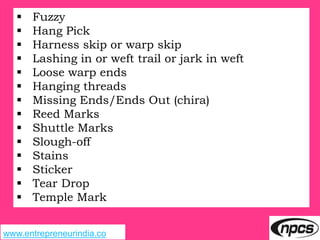
 Fuzzy
 Hang Pick
 Harness skip or warp skip
 Lashing in or weft trail or jark in weft
 Loose warp ends
 Hanging threads
 Missing Ends/Ends Out (chira)
 Reed Marks
 Shuttle Marks
 Slough-off
 Stains
 Sticker
 Tear Drop
 Temple Mark
www.entrepreneurindia.co
 Uneven cloth
 Wrong Denting
 Wrong Drawing
 Control of Fabric Quality at Loom State
 Design Specifications
 First Piece Inspection
 Weaving Defects
 Grey Inspection
 Recording of Loomwise and Weaverwise
Fabrics Faults
 Point Rate System
 Directory Section
Tags
www.entrepreneurindia.co
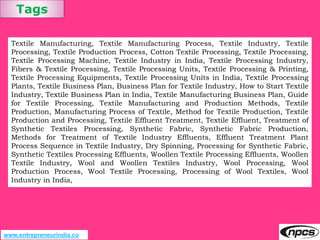
Textile Manufacturing, Textile Manufacturing Process, Textile Industry, Textile
Processing, Textile Production Process, Cotton Textile Processing, Textile Processing,
Textile Processing Machine, Textile Industry in India, Textile Processing Industry,
Fibers & Textile Processing, Textile Processing Units, Textile Processing & Printing,
Textile Processing Equipments, Textile Processing Units in India, Textile Processing
Plants, Textile Business Plan, Business Plan for Textile Industry, How to Start Textile
Industry, Textile Business Plan in India, Textile Manufacturing Business Plan, Guide
for Textile Processing, Textile Manufacturing and Production Methods, Textile
Production, Manufacturing Process of Textile, Method for Textile Production, Textile
Production and Processing, Textile Effluent Treatment, Textile Effluent, Treatment of
Synthetic Textiles Processing, Synthetic Fabric, Synthetic Fabric Production,
Methods for Treatment of Textile Industry Effluents, Effluent Treatment Plant
Process Sequence in Textile Industry, Dry Spinning, Processing for Synthetic Fabric,
Synthetic Textiles Processing Effluents, Woollen Textile Processing Effluents, Woollen
Textile Industry, Wool and Woollen Textiles Industry, Wool Processing, Wool
Production Process, Wool Textile Processing, Processing of Wool Textiles, Wool
Industry in India,
Tags
www.entrepreneurindia.co
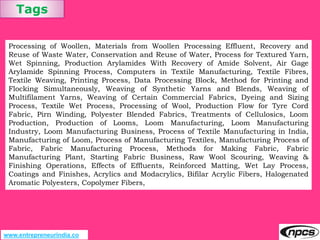
Processing of Woollen, Materials from Woollen Processing Effluent, Recovery and
Reuse of Waste Water, Conservation and Reuse of Water, Process for Textured Yarn,
Wet Spinning, Production Arylamides With Recovery of Amide Solvent, Air Gage
Arylamide Spinning Process, Computers in Textile Manufacturing, Textile Fibres,
Textile Weaving, Printing Process, Data Processing Block, Method for Printing and
Flocking Simultaneously, Weaving of Synthetic Yarns and Blends, Weaving of
Multifilament Yarns, Weaving of Certain Commercial Fabrics, Dyeing and Sizing
Process, Textile Wet Process, Processing of Wool, Production Flow for Tyre Cord
Fabric, Pirn Winding, Polyester Blended Fabrics, Treatments of Cellulosics, Loom
Production, Production of Looms, Loom Manufacturing, Loom Manufacturing
Industry, Loom Manufacturing Business, Process of Textile Manufacturing in India,
Manufacturing of Loom, Process of Manufacturing Textiles, Manufacturing Process of
Fabric, Fabric Manufacturing Process, Methods for Making Fabric, Fabric
Manufacturing Plant, Starting Fabric Business, Raw Wool Scouring, Weaving &
Finishing Operations, Effects of Effluents, Reinforced Matting, Wet Lay Process,
Coatings and Finishes, Acrylics and Modacrylics, Bifilar Acrylic Fibers, Halogenated
Aromatic Polyesters, Copolymer Fibers,
Tags
www.entrepreneurindia.co
Woven Fabrics, Lace and Net Fabrics, Knitted Fabrics, Woven Textile Fabrics, Glass
Fibres, Yarns for Weaving, Weaving of Poplin, Npcs, Niir, Process Technology Books,
Business Consultancy, Business Consultant, Project Identification and Selection,
Preparation of Project Profiles, Startup, Business Guidance, Business Guidance to
Clients, Startup Project, Startup Ideas, Project for Startups, Startup Project Plan,
Business Start-Up, Business Plan for Startup Business, Great Opportunity for
Startup, Small Start-Up Business Project, Best Small and Cottage Scale Industries,
Startup India, Stand Up India, Small Scale Industries, New Small Scale Ideas for
Textile Processing Industry, Textile Processing Business Ideas You Can Start on Your
Own, Indian Woollen Processing Industry, Small Scale Woollen Textile Processing,
Guide to Starting and Operating Small Business, Business Ideas for Textile
Processing,
Tags
www.entrepreneurindia.co
How to Start Textile Manufacturing Business, Starting Textile Processing,
Start Your Own Woollen Textile Processing Business, Textile Processing
Business Plan, Business Plan for Woollen Processing, Small Scale
Industries in India, Textile Processing Based Small Business Ideas in
India, Small Scale Industry You Can Start on Your Own, Business Plan for
Small Scale Industries, Set Up Woollen Processing, Profitable Small
Scale Manufacturing, How To Start Small Business in India, Free
Manufacturing Business Plans, Small and Medium Scale Manufacturing,
Profitable Small Business Industries Ideas, Business Ideas for Startup
www.entrepreneurindia.co
Niir Project Consultancy Services (NPCS) can provide
Process Technology Book on
Textile Processing with
Effluent Treatment
(Sizing, Combined Effluent, Primary Treatment, Woollen Textile, Color
Removal, Melt Spinning, Dry Spinning, Textile Fibres, Wool Fulling,
Printing Process, Weaving of Synthetic Yarns and Blends, Fabric Defects
and Value Loss, Pirn Winding, Polyester Blended Fabrics)
See more
https://goo.gl/0coEcl
https://goo.gl/Vmx7Za
https://goo.gl/vxs104
https://goo.gl/1nT8Pf
www.entrepreneurindia.co
Take a look at
Niir Project Consultancy Services
on #Street View
https://goo.gl/VstWkd
www.entrepreneurindia.co
Locate us on
Google Maps
https://goo.gl/maps/BKkUtq9gevT2
www.entrepreneurindia.co
Our inexhaustible Client list includes public-
sector companies, Corporate Houses,
Government undertaking, individual
entrepreneurs, NRI, Foreign investors, non-profit
organizations and educational institutions from
all parts of the World. The list is just a glimpse of
our esteemed & satisfied Clients.
Click here to take a look
https://goo.gl/G3ICjV
OUR CLIENTS
Free Instant Online Project Identification &
Selection Search Facility
Selection process starts with the generation of a product idea. In order
to select the most promising project, the entrepreneur needs to
generate a few ideas about the possible projects.
Here’s we offer a best and easiest way for every entrepreneur to
searching criteria of projects on our website
www.entrepreneurindia.co that is “Instant Online Project Identification
and Selection”
www.entrepreneurindia.co
NPCS Team has simplified the process for you by
providing a "Free Instant Online Project Identification &
Selection" search facility to identify projects based on
multiple search parameters related to project costs
namely: Plant & Machinery Cost, Total Capital Investment,
Cost of the project, Rate of Return% (ROR) and Break Even
Point % (BEP). You can sort the projects on the basis of
mentioned pointers and identify a suitable project
matching your investment requisites.
Click here to go
http://www.entrepreneurindia.co/project-identification
www.entrepreneurindia.co
Contact us
Niir Project Consultancy Services
106-E, Kamla Nagar, Opp. Spark Mall,
New Delhi-110007, India.
Email: npcs.ei@gmail.com , info@entrepreneurindia.co
Tel: +91-11-23843955, 23845654, 23845886, 8800733955
Mobile: +91-9811043595
Website : www.entrepreneurindia.co , www.niir.org
Take a look at NIIR PROJECT CONSULTANCY SERVICES on
#StreetView
https://goo.gl/VstWkd
www.entrepreneurindia.co
o One of the leading reliable names in industrial world for
providing the most comprehensive technical consulting services
o We adopt a systematic approach to provide the strong
fundamental support needed for the effective delivery of services
to our Clients’ in India & abroad
Who are we?
www.entrepreneurindia.co
We at NPCS want to grow with you by providing solutions scale
to suit your new operations and help you reduce risk and give a
high return on application investments. We have successfully
achieved top-notch quality standards with a high level of
customer appreciation resulting in long lasting relation and
large amount of referral work through technological
breakthrough and innovative concepts. A large number of our
Indian, Overseas and NRI Clients have appreciated our
expertise for excellence which speaks volumes about our
commitment and dedication to every client's success.
www.entrepreneurindia.co
We bring deep, functional expertise, but are known for
our holistic perspective: we capture value across
boundaries and between the silos of any organization.
We have proven a multiplier effect from optimizing the
sum of the parts, not just the individual pieces. We
actively encourage a culture of innovation, which
facilitates the development of new technologies and
ensures a high quality product.
www.entrepreneurindia.co
o Project Identification
o Detailed Project Reports/Pre-feasibility Reports
o Business Plan
o Industry Trends
o Market Research Reports
o Technology Books and Directory
o Databases on CD-ROM
o Laboratory Testing Services
o Turnkey Project Consultancy/Solutions
o Entrepreneur India (An Industrial Monthly Journal)
What do we offer?
www.entrepreneurindia.co
o We have two decades long experience in project consultancy and
market research field
o We empower our customers with the prerequisite know-how to
take sound business decisions
o We help catalyze business growth by providing distinctive and
profound market analysis
o We serve a wide array of customers , from individual
entrepreneurs to Corporations and Foreign Investors
o We use authentic & reliable sources to ensure business precision
How are we different ?
www.entrepreneurindia.co
Our Approach
Requirement collection
Thorough analysis of the project
Economic feasibility study of the
Project
Market potential survey/research
Report Compilation
www.entrepreneurindia.co
Who do we serve?
o Public-sector Companies
o Corporates
o Government Undertakings
o Individual Entrepreneurs
o NRI’s
o Foreign Investors
o Non-profit Organizations, NBFC’s
o Educational Institutions
o Embassies & Consulates
o Consultancies
o Industry / trade associations
www.entrepreneurindia.co
Sectors We Cover
o Ayurvedic And Herbal Medicines, Herbal Cosmetics
o Alcoholic And Non Alcoholic Beverages, Drinks
o Adhesives, Industrial Adhesive, Sealants, Glues, Gum & Resin
o Activated Carbon & Activated Charcoal
o Aluminium And Aluminium Extrusion Profiles & Sections,
o Bio-fertilizers And Biotechnology
o Breakfast Snacks And Cereal Food
o Bicycle Tyres & Tubes, Bicycle Parts, Bicycle Assembling
www.entrepreneurindia.co
Sectors We Cover Cont…
o Bamboo And Cane Based Projects
o Building Materials And Construction Projects
o Biodegradable & Bioplastic Based Projects
o Chemicals (Organic And Inorganic)
o Confectionery, Bakery/Baking And Other Food
o Cereal Processing
o Coconut And Coconut Based Products
o Cold Storage For Fruits & Vegetables
o Coal & Coal Byproduct
www.entrepreneurindia.co
Sectors We Cover Cont…
o Copper & Copper Based Projects
o Dairy/Milk Processing
o Disinfectants, Pesticides, Insecticides, Mosquito Repellents,
o Electrical, Electronic And Computer based Projects
o Essential Oils, Oils & Fats And Allied
o Engineering Goods
o Fibre Glass & Float Glass
o Fast Moving Consumer Goods
o Food, Bakery, Agro Processing
www.entrepreneurindia.co
Sectors We Cover Cont…
o Fruits & Vegetables Processing
o Ferro Alloys Based Projects
o Fertilizers & Biofertilizers
o Ginger & Ginger Based Projects
o Herbs And Medicinal Cultivation And Jatropha (Biofuel)
o Hotel & Hospitability Projects
o Hospital Based Projects
o Herbal Based Projects
o Inks, Stationery And Export Industries
www.entrepreneurindia.co
Sectors We Cover Cont…
o Infrastructure Projects
o Jute & Jute Based Products
o Leather And Leather Based Projects
o Leisure & Entertainment Based Projects
o Livestock Farming Of Birds & Animals
o Minerals And Minerals
o Maize Processing(Wet Milling) & Maize Based Projects
o Medical Plastics, Disposables Plastic Syringe, Blood Bags
o Organic Farming, Neem Products Etc.
www.entrepreneurindia.co
Sectors We Cover Cont…
o Paints, Pigments, Varnish & Lacquer
o Paper And Paper Board, Paper Recycling Projects
o Printing Inks
o Packaging Based Projects
o Perfumes, Cosmetics And Flavours
o Power Generation Based Projects & Renewable Energy Based Projects
o Pharmaceuticals And Drugs
o Plantations, Farming And Cultivations
o Plastic Film, Plastic Waste And Plastic Compounds
o Plastic, PVC, PET, HDPE, LDPE Etc.
www.entrepreneurindia.co
Sectors We Cover Cont…
o Potato And Potato Based Projects
o Printing And Packaging
o Real Estate, Leisure And Hospitality
o Rubber And Rubber Products
o Soaps And Detergents
o Stationary Products
o Spices And Snacks Food
o Steel & Steel Products
o Textile Auxiliary And Chemicals
www.entrepreneurindia.co
Sectors We Cover Cont…
o Township & Residential Complex
o Textiles And Readymade Garments
o Waste Management & Recycling
o Wood & Wood Products
o Water Industry(Packaged Drinking Water & Mineral
Water)
o Wire & Cable
www.entrepreneurindia.co
Contact us
Niir Project Consultancy Services
106-E, Kamla Nagar, Opp. Spark Mall,
New Delhi-110007, India.
Email: npcs.ei@gmail.com , info@entrepreneurindia.co
Tel: +91-11-23843955, 23845654, 23845886, 8800733955
Mobile: +91-9811043595
Website : www.entrepreneurindia.co , www.niir.org
Take a look at NIIR PROJECT CONSULTANCY SERVICES on
#StreetView
https://goo.gl/VstWkd
www.entrepreneurindia.co
www.niir.org
Follow Us
www.entrepreneurindia.co
For more information, visit us at:
www.entrepreneurindia.co

Textile Processing with Effluent Treatment

  • 1.
    www.entrepreneurindia.cowww.entrepreneurindia.co Textile Processing with Effluent Treatment (Sizing,Combined Effluent, Primary Treatment, Woollen Textile, Color Removal, Melt Spinning, Dry Spinning, Textile Fibres, Wool Fulling, Printing Process, Weaving of Synthetic Yarns and Blends, Fabric Defects and Value Loss, Pirn Winding, Polyester Blended Fabrics)
  • 2.
    www.entrepreneurindia.co Introduction A textile orcloth is a flexible material consisting of a network of natural or artificial fibres (yarn or thread). Yarn is produced by spinning raw fibres of wool, flax, cotton, hemp, or other material to produce long strands. Textiles are formed by weaving, knitting, crocheting, knotting, or felting.
  • 3.
    www.entrepreneurindia.co The words fabricand cloth are used in textile assembly trades (such as tailoring and dressmaking) as synonyms for textile. However, there are subtle differences in these terms in specialized usage. Textile refers to any material made of interlacing fibres. A fabric is a material made through weaving, knitting, spreading, crocheting, or bonding that may be used in production of further goods (garments, etc.).
  • 4.
    www.entrepreneurindia.co Cloth may beused synonymously with fabric but is often a finished piece of fabric used for a specific purpose (e.g., table cloth). Textile manufacturing is a major industry, it is based in the conversion of three types of fibre into yarn, then fabric, then textiles. These are then fabricated into clothes or other artefacts. Cotton remains the most important natural fibre, so is treated in depth.
  • 5.
    www.entrepreneurindia.co There are manyvariable processes available at the weaving and fabric forming stages coupled with the complexities of the finishing and colouration processes to the production of wide ranges of products. Certain other fiber properties increase its value and desirability in its intended end use but are not necessary properties essential to make a textile fiber. Such secondary properties include moisture absorption characteristics, fiber resiliency, abrasion resistance, density, luster, chemical resistance, thermal characteristics, and flammability.
  • 6.
    www.entrepreneurindia.co Some primary propertiesof textile fibers are: fiber length to width ratio, fiber uniformity, fiber strength and flexibility, fiber extensibility and elasticity, and fiber cohesiveness. Some, mostly larger, firms operate in the organized sector where firms must comply with numerous government labour and tax regulations. Most firms, however, operate in the small scale unorganized sector where regulations are less stringent and more easily evaded. The textile industry occupies a unique place in our country.
  • 7.
    www.entrepreneurindia.co One of theearliest to come into existence in India, it accounts for 14% of the total Industrial production, contributes to nearly 20% of the total exports. Being the largest foreign exchange earner, it accounts for more than 5 per cent of GDP.
  • 8.
    www.entrepreneurindia.co Market Outlook The Indiantextiles industry, currently estimated at around US$ 108 billion, is expected to reach US$ 223 billion by 2021. The industry is the second largest employer after agriculture, providing employment to over 45 million people directly and 60 million people indirectly.
  • 9.
    www.entrepreneurindia.co The Indian TextileIndustry contributes approximately 5 per cent to India’s Gross Domestic Product (GDP), and 14 per cent to overall Index of Industrial Production (IIP). The growth implies domestic sales to rise to US$ 315 billion from currently US$ 68 billion. At the same time, exports are implied to increase to US$ 185 billion from approximately US$ 41 billion currently.
  • 10.
    www.entrepreneurindia.co Indian exports oflocally made retail and lifestyle products grew at a compound annual growth rate (CAGR) of 10 per cent from 2013 to 2016, mainly led by bedding bath and home decor products and textiles.
  • 11.
  • 12.
    www.entrepreneurindia.co Production of rawcotton in India grew from 28 million bales in FY07 to 38 million bales in FY15 and further increased to 35.2 million bales in FY16.
  • 13.
  • 14.
  • 15.
  • 16.
    www.entrepreneurindia.co Table of Contents 1.Characteristicsof Cotton Textile Processing  Characteristics of Effluents  Sizing (Slashing)  Desizing  Scouring  Bleaching  Mercerizing  Dyeing  Printing  Final Finishing
  • 17.
    www.entrepreneurindia.co  Combined Effluent Treatment  Desizing  Scouring  Bleaching  Mercerizing  Dyeing  Printing  Combined Effluent  Primary Treatment  Secondary Treatment  Tertiary Treatment
  • 18.
    www.entrepreneurindia.co 2. Characteristics andTreatment of Synthetic Textiles Processing Effluents  Processes, Volume and Characteristics of Effluents  Treatment 3. Characteristics and Treatment of Woollen Textile Processing Effluents  Processes, Sources and Characteristics of Effluents
  • 19.
    www.entrepreneurindia.co  Raw WoolScouring  Weaving & Finishing Operations  Characteristics of Scouring Effluents  Characteristics of Effluents from Weaving &  Finishing Operations  Effects of Effluents  Treatment of Wool Processing Effluents  Primary Treatment  Secondary Treatment  Tertiary Treatment  Recovery of Valuable Materials from Woollen  Processing Effluent
  • 20.
    www.entrepreneurindia.co 4. Color Removal 5.Recovery and Reuse of waste Water 6. Conservation and Reuse of Water 7. Melt Spinning  Associated Apparatus  Spinneret Assembly producing Plug Flow  Multifilamentary Yarns of Uniform Quality
  • 21.
    www.entrepreneurindia.co  Filament ManufacturingDevice of Small Height  Filaments and Fibers Having Discontinuous Cavities  Spinning Pack Filter  Polyesters  Highly Oriented Undrawn Yarn  Multifunctional Chain Branches  Transfer System Between Melt Source and Spinning Position  Enhanced Dyeability and Thermal Stability by  High Speed Spinning  Deep-Dyeing Textured Yarn Spun at High Speed  High Speed Production of Preoriented Yarn  Vinyl Copolymer to Reduce Pilling
  • 22.
    www.entrepreneurindia.co  Anti-Pilling Filamentswith High Tenacity and  low Knot Tenacity  Low carboxyl Polyester Fibers Using Alkali  Metal salt as catalyst  Antistatic Polyether-Polyester Block Copolymer  Process for Textured Yarn  C-Shaped Filaments  Nylons  Polycaproamide Reacted with Cyclic Tetracarboxylic  Acid Dianhydride  Polypyrrolidone with Alkylamines for Improved  Extrudability  Nylon 66 Spinning Process
  • 23.
    www.entrepreneurindia.co  Magnesium OxideIncorporated into Polycaprolactam  Trilobal Filaments  High Speed Spinning of Polyamides  Acrylics  Acrylonitrile/Styrene/Isobutylene Copolymer Needing  No After-Stretch  Extrusion of a Single Phase Melt of Polyacrylonitrile  and Water  Other Polymers  Polyethylene Oxide Monofilament
  • 24.
    www.entrepreneurindia.co  Nylon ModifiedPhenolic Resin Fiber  Nonwoven Webs  Reinforced Matting  Webs of Continuous Thermoplastic Filaments  Continuous Production of Tubular Modular Filter Elements  Bonded, Low Density Matting  Wet Lay Process  Coatings and Finishes  Fiber Finishes  Stabilized Silicone Oil Coating for Melt Spinning Nozzles
  • 25.
    www.entrepreneurindia.co 8. Dry Spinning Acrylics and Modacrylics  Bifilar Acrylic Fibers  Modacrylics with Improved Coloristic Properties  Removal or Residual Solvent  Cellulosics  Manufacture of Viscose Filaments  Cellulose spun into Ammonia Atmosphere  Other Polymers
  • 26.
    www.entrepreneurindia.co  Polypyrrolidone Halogenated AromaticPolyesters Flame Retardant Melamine Protein Fibers Associated Apparatus Dry Spinning Pack Assembly Static Mixing Apparatus
  • 27.
    www.entrepreneurindia.co 9. Wet Spinning Acrylics and Modacrylics  Reduction of Voids in Wet-Spun Acrylic Fibers  Acrylic Fibers Free from Delustering  Improved Hot/Wet Properties  Flame-Retardant Acrylics  Modacryl Filaments with Permanent Brilliance and  Transparence  Cellulose and Starch  Rayon Fibers Containing Starch  Continuous Process for Viscose Yarn
  • 28.
    www.entrepreneurindia.co  Water-Insensitive StarchFibers  Polyamides and Other Nitrogen-containing Polymers  Production Arylamides with Recovery of Amide Solvent  Air Gage Arylamide Spinning Process  Reduced Salt Content in Arylamide Fibers  Neutralization of Polyamide Spin Dope  Fibers from Anisotropic Dopes of Aromatic Polymers
  • 29.
    www.entrepreneurindia.co  Arylene Oxadiazole/AryleneN-Alkylhdrazide  Copolymer Fibers  Aromatic Oxadizole Polymers and Copolymers  Vinyls  Recovery and Recycle of Salt Solution in Vinyl Polymer  Spinning  Lithium Halides as Solvents for Polyhydroxymethylene
  • 30.
    www.entrepreneurindia.co 10. Computers inTextile Manufacturing  Computer - Aided Design (CAD) systems  Computer - aided manufacturing  Computer - aided design  Computer - aided process planning  Mechatronics and information engineering  Computer - Aided Logistic Support (CALS)  Development of LAN system  Network controller
  • 31.
    www.entrepreneurindia.co 11. The Propertiesof Textile Fibres  Important properties of fibres  Fibre shape and strength of yarns  Fibre extensibility  Softness  Plasticity and thermoplasticity  Lustre  Fibre density  Solubility in various solvents  Affinity for dyes  Fibre structure  The special properties of synthetic fibres
  • 32.
    www.entrepreneurindia.co 12. Basic Aspectsof Textile Fibres  Filament and staple  Yarn  Fabrics  Woven fabrics  Knitted fabrics  Lace and net fabrics  Braided fabrics  Felt fabrics  Bonded fibre fabrics  Textile mills  Woven textile fabrics
  • 33.
    www.entrepreneurindia.co  Cotton  Wool Silk  Rayon  Acetate  Nylon  Vinyon  Mohair  Linen  Glass fibres  Dacron  Orlon  Vicara  Yarns for weaving
  • 34.
    www.entrepreneurindia.co 13. Structure andProperties of Textile Fibres  Fibre structure  Properties of synthetic fibres 14. Textile Weaving  Plain Weave  Twill Weaves  Effect and flush  Satin Weaves  Basket and rib weaves  Weave Combinations
  • 35.
    www.entrepreneurindia.co  Face andback of fibres  Knitted Fabrics  Colouring  Braiding  Lace  Nonwoven fabrics  Bonded Fabrics  Automatic weaving machine  3-D weaving processes
  • 36.
    www.entrepreneurindia.co 15. Textile WetProcesses  Cotton Textiles  Sizing (Slashing)  Desizing  Scouring  Bleaching  Mercerizing  Dyeing  Printing
  • 37.
    www.entrepreneurindia.co  Finishing  SyntheticTextiles  Wool Processing  Wool Scouring  Wool fulling  Wool Carbonizing  Water Usage  Data Processing Block
  • 38.
    www.entrepreneurindia.co 16. Printing Processes Fixation  Fixation with Vapor of Organic Solvent  Dyestuffs for Methylene Chloride Fixation Processes  Improved Fixation of Reactive Dyes on Cellulose Fibers  Treatments of Cellulosics  Crosspadding or Overprinting Impregnated Cellulose  Materials  Basic Dyes and Simultaneous Crosslinking
  • 39.
    www.entrepreneurindia.co  Printing andSimultaneous Finishing  Other Treatments  Addition of Lactone for pH Adjustments  Sodium Hydrosulfite Aftertreatment of Aromatic  Polyesters  Improved Pretreatment and Aftertreatment for Optimum  Handle  Aftertreatment with Surfactant and Reductonate  Coloration of Aromatic Polyester or Cellulose Triacetate  Special effects
  • 40.
    www.entrepreneurindia.co  Continuous Processfor Two-Color Effect on Blends  Double-Surface Multicolor Printed Cloth  Double Face Printing of Polyester Fabrics  Well - Defined Multicolor Patterns on Porous Substrates  Polymer - Printed Fabric Having Differential Dyeing  Characteristic  Acid Dye Mixture for Differential-Dyeing Nylons  Spotted Effect on Synthetic Fiber Materials  Resist Printing Polyesters with Acid Dyes  Discharge Effects on Prints with Disperse Dyes
  • 41.
    www.entrepreneurindia.co  Reserve Effectsin Multicolor Printing  Relief Printing to Simulate Animal Skins  Camouflage Dyeings and Prints on Synthetics and Blends  Photographic Techniques  Continuous Repetitive Patterns on Piled Fabrics  Impregnation with Leuco Ester of Vat Dyestuff  Other Processes  Continuous Process for Optical Brightening and Printing  Continuous Dyeing and Printing of Piece Goods  Printing Heavy Pile Fabrics with Powder Preparations
  • 42.
    www.entrepreneurindia.co  Improved Alignmentof Printed Patterns  Uniform Heat-Setting of Continuous Synthetic Filament  Groups  Voluminous Substrate Rolled Up with Foamed Dye  Continuous Printing Process by Direct Liquid Film  Transfer  Method for Printing and Flocking Simultaneously  Sprayed Carriers for Continuous Print Fixation
  • 43.
    www.entrepreneurindia.co 17. Weaving ofSynthetic Yarns And Blends  Introduction  Polyester Blended Fabrics  Sizing  Pirn Winding  Weaving  Weaving of Multifilament Yarns  Commonly Used Multifilament Fabrics  Warping  Sizing  Monofilament Fabrics
  • 44.
    www.entrepreneurindia.co 18. Weaving ofCertain Commercial Fabrics  Introduction  Weaving of Poplin  Wrap preparation  Weaving  Denim  Dyeing and Sizing Processes  Tyre Cord Fabric  Yarn and Fabric Particulars  Production Flow for Tyre Cord Fabric  Weaving
  • 45.
    www.entrepreneurindia.co  Weaving ofTapes  Tubular Cloth  Weaving of Aramide (Kevlar) yarns  Characteristics of Aramides  Ranges of Application of Kevlar Fibres  Basic Requirements  Warping  Sizing  Weavin
  • 46.
    www.entrepreneurindia.co 19. Weaving andFabric Engineering Calculations  Introduction  Conversion Tables  Yarn Numbering System  SI Units recommended for Textiles  Folded Yarns  Average Count  Weight of a Piece of Cloth  Heald Calculations  Reed Calculations  Take-Up Motion on a Plain Loom  Loom speed
  • 47.
    www.entrepreneurindia.co  Production ofLooms  Efficiency  Shuttle Movement  Accelerating force of Sley  Calculation on shuttleless weaving Machines Example 33  Fractional Cover and Cover Factor  Diameter  Bulk density  Fractional Cover  Cloth Setting Rules
  • 48.
    www.entrepreneurindia.co 20. Fabric Defectsand Value Loss  Grading of fabrics  Value loss  Types of Fabrics Defects  Common Fabric Defects and their causes  Bar  Box Mark  Broken Pattern  Broken Pick  Cracks  Cut weft  Defective selvedges  Floats Stiches
  • 49.
    www.entrepreneurindia.co  Fuzzy  HangPick  Harness skip or warp skip  Lashing in or weft trail or jark in weft  Loose warp ends  Hanging threads  Missing Ends/Ends Out (chira)  Reed Marks  Shuttle Marks  Slough-off  Stains  Sticker  Tear Drop  Temple Mark
  • 50.
    www.entrepreneurindia.co  Uneven cloth Wrong Denting  Wrong Drawing  Control of Fabric Quality at Loom State  Design Specifications  First Piece Inspection  Weaving Defects  Grey Inspection  Recording of Loomwise and Weaverwise Fabrics Faults  Point Rate System  Directory Section
  • 51.
    Tags www.entrepreneurindia.co Textile Manufacturing, TextileManufacturing Process, Textile Industry, Textile Processing, Textile Production Process, Cotton Textile Processing, Textile Processing, Textile Processing Machine, Textile Industry in India, Textile Processing Industry, Fibers & Textile Processing, Textile Processing Units, Textile Processing & Printing, Textile Processing Equipments, Textile Processing Units in India, Textile Processing Plants, Textile Business Plan, Business Plan for Textile Industry, How to Start Textile Industry, Textile Business Plan in India, Textile Manufacturing Business Plan, Guide for Textile Processing, Textile Manufacturing and Production Methods, Textile Production, Manufacturing Process of Textile, Method for Textile Production, Textile Production and Processing, Textile Effluent Treatment, Textile Effluent, Treatment of Synthetic Textiles Processing, Synthetic Fabric, Synthetic Fabric Production, Methods for Treatment of Textile Industry Effluents, Effluent Treatment Plant Process Sequence in Textile Industry, Dry Spinning, Processing for Synthetic Fabric, Synthetic Textiles Processing Effluents, Woollen Textile Processing Effluents, Woollen Textile Industry, Wool and Woollen Textiles Industry, Wool Processing, Wool Production Process, Wool Textile Processing, Processing of Wool Textiles, Wool Industry in India,
  • 52.
    Tags www.entrepreneurindia.co Processing of Woollen,Materials from Woollen Processing Effluent, Recovery and Reuse of Waste Water, Conservation and Reuse of Water, Process for Textured Yarn, Wet Spinning, Production Arylamides With Recovery of Amide Solvent, Air Gage Arylamide Spinning Process, Computers in Textile Manufacturing, Textile Fibres, Textile Weaving, Printing Process, Data Processing Block, Method for Printing and Flocking Simultaneously, Weaving of Synthetic Yarns and Blends, Weaving of Multifilament Yarns, Weaving of Certain Commercial Fabrics, Dyeing and Sizing Process, Textile Wet Process, Processing of Wool, Production Flow for Tyre Cord Fabric, Pirn Winding, Polyester Blended Fabrics, Treatments of Cellulosics, Loom Production, Production of Looms, Loom Manufacturing, Loom Manufacturing Industry, Loom Manufacturing Business, Process of Textile Manufacturing in India, Manufacturing of Loom, Process of Manufacturing Textiles, Manufacturing Process of Fabric, Fabric Manufacturing Process, Methods for Making Fabric, Fabric Manufacturing Plant, Starting Fabric Business, Raw Wool Scouring, Weaving & Finishing Operations, Effects of Effluents, Reinforced Matting, Wet Lay Process, Coatings and Finishes, Acrylics and Modacrylics, Bifilar Acrylic Fibers, Halogenated Aromatic Polyesters, Copolymer Fibers,
  • 53.
    Tags www.entrepreneurindia.co Woven Fabrics, Laceand Net Fabrics, Knitted Fabrics, Woven Textile Fabrics, Glass Fibres, Yarns for Weaving, Weaving of Poplin, Npcs, Niir, Process Technology Books, Business Consultancy, Business Consultant, Project Identification and Selection, Preparation of Project Profiles, Startup, Business Guidance, Business Guidance to Clients, Startup Project, Startup Ideas, Project for Startups, Startup Project Plan, Business Start-Up, Business Plan for Startup Business, Great Opportunity for Startup, Small Start-Up Business Project, Best Small and Cottage Scale Industries, Startup India, Stand Up India, Small Scale Industries, New Small Scale Ideas for Textile Processing Industry, Textile Processing Business Ideas You Can Start on Your Own, Indian Woollen Processing Industry, Small Scale Woollen Textile Processing, Guide to Starting and Operating Small Business, Business Ideas for Textile Processing,
  • 54.
    Tags www.entrepreneurindia.co How to StartTextile Manufacturing Business, Starting Textile Processing, Start Your Own Woollen Textile Processing Business, Textile Processing Business Plan, Business Plan for Woollen Processing, Small Scale Industries in India, Textile Processing Based Small Business Ideas in India, Small Scale Industry You Can Start on Your Own, Business Plan for Small Scale Industries, Set Up Woollen Processing, Profitable Small Scale Manufacturing, How To Start Small Business in India, Free Manufacturing Business Plans, Small and Medium Scale Manufacturing, Profitable Small Business Industries Ideas, Business Ideas for Startup
  • 55.
    www.entrepreneurindia.co Niir Project ConsultancyServices (NPCS) can provide Process Technology Book on Textile Processing with Effluent Treatment (Sizing, Combined Effluent, Primary Treatment, Woollen Textile, Color Removal, Melt Spinning, Dry Spinning, Textile Fibres, Wool Fulling, Printing Process, Weaving of Synthetic Yarns and Blends, Fabric Defects and Value Loss, Pirn Winding, Polyester Blended Fabrics) See more https://goo.gl/0coEcl https://goo.gl/Vmx7Za https://goo.gl/vxs104 https://goo.gl/1nT8Pf
  • 56.
  • 57.
    Take a lookat Niir Project Consultancy Services on #Street View https://goo.gl/VstWkd www.entrepreneurindia.co Locate us on Google Maps https://goo.gl/maps/BKkUtq9gevT2
  • 58.
    www.entrepreneurindia.co Our inexhaustible Clientlist includes public- sector companies, Corporate Houses, Government undertaking, individual entrepreneurs, NRI, Foreign investors, non-profit organizations and educational institutions from all parts of the World. The list is just a glimpse of our esteemed & satisfied Clients. Click here to take a look https://goo.gl/G3ICjV OUR CLIENTS
  • 59.
    Free Instant OnlineProject Identification & Selection Search Facility Selection process starts with the generation of a product idea. In order to select the most promising project, the entrepreneur needs to generate a few ideas about the possible projects. Here’s we offer a best and easiest way for every entrepreneur to searching criteria of projects on our website www.entrepreneurindia.co that is “Instant Online Project Identification and Selection” www.entrepreneurindia.co
  • 60.
    NPCS Team hassimplified the process for you by providing a "Free Instant Online Project Identification & Selection" search facility to identify projects based on multiple search parameters related to project costs namely: Plant & Machinery Cost, Total Capital Investment, Cost of the project, Rate of Return% (ROR) and Break Even Point % (BEP). You can sort the projects on the basis of mentioned pointers and identify a suitable project matching your investment requisites. Click here to go http://www.entrepreneurindia.co/project-identification www.entrepreneurindia.co
  • 61.
    Contact us Niir ProjectConsultancy Services 106-E, Kamla Nagar, Opp. Spark Mall, New Delhi-110007, India. Email: npcs.ei@gmail.com , info@entrepreneurindia.co Tel: +91-11-23843955, 23845654, 23845886, 8800733955 Mobile: +91-9811043595 Website : www.entrepreneurindia.co , www.niir.org Take a look at NIIR PROJECT CONSULTANCY SERVICES on #StreetView https://goo.gl/VstWkd www.entrepreneurindia.co
  • 62.
  • 63.
    o One ofthe leading reliable names in industrial world for providing the most comprehensive technical consulting services o We adopt a systematic approach to provide the strong fundamental support needed for the effective delivery of services to our Clients’ in India & abroad Who are we? www.entrepreneurindia.co
  • 64.
    We at NPCSwant to grow with you by providing solutions scale to suit your new operations and help you reduce risk and give a high return on application investments. We have successfully achieved top-notch quality standards with a high level of customer appreciation resulting in long lasting relation and large amount of referral work through technological breakthrough and innovative concepts. A large number of our Indian, Overseas and NRI Clients have appreciated our expertise for excellence which speaks volumes about our commitment and dedication to every client's success. www.entrepreneurindia.co
  • 65.
    We bring deep,functional expertise, but are known for our holistic perspective: we capture value across boundaries and between the silos of any organization. We have proven a multiplier effect from optimizing the sum of the parts, not just the individual pieces. We actively encourage a culture of innovation, which facilitates the development of new technologies and ensures a high quality product. www.entrepreneurindia.co
  • 66.
    o Project Identification oDetailed Project Reports/Pre-feasibility Reports o Business Plan o Industry Trends o Market Research Reports o Technology Books and Directory o Databases on CD-ROM o Laboratory Testing Services o Turnkey Project Consultancy/Solutions o Entrepreneur India (An Industrial Monthly Journal) What do we offer? www.entrepreneurindia.co
  • 67.
    o We havetwo decades long experience in project consultancy and market research field o We empower our customers with the prerequisite know-how to take sound business decisions o We help catalyze business growth by providing distinctive and profound market analysis o We serve a wide array of customers , from individual entrepreneurs to Corporations and Foreign Investors o We use authentic & reliable sources to ensure business precision How are we different ? www.entrepreneurindia.co
  • 68.
    Our Approach Requirement collection Thoroughanalysis of the project Economic feasibility study of the Project Market potential survey/research Report Compilation www.entrepreneurindia.co
  • 69.
    Who do weserve? o Public-sector Companies o Corporates o Government Undertakings o Individual Entrepreneurs o NRI’s o Foreign Investors o Non-profit Organizations, NBFC’s o Educational Institutions o Embassies & Consulates o Consultancies o Industry / trade associations www.entrepreneurindia.co
  • 70.
    Sectors We Cover oAyurvedic And Herbal Medicines, Herbal Cosmetics o Alcoholic And Non Alcoholic Beverages, Drinks o Adhesives, Industrial Adhesive, Sealants, Glues, Gum & Resin o Activated Carbon & Activated Charcoal o Aluminium And Aluminium Extrusion Profiles & Sections, o Bio-fertilizers And Biotechnology o Breakfast Snacks And Cereal Food o Bicycle Tyres & Tubes, Bicycle Parts, Bicycle Assembling www.entrepreneurindia.co
  • 71.
    Sectors We CoverCont… o Bamboo And Cane Based Projects o Building Materials And Construction Projects o Biodegradable & Bioplastic Based Projects o Chemicals (Organic And Inorganic) o Confectionery, Bakery/Baking And Other Food o Cereal Processing o Coconut And Coconut Based Products o Cold Storage For Fruits & Vegetables o Coal & Coal Byproduct www.entrepreneurindia.co
  • 72.
    Sectors We CoverCont… o Copper & Copper Based Projects o Dairy/Milk Processing o Disinfectants, Pesticides, Insecticides, Mosquito Repellents, o Electrical, Electronic And Computer based Projects o Essential Oils, Oils & Fats And Allied o Engineering Goods o Fibre Glass & Float Glass o Fast Moving Consumer Goods o Food, Bakery, Agro Processing www.entrepreneurindia.co
  • 73.
    Sectors We CoverCont… o Fruits & Vegetables Processing o Ferro Alloys Based Projects o Fertilizers & Biofertilizers o Ginger & Ginger Based Projects o Herbs And Medicinal Cultivation And Jatropha (Biofuel) o Hotel & Hospitability Projects o Hospital Based Projects o Herbal Based Projects o Inks, Stationery And Export Industries www.entrepreneurindia.co
  • 74.
    Sectors We CoverCont… o Infrastructure Projects o Jute & Jute Based Products o Leather And Leather Based Projects o Leisure & Entertainment Based Projects o Livestock Farming Of Birds & Animals o Minerals And Minerals o Maize Processing(Wet Milling) & Maize Based Projects o Medical Plastics, Disposables Plastic Syringe, Blood Bags o Organic Farming, Neem Products Etc. www.entrepreneurindia.co
  • 75.
    Sectors We CoverCont… o Paints, Pigments, Varnish & Lacquer o Paper And Paper Board, Paper Recycling Projects o Printing Inks o Packaging Based Projects o Perfumes, Cosmetics And Flavours o Power Generation Based Projects & Renewable Energy Based Projects o Pharmaceuticals And Drugs o Plantations, Farming And Cultivations o Plastic Film, Plastic Waste And Plastic Compounds o Plastic, PVC, PET, HDPE, LDPE Etc. www.entrepreneurindia.co
  • 76.
    Sectors We CoverCont… o Potato And Potato Based Projects o Printing And Packaging o Real Estate, Leisure And Hospitality o Rubber And Rubber Products o Soaps And Detergents o Stationary Products o Spices And Snacks Food o Steel & Steel Products o Textile Auxiliary And Chemicals www.entrepreneurindia.co
  • 77.
    Sectors We CoverCont… o Township & Residential Complex o Textiles And Readymade Garments o Waste Management & Recycling o Wood & Wood Products o Water Industry(Packaged Drinking Water & Mineral Water) o Wire & Cable www.entrepreneurindia.co
  • 78.
    Contact us Niir ProjectConsultancy Services 106-E, Kamla Nagar, Opp. Spark Mall, New Delhi-110007, India. Email: npcs.ei@gmail.com , info@entrepreneurindia.co Tel: +91-11-23843955, 23845654, 23845886, 8800733955 Mobile: +91-9811043595 Website : www.entrepreneurindia.co , www.niir.org Take a look at NIIR PROJECT CONSULTANCY SERVICES on #StreetView https://goo.gl/VstWkd www.entrepreneurindia.co
  • 79.
  • 80.
    For more information,visit us at: www.entrepreneurindia.co www.entrepreneurindia.co