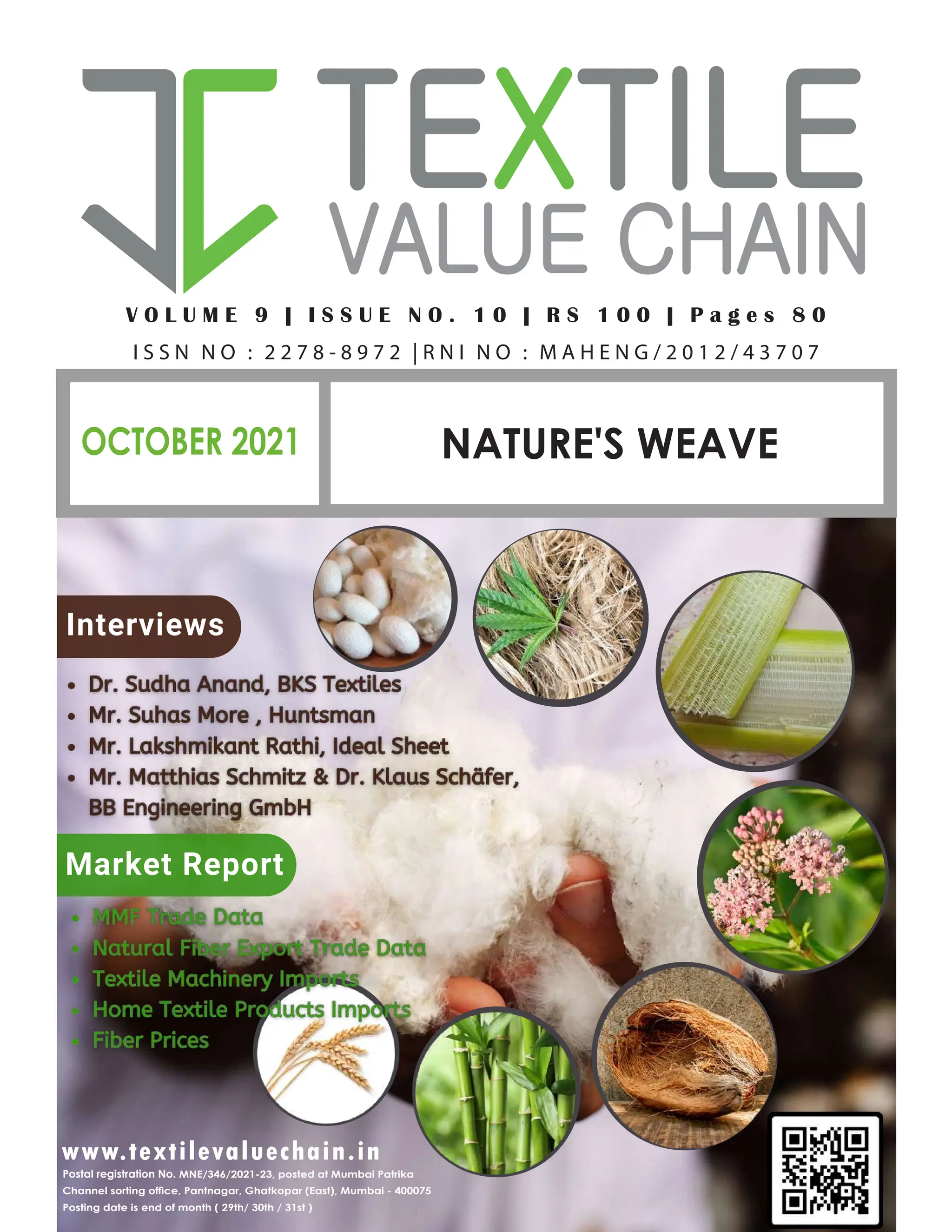
Interviews
Market Report
OCTOBER 2021
V O L U M E 9 | I S S U E N O . 1 0 | R S 1 0 0 | P a g e s 8 0
I S S N N O : 2 2 7 8 - 8 9 7 2 | R N I N O : M A H E N G / 2 0 1 2 / 4 3 7 0 7
www.textilevaluechain.in
NATURE'S WEAVE
Postal registration No. MNE/346/2021-23, posted at Mumbai Patrika
Channel sorting office, Pantnagar, Ghatkopar (East), Mumbai - 400075
Posting date is end of month ( 29th/ 30th / 31st )
Futuristic Twisting
Futuristic Twisting
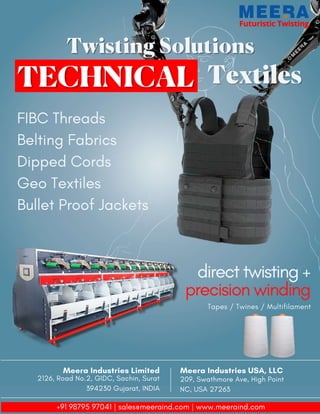
Twisting Solutions
Twisting Solutions
Textiles
Textiles
FIBC Threads
Belting Fabrics
Dipped Cords
Geo Textiles
Bullet Proof Jackets
direct twisting +
precision winding
Tapes / Twines / Multifilament
Meera Industries USA, LLC
209, Swathmore Ave, High Point
NC, USA 27263
Meera Industries Limited
2126, Road No.2, GIDC, Sachin, Surat
394230 Gujarat, INDIA
+91 98795 97041 | sales@meeraind.com | www.meeraind.com
For QUALITY Products from Europe and EFFICIENT Services in India
------------------------------------------------------------------------------------------------------------------------------------------------------
We represent in India the following Textile Machinery & Accessories manufacturers for
Technical Textiles :
LACOM GmbH, Germany : Hotmelt Laminating and Coating Systems – Multi
Purpose, Multi Roller, Gravure Roller and Slot Die for complete range of
Technical Textiles (Website: www.lacom-online.de)
MORCHEM S.A.U., Spain : PUR Hotmelt Adhesives for Technical Textiles, Solvent
Based, Water Based adhesives, cleaners and primers. (Website:
https://www.morchem.com/markets-and-solutions/textile-lamination/ )
Fibres, Waste Recycling & Nonwovens :
Margasa, Spain: Textile Hard Waste Recycling Lines -complete with preparation,
cutting, Storage, feeding, tearing, filtration and fiber packing. Peripheral
equipment, for nonwovens waste. Complete lines for “Airlay Nonwovens” with
thermo or resin bonding. Cotton Waste Cleaning Lines.
(Website: http://www.margasa.com)
FARE' S.p.A., Italy : Complete Lines for Spunbond / Meltblown nonwoven
products /complete line to produce all type of fibers including mono and
bicomponent including PET and PET fibers. Machines for producing Tapes and
Rafia (website : www.farespa.com)
Conventional :
Mariplast Spa, Italy : All type of Yarn Carriers for spun and filament yarns -
Cylindrical Tubes, Roving Bobbins, Ring Frame Bobbins, Cones and one time use
and Reusable Dye Tubes (Website: www.mariplast.com)
C + L Textilmaschinen GmbH, Germany : Reeling (Yarn Hank Forming) Machines,
steaming, Bulking and Banding Machines for yarns ( Rep.for Western and
Southern India) (Website: www.croon-lucke.com)
Contact : ASTRA TECH INDIA E-mail : info@astratech.co.in Website: www.astratechindia.co.in
Contact Person : Mr. Hemant Dantkale
Mobile : 98201 06018 Phone No.: 022-28516018 E-mail : hdantkale@astratech.co.in
HEAD OFFICE:
406, “Kaveri” Jagannath Mandir Marg, Opp. Holiday Inn, Near Sakinaka Metro Station,
Mumbai–400 072
Regd.Office:
B-404, Monarch Manor, 90 Feet Road, Dsouza Nagar, Kurla (West), MUMBAI – 400 072
Branch Office : Coimbatore : email: Coimbatore@astratech.co.in
COMING SOON
SSMS
PRODUCTION LINE
CONTENTS
ADVERTISER INDEX
COVER STORY
O C T O B E R 2 0 2 1
Back Page: Raymond
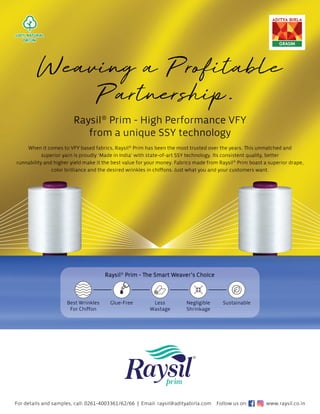
Back Inside: Raysil
Front Inside: Rimtex
Page 3: Meera Industries
Page 4: Colorjet
Page 5: LRT
Page 6: Astra Tech
Page 7: Sidwin Fabric
Page 8: Liva
Page 69: Savio
START-UP FOCUS
MANUFACTURING FOCUS
EXPORT FOCUS
FASHION FOCUS
9
RETAIL FOCUS
11 PIVOTAL:Innovative Strategic Relook at
Multiple Fibres - Mr. Suresh Kotak
14 Organic Cotton: A Sustainable Solution for
the Fashion Industry - Ms. Somasree Roy
16 Orange Fiber: The Fabric From Fruit- Ms. Annu
Jain
18 Clothing from Vegan Wool Fibres - Dr. N.N.
Mahapatra
21 Sustainable Fabrics to Transform the Fashion
Industry for Good
30 How Spinning And Recycling Go To-
gether At BB Engineering
PROCESSING FOCUS
37 Indian Stock Market Entering a New Era with
Start-ups Listing in Domestic Market
3910 Essential Skills to Become a Successful En-
trepreneur
41 Role Of Textile Smes In Achieving The Target
Of US $1 Trillion In Merchandise Exports -
Dr. Jagat Shah
28 Sustainability Via Innovation Is Huntsman’s
Major Focus
EVENT CALENDAR
23 Branding: The Main Component Of Textile In-
dustry - Dr. Sudha Anand
26 Signs Of Demand For Textile Industry Picking
Up: Rathi Laxmikant
INTERVIEW
32 Caustic Circularity-A Game Changer for The
Textile Industry - Mr. Vinay Patil
34 Hurdles and Roadmaps for the Manufactur-
ing Industry
SME FOCUS
36
Why Exclusive Emphasis On Manufacturing
Firms In MSME Sector Is Imperative To Trans-
form Indian Economy - Mr. Ronak Chiripal
STOCK MARKET
68Show calendar
43 Digital Fashion Trends and Avatars: The New
Era of Fashion
45Mexico’s Sustainable Fashion
POST EVENT REPORT
47Predictions 2021: How Vcom Can Change
Shoppers Behaviour
48ITAMMA Accepts New Normal Digitalized
World to overcome COVID
53Conference On Export And Market Opportu-
nities For Ichalkaranji Cluster
59Asian Textile Fibre Prices Move Higher In Oc-
tober
61Surge in Home Textile Imports of India
60MMF- Trade statistics
India’s Textile Machinery Imports Witnessed a
Hike
64
Natural Fibers Report
66
MARKET REPORT
Page 72: Sitex
Page 73: Yarn Expo Turkey
Page 74: Trutzschler
Page 75: Amritlakshmi
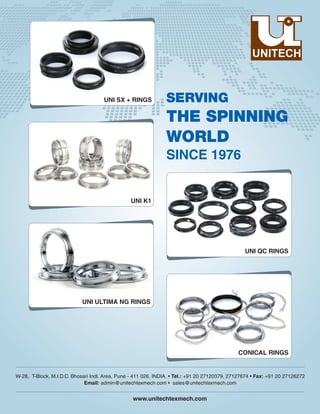
Page 76: Unitech
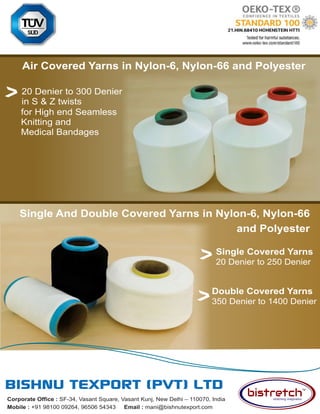
Page 77: Bishnu Texport
Page 78: Omax Cotspin
Page 70: Non Woven Tech
Page 71: Yarn Expo
JIGNA SHAH
EDITOR AND PUBLISHER
All rights reserved Worldwide; Reproduction of any of the content from this
issue is prohibited without explicit written permission of the publisher.
Every effort has been made to ensure and present factual and accurate
information. The views expressed in the articles published in this magazine
are that of the respective authors and not necessarily that of the publisher.
Textile Value chain is not responsible for any unlikely errors that might
occur or any steps taken based in the information provided herewith.
REGISTERED OFFICE
Innovative Media and
Information Company
189/5263, Sanmati, Pantnagar,
Ghatkopar (East), Mumbai 400075.
Maharashtra, INDIA.
Cell: +91-9769442239 /
+91. 9860634305
Email: info@textilevaluechain.com
innovativemedia012@gmail.com
Web: www.textilevaluechain.com
OWNER, PUBLISHER,
PRINTER AND EDITOR -MS.
JIGNA SHAH Printed and
Processed by her at, Impression
Graphics,
Gala no.13, Shivai Industrial
Estate, Andheri Kurla Road,
Sakinaka, Andheri (East),
Mumbai 400072,
Maharashtra, India.
SUBSCRIPTION
Digital + Print Copy issue
1 Year : 12 issues : Rs. 800
2 Years : 24 issues : Rs. 1500
3 years : 36 issues : Rs. 2100
Online Registration
https://textilevaluechain.in/subscription/
Subscription Enquiry
Ms. Vaibhavi Kokane
+91-9869634305 ; textilevaluechain123@gmail.com
Marketing and Advertising enquiry
Mohammad Tanweer
+91-9167986305 ; sales@textilevaluechain.com
EDITOR AND PUBLISHER
Ms. Jigna Shah
EDITORIAL TEAM
10
O C T O B E R 2 0 2 1
The Planet environment changes are affecting the health
of the population of the world; this is impacting the econ-
omy and the way of doing business worldwide, this is im-
pacting socio-cultural changes, overall affecting human
life. There are many “New Normal” that have come ear-
lier and more will come, and business will change its dy-
namics from time to time. As humans we need to change
and upgrade ourselves at all stages of life.
Economy comprises 3 business activities ie. Manufactur-
ing, Trading, Services.All the 3 businesses have their own
importance and can’t exist without one another. World is
becoming digital where integration of all 3 is very im-
portant. Manufacturing industries have a power, as they
have more capital investment in machinery, infrastruc-
ture, manpower and many more; Technical knowledge
requirement is of prime importance in manufacturing.
Today many corporates are outsourcing manufacturing
to SMES/clusters units and Corporates are mainly fo-
cusing on branding since that is a major tool to sell and
position a product in the market. Corporate Manufactur-
ing industry indirectly moving towards trading who are
focusing on selling the products brands through different
marketing channels. Common Facility Center for manu-
facturing is the new normal for Industry where SME /
Cluster based manufacturing units can take advantage
of the same. Trading in manufacturing function ie. con-
tract based manufacturing where the company is making
some other company products exists for marketing and
branding which only sells the products. Trading busi-
ness is done by individual entrepreneurs / self employed
who sell the manufactured product to domestic market
or international market , and marketing and sales intel-
ligence is required in trading business. Service industry
is the service requirement to run manufacturing and
trading industry of all business functions, service needs
more human touch, healing power and marketing skills.
Today, the Digital Era, where new Trading platforms cre-
ate a lot of marketing and selling opportunities and cre-
ated by online markets, manufacturers are increasingly
dependent on new channels, online platforms and many
more. Online platforms have their shares but currently it
is less than 10% on buying habits. Major chunk of busi-
ness is offline buying, and many online platforms are
also reversing their value chain by having physical stores
like nykka, chumbak and many more. Online Platforms
which are purely service oriented, timely distribution is
the most important key.
Industry dynamics are changing , so we are… !!!
E D I T O R I A L
Manufacturing
and
Brand Power
CREATIVE DESIGNER
Ms. Manali Bhanushali
CONTENT WRITER
Ms. Somasree Roy
ADVISOR - EDITORIAL & MARKETING
Mr. Samuel Joseph
11
C O V E R S T O R Y
O C T O B E R 2 0 2 1
PIVOTAL:
INNOVATIVE STRATEGIC RELOOK
AT MULTIPLE FIBRES
The reimagining the Global Textile In-
dustry and the opportunities for India
is timely and also critical. It is also im-
perative for us to assess and think in
this direction right away. We must get
into the state of sufficient and efficient
desire for excellence and get our right-
ful place in the global participation
prominently.
The government has rightly initiated
multi measures from all directions to
enable and empower this industry to
come up to global standards and be-
come a vital part of International tex-
tile chain with pre dominance.
The aim is to become alternative sup-
plier to cater to the global requirements
in terms of reach out, capacity building
and meeting global competition in tex-
tiles.
Various measures are in the direction
of positive initiations and encourage-
ment - technological upgradation, in-
frastructure scaling, adding and im-
provisations. It also addresses the skill
deficiencies and emerging environmen-
tal cautions, sustainable requirements
and adaptation to emerging world after
Corona pandemic.
The emerging geo political and environ-
mental requirements have been also
conducive for changing the dynamics of
Indian Textile Industry.
Very aptly and appropriately the tex-
tile community and the government
are thinking harmoniously to give total
uplift to the textile industry and make
it viable and acquire a significant sup-
plier role of textiles in the global con-
text. The new textile policy is also in
the wings.
Production Link Incentivization (PLI)
Augments Efficient Diversified Textile
Products
We have now significant encourage-
ments in various government schemes
along with PLI i.e. Production Linked
Incentivization. This is cardinal
scheme.
One of the most important considera-
tions which is being contemplated is
Focused Product Incentive Scheme
(under PLI). This would lead to prod-
uct diversification which is a sine – qua
– non to MAP and MATCH the global
product requirements. Global product
requirements are highly diversified
and specific.
This step could revolutionize our total
textile scenario and will make our tex-
tile industry SAMARTH and SAKSH-
AM to meet the global challenges.
The production oriented incentive ap-
proach of government is directionally
correct.
I believe that efficient supply which
gets clearly into diversification of the
products in terms with HS Codes de-
liberations with study of different prod-
ucts globally traded could be immense-
ly transformational.
I am also reminded by my relook at
economists JB Say’s law “Supply Cre-
ates Demand”. This reinforces my view
that strengthening supply chain is im-
perative, keeping in view the demand
axis. These measures will address itself
to the buyers requirements also.
The enhanced production capabilities
will satisfy the global requirements.
The result for India will be --- that
which is being sourced just now only
from one country will be alternatively
sourced from India also.
My endeavoured niched study in fol-
lowing paragraphs is more oriented
towards the Fibre Profile of India in
above context. The fibres strength is
pivotal for the resurge, reform and re-
boot of our textile industry. We have to
also introspect about our fibre endow-
ments which can really give us very
fundamental strength to come up to
greater and greater heights.
I need not emphasize but the raw ma-
terials are very foundational of any in-
dustry, not only textiles.
Rich Fibre Endowments of India
The strength of multi fibres that we
have today needs optimization and re-
search orientation will enable India to
come up with the grips and lead the
way to become an alternative textile
supplier to world markets.
In India’s case we have many strong
points about our fibre endowments. You
need to appreciate that our good fibre
endowments are PIVOTAL and FORE-
MOST for achieving dynamism in tex-
tile industry.
In the following paragraphs I would
like to invoke some thoughts on our Fi-
bres Endowments and how to invoke an
internal rise these strength as growth
proponents.
Chairman ,
Kotak Commodities
MR. SURESH KOTAK
12 C O V E R S T O R Y
Cotton
Today, India ranks as the biggest pro-
ducer of Cotton in the world. It also has
the highest acreage devoted to cotton
production but sill it has to import cer-
tain extra length staple cotton as well
as certain extra strength cotton and
contamination free cotton regularly.
We need to address our self to remove
this lacuna as well as other persisting
lacunas.
We need to ingest our strength of this
biggest and precious most raw material
endowment – raw cotton.
Cotton is not only of civilizational or
social value but also has immense eco-
nomic value which is unrealised and
not operationalized.
It has been researched by Techno Eco-
nomic Researchers that Cotton has
great potential power to resurge our
national eco system Metamorphically.
Cotton is a multi-component produce
and it has elongated utilizable supply
chain. This chain extends backward
and forward. The economics of this
value chain is still underutilized or not
sufficiently unfolded.
The cotton essentially is a bi-compo-
nent product. The cotton comes in an
unginned form having 2/3rd in form of
cotton seed and 1/3rd of raw cotton fi-
bre. Thus, it is a forward and backward
supply chain – one of cotton i.e. 33%
and 67% of oil bearing cotton seeds. A
Cotton seed is a huge oil economy and
it enriches cotton eco system. The total
cotton seed production averages 10mil-
lion tonnes of cotton seeds.
We need to appreciate work of CIRCOT
in this connection. CIRCOT, is a gov-
ernment organisation established in
1926 and has been relentlessly working
in the direction of cotton and other fi-
bre applications in different ways and
increase fibre efficiency in applications.
it researches in the technology aspects
with a view to develop, innovate fibre
applications.
CIRCOT works for different blends of
fibres with cotton and thus developed
wide spectrum fibre uses in association
with Cotton.
CIRCOT has many new innovated tex-
tile products for differing textile ap-
plications which can kick start many
many new textile goods unit, unique-
ness of which can give us primacy in
international; area.
I recommend everybody concerned with
fibre and textiles to become familiar
with CIRCOT and benefit. Even cot-
ton residues, plant residues like Stalks
have multiple uses as researched by
CIRCOT.
The residues in cotton chain like lint-
ers or seeds are highly utilizable and
can create enormous wealth and value.
The latest research is Nano Cellulosic
Material of high technical multiple ap-
plications out of cotton residues.
There is also an attempt by CIRCOT to
develop naturally coloured cotton.
I am connected with ISCI (Indian So-
ciety for Cotton Improvement) and In-
dian Fibre Society where retired and
active scientists of CIRCOT and other
fibre institutions work together with
industry and farmers to create condi-
tions and cultural promotion for our
fibre endowments.
Other Natural Fibres
India has endowment in various other
natural fibres such as Bamboo Fibre,
Fruit Fibres from Banana and Pine-
apple. Tree Fibres, like Kapok and
Ankund and coconut fibres like Coir
and some others. We also have animal
fibres like Wool and Silk. Bast Fibres
like Jute, etc. kindly refer to the total
fibre chart given at the end of fibre dis-
cussion to appreciate the rich over all
fibre endowments in India with prima-
cy of cotton.
All these natural fibres are document-
ed by FAO in a global meeting in 2009,
where I attended as Indian Represent-
ative and presented our heritage of dif-
ferent fibres. WE NEED TO UTILIZE
ALL THIS and develop very competi-
tive applications in development of in-
novative textile products.
Cellulosic Manmade Fibres.
We have pulpy woods which give us
cellulose and we are producing rayon
fibres out of that. The ongoing develop-
ments are that we can utilize natural
residues of Cotton, reutilization of tex-
tile fabrics (Lenzing has already done).
Mineral Fibres
The most important mineral fibre
which is derived from Hydrocarbons
is well known Polyester and other as-
sociative fibres like Nylon, Poly ethane
Acrylic and so on. There is a huge de-
velopment in this and it has captured
as a principal fibre globally.
INDIA IS THE SECOND LARGEST
PRODUCER OF MANMADE FIBRES
with world class organisation like Reli-
ance and Indo Rama, we produce good
amount of Polyester Fibre. WE ARE
QUITE ADVANCED IN THIS AREA of
manmade fibre production we still need
to develop many speciality manmade
fibre for our technical textiles and in-
dustrial applications.
This area of fibre is also our present
Strength to give diversified products
and production.
With all the advantages of having one
of the largest base of fibre availability
of different kinds, its applications in
terms of blend and product innovations
and its proper utilization is to be ad-
dressed without any delay or hesitancy.
We can augment our diversified re-
source advantage rapidly. The resource
advantage that we have, no other coun-
try has.
Refocus on Cotton as High Priority -
Significant most – pivotal material for
our textile economics.
With all this I recommend to enhance,
use and utilization of Cotton as piv-
otal fibre which has versatile uses and
untapped applications. We need to re-
search and innovate in this area by use
of genomics and other instruments of
bio technology, etc.
It is lamentable that our cotton endow-
ment has still not been taken full ad-
vantage of utilization and applications.
Indian cotton has the largest area un-
der single crop. It has a great propen-
sity to raise its productivity from 500
to minimum 2000kg per hectare. Actu-
ally the highest productivity has been
achieved upto 2000kg in Brazil, about
1200kg in China and in Pakistan hov-
ers around 900kgs.
O C T O B E R 2 0 2 1
India also has a great advantage in hav-
ing all the variety Cotton of different
counts but still we suffer on account of
contamination, adulteration and lower
parameters as compared to global cot-
ton for same count, etc. these lacunas
should be removed in the right earnest.
The cotton as a fibre is always open to
greatest degree of achievement and the
organic cottons can support bio diver-
sity and biological cycles
Organic Cotton
India can lead in the organic cotton. To-
day we are producing 59470 metric ton
i.e. 51% of global production, china with
22521MT which is 19%, Kirgizstan with
8019MT which is 6.8%, Turkey 7741MT
which is 6.6%, Tajikistan with 6405MT
which is 5.4%, USA with 4%, Tanzania
with 3%.
Organic farming in India is certified
under the NPOP i.e. National Program
for Organic Production. There are 200
producer goods in 8 states. The total
area under organic cultivation is 1,
72,180 hectare.
Let us realise that cotton has much
greater economics than presently seen.
It is not only a fibre crop but also an oil
producing crop. And each part of cotton
is commercially usable with great util-
ity and applications.
What an enormous amount of textile
opportunities we can create out of cot-
ton – our richest fibre endowment, we
still have to visualise comprehensively,
directionally and strategically.
Conclusion
The last world trade organisation’s eco-
nomic conference in Davos in 2018 has
defined the coming times of economic
change as setting of fourth industrial
revolution.
We have to realise that we have entered
the era of circular economy (reference
Davos 2018 McKenzie) the sustainabil-
ity and regenerative abilities of natural
fibres will play a great part and due to
environment demand is more of organic
natural fibres. Here cotton is already
well entranced in fabric of Indian econ-
omy can play pivotal dominant role.
We need to appreciate that the fibres
of synthetic origin requires enormous
level of energy and are manufactured
by different processes producing vary-
ing levels of greenhouse gas omission.
The global consumers are increasingly
becoming concerned about the environ-
mental impact on their lifestyle and
consumption pattern and are willing
to pay premium for textiles of organic
material.
It has been recommended that carbon
based products obtained by synthesis-
ing chemical or petroleum products
needs to be discouraged and go for more
of reuse of that material.
However, we should still utilize all the
fibres judiciously, aptly and with dis-
criminations and lead the spectrum
of fibre availability to invigorate our
new era for radicalization of our textile
power.
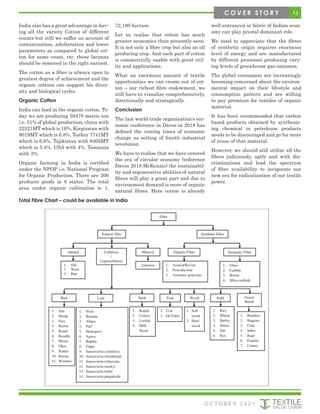
Total Fibre Chart – could be available in India
13
C O V E R S T O R Y
O C T O B E R 2 0 2 1
As people become more
aware of the environmental
impact that synthetic fibres
create, sustainable and en-
vironment-friendly materi-
als are being developed. The
development of these fibres
that can substitute synthetic
fibres has piqued the curios-
ity of researchers. As a result
of our collective awareness of
the fashion industry’s ecolog-
ical consequences, business-
es have begun to embrace
sustainable materials.
One of the most dramatic
changes has been the shift away from
traditional cotton. As an environmen-
tally friendly option, sustainable and
socially responsible businesses are now
adopting organic cotton fabric as well.
The process of production is less dam-
aging to the environment and humans.
Unlike the traditional style, which uses
synthetic pesticides and hazardous
chemicals, organic farming has a low-
impact approach.
What is Organic Cotton?
Organic cotton is a type of cotton that
has been grown naturally without us-
ing synthetic agricultural agents like
fertilisers or pesticides. In addition,
the crop is farmed without the use of
genetically-engineered organisms. Or-
ganic cotton cultivation’s ingredients,
agricultural procedures, and manu-
facturing techniques are environmen-
tally friendly as opposed to traditional
cotton growing. It was first cultivated
in the 1980s as a means of ensuring
sustainable, environmentally friendly,
and organic farming. Organic cotton
benefits human and environmental
health by promoting and enhancing
biodiversity, soil biological activity, and
biological cycles. Organic cotton is the
most skin-friendly, relaxing, and safe
natural fabric.
Application
• Organic cotton, unlike ordinary cot-
ton, is never sensitive to infant skin.
It’s the perfect material for covering
and cleaning newborns, especially for
producing garments, bandages, clean-
ing and disinfecting injuries, baby crib
bedding, baby outfits, towels, and a va-
riety of other items.
• It is used in making clothes. Bedding,
T-shirts, underwear, and even footwear
are all made using it. Ear swabs, cotton
pads, and sanitary napkins are among
the personal care products that contain
this substance.
• It can also be used effectively in pro-
cedures where infection from any cause
is potentially lethal.
• Organic Cotton Seed Oil, a residue
of organic cotton production, is widely
used in snacks and livestock feed.
Market Demand
Consumers are searching for apparel
that can exhibit more sus-
tainable manufacturing
practises. According to the
Textile Exchange’s Cotton
Demand Insights Report,
demand for organic cotton
would climb by 84 percent
by 2030, relative to a base-
line year of 2019/20. This
shift to organic cotton is a
positive step forward for
the fashion industry.
Tanzania (5%), Tajikistan
(4%), and the United States
were the top seven organic
cotton-producing countries
in terms of output, accounting for 95%
of global output (3%).
In 2019–20, two new nations — Uzbek-
istan and Myanmar — were added to
the list of organic cotton growers, with
at least three more likely in the coming
years.
Tanzania and Kyrgyzstan were the two
countries that contributed the most to
global growth in 2019–20, followed by
Uganda, the US, Pakistan, India, and
Turkey.
The Benefits of Organic Cotton Eco-
friendly
1. Eco-friendly
It is the outcome of a technique of agri-
culture that is both ecologically friendly
and efficient. Organic cotton production
emits less carbon since it consumes less
fuel and energy. It also minimises con-
tamination of water since it is produced
without using chemicals. The workers’
health is also not affected. Finally, the
production of organic cotton doesn’t in-
clude the excess usage of pesticides and
fertilizers, which damage the environ-
ment irreversibly.
14 C O V E R S T O R Y
ORGANIC COTTON – A SUSTAINABLE
SOLUTION FOR THE FASHION INDUSTRY
MS. SOMASREE ROY
Textile Value Chain
Key Points
• Organic cotton 1st cultivated in the 1980’s
• The process of production is less damaging to the environ-
ment and humans
• Organic cotton is a type of cotton that has been grown natu-
rally without using synthetic agricultural agents
• Organic cotton is the most skin-friendly, relaxing, and secure
natural fabric.
• Tanzania (5%), Tajikistan (4%), and the United States were
the top organic cotton-producing countries
• Uzbekistan and Myanmar were added to the list of organic
cotton growers in 2019–20.
O C T O B E R 2 0 2 1
2. Aids farmers in providing food for
their families.
Organic farmers always cultivate other
crops along with their cotton to achieve
a steady system on their farms that fur-
ther helps in keeping the soil healthy,
supporting wildlife, and conserving
topsoil. Cotton farmers may use these
crops to create a more secure, conveni-
ent, sufficient, and varied food supply
as well as an additional means of reve-
nue for their families and communities.
3. Less Water Consumption
When compared to traditional cotton,
the method of cultivating and growing
organic cotton uses less water. It also
minimises nutrient loss and soil degra-
dation, both of which contribute to wa-
ter contamination. Furthermore, the
organic system relies heavily on rain-
water for the growth of the crop.
4. High Ethical Standards
Organic clothing is safer since it is
made according to more stringent pro-
duction standards. It is done not just to
reduce adverse environmental impacts,
but also to ensure customer satisfaction
by adhering to high ethical values like
Fairtrade Cotton, the Better Cotton In-
itiative, FLO International, and other
global movements that support organic
cotton.
5. Ideal for people with Allergies and
skin problems.
Organic cotton fabric contains no chem-
ical residues, so anyone with allergies
or particular chemical sensitivities will
benefit substantially from wearing or-
ganic cotton clothes. It feels great on
the skin if you don’t have an allergy or
chemical sensitivity.Furthermore, most
people who swear by organic cotton
clothing claim that it smells good com-
pared to conventional cotton.
6. Extremely adaptable
You’ll be happy to know that organic
cotton textiles are a very natural fi-
bre that requires minimal care and is
highly adaptable when used in mak-
ing clothes. The durability of the cotton
fabric and threads is what makes them
excellent for all forms of apparel, so you
may use organic cotton for practically
any form of clothing. Organic cotton
is an excellent choice
for designing summer
outfits, t-shirts, and
blouses.
Drawbacks of Organic
cotton
• It’s possible that the
yields will be lower than
with regular cotton.
Lower yields can have a
variety of economic and
sustainability-related
implications and adverse reactions.
• In other cases, organic cotton may ne-
cessitate extra human labour.
• Converting to organic certification
can be a lengthy process (specifically
for farm conversions).
• Just a small proportion of all cotton
farmed is organic (because the demand
for organic cotton is also lower).
• Organic cotton clothes that are pur-
chased in stores may be more costly
than non-certified or normal cotton
clothes.
• Growing, producing, supplying, and
selling certified organic cotton may
pose some business risks for farmers,
manufacturers, and sellers.
Eco-friendly Techniques Used in Or-
ganic Cotton
• Synthetic fertilisers, insecticides,
herbicides, growth regulators, and
seeds with biotech characteristics are
forbidden and not used in the growing
or harvesting of organic cotton. Be-
cause organic cotton growers are not
allowed to use the same techniques as
traditional farmers, organic cotton re-
quires more effort.
• Every crop cultivation, including cot-
ton cultivation, necessitates fertile soil
with organic carbon. Crop rotations
with legumes, cover crops to preserve
soil during harvesting one crop and
growing the next, composting green
plant material to produce organic fer-
tiliser, and mulching are all methods
used in organic systems in order to im-
prove soil fertility. Fertilizer derived
from natural sources may be used to
boost fertility, while synthetic fertilis-
ers must be avoided.
• Organic cotton cultivation is a farm-
ing strategy that promotes the growth
of biodiversity in order to meet the re-
quirements of the crops. The use of lo-
cally adapted pest-tolerant varieties,
legume-based crop diversification, crop
rotations, and intercropping to preserve
soil health, organic sources of fertiliser,
and pest control based on prevention
by the use of natural enemies and trap
crops are all foundations of organic cot-
ton production.
The Future of Organic Cotton
Concerns about living a life free of in-
credibly hazardous chemicals, the need
for an environmentally friendly agri-
cultural and industrial culture, and a
growing consciousness about the deple-
tion of natural resources and their re-
percussions are all factors that are in-
fluencing people’s lifestyles around the
globe. The significance of organic cotton
is highlighted in this perspective.
Despite these obstacles, rising concerns
and laws about ecological sustainabil-
ity and safety will boost the market for
organic cotton. Customers are also get-
ting more prepared to pay for organic
items as they seek out more sustaina-
ble practices. As demand and prices for
cotton are once again increasing, the
future market for organic cotton looks
bright.
References:
• https://www.soilassociation.org/take-action/
organic-living/fashion-textiles/organic-cotton/
• https://www.sustainme.in/blogs/news/8-bene-
fits-of-organic-cotton-clothing
• https://indiantextilejournal.com/articles/fade-
tails.asp?id=644
• https://bettermeetsreality.com/pros-cons-advan-
tages-disadvantages-of-organic-cotton/
15
C O V E R S T O R Y
O C T O B E R 2 0 2 1
Introduction
Textile fibres could be made from natu-
ral and synthetic materials. Natural
fibres generally known as could be ani-
mal or plant fibres such as silk, mohair,
cashmere, cotton, jute, hemp, flax, coir,
etc., while synthetic would be nylon,
rayon, polyester, etc., which consti-
tute man-made fibres that are manu-
factured by artificial processes. There
have been others, like banana fibres,
from the plant but heavily processed to
make them usable to weave cloth. One
of the latest to join the bandwagon is
orange fibre, made from waste material
or the peel of the orange.
Orange Fiber is the first patented mate-
rial made from citrus juice by-products.
Citrus fruits are healthy and tasty, and
the worldwide production of oranges
is steadily increasing. However, in the
citrus fruit industry, processing that
float, for example to make it into juices,
also generates huge amounts of waste.
Lightweight Citrus cellulose yarn can
be used in its entirety to make a 100%
citrus biodegradable fabric that is soft,
silky, and lightweight.
It can also be blended with other ma-
terials and be opaque or shiny accord-
ing to the designer’s needs.The fibre is
made through a process that was inno-
vated in collaboration with Politecnico
di Milano University. [2]
Current Uses of Orange Peel Waste
•Oil Extraction
•Dyeing
•Antimicrobial finishing
•Mosquito repellent finish
•Print transfer medium
•Water purification
•Textile effluent waste
•Bio-adsorbent
•Biogas
•Bio-char [3]
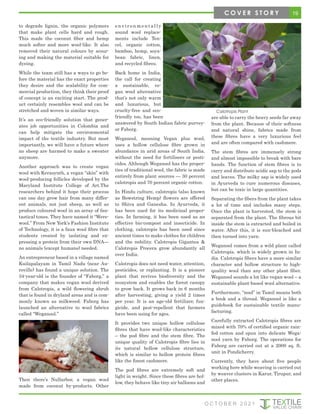
The Process
• The peels are processed with a pat-
ented method to extract the cellulose
that is spun to form the final yarn. The
fabric looks and feels like silk: soft to
the touch and with a shiny appearance.
The biodegradable yarn can be spun
with any type of existing yarn.
• Orange Fiber’s patented process
breathes new life into the pastazzo,
which is an atechnical term for what
is left over after squeezing the citrus
fruits.
The wet citrus residual, pastazzo, is
processed to be able to extract the cel-
lulose that will form the final yarn.
• A biodegradable material like silk is
produced: soft to the touch and shiny in
appearance, it is suitable to be woven
with any type of existing yarn.
Benefits of the orange fiber
• Orange Fiber is created from citrus
ORANGE FIBER -
THE FABRIC FROM FRUIT
Key Points
• Orange Fiber is the first patented substance obtained from citrus juice waste.
• Citrus cellulose yarn is lightweight and can be used in its entirety to create a
100% citrus biodegradable fabric that is soft, silky, and lightweight.
• The company made three prototype fabrics like lace silk, cream coloured satin
and Viscose fabric
Faculty,
Department of Textiles and Apparel Designing, Sir Vithaldas Thackersey
College of Home Science (Autonomous), SNDT Women’s University
MS. ANNU JAIN
Image no 1 - Salvatore Ferragamo Collection using Orange Fiber
16 C O V E R S T O R Y
O C T O B E R 2 0 2 1
juice by-products that would otherwise
be thrown away. This means that hun-
dreds of thousands of tonnes of orange
peels find good use as ethereal fabrics
perfectly suited to high-quality textiles
and fashion.
• Organic Orange Fiber Fabric is won-
derfully soft, cuddly, and strong. It
drapes beautifully, is anti-wrinkle, and
a plus point is that it comes in lots of
ranges and types, e.g.,crepe, satin, cot-
ton, etc.
• From the perspective of safeguarding
the interests of the environment, the
world’s production of waste materials
in the form of orange peels exceeds 700
tonnes per year. By utilising this waste
productively, it offers a solution.
•While a textile made from food may
seem a little unusual at first glance, the
idea has environmental and social ben-
efits as well as being a positive addition
to the fashion and textile industry. In
addition to being good for the environ-
ment, the textile is good for the body as
well, containing health properties.
• As it is made from citrus, the natural
oils within the fabric contain vitamins
A, C, and E.
Upon contact, these vita-
mins are released and ab-
sorbed through the skin.
• Aside from looking pretty
and feeling nice, the orange
yarn has an additional ben-
efit:
thanks to nanotechnology,
the material still contains
essential oils and vitamin C
that are present in the cit-
rus fruit peel.
• The skin absorbs these oils
and is nourished by them,
making the fabric a wear-
able body cream. According
to Orange Fiber, despite the
oils, the fabric does not feel
greasy. The oils are guaran-
teed to last at least twenty washing cy-
cles, but the company is experimenting
with recharging methods using special
fabric softeners.
• The company made three prototype
fabrics. The first is a lace silk in black
and white, the second is a cream-color-
ed satin from which clothes such as
summer dresses can be made, and the
third is a viscose-like fabric from which
clothes such as shirts can be made.The
citrus peel yarn has won several na-
tional and international awards.
• An orange fibre blended with silk pro-
vides a silken-feeling thread that looks
and functions just like real silk.
• The orange fibre can be dyed, printed,
and coloured to create whatever look
and feel we want.
• The new vitamin-enriched textile
represents a brand new opportunity in
high-quality textiles and fashion.
Conclusion
As per the call of the current scenario,
sustainable fibers are the need of the
hour. Orange Fiber & Fabric is the new
development made which is suitable as
per the market trends and also sustain-
ability & environmentally friendly. This
fiber which has also been used by Well
known Designer Salvatore Ferragamo
for his collection seems like the fiber of
the Present Time. Also these Sustain-
able fibers are indeed the fibers of the
Present & growing Future.
References
1. Fabrics from Oranges - interesting
and exciting. Retrieved fromhttps://
www.unnatisilks.com/blog/fabrics-
from-oranges-interesting-and-exciting/
2. Future of fashion: Innovative fabric
- Orange fibre. Retrieved fromhttps://
amberoot.com/blogs/blog/future-of-
fashion-innovative-fabric-orange-fibre
3. Sachidhanandham S. (2020). Textiles
from orange peel waste. Science & Tech-
nologyDevelopment Journal, 23(2):508-
516. DOI : 10.32508/stdj.v23i2.1730.
Retrieved from https://www.research-
gate.net/publication/340927840
4. Sheena S. (2019, October 13). Orange
Fiber - Sustainable Fashion made of
Orange Peel.Retrieved from
https://en.reset.org/blog/orange-fiber-
sustainable-fashion-made-orange-
peel-10142019
Image References
Image no 1 - Salvatore Ferragamo
Collection using Orange Fiber https://
www.livekindly.co/italys-orange-fiber-
sustainable-vegan-silk-cruelty-free/
Image No 2 - Process of Making Orange
Fiber -
https://www.unnatisilks.com/blog/
fabrics-from-oranges-interesting-and-
exciting/
Image no 3 - Fruit to Fiber -
https://www.linkedin.com/company/
orange-fiber-s.r.l./
Image no 4 - Orange Fiber process -
https://www.unnatisilks.com/blog/
fabrics-from-oranges-interesting-and-
exciting/
Image no 5 - Properties of textiles made
from orange peel waste https://www.re-
searchgate.net/publication/340927840
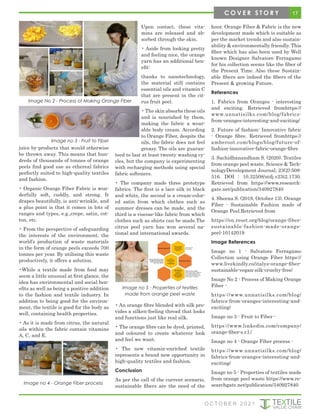
Image No 2 - Process of Making Orange Fiber
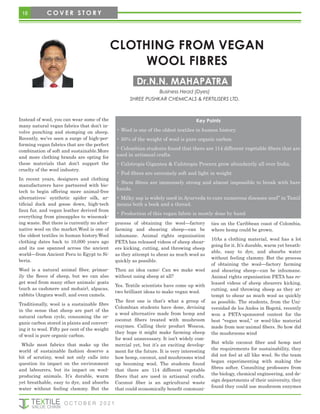
Image no 3 - Fruit to Fiber
Image no 4 - Orange Fiber process
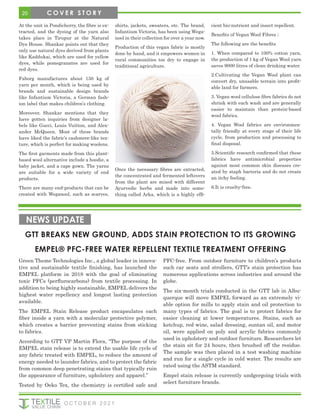
Image no 5 - Properties of textiles
made from orange peel waste
17
C O V E R S T O R Y
O C T O B E R 2 0 2 1
18 C O V E R S T O R Y
CLOTHING FROM VEGAN
WOOL FIBRES
Instead of wool, you can wear some of the
many natural vegan fabrics that don’t in-
volve punching and stomping on sheep.
Recently, we’ve seen a surge of high-per-
forming vegan fabrics that are the perfect
combination of soft and sustainable.More
and more clothing brands are opting for
these materials that don’t support the
cruelty of the wool industry.
In recent years, designers and clothing
manufacturers have partnered with bio-
tech to begin offering more animal-free
alternatives: synthetic spider silk, ar-
tificial duck and goose down, high-tech
faux fur, and vegan leather derived from
everything from pineapples to winemak-
ing waste. But there is currently no alter-
native wool on the market.Wool is one of
the oldest textiles in human history.Wool
clothing dates back to 10,000 years ago
and its use spanned across the ancient
world—from Ancient Peru to Egypt to Si-
beria.
Wool is a natural animal fiber, primar-
ily the fleece of sheep, but we can also
get wool from many other animals: goats
(such as cashmere and mohair), alpacas,
rabbits (Angora wool), and even camels.
Traditionally, wool is a sustainable fibre
in the sense that sheep are part of the
natural carbon cycle, consuming the or-
ganic carbon stored in plants and convert-
ing it to wool. Fifty per cent of the weight
of wool is pure organic carbon.
While most fabrics that make up the
world of sustainable fashion deserve a
bit of scrutiny, wool not only calls into
question its impact on the environment
and labourers, but its impact on wool-
producing animals. It’s durable, warm
yet breathable, easy to dye, and absorbs
water without feeling clammy. But the
process of obtaining the wool—factory
farming and shearing sheep—can be
inhumane. Animal rights organisation
PETA has released videos of sheep shear-
ers kicking, cutting, and throwing sheep
as they attempt to shear as much wool as
quickly as possible.
Then an idea came: Can we make wool
without using sheep at all?
Yes. Textile scientists have come up with
two brilliant ideas to make vegan wool.
The first one is that’s what a group of
Colombian students have done, devising
a wool alternative made from hemp and
coconut fibers treated with mushroom
enzymes. Calling their product Woocoa,
they hope it might make farming sheep
for wool unnecessary. It isn’t widely com-
mercial yet, but it’s an exciting develop-
ment for the future. It is very interesting
how hemp, coconut, and mushrooms wind
up becoming wool. The students found
that there are 114 different vegetable
fibers that are used in artisanal crafts.
Coconut fiber is an agricultural waste
that could economically benefit communi-
ties on the Caribbean coast of Colombia,
where hemp could be grown.
10As a clothing material, wool has a lot
going for it. It’s durable, warm yet breath-
able, easy to dye, and absorbs water
without feeling clammy. But the process
of obtaining the wool—factory farming
and shearing sheep—can be inhumane.
Animal rights organisation PETA has re-
leased videos of sheep shearers kicking,
cutting, and throwing sheep as they at-
tempt to shear as much wool as quickly
as possible. The students, from the Uni-
versidad de los Andes in Bogotá, recently
won a PETA-sponsored contest for the
best “vegan wool,” or wool-like material
made from non-animal fibers. So how did
the mushrooms wind
But while coconut fiber and hemp met
the requirements for sustainability, they
did not feel at all like wool. So the team
began experimenting with making the
fibres softer. Consulting professors from
the biology, chemical engineering, and de-
sign departments of their university, they
found they could use mushroom enzymes
Dr.N.N. MAHAPATRA
Business Head (Dyes)
SHREE PUSHKAR CHEMICALS & FERTILISERS LTD.
O C T O B E R 2 0 2 1
Key Points
• Wool is one of the oldest textiles in human history.
• 50℅ of the weight of wool is pure organic carbon.
• Colombian students found that there are 114 different vegetable fibers that are
used in artisanal crafts.
• Calotropis Gigantea & Calotropis Procera grow abundantly all over India.
• Pod fibres are extremely soft and light in weight
• Stem fibres are immensely strong and almost impossible to break with bare
hands.
• Milky sap is widely used in Ayurveda to cure numerous diseases nool” in Tamil
means both a book and a thread.
• Production of this vegan fabric is mostly done by hand
to degrade lignin, the organic polymers
that make plant cells hard and rough.
This made the coconut fiber and hemp
much softer and more wool-like. It also
removed their natural colours by scour-
ing and making the material suitable for
dyeing.
While the team still has a ways to go be-
fore the material has the exact properties
they desire and the scalability for com-
mercial production, they think their proof
of concept is an exciting start. The prod-
uct certainly resembles wool and can be
stretched and woven in similar ways.
It’s an eco-friendly solution that gener-
ates job opportunities in Colombia and
can help mitigate the environmental
impact of the textile industry. But most
importantly, we will have a future where
no sheep are harmed to make a sweater
anymore.
Another approach was to create vegan
wool with Kerasynth, a vegan “skin” with
wool-producing follicles developed by the
Maryland Institute College of Art.The
researchers behind it hope their process
can one day grow hair from many differ-
ent animals, not just sheep, as well as
produce coloured wool in an array of fan-
tastical tones. They have named it “Were-
wool.” From New York’s Fashion Institute
of Technology, it is a faux wool fibre that
students created by isolating and ex-
pressing a protein from their own DNA—
no animals (except humans) needed.
An entrepreneur based in a village named
Kuilapalayam in Tamil Nadu (near Au-
roville) has found a unique solution. The
34-year-old is the founder of “Faborg,” a
company that makes vegan wool derived
from Calotropis, a wild flowering shrub
that is found in dryland areas and is com-
monly known as milkweed. Faborg has
launched an alternative to wool fabrics
called “Weganool.”
Then there’s Nullarbor, a vegan wool
made from coconut by-products. Other
e n v i r o n m e n t a l l y
sound wool replace-
ments include Ten-
cel, organic cotton,
bamboo, hemp, soya-
bean fabric, linen,
and recycled fibres.
Back home in India,
the call for creating
a sustainable, ve-
gan wool alternative
that’s not only warm
and luxurious, but
cruelty-free and eco-
friendly too, has been
answered by South Indian fabric purvey-
or Faborg.
Weganool, meaning Vegan plus wool,
uses a hollow cellulose fibre grown in
abundance in arid areas of South India,
without the need for fertilisers or pesti-
cides. Although Weganool has the proper-
ties of traditional wool, the fabric is made
entirely from plant sources — 30 percent
calotropis and 70 percent organic cotton.
In Hindu culture, calotropis (also known
as Bowstring Hemp) flowers are offered
to Shiva and Ganesha. In Ayurveda, it
has been used for its medicinal proper-
ties. In farming, it has been used as an
effective bio-compost and insecticide. In
clothing, calotropis has been used since
ancient times to make clothes for children
and the nobility. Calotropis Gigantea &
Calotropis Procera grow abundantly all
over India.
Calotropis does not need water, attention,
pesticides, or replanting. It is a pioneer
plant that revives biodiversity and the
ecosystem and enables the forest canopy
to grow back. It grows back in 6 months
after harvesting, giving a yield 2 times
per year. It is an age-old fertilizer, fun-
gicide, and pest-repellent that farmers
have been using for ages.
It provides two unique hollow cellulose
fibres that have wool-like characteristics
– the pod fibre and the stem fibre. The
unique quality of Calotropis fibre lies in
its natural hollow cellulose structure,
which is similar to hollow protein fibres
like the finest cashmere.
The pod fibres are extremely soft and
light in weight. Since these fibres are hol-
low, they behave like tiny air balloons and
are able to carry the heavy seeds far away
from the plant. Because of their softness
and natural shine, fabrics made from
these fibres have a very luxurious feel
and are often compared with cashmere.
The stem fibres are immensely strong
and almost impossible to break with bare
hands. The function of stem fibres is to
carry and distribute acidic sap to the pods
and leaves. The milky sap is widely used
in Ayurveda to cure numerous diseases,
but can be toxic in large quantities.
Separating the fibers from the plant takes
a lot of time and includes many steps.
Once the plant is harvested, the stem is
separated from the plant. The fibrous bit
inside the stem is extracted and boiled in
water. After this, it is sun-bleached and
then turned into yarn.
Weganool comes from a wild plant called
Calotropis, which is widely grown in In-
dia. Calotropis fibers have a more similar
character and hollow structure to high-
quality wool than any other plant fiber.
Weganool sounds a lot like vegan wool – a
sustainable plant-based wool alternative.
Furthermore, “nool” in Tamil means both
a book and a thread. Weganool is like a
guidebook for sustainable textile manu-
facturing.
Carefully extracted Calotropis fibres are
mixed with 70% of certified organic rain-
fed cotton and spun into delicate Wega-
nool yarn by Faborg. The operations for
Faborg are carried out at a 2000 sq. ft.
unit in Pondicherry.
Currently, they have about five people
working here while weaving is carried out
by weaver clusters in Karur, Tirupur, and
other places.
Calotropis Plant
19
C O V E R S T O R Y
O C T O B E R 2 0 2 1
20
Green Theme Technologies Inc., a global leader in innova-
tive and sustainable textile finishing, has launched the
EMPEL platform in 2018 with the goal of eliminating
toxic PFCs (perflurocarbons) from textile processing. In
addition to being highly sustainable, EMPEL delivers the
highest water repellency and longest lasting protection
available.
The EMPEL Stain Release product encapsulates each
fiber inside a yarn with a molecular protective polymer,
which creates a barrier preventing stains from sticking
to fabrics.
According to GTT VP Martin Flora, “The purpose of the
EMPEL stain release is to extend the usable life cycle of
any fabric treated with EMPEL, to reduce the amount of
energy needed to launder fabrics, and to protect the fabric
from common deep penetrating stains that typically ruin
the appearance of furniture, upholstery and apparel.”
Tested by Oeko Tex, the chemistry is certified safe and
PFC-free. From outdoor furniture to children’s products
such car seats and strollers, GTT’s stain protection has
numerous applications across industries and around the
globe.
The six-month trials conducted in the GTT lab in Albu-
querque will move EMPEL forward as an extremely vi-
able option for mills to apply stain and oil protection to
many types of fabrics. The goal is to protect fabrics for
easier cleaning at lower temperatures. Stains, such as
ketchup, red wine, salad dressing, suntan oil, and motor
oil, were applied on poly and acrylic fabrics commonly
used in upholstery and outdoor furniture. Researchers let
the stain sit for 24 hours, then brushed off the residue.
The sample was then placed in a test washing machine
and run for a single cycle in cold water. The results are
rated using the ASTM standard.
Empel stain release is currently undgergoing trials with
select furniture brands.
GTT BREAKS NEW GROUND, ADDS STAIN PROTECTION TO ITS GROWING
EMPEL® PFC-FREE WATER REPELLENT TEXTILE TREATMENT OFFERING
At the unit in Pondicherry, the fibre is ex-
tracted, and the dyeing of the yarn also
takes place in Tirupur at the Natural
Dye House. Shankar points out that they
only use natural dyes derived from plants
like Kaddukai, which are used for yellow
dyes, while pomegranates are used for
red dyes.
Faborg manufactures about 150 kg of
yarn per month, which is being used by
brands and sustainable design brands
like Infantium Victoria, a German fash-
ion label that makes children’s clothing.
Moreover, Shankar mentions that they
have gotten inquiries from designer la-
bels like Gucci, Louis Vuitton, and Alex-
ander McQueen. Most of these brands
have liked the fabric’s cashmere-like tex-
ture, which is perfect for making woolens.
The first garments made from this plant-
based wool alternative include a hoodie, a
baby jacket, and a cape gown. The yarns
are suitable for a wide variety of end
products.
There are many end-products that can be
created with Weganool, such as scarves,
shirts, jackets, sweaters, etc. The brand,
Infantium Victoria, has been using Wega-
nool in their collection for over a year now.
Production of this vegan fabric is mostly
done by hand, and it empowers women in
rural communities too dry to engage in
traditional agriculture.
Once the necessary fibres are extracted,
the concentrated and fermented leftovers
from the plant are mixed with different
Ayurvedic herbs and made into some-
thing called Arka, which is a highly effi-
cient bio-nutrient and insect repellent.
Benefits of Vegan Wool Fibres ;
The following are the benefits
1. When compared to 100% cotton yarn,
the production of 1 kg of Vegan Wool yarn
saves 9000 litres of clean drinking water.
2.Cultivating the Vegan Wool plant can
convert dry, unusable terrain into profit-
able land for farmers.
3. Vegan wool cellulose fibre fabrics do not
shrink with each wash and are generally
easier to maintain than protein-based
wool fabrics.
4. Vegan Wool fabrics are environmen-
tally friendly at every stage of their life
cycle, from production and processing to
final disposal.
5.Scientific research confirmed that these
fabrics have antimicrobial properties
against most common skin diseases cre-
ated by staph bacteria and do not create
an itchy feeling.
6.It is cruelty-free.
C O V E R S T O R Y
NEWS UPDATE
O C T O B E R 2 0 2 1
SUSTAINABLE FABRICS TO TRANSFORM THE
FASHION INDUSTRY FOR GOOD
Textile Value Chain
Editorial Team
While the fashion industry is flourish-
ing, more attention is being drawn to
the industry’s extensive list of adverse
environmental effects. People are at-
tempting to make textiles and fashion
more sustainable and environment-
friendly since they grow more conscious
of the significance of conserving the
planet for future generations.
Shopping for sustainably created gar-
ments is one approach to assure a more
thoughtful purchase in the world of
conscious fashion. Because fast fash-
ion is produced at such a rapid speed to
satisfy demand, producers must rely on
virgin synthetic materials, which are
both inexpensive and quick to make.
But it is not only time to slow-down but
also to pay attention to our clothing la-
bels.
Now-a-days, several biodegradable
materials are being used to transform
the global fashion industry. These eco-
friendly materials and textiles are cre-
ated with cutting-edge technology that
eliminates the necessity of pesticides in
the clothing industry, also lowering to-
tal wastage of water, eliminating toxic
dyes and processing chemicals, and up-
cycling previously discarded fabrics.
To understand more about sustainable
fabrics let’s look at the definition of
‘Sustainable Fabric’.
What is Sustainable Fabric?
Sustainable fabrics refers to the fab-
rics that are created from natural or
recycled resources, such as sustain-
ably cultivated fibre crops or recycled
materials, with the goal of minimising
damage caused by the manufacturing
process, fibre qualities, or ultimate ef-
fect on the environment. Such fabrics
can also help with waste minimization,
conservation of water, carbon reduc-
tion, and soil restoration, as previously
stated, no fabric is completely sustain-
able.
With limited resources and fibres such
as acrylic, polyester, spandex and nylon
having adverse effect on the nature, it
is high time for the fashion industry to
take a glance at the sustainable solu-
tions and prove that textile and apparel
manufacturing is not going to harm the
environment from now on.
Even though there are numerous eco-
logically sustainable materials which
are revolutionising the fashion indus-
try, the following are some of the most
widely used fabrics in sustainable fash-
ion.
Hemp
Hemp is a type of cannabis plant that is
used for a variety of purposes. It grows
quickly, doesn’t degrade the soil, uses
a lot less water, and doesn’t need pes-
ticides. Hemp produces a long-lasting
fabric that does not cause irritation to
the skin and has a wide range of appli-
cations. It’s frequently substituted for
cotton and regarded as a carbon-nega-
tive raw material. Since this fabric has
a lot of benefits such as being naturally
UV resistant and antimicrobial, it is
usually more expensive and less acces-
sible to everyone.
Organic Cotton
Cotton farming uses a lot of harsh
pesticides, chemicals and significant
amount water only to make one clean-
ing item. There are nevertheless, more
environmentally friendly methods of
creating the fabric that consider the
larger ecology and natural habitats.
Organic cotton is one of such environ-
mentally sustainable fabrics available.
Organic cotton production utilises 62
percent less energy and 88 percent less
water than traditional cotton farming.
Organic cotton is grown without using
hazardous pesticides, synthetic fertilis-
Key Points
• Shopping for sustainably created
garments is one approach to assure a
more thoughtful purchase in the world
of conscious fashion
• Hemp produces a long-lasting fabric
that does not cause irritation to the
skin and has a wide range of applica-
tions.
• Organic cotton production utilises 62
percent less energy and 88 percent less
water than traditional cotton farming.
• Lenzing, the firm that invented TEN-
CEL™, uses eucalyptus wood, which
grows without the use of hazardous
chemicals or insecticides.
21
C O V E R S T O R Y
O C T O B E R 2 0 2 1
22 C O V E R S T O R Y
ers, or seeds that have
been genetically modi-
fied (GMOs).
Linen
Linen is a plant-based
natural fibre which
has been used in the
production of cloth-
ing for centuries. The
grass-like fibres need
to be grown, treated,
and processed for
months before they
are soft and supple
enough to be weaved
into garments. When
discarded, Linen will
biodegrade, offering
a more environment-
friendly alternative.
It is a super soft and
breathable textile de-
rived from flax plant and is frequently
blended with cotton. Linen is regarded
one of the most sustainable fabrics used
presently in the production of clothing
and bedding.
Bamboo
Bamboo is one of the fastest-growing,
regenerative plant which doesn’t need
fertilisation and is frequently promoted
as a sustainable fabric. Micro holes and
tiny gaps are there in the fibre, allow-
ing for better moisture absorption and
ventilation than other fibres. Sustain-
able brands prefer bamboo fabric since
it is extremely comfortable and absor-
bent. Just like Hemp.
Bamboo too absorbs more CO2 than
some trees. It doesn’t need a lot of re-
sources and can survive just on rainwa-
ter.
Tencel
TENCEL™ is one of the most innova-
tive fibres in the market today. Lenz-
ing, the firm that invented TENCEL™,
uses eucalyptus wood, which grows
without the use of hazardous chemicals
or insecticides.
TENCELTM is one of today’s most ad-
vanced fibres. Eucalyptus trees use
relatively require less land than cotton
to produce the same amount of textile.
TENCEL™ yarn is also made using
100% renewable energy and consumes
80% less water than conventional yarn.
Piñatex
Although it may seem impossible, pine-
apple leaves can be used as a vegan
substitute for leather. Ananas Anam,
a London-based company, has created
Piñatex, an organic, non-woven leather
substitute created from cellulose de-
rived from pineapple leaves that looks
and feels like leather. Pineapple leaf
fibres, a by-product of the Philippines’
pineapple harvest, are used to create
the revolutionary pineapple fabric.
Its manufacturing process is far more
eco-friendly and cruelty-free than tra-
ditional leather. It uses less water and
does not include any dangerous chemi-
cals that are damaging to wildlife in the
environment. The remaining leaf waste
is composted or utilised as fertiliser.
Modal
Another semi-synthetic fabric noted for
its superior comfort and breathability
is modal. It’s a cutting-edge fabric cre-
ated from spinning cellulose from the
beechwood tree. As beechwood trees re-
generate on their own, they’re regarded
as a long-term raw material for making
the revolutionary modal fabric.
The fabric is also 50% more absorbent
when compared to cot-
ton has a silky, smooth
texture, thus making
it a suitable option for
sports and underwear
manufacturers.
Modal’s manufacturer,
Lenzing, has also de-
veloped non-toxic and
ecologically friendly
techniques which al-
low it to recover up to
95 percent of the ma-
terials utilised in its
production, lowering
the textile’s overall
carbon emissions.
Final Thoughts?
Poor fabric selection is
a major contributor to
unsustainable fashion.
Many of the elements
that end up in our clothes are harm-
ful to humans or animals (sometimes
both). In addition to the toxic chemicals
and micro - plastics that they discharge
into the environment for years.
By stocking your closets with most of
the sustainable textiles featured here,
you can contribute to make the world a
better place by purchasing eco-friendly
and organic garments.
References:
https://www.thegoodtrade.com/fea-
tures/sustainable-clothing-fabrics
https://www.thewellessentials.com/
blog/5-sustainable-and-eco-friendly-
textiles
https://www.curiouslyconscious.
com/2019/12/which-fashion-fabrics-are-
most-sustainable.html/
https://www.sustainablejungle.com/
sustainable-fashion/sustainable-fab-
rics/
https://fashionunited.com/news/
business/6-sustainable-textile-innova-
tions-that-will-change-the-fashion-in-
dustry/2017100917734
Source: Luxiders.com
O C T O B E R 2 0 2 1
BRANDING: THE MAIN
COMPONENT OF
TEXTILE INDUSTRY
BKS Textile Company, a leading
manufacturer and exporter of made-
ups and cotton fabrics, was incorpo-
rated on February 12, 2004 with an
authorised capital of Rs. 99.80 lakh.
Located at Palladam in Tamil Nadu,
the BKS company is a pioneer in
home textiles and technical textiles.
BKS Textile Company, which is
family-run, was started by Sen-
thil Kumar, a well-known name in
the textile industry in South India.
Dr Sudha Anand, his daughter is
the Managing Director. Dr. Sudha
Anand, Medical Doctor by education
realised being an entrepreneur is
more interesting than a medical pro-
fessional joined her family business
in 2005. She virtually learnt
a lot of things about textiles
from her father and was tech-
nically trained by him. Sen-
thil Kumar originally started
BKS Textile Company in
1985 in Tirupur near Coim-
batore in Tamil Nadu which
today has emerged as a ver-
tically integrated manufac-
turer and exporters of home
textiles, mainly bed linen employing
over 1000 employees.
The Chairman and Managing Direc-
tor Senthil Kumar’s another daugh-
ter, Sangita Velkrishnan is also in-
volved in the working of the company
and Senthil Kumar who is involved
in strategy decisions, was formerly
Chairman of South India Mill Asso-
ciation (SIMA) and also he actively
participated in textile organisations
like TEXPROCIL, and many more.
Dr Sudha Anand replies to some vi-
tal questions about the company. Ex-
cerpts below:
Journey till now …
I started international marketing for
the company, with nearly 95%of our
business in exports, we have a lot of
international and long-standing cus-
tomers. The UK is a major market
for us and I continued my career in
marketing and branding. We devel-
oped a domestic brand called SVAS
in 2012 for the Indian market for
home decor and lifestyle products.
I did some courses in management
area and I am still learning because
learning can never stop. The journey
is quite interesting and our business
growth is quite stable and gradual
because we believe in sustained
growth. We are looking forward to a
great future.
Marketing Management Tech-
niques
We have unique selling points like
how we are different from our com-
petitors. BKS textiles is sustainabil-
ity-oriented company. We have ac-
quired a lot of company certificates
like ISO 9000, ISO 14000 and SA
8000 for social accountability. We
are a member of the BCI cotton and
many more. We have built the trust
among the customers, who always
look for reliability and trustworthi-
ness of suppliers.
All our manufacturing practices are
very responsible and we give more
importance to manufacturing prac-
tices. For instance, our dyeing
unit follows zero liquid dis-
charge (ZLD) principle and we
have also installed wind power
generating technology. Besides,
we also worked with non-profit
organisation for plantation and
are increasing green cover in
the city in our drive towards
sustainable manufacturing.
Communication and interac-
tion are very important. We stay in
touch with industry peers and keep
physical interaction with other in-
dustry. Moreover, we attend textile
forums and meetings so it will be
much helpful for getting ideas about
current issue or trend.
I totally believe in empowering peo-
ple who take their decision indepen-
Managing Director,
BKS Textile Company
DR. SUDHA ANAND
Key Points
•BKS textiles is a sustainability-oriented company
•Communication with customers stays as top priority
•Employees are given a say in decisions
•Research & development given due importance
•Marketing plays a key role in its success.
•Cost Cutting in difficult times is vital.
23
I N T E R V I E W
O C T O B E R 2 0 2 1
24
dently, and depending on their hi-
erarchy, they should be given right
skills and training to handle their job
effectively. Also, I believe in encour-
aging and energising people with the
best possible ways in this time.
Confidentiality is a big challenge
when you want to differentiate your-
self from the competitors. So, we
have non-disclosure agreement from
our employees who are involved in
product development, marketing and
sales. We have a strict NDA policy.
We choose people based on attitude
not only the skills. I believe people
with the right attitude always re-
spect confidentiality in the effort
that is gone beyond or behind inno-
vating some products or something
companies specialising in.
We have some controls in our soft-
ware wherein only particular people
get rights and access about certain
information. For example, market-
ing team can access only custom-
ers related information, production
team accesses only production re-
lated information so they won’t have
any other information access.
Technology helps to maintain Con-
fidentiality in the organisation like
give right information to right peo-
ple.
Covid times and BKS approach
During the 1st wave of COVID-19 no
one had any clue about what is go-
ing on. Even we don’t have any idea
about how to run a manufacturing
business in this difficult time and
Covid badly affected our company’s
reputation and mainly finance was
very much hit.
We decided to increase our inhouse
employees strength to about 70℅
against 30% for outside employees.
After the lockdown we were not al-
lowed to bring in people from out-
side. After learning a lesson from the
1st wave, we quickly adopted and in-
creased our recruitment of in-house
employees. Now we have 95℅ in-
house employees and we have proper
control over there. All facilities are
now available like vaccination for
getting proper protection.
This major move helped us in the
2nd wave. When there was a severe
lockdown, not only did our work kept
going, but we were ready to face
every challenge. We were in contact
with our customers catering to their
needs from time to time.
Motivation goes a long way. I always
believe in small appreciations. Any
bigger or smaller task, there will be
small appreciation from the company
or from the management. We totally
believe in challenging targets, but
achievable targets to our employees.
It is a very positive way to motivate
people or employees and it’s really
helpful.
Steps for success
Increasing efficiency and productiv-
ity of the company mean cost must
go down. In order to improve the pro-
ductivity, we have micro skill train-
ing to our employees, like sewing is a
micro skill so techniques under that
and how to place. After Micro skill-
ing productivity totally went up and
cost came down and also, we encour-
age production incentives and give
prizes which help to motivate people
to achieve more productivity. Once
productivity is increased then rev-
enue also goes up.
Other strategy is we always take
a call on a particular process -- ‘we
make or we buy’, whichever is cheap-
er we go with it so cost always mat-
ters. This choice helps in cost cutting
and increasing productivity.
Success means to me is to build sus-
tainable and profitable enterprise,
which is growing continually.
I believe strong branding is required
for company’s sustainability and so
the intention behind to starting our
own brand for Indian market. There
is a lot of B2B business brands to be
seen as a business competitors. We
focus more on branding and also con-
tinuous growth. If profitability is not
there and stagnancy in growth which
hit our business means failure to me
Being a director of this company
gives me lot of opportunity to meet
people and know things in the inter-
national arena.
It is very challenging and makes in-
teresting also. I am on this position
of being one of the directors of the
company to impact on many people
lives in a positive way. My every de-
cision impact everyone so that’s what
I like as being a director.
The Branding Strategy
Developing brands is the most im-
portant strategy. We are focusing
on developing domestic brand which
helps to see differently in custom-
ers view and also, we are present
on the strong, new E platforms and
we plan to diversify into neighbour-
ing countries with our brands and so
branding and digital presence and e
commerce selling platforms are very
important in these times.
We have a work management sys-
tem implemented in our team and
we have action plan once a project is
decided so there is a macro planning
as well as micro planning format.
Planning is important because it is
70℅ of a project and once planning is
done, execution has to be monitored
meticulously with regular reviews.
So planning and regular reviews are
very important.
Research & Development
We would like to go with sustainable
products so that all our product de-
velopment and research efforts will
go into that area.
We want to bring in more sustain-
able products under our umbrella.
We are in the process of building the
right technical team so that soon we
will be able to reach our goal.
Pandemic badly affected our busi-
ness. So, we are focusing on reduce
inventory and cost cutting and we
kept in touch with our customers on
regular basis.
We were not able to meet our cus-
tomers physically and so we were
having regular video conference
and meetings with our customers to
know what is the situation in their
country, in their company, or in their
State. We also explained our situ-
ation to the customers so that con-
stant communication between us is
I N T E R V I E W
O C T O B E R 2 0 2 1
really helpful to keeping the rela-
tionship maintained during the pan-
demic time.
Once we know what’s happening in
the customers side then we will be
prepared in our side also. For e.g.,
(If the customer says his sales have
slowed then we delay the deliveries
and once the customer says his sales
have picked up, we will ramp up the
sales and improve the delivery dates)
The future growth measures
We want to increase our in-house
manufacturing capacity to keep con-
trol on quality and the cost and we
tie up with the more retail chains
and we like to develop our domestic
brand SVAS in the Indian market
and presence in digital platforms.
This is now top priority for us.
We want to diversify into wider with
processing which is underway and
we will be bringing the union corpo-
ration by mid of 2022 and we want
to increase our in-house sewing ca-
pacity. Due to these steps, we will
be increasing marketing footprint in
many countries.
Today, the young generation thinks
and feels that textile is a very old
fashion industry.
When I meet a person who is confused
about choosing between textile and
any other field, I will boldly say that
demand for the textile will never go
away as it is a product that’s required
by everyone in the world throughout
the year. Besides through the textile,
we give employment to many people
in India because textile is the second
most employment generation field
next to agriculture. This will give a
positive impact on their lives.
Today, there are many branches in
the textile field, including research
and development and innovation so
research and development going on
big way for e.g., a lot of new products
are coming up like carbon fibre, ba-
nana fibre, hemp, organic cotton and
so there is plenty of opportunity in
textile field. And technical textile is
very ancient in India so that young
generation can focus more on tech-
nical textiles because opportunity is
unlimited. Besides consumers prefer
less to buy from China so that India
stays as the second largest manufac-
turer and exporter in textile. India
has very good future in textile.
GKD GENERATES GREAT INTEREST IN ITS SOLUTIONS FOR THE
NONWOVENS INDUSTRY
NEWS UPDATE
Returning after an 18-month break, the
INDEX exhibition in Geneva enjoyed a
large number of visitors, a good over-
all atmosphere, and clearly discernible
investment interest. Over 500 exhibi-
tors from 44 countries showcased their
products at the world’s largest nonwo-
vens exhibition.
Special topography and short deliv-
ery times
The new GKD CONDUCTIVE 2215
process belt material – a cross twill
weave produced from special polyester
filaments for airlay and meltblown non-
woven forming – received extremely
positive feedback. Here, carbon-coat-
ed filaments ensure secure discharge
of unavoidable electrostatic charges
which occur during forming processes.
The innovative interaction of material
choice, filament diameter, weave tech-
nology, and air permeability also cre-
ates a special texture to the new form-
ing fabric from GKD. It guarantees
precise and homogeneous nonwoven
deposit, while at the same time deliver-
ing good extraction and a minimized
risk of fiber entanglement or loss.
Glass hybrid lightweights with anti-
stick coating
The glass hybrid fabric belts with anti-
stick coating for sophisticated thermal
bonding processes were a second attrac-
tion to visitors at the GKD trade fair
stand. Numerous existing and prospec-
tive customers took the opportunity to
learn about the reinforced fabric design
of this belt type, which was being pre-
sented at INDEX for the first time.
Thanks to their single-ply mesh de-
sign, employing stainless steel wires
in the weft direction and warp wires
produced from fiberglass strands, they
are energy efficient lightweights and
thereby particularly economical in use.
This cost effectiveness is achieved by a
significantly higher production speed,
a service life that extends over sev-
eral years, and minimized cleaning in-
tervals. The complete PFA coating of
wires, strands, and intersections espe-
cially qualifies this belt type for highly
adhesive products or those with great
shrinking forces. With the further rein-
forced fabric design – available in both
magnetic and non magnetic form – the
already excellent properties of cross
stability, tracking stability and service
life have been further improved.
Field-proven products for drying and
filtration
The seamless spiral belts produced by
GKD also proved to be popular problem
solvers at the INDEX exhibition.
The products showcased by GKD at the
exhibition were rounded off by metal
filter media for central filters and spin-
ning beams, as well as blower screens
for polymer filtration.
Many users and machine builders took
the opportunity to get a close up look
at the high performance product range
of the world’s leading technical weavers
and directly discuss concrete challeng-
es in nonwoven production with the ex-
perts from GKD.
25
I N T E R V I E W
O C T O B E R 2 0 2 1
SIGNS OF DEMAND FOR TEXTILE INDUSTRY
PICKING UP: RATHI LAXMIKANT
The Ideal Group is a pioneer in the man-
ufacturing of spinning parts, which in-
cludes sipping tubes, bobbins and hold-
ers, and also dyeing cheese and cones.
The company recently returned from a
successful participation in a physical
exhibition, CAITME 21, in Tashkent.
In an exclusive and concise interview,
Mr. Rathi Laxmikant, President– Sales
and Marketing, Ideal Group, speaks to
the Textile Value Chain. excerpts
What has the response been to the
industry, and particularly to Ideal
Group’s products, now that you have
returned from the first physical exhibi-
tion, CAITME 21, in Tashkent, Uzbeki-
stan?
Rathi Laxmikant: Because of the over-
all good demand, the textile and cloth-
ing industries are having the best of
times. In the last 8–10 months, robust
demand has been observed across all
sectors and across all major markets.
Due to the positive business environ-
ment, there is a lot of enthusiasm in the
industry for innovation and new devel-
opments. The CAITME 21 was placed
exactly during this positive time and,
therefore, the response from the indus-
try was excellent.
Of course, the start was a roller-coaster
ride with a lukewarm response from
the exhibitors. There were many chal-
lenges due to COVID-19 protocols, like
travel restrictions, limited flights, etc.
But, the focused exhibitors decided to
go ahead and make it a huge success.
Ideal presented the following products:
• HIG and Slim HCC spinning tubes.
• The most reliable simplex bobbins
• The Millennium series bobbin holders
• The dyed cheese and cones
The products offer unique advantages
over their competitors. For example,
the bobbin falling from the Bobbin
Transport System is a unique issue,
and Ideal’s Millennium series bobbin
holders provide a complete solution to
the same. Similarly, the high-impact
ABS simplex has higher strength and
stability compared to the PP simplex,
which is used in this market.
Do you feel that physical exhibitions
will be a reality now, especially in
2022 and beyond?
Substantiate with what you saw on the
13th CAITME.
Rathi Laxmikant: Virtual exhibitions
can’t replace physical ones. The per-
sonal interactions add a lot of value
and create the perfect dialogue. During
CAITME 13, we could feel the custom-
er’s expectations and, thus, were able
to offer the best possible solutions. I
have no doubt that physical exhibitions
will be a reality in 2022 and beyond.
How did the Ideal Group fare during
the nearly two years when the pan-
demic CONVID-19 was at its peak
worldwide?
Rathi Laxmikant: The time was chal-
lenging, and such a time is the best
to introspect, take stock of the situa-
tion, and improve. I think challenges
like these bring new opportunities.
Key Points
• Due to the positive business environment, there is a lot of enthusiasm in the
industry for innovation and new developments.
• The products offer unique advantages over their competitors.
• The high-impact ABS simplex has higher strength and stability
• We have launched a completely new Millennium series of bobbin holders
• Central Asia is blessed with excellent quality cotton for coarse and medium
counts.
26 I N T E R V I E W
O C T O B E R 2 0 2 1
Ideal has done a lot of work on prod-
uct and process improvement. We have
launched a completely new Millennium
series of bobbin holders along with
some other products. The upgrade of
the Hi-Tech lappet hook to Ultratech
brought in many more opportunities
too. Similarly, the use of digital com-
munication helped us spread our wings
in new markets.
How has the group fared in exports
during this time?
Rathi Laxmikant: We can call it a bless-
ing in disguise. We could get in contact
with different markets through various
digital channels and establish our pres-
ence there.
Which are the major segments, you
think, that hold good prospects in the
Central Asian markets?
Rathi Laxmikant: Central Asia is
blessed with excellent quality cotton
for coarse and medium counts. Invest-
ments in spinning will continue at the
same pace for the next few years. At
the same time, countries like Uzbeki-
stan have started encouraging invest-
ment in further processes to strengthen
the textile value chain. Investment in
knitting, dyeing, and also weaving will
gather more momentum in the coming
months.
Will your company be exhibiting at
major exhibitions in 2022? What is the
strategy for the near future?
Rathi Laxmikant: We are interested in
participating in major exhibitions like
India ITME, ITMA Europe, etc. and
displaying our new range of products.
What was the take-home message
from the CAITME 2021?
Rathi Laxmikant: CAITME was a suc-
cessful event due to the good participa-
tion from industry entrepreneurs and
technocrats. The COVID protocols en-
sured the safety of the participants.
ITALIAN TEXTILE MACHINERY:
THIRD QUARTER 2021 REMAINS POSITIVE FOR NEW ORDERS
NEWS UPDATE
The index of orders intake for Italian textile machines, as
compiled by ACIMIT, the association that groups together
Italian textile machinery producers, rose by 66% for the peri-
od from July to September 2021 compared to the same period
in 2020. The value of the index stood at 119.8 points (basis
2015=100). This growth has concerned both the Italian and
foreign markets, with an increase in domestic orders of 130%
compared to the same period in 2020, and up 54% for foreign
orders.
However, the index of orders intake shows a -17% drop when
compared to the previous quarter this year, due mainly to
the summer break and a demand for machinery that has sta-
bilized over the last few months.
ACIMIT President Alessandro Zucchi says regarding these
figures, “Overall, the numbers for new orders remain posi-
tive, in spite of a slight decline compared to the months
prior to the summer period.
This proves that Italian companies have been capable of
responding quickly to new market conditions, as has often
happened in other historical periods. The ability to adapt,
coupled with a remarkable flexibility, are part of our DNA as
Italian businesses, not just in our specific sector”.
This positive moment for Italy’s textile machinery sector is
expected to continue through to the year’s end, as ACIMIT’s
analysis notes. Indeed, Italian machinery manufacturers
are forecasting an increase in the orders intake for the last
quarter of the year, both abroad and domestically. ACIMIT’s
President concludes: “The resumption in trade show attend-
ance we’ve witnessed has improved the climate of confidence
among companies.
However, we need to make the most of this moment, since
the difficulties are not yet entirely behind us. In particular,
we must continue on the path of digitalisation and sustain-
ability”.
27
I N T E R V I E W
O C T O B E R 2 0 2 1
Be it digital technologies or self-reliance, Huntsman Corpo-
ration, a leader in dyestuff industry, has made rapid strides.
Mr. Suhas More, Commercial Director at Huntsman Corpo-
ration speaks to the Textile Value Chain in an exclusive in-
terview about the steps the company has taken during the
present pandemic times, and also the future plans and strat-
egies.
Excerpts:
How did Huntsman manage during the pandemic times,
esp. what were the steps to overcome the crisis?
Suhas More: One thing the pandemic has taught us is that
being agile and flexible will always be critical. While the
Covid-19 outbreak has proven to be a huge disruptor, it has
also provided us with an opportunity to innovate and rein-
vent ourselves. For instance, we have leveraged technology
to remain connected with our customers and developed cus-
tomized products to cater to their evolving needs. As the cri-
sis continues, it has become evident that identifying effective
ways of working, collaborating, and challenging the status
quo is the only way forward for the chemical industry. To
become a USD300 billion industry by 2025, it is imperative
that we continue building on our R&D capabilities, invest in
the right talent, and leverage new opportunities as well as
technologies to ensure sustained growth for the sector.
The safety of our employees and partners remains our top-
most priority. With the situation now returning to normalcy
along with the administration of vaccines, we continue to
take all the necessary precautionary measures to help curb
the spread of infection.
What are the steps it took to automate/digitalise the com-
pany in the dyes & intermediates sector?
Suhas More: Applying digital technologies is becoming a
strategic imperative in the chemical industry, it opens up
a brighter future with ample opportunities for us. The first
and the most important step is to have a proper road map.
Leading companies are introducing new organizational ap-
proaches to digitalization, as they see value across their
portfolios and align their organizations to best capture the
advantages.
Digitization is the need of the hour and is inevitable the pro-
cess might be slow, but the goal will be achieved. With the
GOI’s Aatma Nirbhar Bharat, and Digital India.
The chemical industry saw a rapid wave of digital growth
during the pandemic which has accelerated the process of
digital adoption.
Artificial Intelligence (AI) and big data have possibly the
most potential to disrupt every aspect of a chemical compa-
ny’s business model, from research and development to cus-
tomer interaction, operations to compliance and shareholder
value to social responsibility.
However, robotics and its adoption in Indian chemical indus-
try will be gradual given the economics and availability of
skilled/semi-skilled labor compared to developed countries.
Nevertheless, its value is evident in super skilled and high
precision work (viz electronics, auto, 3D printing, etc.).
What are the future plans & goals for the future?
Suhas More: In line with the government’s vision to make
India more self-reliant, we aim to continue expanding our
presence across the country, while further building on our
existing product portfolio to meet the needs of diverse mar-
kets across the globe. As always, we will continue supporting
our customers all over the world through the development
of innovative, ecological solutions that help reduce environ-
mental footprint and enhance resource optimization.
Key Points
• We have leveraged technology to remain connected with
our customers
• The safety of our employees and partners remains our
topmost priority.
• The first and the most important step is to have a proper
road map.
• We intend to continue expanding our presence across the
country in accordance with the government’s vision of mak-
ing india more self-sufficient.
• One of our key focus areas as a brand will be to continue
driving sustainability through innovation.
• India is a global dye supplier, accounting for 16% of global
dyestuff and dye intermediary production.
SUSTAINABILITY VIA INNOVATION
IS HUNTSMAN’S MAJOR FOCUS
28 I N T E R V I E W
O C T O B E R 2 0 2 1
One of our key focus areas as a brand will be to continue
driving sustainability through innovation. It is not only
about developing new products, but also about ensuring
that production practices are sustainable. We will continue
to support our customers through the development of these
solutions to help them achieve better resource optimization
and cost efficiency.
We are also developing and introducing new products from
time to time to cater to evolving customer needs, while also
enhancing quality and enabling cost optimisation. Our in-
novative Novacron P range Dyes & Lyoprint printing range
auxiliaries meet key requirements, combining performance
and functionality with aesthetics and fashion. Together with
our long-standing expertise across Digital & Traditional
printing, we are well placed to support the current and fu-
ture needs of the textile mills, brands & retailers.
Throw some light on the various products for the textile in-
dustry. How do they fare in eco and sustainability terms?
Suhas More: The textile industry accounts for the largest
consumption of dyestuffs (about 80% of the total dye produc-
tion). 40-50% of dyes produced in the developed countries
find application in the paint industry, 30-40% in other in-
dustries, and less than 10% of the aggregate is used in the
textile sector. However, due to the growth in export and the
very high export potential of the dyestuff, the dependence
of this sector on the textile sector is slowly being diluted.
Further, the domestic demands for dyes are increasing due
to the growth of industrial paint industries, printing indus-
tries, plastic and tannery industries, which are also consum-
ers of dyestuff. The world market, which was traditionally
highly dominated by Europe and North America, is now be-
ing slowly taken over by Asia. Asian markets are growing
at a very rapid pace. Since European countries concentrate
on specialty products, they have continued to remain major
players in this industry.
Our textile dyes, chemicals and digital inks provide the lat-
est enhancing capabilities to finished textile of all major fi-
bres, including cotton, polyester, wool, nylon, silk and acryl-
ic. With respect to printing, we provide advanced digital inks
to textile printers of various fabric blends which help achieve
an unlimited array of complex colours and patterns while
offering cost savings and resource optimisation. Our portfo-
lio of digital inks includes our nextgeneration solutions NO-
VACRON ADVANCE and ERIOFAST VISTA, designed for
remarkable coloristic performance at reduced energy con-
sumption, LANASET and TERASIL inks, primarily used for
apparel and sportswear, and LYOSPERSE, TERASIL and
NOVACRON inks for apparel and home textiles.
We also have digital ink solutions that have been developed
keeping in mind the fast-growing segments of soft-signage
and technical textiles.
Adopting sustainable practices across the value chain, right
from procurement of materials to the processing and manu-
facturing of textiles, has gained much needed attention in
the last few years. These emerging technologies are enabling
manufacturers address the triple bottom line, balancing the
impact on people, planet, and profits. Sustainability matrix
is a complex array of multiple variables both internal and
external to the organisation.
What are the prospects of the dyes & intermediates sec-
tor? How do you think India can achieve greater perfor-
mance in this sector?
Suhas More: India is a global supplier of dye, accounting for
~16% of the global production of dyestuffs and dye interme-
diaries. India has a strong presence in the exports market in
the sub segment of dyes, pharmaceuticals, and agrochemi-
cals. The country exports dyes to Germany, the UK, the US,
Switzerland, Spain, Turkey, Singapore, and Japan. The In-
dian dyes and pigments market is projected to reach US$
63.0 billion by 2022.
The Indian textiles and apparel market is growing at an un-
precedented rate and contributes to 7 percent of the coun-
try’s industrial output. As output grows, it is essential that
the sector comes together to minimise the impact of opera-
tions on the environment. The dyeing and finishing needs
of textile manufacturers in 36 countries around the globe,
including USA, Germany and China are met through our
manufacturing facility in Vadodara, Gujarat. Nearly 35%
of the products manufactured at the site are used locally.
Digital printing offers high-resolution prints with unlimited
colour combinations and utilises less amount of ink, electric-
ity, and water as compared to other traditional techniques.
Huntsman Textile Effects is one of the leading providers of
integrated textile solutions for every aspect of digital print-
ing right from Preparatory and Digital Inks to finishing seg-
ments. Our Novacron XKS HD and NOVACRON ADVANCE
ranges offer superior performance and enhanced reliability
along with higher definition compared to similar inkjet prep-
arations.
29
I N T E R V I E W
O C T O B E R 2 0 2 1
30 I N T E R V I E W
HOW SPINNING AND RECYCLING GO
TOGETHER AT BB ENGINEERING
As a medium-sized German machine
construction business, BB Engineering
has been manufacturing components
and systems for synthetic fiber and film
production for more than 20 years. For
several years now, the company has
been concentrating on recycling sys-
tem development work. We discussed
just how the seemingly different busi-
ness units interact and how the recy-
cling business profits from the existing
extrusion and spinning systems know-
how with Dr Klaus Schäfer, Managing
Director, and Mr Matthias Schmitz,
Head of Engineering Recycling Tech-
nology.
Dr Schäfer, BB Engineering has its ori-
gins in the manufac-ture of extrusion
and filtration systems for synthetic fib-
er spinning equipment. How did you
come to open a new business unit
dedicated to PET recycling?
Dr Klaus Schäfer: You are funda-
mentally right. Our original business
was, and remains, focused on compo-
nents such as extruders and fil-ters
for processing the most diverse poly-
mers into synthetic fibers, but also into
films and on developing and distribut-
ing other products. Soon, our portfolio
was complemented by our own compact
spinning system – in the form of the
VarioFil. Our extruder and filters have
also been used for rPET for many years
now. We first supplied components for
rPET back in 2005. For these reasons,
PET recycling was not something com-
pletely new to us. In 2012, we unveiled
the VarioFil type ‘R’, which also spins
rPET granulate into high-end yarn.
And, in 2016, we went a step further
with the type ‘R+’: the direct process-
ing of bottle flakes using our compact
spinning system – in other words, re-
cycling and spinning in a single step.
The background to this was to dispense
with the intermediate step of producing
the granulate, hence saving lots of en-
ergy and cutting conversion costs, and
to create high-quality POY from bottle
flakes.
What potential benefits do you see in
the recycling of synthetic fibers?
Dr Klaus Schäfer: Apart from the social
responsibility of acting in a resource-
and environmentally-friendly man-
ner, we believe that recy-cling fibers
presents our customers with consider-
able com-mercial opportunities. Firstly,
there is production waste. De-spite
spinning technology becoming ever bet-
ter, there is al-ways waste in the form
of B-quality goods, caused by over-pro-
duction and during start-up and retool-
ing. Instead of simply disposing of this
– in view of constantly rising prices for
raw materials and decreasing avail-
ability – nevertheless val-uable mate-
rial, it is far more economical to process
it and re-turn it to the production pro-
cess. Yarn manufacturers can not only
cut costs, they also become more auton-
omous. Fur-thermore, general develop-
ments, such as increasing popula-tion
densities and fast fashion, are creat-
ing ever greater de-mand for polyester
and polyester fibers. Here, many major
textiles manufacturers have set them-
selves ambitious tar-gets with regards
to the utilization of recycled fibers. So,
you can now see that the potential ben-
efits of fiber recycling are tremendous.
So, VarioFil R/R+ was a huge mile-
stone for BB Engineer-ing. You are
now expanding your portfolio with the
VacuFil. What exactly is the VacuFil
and how does this system dif-fer from
the VarioFil R/R+?
Matthias Schmitz: The starting
point for the VacuFil was the aim of of-
fering our clientèle a zero-waste spin-
ning system with which they can reu-
tilize their own production waste. Very
much in line with the circular economy.
The VacuFil recycles this waste. The
VarioFil then spins the processed ma-
terial. Whereby the VacuFil stands on
its own, of course, and can also be com-
bined with a granulation process and
other further pro-cessing procedures.
Equally, starting materials other than
spinning waste can be processed as well
– such as bottle waste, trays, films, etc.
Matthias Schmitz, Head of Engineering
Recycling Tech-nology
Dr Klaus Schäfer, Managing Director of
BB Engineering GmbH
O C T O B E R 2 0 2 1
On the one hand, these of course have
completely different properties and, on
the other hand, the requirements of the
subsequent recycled material also vary
depending on the end use. To ensure the
VacuFil is able to fulfill such changing
recycling tasks in a reliable and repro-
ducible manner, the flexible controlling
of the intrinsic viscosi-ty was the top
priority during development.
Where do you acquire your know-
how? Processing virgin material into
films and filaments and recycling pol-
yester are actually two completely
different processes.
Dr Klaus Schäfer: Of course,
these are two completely different pro-
cesses, but we view the necessary con-
version into recycled material from per-
spective of the end product. The desired
properties of the end product determine
the requisite quality of the starting ma-
terial and hence also the requirements
for the re-cycled materials and their
production. We come full circle. Hence,
we know precisely what is important
when recycling PET to ensure that fur-
ther processors are able to use it to cre-
ate high-quality products.
In theory, that sounds very promising.
What does the per-formance look like
in practice?
Matthias Schmitz: Our trials
have shown that – in the right config-
uration – our high-end extrusion and,
above all, our filtration technologies are
able to produce high-end rPET granu-
late for high-quality POY or FDY. Our
system creates an intrinsic-viscosity
build-up of up to 0.15 dl/g and homoge-
neity fluctuations of just ± 0.01 dl/g. We
have achieved outstanding results in
our tests. In part, the recycled materi-
als from our VacuFil systems even offer
superior spinning properties compared
to the virgin ma-terial used in the tests
– particularly with regards to spinning
breaks and lint formation. We offer our
test system to cus-tomers and other
interested parties for specific material
and process tests.
These are surprisingly positive re-
sults, considering you normally have
to accept compromises when using
recy-cled materials. How have you
achieved this? What is so special
about the VacuFil process?
Matthias Schmitz: F u n d a m e n -
tally, we use liquid-state polycondensa-
tion, which cleans more effectively than
solid-state polycondensation processes.
But the truly special feature with the
VacuFil is, above all, our Visco+ compo-
nent. With this, we have devel-oped a
unique vacuum filter system for viscos-
ity build-up and viscosity homogeniza-
tion. We currently have a patent pend-
ing here. Add to this the interaction
with high-end extrusion, large-area fil-
tration and the excellent degasification
technol-ogy.
Dr Klaus Schäfer: The right con-
figuration of these units is absolutely
decisive. We are proud that we have
succeeded here, drawing on our many
years of extrusion and filtration exper-
tise.
Mr Schmitz, you mentioned that the
VacuFil is compati-ble with various
further processing procedures. What
pos-sibilities do manufacturers actu-
ally have?
Matthias Schmitz: You can com-
bine the VacuFil with various pelleting
units. However, you can also feed the
recycled melt from the VacuFil directly
into the further processing systems, re-
gard-less of whether these are spinning
systems, film production units or other
manufacturing processes. There are
many possible options. BB Engineering
also offers several optional add-ons for
the VacuFil. For example, our 3DD mix-
ing sys-tem, which enables the recycled
material to be returned to the virgin
polymer flow in a polycondensation
system. This mixing system can also be
used to add additives, mas-terbatches
and similar to the rPET melt. Overall,
the VacuFil is extremely modular and
flexible.
A really exciting system. We wish you
continued success and thank you for
talking to us!
Dr Klaus Schäfer: We would also
like to thank you.
Matthias Schmitz and Dr Klaus Schäfer by the VacuFil test system at the company HQ in Remscheid
The VacuFil test system at the company HQ
in Remscheid is available for customers and
interested parties for material and process
testing.
31
I N T E R V I E W
O C T O B E R 2 0 2 1
CAUSTIC CIRCULARITY-A GAME CHANGER
FOR THE TEXTILE INDUSTRY
Caustic circularity is not only environ-
mentally beneficial; it will also improve
the textile industry’s competitiveness.
Caustic circularity can be a game
changer for the industry!
Application of caustic soda in Textile
Industry and its Impact on fabric
• Mercerization of Cotton Fabric
Enhanced dye affinity
Improved fibre strength
Enhanced air permeability
Better Lustre
Enhanced colour fastness
Enhanced shrinkage resistance
• Scouring & Bleaching of Fabric
Removes impurities (natural & added)
such as oils, fats, waxes, proteins, and
pectin. Removes added impurities dur-
ing sizing, and gives proper whiteness
to product, and makes it highly absor-
bent for next process.
Recent Trends in Textile Processing
• Spent caustic is rarely recycled in
majority of the textile processing facili-
ties due to the heavy impurities / con-
taminants.
• Spent caustic (wash liquor) is usu-
ally sent to the mill wastewater treat-
ment plant or sold outside agencies at
nominal price. This can be used either
to generate NaOCl or purified and con-
centrated for recycle.
• In general, when wash liquor is sent
to ETP, it has higher pH which is neu-
tralized by hydrochloric or sulphuric
acid, resulting in increased cost of op-
eration and TDS of effluent being dis-
charged after treatment.
• When spent caustic is sent to conven-
tional CRP, plant technicians are not
willing to reuse for processing of costly
raw material due to impurities present
in recovered caustic.
• Operating cost (steam, power and
scaling -down) of conventional CRP is
very high.
Impurities Present in Spent Caustic
• Dissolved chemicals / sizing chemi-
cals (during mercerizing of material at
Grieg / half bleached stage)
• Dyestuff (while dyed material is mer-
crized)
• Cotton lint
• Pectin
• Oils, Fats & Waxes
• Hemi-cellulose
• Gassing dust from singed fabric
• Metals from machines and pipelines
• Various metals from machines and
pipelines
In short, recycling of caustic is not
appreciated for quality product be-
cause of:
1) Quality of recycled caustic
2) Cost of recycling and treatment at
ETP
3) Adverse impact on end product
In order to resolve this issue, S.A. Phar-
machem’s technical team has taken
several trials and ultimately devel-
oped a full proof process for recycling
of caustic. This new development is
known as “Caustic Purification Sys-
tem”.
Caustic Purification System (CPS)
Caustic purification system is designed
Managing Director,
S.A. Pharmachem, Pvt.Ltd.
MR. VINAY PATIL
32 P R O C E S S I N G F O C U S
O C T O B E R 2 0 2 1
specifically to recover, purify and reuse
caustic from various industrial applica-
tions.
Koch Separation Solutions’ Caustic-
COR Nano filtration Membrane Sys-
tems offer a cost-effective, environ-
mentally friendly way to recover the
expensive caustic soda used in the tex-
tile processing and other industries like
paper/pulp, food & beverage with extra
purified stage at a comparatively lower
cost.
Practical Experiences Using SelRO®
Membrane
• >90% recovery
• Reduction in total suspended solids
around 49%.(at ETP primary collection
tank)
• Reduction in total dissolved solids
around 9%(at ETP primary collection
tank)
• Reduction in COD around 55 %(at
ETP primary collection tank)
• Reduction in turbidity around 99%
(recovered caustic is colourless & crys-
tal clear)
• Reduction in iron content around 45%
(recovered caustic stage while com-
pared to conventional CRP)
• Compact design (required low space
for installation)
• Payback < 2 years (enjoy with quality
of end product)
Process advantages of Caustic Purifi-
cation System
• As the purified Caustic is free of im-
purities, it improves Caustic Recovery
Plant overall efficiency.
• It reduces steam consumption of CRP,
• It reduces scaling inside CRP (less
damage to equipment),
• It reduces the cleaning frequency of
CRP unit.
• Lower frequency of cleaning of CRP,
reducing downtime of the CRP unit.
• It reduces acid consumption (required
for neutralization at ETP)
• It reduces load on ETP (TDS, TSS &
COD).
• Strength of purified caustic remains
~ same as feed.
LEVEL PLAYING FIELD FOR DOMESTIC POLYESTER SPUN YARN ( PSY ) PRO-
DUCERS : URGES NITMA
NEWS UPDATE
President, Shri Sanjay Garg urges
the textile ministry that the domestic
Polyester Spun Yarn manufacturers be
given level playing field as the PSY im-
ports is @ zero duty under ASEAN FTA
from Indonesia & Vietnam, whereas
polyester staple fibre is not included in
the FTA which is cleared at full duty
rate of 5%.
Shri Garg, President NITMA along
with a small delegation met with the
Textile Secretary on 8th Nov 2021 and
pleaded him to levy ADD on PSY at the
rate of 5% due to the fact that Polyester
staple fibre is not included in the FTA
which is cleared at full duty rate of 5%
whereas PSY imports are cleared at
zero duty under ASEAN FTA from In-
donesia and Vietnam and sought level
playing field for the domestic industry.
He stated that in the presence of this
anomaly, domestic mills have no chance
to compete with the imported goods.
Imports are doubling every year since
2015 from 486 Tons/month to 5,109
Tons per month in 2020/2021. Current
market share of imports has reached
25% of the total domestic consumption.
In a matter of 1-2 years, it will signifi-
cantly & thereafter completely wipe out
the domestic polyester spinning indus-
try.
Shri Garg opined that alternatively, re-
moval of basic custom duty on polyester
staple fibre or its inclusion in the ASE-
AN FTA would also give a level playing
field to the domestic industry. As both
these options would take a long time to
materialize, he appealed to the Textile
Secretary that the anti-dumping be im-
posed till such time the FTA is modified
to include polyester staple fibre or till
such time that the basic custom duty on
polyester staple fibre is removed.
It is worth mentioning here that the Di-
rectorate General of Trade Remedies ,
after 18 months of elaborate investiga-
tions , has already recommended the
imposition of duty on the same.
Shri Garg advocated that domestic
manufacturers do not require any un-
due protection or advantage over the
imports but only thing that is needed is
a level playing field. In order to protect
the domestic industry and to create a
level playing field , the rate of duty on
input raw material and finished goods
need to be the same ,which is currently
not the case hence early imposition of
the anti dumping duty is required. This
move is necessary to not only revive
the domestic spun yarn industry but
also to save and protect the domestic
industry thereby encouraging “ Make
In India “ .
33
P R O C E S S I N G F O C U S
O C T O B E R 2 0 2 1
Manufacturers today have access to a
wide range of technical solutions that
help them enhance operational pro-
ductivity and create exceptional busi-
ness possibilities. Nonetheless, several
manufacturers don’t fully utilise these
technologies, owing to a lack of ap-
propriate information, an inflexible
organisational structure, ineffective
growth strategies, or safety issues.
Hence, manufacturers are missing
out on some of the most lucrative com-
mercial prospects.
Automation, cyber-physical systems,
and data interchange are all part of
Industry 4.0 (also known as manu-
facturing digitization). It is no longer
a prime focus, and production com-
panies all over the world are using
it to get the advantages of enhanced
performance, decreased inefficien-
cies, and cheaper costs while increas-
ing flexibility. The adoption of Industry
4.0 enabling technologies, on the other
hand, is a demanding process that be-
comes considerably more complex with-
out a consistent methodology. Absence
of information, incapability of properly
measuring the ROI, and unavailability
of a competent workforce are just a few
of the obstacles.
Let’s have a look at the hurdles faced by
the manufacturing industry—
• The Skills Gap in the Manufacturing
Industry
The increasing skills gap is among the
most significant manufacturing issues.
Younger people are urgently needed in
the industrial industry. Many younger,
tech-savvy factory floor operators and
engineers have a good understanding
of technology and can assist in trans-
lating the “jargon” for all those who are
unfamiliar with it. As a result, compa-
nies with an ageing labour force may
perceive the skills gap as becoming an
obstacle to implementation. Collabora-
tion with reputable colleges to generate
skilled employees for the factory floor
might be a great strategy to overcome
the skills gap.
• Language Barrier
Manufacturers are used to complicated
concepts and technical terms, but they
sometimes struggle with unknown
words when it comes to much more dig-
ital lingo. Among the most challenging
barriers to digital engagement and im-
plementation is the absence of a com-
mon language.
• Expenses and ROI
The leading companies in Industry
4.0 are similar to the major players
in financial advisory when it comes to
expenses and returns on investment.
They discuss how technology can have
a “revolutionary” and “game-changing”
effect on production and people, but
compared to the expenses, the effect
takes time to manifest. At this point,
calculating an exact and expected ROI
is extremely challenging. That only
feeds into the idea that Industry 4.0 is
costly.
• supply chain and inventory man-
agement.
Every manufacturing company has to
manage their supply chain and inven-
tories. Businesses require better, more
flexible manufacturing techniques as
they try to increase output.
In the manufacturing sector, inven-
tory management is a prevalent con-
cern. Keeping insufficient stock can
be detrimental to revenues as well as
client relations. Maintaining an ex-
cessive number of goods can be expen-
sive to keep and sell. As a result, man-
ufacturers can save time and money
by investing in the correct software
and procedures for inventory tracking
and management.
Following the COVID-19 pandemic,
the impact of supply chain issues has
been a hot topic. Several manufactur-
ers depend on China for parts, particu-
larly computer and electronic parts.
The supply chain disruption is already
having an impact on these businesses.
• Safety Concerns
Regardless of the fact that many of
us use net banking and are gradually
shifting business online, there seems to
be a widespread misconception in man-
ufacturing that a cluster of on-premises
servers is safer than a cloud-based ap-
plication. In reality, most on-premises
systems lack the level of security of-
fered by the finest cloud service provid-
ers.
A Digital Transformation Roadmap for
the Manufacturing Industry
Picturing the roadmap and determin-
ing the path wherein the company is
heading will help to determine further
steps for digital transformation. Be-
cause digitization affects all aspects of
HURDLES AND ROADMAPS FOR THE
MANUFACTURING INDUSTRY
Key Points
• Automation, cyber-physical systems, and
data interchange are all components of In-
dustry 4.0. (also known as manufacturing
digitization).
• Businesses required better, more flexible
manufacturing techniques which helps to in-
crease business output.
• Online platforms and E-commerce help
every businessmen
• A digital unit should be designed to encour-
age creative approaches
Textile Value Chain
Editorial Team
34 M A N U F A C T U R I N G F O C U S
O C T O B E R 2 0 2 1
business, it must be well coordinated
and organized.The roadmap lays out
a step-by-step process for senior man-
agement to develop a strategy, define
end-goals, and commit the necessary
resources and assets to the digital
transformation.This aids in determin-
ing where the organisation stands right
now in terms of digitization and where
it aims to go.
1. Clarity of vision and digital strategy
Prior to embarking on any kind of
transformation, companies must have a
very clear understanding of what they
are hoping to accomplish. The ability
of the management team to convey the
organisation’s objectives to partners,
workers, and customers is critical. Only
then will they be able to make sure that
everybody in the company understands
and supports their goal. It will also
make it easier to define precise goals
for expanding the value chain, such
as financial savings, profit, agent per-
formance, and workforce satisfaction.
New practises and skills that are need-
ed to improve client satisfaction must
also be considered.
2. Plan to encourage new fast operat-
ing procedures.
The way a company manages itself is
extremely important for its success.
Internally, a digital unit should be es-
tablished to promote creative approach-
es to operating for digital performance,
including flexible production processes,
running tests, acquiring knowledge
about approaches which promote inno-
vation whilst also retaining customers,
and the formation of cross-functional
teams with diverse skill sets.
3. Analyse your company’s main
strengths and capacities.
Manufacturers must address the main
talents and skills required for transfor-
mation as we move into a new age of
competition and innovation. Although
optimisation is essential, it is unlikely
to become the single aspect that de-
termines success. Rather, an aspect of
the transition is preparing to use digi-
tal skills and expertise to redesign the
company’s value propositions and pro-
cedures. Cloud services, actionable in-
sights, e-commerce platforms, connect-
ed devices, the Internet of Things (IoT),
data analytics, and other technologies
have quickly become indispensable.
4. Select the appropriate digital trans-
formation associate.
After doing internal talent evaluation,
the organisation may have concluded
that it won’t be enough to handle such
a large-scale shift as digital transfor-
mation. As a result, the company may
require the assistance of a trusted part-
ner who will be there for every step of
the way and will guide them through
the digital transformation process. Pri-
or to actually deciding on a technology
partner, the company needs to think
about their manufacturing experience,
technology proficiency, and capability
to assist and drive an effective road-
map.
In the manufacturing industry, a digi-
tal transformation roadmap lays out
a strategy to manage changes in pro-
cesses, business strategies, and client
experience. Manufacturers can use this
to create essential standards, monitor
KPIs, and assess progress. It can cover
everything, including establishing ag-
ile methodologies to skilling up employ-
ees, upgrading technology stacks, de-
termining budgets and timelines, and
redesigning architecture, among other
things.
References:
https://www.fourjaw.com/blog/10-hur-
dles-for-industry-4-0-uptake/
https://www.predictiveindex.com/blog/
common-problems-in-manufacturing-
industry/
https://www.softwebsolutions.com/re-
sources/digital-transformation-road-
map-in-manufacturing-industry.html
https://www.manufacturingtomorrow.
com/article/2021/07/digital-transfor-
mation-roadmap-for-manufacturing-
industry/17371
TEXTILE APPAREL JOBS is the Indian Global
Online Employment Platform for both Organization
who needs an Efficient Human Resource to build
strong team and for people who are seeking Dream
Jobs with Meaningful Career.
www.textileappareljobs.com texappjobs@gmail.com +91 9987256702
Image Source: fujitsu.com
35
M A N U F A C T U R I N G F O C U S
O C T O B E R 2 0 2 1
MSME manufacturing firms
have been imperative to the
growth of the Indian econo-
my. These small-to-medium-
sized ventures have always
contributed largely to the
country’s GDP, thus contrib-
uting to different aspects of
its development.
The Indian MSME sector
contributes about 29% to-
wards the GDP through its
national and international
trade. As per the MSME
Ministry data, as of May
16, 2021, India has approxi-
mately 6.3 crore MSMEs
(including both service and manufac-
turing firms). It is to be noted that this
sector still has a lot of unexplored ter-
ritory for growth. It won’t be wrong to
say that, with so much growth poten-
tial, emphasising the development of
MSME manufacturing firms can work
as a long-term development tool for In-
dia.
Low Capita Requirements
One of the plus points of the MSME
manufacturing units is their low-cap-
ital-intensive setups. These organisa-
tional units work with the manpower
and raw materials that are easily
available in the particular geographi-
cal regions. Such set-ups can also
absorb semi-skilled and unskilled
graduates into their work forces. Thus,
solving issues like unemployment, sea-
sonal unemployment, and disguised
unemployment for the youth of the
country. In short, MSME units operate
with fewer business overheads.
Another advantage that MSME manu-
facturing businesses have over other
businesses is their ability to produce
goods quickly. With the ready availabil-
ity of labour and a small managerial
hierarchy, decisions can be taken and
implemented faster than in organisa-
tional units with large structures. With
optimal output in less time, it further
reduces the cost of production.
Increased Per capita Income
The MSME manufacturing sector,
which gives livelihood to so many fami-
lies, is a driving factor for the per capita
income of the country. With more MS-
MEs, more and more households’ per
capita incomes increase, which leads to
a general increase in lifestyle and over-
all development in the economy. Espe-
cially in these uncertain times when
the world has been hit by COVID-19,
India, like other countries, would like
to depend less and less on exports. In
such changing scenarios, MSMEs can
prove to be the pillars of the changing
economy.
As per a study by the Centre for Civ-
il Society, the manufacturing sector
among MSMEs, which is a little larger
than the services sector, constitutes
90% of the total industrial units spread
all over India. Only 55% of the total
MSMEs units are located in urban ar-
eas; the other 45% of the units are lo-
cated in rural areas of states like Uttar
Pradesh, Maharashtra, Tamil Nadu,
West Bengal etc. This leads to an eq-
uitable distribution of national income,
poverty alleviation, and inclusive eco-
nomic growth. Thus, growth in MSMEs
can surely predict an increased GDP
for the country.
Digital and entrepreneur
boom in the country
All over the world, small and
medium enterprises have al-
ways been considered the en-
gines of growth. Only MSMEs
have the advantage of bringing
latent entrepreneur talent and
providing opportunities to var-
ious sectors of society.
Also, the young entrepreneur
talent in the country is keen
on making digital deals. After
major events such as demon-
etisation and the current pan-
demic, there has been a rise in digital
transactions. According to a survey by
web hosting solutions provider, Blue-
host, Indian Micro, Small and Medium
Enterprises (MSMEs) are prioritis-
ing payments digitally over cash. The
survey further revealed that out of 400
MSMEs who participated in the survey,
72 percent transacted digitally, as com-
pared to 28 percent who chose cash.
This is one such sphere that can help
the youth channelize the country’s
resources towards a common goal of
growth.
Infrastructure Development
The rise in demand for machinery and
raw materials for setting up MSME
units leads to not just the B2C trade
but also the B2B trade. This leads to
inter-industry trade generation too.
More production by MSMEs will lead
to more demand for manufacturing ma-
chinery. which further requires large-
scale industries for the production of
machinery. As a result, the infrastruc-
ture is growing.
It won’t be wrong to say that focusing
on the development of MSME manufac-
turing firms will not just help in eco-
nomic growth but will also accelerate
the rate of its growth.
WHY EXCLUSIVE EMPHASIS ON
MANUFACTURING FIRMS IN MSME SECTOR IS
IMPERATIVE TO TRANSFORM INDIAN ECONOMY
CEO, Nandan Terry
MR. RONAK CHIRIPAL
Key Points
• The Indian MSME sector contributes about 29% towards
the GDP
• Optimal output in less time helps to reduce cost produc-
tion
• Only MSME have the advantage to providing opportuni-
ties to the various sectors of society
• MSMEs’ increased output will increase demand for manu-
facturing machinery.
• MSME helps to accelerate the rate of economic growth.
36 S M E F O C U S
O C T O B E R 2 0 2 1
INDIAN STOCK MARKET ENTERING A NEW
ERA WITH START-UPS LISTING IN
DOMESTIC MARKET
When coupled with the potential to list in India, the start-up
ecosystem, can pave the way for significant wealth genera-
tion as well as employment opportunities. It’s also offered
modern investors additional choices, as they seem to be less
eager in dividends and far keener in equities that feed their
need for rapidly accumulating
wealth.
The amount of people start-
ing businesses has always
been an indicator of a thriving
economy, and India is seeing
a same rise with the advent
of new, innovative enterprises
internet - based. These are
also indicators of the huge op-
portunities for drawing multi-
fold funding which will result in increased jobs, lifestyles,
and efficiency, in addition to size, even to existing conven-
tional enterprises.
As Covid-19 increased the need for rapid online deliveries of
vital supplies, food and groceries, garments start-ups gar-
nered significant investment in 2020. According to a study,
India’s online start-ups leaders, which run businesses relat-
ing to e-commerce to food delivery and online insurance, are
on the verge of going public, with a total amount of $180
billion by 2025.
According to Ajay Tyagi, chairman of the Securities and Ex-
change Board of India (SEBI), latest filings and public issues
show the Indian markets’ maturity in adopting the business
models of innovative tech firms, which cannot be valued us-
ing traditional profitability metrics.
He added, the success tales of such modern digital business-
es’ initial public offerings would only draw additional capital
in the domestic market that helps to develop a new ecosys-
tem of investors and entrepreneurs.
Twenty-two start-ups have already achieved unicorn status
in 2021. It is the ideal time for an Indian start-up company
to obtain funds from the general public via initial public of-
ferings (IPOs). The main objective of any start-up is to se-
cure an Initial Public Offering (IPO). The floodgates for more
cash and development in the start-up industry are opened by
a successful IPO. With the exception of a few notable exam-
ples such as Indiamart and MakeMyTrip, most start-ups in
India have failed to go public.
Zomato, Flipkart, Nykaa, Delhivery and Policybazaar are
among the Indian start-
ups preparing to be listed
in domestic market. Ola,
BigBasket, Pepperfry,
Oyo, and Byjus’s are also
among the companies
looking at the market.
This will allow these
businesses to increase
additional capital, offer
investors with a piece
of potential tech giants,
give an easier exit path for venture capital funds that are
invested in companies here, and create more venture capital
investment for start-ups via the revenues they make.
A report said, “Although Amazon and Flipkart hold more
than 80% of the market, the competitive environment is
continually changing.” “For instance, Reliance Jio, includ-
ing multiple vertical e-commerce companies and numerous
brands which are already delivering straight to customers, is
expected to appear as a substantial competitive challenge,”
it added. “We think e-commerce logistics companies like Del-
hivery are a good investment.”
According to market players, the effective IPO will motivate
venture fund and private equity firms to invest in additional
domestic start-ups companies. It will also encourage other
unicorns, or unlisted companies valued over $1 billion, to
avoid the urge to list in the United States and make their
international debut.
Businesses generated roughly Rs 4,600 crore via initial capi-
tal sales in FY21, over nearly twice the money raised in FY20
of Rs 2,140 crore, demonstrating the maturity of India’s IPO
market, according to Tyagi. At the end of June in FY22, busi-
nesses had raised Rs 1,200 crore via IPOs.
Let’s explore who the major unicorn players are looking to
list in the domestic market –
Key Points
• Twenty-two start-ups have already achieved unicorn status
in 2021.
• Zomato, Flipkart, Nykaa, Delhivery and Policybazaar are
among the Indian start-ups preparing to be listed in domestic
market.
• According to market players, the effective IPO will motivate
venture fund and private equity firms to invest in additional
domestic start-ups companies.
Textile Value Chain
Editorial Team
37
S T O C K M A R K E T
O C T O B E R 2 0 2 1
1. Zomato
It is the largest online food delivery service, with over 2 mil-
lion orders delivered every day. In India, it controls almost
half of the market. The company’s sales increased by 105
percent in FY 2020 compared to the last year. The compa-
ny earned $41 million during first quarter of financial year
2020-21, while losing $12 million.
2. Policy Bazar
Throughout the first quarter of fiscal year 2020-21, the busi-
ness earned $41 million despite losing $12 million. Yashish
Dahiya, the start-up company’s co-founder, informed the
press that the company expects to raise $250 million after
a round of funding at a valuation of $2 billion prior to going
public in September 2021. Started as an insurance platform,
the start-up intends to go public, with a market capitaliza-
tion of over $3.5 billion. According to Dahiya, the IPO will
be worth $500 million. Policy Bazaar is planning to list in
Mumbai, but Dahiya is willing to list in both countries.
3. Nykaa
It is an Indian app-based start-up for fashion, beauty, and
wellness products founded in 2012 by Falguni Nayar, a for-
mer MD of Kotak Mahindra Capital and a former student of
IIM(Ahmedabad). Nykaa aims to sell up to 43 million shares
for a total value of $5.3 billion. The company has received
funds in several rounds. Fidelity Management, Lexdale In-
ternational, and Stead View Capital are among its major in-
vestors.
4. Flipkart
Walmart was rumoured to be contemplating an IPO for Indi-
an e-commerce giant Flipkart in 2021 September, according
to press reports. The CEO of Walmart also mentioned that,
with Flipkart and its online payment subsidiary PhonePe
both developing at a rapid pace, both firms have opportunity
for more investors and might expand in a variety of ways,
including through initial public offerings (IPOs). According
to the estimate, Flipkart’s IPO might be worth more than
$50 billion.
5. Delhivery
India’s largest third-party online logistics provider. It has
over 85 fulfilment centres and ships about 1 million parcels
every day, with customers including e-commerce giants Ama-
zon and Flipkart. According to sources, the business is likely
to go public in the next 6-8 months, with a market capitali-
zation of US$3.5-4 billion. The public offering is expected to
garner between $400 million and $500 million.
The importance of these firms is clear to modern consum-
ers who may frequently utilise the platforms and services of
these internet start-ups to buy food, compare policies while
purchasing insurance, mail parcels, or stay up to date with
the latest fashion trends.
While we’ve all worked hard to make it easier for start-ups
in India to list, this is also a chance for Indian exchanges to
benefit from massive market capitalization, with hundreds
of listed firms making a contribution to India’s wealth gen-
eration in the future.
A NEW DYNAMIC FOR THE TMAS BOARD
NEWS UPDATE
TMAS – the Swedish Textile Machinery
Association – has appointed three new
members to its board.
Jerker Krabbe of Eton Systems, Sem-
ir Paclica of Baldwin Technology and
Sven Öquist of Coloreel will contrib-
ute a wealth of experience from a wide
range of industries to the association.
“Eton Systems has implemented a
number of growth and innovation strat-
egies in recent years that have contrib-
uted to the company’s leading market
position,” he says. “After six months,
I’m finally getting to grips with the
complexity of the textile industry and
happy to be contributing my commer-
cial experience to both Eton and the
board of TMAS. I want to continue to
broaden my knowledge within the tex-
tile industry, but also learn and share
my experiences with the team.
“The textile machinery industry is
moving forward fast on a digitaliza-
tion journey which I believe will benefit
countries like Sweden,” he adds. “There
is a growing trend of reshoring manu-
facturing back to developed countries
and therefore a need for further auto-
mation. Here I think many members of
TMAS can contribute and really take
advantage of the change. It will also be
increasingly important to have an en-
vironmentally positive footprint and I
think that is a huge opportunity for us
as an association to work together.”
Semir Pavlica has a master’s in finance
and started his career at the SEB bank-
ing group before joining Baldwin Tech-
nology five ago. He is now managing
the company’s process improvement
and performance.
“This is an exciting role as Baldwin
Technology continues to make inroads
with its game changing non-contact
spray technology for the textile finish-
ing sector,” he says. “I’m data driven,
have an analytical mind-set and an eye
for marketing, combined with a drive
and an enthusiasm to learn.
I’m happy to be contributing to improv-
ing the market exposure of all TMAS
members and the targeted customer
approach taken by the association.”
Sven Öquist joined Coloreel as Vice
President of Sales in April this year.
He has an international background
with previous positions as Managing
Director/CEO for a number of Swedish
companies. He has also led the global
sales team at Polestar, the electrified
brand of Volvo Cars.
38 S T O C K M A R K E T
O C T O B E R 2 0 2 1
Entrepreneurial dreamers may be en-
ticed by the idea of becoming their own
boss and making a fortune, but the po-
tential drawbacks of setting up a busi-
ness are numerous. Restless nights,
lack of funds, revenue isn’t guaranteed,
employer-sponsored benefits aren’t
available, and when your firm loses
money, you might lose your personal
assets, not just the company’s capital.
While some people are born
to be entrepreneurs, others
require specialised skills to
establish and run a successful
firm.
The majority of people believe
that being an entrepreneur
means coming up with a big
concept. That’s true. To begin
anything new, you’ll need a
good concept: something that
people desire, something they
need, and, most importantly,
especially for the people who
will invest in your idea, some-
thing that can be scaled.
Many entrepreneurs assume
that their total expertise and
skills in a specific field will be
the most essential aspect in
determining their start-up’s
performance level. The most
successful entrepreneurs, on the other
hand, have mastered a set of skills that
have aided them in achieving their ob-
jectives.
While courage and patience are re-
quired to start and maintain a new
firm, you should also focus on develop-
ing the following skills, which are es-
sential for your ultimate prosperity in
multiple ways.
1. Managerial Skills:
Business managerial skills are char-
acteristics that an entrepreneur must
possess in order to successfully run a
business and achieve all of its objec-
tives. As they have a comprehensive
understanding of every function, en-
trepreneurs with this set of skills can
supervise and manage the activities of
various departments. Multitasking, as-
signing work, and making important
organisational decisions are all skills
needed in company management.
2. Ability to Learn
The process of learning is never-ending.
The majority of entrepreneurs make
the mistake of limiting their learning
to what they learned in college. Knowl-
edge, on the other hand, is a lifelong
process that entrepreneurs must mas-
ter. As a result, you should keep up
with technological advancements, in-
dustry evolution, sales techniques, and
other factors.
Continue to learn new things. More
importantly, seek out some of the most
successful people in your field and don’t
be hesitant to ask for their guidance or
views.
3. Effective Communication
A good communicator is a must for any
entrepreneur. If you aren’t an effective
communicator, you won’t be able to lead
a strong team or deliver excellent cus-
tomer service. Entrepreneurs should
have exceptional written
and verbal communication
skills. It’s a two-way process
in terms of communication.
You have to pay attention
to project requirements and
discussions throughout pro-
ject meetings, as well as oth-
er people’s motivations, in-
terests, and more, to openly
communicate.
Instead of turning people off
because you look extremely
concerned with your own
interests, this can create a
partnership, get the others
enthusiastic about your ob-
jectives, and more.
4. Sales Skills:
The skill of selling is strong-
ly intertwined with the com-
munication skills required
for success. They must be able to sell
anything and everything in order to
succeed as entrepreneurs. An entrepre-
neur must pitch a business idea to in-
vestors, goods or services to clients, and
himself to employees.
Be able to conduct outreach and gener-
ate new business prospects with ease.
Identify and invest substantially in the
development of the relevant sales chan-
nels that convert better.
5. Risk-Taking Ability
You should have the confidence to ex-
39
O C T O B E R 2 0 2 1
S T A R T - U P F O C U S
10 ESSENTIAL SKILLS TO BECOME A
SUCCESSFUL ENTREPRENEUR
Key Points
• Managerial skills can supervise and manage all activities
of various department
• Multitasking and important organisational decision skills
needs to every entrepreneur.
• Courage and patience required to start and maintain new
firm.
• A good communicator is must for any Enterpreneur
• Enterpreneur must have confidence to execute innovative
ideas and also have risk taking task to get more profit in
there business
• By developing financial management skills, entrepreneurs
can avoid overpaying and make better use of resources.
• Time management skill assists enterpreneur in prioritis-
ing and determining how to approach the most crucial ones.
• Business planning is one of the most critical skills an en-
trepreneur must possess.
Textile Value Chain
Editorial Team
ecute your excellent ideas and projects
in order to tap into the power of crea-
tivity. Even if you conduct rigorous re-
search on your ideas, you should also
have the courage and strength to take
a risk and attempt new things.
Trying to find a successful way in life is
never an easy task. To become success-
ful in their endeavours, entrepreneurs
need to take several steps to achieve
the correct balance of skills, qualities,
and expertise.
6. Problem-solving Skills
Entrepreneurs are frequently confront-
ed with difficult and unforeseeable cir-
cumstances. An entrepreneur should
have great problem-solving skills to
manage stressful events and patiently
discover alternative options, whether
it’s an investor declining further invest-
ment or a team member refusing to co-
operate with the project requirements.
They will achieve their corporate goals
if they possess excellent problem-solv-
ing abilities.
7. Creativity
If you keep doing the same thing, you
are unlikely to see any fresh and im-
proved results. To identify what fits
better, you should try something new.
You must also try new things on a regu-
lar basis to enrich your life.
It could be as easy as meeting new peo-
ple or enrolling in a class that capti-
vates your interest.
8. Finance and management skills
A company’s financial management will
determine whether it succeeds or fails.
Entrepreneurs should be able to man-
age resources, evaluate investments,
and estimate ROI.
They also need to learn how to use ac-
counting and budgeting software to
keep track of all the financial trans-
actions. Entrepreneurs may prevent
overpaying and use resources effective-
ly by developing financial management
skills.
9. Time Management Skills
A successful entrepreneur considers
time management to be an essential
skill. If you’re going to manage your
time effectively, you’ll need a compre-
hensive strategy or timetable for your
regular activities.
This skill also assists you in prioritising
and determining how to approach the
most crucial ones. Keep in mind that if
you don’t master your time, you’ll never
achieve your objectives.
10. Business Planning Skills
Although a successful entrepreneur
must have established a successful
firm, business planning is one of the
most critical skills an entrepreneur
must possess.
Sometimes, entrepreneurs succeed in
their firms by relying only on their own
determination, but having a proper
business plan is important. Make use
of the skills listed above to build a long-
lasting corporate structure.
References:
https://addicted2success.com/entre-
preneur-profile/12-essential-skills-re-
quired-to-succeed-as-an-entrepreneur/
https://in.indeed.com/career-advice/ca-
reer-development/entrepreneur-skills
https://www.ideatovalue.com/lead/eric-
gordon/2017/12/7-essential-skills-re-
quired-succeed-entrepreneur/
https://www.forbes.com/sites/quo-
ra/2017/09/11/what-are-the-most-
important-skills-entrepreneurs-
need/?sh=23fc3075106c
Image Source: Startupstories.in
40 S T A R T - U P F O C U S
O C T O B E R 2 0 2 1
41
O C T O B E R 2 0 2 1
E X P O R T F O C U S
ROLE OF TEXTILE SMES IN ACHIEVING
THE TARGET OF US $1 TRILLION IN
MERCHANDISE EXPORTS
DR. JAGAT SHAH
For fifty years, India used to import
oxygen ventilators from around the
world, and lately, most from China.
When the pandemic hit India and the
world in 2020, India faced a huge short-
age of life-saving ventilators and PPE
kits.
There is a saying that “necessity is the
mother of invention”. Many companies
in India converted a part of their man-
ufacturing facility to make ventilators
and in four months came up with an in-
ternational standard ventilator. Today,
some of these companies have quali-
fied for UN supplies and have started
exporting. The same storey applies to
the PPE kits and many other products.
This is an apt example of what an Atma
Nirbhar Bharat, through its entrepre-
neurs, can achieve in manufacturing
and exports.
Today, the largest economy in the world
is the USA, with a GDP of $22 trillion.
Second is China, with a GDP of $14
trillion. India has a US $ 2.9 trillion
economy. China’s total exports are US
$2.73 trillion, the United States’ total
exports are US $2.18 trillion, and India
ranks 13th with US $484 billion (US
$0.48 trillion).China is an export-led
economy, and India is a consumption-
led economy.
If India wants to reach a US $5 trillion
economy by 2025, as per the wishes
and efforts of our dynamic and glob-
ally respected PM Narendra Modi, it
can only reach this milestone through
US $1 trillion of exports. Textiles play
the most important role in achieving
this target. Due to their large volumes
of production, largee Textile companies
in India are primarily interested in the
large market of India. It is the textile
small and medium enterprises (SMEs)
of India that are more interested in ex-
ports.
Exports are the benchmark of com-
petitiveness. If textile SME’s in India
need to increase exports, there are
some strategic and some operational
aspects that they will need to work on.
Here are some suggestions for a strate-
gic approach: KEY-DW.
K: We have now entered into a knowl-
edge economy. As textile SME own-
ers and staff gain knowledge about
global markets and competitiveness, so
will their business grow, including ex-
ports.
E :We have entered into an eco-friend-
ly economy. The recent COP21 cli-
mate summit has reinforced this global
commitment. India is the only country
that has so far fulfilled its commitment.
Textile SME owners should look at
starting one new eco-friendly product
or business that will have a huge global
market for exports. The younger gen-
erations of business families will also
love to join and build this type of busi-
ness because they are more sensitive
towards the environment than earlier
generations.
Y: We have entered into a youth-driven
economy. 65% of the Indian popula-
tion is below 35 years of age and 50%
of the population is below 25 years of
age. India is today one of the young-
est nations in the world, with a mean
age of 29 years. This segment of the
population is not only a market in itself
but also a workforce to be incorporated
into textile SME’s by inducting college-
going interns and fresh graduates into
the workforce as they understand the
taste of today’s youth as a market and
are digitally more connected and love
the work from home approach.
D: We have entered into a digital econ-
omy. Every textile SME owner must
do a digital audit of its functions like
finance, HR, marketing , admin, and
production. Except for production, al-
most all functions of business can be
digitalized. Many people say that this
may lead to unemployment in India.
This is not true. In fact, it may lead to
the reskilling of the existing workforce
to become more competitive with the
latest skills needed by textile SME’s.
Another aspect of the digital economy
is that businesses across India and the
Key Points
• The United States has the world’s
largest economy, with a GDP of $22
trillion.
Textile SMEs should consider develop-
ing one new environmentally friendly
product.
• An entrepreneur’s work is NOT TO
RUN the business but TO GROW the
business
• Every textile SMEs should move
some of their sales to online e-com-
merce as an alternative channel of
distribution.
• Exporters are India’s economic
soldiers.
Founder Global Network,
Vibrant Markets & Mentor on road / Smart village
world are going online with their sales.
Every textile SME should partly move
their sales to online e-commerce as an
alternate channel of distribution, either
by way of joining online aggregators or
by starting their own stand-alone e-
commerce portals, which starts from
as low an investment as Rs. 35,000 (US
$500) a year. Social media marketing
should also be understood and invested
in, as all over the world, people have
started using these for decision mak-
ing.
W: We have entered into a work-from-
home economy (WFH). Textile SME
owners should try to do a WFH audit
and see which functions of their busi-
ness can be done from home by them as
well as their staff. This way, they can
get a national talent pool to work for
them. Even job interviews can be con-
ducted online. Even a hybrid model can
be tested for local staff. This will lead
to an increase in productivity as well as
competitiveness. Because of this factor,
Indian service exports in IT, pharma
research, medical transcription, LPO,
BPO, etc. grew twenty times because
of this factor. The same impact can be
achieved by MSMEs in products too.
We tested this model with more than
50 SME’s, including textile companies
in India during the pandemic, and it
worked wonders. These companies will
continue to use the hybrid model or
WFH approach.
It is easier to earn a dollar than a ru-
pee. In terms of operations, textile
SMEs should investigate the establish-
ment of shared warehouses abroad on a
cluster basis, participate more aggres-
sively in virtual expos, conduct digital
market research using the SPANCO
approach, prepare themselves for ex-
ports with packaging and certification
standards, place their products and
services on E-commerce portals for
sales, appoint agents and reps in inter-
national markets, organise digital B2B
meetings with importers, and partici-
pate in i
Innovation in products, design, and
services of textile SME’s will act as a
differentiator for them in global mar-
kets and will get them better prices. An
entrepreneur’s work is NOT TO RUN the
business but TO GROW the business,
which is possible only by delegating au-
thority and implementing an IT-based
monitoring system.
Governments, both state and central,
have a strategic role to play as a fa-
cilitator for exports by declaring an
aggressive and practical export policy
with overseas market growth incen-
tives. The production-linked incentive
scheme is a good step in the right direc-
tion, and I hope textile SMEs can ben-
efit from it.
Exporters are the economic soldiers of
India. I am confident in the hard-work-
ing nature, honesty, ability, ingenuity,
and street smartness of textile SME’s
to enter and grow in global markets to
take Indian exports to $ 1 trillion.
KRISHNA ANTIOXIDANT PVT.LTD EYES A REVENUE GROWTH OF 25% ALONGSIDE
STRENGTHENING ITS FORAY INTO THE SPECIALITY CHEMICAL SEGMENT FOR 2022
NEWS UPDATE
CRISTOL™, a brand by KAPL (Krishna Antioxidant Pvt.
Ltd.), and one of the leading manufacturers of specialty
chemicals in India has registered an impressive double dig-
it overall growth of 30% in the past 3 years and eyes 25%
growth in revenue and 30% growth in profitability by the
end of 2022. KAPL’s exports amount to more than 70% of
its revenue from sales which reflects the faith of the global
community and the reliability of the products offered by the
company. With experience and expertise of more than three
decades, the company has been successfully delivering high-
performance chemicals globally.
CRISTOL™ has successfully managed to maintain double-
digit growth despite the slowdown caused by the pandemic.
The brand has maintained an upward growth trajectory. It
has been posting impressive growth figures for the last 2
years.
Commenting on KAPL’s s future plans, Managing Director,
Mr. Anil Gupta quoted, “With the Chemical Industry wit-
nessing a growth of 13-14% in the last 5 years, the sector
is diversifying its outreach globally. Today, after almost 3
decades of inviolable commitment to quality and innovation,
CRISTOL™ has established itself as a stalwart of the chemi-
cal industry. Banking on our expertise & core strength in
the Speciality Chemicals segment, we aim at positioning the
brand as the most reliable producer of specialty chemicals
in the oil & gas and petrochemicals sector globally over the
next few years.”
Alongside leading a high stance in the specialty chemicals
industry, CRISTOL™ has marked its fronts in bold in the
oil & gas and petrochemicals segments. Under the oil & gas
unit, the company manufactures upstream, midstream &
downstream products that range from drilling, production,
refinery chemicals & lubricant additives.
CRISTOL™ offers a wide range of products to diverse in-
dustrial segments. . With a capacity of carrying out polyva-
lent group process capabilities, manufacturing units produce
Phosphites Antioxidants, Polymers, Surfactants, Acids, Es-
ter, Amides, Amine, Aniline Derivatives, Quats, Nitrates,
and finished formulations with the help of world-class test-
ing and analytical facilities. The company’s contract manu-
facturing arm complements their range of products.
42 E X P O R T F O C U S
O C T O B E R 2 0 2 1
43
F A S H I O N F O C U S
O C T O B E R 2 0 2 1
DIGITAL FASHION TRENDS AND AVATARS:
THE NEW ERA OF FASHION
Textile Value Chain,
Editorial Team
We are entering a period in which human interactions and
business transactions are largely taking place in virtual
space, thanks to the technological devel-
opments and long-awaited social shifts.
During the COVID-19 pandemic, sever-
al digital trends evolved and expanded
at a rapid pace. Also, when it comes to
digital apparel and virtual fashion, we
looked into many possibilities and differ-
ent points of view.
Gen Z is the generation that has fully
embraced avatars. Since they grew up
in a digital world, this generation sees
their avatars as extensions of them-
selves. They’re searching for ways to
genuinely convey their uniqueness in
how they present themselves digitally.
Nevertheless, given the fashion system’s
high level of innovation and fluidity, which has influenced
and been influenced by cultural, social, and economic factors
for generations, we anticipate something revolutionary and
unprecedented in the coming months.
The growth of online fashion and augmented reality (AR)
clothes is the most significant development we are witness-
ing now, which has been driven by the pandemic. They’re
expected to become a means to style your avatars in online
games and virtual meetings in the near future, even while
relaxing in your pjs at home.
What is Digital Avatar?
A digital avatar is a visual representa-
tion of a person or the character of a user
performing a certain action. This can be
a 2D icon, like those found on social net-
working sites and forums, or a 3D figure,
like those found in games and virtual
worlds. It’s a social media-driven trend
started by a tech-savvy group of fashion
enthusiasts. 3D fashion avatars can be
used in a variety of ways, so it’s impor-
tant to know what you need and how
you’ll use one. The major applications in
the fashion sector are –
Visualizing the Design
Designers can utilise the standard ava-
tar in the most of the 3D garment simulation software to
replicate clothing, adjust design characteristics, and add or
delete particular elements of the clothing.
The capability of visualising the style, length, and total
drape of a clothing in real time has numerous advantages.
The ability to create seasonal collections and make quicker
design related is a significant benefit.
It allows designers to choose preferred clothing lengths,
sleeve length variants, examine and adjust seam positions,
Key Points
• Digital avatars can be used in most of
the 3D garment simulation software to
replicate clothing, adjust design char-
acteristics, and add or delete particular
elements of the clothing.
• Avatars can be animated to fit posi-
tions in order to assess apparel draping
and stress behaviour when the body
moves to extreme positions for fit pur-
poses.
• AR/VR (Augmented and Virtual Re-
ality) is the way of the future for online
shopping.
Image Source: keiseimagazine.com
choose specific embellishments and brand placements, and
colours. All this reduces the requirement for a physical sam-
ple to ensure the garment’s length or style throughout the
initial phases of development.
Fit and Sizing using Digital Avatars
The Virtual avatars for 3D fit and sizing analysis are the
nearest digital representation of the actual fit model’s figure
or physical outfit form (mannequin/dummy) used for fabric
draping.
The Optitex 3D garment simulation system, for example,
features customizable avatars that permit users to build
numerous size-specific digital avatars and size set avatars
based on the needs of a fashion company or retailer.
The body measurements of a 3D avatar are recorded, ensur-
ing sizing uniformity while generating new styles. In the
initial phases of product development, these digital avatars
make 3D fit analysis fast and reliable while removing the
cost of sampling.
Avatars can be animated to fit positions in order to assess
apparel draping and stress behaviour when the body moves
to extreme positions for fit purposes. This feature allows you
to try to fix fitting related problems digitally early in the gar-
ment design phase, making it much easier to get to a well-
fitted approved manufacturing sample.
For Marketing and Virtual Showrooms
For marketing reasons, 3D digital avatars usually have a
variety of options.
They aren’t always precise or realistic figures to fit on, and
they may not be perfect for an exact 3D fit. Rather, for visual
displays and marketing, such avatars are created in 3D soft-
ware to match the perfect human model.
AR/VR (Augmented and Virtual Reality) is the way of the
future for online shopping. It’s excellent for increasing client
involvement, but entertainment only goes so far.
In case of Virtual Runaways
3D artists have complete control over their avatars for the
virtual runway. For virtual fashion shows, realistic looking
3D avatars have been developed and animated.
There are a lot of opportunities for creating outstanding as
well as genuine digital avatars with the current 3D technolo-
gies. A broad array of animated positions and realistic and
synchronised body and apparel movements are possible with
digital avatars that have been designed. A professional, en-
tertaining, and incredibly creative 3D digital garment pres-
entation is created when unique camera angles, lighting,
and backgrounds are included.
Final Thoughts
Real-life shopping experiences have declined in recent years,
while online fashion has flourished.
Applications like Genies, that allows users to build entirely
customized avatars for use in messaging applications like
Messenger and WhatsApp, have demonstrated innovations
in the digital fashion space.Smart companies will seek to
combine physical goods and digital offerings, enabling cus-
tomers to interact with them in a variety of ways depending
on the client, while maintaining a positive experience on a
regular basis.
References:
https://shop.businessoffashion.com/products/the-oppor-
tunity-in-digital-fashion-andavatars?utm_source=braze_
marketing&utm_medium=email&utm_campaign=Digital_
Assets_Report_051121_Registrants&utm_content=
https://www.taas.nyc/blog/3d-digital-avatars-for-fashion
https://www.dailysabah.com/life/fashion/latest-fash-
ion-trend-virtual-clothing-for-online-avatars?gallery_
image=undefined#big
44 F A S H I O N F O C U S
O C T O B E R 2 0 2 1
One of the biggest trends in
the fashion industry at the
moment is sustainability.
Eco-friendly, ethical style is
on the rise, and there are
hundreds of designers, ar-
tisans, and creators, from
tiny independent labels to
big-name brands, who are
showing that you can be fash-
ionable without harming the
planet.
You might not immediately
think of Mexico when you
think of fashion, but it is a
country at the forefront of in-
novation in many fields, and particularly when it comes to
sustainability, ethical creation, and environmentally-aware
businesses. From slow fashion and ethical labor to green
materials and eco-friendly style, Mexican businesses and
brands are pioneering this revolution in the fashion industry.
Sustainable fashion comes in various garbs. It can simply
mean designing and making clothes out of environmentally-
friendly materials, and avoiding things like water waste or a
large carbon footprint. It can also mean using organic or re-
cycled fabrics, or buying raw materials locally. But sustain-
ability and ethical fashion isn’t just about being green. It can
also refer to fairer or more ethical labor practices, paying
fairer wages and supporting the local economy.
So if you are planning a trip to visit the Mexican Riviera
and would like to discover a little bit more about sustainable
fashion in Mexico (and maybe pick up a few gorgeous pieces
at the same time) here are the top 8 brands pioneering sus-
tainable fashion in Mexico right now.
Golden Ponies
Bespoke, made-to-order, slow fashion shoes, clothes, and ac-
cessories from Guadalajara, Golden Ponies is one of Mexico’s
top sustainable brands. Everything they create is made with
vegan materials, making it great for the planet, and they are
committed to avoiding waste at all costs. As a result, they
don’t use a warehouse or have any stock, and make all their
pieces to order.
Minna
A wonderful independent brand creating gorgeous home de-
cor and interior design, Minna will bring an amazing new
style to your spaces. Named af-
ter the founder’s grandmother
and inspired by her passion for
weaving, Minna employs the
families of traditional weav-
ers in both Mexico and Guate-
mala, ensuring fair wages and
jobs while helping preserve
these artisan skills. Every
piece is created specially, en-
suring that anything you buy
from Minna is unique and one-
of-a-kind.
Nisolo
Drawing on the rich tradition
of leatherwork from the Mexican state of Leon, Nisolo is one
of the most impressive sustainable shoe brands around. Com-
mitted to providing a fair wage environment for all workers
and artisans in their factories (based in Leon), Nisolo shoes
are created using traditional methods handed down from
generation to generation.
Maralgui
Founded by charismatic young designer Mariana Navarro
from Mexico City, Maralgui is based on the principle that
“the most important thing that you have to analyze before
you buy something is that it doesn’t make our world worse.”
Maralgui is an extension of Mariana’s ethos, a brand that
lives and breathes eco-fashion, and her designer bags are all
made from fortified, water-resistant paper. What started out
as a small stall at a flea market has grown to become a suc-
cessful online company, and one of the most exciting names
in environmental fashion today.
Alejandra Raw
Raw is the latest fashion project from Alejandra Márquez
García, a designer from Guadalajara. She creates incredible
fashion pieces that adhere to two important positions - that
they should take care of the resources of the planet, and that
they should preserve her Mexican roots and traditions. From
cocktail dresses and kimonos to accessories and jewelry, Ale-
jandra uses traditional textiles as well as upcycled materi-
als, and fashions her pieces using hand-knitting and pedal
loom techniques.
Coeur
Coeur’s founder and lead designer, Karla Correa, only works
with natural materials sourced from within Mexico itself.
MEXICO’S SUSTAINABLE FASHION
Key Points
• From slow fashion and ethical labor to green materials
and eco-friendly style, Mexican businesses and brands are
pioneering this revolution in the fashion industry.
• Everything Golden Ponies create is made with vegan ma-
terials, making it great for the planet, and they are commit-
ted to avoiding waste at all costs.
• Maralgui is an extension of Mariana’s ethos, a brand that
lives and breathes eco-fashion, and her designer bags are all
made from fortified, water-resistant paper.
• Being made in Mexico and committed to reducing their
carbon footprint, Les Fille du Nord also supports artisans
and designers from indigenous Mexican communities.
Textile Value Chain
Editorial Team
45
F A S H I O N F O C U S
O C T O B E R 2 0 2 1
The company is rigorously committed to ensuring that the
entire production process is transparent and ethical, while
simultaneously creating beautiful, fascinating clothes that
are a joy to wear. Coeur’s collection is made with premium
quality textiles to the highest design standards, and the
pieces are effortlessly versatile, made to look elegant and so-
phisticated in almost any scenario.
Carla Fernández
Another brand that finds inspiration from the rich cultur-
al history of Mexican design and textile production, Carla
Fernandez has found global fame thanks to their focus on
preserving the cultures, styles, and traditions of indigenous
Mexican peoples. Using ancient techniques to create beauti-
ful, handmade clothes that are founded in the colors and de-
signs from indigenous and mestizo communities from across
Mexico. Based in Mexico City, Carla and her team are right
in the vanguard of ethical fashion in Mexico.
Les Filles Du Nord
Founded in 2015 by two friends who grew up together in the
north of Mexico before pursuing separate careers in fashion,
Les Filles du Nord is an exciting limited edition beachwear
line based in Mexico City’s sophisticated Polanco district. Af-
ter working as shoppers for stores like Saks Fifth Avenue
and Palacio de Hierro, Angelica Tovar and Daniela Garza
came together to design and make gorgeous swimwear and
loungewear collections featuring artisanal hand-stitched
embroidery. As well as being made in Mexico and commit-
ted to reducing their carbon footprint, Les Fille du Nord also
supports artisans and designers from indigenous Mexican
communities.
MANAGEMENT SUCCESSION PLANNING AT USTER TECHNOLOGIES AG
NEWS UPDATE
Uster Technologies is to have a new Chief Executive, in a
planned and phased handover by April 2022. At his own request,
current CEO Thomas Nasiou decided to step-down, and will be
succeeded by Davide Maccabruni, former CEO of SSM Schärer
Schweiter Mettler AG and General Manager of Savio Group
Components.
Thomas Nasiou, who has been CEO for the past 6 years and in
Uster Technologies for the last 16 years, has decided to step-
down as CEO: “Since I joined Uster and also during my tenure
as CEO, I only felt privileged and honored to meet and work with
so many colleagues and friends. We have been through some ex-
citing and challenging times, innovating, developing and grow-
ing together, keeping in mind creating value for ourselves, for
our organization and for our customers and partners,” he says.
“We maintained our focus on the needs of our customers and our
commitment to providing the best solutions to help them with
the many challenges they face in todays but mainly tomorrow’s
demanding market environment. The work has been enjoyable
and fulfilling. It is time for me to change my priorities in life and
focus more on other personal interests, which require time and
energy. I am glad that we have found the ideal successor, so we
can work towards a seamless transition for the future.”
The successor of Thomas Nasiou will join Uster on January 1,
2022 and will take over as CEO on April 1, 2022.
New CEO: a colleague with textile industry background
Davide Maccabruni has extensive experience of the textile in-
dustry, with customers and the markets. His experience has
been gained working in both innovation and management roles
at Sultex (ITEMA weaving), at SSM and at Savio. He has a de-
tailed understanding of the needs of modern textile manufactur-
ers.
“This background makes him uniquely qualified to take the next
step as CEO” says Thomas Nasiou: “Davide’s deep and broad
textile expertise, knowledge and innovation spirit will ensure
continuity and stability of the Uster business. His experiences
as well as his personal values fit ideally to the Uster culture.”
From 1998 until 2004 he worked as assistant and research asso-
ciate in the Institute for Textile Machinery and Textile Industry
/ Institute of Manufacturing Automation at the Swiss Federal
Institute of Technology (ETH) in Zurich. From 2004 until 2006
he was a project manager at SSM and from 2006 until 2009
he has been the CTO in Sultex and ITEMA Weaving. In 2009
he joined SSM as CTO and in 2016 he became its CEO, until
2020 when he joined Savio as the General Manager of the Savio
Group Components.
“I am glad and honored to join Uster, an organization that of-
fered so much to our textile industry “, he says. “I commit to
serve with my knowledge and experience to the efforts of all
Uster colleagues to stay focused on ‘Think Quality’ and remain
successful developing solutions that create value for the entire
textile chain. But more importantly, to work together and make
sure that the Uster spirit of a great organization remains and
thrives.”
The Board of Directors and Toyota Industries Corporation are
pleased that the successor for the CEO has been found early,
providing the time for continuity and a successful takeover.
46 F A S H I O N F O C U S
O C T O B E R 2 0 2 1
47
O C T O B E R 2 0 2 1
R E T A I L F O C U S
PREDICTIONS 2021: HOW VCOM
CAN CHANGE SHOPPERS
BEHAVIOUR
Founder & CEO,
BigBox
MR. SANTHOSH PALAVESH
The pandemic saw people hosting weddings
on Zoom, gave rise to the WFH phenomenon,
and had the most significant impact on how
people shop. 86% of Indians shifted their
shopping needs online during the last two
years! Faster delivery, easy availability, and
sales online have proved to be a big attraction
for eCommerce shoppers. But eCommerce has
its own pitfalls, and many shoppers have ex-
pressed their discontent with the online shop-
ping experience.
Here is a quick look at why eCommerce is
failing for consumers:
● No real sense of the product: You can not
see or touch the product you want to buy and
often end up with a lousy product or, at worst,
something fake entirely.
● Boring catalogs: people hate looking at bor-
ing catalogs for hours only to have the ‘Not In
Stock’ message further annoy them.
● Shopping local: People want to shop from
their local stores, artisans and do not want
to buy cheap products from big eCommerce
stores like Amazon anymore. The problem
is finding local vendors in an overcrowded
eCommerce marketplace and never knowing
which website is authentic and which ones
are fake!
What is the Solution?
vCommerce is video retail. vCommerce will
enable shoppers to visit their favorite stores
in real-time via video calls and video chat.
You can download a vCommerce integrated
app and start visiting stores in real-time.
vCommerce offers a much better shopping ex-
perience and enables shoppers to look at the
product before they buy. They can even ask
questions directly to the salesperson rather
than wait for an automated response.
Here is why shoppers will love vCommerce!
● Shop in real-time. Many shoppers ex-
pressed a desire to return to shopping offline.
They have missed the thrill of visiting their
favorite store in real life during the pandemic
and want to return to local brands. vCom-
merce is the perfect solution for both shoppers
and retailers!
● No need to rely on product descriptions:
Most shoppers hate reading product descrip-
tions written by professional content writers
who are paid to make the brand look good.
With video calls, you can see exactly what
you will be purchasing before you spend any
money.
● Interact with the store. ‘Do you have this in
my size?’ ‘What are the color options?’ ‘How
many shoes will fit on that shoe rack? …..
Video calling will enable you to interact with
the salesperson and get the information you
need in real-time from a real person. You can
even negotiate prices if the retailer allows it,
just like the good old days!
● Vocal for local. One of the most significant
changes to come with the pandemic was the
demand for local products. People want to buy
from their local vendors and encourage their
local artisans and have no desire to put mon-
ey into big brands’ pockets anymore. vCom-
merce will enable a hyper-local marketplace
which means you can buy quality products
from small businesses who are incredibly pas-
sionate about their products!
We already know that people love video
through the popularity of Tik-Tok videos, Ins-
tagram reels, and facetime. Online videos will
make up 82% of all consumer traffic online
by the year 2022. Retailers will benefit from
shifting to a vCommerce platform, especially
the Indian retail sector that remains unor-
ganized and plunged into losses during the
Covid19 pandemic.
Here is why Indian retailers must consider
vCommerce:
● Bring back lost customers: Many business-
es had to shut shop due to the multiple lock-
downs in the past two years. They have lost
their loyal customers, and vCommerce can
help them make a comeback.
● Cost-effective: vCommerce enables retail-
ers to start selling online through video chat
which means no need for expensive hardware,
costly websites, or professionally created cat-
alogs.
● No learning curve. 80% of eCommerce start-
ups fail to make it past the first year. vCom-
merce is relatively easier to learn- most peo-
ple know how to use the video facility on their
phones today, with more than 1 billion mobile
devices in the country.
The Indian online market is expected to grow
to US$ 200 billion by 2026 from US$ 38.5 bil-
lion as of 2017. Most of these shoppers will
be high earners and millennials looking for a
better shopping experience online. Although
they have shifted, many online shopping
needs expressed reluctance to shop for big ex-
penditure products like electronics, automo-
biles, and luxury items. vCommerce and help
fill this gap as well.
Here is a quick review of how vCom will shift
consumer behavior:
● More vocal for local
● Demand for a better shopping experience
● Buying non-essential and luxury items on-
line
● Moving from the eCommerce marketplace
to video shopping
● Shifting from big eCom giants such as Ama-
zon and Flipkart to supporting local artisans
and small businesses
vCommerce is a win-win for both shoppers
and retailers and can revolutionize the Indian
retail industry, which has been slow to adopt
eCommerce as a solution for several decades.
The complex algorithms, monopolistic hold by
eCom giants, and the never-ending expenses
of operating an eCommerce business have so
far discouraged the average Indian Retailer
from making a move online. Two years of con-
tinuous lockdowns and evolving consumer be-
havior have now forced their hand. They have
no choice but to bring their business on the
internet to survive, and vCommerce can be
the respite they are seeking.
Vcommerce is the future!
ITAMMA ACCEPTS NEW NORMAL DIGITALIZED
WORLD TO OVERCOME COVID
“Launching of “B. K. Mehta Modern
Virtual Library”
Mrs Hansaben Mehta, Director, B. Me-
hta Engg. Co. P. Ltd. & President, NA-
SEOH due to ill health couldn’t attend
the inaugural function and deputed
Mr M D Vora, also Past President and
Trustee of ITAMMA to launch the “B.
K. Mehta Modern Virtual Library,” Mr
M. D. Vora read out the speech of Mrs
Hansaben Mehta as below
“Respected Chief Guest Mr. Bhadresh
Dodhia, Head - International Sales &
Finance, Dodhia Group and Vice Chair-
man, SRTEPC, Special Guest Mr. Ajit
Patil, IAS, Jt. CEO, MIDC and my
friends. I am glad to state that this
“VAASTU” premises is having the spir-
itual and historical importance which
has recorded many milestones in past
and has also given us an opportunity
to hear from the stalwarts of the in-
dustry from this dais….
Yes, I do agree and have
experienced such mo-
ments….
Today I am proud to see
that ITAMMA has ac-
cepted the new normal
very successfully after
the pandemic. In this
regard I wish to share
with you a very impor-
tant incidence taken
place few months ago at
ITAMMA. It was Janu-
ary 2021 when I came
to know from Mr. Mha-
tre about the collapsing
of our Conference Room
due to the attack of
heavy rains and cyclon-
ic storms. He shared his
thoughts of redevelop-
ment of the same with
Modern Virtual Library
for the students. I was impressed by
his idea and came forward to support
ITAMMA to bring this proposal in ac-
tual operation. Today after attending
the inauguration of B K Mehta Modern
Virtual Library, I am totally convinced
and confident that this infrastructure
will be definitely helping Indian Tex-
tile Engineering Industry to develop
their technological set-up and bringing
on the surface the talent and the low-
cost technologies available with the
students. And also happy to see that
ITAMMA has converted the challenge
into opportunity further strengthening
ITAMMA with a Digital infrastructure.
I thank all the Office Bearers, Manage-
ment and the Directorate of ITAMMA
for their efforts in growing the Associa-
tion to the next level.
I congratulate to all Award winners and
those who will be felicitated today for
their yeoman services to ITAMMA.
I send my apology for not able to attend
this important function in person due
to my ill health, but my good wishes
are always to ITAMMA and its team for
taking it to greater heights.
Thank You !!”
In the opening remarks Mr N D Mha-
tre, Director General (Tech) informed
that “B. K. Mehta Modern Virtual Li-
brary” will CONNECT the Students
with a SMART DATA in regard with
their requirements of content for tech-
nical presentations, article/paper writ-
ing, Job search/placement, etc. and fur-
ther assisting them in connecting with
the Industry Experts/Industrialists /
Government facilities, etc. This DATA
will be provided to the Student in a
PEN DRIVE on complimentary basis
under “B K Mehta Endowment Fund.”
Mr Mhatre further in-
formed that “B. K. Mehta
Technology Networking
Mission” will give an op-
portunity to Students
from different Textile
Institutes to interact in
physical meeting with the
Textile Technologists and
Experts who are well con-
nected with the Textile
Industry and are special-
ized in Metallurgy, Au-
tomation, Mechanisms,
Heat Treatment, Surface
Finishing, Systems, Oil,
Engineering, Lubricant,
Lean, Technologists,
Company Turnaround,
3D modeling, Mechatron-
ics, Reverse Engineering,
Six Sigma, Theory of Con-
straints, etc. Also there
will be live and Virtual
Mr M D Vora- President (2000/01) and Trustee,
ITAMMA Inaugurating “State-of-the-Art Conference
Room” equipped with “B. K. Mehta Modern Virtual
Library”
Mr M D Vora- President (2000/01) and Trustee,
ITAMMA and Office Bearers ITAMMA lighting
the lamp after inaugurating the “State-of-the-
Art Conference Room” equipped with “B. K.
Mehta Modern Virtual Library”
Mrs Hansaben Mehta Family Members joining the
Inauguration “State-of-the-Art Conference Room”
equipped with “B. K. Mehta Modern VirtualLibrary”
Mr M D Vora- President(2000/01) and Trustee,
ITAMMA Inaugurating “B. K. Mehta Modern
Virtual Library”
48
O C T O B E R 2 0 2 1
P O S T E V E N T R E P O R T
49
O C T O B E R 2 0 2 1
interaction of Experts, Students, In-
dustrialists and Government bodies on
Technology networking and exploring
opportunities for finalizing joint pro-
jects further leading to Atma Nirbhar
Bharat. This initiative will provide op-
portunities to Students for placement
as per their field of interest and Indus-
trialists for the selecting appropriate
man-power as per their requirement.
Thus helping Indian Textile Engineer-
ing Industry to develop their technolog-
ical set-up and bringing on the surface
the talent and the low-cost technologies
available with the students.
Mr Mhatre also informed that “B. K.
Mehta Memorial Lecture Series” is
being organized in the form of Tech-
nical Webinars on 3rd Wednesday of
every month, whereby handouts per
subject, prior to the webinar are dis-
tributed. This series will help as a
refresher course covering important
topics of LEAN Journey step wise and
will strengthen Technical, Technologi-
cal and Techno-commercial aspects of
the Entrepreneur, their factory man-
power, vendors and Society around. All
the presentations of the Guest Speak-
ers during these webinars will be made
available on the You Tube with a provi-
sion of the access link.
Mr. Dhijen Mehta, President, ITAMMA deliv-
ers Welcome Speech
The event started by lighting the lamp
in a very traditional way followed by
a prayer which was followed by a wel-
come speech by Mr. Dhijen Mehta,
President, ITAMMA who said that “ to-
day COVID-19 has demanded a change
in the existing geopolitical system, call-
ing for restructuring of all the arrange-
ments of trade and barter agreements,
MoUs, rules and regulations, policies,
planning, legal laws, etc. thus convey-
ing the message that ‘World is flat.’ We
have also experienced that Sanitiza-
tion, Social distancing and Digitaliza-
tion has become the buss words in this
era of Social Revolution. Knowing the
importance of the same we appreciate
the initiatives of Mrs. Hansaben com-
ing forward for the development of
Modern Virtual Library and funding
the Special Award “ITAMMA –Corona
Warrior Award-2020” as a salute and
recognition to ITAMMA Members who
have contributed by the development
of new machines /systems which have
been useful and outstanding to lay man
to fight against COVID-19. We will be
able to see the ITAMMA Member bag-
ging this Award during the Award func-
tion. “
Release of ITAMMA Voice from LHS Mr N D
Mhatre, Director General (Tech), ITAMMA,
Mr. Dhijen Mehta, President, ITAMMA, Mr.
Bhadresh Dodhia, Head - International Sales
& Finance, Dodhia Group (Chief Guest), Mr
Purvik Panchal, Vice-President, ITAMMA, Mr
Chandresh Shah, President (2020-21) ITA-
MMA, Mr Jugal Kishore Pansari, President
(2019-20), ITAMMA
Thereafter ITAMMA Voice, issue no. 11
based on topic “Covid Born to Accept-
ance of New Normal Digitalized World”
was released by Chief Guest.
Appreciation of members for their Yeo-
men services to the Association
Shri Madhusudan D. Vora was elected
as the 40th President of the Association
in the year 2000-2001 was felicitated
with Life-time Service Award.
Mr S G Vaidya - was elected as the 47th
President of the Association in the year
2007-2008 was felicitated with Special
Appreciation Award.
Mr Sudhir Dani, was elected as the
44th President of the Association in
the year 2004-2005 was felicitated with
Special Appreciation Award.
Mr Kirti Rathod was elected as the
42nd President of the Association in
the year 2002-2003 was felicitated with
Special Appreciation Award.
Felicitation of Mr M D Vora- President
(2000/01) and Trustee, ITAMMA by “Life-time
Service Award” by the Chief Guest,Mr. Bhad-
resh Dodhia, Head - International Sales & Fi-
nance, Dodhia Group
Felicitation of Mr S G Vaidya - President
(2007/08), ITAMMA by “Special Apprecia-
tion Award” Mr A. T. Shahani, of M/s Vaidya
And Associates received it in absence of Mr
S G Vaidya, from the Chief Guest, Mr. Bhad-
resh Dodhia, Head - International Sales & Fi-
nance, Dodhia Group; M
Felicitation of Mr Sudhir Dani, President
(2004/05), ITAMMA by “Special Apprecia-
tion Award” by the Chief Guest, Mr. Bhad-
resh Dodhia, Head - International Sales &
Finance, Dodhia Group
P O S T E V E N T R E P O R T
Felicitation of Mr Kirti Rathod President
(2002/03), ITAMMA by “Special Apprecia-
tion Award” by the Chief Guest, Mr. Bhad-
resh Dodhia, Head - International Sales &
Finance, Dodhia Group
MoU signing Ceremony
ITAMMA signed MoUs
• Tata Business Hub Limited - the
platform will serve ITAMMA member
companies in achieving 3 key objectives
- Grow Business, Solve Challenges and
Optimize Business Processes.
Mr Jayesh Borat, Relationship Head Industry
Association, Tata Business Hub Limited ex-
changes MoU with Mr. Dhijen Mehta, Presi-
dent, ITAMMA
• Alliance Insurance Brokers Pvt. Ltd
– will provide one-stop solutions on all
Insurance and Risk Management ser-
vices whereby managing entire gamut
insurance for businesses like Manufac-
turing, services, power, infrastructure
etc. but have also build proficiency in
new age products like Cyber Insurance,
Liability and Business Interruption.
Mr. Mehul Palan, Head, Alliance Insurance
Brokers Pvt. Ltd exchanges MoU with Mr. Dhi-
jen Mehta, President, ITAMMA
Mr. Avinash Chandra, Ex. Vice-President, YES
BANK Ltd exchanges MoU with Mr. Dhijen
Mehta, President, ITAMMA
Thereafter the Award function started where the following ITAMMA members
bagged the Awards in respective categories.
• YES BANK Ltd - members will
be benefitted by the Bank’s lending
schemes to MSME units, need-based
credit and interest rate facilities to the
good rated MSME units
Award winner Category
M/s SIDDHI ENGINEERS, Ahmedabad “Make in India” Award for 2019-20
M/s SAMRUDDHI ENGINEERING,
Ahmedabad
“Operational Excellence “ Award for 2019-20
M/s Inspiron Engineering Pvt. Ltd.,
Ahmedabad
Special Award for Recognition of Patents”
2019-20 (Best International Patent Titled “A
Manifold)
M/s Prashant Ahmedabad (Westpoint M a -
chinery Pvt. Ltd.)
“Special Award for Recognition of Patents”
2019-20 (Best Indian Patent Titled “An Im-
proved Yarn Tension Control Apparatus”)
All the above Awards are funded by the “B. K. Mehta Endowment Fund” named after
Shri Balbhai Mehta- who was Past Presidents and Trustees of ITAMMA, and had done yeo-
man services to the cause of the textile engineering industry & ITAMMA. It was created for
improvement of textile engineering designs.
M/s.Precision Mumbai. (Rubber Industries
Pvt. Ltd.)
Top Rank Award for Highest Export Excel-
lence
Award for Accessory Sector 2019-20
M/s. Super Tex Industries, Mumbai Highest Export Excellence Award for Acces-
sory, Sector 2019-20
M/s. Lakshmi Coimbatore, Ring Trav-
ellers (Cbe) Ltd.,
Export excellence award for Spinning Acces-
sory, sector - large scale manufacturer 2019-
20
M/s. Trim Engineering Services, Rajkot Export excellence award for Spinning Ma-
chinery, sector (MSME) 2019-20
M/s Inspiron Engineering Pvt. Ltd.,
Ahmedabad, sector (MSME)
Export excellence award for spinning acces-
sory 2019-20
M/s. Maksteel Wire Healds Pvt. Ltd., Va-
dodra, sector (MSME)
Export excellence award for Weaving Acces-
sory 2019-20
M/s. Gurjar Gravures Pvt. Ltd, Ahmedabad,
sector (MSME)
Export excellence award for processing acces-
sory 2019-20
M/s. Yogesh Dyestuff Products Pvt. Ltd.
Mumbai.
Special Award for Dyestuff & Chemical prod-
ucts, 2019-20
M/s. Century Inks Pvt. Ltd., Mumbai. Special Award for the category of Micro &
Small Enterprises
M/s. Gurjar Images, Ahmedabad Merchant Export Excellence award for Textile
Machinery & Accessories
M/s. Bharat Patterns & Engineers,
Ahmedabad
Special Award “ITAMMA –Corona Warrior
Award- 2020”
The above awards are funded by the “J.G Roy Endowment Fund” The fund is named after
Shri Jayantilal G. Roy- a District Governor, Trustee and Past President of ITAMMA, who has
rendered remarkable services to the textile industry.
50
O C T O B E R 2 0 2 1
P O S T E V E N T R E P O R T
51
O C T O B E R 2 0 2 1
M/s. Bharat Patterns & Engineers,
Ahmedabad
Special Award “ITAMMA –Corona Warrior
Award- 2020”
The Award is funded by Madam Hansaben Mehta as a salute and recognition to ITAMMA
Members who have contributed by the development of new machines /systems which have
been useful and outstanding to lay man to fight against COVID-19.
Certificate of Appreciation for participation in “ITAMMA Operational Excel-
lence Award 2019-20”
Prashant Gamatex Pvt Ltd Ahmedabad
Laxmi Shuttleless Loms Pvt Ltd, Ahmedabad
Ideal Sheet Metal Stampings & Pressing Pvt Ltd Ahmedabad
Inspiron Engineering Pvt Ltd Ahmedabad
Ms Amoli Shah, Director of M/s Prashant
Westpoint Machinery Pvt. Ltd. and Mr
ApuvaKapadia, Technical Director, M/s
PrashantGroup receiving“Special Award
forRecognition of Patents” 2019-20 for the
Best Indian Patent Titled “An Improved
Yarn Tension Control Apparatus”
Felicitation of Jury
• Ms Sanghamitra B Jayant, Sr. Man-
ager - Corporate Strategy Manage-
ment, BHEL
• Mr. Thomson Joseph, CEO, Tru-
etzschler India Private Limited
• Dr. Gopakumar G Nair, Registered
Patent & Trademark Attorney
• Dr. Suranjana Gangopadhyay, Pro-
fessor and Head of Textile Manu-
facturers Department, Veermata Ji-
jabai Technological Institute (VJTI),
• Mr. Kaushik Shah, CA, of K K Shah
and Associates
The function was further taken for-
ward with a programme of ‘Farewell
Dinner” to Mr Jugal Kishore Pansari,
President (2019-20) and Mr Chandresh
Shah, President (2020-21).
Mr Jugal Kishore Pansari said “ IN-
NOVATION’ sustains you in your Busi-
ness- this phrase was well experienced
during my tenure in the years 2019 &
2020.
The adventure began with a kick start
from ITMA’2019 at Barcelona, and
concluded with the Seminar on “Zero –
Harm Culture in Manufacturing”.
While Mr Chandresh Shah said “As
we are aware that the year 2020 was
one of the most difficult and challeng-
ing time for everyone due to Covid 19
pandemic, however still we were able
to execute our activities at ITAMMA by
changing our guard from offline to on-
line events with a slogan of ‘Show must
go on.’
However it was only possible due to the
sincere and obedient efforts and hard-
ships put by my colleagues and staff
members of ITAMMA.”
Chief Guest, Mr. Bhadresh Dodhia,
Head - International Sales & Finance,
Dodhia Groupdelivered the Chief
Guest Speech as below:
Respected Shri Dhijen Mehta, Presi-
dent, ITAMMA, Shri Purvik Panchal,
Vice-President, ITAMMA Special
GuestShri Ajit Patil, IAS, Jt. CEO,
MIDC., Former Presidents, ITAMMA,
Industry stalwarts, Media, Ladies &
Gentlemen
It is indeed a pleasure for me to have
the opportunity to address this august
gathering as the Chief Guest in ITA-
MMA which is the Oldest (established
in 1943) and largest (about 400+ mem-
bers) Association of Textile Engineer-
ing Industry.
As I understand, ITAMMA has been
taking several landmark initiatives for
the benefit of its members and Textile
Machinery manufacturing sectoras a
whole.Launching of the B. K. Mehta
Modern Virtual Library today in this
covid pandemic times, is another mile-
stone initiative taken by the Associa-
tion for its member’s benefit.
I am sure, this is the best honour we
could give to B. K. Mehta ji who is pop-
ularly known as Balbhai. Friends, Tex-
tile Machineries and accessories are
part and parcel of the textile industry.
Textile manufacturing itself is a global
industry that has been a part of human
civilization.
Textile manufacturing was a catalyst
for the Industrial Revolution in Amer-
ica that sparked in the eighteenth and
nineteenth centuries. It called for an
economy that caused the movement of
people from the rural areas to urban
centres, to leave their agricultural jobs
in exchange for works in the manufac-
turing segment.
Technology has also been an inevita-
ble part of the entire evolution in the
Mr. Kaushik Shah, CA, of K K Shah and Asso-
ciates, receiving Memento of Appreciation
for being Jury for ITAMMA Awards 2019/20
Mr. Jugal Kishore Pansari, President (2009/20)
receiving Memento from the Chief Guest
P O S T E V E N T R E P O R T
textiles manufacturing sector. All the
processes and conversions involved in
Textile manufacturing such as fibre
production, yarn production, fabric pro-
duction, processing, pre and post treat-
ment of fabrics, dying and printing,
finishing and so on, have been possible
with applications of different textile
technology and R & D for manufactur-
ing suitable machinery.
From different types of raw-materials,
textiles are manufactured by polymer-
ising, matting, condensing, pressing fi-
bres together or spun fibres made into
yarn and subsequently netted, looped,
knit, or woven to make fabrics. The
very quality, applicability, etc. of tex-
tiles also depend a lot on technology
and machinery.
In India also we have seen lots of evolu-
tion in the textiles sector. However, in
the textile machinery manufacturing
segment we have enormous room to
further grow.
Currently, global production of textile
machinery annually is worth around
US$30 billion. Some of the biggest man-
ufacturers of textile machinery
include Italy, Germany, Swit-
zerland, and France. India has
tremendous growth opportu-
nity and prospect in textile
machinery manufacturingas
the Indian textile industry has
been fast expanding and gov-
ernment is very keen to devel-
op the textile industry,it being
the leading employment pro-
viding manufacturing segment
and having major share in ex-
port earnings for the country.
Besides, the Technological
Upgradation Fund Scheme
(TUFS), the recently launched
Government initiatives namely the Pro-
duction Link Incentive (PLI) Scheme
and PM Mitra Scheme are going to
create further demand pressure on the
textile machinery sector. The domestic
textile machinery manufacturers in-
cluding the members of ITAMMA need
to grab the emerging opportunities.
For your kind information, I wouldlike
to mention that from the SRTEPC we
have also taken up
with the Ministry
of Finance, Ministry
of Commerce and
Industry and Min-
istry of Textiles to
rectify the existing
GST anomalies in
the textile machin-
ery manufacturing
sector, to help and
encourage more in-
vestment in this
segment.
As both the textiles
and textile machin-
erysectors are interlinked, interde-
pendent and complementing to each
other, there is a strong positive corela-
tion between the two in their respective
growth and prosperity.
From this front, Association of both
SRTEPC and ITAMMA is crucial and
important, as our combined develop-
ment will not only create win-win-sit-
uation to both but will enable India to
become a leading global player in Tex-
tile sector.
Last but not the least, I appeal to the
textile machinery manufacturing fra-
ternity to focus more on R & D and in-
novation as there is huge demand and
untapped opportunity lying in India
and world-wide.
I would also like to congratulate all
the ITAMMA Award winners who have
made excellent contribution to tex-
tile machinery manufacturing during
2019-20. I wish you all the best.
Jai Hind!
Mr Purvik Panchal, Vice-President,
ITAMMA, delivered Vote of Thanks,
thanking Mrs Hansaben Mehta for
adding Modern digital facilities to the
infrastructure of ITAMMA and mak-
ing this event as the milestone and
historical event for ITAMMA. He also
thanked M/s Alliance Insurance Bro-
kers Pvt. Ltd., YES Bank Limited and
M/s Supertex Industries, Mumbai for
extending sponsorship for this event.
Mr. Bhadresh Dodhia, Head - International Sales & Fi-
nance, Dodhia Group (Chief Guest) delivering Chief
Guest Address
Mr Purvik Panchal, Vice-President, ITAMMA delivering Vote of
Thanks
Ms Masoomi Mehta, Financial Market Graduate
from H R College receiving Memento of Appre-
ciation from the Chief Guest for hosting the event
Mr. Bhadresh Dodhia, Head - Internation-
al Sales & Finance, Dodhia Group (Chief
Guest) receiving Memento from the Office
Bearers of ITAMMA
52
O C T O B E R 2 0 2 1
P O S T E V E N T R E P O R T
53
O C T O B E R 2 0 2 1
CONFERENCE ON EXPORT AND MARKET
OPPORTUNITIES FOR ICHALKARANJI CLUSTER
Ichalkaranji is majorly known as textile
hub and shuttle less city. The Textile
Commissioner Of-fice (Ministry of Tex-
tiles), DKTE institute, PDEXCIL and
Textile Value Chain Media; 4 service in-
dustry jointly organised the conference
for Industry development on 27th Octo-
ber, 2021 at Conference Hall of Janata
Sahakari Bank, New Building Opposite
to Ichalkaranji Municipal Cor-poration,
Ichalkaranji between 3pm to 7pm. En-
tire Conference was Live on YouTube
Channel of DKTE institute. View Con-
ference Video
The conference theme was “Export
and Market Opportunities for the
Ichalkaranji cluster”. The main objec-
tive of this conference was to gather all
textile manufacturers of Ichalkaranji
and give guidance about export and
market development.
Conference started by lighting a
lamp by Mr. Prakash Awade, MLA-
Ichalkaranji; Ms. RoopRashi, Textile
Commissioner of India; Ms. Usha Pol,
Deputy Director General- Textile Com-
missioner ; Mr. S P Verma, Joint Textile
Commissioner ; Mr. Vishwanath Agar-
wal, Vice Chairman PDEXCIL and Mr.
Sunil Patil, Immediate Past Chairman
PDEXCIL.
Dr. P V Kadole, Director of DKTE in-
stitute and also director of various or-
ganisations and banks, welcomed all
the dignitaries and chief guests present
while delivering his welcome speech. At
the same time, he pointed out that the
shortcomings felt by the manufacturer
while exporting will be resolved here
and the questions raised related ex-
port-import will be answered through
this program. Direct and Merchant Ex-
port know how, many more queries will
be answered here.
Shri PRAKASH AWADE, MLA-
Ichalkaranji, Vice Chairman of DKTE
Institute, former Minister of Textiles-
Ichalkaranji guided everyone on the
subject of Ichalkaranji Cluster and De-
velopment. Ichalkaranji Shuttle less
City journey started in year 2004, Mr.
Awade and his team took lot of efforts
to become shuttle less city of India by
facing all odds and challenges. Finance
challenges are resolved by Kallappa
Janta Sahakari Bank, approximately
60 % of the city entrepreneurs has got
finance through this bank. New Tech-
nology seminars/ exhibitions visited in-
ternational-ly and many more needed
education/ skills program given by in-
stitutes, government and many private
bodies. Today Ichalkaranji has proud to
become shuttleless city and set exam-
ple in In-dia for textile cluster Develop-
ment. Today all branded International
weaving loom company like TSUDA-
KOMA, PICANOL, ITEMA Weaving
etc. have their presence through re-
gional office in Ichalkaranji, this is
power of manufacturing development.
After modernisation of weaving tech-
nology, next challenge industry faced
is sizing and pro-cessing ; as Morden
weaving loom not supported old siz-
ing machinery. New branded sizing
machinery like Karl Mayer, Benninger
has also established in Ichalkaranji.
For Processing of Fabrics, Entire new
plant has set up with Effluent Treat
Plant ( ETP) , Zero Liquid Discharge(
ZLD).
By working on the plain loom and de-
signing, the manufacturer sells fabric
to the merchant ex-porter and the mer-
chant exporter sells the fabric in his
own name, so the main manufacturer
left behind.Common Facility Centre
needs to be established so every person
to sell his fabric at the international
level and get a fair price for his fabric.
Mr. Awade also mentioned that they
have set up a garment sector in
Ichalkaranji, at start 4,500 women had
been trained and given stipend in re-
turn and due to this training process,
today 8000 to 10000 women are work-
ing in various garment industries.
Ichalkaranji town has 3 lac popula-
tion, Government criteria of below 5 lac
population town , our city has highest
per capi-ta income, this is hard work-
ing city, 24 hours city works. Survey
conducted about “ Rank Cities on Em-
ployability (whoever wants work, get it
)” in which top ranked is Surat and sec-
ond rank got Ichalkaranji. Since every
person got a job in Ichalkaranji, the
per capita income of Ichalkaranji is Rs.
1,70,000 / Year ( highest in India under
5 Lac population Town).
Ichalkaranji is the decentralised top
centre not only in Maharashtra, but
also in the interna-tional arena. Every-
thing is good in Ichalkaranji, but today
Ichalkaranji is lagging behind in terms
of export, middle chain getting benefits
of exports but manufacturer are not. At
present, Ichalkaranji has a handful of
exporters, but expects this number to
increase. The main reason why textile
export is not very good in Ichalkaranji
P O S T E V E N T R E P O R T
is because of working capital. Banks
give loans to big industrialists and cor-
porate , but our small entrepreneur or
exporters do not get bank loans. TUFS
scheme given only to corporate sector ,
as India’s 62 % fabric produced by de-
centralised power loom owners , only
6.3% TUFS scheme benefits utilised by
decentralised sec-tor, rest benefits are
enjoyed by corporates. India’s total tex-
tile industry have only 4 % corpo-rates
; 96 % is SME / Decentralised sector
which is ignored by ministry of textiles.
Ichalkaranji’s textiles are of good qual-
ity, but the export value chain is miss-
ing. Due to the sus-pension of bank
finance, the exporters are not getting
the desired compensation. Main reason
for this is the DGFT, SIDBI schemes
which weavers are not benefiting from.
The export of Ichalkaranji is expected
to reach Rs 10,000 crore in the next
4 years, and by breaking the export
chain, every exporter should be able to
sell their material directly.
Tirupur Cluster is known for Highest
Exporter for Knit Fabrics , same way
Ichalkaranji vision is for highest Ex-
porter for Woven fabrics, this is aimed
in next 4 years with Rs. 10000 Crores
plus exports.
Shri Vishwanath Agarwal, Vice Chair-
man of PDEXCIL stated about power
loom industry. India is having 25 lac
power looms out of which 13 lacs situ-
ated at Maharashtra, more than 50 %.
63 % direct employer, Ichalkaranji has
1,15,000 looms out of which 35000 is
shuttle-less / air jet looms. Daily lacs
meter has been made in Ichalkaranji
and Crores of rupees made, Produc-
tion quality is good, now processing also
in town, now only need export push,
schemes which benefits to industry.
This town is hard working where peo-
ple work as per work and not see time.
Local leadership of Mr. Awade is good
in city which has benefited Ichalkaran-
ji Textile Industry.
PDEXCIL was established in year 1995
and has 2000 members out of which
500 members are from Ichalkaranji.
He requested that the exporters want
another alternative market so that
they can make more profit. Yarn Bank
and Powertex scheme need to be back
by textile minis-try. Exporters did not
want financial help from the govern-
ment but wanted some schemes which
would help them to manufacture and
sell textiles and make profit with some
special concessions which would be
beneficial to every exporter.
Mr. Suresh Dapodkar, Foreign Trade
Development Officer from DGFT guid-
ed everyone on the topic of export op-
portunities and process.One of the most
important step for export is to have
import-export code ( IEC), to apply for
IEC, only requirement is pan number,
a Cancelled Cheque, Bank Certificate
and Address Proof , it takes only one
day to issue IEC code.
EPCG ( Export Promotion Capital
Goods ) Duty Free Import , Duty Ex-
emption scheme. As per scheme what-
ever amount import , export obliga-
tion to fulfil is 6 times as per product
descrip-tion mentioned in list, Export
obligation need to fulfil by 50 % in
first four years and another 2 years
for next 50 % , If not done then need to
pay penalty like duty + interest. Detail
infor-mation has given in Chapter 5 of
Foreign trade policy ( FTP). Another
scheme mentioned for Advance Au-
thorised Scheme for raw material and
components and for import of machine
an-other scheme mentioned. All system
is now online, no need of physical visit
to office or local office required for pro-
cessing of anything. Direct Export is
easy, suggested to do direct export for
benefits of schemes and other incen-
tives.
Mr. Anand Singh, General Manager
and In-charge of National Trade and
Mr. Vishnu Khanolkar the ECGC’s
Branch Manager gave a good presenta-
tion on Export Risk and Insurance and
guided everyone.
Mr. Anand Singh Started as “No export
transaction can take place without pay-
ment” . Top 5 exporting country in the
world is China, USA, Germany, Japan
, S. Korea. Indian ranking is 19th in
world export. Awareness of Insurance
is very high in these 5 countries. Gen-
erally Import is in advance payment
term and Export is on Credit terms. If
defaulted, then insurance can save you
and can do more export. Government
of India targeted to achieve 400 mil-
lion in exports in year 2021-2022. Also,
he stated that those who will export
should take export credit insurance,
which will benefit the exporting class,
237 countries are listed in world import
export system.
Mr. Vishnu Khanolkar mentioned
ECGC is an organisation that promotes
exporters for export and ECGC is work-
ing on credit insurance. Khanolkar
gave a detailed presentation on the ad-
vantages of ECGC, different branches
and in-depth information about buyer
risk, country risk and credit risk and
who benefits from ECGC and how their
rates are. ECGC covered the country
as well as political risk, which is very
important if the exporter wants to do
his business without loss.
Mr. Sharad Tondan, CEO of Standon
Consulting and Advisor of the Yarn
Bazaar, Co-founder of Textile Courses
Online started his presentation and
mentioned he associated in this mar-
ket from last 17 years and thanked
Ichalkaranji for inviting him. He gave a
presentation on business growth in ex-
54
O C T O B E R 2 0 2 1
P O S T E V E N T R E P O R T
55
O C T O B E R 2 0 2 1
port (parde ke piche), in which he said
that export grows by selling fabric but
it is not enough just to export fabric,
many things are required for it.Many
people try to export but they don’t suc-
ceed, only 3% people succeeded in ex-
port. Export order is first step, taking
order is easy but getting repeat order
is the key. If you really want to start
an export business, you have to change
yourself first. He also advised the audi-
ence on what they should consider be-
fore and after exporting.
- Since mindset is a key factor ,
he clarified the points on what changes
should be made if you are ready and
how to get started if you are not ready.
- Industry excuse for is “practi-
cally not possi-ble’’ but everything is
possible , people does it and succeed it.
- What is desired and what is
our commitment towards work. Im-
mediate loss need to bear for long term
success.
- Textile entrepreneur problem is every-
thing wants to do alone, one man army
is easy to run a business alone, but it is
very difficult to grow, so it is necessary
to develop a good and skilled team.
- Investment is very much needed at
the beginning but it will pay off as the
business grows.
- Certification is required ISO
9000,GOTS, many more.
- Customer needs Timely delivery , this
is major challenge . Services and Com-
munication needs to be fast , how fast
you can work on it.
- Exporter competition is not
limited to cities but to the whole world.
- Export looks very lucrative but
without preparation if you dive in ex-
port with luck and with-out hard work,
it will be meaningless.
He is Associated with IACC ( Indo
American Chamber of Commerce ), fa-
cilitator for India and USA trade, any
business activities between two coun-
tries are associated can take forward
by him.
Mr. Jagat Shah, International Market
Innovation Advisor; consulting for ex-
porter from15- 20 years, joined every-
one through virtual platform and told
everyone that if there is knowledge,
there will be exports, as well as detailed
information on the eco friendly econo-
my, the digital economy, the youthful
economy, and finally the work-from-
home economy. He stated that world
has changed after Covid 19 pandemic
today’s economy is different , stated 5
kind of economy exist today in world
with abbreviation KEYDW means
K: Knowledge Economy; Knowledge is
power and power gives confidence for
business.
E : Eco Friendly Economy; Sustainable,
recycled, waste products effective uti-
lisation to make world better place to
live.
Y : Youth Driven Economy; 65 % of
population is below 35 years, India is
young, Young India involvement in the
business, decision making is the key
factor to grow.
D: Digital Economy ; After pandemic
60 % work operation done digitally, Be
Smart , Go Digital.
W: Work from Home Economy; Busi-
ness 3 operations we can do from Home
like Marketing, Human Resources and
Finance; Save cost by work from home
culture and grow.
After understanding Economy of World,
understand Export Requirement ie.
Preparation and Market.
PREPARATION needs World class
website / electronic visiting card,
LinkedIn ( professional so-cial media,
all importer are in LinkedIn ), Digital
Brochure with nicely designed, Design
will cre-ate brand, innovation will lead,
value addition, digital marketing tool
( social media - Instagram as a effec-
tive marketing tool ) YouTube chan-
nel should have minimum 3 videos
like company video, product video and
customer benefits video. Your business
should be seen everywhere, trade on
the online platform even if not physi-
cally with everyone. Engaging young-
sters in marketing will benefit the busi-
ness a lot and their ideas will also be
useful for the business.
World have more Merchant Exporter
due to Export orders generated by
trusting Human being ; people work
ethics, honesty, integrity, attitude mat-
ter most in Export business. After that
com-pany integrity, culture, attitude
matters, then Product then Price; Price
is the last factor to im-porter consider
to give business. Also; marketing , au-
tomation, sample presentation matter
to few buyers.
MARKET ,to start with Select First 5
countries, collect database, enrol with
ECGC for insurance, secure and check
credibility, start Digital meetings, set
up Marketing budget as an investment
, participate in virtual expo ( for lead
generation) ware house ( make goods
available near to market ) get secure
payment, ensure timely delivery , reg-
ister in B2C portal, tender based im-
port portal, focus, delegate your work,
make more system based work.
India is most difficult market, entire
world eyeing on India for selling their
product ,want to sell product to youth.
Managerial, professional and knowl-
edge based approach required for
Ichalkaranji market. Young generation
join once you give and show value of In-
dustry, its fortu-nate that Ichalkaranji
market have more young generation
in business. Entrepreneur Never run
business but grows business.
Mr. Rahul Mehta, Chief Mentor of
CMAI ( Clothing Manufacture Associa-
tion of India ) joined virtually expressed
his thoughts as mentor. He shared his
views as a cluster and requirement as
follows:
P O S T E V E N T R E P O R T
- Branding effort : Branding is an
important tool, Create Ichalkaranji
Brand, 50 % sales done through brand,
as brand has value stand by product
, Create own brand personality. As a
cluster what speciality , USP, Advan-
tage brand perception have whether
some count of quali-ty fabric, finished
fabric etc. Make a dedicated website for
Ichalkaranji market.
- Constant communication to market :
Share innovation, expansion, informa-
tion to the mar-ket. Eg. Surat commu-
nication is very fast, once market intro-
duce any new fabric immediately comes
to mumbai market within 3-4 days. On-
line Medium is the best way for com-
munica-tion, communicate with CMAI
members , we have members from cor-
porate, retailer, small entrepreneurs ,
range of members. CMAI can be facili-
tator for Cluster.
- Online Business : According to
survey Online Buying is 5- 6 %
of the business it will reach upto
11 % by 2025. Selling online is
inexpensive ; need only good e-
commerce website, good pho-to-
graphs, good presentation, easy
user interface. The quality and
quantity of everything is based
on the demand of the market, and
today, social media handles are
becoming very use-ful for know-
ing the demand and trend.
- Market Segment Requirement
: India’s 60 % population is below 35
years of age, young India needs Cotton
feel not purely synthetic fabrics. Digi-
tal Savvy youth have more awareness
of environment friendly, sustainable
product. As per the market ; quantity
and variation need to make. Eg. Do-
mestic market buys less quantity may
be around 50 pcs per style , but Export
market buys quantity like may be mini-
mum 5000 pc per style. Taste, quantity,
quality, rele-vance all important as per
market.
CMAI is organising Fabric and Acces-
sories show in Mumbai in month of
February, invited Ichalkaranji clus-
ter stake holders to participate. 40000
shuttle less loom, 2,00,000 lac meter
processing per day , India’s 5th process-
ing house, Ichalkaranji cluster has lot
of potential.
Mr. S. P. VERMA, Joint Textile Com-
missioner enthuse the audience with
his motivational speech and giving
examples which he have experienced
through out his journey for cluster de-
velopment. He started by mentioning
in year 2004 cluster development start-
ed with govern-ment support and hard
word of the cluster entrepreneurs, each
cluster grown in some level.
Ichalkaranji cluster is the most devel-
oped cluster in Maharashtra in terms
of advance technol-ogy, Young man
power, enthusiasm, innovation, qual-
ity ; cluster only required Confidence,
Moral Support, release fear of Export,
marketing support/ budget. When clus-
ter buys machine that time don’t think
but to run and grow business under-
standing market and doing correct way
of marketing is missing and marketing
is lacking everywhere.
He explained and mentioned that there
are three gears of success. The first is
the Market front, which is the big gear.
Market includes Planning of 5 consum-
er segment identification , mapping of
market , need of customer , time of sup-
ply, get the feedback, Analysis of prod-
uct and market. Write Marketing Plan
which includes target market, market
size, competitive fac-tors etc.
The second is Production (middle gear),
in which all the things like Planning,
Purchasing Raw Material, Producing
Quality, Market Feedback are decided.
The third and last is finance (small
gear) which includes Working Capital,
Margin / profit of each product, Cash -
Cost sheet.
He also shared information about
SPANCO CYCLE. SPANCO is an ab-
breviation of 6 stages of a typical sales
cycle which occurs during every sales
process. Basic Tool for Marketing sug-
gested by SPANCO cycle :
S- Suspect ( country / agency / mart )
planning / market research - involve
with your home , wife and kids give re-
search , data collection etc . Surat has
done this, Surat has now 30 % lady
en-trepreneur. Check HS code
, importer, which country, who
is doing etc , china is mapping
and analysing data from across
world.
P- Prospect : after identify mar-
ket, correct prospect is impor-
tant , who can buy product and
make a buyer as a partner. key
success factors strategy : mass
production or niche market ,
market study research in mar-
ket , mall / retail market ; insti-
tutional buyer - railway , CSD
A- Approach : Approaching buyer in a
right way through online, offline com-
munication
N- Negotiate terms and conditions.
C- Closing is an art which involves lit-
tle tactics and strategies.
O - Order , getting PO is the first
achievement for business.
Being Cluster development Expert, he
shared his views on cluster growth as
follows
Advantages from Clustering
• Pool of specialised local labour (lower
labour costs)
• Competing suppliers of raw material
(low input costs)
• Dedicated providers of machinery
(faster tech diffusion)
56
O C T O B E R 2 0 2 1
P O S T E V E N T R E P O R T
57
P O S T E V E N T R E P O R T
O C T O B E R 2 0 2 1
• Economies of scale/scope for service
providers
• Responsive support framework
• Dedicated infrastructures created
over time
• Mutually reinforcing elements
What is social capital?
• Strength and quality of inter-rela-
tionships among cluster stakeholder
• That enables them to work closely to-
gether
• It is invariably the least visible of the
assets of the cluster, but also the most
crucial
How can social capital help a cluster to
develop?
•Foster the level of local economy ac-
tivity by decreasing risks and focusing
expectations
•Improves the character of competition
and refocuses it towards innovation
and quality
•Facilitates the dissemination of best
practice and the absorption of new
techniques
•Makes it easier for public and private
sector to cooperate in creating and op-
erating infrastructure
A working definition of trust
•Critical level of mutual understand-
ing
•leading to shared expectations and
agreed form of behaviour
•within a given group of cluster stake-
holders that engage on a common ven-
ture to foster their individual benefits
•Strategic approach in a cluster
•Attitude makes everything
Lastly, he stated, “Be a leader, become
a leader.” and appealed to go ahead.
Making a Cluster as a Company and
represent company in international
market and get mass production or-
ders from Global market. Kindly write
to Mr. Verma on verma.sp@gov.in for
any interface, seminar, training re-
quirements.
Ms. USHA POL, Deputy Director Gen-
eral, Textile Commissioner, spoken
on TUFS – ATUF Scheme Future and
TSRS- submission of statistical re-
turns.
Starting with background of TUFS
from 1999-2015, TUFS benefits were
given to different credit linked up-
graded machinery etc. ATUFS scheme
is from January 2016 to March 2022.
Under pre-vious TUFS, 70 percent sub-
sidy was given to non-MSME and only
30 % to MSME/ SSI. Under ATUFS,
it’s reversed; almost 80 % of subsidy is
being taken by MSME/ SSI and 20 %
by non- MSMEs with upper ceilings of
subsidy of Rs. 30 crore for Garmenting,
Technical Textiles and Rs. 20 crore for
other segments.
During 2014, the C&AG conducted the
Performance Audit of TUFS which re-
vealed certain laps-es in implementa-
tion such as release of subsidy to ineligi-
ble beneficiaries including non-existent
units, investment in machinery which
did not meet benchmark technology,
and irregu-larities in subsidy calcula-
tion etc. were observed.
Taking into consideration the observa-
tions of C&AG, the Ministry introduced
the Amended Technology Upgrada-
tion Funds Scheme (ATUFS) w.e.f.
13.01.2016 with necessary checks and
balances incorporated into the GR of
ATUFS to strengthen the mechanism
of due diligence and verification under
the scheme.
The scheme aims at augmenting of
investment, productivity, quality, em-
ployment, exports along with im-port
substitution in the textile industry. The
scheme is being implemented and mon-
itored end-to-end through an online
iTUFS portal.
Further, we are constantly simplify-
ing various processes and formats for
reducing compliance burden and facili-
tate faster processing of claims. Indus-
try suggestions will be very helpful to
do so.
Further, special measures like intro-
duction of Bank Guarantee scheme,
relaxation in various timelines etc.
were taken during Covid pandemic to
provide relief to the industry.
As a result pace of settlement of claims
under ATUFS has gained traction and
improved significantly in the last 1.5
years.
Textile Statistical Return System
(TSRS) – Ms Usha Pralhad Pol ,DDG,
provided infor-mation about the por-
tal ( http://www.txcindia-stats.gov.in/
) developed by the Office of the Textile
Commissioner, Govt. of India for online
submission of Textile Statistical Return
System (TSRS) by the textile industry.
She requested the participants to im-
press upon the industry to register in
the TSRS portal and submit the Annu-
al and Monthly Statistical Returns as
this would help the government to have
comprehensive and updated data on
textile industry and there-by help the
government in making right financial,
fiscal and trade policy decisions which
would ultimately be in the interest of
the textile industry.
Further she also said that as the statis-
tical returns are being collected under
the Collection of Statistical Act 2008,
the data collected un-der TSRS will be
purely for statistical purpose and indi-
vidual unit need not fear about disclo-
sure of individual unit level statistical
data to a third party.
Ms. ROOP RASHI , The Textile Com-
missioner of India and Chief Guest
of the conference started that It’s her
first cluster visit after becoming Textile
Commissioner of India and she is hap-
py to come and visit the cluster.
She is amazed to see growth, all gen-
eration is in business of textiles in
Ichalkaranji cluster due to leadership
and motivation given by Mr. Awade
for the develop-ment of the cluster and
DKTE Institute, also stated that DKTE
needs to do more publicity for their
quality institute and education.
Vastra Vikas - Approaches for Growth;
She stated that Demand of textile will
never go whether profit is more or less
and insisted on quality products which
gets going and it will create new mar-
ket. Mass Production or Niche always
debate / confusion. If Mass market
share taken by other giants or other
neighbouring countries, niche is the
only way to go forward with quality.
Be different, make niche product which
is not exist in market and create your
own market for same, First mover ad-
vantage always get you as a leader..
Export not very difficult, market have
immense capacity, make your own iden-
tity in market and owe your identity,
come out of mediocre mentality , make
a simple communication that con-nect
with market ( Indian or International
, both ) as per requirement. Why only
international brand dominates us ?
Textile commissioner office is provider
and facilitator between the industry
and Government of India, she insisted
whatever interfacing required, we are
here to support.
Banking Sector inter-face we will plan
very soon. We are also in a learning
process, face many challenges, support
us for smoothen process. Every crisis
has an opportunity like Covid 19 made
government com-pletely digitalised, pa-
perless office.
Kindly write your suggestions to ra-
shir@cag.gov.in
Success Story based in Ichalkaranji,
who have already succeeded doing ex-
port from Ichalkaranji and won various
TEXPROCIL Awards.
Mr. Nikunj Bagadia, Ken Enterprise
who is doing business from last 3 dec-
ades shared his thoughts that he feel
gratitude and thanked to Mr. Awade for
this cluster building activity and Shut-
tle less city vision achieved 15000 shut-
tle less looms which is offering variety
of products today to the world.
Cluster can compete with Mills better
today as mills equipment configured
to make certain 5 to 10 products but
cluster can offer wide va-riety ie from
10s count to 120s count, 38 inch to 140
inch width fabric; no mill can offer such
a variety in the export market.
Few statistics to share is, India’s to-
tal dyed fabrics export is 11000 crores,
Grey fabrics 2500 crores, printed fab-
rics is 4000 crores, installation 40000
shuttle less loom in India out of that 30
% is in Ichalkaranji, entire country ex-
port Ichalkaranji share is only 3 %, See
the potential of the cluster and grab the
opportunity.
Conference proceeded by Panel Discus-
sion, query from the industry has been
resolved; more interactive talks are
planed in future to get going and devel-
opment of the cluster.
Conference is concluded by Vote of
Thanks given by Mr. Sunil Patil former
Chairman of PDEXCIL.
Requirement of the Industry
• Financial institute interface Finance
and Loans
• ATUFS benefits to industry , smooth-
en the process
• DGFT and ECGC involvement in the
market
• Production Data addition in Govern-
ment System
• Constant Push to market , more Ex-
port related seminars in industry
• Making a system for cluster, which
runs automatically ( block chain / AI
system for cluster )
• Social Media Club , below age of 25
years for Export understanding and
Marketing
• Making a cluster Fabric brand ( USP
of cluster fabric) and represent in na-
tional and interna-tional market
• Making a dedicated Ichalkaranji clus-
ter information and sourcing website
/ portal and com-municate to national
and international market.
• Making a Cluster as a Company and
represent company in international
market and get mass production orders
from Global Market.
58 P O S T E V E N T R E P O R T
O C T O B E R 2 0 2 1
ASIAN TEXTILE FIBRE PRICES MOVE HIGHER IN
OCTOBER
Polyester
Polyester staple fibre prices were lifted
across Asian markets by 5-10% amid
rising cost, low production levels and
some demand recovery.
In China, some offers in Jiangsu and
Zhejiang were hiked in early October,
reacting to rising PTA and MEG cost,
with less discounts available. In Jiang-
su and Zhejiang, most of offers for fibre
were moved to a lower level with dis-
counts on offer. Mainstream nomina-
tions from Hengyi Petrochemical and
Ningbo Quandi were cut, seeing 1.4D
semi-dull materials and 3-D-crimped
hollow siliconized fibre pegged lower.
In Fujian, offers moved downwards and
firm deals remained in discussion. In
Shandong and Hebei, prices kept drop-
ping amid rigid demand from down-
stream buyers. Offers for 1.4D direct-
melt polyester staple were raised in
Jiangsu and Zhejiang to average 7.78-
8.02 Yuan a kg (US$1.21-1.25 a kg, up
US cents 13 on the month) while the
same in Fujian and Shandong were lift-
ed US cents 12-13 to US$1.19-1.2 a kg.
In Taiwan, offer for 1.4D were stable at
US$1.10 a kg FOB.
In Pakistan, producers again raised
their offer, although less sharply, amid
recent rise on raw material and com-
peting cotton prices. 1.4D PSF offers
were lifted by PakRs12 or US cents 5
to PakRs234-238 a kg (US$1.37-1.38 a
kg).
In India, producers’ offers were raised
for October to INR110.75 a kg (US$1.48
a kg) for 1.2D and to INR110 a kg
(US$1.47 a kg) for 1.4D. In India, offers
are revised every fortnight.
Nylon
Nylon staple fibre prices surged 6% in
October in China while producers re-
ported breakeven business amid nor-
mal demand. 1.5D offers averaged
18.90-19.40 Yuan a kg (US$2.94-3.02
a kg, up US cents 16 on the month).
Acrylic
Acrylic staple fibre markets were qui-
et across Asia after previous buoyancy
and prices were kept firm on the week.
Offers for Taiwan origin 1.5D acrylic
fibre were raised US cents 10 on the
month to US$2.92-3.00 a kg FOB.
In China, the reference prices of cotton-
type staple fiber, tow and top were lifted
over as feedstock acrylonitrile cost and
increase in costs of accessories. Thus,
acrylic fibre producers sold goods at
higher prices. Downstream spun yarn
producers only bought goods on need
basis, and the volume was limited. The
industrial run rate stayed at 50-60%
during October. Demand for fibre was
moderate as fresh orders for spun yarn
was limited. Prices for medium-length
and cotton-type acrylic fibre 1.5D and
3D tow averaged 19.60-20.50 Yuan a
kg (US$3.05-3.19 a kg, up US cents 16
from September average.
In Pakistan, overseas suppliers raised
their offers in Karachi market to aver-
age PakRs.480-485 a kg (US$2.80-2.82
a kg, up US cents 13 on the month).
Indian producers offers for October
were up INR4 from September at
INR228-230 a kg (US$3.11-3.14 a kg).
Overall, acrylic fibre prices were at a
high position during the month, thus
there was limited room for further rise
in the coming month.
Viscose
Viscose staple fibre prices firm up in
China during October over low produc-
tion levels, and whatever the fall in
dissolving pulp cost. Affected by power
regulations, industrial run rate was
low at around 55%, although the power
rationing in some regions of Jiangsu
eased somewhat. Prices generally saw
weaker upward momentum later in the
month. Possibly affected by the regu-
lation on steam coal prices, upstream
feedstock prices are expected to stabi-
lise. With moderate inventory pressure,
viscose producers mainly delivered
goods for previous orders. In spot, aver-
age prices jumped 8-9% to 13.36 Yuan a
kg (US$2.08 a kg,) for 1.5D and 1.2D to
13.90 Yuan a kg (US$2.17 a kg).
In Taiwan, offers for 1.5D were steady
at US$2.05 a kg FOB during the month.
In Pakistan, viscose fibre prices have
remained stable since the previous
drop seen in mid-August. Offers in Ka-
rachi at PakRs350-355 a kg (US$2.04-
2.07 a kg).
In India, producers raised their of-
fers in the third week of October on
global cues. Offers for 1.2-1.5D were at
INR203-205 a kg (US$2.72-2.74 a kg).
Overall, it is expected that prices will
mostly stable, with the possibility of
mild downticks, amid thin transac-
tions.
TEXTILE BEACON
59
M A R K E T R E P O R T
O C T O B E R 2 0 2 1
MMF- TRADE STATISTICS
India - Man Made Fiber
EXPORTS
Product Sep-20 Sep 2021 "Jan- Sep 2020" "Jan - Sep 2021" % Change
POLYESTER
Staple Fibre 21.22 30.72 176.52 299.03 69.40
Filament Yarn 56.93 78.62 435.3 733 68.39
ACRYLIC
Staple Fibre 0.57 0.25 17.58 4.42 -74.86
NYLON
Filament Yarn 1.33 2.91 13.36 20.35 52.32
VISCOSE
Staple Fibre 11.19 13.87 86.24 145.32 68.51
Filament Yarn 2.92 2.22 16.61 25.93 56.11
IMPORTS
Commodity Sep-20 Sep 2021 "Jan- Sep 2020" "Jan - Sep 2021" % Change
POLYESTER
Staple Fibre 6.72 9.22 58.38 74.75 28.04
Filament Yarn 5.84 11.18 49.46 98.55 99.25
ACRYLIC
Staple Fibre 3.62 8.06 42.25 69.55 64.62
NYLON
Filament Yarn 1.95 1.07 10.08 16.98 68.45
VISCOSE
Staple Fibre 9.13 10.49 80.61 118.62 47.15
Filament Yarn 7.76 20.63 73.02 146.49 100.62
Source: Ministry of Commerce and Industry
Unit: USD Million
60 M A R K E T R E P O R T
O C T O B E R 2 0 2 1
SURGE IN HOME TEXTILE IMPORTS OF INDIA
The Indian home textiles market is expanding, drawing
the attention of international brands which have entered
the Indian market on their own or via joint ventures. This
has occurred as a result of increasing levels of wealth
among Indian consumers, who are now seeking excellent
home textiles.
Increasing household income, growing population, rise in
organised retail, and development of end-use sectors like
housing, healthcare, and hospitality are all accelerating
the development of Indian home textile Industry.
India has established itself as a major importer of a wide
range of home textile products, like linens and household
goods, to markets across the world. Buyers of Indian home
textile products are enthralled by the product selection,
which is traditionally manufactured in current designs,
colours, and with a touch of innovation.
However, the Covid-19 outbreak temporarily hindered
home textile imports in 2020, by the end of August 2021,
India had started to recover.
Blankets and Traveling Rugs imports were worth roughly
14.38 million dollars in August 2020, climbing to 18.46
million dollars in July 2021. By the end of August 2021,
India had imported 4.2 million USD worth bed linen, ta-
ble linen, toilet linen, and kitchen linen, growing by 22.09
percent.
Imports of Curtains, drapes, interior blinds, and valanc-
es exports witnessed a surge by 26.23% in August 2021,
from 7.13 million USD in 2020 to 9 million USD by Au-
gust 2021.
Furnishing articles, nes, except mattresses, and other
items imports were totalled $27.65 million at the end of
August 2020, rising to $41.02 million by the end of August
2021.
Imports of Blankets and Travelling Rugs
China was in the leading position with exports of Blan-
kets and Traveling Rugs valued 13.79 million USD in Au-
gust 2020 and 17.71 million USD in August 2021. India
inported items valued $0.04 million by August 2020 from
Hong Kong, which increased to $0.17 million by August
2021.
Imports from Thailand were worth 0.14 million at the
end of August, 2021. Between Jan-Aug 2020, India had
imported 0.1 million dollars totalled blankets and Travel-
ling Rugs from France, but dropped to 0.07 million dollars
by the end of August 2021 by 25.88%. UK exported items
worth approximately 0.07 million dollars to India by Au-
gust 2021.
USA had a fall in exports by 54.91% to 0.06 million USD
during the period of Jan to Aug 2021. During the corre-
sponding period, Ital’s exports increased to 0.05 million
USD.
Imports of Bed linen, Table linen, Toilet linen and Kitch-
en linen
China’s exports of Bed linen, Table linen, Toilet linen, and
Kitchen linen were totalled 1.7 million USD and 2.7 mil-
lion USD, respectively, by August 2020 and 2021. USA’s
exports climbed up to 0.58 million dollars.
By the end of August 2021, India had imported UK with
0.26 million USD valued bed linen, table linen, toilet lin-
en, and kitchen linen. Exports of Germany totalled $0.1
million at the end of August 2020, rising to $0.13 million
in the same period of 2021.
Between January and August 2021, Portugal’s exports
declined by 46.92% to 0.09 million USD. Imports from
Japan increased in 2021 with total exports valued 0.07
million dollars. Both Turkey and Taiwan supplied items
Textile Value Chain
Editorial Team
0
5
10
15
20
25
30
35
40
45
Blankets and
Travelling Rugs
Bed linen, Table linen,
Toilet linen and
Kitchen linen
Curtains, Drapes,
Interior blinds,
Valances
Furnishing articles
nes, Except
mattresses, etc
14.38
3.44
7.13
27.65
18.46
4.2
9
41.02
India - Home Textile IMports
Jan-Aug 2020 Jan - Aug 2021
61
M A R K E T R E P O R T
O C T O B E R 2 0 2 1
worth 0.04 million dollars to India during the same time
span.
Imports of Curtains, Drapes, Interior blinds, Valances
China remained in first place in both years, with exports
of 4.52 million USD by August 2020 which grew by 18.72%
to 5.36 million USD in 2021. Korea’s exports by August
2021 were totalled 2.7 million USD. India imported $0.32
million from USA and $0.21 million to Germany during
the corresponding time in 2021.
Imports of Curtains, drapes, interior blinds, and valances
from Singapore increased from 0.02 million USD in 2020
to 0.11 million USD at the end of August 2021. Items val-
ued 0.03 million USD were imported by India from Spain
in the same period in 2021.
Both Hong Kong and Malaysia exported Curtains, drapes,
interior blinds, and valances worth 0.02 million dollars
to India by August 2021. India’s overall imports of these
products dropped by 88% in between January to August
2021.
Imports of Furnishing articles, nes, Except mattresses,
etc
By August 2020, India had imported 19.63 million USD
worth of furnishing articles, nes, Except mattresses, etc
from China, which has jumped up to 39.54 million dollars
by the end of August 2021.
Exports of Bangladesh increased significantly to 0.44 mil-
lion dollars in the same period. UAE’s exports decreased
by 59.56% to 0.17 million USD during that time span.
Turkey witnessed a hike in their exports to India with to-
tal imports of products valued 0.12 million dollars at the
end of August 2021. On the other hand, India’s imports to
Vietnam dropped by 97.46%.
During the corresponding period in 2021, Germany, Italy
and Thailand exported furnishing articles, nes, Except
mattresses, etc worth 0.06 million dollars to India.
Bed linen, Table linen, Toilet linen and Kitchen linen
Country
Jan-Aug
2020 (R)
Jan-Aug
2021 (P)
%Growth
CHINA P RP 1.7 2.7 58.77
U S A 0.21 0.58 174.6
U K 0.15 0.26 73.96
GERMANY 0.01 0.13 873.91
PORTUGAL 0.16 0.09 -46.92
JAPAN 0.01 0.07 1,258.00
MALAYSIA 0.06
SOUTH AFRICA 0.05
TAIWAN 0.04
TURKEY 0 0.04 40,100.00
OTHERS 1.2 0.18 -85.00
TOTAL 3.44 4.2 22.09
Curtains, Drapes, Interior blinds, Valances
Country
Jan-Aug
2020 (R)
Jan-Aug
2021 (P)
%Growth
CHINA P RP 4.52 5.36 18.72
KOREA RP 1.61 2.7 67.14
U S A 0.38 0.32 -16.01
GERMANY 0.2 0.21 6.74
TAIWAN 0.12 0.18 48.87
SINGAPORE 0.02 0.11 378.38
SPAIN 0.01 0.03 301.22
HONG KONG 0.02 0.02 13.81
MALAYSIA 0.02
VIETNAM SOC
REP
0.02
OTHERS 0.25 0.03 -88
TOTAL 7.13 9 26.23
Source: Ministry of Commerce and Industry
Unit: USD Million
Unit: USD Million
Source: Ministry of Commerce and Industry
28.4%
22.09%
26.23%
48.35%
% Growth
Blankets and Travelling Rugs
Bed linen, Table linen, Toilet
linen and Kitchen linen
Curtains, Drapes, Interior blinds,
Valances
Furnishing articles nes, Except
mattresses, etc
62 M A R K E T R E P O R T
O C T O B E R 2 0 2 1
Blankets and Travelling Rugs
Country Jan-Aug 2020
(R)
Jan-Aug 2021
(P)
%Growth
CHINA P RP 13.79 17.71 28.49
HONG KONG 0.04 0.17 289.91
THAILAND 0 0.14 35,500.00
SPAIN 0.05 0.08 v
FRANCE 0.1 0.07 -25.88
U K 0.04 0.07 72.07
U S A 0.14 0.06 -54.91
ITALY 0.01 0.05 782.26
U ARAB EMTS 0.02 0.02 -13.96
BANGLADESH PR 0.01 0.01 -55.08
OTHERS 0.18 0.08 -55.56
TOTAL 14.38 18.46 28.37
Unit: USD Million
Furnishing articles nes, Except mattresses, etc
Country
Jan-Aug 2020
(R)
Jan-Aug
2021 (P)
%Growth
CHINA P RP 19.63 39.54 101.44
BANGLADESH PR 0.11 0.44 289.95
HONG KONG 0.11 0.2 88.33
U ARAB EMTS 0.42 0.17 -59.56
U S A 2.46 0.14 -94.24
TURKEY 0.04 0.12 214.67
VIETNAM SOC REP 3.84 0.1 -97.46
GERMANY 0.22 0.06 -73.09
ITALY 0.02 0.06 163.26
THAILAND 0.09 0.06 -38.43
OTHERS 0.71 0.13 -81.69
TOTAL 27.65 41.02 48.35
Unit: USD Million
Source: Ministry of Commerce and Industry Source: Ministry of Commerce and Industry
FET HAILS INDEX20 IMPACT
Fibre Extrusion Technology, UK is celebrating a successful
INDEX20 nonwovens exhibition in Geneva, Switzerland,
which closed on 22 October. Although the company has a
long history in supplying meltspinning equipment for the
nonwovens sector, this represents its first venture at a dedi-
cated nonwovens show.
FET’s Managing Director, Richard Slack explains. “Techtex-
til and ITMA have previously been our main exhibitions of
choice, but INDEX20 was an ideal vehicle for FET to launch
our new laboratory scale spunbond system, which enables
client development of nonwoven fabrics in a number of for-
mats and polymers.”
FET already has spunbond systems in the field, including
composite systems which utilise both spunbond and melt-
spun functions. The growth in global nonwovens technology,
partly driven by demand for pandemic-related materials, is
forecast to continue.
“We were delighted with the response at INDEX”, continued
Richard Slack. “There was considerable interest shown in
the new spunbond system and its potential for lab scale in-
novation. It’s clear that the industry is seeking new alterna-
tives to synthetics at the moment, and our technology is able
to assist with the testing and assessment of many of the new
feedstocks being pioneered in this extremely inventive sec-
tor, where everyone is suddenly talking and cooperating with
everyone else, regardless of whether they are generally com-
petitors. We recorded in excess of 20 serious enquiries from
totally new contacts and sectors, including blue chip compa-
nies in the hygiene, medical and packaging industries.”
“There were initial concerns about projected attendance fig-
ures, especially from China and USA companies, but we ex-
perienced good footfall from key decision makers, especially
those from Europe. It was encouraging to at last experience
the opportunity for face-to-face contact with old and new cus-
tomers on a large scale and we are now starting to reap the
benefits with enquiries continuing to flow in”.
NEWS UPDATE
63
M A R K E T R E P O R T
O C T O B E R 2 0 2 1
The textile machinery industry in India is flourishing, thanks to
the nation’s growing textile and garment market. Presently, the
textile machinery sector is playing a crucial role in the country’s
textile and garment sector’s transition from labor-intensive to
more modern and automated manufacturing. The Indian tex-
tile machinery sector is likely to increase in the coming years,
thanks to rising demand for textile machinery in both domestic
and foreign markets.
Despite the fact that the Covid-19 pandemic hampered the tex-
tile machinery industry in 2020, India had managed to revive by
the end of August 2021.
Imports of Machinery for processing fibre totalled $78.65 million
in August 2020, rising to $203.02 million by the end of August
2021. India has imported 254.31 million USD worth of Auxiliary
Machinery and parts textile machinery by the end of August
2021, an increase of 89.75 percent. Weaving Machines (Looms)
imports increased by 31.85 percent by August 2021, from 183.63
million USD in 2020 to 242.1 million USD in 2021. Imports of
Machinery for knitting, lace, embroidery, tufting, etc. totalled
$102.46 million between January to August 2020, growing to $
04.25 million in the corresponding period of 2021. The country
imported machinery for making belt, nonwovens and hats worth
56.31 million dollars by August 2021.
Imports of Machinery for Processing Fibre
With imports of Machinery for processing fibre worth 24.98
million USD by August 2020 and 76.81 million USD by August
2021, Japan took the leading position. By August 2020, India
had imported commodities worth $14.44 million from China,
which climbed up to $32.78 million by August 2021. Germany’s
exports totalled 19.54 million dollars at the end of August 2021.
India bought 1.65 million USD worth of machineries from Neth-
erlands between January and August 2020, but this jumped to
16.64 million dollars by the end of August 2021. By August 2021,
the Italy and Switzerland shipped machineries to India worth
about 15.91 and 11.24 million USD respectively. Malaysia’s ex-
ports to India were worth 0.29 million USD by August, 2020
which increased significantly to 7.49 million USD at the end of
August 2021.
Imports of Auxiliary Machinery and Parts Textile Machinery
China ranked first in both years, exporting 42.04 million USD
valued auxiliary machinery and textile machinery parts to In-
dia by the end August 2020 and August 2021 respectively. Be-
tween Jan-Aug 2021, India imported machinery worth $71.57
million USD from Germany. India’s imports from Japan were
totalled 15.59 million dollars by August 2020 which increased
to 19.36 million dollars by August 2021. Between Jan to Aug
2020, Netherland’s exports to India totalled 4.95 million dollars,
rising to 7.56 million dollars by 52.73% at the end of August
2021. By August 2021, Korea and France have exported aux-
iliary machinery and textile machinery parts valued 4.97 and
4.34 million dollars. India’s imports from the rest of the world
grew by 89.82 percent.
Imports of Weaving Machines (Looms)
With total exports of weaving machines (looms) worth 66.41
million USD by August 2020 and 138.7 million USD by August
2021, China secured the top position. By the end of August 2021,
Japan’s exports to India dropped by 25.88% to 33.59 million dol-
lars. By August 2021, USA and Hongkong, who had exported
weaving machines worth 1.56 and 2.64 million USD to India,
increased their exports to 5.92 and 4.12 million USD. On the
other hand, UAE’s exports declined to 3.34 million dollars by
20.02% between January and August of this year. India’s overall
weaving machine imports had increased by 31.84 percent.
Imports of Machines for Knitting, Lace, Embroidery, Tufting, Etc
Germany exported Machinery for knitting, lace, embroidery,
tufting, etc. to totalled 16.05 million USD by the end of August
2021. Taiwan’s exports were worth 10.79 and 10.97 million USD
in the respective years. Turkey secured the 5th position exporter
in both the years 2020 and 2021, with total exports of 0.19 mil-
lion USD and 5.14 million USD in the corresponding period of
both years. As of August 2021, India’s imports from Singapore
and United States were totalled 2.22 and 2.12 million dollars. At
the end of August 2021, India’s overall exports of machines for
64 M A R K E T R E P O R T
INDIA’S TEXTILE MACHINERY IMPORTS
WITNESSED A HIKE
Textile Value Chain
Editorial Team
0
50
100
150
200
250
300
Machines for
processing
textile fibres
Auxiliary
machinery
and parts for
textile
machinery
Weaving
machines
(looms)
Machines for
knitting, lace,
embroidery,
tufting, etc
.Machinery
for making
felt,
nonwovens,
including hats
78.65
134.02
183.63
102.46
39.01
203.02
254.31 242.1
204.25
56.31
Axis
Title
USD Million
India - Textile Machinery Imports
Jan-Aug 2020 Jan-Aug 2021
O C T O B E R 2 0 2 1
65
M A R K E T R E P O R T
Knitting, Lace, Embroidery, Tufting, and other crafts climbed
by 99.30%.
Exports of Machinery for Making Felt and Nonwovens, Includ-
ing Hats
France exported machinery for making belt, nonwovens and
hats worth 0.02 million USD to India between Jan and Aug
2020 which hiked up to 12.18 million USD during the same time
span in 2021. Germany’s exports of these machinery increased
by 13.07% by August 2021 with total exports of 1.73 million dol-
lars. By the end of August 2021, India purchased machinery
worth around 0.5 million from both Korea and Taiwan. Hong-
kong witnessed a fall in the exports of machinery to India with
total exports decreased by 64.67% to 0.31 million USD. India’s
total imports of machinery for making belt, nonwovens and hats
were worth 56.12 million dollars.
India - Textile Machinery Imports
Sr. No. Commodity Name Jan-Aug 2020 (R) Jan-Aug 2021 (F) %Growth
1 Machinery For Processing Textile Fibres 78.65 203.02 158.15
2 Auxilary Machinery And Parts Textile Machinery 134.02 254.31 89.75
3 Weaving Machines (Looms) 183.63 242.1
4 Machinery For Knitting, Lace, Embroidary, Tufting, Etc. 102.46 204.25 99.34
5 Machinery For Making Belt, Nonwovens, Including Hats. 39.01 56.31 44.36
Total 537.77 959.99 78.51
Source: Ministry of Commerce and Industry
Machines For Processing Textile Fibres
Sr. No. Country Jan-Aug 2020 (R) Jan-Aug 2021 (F) % Change
1 JAPAN 24.98 76.81 207.5
2 CHINA P RP 14.44 32.78 126.94
3 GERMANY 13.36 19.54 46.31
4 NETHERLAND 1.65 16.64 908.67
5 ITALY 6.69 15.91 137.63
6 SWITZERLAND 7.09 11.24 58.64
7 BELGIUM 2.02 9.16 352.67
8 MALAYSIA 0.29 7.49 2,494.29
9 FRANCE 2.38
10 HONG KONG 0.23 1.98 763.74
11 Others 7.89 9.08 15.08
Total 78.64 203.01 158.15
Weaving Machines (Looms)
Sr. No. Country Jan-Aug 2020 (R) Jan-Aug 2021 (F) % Growth
1 CHINA P RP 66.41 138.7 108.87
2 JAPAN 45.32 33.59 -25.88
3 BELGIUM 36.55 21.73 -40.56
4 ITALY 12.57 18.55 47.57
5 U S A 1.56 5.92 278.83
6 HONG KONG 2.64 4.12 56.03
7 U ARAB EMTS 4.18 3.34 -20.02
8 GERMANY 1.28 2.72 112.95
9 TURKEY 1.23 2.17 76.65
10 NETHERLAND 0.05 1.96 3,692.07
11 Others 11.82 9.27 -21.57
Total 183.61 242.07 31.84
Machines For Knitting, Lace, Embroidery, Tufting, Etc
Sr. No. Country Jan-Aug 2020 (R) Jan-Aug 2021 (F) % Growth
1 CHINA P RP 60.6 139.59 130.34
2 GERMANY 11.7 16.05 37.27
3 TAIWAN 10.79 10.97 1.67
4 JAPAN 5.78 10.35 79.19
5 TURKEY 0.19 5.14 2,640.86
6 KOREA RP 2.74 4.74 72.96
7 SWITZERLAND 1.53 4.38 187.23
8 ITALY 1.01 2.53 149.78
9 SINGAPORE 0.64 2.22 245.21
10 U S A 2.46 2.12 -14.08
11 Others 5.04 6.15 22.02
Total 102.48 204.24 99.30
Auxiliary Machinery and Parts for Textile Machinery
Sr. No. Country Jan-Aug 2020 (R) Jan-Aug 2021 (F) % Growth
1 CHINA P RP 42.04 85.78 104.06
2 GERMANY 35.52 71.57 101.49
3 SWITZERLAND 10.39 20.77 99.8
4 JAPAN 15.59 19.36 24.17
5 ITALY 5.38 9.15 70.04
6 BELGIUM 2.88 7.99 177.11
7 NETHERLAND 4.95 7.56 52.73
8 CZECH REPUBLIC 0.45 5.32 1,074.70
9 KOREA RP 2.05 4.97 143.05
10 FRANCE 2.89 4.34 49.92
11 Others 11.84 17.51 47.89
Total 133.98 254.32 89.82
O C T O B E R 2 0 2 1
Unit: USD Million
NATURAL FIBERS REPORT
Silk
Sr. No Commodity Sep
2020 (R)
Sep
2021 (F)
Jan-Sep
2020 (R)
Jan-Sep
2021 (F)
%Growth
1 SILK-WORM COCOONS SUITABLE FOR REELING
0 0.91 0 0.94 25,394.59
2 WOVEN FABRICS OF SILK OR OF SILK WASTE
5.79 9.46 40.4 56.05 38.73
3 YRN SPN FRM SLK WST NT PUT UP FR RETAL SLE
0.23 0.21 1.6 1.48 -7.23
4 RAW SILK (NOT THROWN)
0.04 0.1 1.44 1,367.78
5 SLK YRN AND YRN SPUN FROM SLK WAST PUT UP
FOR RETAIL SALE,SLK-WORM GUT
0.08 0.08 0.5 0.54 8.13
6 SLK YARNS(OTHR THN YRN SPUN FROM SLK WSTE)
NT PUT UP FOR RETAIL SALE
0 0.57 0.14 1.39 871.97
7 SLK WSTE (INCLD COCOONS NT SUTBLE FR RELNG-
YARN WSTE AND GARNTE STOCK)
1.72 1.69 12.7 23.1 81.86
Wool / Animal Hair / Horsehair Yarn and Fabric
Sr. No Commodity Sep
2020 (R)
Sep
2021 (F)
Jan-Sep
2020 (R)
Jan-Sep
2021 (F)
%Growth
1 WOVEN FABRICS OF CARDED WOOL OR OF CARDED
FINE ANIMAL HAIR
152.27 414.56 917.39 2,102.33 129.16
2 FINE/COARSE ANML HAIR NT CRDED/COMBED
18.24 12.86 63.12 121.7 92.8
3 WOOL NOT CARDED OR COMBED
27.96 57.83 68.43 18.33
4 YRN OF CRDED WOOL NT PUT UP FR RETAIL SALE
172.91 466.97 1,127.15 1,702.22 51.02
5 WOVN FBRCS OF CMBD WOOL/FINE ANML HAIR
641.86 1,990.42 3,369.87 7,609.18 125.8
6 GRNTD STOCK OF WOOL/FINE/COARSE ANML HAIR
0.04 0.04 0.1 136.32
7 YRN OF CMBD WOOL NT PUT UP FR RETAIL SALE
3.68 5.5 23.93 34.87 45.74
8 WOVN FBRCS OF CORSE ANML HAIR/OF HORS HAIR
0.47 13.01 11.95 -8.2
9 YRN OF COARSE ANML HAIR/OF HORS HAIR(INCL
GMPD HORSHAIR YARN)W/N PUT UP FR RETL SALE
0
10 WOOL AND FINE OR COARSE ANIMAL HAIR, CARD-
ED OR COMBED (INCLUDING COMBED
491.21 630.42 2,397.21 3,546.21 47.93
11 WASTE OF WOOL OR OF FINE OR COARSE ANIMAL
HAIR, INCLUDING YARN WASTE BUT EXCLUDING
GARNETTED STOCK
256.83 511.81 671.99 1,872.17 178.6
12 YARN OF FINE ANIMAL HAIR (CARDED OR
COMBED), NOT PUT UP FOR RETAIL SALE
0 0
13 YARN OF WOOL OR FINE ANIMAL HAIR, PUT UP FOR
RETAIL SALE
0.62 0.37 2.48 2.86 15.65
Unit: USD Million
66 M A R K E T R E P O R T
O C T O B E R 2 0 2 1
67
O C T O B E R 2 0 2 1
M A R K E T R E P O R T
Cotton
Sr. No Commodity
Sep
2020 (R)
Sep
2021 (F)
Jan-Sep
2020 (R)
Jan-Sep
2021 (F)
%Growth
1 COTN YRN(OTHR THN SWNG THRD)CNTNG 85% OR
MORE BY WT OF COTON NT PUT UP FR RETL SALE
233.61 442.8 1,145.66 2,432.11 112.29
2 COTON YRN(OTHR THN SEWNG THRD)CONTNG
COTON <85% BY WT NT PUT FOR RETAIL SALE
5.61 23.74 33.28 123.65 271.55
3 COTON SEWNG THRED W/N PUT UP FOR RETL SALE
1.43 1.74 6.23 10.02 60.75
4 WOVN FBRCS CONTNG<85% COTON,MXD MAINLY
OR SOLELY WTH MANMADE FBRS WEGHNG<=200G/
M2
2,529.56 5,746.84 11,500.61 25,247.19 119.5
5 WOVN FBRCS OF COTON CONTNG>=85% BY WT OF
COTON WEGHNG NT MORE THN 200 G/M2
67,888.19 74,244.63 2,87,172.99 4,40,507.72 53.39
6 WOVN FBRCS OF COTTON, CONTNG >=85% COTN BY
WT WEIGHING>200 GM PER SQM
29,417.52 40,134.29 1,15,182.07 2,24,221.91 94.67
7 WOVN FBRCS OF COTON,CONTNG<85%
COTTON,MXD MAINLY WTH MNMD FBRS WEIGH-
ING>200 G/M2
10,233.87 17,811.48 43,330.80 1,07,029.45 147.01
8 COTTON YARN (OTHER THAN SEWING THREAD)
PUT UP FOR RETAIL SALE
196.7 57.94 433.13 522.2 20.56
9 COTTON, NOT CARDED OR COMBED 76,451.07 80,803.37 3,07,390.21 7,89,126.75 156.72
10 OTHER WOVEN FABRICS OF COTTON
4.93 3.51 21.21 26.97 27.14
11 COTTON, CARDED OR COMBED 1.51 4.62 4.59 23.56 412.89
12 COTON WAST(INCL YARN WAST AND GRNTED
STOCK)
6.48 7.87 48.98 46.78 -4.5
Vegetable Textile Fibres, Paper Yarn, Woven Fabric
Sr. No Commodity
Sep
2020 (R)
Sep
2021 (F)
Jan-Sep
2020 (R)
Jan-Sep
2021 (F)
%Growth
1 YARN OF JUTE OR OF OTHER TEXTILE BAST FIBRES OF
HEADING 5303
0.94 0.89 4.04 10.58 162.02
2 TRUE HEMP(CANABIS SATIVAL)RAW/PROCESSED BUT
NOT SPUN TOW AND WASTE OF TRUE HEMP (INCL
YARN WASTE AND GARNETTED STO
0 0 0.01 544.44
3 JUTE AND OTHR TXTL BAST FBRS(EXCL FLAX,TRUE
HEMP AND RAMIE)RAW/PRCSSD BUTNT SPUN;TOW AND
WASTE(INCL YARN WASTE AND GARNT
4.24 4.29 7.86 11.73 49.23
4 WOVEN FABRICS OF OTHER VEGETABLE TEXTILE
FIBRES; WOVEN FABRICS OF PAPER YARN
0.79 0.69 5.45 4.64 -14.79
5 FLAX YARN 0.17 0.39 1.16 3.26 180.27
6 WASTE OF WOOL OR OF FINE OR COARSE ANIMAL
HAIR, INCLUDING YARN WASTE BUT EXCLUDING GAR-
NETTED STOCK
0.35 0.7 0.9 2.53 180.74
7 WOVEN FABRICS OF FLAX 2.89 4.17 11.09 19.59 76.54
8 COCONUT,ABACA,RAMIE AND OTHR VGTBL TXTL FBRS
N.E.S.OR INCLUDED,RAW OR PRCSSD, TOW,NOILS AND
WASTE OF THESE FIBRS
26.05 31.84 154.31 247.61 60.46
9 YARN OF OTHER VEGETABLE TEXTILE FIBRES; PAPER
YARN
0.54 0.55 2.18 3.47 58.81
10 FLUX,RAW OR PRCSSD BUT NT SPUN;FLAX TOW AND
WAST(INCL YARN WAST AND GARNTTD STOCK)
0.11 0.57 0.88 3.45 293.73
Source: Ministry of Commerce and Industry
SHOW CALENDAR
DECEMBER 2021
1st- 3rd
1st – 2nd
2nd- 5th
2nd – 4th
2nd – 4th
3rd -5th
3rd – 6th
3rd – 4th
3rd - 6th
5th-7th
17th-19th
8th – 11th
The Fast Textile International Textile Fair 2021
PTAK WARSAW EXPO, Pruszków, Poland
https://fasttextile.com/en/
Performance Days Functional Fabric – 2021
Messe München, Munich, Germany
https://www.performancedays.com/
FESPA Eurasia 2021
Istanbul Expo Center, Bakırköy, Turkey
https://g.co/kgs/BfEhAb
Quilt, Craft & Sewing Festivals Portland 2021
Portland Expo Center, Portland, OR 97217, USA
https://quiltcraftsew.com/portland.html
Ethiopia International Trade Exhibition 2021
Addis, ababa, Ethopia
https://g.co/kgs/ZdeQLz
Gartex Texprocess India
Delhi
Https://Www.Gartexindia.Com/
All African Leather Fair - 2021
Addis Ababa, Ethiopia
Https://G.Co/Kgs/Vnhujg
Lagos Fashion 2021
Eko Hotels & Suites,Lagos, Nigeria
https://lagosfashionfair.com/
Africa Sourcing and Fashion Week 2021
Millennium Hall, Addis Ababa, Ethiopia
https://www.asfw-online.com/
Yarn Expo
SIECC, Sarsana, Surat, Gujarat, India
https://yarnexpo.sgcci.in/
Non Woven Tech Asia
Pragati Maidan, Delhi, India
https://www.nonwoventechasia.com/
CBME Istanbul Kids Fashion 2021
Istanbul Expo Center, Istanbul, Turkey
https://www.cbmeturkey.com/en/home.html
JANUARY 2022
5th-11th
6th-8th
2nd- 5th
7th -10th
7th -10th
11th-14th
11th-12th
11th-13th
13th-15th
15th-17th
Dallas Total Home & Gift Market
Dallas Market Center, USA
https://g.co/kgs/7AdUiL
Cinte Techtextil China
Shanghai New International Expo Centre
https://cinte-techtextil-china/html
FESPA Eurasia 2021
Istanbul Expo Center, Bakırköy, Turkey
https://g.co/kgs/BfEhAb
China International Sewing Equipment Exhibition
Shanghai New International Expo Centre
https://en.cisma.com.cn/
Garment Technology Expo
NSIC Exhibition Complex, New Delhi, India
https://g.co/kgs/hSJuZr
Heimtextil 2022
Congress Center Messe Frankfurt, Germany
https://heimtextil.messefrankfurt.com/
The London Textile Fair
Business Design Centre, London, UK
https://www.thelondontextilefair.co.uk/
PSI 2022
Exhibition center near Düsseldorf, Germany
https://g.co/kgs/BhxjsX
DOMOTEX
Messegelände, 30521 Hannover
https://www.domotex.de/exhibitor/tex-india/
Tex-Stil 2022
WEST ENTRANCE Vestre Engvej 57 DK-7100
https://www.textileinstitute.org/
9th -11th The 8th China Homelife & Machinex India
Bombay Exhibition Centre, Mumbai, India
https://g.co/kgs/NZhksL
FEBRUARY 2022
24th-26th Istanbul yarn Fair
Tüyap İstanbul Fair and Congress Center
https://www.iplikfuari.com/en/
68 E V E N T C A L E N D A R
O C T O B E R 2 0 2 1
SIRIUS TWISTING TECHNOLOGY
Sirius represents the Savio proposal in the field of traditional Two-for-
one twisting, ensuring high structural standardization, a wide range of
feeding and spindle dimensions for every yarn type and count.
The electronic solutions simplify the operator intervention, allowing to
obtain every possible combination of parameters in order to reach the
best output working condition.
SIMPLE, RELIABLE STATE OF THE ART TWISTING
Cosmos represents a further Savio proposal in the field of traditional
Two-for-one twisting, ensuring maximum cost-effectiveness of the
technological process through manufacturing solutions that allow a
reduction in investment with a minimum of energy consumption.
In this way, the machine productivity, the quality of the end product,
the technological flexibility are maximized together with low investment
cost.
Excellence through time
SAVIO MACCHINE TESSILI S.P.A.
Via Udine, 105,
33170 Pordenone, Italy
Tel. +39 0434 3971
Fax +39 0434 397599
www.saviospa.it
SAVIO INDIA PRIVATE LIMITED
Tamaraikulam P.O, Kinathukadavu T.K
Pollachi, Coimbatore - 642109
Tamil Nadu, India
Tel. +91 4259 201500
E-mail: mail@savioindia.in
Marketed by:
A.T.E. ENTERPRISES PRIVATE LIMITED
A-19, CTS No 689,Veera Desai Road
Andheri (West) Mumbai - 400053, India
Tel: +91-22-66766100
E-mail: spinning@ateindia.com
+91 99250 10553 sales@nonwoventechasia.com www.nonwoventechasia.com
Support By Stall Designing Partner
Organized By
Exclusive
Nonwoven
Exhibition In India
NEW DATES
ANNOUNCING..
DECEMBER 2021
17 18 19
Pragati Maidan, Delhi, India
BOOK YOUR
STALL NOW
TS EN ISO 9001:2015
M - C
10002
TSE - ISO
‹STANBUL
TÜYAPFAIRCONVENTIONANDCONGRESSCENTER
Büyükçekmece, ‹stanbul / Turkey
Better blending from
the beginning: BO-P
The new portal bale opener allows up to 50% more working width
and 25 to 40% better blending. At the same time, the portal con-
cept saves floor space: The BO-P can also be placed close to a
wall because the bale lay-down area is freely accessible.
w w w . t r u e t z s c h l e r . c o m
2.9m or 3.5m
working width – less
space requirement –
better blending
Amritlakshmi developed the Zero Twist Yarn Sizing Machine in 1985 and
have supplied more than 150 machines to size 50 D to 150D Yarn and
before that, we have supplied more than 300 Cotton Yarn Sizing
Machines.
Today the Amritlakshmi Brand stands for its consistency & In House R&D
and Manufacturing, Selling, and After-Sale Service all under one roof with
experts capable of prompt Service to each Customer through an
excellent network of Agents.
Direct Warping Machine (up to 700 mpm)
2 Tier (Speed up to 400 mpm )
3 Tier Filament Plant (Speed up to 500 mpm)
Beaming Machine (up to 4.5 meters & Speed up
to 220 mpm)
Viscose Sizing
Polyester Mini Sizer
Cooking & Storage Vessels
Amritlakshmi’s Motto always has been,
"WeavingDreamsintoReality”
DIRECT WARPER
WITH EVENISER
HIGH SPEED
FILAMENT
SIZING MACHINE
+91 80800 62392 amritlakshmi@amritlakshmi.com amritlakshmi.com
COOKING &
STORAGE
VESSELS
FILAMENT
BEAMING
MACHINE
Range of Products
(Filament Yarn)
Corporate Office : SF-34, Vasant Square, Vasant Kunj, New Delhi – 110070, India
Mobile : +91 98100 09264, 96506 54343 Email : mani@bishnutexport.com
Air Covered Yarns in Nylon-6, Nylon-66 and Polyester
Single Covered Yarns
20 Denier to 250 Denier
for High end Seamless
Knitting and
Medical Bandages
20 Denier to 300 Denier
in S & Z twists
Double Covered Yarns
350 Denier to 1400 Denier
Single And Double Covered Yarns in Nylon-6, Nylon-66
and Polyester
F A R M T O F A S H I O N
F
A
R
M
I
N
G
G
I
N
N
I
N
G
K
N
I
T
T
I
N
G
D
Y
E
I
N
G
A
N
D
P
R
I
N
T
I
N
G
G
A
R
M
E
N
T
I
N
G
S
P
I
N
N
I
N
G
1800 - 889 - 6020
info@omaxcotspin.com
www.omaxcotspin.com
Sr. No. 842,843,845/1, Near. Petrol Pump, Village Rajsitapur , Ta. Dhrangadhra Dist. Surendranagar. Gujarat. (INDIA).
R
Ra
ay
ysi
i
i
il
l®
®
®
P
P
P
P
Pr
r
ri
i
i
im
m
m -
- H
H
H
Hi
ig
gh
h
h P
P
P
Pe
e
e
er
r
rf
f
fo
o
or
r
r
rm
m
m
m
m
ma
a
anc
c
ce
e
e V
V
V
V
V
V
VF
F
FY
Y
Y
Y
fr
r
r
ro
o
om
m
m
m
m
m a
a
a
a
a
a u
un
n
ni
i
i
iq
q
qu
ue
e S
S
S
SS
S
S
S
S
SY
Y
Y t
t
t
te
e
e
e
e
ec
c
c
c
ch
h
hn
no
olo
o
o
og
g
g
g
g
g
gy
y
y
y
y
y
For details and samples, call: 0261-4003361/62/66 | Email: raysil@adityabirla.com
W
W
When i
it
t co
ome
mes
s to
to V
VFY
FY b
bas
a e
ed
ed
e f
f
fab
ab
br
ri
ri
ic
cs
cs
s
s, R
R
Rays
ysil
il®
P
P
Pri
r
rim
m ha
has
s
s b
be
ee
en
en t
th
he
he
e
e m
m
m
mo
os
s
st
t tr
tr
rus
uste
ted
d o
o
ov
ve
e
e
er
r t
t
th
he
he y
y
yea
ea
ea
a
ar
rs
rs
s. Th
Th
Thi
Thi
is
s unmatc
che
he
hed
d a
a
an
n
nd
d
d
d
su
upe
peri
rio
or yar
arn
n is
is p
prou
ud
ud
u ly
ly
y ‘
‘M
M
Ma
Ma
ad
d
d
de
e i
in In
nd
dia’
’ w
w
wit
ith
h st
st
sta
ate
e-
e-o
of-a
-a
art
rt
rt
t S
S
S
SS
S
SY
SY
Y t
te
ec
echnol
ol
lo
og
g
gy
y.
y.
. I
It
ts
ts
ts c
con
on
nsi
si
si
is
st
st
t
te
en
n
nt q
qu
quality, b
be
et
ette
e
er
r
runn
nab
abilit
ity
y an
and higher y
yie
i ld
d m
m
ma
ak
k
ke
e i
it
t t
t
th
h
he
he b
b
bes
st
t v
value
e
e fo
fo
for
r
r
r y
you
ur
r mo
on
one
e
ey
ey
y
y.
. Fa
Fa
Fab
br
bri
ics ma
a
ad
de
e
e f
f
fr
ro
o
o
om
m
m Ra
Ra
Ray
y
ys
ys
si
il
il®
®
P
Prim
m
m boa
ast
st
st a s
s
su
up
up
pe
er
er
rio
io
io
or d
dr
dra
ape,
color br
ril
illi
l a
ance
ce
ce a
a
and
nd
d
d t
t
th
he
he
e
h d
d
desir
re
ed
ed wrink
nk
n les
s i
in
n chi
hi
iff
ffo
ffo
ffo
ffo
on
n
ns
ns
s
s. Ju
Ju
us
st wha
at
t
t yo
yo
ou
u
u
u a
a
a
an
n
nd
d y
yo
yo
ou
u
u
ur
r
r c
cu
us
usto
om
me
mers
rs
s w
wan
an
nt
t.
t.
Ra
Ra
Rays
ys
ysil
il®
P
P
Pri
rim
m - The
The S
Sma
mart
rt W
Wea
eave
ver’
r s
s Ch
Choi
oice
ce
Negligible
Shrinkage
Glue-Free Sustainable
Less
Wastage
Be
Best
st W
Wrink
kl
les
For Chiffon
Follow us on: www.raysil.co.in
Textile Value Chain- Oct 2021

Textile Value Chain- Oct 2021

  • 1.
    Interviews Market Report OCTOBER 2021 VO L U M E 9 | I S S U E N O . 1 0 | R S 1 0 0 | P a g e s 8 0 I S S N N O : 2 2 7 8 - 8 9 7 2 | R N I N O : M A H E N G / 2 0 1 2 / 4 3 7 0 7 www.textilevaluechain.in NATURE'S WEAVE Postal registration No. MNE/346/2021-23, posted at Mumbai Patrika Channel sorting office, Pantnagar, Ghatkopar (East), Mumbai - 400075 Posting date is end of month ( 29th/ 30th / 31st )
  • 3.
    Futuristic Twisting Futuristic Twisting TwistingSolutions Twisting Solutions Textiles Textiles FIBC Threads Belting Fabrics Dipped Cords Geo Textiles Bullet Proof Jackets direct twisting + precision winding Tapes / Twines / Multifilament Meera Industries USA, LLC 209, Swathmore Ave, High Point NC, USA 27263 Meera Industries Limited 2126, Road No.2, GIDC, Sachin, Surat 394230 Gujarat, INDIA +91 98795 97041 | sales@meeraind.com | www.meeraind.com
  • 6.
    For QUALITY Productsfrom Europe and EFFICIENT Services in India ------------------------------------------------------------------------------------------------------------------------------------------------------ We represent in India the following Textile Machinery & Accessories manufacturers for Technical Textiles : LACOM GmbH, Germany : Hotmelt Laminating and Coating Systems – Multi Purpose, Multi Roller, Gravure Roller and Slot Die for complete range of Technical Textiles (Website: www.lacom-online.de) MORCHEM S.A.U., Spain : PUR Hotmelt Adhesives for Technical Textiles, Solvent Based, Water Based adhesives, cleaners and primers. (Website: https://www.morchem.com/markets-and-solutions/textile-lamination/ ) Fibres, Waste Recycling & Nonwovens : Margasa, Spain: Textile Hard Waste Recycling Lines -complete with preparation, cutting, Storage, feeding, tearing, filtration and fiber packing. Peripheral equipment, for nonwovens waste. Complete lines for “Airlay Nonwovens” with thermo or resin bonding. Cotton Waste Cleaning Lines. (Website: http://www.margasa.com) FARE' S.p.A., Italy : Complete Lines for Spunbond / Meltblown nonwoven products /complete line to produce all type of fibers including mono and bicomponent including PET and PET fibers. Machines for producing Tapes and Rafia (website : www.farespa.com) Conventional : Mariplast Spa, Italy : All type of Yarn Carriers for spun and filament yarns - Cylindrical Tubes, Roving Bobbins, Ring Frame Bobbins, Cones and one time use and Reusable Dye Tubes (Website: www.mariplast.com) C + L Textilmaschinen GmbH, Germany : Reeling (Yarn Hank Forming) Machines, steaming, Bulking and Banding Machines for yarns ( Rep.for Western and Southern India) (Website: www.croon-lucke.com) Contact : ASTRA TECH INDIA E-mail : info@astratech.co.in Website: www.astratechindia.co.in Contact Person : Mr. Hemant Dantkale Mobile : 98201 06018 Phone No.: 022-28516018 E-mail : hdantkale@astratech.co.in HEAD OFFICE: 406, “Kaveri” Jagannath Mandir Marg, Opp. Holiday Inn, Near Sakinaka Metro Station, Mumbai–400 072 Regd.Office: B-404, Monarch Manor, 90 Feet Road, Dsouza Nagar, Kurla (West), MUMBAI – 400 072 Branch Office : Coimbatore : email: Coimbatore@astratech.co.in
  • 7.
  • 9.
    CONTENTS ADVERTISER INDEX COVER STORY OC T O B E R 2 0 2 1 Back Page: Raymond Back Inside: Raysil Front Inside: Rimtex Page 3: Meera Industries Page 4: Colorjet Page 5: LRT Page 6: Astra Tech Page 7: Sidwin Fabric Page 8: Liva Page 69: Savio START-UP FOCUS MANUFACTURING FOCUS EXPORT FOCUS FASHION FOCUS 9 RETAIL FOCUS 11 PIVOTAL:Innovative Strategic Relook at Multiple Fibres - Mr. Suresh Kotak 14 Organic Cotton: A Sustainable Solution for the Fashion Industry - Ms. Somasree Roy 16 Orange Fiber: The Fabric From Fruit- Ms. Annu Jain 18 Clothing from Vegan Wool Fibres - Dr. N.N. Mahapatra 21 Sustainable Fabrics to Transform the Fashion Industry for Good 30 How Spinning And Recycling Go To- gether At BB Engineering PROCESSING FOCUS 37 Indian Stock Market Entering a New Era with Start-ups Listing in Domestic Market 3910 Essential Skills to Become a Successful En- trepreneur 41 Role Of Textile Smes In Achieving The Target Of US $1 Trillion In Merchandise Exports - Dr. Jagat Shah 28 Sustainability Via Innovation Is Huntsman’s Major Focus EVENT CALENDAR 23 Branding: The Main Component Of Textile In- dustry - Dr. Sudha Anand 26 Signs Of Demand For Textile Industry Picking Up: Rathi Laxmikant INTERVIEW 32 Caustic Circularity-A Game Changer for The Textile Industry - Mr. Vinay Patil 34 Hurdles and Roadmaps for the Manufactur- ing Industry SME FOCUS 36 Why Exclusive Emphasis On Manufacturing Firms In MSME Sector Is Imperative To Trans- form Indian Economy - Mr. Ronak Chiripal STOCK MARKET 68Show calendar 43 Digital Fashion Trends and Avatars: The New Era of Fashion 45Mexico’s Sustainable Fashion POST EVENT REPORT 47Predictions 2021: How Vcom Can Change Shoppers Behaviour 48ITAMMA Accepts New Normal Digitalized World to overcome COVID 53Conference On Export And Market Opportu- nities For Ichalkaranji Cluster 59Asian Textile Fibre Prices Move Higher In Oc- tober 61Surge in Home Textile Imports of India 60MMF- Trade statistics India’s Textile Machinery Imports Witnessed a Hike 64 Natural Fibers Report 66 MARKET REPORT Page 72: Sitex Page 73: Yarn Expo Turkey Page 74: Trutzschler Page 75: Amritlakshmi Page 76: Unitech Page 77: Bishnu Texport Page 78: Omax Cotspin Page 70: Non Woven Tech Page 71: Yarn Expo
  • 10.
    JIGNA SHAH EDITOR ANDPUBLISHER All rights reserved Worldwide; Reproduction of any of the content from this issue is prohibited without explicit written permission of the publisher. Every effort has been made to ensure and present factual and accurate information. The views expressed in the articles published in this magazine are that of the respective authors and not necessarily that of the publisher. Textile Value chain is not responsible for any unlikely errors that might occur or any steps taken based in the information provided herewith. REGISTERED OFFICE Innovative Media and Information Company 189/5263, Sanmati, Pantnagar, Ghatkopar (East), Mumbai 400075. Maharashtra, INDIA. Cell: +91-9769442239 / +91. 9860634305 Email: info@textilevaluechain.com innovativemedia012@gmail.com Web: www.textilevaluechain.com OWNER, PUBLISHER, PRINTER AND EDITOR -MS. JIGNA SHAH Printed and Processed by her at, Impression Graphics, Gala no.13, Shivai Industrial Estate, Andheri Kurla Road, Sakinaka, Andheri (East), Mumbai 400072, Maharashtra, India. SUBSCRIPTION Digital + Print Copy issue 1 Year : 12 issues : Rs. 800 2 Years : 24 issues : Rs. 1500 3 years : 36 issues : Rs. 2100 Online Registration https://textilevaluechain.in/subscription/ Subscription Enquiry Ms. Vaibhavi Kokane +91-9869634305 ; textilevaluechain123@gmail.com Marketing and Advertising enquiry Mohammad Tanweer +91-9167986305 ; sales@textilevaluechain.com EDITOR AND PUBLISHER Ms. Jigna Shah EDITORIAL TEAM 10 O C T O B E R 2 0 2 1 The Planet environment changes are affecting the health of the population of the world; this is impacting the econ- omy and the way of doing business worldwide, this is im- pacting socio-cultural changes, overall affecting human life. There are many “New Normal” that have come ear- lier and more will come, and business will change its dy- namics from time to time. As humans we need to change and upgrade ourselves at all stages of life. Economy comprises 3 business activities ie. Manufactur- ing, Trading, Services.All the 3 businesses have their own importance and can’t exist without one another. World is becoming digital where integration of all 3 is very im- portant. Manufacturing industries have a power, as they have more capital investment in machinery, infrastruc- ture, manpower and many more; Technical knowledge requirement is of prime importance in manufacturing. Today many corporates are outsourcing manufacturing to SMES/clusters units and Corporates are mainly fo- cusing on branding since that is a major tool to sell and position a product in the market. Corporate Manufactur- ing industry indirectly moving towards trading who are focusing on selling the products brands through different marketing channels. Common Facility Center for manu- facturing is the new normal for Industry where SME / Cluster based manufacturing units can take advantage of the same. Trading in manufacturing function ie. con- tract based manufacturing where the company is making some other company products exists for marketing and branding which only sells the products. Trading busi- ness is done by individual entrepreneurs / self employed who sell the manufactured product to domestic market or international market , and marketing and sales intel- ligence is required in trading business. Service industry is the service requirement to run manufacturing and trading industry of all business functions, service needs more human touch, healing power and marketing skills. Today, the Digital Era, where new Trading platforms cre- ate a lot of marketing and selling opportunities and cre- ated by online markets, manufacturers are increasingly dependent on new channels, online platforms and many more. Online platforms have their shares but currently it is less than 10% on buying habits. Major chunk of busi- ness is offline buying, and many online platforms are also reversing their value chain by having physical stores like nykka, chumbak and many more. Online Platforms which are purely service oriented, timely distribution is the most important key. Industry dynamics are changing , so we are… !!! E D I T O R I A L Manufacturing and Brand Power CREATIVE DESIGNER Ms. Manali Bhanushali CONTENT WRITER Ms. Somasree Roy ADVISOR - EDITORIAL & MARKETING Mr. Samuel Joseph
  • 11.
    11 C O VE R S T O R Y O C T O B E R 2 0 2 1 PIVOTAL: INNOVATIVE STRATEGIC RELOOK AT MULTIPLE FIBRES The reimagining the Global Textile In- dustry and the opportunities for India is timely and also critical. It is also im- perative for us to assess and think in this direction right away. We must get into the state of sufficient and efficient desire for excellence and get our right- ful place in the global participation prominently. The government has rightly initiated multi measures from all directions to enable and empower this industry to come up to global standards and be- come a vital part of International tex- tile chain with pre dominance. The aim is to become alternative sup- plier to cater to the global requirements in terms of reach out, capacity building and meeting global competition in tex- tiles. Various measures are in the direction of positive initiations and encourage- ment - technological upgradation, in- frastructure scaling, adding and im- provisations. It also addresses the skill deficiencies and emerging environmen- tal cautions, sustainable requirements and adaptation to emerging world after Corona pandemic. The emerging geo political and environ- mental requirements have been also conducive for changing the dynamics of Indian Textile Industry. Very aptly and appropriately the tex- tile community and the government are thinking harmoniously to give total uplift to the textile industry and make it viable and acquire a significant sup- plier role of textiles in the global con- text. The new textile policy is also in the wings. Production Link Incentivization (PLI) Augments Efficient Diversified Textile Products We have now significant encourage- ments in various government schemes along with PLI i.e. Production Linked Incentivization. This is cardinal scheme. One of the most important considera- tions which is being contemplated is Focused Product Incentive Scheme (under PLI). This would lead to prod- uct diversification which is a sine – qua – non to MAP and MATCH the global product requirements. Global product requirements are highly diversified and specific. This step could revolutionize our total textile scenario and will make our tex- tile industry SAMARTH and SAKSH- AM to meet the global challenges. The production oriented incentive ap- proach of government is directionally correct. I believe that efficient supply which gets clearly into diversification of the products in terms with HS Codes de- liberations with study of different prod- ucts globally traded could be immense- ly transformational. I am also reminded by my relook at economists JB Say’s law “Supply Cre- ates Demand”. This reinforces my view that strengthening supply chain is im- perative, keeping in view the demand axis. These measures will address itself to the buyers requirements also. The enhanced production capabilities will satisfy the global requirements. The result for India will be --- that which is being sourced just now only from one country will be alternatively sourced from India also. My endeavoured niched study in fol- lowing paragraphs is more oriented towards the Fibre Profile of India in above context. The fibres strength is pivotal for the resurge, reform and re- boot of our textile industry. We have to also introspect about our fibre endow- ments which can really give us very fundamental strength to come up to greater and greater heights. I need not emphasize but the raw ma- terials are very foundational of any in- dustry, not only textiles. Rich Fibre Endowments of India The strength of multi fibres that we have today needs optimization and re- search orientation will enable India to come up with the grips and lead the way to become an alternative textile supplier to world markets. In India’s case we have many strong points about our fibre endowments. You need to appreciate that our good fibre endowments are PIVOTAL and FORE- MOST for achieving dynamism in tex- tile industry. In the following paragraphs I would like to invoke some thoughts on our Fi- bres Endowments and how to invoke an internal rise these strength as growth proponents. Chairman , Kotak Commodities MR. SURESH KOTAK
  • 12.
    12 C OV E R S T O R Y Cotton Today, India ranks as the biggest pro- ducer of Cotton in the world. It also has the highest acreage devoted to cotton production but sill it has to import cer- tain extra length staple cotton as well as certain extra strength cotton and contamination free cotton regularly. We need to address our self to remove this lacuna as well as other persisting lacunas. We need to ingest our strength of this biggest and precious most raw material endowment – raw cotton. Cotton is not only of civilizational or social value but also has immense eco- nomic value which is unrealised and not operationalized. It has been researched by Techno Eco- nomic Researchers that Cotton has great potential power to resurge our national eco system Metamorphically. Cotton is a multi-component produce and it has elongated utilizable supply chain. This chain extends backward and forward. The economics of this value chain is still underutilized or not sufficiently unfolded. The cotton essentially is a bi-compo- nent product. The cotton comes in an unginned form having 2/3rd in form of cotton seed and 1/3rd of raw cotton fi- bre. Thus, it is a forward and backward supply chain – one of cotton i.e. 33% and 67% of oil bearing cotton seeds. A Cotton seed is a huge oil economy and it enriches cotton eco system. The total cotton seed production averages 10mil- lion tonnes of cotton seeds. We need to appreciate work of CIRCOT in this connection. CIRCOT, is a gov- ernment organisation established in 1926 and has been relentlessly working in the direction of cotton and other fi- bre applications in different ways and increase fibre efficiency in applications. it researches in the technology aspects with a view to develop, innovate fibre applications. CIRCOT works for different blends of fibres with cotton and thus developed wide spectrum fibre uses in association with Cotton. CIRCOT has many new innovated tex- tile products for differing textile ap- plications which can kick start many many new textile goods unit, unique- ness of which can give us primacy in international; area. I recommend everybody concerned with fibre and textiles to become familiar with CIRCOT and benefit. Even cot- ton residues, plant residues like Stalks have multiple uses as researched by CIRCOT. The residues in cotton chain like lint- ers or seeds are highly utilizable and can create enormous wealth and value. The latest research is Nano Cellulosic Material of high technical multiple ap- plications out of cotton residues. There is also an attempt by CIRCOT to develop naturally coloured cotton. I am connected with ISCI (Indian So- ciety for Cotton Improvement) and In- dian Fibre Society where retired and active scientists of CIRCOT and other fibre institutions work together with industry and farmers to create condi- tions and cultural promotion for our fibre endowments. Other Natural Fibres India has endowment in various other natural fibres such as Bamboo Fibre, Fruit Fibres from Banana and Pine- apple. Tree Fibres, like Kapok and Ankund and coconut fibres like Coir and some others. We also have animal fibres like Wool and Silk. Bast Fibres like Jute, etc. kindly refer to the total fibre chart given at the end of fibre dis- cussion to appreciate the rich over all fibre endowments in India with prima- cy of cotton. All these natural fibres are document- ed by FAO in a global meeting in 2009, where I attended as Indian Represent- ative and presented our heritage of dif- ferent fibres. WE NEED TO UTILIZE ALL THIS and develop very competi- tive applications in development of in- novative textile products. Cellulosic Manmade Fibres. We have pulpy woods which give us cellulose and we are producing rayon fibres out of that. The ongoing develop- ments are that we can utilize natural residues of Cotton, reutilization of tex- tile fabrics (Lenzing has already done). Mineral Fibres The most important mineral fibre which is derived from Hydrocarbons is well known Polyester and other as- sociative fibres like Nylon, Poly ethane Acrylic and so on. There is a huge de- velopment in this and it has captured as a principal fibre globally. INDIA IS THE SECOND LARGEST PRODUCER OF MANMADE FIBRES with world class organisation like Reli- ance and Indo Rama, we produce good amount of Polyester Fibre. WE ARE QUITE ADVANCED IN THIS AREA of manmade fibre production we still need to develop many speciality manmade fibre for our technical textiles and in- dustrial applications. This area of fibre is also our present Strength to give diversified products and production. With all the advantages of having one of the largest base of fibre availability of different kinds, its applications in terms of blend and product innovations and its proper utilization is to be ad- dressed without any delay or hesitancy. We can augment our diversified re- source advantage rapidly. The resource advantage that we have, no other coun- try has. Refocus on Cotton as High Priority - Significant most – pivotal material for our textile economics. With all this I recommend to enhance, use and utilization of Cotton as piv- otal fibre which has versatile uses and untapped applications. We need to re- search and innovate in this area by use of genomics and other instruments of bio technology, etc. It is lamentable that our cotton endow- ment has still not been taken full ad- vantage of utilization and applications. Indian cotton has the largest area un- der single crop. It has a great propen- sity to raise its productivity from 500 to minimum 2000kg per hectare. Actu- ally the highest productivity has been achieved upto 2000kg in Brazil, about 1200kg in China and in Pakistan hov- ers around 900kgs. O C T O B E R 2 0 2 1
  • 13.
    India also hasa great advantage in hav- ing all the variety Cotton of different counts but still we suffer on account of contamination, adulteration and lower parameters as compared to global cot- ton for same count, etc. these lacunas should be removed in the right earnest. The cotton as a fibre is always open to greatest degree of achievement and the organic cottons can support bio diver- sity and biological cycles Organic Cotton India can lead in the organic cotton. To- day we are producing 59470 metric ton i.e. 51% of global production, china with 22521MT which is 19%, Kirgizstan with 8019MT which is 6.8%, Turkey 7741MT which is 6.6%, Tajikistan with 6405MT which is 5.4%, USA with 4%, Tanzania with 3%. Organic farming in India is certified under the NPOP i.e. National Program for Organic Production. There are 200 producer goods in 8 states. The total area under organic cultivation is 1, 72,180 hectare. Let us realise that cotton has much greater economics than presently seen. It is not only a fibre crop but also an oil producing crop. And each part of cotton is commercially usable with great util- ity and applications. What an enormous amount of textile opportunities we can create out of cot- ton – our richest fibre endowment, we still have to visualise comprehensively, directionally and strategically. Conclusion The last world trade organisation’s eco- nomic conference in Davos in 2018 has defined the coming times of economic change as setting of fourth industrial revolution. We have to realise that we have entered the era of circular economy (reference Davos 2018 McKenzie) the sustainabil- ity and regenerative abilities of natural fibres will play a great part and due to environment demand is more of organic natural fibres. Here cotton is already well entranced in fabric of Indian econ- omy can play pivotal dominant role. We need to appreciate that the fibres of synthetic origin requires enormous level of energy and are manufactured by different processes producing vary- ing levels of greenhouse gas omission. The global consumers are increasingly becoming concerned about the environ- mental impact on their lifestyle and consumption pattern and are willing to pay premium for textiles of organic material. It has been recommended that carbon based products obtained by synthesis- ing chemical or petroleum products needs to be discouraged and go for more of reuse of that material. However, we should still utilize all the fibres judiciously, aptly and with dis- criminations and lead the spectrum of fibre availability to invigorate our new era for radicalization of our textile power. Total Fibre Chart – could be available in India 13 C O V E R S T O R Y O C T O B E R 2 0 2 1
  • 14.
    As people becomemore aware of the environmental impact that synthetic fibres create, sustainable and en- vironment-friendly materi- als are being developed. The development of these fibres that can substitute synthetic fibres has piqued the curios- ity of researchers. As a result of our collective awareness of the fashion industry’s ecolog- ical consequences, business- es have begun to embrace sustainable materials. One of the most dramatic changes has been the shift away from traditional cotton. As an environmen- tally friendly option, sustainable and socially responsible businesses are now adopting organic cotton fabric as well. The process of production is less dam- aging to the environment and humans. Unlike the traditional style, which uses synthetic pesticides and hazardous chemicals, organic farming has a low- impact approach. What is Organic Cotton? Organic cotton is a type of cotton that has been grown naturally without us- ing synthetic agricultural agents like fertilisers or pesticides. In addition, the crop is farmed without the use of genetically-engineered organisms. Or- ganic cotton cultivation’s ingredients, agricultural procedures, and manu- facturing techniques are environmen- tally friendly as opposed to traditional cotton growing. It was first cultivated in the 1980s as a means of ensuring sustainable, environmentally friendly, and organic farming. Organic cotton benefits human and environmental health by promoting and enhancing biodiversity, soil biological activity, and biological cycles. Organic cotton is the most skin-friendly, relaxing, and safe natural fabric. Application • Organic cotton, unlike ordinary cot- ton, is never sensitive to infant skin. It’s the perfect material for covering and cleaning newborns, especially for producing garments, bandages, clean- ing and disinfecting injuries, baby crib bedding, baby outfits, towels, and a va- riety of other items. • It is used in making clothes. Bedding, T-shirts, underwear, and even footwear are all made using it. Ear swabs, cotton pads, and sanitary napkins are among the personal care products that contain this substance. • It can also be used effectively in pro- cedures where infection from any cause is potentially lethal. • Organic Cotton Seed Oil, a residue of organic cotton production, is widely used in snacks and livestock feed. Market Demand Consumers are searching for apparel that can exhibit more sus- tainable manufacturing practises. According to the Textile Exchange’s Cotton Demand Insights Report, demand for organic cotton would climb by 84 percent by 2030, relative to a base- line year of 2019/20. This shift to organic cotton is a positive step forward for the fashion industry. Tanzania (5%), Tajikistan (4%), and the United States were the top seven organic cotton-producing countries in terms of output, accounting for 95% of global output (3%). In 2019–20, two new nations — Uzbek- istan and Myanmar — were added to the list of organic cotton growers, with at least three more likely in the coming years. Tanzania and Kyrgyzstan were the two countries that contributed the most to global growth in 2019–20, followed by Uganda, the US, Pakistan, India, and Turkey. The Benefits of Organic Cotton Eco- friendly 1. Eco-friendly It is the outcome of a technique of agri- culture that is both ecologically friendly and efficient. Organic cotton production emits less carbon since it consumes less fuel and energy. It also minimises con- tamination of water since it is produced without using chemicals. The workers’ health is also not affected. Finally, the production of organic cotton doesn’t in- clude the excess usage of pesticides and fertilizers, which damage the environ- ment irreversibly. 14 C O V E R S T O R Y ORGANIC COTTON – A SUSTAINABLE SOLUTION FOR THE FASHION INDUSTRY MS. SOMASREE ROY Textile Value Chain Key Points • Organic cotton 1st cultivated in the 1980’s • The process of production is less damaging to the environ- ment and humans • Organic cotton is a type of cotton that has been grown natu- rally without using synthetic agricultural agents • Organic cotton is the most skin-friendly, relaxing, and secure natural fabric. • Tanzania (5%), Tajikistan (4%), and the United States were the top organic cotton-producing countries • Uzbekistan and Myanmar were added to the list of organic cotton growers in 2019–20. O C T O B E R 2 0 2 1
  • 15.
    2. Aids farmersin providing food for their families. Organic farmers always cultivate other crops along with their cotton to achieve a steady system on their farms that fur- ther helps in keeping the soil healthy, supporting wildlife, and conserving topsoil. Cotton farmers may use these crops to create a more secure, conveni- ent, sufficient, and varied food supply as well as an additional means of reve- nue for their families and communities. 3. Less Water Consumption When compared to traditional cotton, the method of cultivating and growing organic cotton uses less water. It also minimises nutrient loss and soil degra- dation, both of which contribute to wa- ter contamination. Furthermore, the organic system relies heavily on rain- water for the growth of the crop. 4. High Ethical Standards Organic clothing is safer since it is made according to more stringent pro- duction standards. It is done not just to reduce adverse environmental impacts, but also to ensure customer satisfaction by adhering to high ethical values like Fairtrade Cotton, the Better Cotton In- itiative, FLO International, and other global movements that support organic cotton. 5. Ideal for people with Allergies and skin problems. Organic cotton fabric contains no chem- ical residues, so anyone with allergies or particular chemical sensitivities will benefit substantially from wearing or- ganic cotton clothes. It feels great on the skin if you don’t have an allergy or chemical sensitivity.Furthermore, most people who swear by organic cotton clothing claim that it smells good com- pared to conventional cotton. 6. Extremely adaptable You’ll be happy to know that organic cotton textiles are a very natural fi- bre that requires minimal care and is highly adaptable when used in mak- ing clothes. The durability of the cotton fabric and threads is what makes them excellent for all forms of apparel, so you may use organic cotton for practically any form of clothing. Organic cotton is an excellent choice for designing summer outfits, t-shirts, and blouses. Drawbacks of Organic cotton • It’s possible that the yields will be lower than with regular cotton. Lower yields can have a variety of economic and sustainability-related implications and adverse reactions. • In other cases, organic cotton may ne- cessitate extra human labour. • Converting to organic certification can be a lengthy process (specifically for farm conversions). • Just a small proportion of all cotton farmed is organic (because the demand for organic cotton is also lower). • Organic cotton clothes that are pur- chased in stores may be more costly than non-certified or normal cotton clothes. • Growing, producing, supplying, and selling certified organic cotton may pose some business risks for farmers, manufacturers, and sellers. Eco-friendly Techniques Used in Or- ganic Cotton • Synthetic fertilisers, insecticides, herbicides, growth regulators, and seeds with biotech characteristics are forbidden and not used in the growing or harvesting of organic cotton. Be- cause organic cotton growers are not allowed to use the same techniques as traditional farmers, organic cotton re- quires more effort. • Every crop cultivation, including cot- ton cultivation, necessitates fertile soil with organic carbon. Crop rotations with legumes, cover crops to preserve soil during harvesting one crop and growing the next, composting green plant material to produce organic fer- tiliser, and mulching are all methods used in organic systems in order to im- prove soil fertility. Fertilizer derived from natural sources may be used to boost fertility, while synthetic fertilis- ers must be avoided. • Organic cotton cultivation is a farm- ing strategy that promotes the growth of biodiversity in order to meet the re- quirements of the crops. The use of lo- cally adapted pest-tolerant varieties, legume-based crop diversification, crop rotations, and intercropping to preserve soil health, organic sources of fertiliser, and pest control based on prevention by the use of natural enemies and trap crops are all foundations of organic cot- ton production. The Future of Organic Cotton Concerns about living a life free of in- credibly hazardous chemicals, the need for an environmentally friendly agri- cultural and industrial culture, and a growing consciousness about the deple- tion of natural resources and their re- percussions are all factors that are in- fluencing people’s lifestyles around the globe. The significance of organic cotton is highlighted in this perspective. Despite these obstacles, rising concerns and laws about ecological sustainabil- ity and safety will boost the market for organic cotton. Customers are also get- ting more prepared to pay for organic items as they seek out more sustaina- ble practices. As demand and prices for cotton are once again increasing, the future market for organic cotton looks bright. References: • https://www.soilassociation.org/take-action/ organic-living/fashion-textiles/organic-cotton/ • https://www.sustainme.in/blogs/news/8-bene- fits-of-organic-cotton-clothing • https://indiantextilejournal.com/articles/fade- tails.asp?id=644 • https://bettermeetsreality.com/pros-cons-advan- tages-disadvantages-of-organic-cotton/ 15 C O V E R S T O R Y O C T O B E R 2 0 2 1
  • 16.
    Introduction Textile fibres couldbe made from natu- ral and synthetic materials. Natural fibres generally known as could be ani- mal or plant fibres such as silk, mohair, cashmere, cotton, jute, hemp, flax, coir, etc., while synthetic would be nylon, rayon, polyester, etc., which consti- tute man-made fibres that are manu- factured by artificial processes. There have been others, like banana fibres, from the plant but heavily processed to make them usable to weave cloth. One of the latest to join the bandwagon is orange fibre, made from waste material or the peel of the orange. Orange Fiber is the first patented mate- rial made from citrus juice by-products. Citrus fruits are healthy and tasty, and the worldwide production of oranges is steadily increasing. However, in the citrus fruit industry, processing that float, for example to make it into juices, also generates huge amounts of waste. Lightweight Citrus cellulose yarn can be used in its entirety to make a 100% citrus biodegradable fabric that is soft, silky, and lightweight. It can also be blended with other ma- terials and be opaque or shiny accord- ing to the designer’s needs.The fibre is made through a process that was inno- vated in collaboration with Politecnico di Milano University. [2] Current Uses of Orange Peel Waste •Oil Extraction •Dyeing •Antimicrobial finishing •Mosquito repellent finish •Print transfer medium •Water purification •Textile effluent waste •Bio-adsorbent •Biogas •Bio-char [3] The Process • The peels are processed with a pat- ented method to extract the cellulose that is spun to form the final yarn. The fabric looks and feels like silk: soft to the touch and with a shiny appearance. The biodegradable yarn can be spun with any type of existing yarn. • Orange Fiber’s patented process breathes new life into the pastazzo, which is an atechnical term for what is left over after squeezing the citrus fruits. The wet citrus residual, pastazzo, is processed to be able to extract the cel- lulose that will form the final yarn. • A biodegradable material like silk is produced: soft to the touch and shiny in appearance, it is suitable to be woven with any type of existing yarn. Benefits of the orange fiber • Orange Fiber is created from citrus ORANGE FIBER - THE FABRIC FROM FRUIT Key Points • Orange Fiber is the first patented substance obtained from citrus juice waste. • Citrus cellulose yarn is lightweight and can be used in its entirety to create a 100% citrus biodegradable fabric that is soft, silky, and lightweight. • The company made three prototype fabrics like lace silk, cream coloured satin and Viscose fabric Faculty, Department of Textiles and Apparel Designing, Sir Vithaldas Thackersey College of Home Science (Autonomous), SNDT Women’s University MS. ANNU JAIN Image no 1 - Salvatore Ferragamo Collection using Orange Fiber 16 C O V E R S T O R Y O C T O B E R 2 0 2 1
  • 17.
    juice by-products thatwould otherwise be thrown away. This means that hun- dreds of thousands of tonnes of orange peels find good use as ethereal fabrics perfectly suited to high-quality textiles and fashion. • Organic Orange Fiber Fabric is won- derfully soft, cuddly, and strong. It drapes beautifully, is anti-wrinkle, and a plus point is that it comes in lots of ranges and types, e.g.,crepe, satin, cot- ton, etc. • From the perspective of safeguarding the interests of the environment, the world’s production of waste materials in the form of orange peels exceeds 700 tonnes per year. By utilising this waste productively, it offers a solution. •While a textile made from food may seem a little unusual at first glance, the idea has environmental and social ben- efits as well as being a positive addition to the fashion and textile industry. In addition to being good for the environ- ment, the textile is good for the body as well, containing health properties. • As it is made from citrus, the natural oils within the fabric contain vitamins A, C, and E. Upon contact, these vita- mins are released and ab- sorbed through the skin. • Aside from looking pretty and feeling nice, the orange yarn has an additional ben- efit: thanks to nanotechnology, the material still contains essential oils and vitamin C that are present in the cit- rus fruit peel. • The skin absorbs these oils and is nourished by them, making the fabric a wear- able body cream. According to Orange Fiber, despite the oils, the fabric does not feel greasy. The oils are guaran- teed to last at least twenty washing cy- cles, but the company is experimenting with recharging methods using special fabric softeners. • The company made three prototype fabrics. The first is a lace silk in black and white, the second is a cream-color- ed satin from which clothes such as summer dresses can be made, and the third is a viscose-like fabric from which clothes such as shirts can be made.The citrus peel yarn has won several na- tional and international awards. • An orange fibre blended with silk pro- vides a silken-feeling thread that looks and functions just like real silk. • The orange fibre can be dyed, printed, and coloured to create whatever look and feel we want. • The new vitamin-enriched textile represents a brand new opportunity in high-quality textiles and fashion. Conclusion As per the call of the current scenario, sustainable fibers are the need of the hour. Orange Fiber & Fabric is the new development made which is suitable as per the market trends and also sustain- ability & environmentally friendly. This fiber which has also been used by Well known Designer Salvatore Ferragamo for his collection seems like the fiber of the Present Time. Also these Sustain- able fibers are indeed the fibers of the Present & growing Future. References 1. Fabrics from Oranges - interesting and exciting. Retrieved fromhttps:// www.unnatisilks.com/blog/fabrics- from-oranges-interesting-and-exciting/ 2. Future of fashion: Innovative fabric - Orange fibre. Retrieved fromhttps:// amberoot.com/blogs/blog/future-of- fashion-innovative-fabric-orange-fibre 3. Sachidhanandham S. (2020). Textiles from orange peel waste. Science & Tech- nologyDevelopment Journal, 23(2):508- 516. DOI : 10.32508/stdj.v23i2.1730. Retrieved from https://www.research- gate.net/publication/340927840 4. Sheena S. (2019, October 13). Orange Fiber - Sustainable Fashion made of Orange Peel.Retrieved from https://en.reset.org/blog/orange-fiber- sustainable-fashion-made-orange- peel-10142019 Image References Image no 1 - Salvatore Ferragamo Collection using Orange Fiber https:// www.livekindly.co/italys-orange-fiber- sustainable-vegan-silk-cruelty-free/ Image No 2 - Process of Making Orange Fiber - https://www.unnatisilks.com/blog/ fabrics-from-oranges-interesting-and- exciting/ Image no 3 - Fruit to Fiber - https://www.linkedin.com/company/ orange-fiber-s.r.l./ Image no 4 - Orange Fiber process - https://www.unnatisilks.com/blog/ fabrics-from-oranges-interesting-and- exciting/ Image no 5 - Properties of textiles made from orange peel waste https://www.re- searchgate.net/publication/340927840 Image No 2 - Process of Making Orange Fiber Image no 3 - Fruit to Fiber Image no 4 - Orange Fiber process Image no 5 - Properties of textiles made from orange peel waste 17 C O V E R S T O R Y O C T O B E R 2 0 2 1
  • 18.
    18 C OV E R S T O R Y CLOTHING FROM VEGAN WOOL FIBRES Instead of wool, you can wear some of the many natural vegan fabrics that don’t in- volve punching and stomping on sheep. Recently, we’ve seen a surge of high-per- forming vegan fabrics that are the perfect combination of soft and sustainable.More and more clothing brands are opting for these materials that don’t support the cruelty of the wool industry. In recent years, designers and clothing manufacturers have partnered with bio- tech to begin offering more animal-free alternatives: synthetic spider silk, ar- tificial duck and goose down, high-tech faux fur, and vegan leather derived from everything from pineapples to winemak- ing waste. But there is currently no alter- native wool on the market.Wool is one of the oldest textiles in human history.Wool clothing dates back to 10,000 years ago and its use spanned across the ancient world—from Ancient Peru to Egypt to Si- beria. Wool is a natural animal fiber, primar- ily the fleece of sheep, but we can also get wool from many other animals: goats (such as cashmere and mohair), alpacas, rabbits (Angora wool), and even camels. Traditionally, wool is a sustainable fibre in the sense that sheep are part of the natural carbon cycle, consuming the or- ganic carbon stored in plants and convert- ing it to wool. Fifty per cent of the weight of wool is pure organic carbon. While most fabrics that make up the world of sustainable fashion deserve a bit of scrutiny, wool not only calls into question its impact on the environment and labourers, but its impact on wool- producing animals. It’s durable, warm yet breathable, easy to dye, and absorbs water without feeling clammy. But the process of obtaining the wool—factory farming and shearing sheep—can be inhumane. Animal rights organisation PETA has released videos of sheep shear- ers kicking, cutting, and throwing sheep as they attempt to shear as much wool as quickly as possible. Then an idea came: Can we make wool without using sheep at all? Yes. Textile scientists have come up with two brilliant ideas to make vegan wool. The first one is that’s what a group of Colombian students have done, devising a wool alternative made from hemp and coconut fibers treated with mushroom enzymes. Calling their product Woocoa, they hope it might make farming sheep for wool unnecessary. It isn’t widely com- mercial yet, but it’s an exciting develop- ment for the future. It is very interesting how hemp, coconut, and mushrooms wind up becoming wool. The students found that there are 114 different vegetable fibers that are used in artisanal crafts. Coconut fiber is an agricultural waste that could economically benefit communi- ties on the Caribbean coast of Colombia, where hemp could be grown. 10As a clothing material, wool has a lot going for it. It’s durable, warm yet breath- able, easy to dye, and absorbs water without feeling clammy. But the process of obtaining the wool—factory farming and shearing sheep—can be inhumane. Animal rights organisation PETA has re- leased videos of sheep shearers kicking, cutting, and throwing sheep as they at- tempt to shear as much wool as quickly as possible. The students, from the Uni- versidad de los Andes in Bogotá, recently won a PETA-sponsored contest for the best “vegan wool,” or wool-like material made from non-animal fibers. So how did the mushrooms wind But while coconut fiber and hemp met the requirements for sustainability, they did not feel at all like wool. So the team began experimenting with making the fibres softer. Consulting professors from the biology, chemical engineering, and de- sign departments of their university, they found they could use mushroom enzymes Dr.N.N. MAHAPATRA Business Head (Dyes) SHREE PUSHKAR CHEMICALS & FERTILISERS LTD. O C T O B E R 2 0 2 1 Key Points • Wool is one of the oldest textiles in human history. • 50℅ of the weight of wool is pure organic carbon. • Colombian students found that there are 114 different vegetable fibers that are used in artisanal crafts. • Calotropis Gigantea & Calotropis Procera grow abundantly all over India. • Pod fibres are extremely soft and light in weight • Stem fibres are immensely strong and almost impossible to break with bare hands. • Milky sap is widely used in Ayurveda to cure numerous diseases nool” in Tamil means both a book and a thread. • Production of this vegan fabric is mostly done by hand
  • 19.
    to degrade lignin,the organic polymers that make plant cells hard and rough. This made the coconut fiber and hemp much softer and more wool-like. It also removed their natural colours by scour- ing and making the material suitable for dyeing. While the team still has a ways to go be- fore the material has the exact properties they desire and the scalability for com- mercial production, they think their proof of concept is an exciting start. The prod- uct certainly resembles wool and can be stretched and woven in similar ways. It’s an eco-friendly solution that gener- ates job opportunities in Colombia and can help mitigate the environmental impact of the textile industry. But most importantly, we will have a future where no sheep are harmed to make a sweater anymore. Another approach was to create vegan wool with Kerasynth, a vegan “skin” with wool-producing follicles developed by the Maryland Institute College of Art.The researchers behind it hope their process can one day grow hair from many differ- ent animals, not just sheep, as well as produce coloured wool in an array of fan- tastical tones. They have named it “Were- wool.” From New York’s Fashion Institute of Technology, it is a faux wool fibre that students created by isolating and ex- pressing a protein from their own DNA— no animals (except humans) needed. An entrepreneur based in a village named Kuilapalayam in Tamil Nadu (near Au- roville) has found a unique solution. The 34-year-old is the founder of “Faborg,” a company that makes vegan wool derived from Calotropis, a wild flowering shrub that is found in dryland areas and is com- monly known as milkweed. Faborg has launched an alternative to wool fabrics called “Weganool.” Then there’s Nullarbor, a vegan wool made from coconut by-products. Other e n v i r o n m e n t a l l y sound wool replace- ments include Ten- cel, organic cotton, bamboo, hemp, soya- bean fabric, linen, and recycled fibres. Back home in India, the call for creating a sustainable, ve- gan wool alternative that’s not only warm and luxurious, but cruelty-free and eco- friendly too, has been answered by South Indian fabric purvey- or Faborg. Weganool, meaning Vegan plus wool, uses a hollow cellulose fibre grown in abundance in arid areas of South India, without the need for fertilisers or pesti- cides. Although Weganool has the proper- ties of traditional wool, the fabric is made entirely from plant sources — 30 percent calotropis and 70 percent organic cotton. In Hindu culture, calotropis (also known as Bowstring Hemp) flowers are offered to Shiva and Ganesha. In Ayurveda, it has been used for its medicinal proper- ties. In farming, it has been used as an effective bio-compost and insecticide. In clothing, calotropis has been used since ancient times to make clothes for children and the nobility. Calotropis Gigantea & Calotropis Procera grow abundantly all over India. Calotropis does not need water, attention, pesticides, or replanting. It is a pioneer plant that revives biodiversity and the ecosystem and enables the forest canopy to grow back. It grows back in 6 months after harvesting, giving a yield 2 times per year. It is an age-old fertilizer, fun- gicide, and pest-repellent that farmers have been using for ages. It provides two unique hollow cellulose fibres that have wool-like characteristics – the pod fibre and the stem fibre. The unique quality of Calotropis fibre lies in its natural hollow cellulose structure, which is similar to hollow protein fibres like the finest cashmere. The pod fibres are extremely soft and light in weight. Since these fibres are hol- low, they behave like tiny air balloons and are able to carry the heavy seeds far away from the plant. Because of their softness and natural shine, fabrics made from these fibres have a very luxurious feel and are often compared with cashmere. The stem fibres are immensely strong and almost impossible to break with bare hands. The function of stem fibres is to carry and distribute acidic sap to the pods and leaves. The milky sap is widely used in Ayurveda to cure numerous diseases, but can be toxic in large quantities. Separating the fibers from the plant takes a lot of time and includes many steps. Once the plant is harvested, the stem is separated from the plant. The fibrous bit inside the stem is extracted and boiled in water. After this, it is sun-bleached and then turned into yarn. Weganool comes from a wild plant called Calotropis, which is widely grown in In- dia. Calotropis fibers have a more similar character and hollow structure to high- quality wool than any other plant fiber. Weganool sounds a lot like vegan wool – a sustainable plant-based wool alternative. Furthermore, “nool” in Tamil means both a book and a thread. Weganool is like a guidebook for sustainable textile manu- facturing. Carefully extracted Calotropis fibres are mixed with 70% of certified organic rain- fed cotton and spun into delicate Wega- nool yarn by Faborg. The operations for Faborg are carried out at a 2000 sq. ft. unit in Pondicherry. Currently, they have about five people working here while weaving is carried out by weaver clusters in Karur, Tirupur, and other places. Calotropis Plant 19 C O V E R S T O R Y O C T O B E R 2 0 2 1
  • 20.
    20 Green Theme TechnologiesInc., a global leader in innova- tive and sustainable textile finishing, has launched the EMPEL platform in 2018 with the goal of eliminating toxic PFCs (perflurocarbons) from textile processing. In addition to being highly sustainable, EMPEL delivers the highest water repellency and longest lasting protection available. The EMPEL Stain Release product encapsulates each fiber inside a yarn with a molecular protective polymer, which creates a barrier preventing stains from sticking to fabrics. According to GTT VP Martin Flora, “The purpose of the EMPEL stain release is to extend the usable life cycle of any fabric treated with EMPEL, to reduce the amount of energy needed to launder fabrics, and to protect the fabric from common deep penetrating stains that typically ruin the appearance of furniture, upholstery and apparel.” Tested by Oeko Tex, the chemistry is certified safe and PFC-free. From outdoor furniture to children’s products such car seats and strollers, GTT’s stain protection has numerous applications across industries and around the globe. The six-month trials conducted in the GTT lab in Albu- querque will move EMPEL forward as an extremely vi- able option for mills to apply stain and oil protection to many types of fabrics. The goal is to protect fabrics for easier cleaning at lower temperatures. Stains, such as ketchup, red wine, salad dressing, suntan oil, and motor oil, were applied on poly and acrylic fabrics commonly used in upholstery and outdoor furniture. Researchers let the stain sit for 24 hours, then brushed off the residue. The sample was then placed in a test washing machine and run for a single cycle in cold water. The results are rated using the ASTM standard. Empel stain release is currently undgergoing trials with select furniture brands. GTT BREAKS NEW GROUND, ADDS STAIN PROTECTION TO ITS GROWING EMPEL® PFC-FREE WATER REPELLENT TEXTILE TREATMENT OFFERING At the unit in Pondicherry, the fibre is ex- tracted, and the dyeing of the yarn also takes place in Tirupur at the Natural Dye House. Shankar points out that they only use natural dyes derived from plants like Kaddukai, which are used for yellow dyes, while pomegranates are used for red dyes. Faborg manufactures about 150 kg of yarn per month, which is being used by brands and sustainable design brands like Infantium Victoria, a German fash- ion label that makes children’s clothing. Moreover, Shankar mentions that they have gotten inquiries from designer la- bels like Gucci, Louis Vuitton, and Alex- ander McQueen. Most of these brands have liked the fabric’s cashmere-like tex- ture, which is perfect for making woolens. The first garments made from this plant- based wool alternative include a hoodie, a baby jacket, and a cape gown. The yarns are suitable for a wide variety of end products. There are many end-products that can be created with Weganool, such as scarves, shirts, jackets, sweaters, etc. The brand, Infantium Victoria, has been using Wega- nool in their collection for over a year now. Production of this vegan fabric is mostly done by hand, and it empowers women in rural communities too dry to engage in traditional agriculture. Once the necessary fibres are extracted, the concentrated and fermented leftovers from the plant are mixed with different Ayurvedic herbs and made into some- thing called Arka, which is a highly effi- cient bio-nutrient and insect repellent. Benefits of Vegan Wool Fibres ; The following are the benefits 1. When compared to 100% cotton yarn, the production of 1 kg of Vegan Wool yarn saves 9000 litres of clean drinking water. 2.Cultivating the Vegan Wool plant can convert dry, unusable terrain into profit- able land for farmers. 3. Vegan wool cellulose fibre fabrics do not shrink with each wash and are generally easier to maintain than protein-based wool fabrics. 4. Vegan Wool fabrics are environmen- tally friendly at every stage of their life cycle, from production and processing to final disposal. 5.Scientific research confirmed that these fabrics have antimicrobial properties against most common skin diseases cre- ated by staph bacteria and do not create an itchy feeling. 6.It is cruelty-free. C O V E R S T O R Y NEWS UPDATE O C T O B E R 2 0 2 1
  • 21.
    SUSTAINABLE FABRICS TOTRANSFORM THE FASHION INDUSTRY FOR GOOD Textile Value Chain Editorial Team While the fashion industry is flourish- ing, more attention is being drawn to the industry’s extensive list of adverse environmental effects. People are at- tempting to make textiles and fashion more sustainable and environment- friendly since they grow more conscious of the significance of conserving the planet for future generations. Shopping for sustainably created gar- ments is one approach to assure a more thoughtful purchase in the world of conscious fashion. Because fast fash- ion is produced at such a rapid speed to satisfy demand, producers must rely on virgin synthetic materials, which are both inexpensive and quick to make. But it is not only time to slow-down but also to pay attention to our clothing la- bels. Now-a-days, several biodegradable materials are being used to transform the global fashion industry. These eco- friendly materials and textiles are cre- ated with cutting-edge technology that eliminates the necessity of pesticides in the clothing industry, also lowering to- tal wastage of water, eliminating toxic dyes and processing chemicals, and up- cycling previously discarded fabrics. To understand more about sustainable fabrics let’s look at the definition of ‘Sustainable Fabric’. What is Sustainable Fabric? Sustainable fabrics refers to the fab- rics that are created from natural or recycled resources, such as sustain- ably cultivated fibre crops or recycled materials, with the goal of minimising damage caused by the manufacturing process, fibre qualities, or ultimate ef- fect on the environment. Such fabrics can also help with waste minimization, conservation of water, carbon reduc- tion, and soil restoration, as previously stated, no fabric is completely sustain- able. With limited resources and fibres such as acrylic, polyester, spandex and nylon having adverse effect on the nature, it is high time for the fashion industry to take a glance at the sustainable solu- tions and prove that textile and apparel manufacturing is not going to harm the environment from now on. Even though there are numerous eco- logically sustainable materials which are revolutionising the fashion indus- try, the following are some of the most widely used fabrics in sustainable fash- ion. Hemp Hemp is a type of cannabis plant that is used for a variety of purposes. It grows quickly, doesn’t degrade the soil, uses a lot less water, and doesn’t need pes- ticides. Hemp produces a long-lasting fabric that does not cause irritation to the skin and has a wide range of appli- cations. It’s frequently substituted for cotton and regarded as a carbon-nega- tive raw material. Since this fabric has a lot of benefits such as being naturally UV resistant and antimicrobial, it is usually more expensive and less acces- sible to everyone. Organic Cotton Cotton farming uses a lot of harsh pesticides, chemicals and significant amount water only to make one clean- ing item. There are nevertheless, more environmentally friendly methods of creating the fabric that consider the larger ecology and natural habitats. Organic cotton is one of such environ- mentally sustainable fabrics available. Organic cotton production utilises 62 percent less energy and 88 percent less water than traditional cotton farming. Organic cotton is grown without using hazardous pesticides, synthetic fertilis- Key Points • Shopping for sustainably created garments is one approach to assure a more thoughtful purchase in the world of conscious fashion • Hemp produces a long-lasting fabric that does not cause irritation to the skin and has a wide range of applica- tions. • Organic cotton production utilises 62 percent less energy and 88 percent less water than traditional cotton farming. • Lenzing, the firm that invented TEN- CEL™, uses eucalyptus wood, which grows without the use of hazardous chemicals or insecticides. 21 C O V E R S T O R Y O C T O B E R 2 0 2 1
  • 22.
    22 C OV E R S T O R Y ers, or seeds that have been genetically modi- fied (GMOs). Linen Linen is a plant-based natural fibre which has been used in the production of cloth- ing for centuries. The grass-like fibres need to be grown, treated, and processed for months before they are soft and supple enough to be weaved into garments. When discarded, Linen will biodegrade, offering a more environment- friendly alternative. It is a super soft and breathable textile de- rived from flax plant and is frequently blended with cotton. Linen is regarded one of the most sustainable fabrics used presently in the production of clothing and bedding. Bamboo Bamboo is one of the fastest-growing, regenerative plant which doesn’t need fertilisation and is frequently promoted as a sustainable fabric. Micro holes and tiny gaps are there in the fibre, allow- ing for better moisture absorption and ventilation than other fibres. Sustain- able brands prefer bamboo fabric since it is extremely comfortable and absor- bent. Just like Hemp. Bamboo too absorbs more CO2 than some trees. It doesn’t need a lot of re- sources and can survive just on rainwa- ter. Tencel TENCEL™ is one of the most innova- tive fibres in the market today. Lenz- ing, the firm that invented TENCEL™, uses eucalyptus wood, which grows without the use of hazardous chemicals or insecticides. TENCELTM is one of today’s most ad- vanced fibres. Eucalyptus trees use relatively require less land than cotton to produce the same amount of textile. TENCEL™ yarn is also made using 100% renewable energy and consumes 80% less water than conventional yarn. Piñatex Although it may seem impossible, pine- apple leaves can be used as a vegan substitute for leather. Ananas Anam, a London-based company, has created Piñatex, an organic, non-woven leather substitute created from cellulose de- rived from pineapple leaves that looks and feels like leather. Pineapple leaf fibres, a by-product of the Philippines’ pineapple harvest, are used to create the revolutionary pineapple fabric. Its manufacturing process is far more eco-friendly and cruelty-free than tra- ditional leather. It uses less water and does not include any dangerous chemi- cals that are damaging to wildlife in the environment. The remaining leaf waste is composted or utilised as fertiliser. Modal Another semi-synthetic fabric noted for its superior comfort and breathability is modal. It’s a cutting-edge fabric cre- ated from spinning cellulose from the beechwood tree. As beechwood trees re- generate on their own, they’re regarded as a long-term raw material for making the revolutionary modal fabric. The fabric is also 50% more absorbent when compared to cot- ton has a silky, smooth texture, thus making it a suitable option for sports and underwear manufacturers. Modal’s manufacturer, Lenzing, has also de- veloped non-toxic and ecologically friendly techniques which al- low it to recover up to 95 percent of the ma- terials utilised in its production, lowering the textile’s overall carbon emissions. Final Thoughts? Poor fabric selection is a major contributor to unsustainable fashion. Many of the elements that end up in our clothes are harm- ful to humans or animals (sometimes both). In addition to the toxic chemicals and micro - plastics that they discharge into the environment for years. By stocking your closets with most of the sustainable textiles featured here, you can contribute to make the world a better place by purchasing eco-friendly and organic garments. References: https://www.thegoodtrade.com/fea- tures/sustainable-clothing-fabrics https://www.thewellessentials.com/ blog/5-sustainable-and-eco-friendly- textiles https://www.curiouslyconscious. com/2019/12/which-fashion-fabrics-are- most-sustainable.html/ https://www.sustainablejungle.com/ sustainable-fashion/sustainable-fab- rics/ https://fashionunited.com/news/ business/6-sustainable-textile-innova- tions-that-will-change-the-fashion-in- dustry/2017100917734 Source: Luxiders.com O C T O B E R 2 0 2 1
  • 23.
    BRANDING: THE MAIN COMPONENTOF TEXTILE INDUSTRY BKS Textile Company, a leading manufacturer and exporter of made- ups and cotton fabrics, was incorpo- rated on February 12, 2004 with an authorised capital of Rs. 99.80 lakh. Located at Palladam in Tamil Nadu, the BKS company is a pioneer in home textiles and technical textiles. BKS Textile Company, which is family-run, was started by Sen- thil Kumar, a well-known name in the textile industry in South India. Dr Sudha Anand, his daughter is the Managing Director. Dr. Sudha Anand, Medical Doctor by education realised being an entrepreneur is more interesting than a medical pro- fessional joined her family business in 2005. She virtually learnt a lot of things about textiles from her father and was tech- nically trained by him. Sen- thil Kumar originally started BKS Textile Company in 1985 in Tirupur near Coim- batore in Tamil Nadu which today has emerged as a ver- tically integrated manufac- turer and exporters of home textiles, mainly bed linen employing over 1000 employees. The Chairman and Managing Direc- tor Senthil Kumar’s another daugh- ter, Sangita Velkrishnan is also in- volved in the working of the company and Senthil Kumar who is involved in strategy decisions, was formerly Chairman of South India Mill Asso- ciation (SIMA) and also he actively participated in textile organisations like TEXPROCIL, and many more. Dr Sudha Anand replies to some vi- tal questions about the company. Ex- cerpts below: Journey till now … I started international marketing for the company, with nearly 95%of our business in exports, we have a lot of international and long-standing cus- tomers. The UK is a major market for us and I continued my career in marketing and branding. We devel- oped a domestic brand called SVAS in 2012 for the Indian market for home decor and lifestyle products. I did some courses in management area and I am still learning because learning can never stop. The journey is quite interesting and our business growth is quite stable and gradual because we believe in sustained growth. We are looking forward to a great future. Marketing Management Tech- niques We have unique selling points like how we are different from our com- petitors. BKS textiles is sustainabil- ity-oriented company. We have ac- quired a lot of company certificates like ISO 9000, ISO 14000 and SA 8000 for social accountability. We are a member of the BCI cotton and many more. We have built the trust among the customers, who always look for reliability and trustworthi- ness of suppliers. All our manufacturing practices are very responsible and we give more importance to manufacturing prac- tices. For instance, our dyeing unit follows zero liquid dis- charge (ZLD) principle and we have also installed wind power generating technology. Besides, we also worked with non-profit organisation for plantation and are increasing green cover in the city in our drive towards sustainable manufacturing. Communication and interac- tion are very important. We stay in touch with industry peers and keep physical interaction with other in- dustry. Moreover, we attend textile forums and meetings so it will be much helpful for getting ideas about current issue or trend. I totally believe in empowering peo- ple who take their decision indepen- Managing Director, BKS Textile Company DR. SUDHA ANAND Key Points •BKS textiles is a sustainability-oriented company •Communication with customers stays as top priority •Employees are given a say in decisions •Research & development given due importance •Marketing plays a key role in its success. •Cost Cutting in difficult times is vital. 23 I N T E R V I E W O C T O B E R 2 0 2 1
  • 24.
    24 dently, and dependingon their hi- erarchy, they should be given right skills and training to handle their job effectively. Also, I believe in encour- aging and energising people with the best possible ways in this time. Confidentiality is a big challenge when you want to differentiate your- self from the competitors. So, we have non-disclosure agreement from our employees who are involved in product development, marketing and sales. We have a strict NDA policy. We choose people based on attitude not only the skills. I believe people with the right attitude always re- spect confidentiality in the effort that is gone beyond or behind inno- vating some products or something companies specialising in. We have some controls in our soft- ware wherein only particular people get rights and access about certain information. For example, market- ing team can access only custom- ers related information, production team accesses only production re- lated information so they won’t have any other information access. Technology helps to maintain Con- fidentiality in the organisation like give right information to right peo- ple. Covid times and BKS approach During the 1st wave of COVID-19 no one had any clue about what is go- ing on. Even we don’t have any idea about how to run a manufacturing business in this difficult time and Covid badly affected our company’s reputation and mainly finance was very much hit. We decided to increase our inhouse employees strength to about 70℅ against 30% for outside employees. After the lockdown we were not al- lowed to bring in people from out- side. After learning a lesson from the 1st wave, we quickly adopted and in- creased our recruitment of in-house employees. Now we have 95℅ in- house employees and we have proper control over there. All facilities are now available like vaccination for getting proper protection. This major move helped us in the 2nd wave. When there was a severe lockdown, not only did our work kept going, but we were ready to face every challenge. We were in contact with our customers catering to their needs from time to time. Motivation goes a long way. I always believe in small appreciations. Any bigger or smaller task, there will be small appreciation from the company or from the management. We totally believe in challenging targets, but achievable targets to our employees. It is a very positive way to motivate people or employees and it’s really helpful. Steps for success Increasing efficiency and productiv- ity of the company mean cost must go down. In order to improve the pro- ductivity, we have micro skill train- ing to our employees, like sewing is a micro skill so techniques under that and how to place. After Micro skill- ing productivity totally went up and cost came down and also, we encour- age production incentives and give prizes which help to motivate people to achieve more productivity. Once productivity is increased then rev- enue also goes up. Other strategy is we always take a call on a particular process -- ‘we make or we buy’, whichever is cheap- er we go with it so cost always mat- ters. This choice helps in cost cutting and increasing productivity. Success means to me is to build sus- tainable and profitable enterprise, which is growing continually. I believe strong branding is required for company’s sustainability and so the intention behind to starting our own brand for Indian market. There is a lot of B2B business brands to be seen as a business competitors. We focus more on branding and also con- tinuous growth. If profitability is not there and stagnancy in growth which hit our business means failure to me Being a director of this company gives me lot of opportunity to meet people and know things in the inter- national arena. It is very challenging and makes in- teresting also. I am on this position of being one of the directors of the company to impact on many people lives in a positive way. My every de- cision impact everyone so that’s what I like as being a director. The Branding Strategy Developing brands is the most im- portant strategy. We are focusing on developing domestic brand which helps to see differently in custom- ers view and also, we are present on the strong, new E platforms and we plan to diversify into neighbour- ing countries with our brands and so branding and digital presence and e commerce selling platforms are very important in these times. We have a work management sys- tem implemented in our team and we have action plan once a project is decided so there is a macro planning as well as micro planning format. Planning is important because it is 70℅ of a project and once planning is done, execution has to be monitored meticulously with regular reviews. So planning and regular reviews are very important. Research & Development We would like to go with sustainable products so that all our product de- velopment and research efforts will go into that area. We want to bring in more sustain- able products under our umbrella. We are in the process of building the right technical team so that soon we will be able to reach our goal. Pandemic badly affected our busi- ness. So, we are focusing on reduce inventory and cost cutting and we kept in touch with our customers on regular basis. We were not able to meet our cus- tomers physically and so we were having regular video conference and meetings with our customers to know what is the situation in their country, in their company, or in their State. We also explained our situ- ation to the customers so that con- stant communication between us is I N T E R V I E W O C T O B E R 2 0 2 1
  • 25.
    really helpful tokeeping the rela- tionship maintained during the pan- demic time. Once we know what’s happening in the customers side then we will be prepared in our side also. For e.g., (If the customer says his sales have slowed then we delay the deliveries and once the customer says his sales have picked up, we will ramp up the sales and improve the delivery dates) The future growth measures We want to increase our in-house manufacturing capacity to keep con- trol on quality and the cost and we tie up with the more retail chains and we like to develop our domestic brand SVAS in the Indian market and presence in digital platforms. This is now top priority for us. We want to diversify into wider with processing which is underway and we will be bringing the union corpo- ration by mid of 2022 and we want to increase our in-house sewing ca- pacity. Due to these steps, we will be increasing marketing footprint in many countries. Today, the young generation thinks and feels that textile is a very old fashion industry. When I meet a person who is confused about choosing between textile and any other field, I will boldly say that demand for the textile will never go away as it is a product that’s required by everyone in the world throughout the year. Besides through the textile, we give employment to many people in India because textile is the second most employment generation field next to agriculture. This will give a positive impact on their lives. Today, there are many branches in the textile field, including research and development and innovation so research and development going on big way for e.g., a lot of new products are coming up like carbon fibre, ba- nana fibre, hemp, organic cotton and so there is plenty of opportunity in textile field. And technical textile is very ancient in India so that young generation can focus more on tech- nical textiles because opportunity is unlimited. Besides consumers prefer less to buy from China so that India stays as the second largest manufac- turer and exporter in textile. India has very good future in textile. GKD GENERATES GREAT INTEREST IN ITS SOLUTIONS FOR THE NONWOVENS INDUSTRY NEWS UPDATE Returning after an 18-month break, the INDEX exhibition in Geneva enjoyed a large number of visitors, a good over- all atmosphere, and clearly discernible investment interest. Over 500 exhibi- tors from 44 countries showcased their products at the world’s largest nonwo- vens exhibition. Special topography and short deliv- ery times The new GKD CONDUCTIVE 2215 process belt material – a cross twill weave produced from special polyester filaments for airlay and meltblown non- woven forming – received extremely positive feedback. Here, carbon-coat- ed filaments ensure secure discharge of unavoidable electrostatic charges which occur during forming processes. The innovative interaction of material choice, filament diameter, weave tech- nology, and air permeability also cre- ates a special texture to the new form- ing fabric from GKD. It guarantees precise and homogeneous nonwoven deposit, while at the same time deliver- ing good extraction and a minimized risk of fiber entanglement or loss. Glass hybrid lightweights with anti- stick coating The glass hybrid fabric belts with anti- stick coating for sophisticated thermal bonding processes were a second attrac- tion to visitors at the GKD trade fair stand. Numerous existing and prospec- tive customers took the opportunity to learn about the reinforced fabric design of this belt type, which was being pre- sented at INDEX for the first time. Thanks to their single-ply mesh de- sign, employing stainless steel wires in the weft direction and warp wires produced from fiberglass strands, they are energy efficient lightweights and thereby particularly economical in use. This cost effectiveness is achieved by a significantly higher production speed, a service life that extends over sev- eral years, and minimized cleaning in- tervals. The complete PFA coating of wires, strands, and intersections espe- cially qualifies this belt type for highly adhesive products or those with great shrinking forces. With the further rein- forced fabric design – available in both magnetic and non magnetic form – the already excellent properties of cross stability, tracking stability and service life have been further improved. Field-proven products for drying and filtration The seamless spiral belts produced by GKD also proved to be popular problem solvers at the INDEX exhibition. The products showcased by GKD at the exhibition were rounded off by metal filter media for central filters and spin- ning beams, as well as blower screens for polymer filtration. Many users and machine builders took the opportunity to get a close up look at the high performance product range of the world’s leading technical weavers and directly discuss concrete challeng- es in nonwoven production with the ex- perts from GKD. 25 I N T E R V I E W O C T O B E R 2 0 2 1
  • 26.
    SIGNS OF DEMANDFOR TEXTILE INDUSTRY PICKING UP: RATHI LAXMIKANT The Ideal Group is a pioneer in the man- ufacturing of spinning parts, which in- cludes sipping tubes, bobbins and hold- ers, and also dyeing cheese and cones. The company recently returned from a successful participation in a physical exhibition, CAITME 21, in Tashkent. In an exclusive and concise interview, Mr. Rathi Laxmikant, President– Sales and Marketing, Ideal Group, speaks to the Textile Value Chain. excerpts What has the response been to the industry, and particularly to Ideal Group’s products, now that you have returned from the first physical exhibi- tion, CAITME 21, in Tashkent, Uzbeki- stan? Rathi Laxmikant: Because of the over- all good demand, the textile and cloth- ing industries are having the best of times. In the last 8–10 months, robust demand has been observed across all sectors and across all major markets. Due to the positive business environ- ment, there is a lot of enthusiasm in the industry for innovation and new devel- opments. The CAITME 21 was placed exactly during this positive time and, therefore, the response from the indus- try was excellent. Of course, the start was a roller-coaster ride with a lukewarm response from the exhibitors. There were many chal- lenges due to COVID-19 protocols, like travel restrictions, limited flights, etc. But, the focused exhibitors decided to go ahead and make it a huge success. Ideal presented the following products: • HIG and Slim HCC spinning tubes. • The most reliable simplex bobbins • The Millennium series bobbin holders • The dyed cheese and cones The products offer unique advantages over their competitors. For example, the bobbin falling from the Bobbin Transport System is a unique issue, and Ideal’s Millennium series bobbin holders provide a complete solution to the same. Similarly, the high-impact ABS simplex has higher strength and stability compared to the PP simplex, which is used in this market. Do you feel that physical exhibitions will be a reality now, especially in 2022 and beyond? Substantiate with what you saw on the 13th CAITME. Rathi Laxmikant: Virtual exhibitions can’t replace physical ones. The per- sonal interactions add a lot of value and create the perfect dialogue. During CAITME 13, we could feel the custom- er’s expectations and, thus, were able to offer the best possible solutions. I have no doubt that physical exhibitions will be a reality in 2022 and beyond. How did the Ideal Group fare during the nearly two years when the pan- demic CONVID-19 was at its peak worldwide? Rathi Laxmikant: The time was chal- lenging, and such a time is the best to introspect, take stock of the situa- tion, and improve. I think challenges like these bring new opportunities. Key Points • Due to the positive business environment, there is a lot of enthusiasm in the industry for innovation and new developments. • The products offer unique advantages over their competitors. • The high-impact ABS simplex has higher strength and stability • We have launched a completely new Millennium series of bobbin holders • Central Asia is blessed with excellent quality cotton for coarse and medium counts. 26 I N T E R V I E W O C T O B E R 2 0 2 1
  • 27.
    Ideal has donea lot of work on prod- uct and process improvement. We have launched a completely new Millennium series of bobbin holders along with some other products. The upgrade of the Hi-Tech lappet hook to Ultratech brought in many more opportunities too. Similarly, the use of digital com- munication helped us spread our wings in new markets. How has the group fared in exports during this time? Rathi Laxmikant: We can call it a bless- ing in disguise. We could get in contact with different markets through various digital channels and establish our pres- ence there. Which are the major segments, you think, that hold good prospects in the Central Asian markets? Rathi Laxmikant: Central Asia is blessed with excellent quality cotton for coarse and medium counts. Invest- ments in spinning will continue at the same pace for the next few years. At the same time, countries like Uzbeki- stan have started encouraging invest- ment in further processes to strengthen the textile value chain. Investment in knitting, dyeing, and also weaving will gather more momentum in the coming months. Will your company be exhibiting at major exhibitions in 2022? What is the strategy for the near future? Rathi Laxmikant: We are interested in participating in major exhibitions like India ITME, ITMA Europe, etc. and displaying our new range of products. What was the take-home message from the CAITME 2021? Rathi Laxmikant: CAITME was a suc- cessful event due to the good participa- tion from industry entrepreneurs and technocrats. The COVID protocols en- sured the safety of the participants. ITALIAN TEXTILE MACHINERY: THIRD QUARTER 2021 REMAINS POSITIVE FOR NEW ORDERS NEWS UPDATE The index of orders intake for Italian textile machines, as compiled by ACIMIT, the association that groups together Italian textile machinery producers, rose by 66% for the peri- od from July to September 2021 compared to the same period in 2020. The value of the index stood at 119.8 points (basis 2015=100). This growth has concerned both the Italian and foreign markets, with an increase in domestic orders of 130% compared to the same period in 2020, and up 54% for foreign orders. However, the index of orders intake shows a -17% drop when compared to the previous quarter this year, due mainly to the summer break and a demand for machinery that has sta- bilized over the last few months. ACIMIT President Alessandro Zucchi says regarding these figures, “Overall, the numbers for new orders remain posi- tive, in spite of a slight decline compared to the months prior to the summer period. This proves that Italian companies have been capable of responding quickly to new market conditions, as has often happened in other historical periods. The ability to adapt, coupled with a remarkable flexibility, are part of our DNA as Italian businesses, not just in our specific sector”. This positive moment for Italy’s textile machinery sector is expected to continue through to the year’s end, as ACIMIT’s analysis notes. Indeed, Italian machinery manufacturers are forecasting an increase in the orders intake for the last quarter of the year, both abroad and domestically. ACIMIT’s President concludes: “The resumption in trade show attend- ance we’ve witnessed has improved the climate of confidence among companies. However, we need to make the most of this moment, since the difficulties are not yet entirely behind us. In particular, we must continue on the path of digitalisation and sustain- ability”. 27 I N T E R V I E W O C T O B E R 2 0 2 1
  • 28.
    Be it digitaltechnologies or self-reliance, Huntsman Corpo- ration, a leader in dyestuff industry, has made rapid strides. Mr. Suhas More, Commercial Director at Huntsman Corpo- ration speaks to the Textile Value Chain in an exclusive in- terview about the steps the company has taken during the present pandemic times, and also the future plans and strat- egies. Excerpts: How did Huntsman manage during the pandemic times, esp. what were the steps to overcome the crisis? Suhas More: One thing the pandemic has taught us is that being agile and flexible will always be critical. While the Covid-19 outbreak has proven to be a huge disruptor, it has also provided us with an opportunity to innovate and rein- vent ourselves. For instance, we have leveraged technology to remain connected with our customers and developed cus- tomized products to cater to their evolving needs. As the cri- sis continues, it has become evident that identifying effective ways of working, collaborating, and challenging the status quo is the only way forward for the chemical industry. To become a USD300 billion industry by 2025, it is imperative that we continue building on our R&D capabilities, invest in the right talent, and leverage new opportunities as well as technologies to ensure sustained growth for the sector. The safety of our employees and partners remains our top- most priority. With the situation now returning to normalcy along with the administration of vaccines, we continue to take all the necessary precautionary measures to help curb the spread of infection. What are the steps it took to automate/digitalise the com- pany in the dyes & intermediates sector? Suhas More: Applying digital technologies is becoming a strategic imperative in the chemical industry, it opens up a brighter future with ample opportunities for us. The first and the most important step is to have a proper road map. Leading companies are introducing new organizational ap- proaches to digitalization, as they see value across their portfolios and align their organizations to best capture the advantages. Digitization is the need of the hour and is inevitable the pro- cess might be slow, but the goal will be achieved. With the GOI’s Aatma Nirbhar Bharat, and Digital India. The chemical industry saw a rapid wave of digital growth during the pandemic which has accelerated the process of digital adoption. Artificial Intelligence (AI) and big data have possibly the most potential to disrupt every aspect of a chemical compa- ny’s business model, from research and development to cus- tomer interaction, operations to compliance and shareholder value to social responsibility. However, robotics and its adoption in Indian chemical indus- try will be gradual given the economics and availability of skilled/semi-skilled labor compared to developed countries. Nevertheless, its value is evident in super skilled and high precision work (viz electronics, auto, 3D printing, etc.). What are the future plans & goals for the future? Suhas More: In line with the government’s vision to make India more self-reliant, we aim to continue expanding our presence across the country, while further building on our existing product portfolio to meet the needs of diverse mar- kets across the globe. As always, we will continue supporting our customers all over the world through the development of innovative, ecological solutions that help reduce environ- mental footprint and enhance resource optimization. Key Points • We have leveraged technology to remain connected with our customers • The safety of our employees and partners remains our topmost priority. • The first and the most important step is to have a proper road map. • We intend to continue expanding our presence across the country in accordance with the government’s vision of mak- ing india more self-sufficient. • One of our key focus areas as a brand will be to continue driving sustainability through innovation. • India is a global dye supplier, accounting for 16% of global dyestuff and dye intermediary production. SUSTAINABILITY VIA INNOVATION IS HUNTSMAN’S MAJOR FOCUS 28 I N T E R V I E W O C T O B E R 2 0 2 1
  • 29.
    One of ourkey focus areas as a brand will be to continue driving sustainability through innovation. It is not only about developing new products, but also about ensuring that production practices are sustainable. We will continue to support our customers through the development of these solutions to help them achieve better resource optimization and cost efficiency. We are also developing and introducing new products from time to time to cater to evolving customer needs, while also enhancing quality and enabling cost optimisation. Our in- novative Novacron P range Dyes & Lyoprint printing range auxiliaries meet key requirements, combining performance and functionality with aesthetics and fashion. Together with our long-standing expertise across Digital & Traditional printing, we are well placed to support the current and fu- ture needs of the textile mills, brands & retailers. Throw some light on the various products for the textile in- dustry. How do they fare in eco and sustainability terms? Suhas More: The textile industry accounts for the largest consumption of dyestuffs (about 80% of the total dye produc- tion). 40-50% of dyes produced in the developed countries find application in the paint industry, 30-40% in other in- dustries, and less than 10% of the aggregate is used in the textile sector. However, due to the growth in export and the very high export potential of the dyestuff, the dependence of this sector on the textile sector is slowly being diluted. Further, the domestic demands for dyes are increasing due to the growth of industrial paint industries, printing indus- tries, plastic and tannery industries, which are also consum- ers of dyestuff. The world market, which was traditionally highly dominated by Europe and North America, is now be- ing slowly taken over by Asia. Asian markets are growing at a very rapid pace. Since European countries concentrate on specialty products, they have continued to remain major players in this industry. Our textile dyes, chemicals and digital inks provide the lat- est enhancing capabilities to finished textile of all major fi- bres, including cotton, polyester, wool, nylon, silk and acryl- ic. With respect to printing, we provide advanced digital inks to textile printers of various fabric blends which help achieve an unlimited array of complex colours and patterns while offering cost savings and resource optimisation. Our portfo- lio of digital inks includes our nextgeneration solutions NO- VACRON ADVANCE and ERIOFAST VISTA, designed for remarkable coloristic performance at reduced energy con- sumption, LANASET and TERASIL inks, primarily used for apparel and sportswear, and LYOSPERSE, TERASIL and NOVACRON inks for apparel and home textiles. We also have digital ink solutions that have been developed keeping in mind the fast-growing segments of soft-signage and technical textiles. Adopting sustainable practices across the value chain, right from procurement of materials to the processing and manu- facturing of textiles, has gained much needed attention in the last few years. These emerging technologies are enabling manufacturers address the triple bottom line, balancing the impact on people, planet, and profits. Sustainability matrix is a complex array of multiple variables both internal and external to the organisation. What are the prospects of the dyes & intermediates sec- tor? How do you think India can achieve greater perfor- mance in this sector? Suhas More: India is a global supplier of dye, accounting for ~16% of the global production of dyestuffs and dye interme- diaries. India has a strong presence in the exports market in the sub segment of dyes, pharmaceuticals, and agrochemi- cals. The country exports dyes to Germany, the UK, the US, Switzerland, Spain, Turkey, Singapore, and Japan. The In- dian dyes and pigments market is projected to reach US$ 63.0 billion by 2022. The Indian textiles and apparel market is growing at an un- precedented rate and contributes to 7 percent of the coun- try’s industrial output. As output grows, it is essential that the sector comes together to minimise the impact of opera- tions on the environment. The dyeing and finishing needs of textile manufacturers in 36 countries around the globe, including USA, Germany and China are met through our manufacturing facility in Vadodara, Gujarat. Nearly 35% of the products manufactured at the site are used locally. Digital printing offers high-resolution prints with unlimited colour combinations and utilises less amount of ink, electric- ity, and water as compared to other traditional techniques. Huntsman Textile Effects is one of the leading providers of integrated textile solutions for every aspect of digital print- ing right from Preparatory and Digital Inks to finishing seg- ments. Our Novacron XKS HD and NOVACRON ADVANCE ranges offer superior performance and enhanced reliability along with higher definition compared to similar inkjet prep- arations. 29 I N T E R V I E W O C T O B E R 2 0 2 1
  • 30.
    30 I NT E R V I E W HOW SPINNING AND RECYCLING GO TOGETHER AT BB ENGINEERING As a medium-sized German machine construction business, BB Engineering has been manufacturing components and systems for synthetic fiber and film production for more than 20 years. For several years now, the company has been concentrating on recycling sys- tem development work. We discussed just how the seemingly different busi- ness units interact and how the recy- cling business profits from the existing extrusion and spinning systems know- how with Dr Klaus Schäfer, Managing Director, and Mr Matthias Schmitz, Head of Engineering Recycling Tech- nology. Dr Schäfer, BB Engineering has its ori- gins in the manufac-ture of extrusion and filtration systems for synthetic fib- er spinning equipment. How did you come to open a new business unit dedicated to PET recycling? Dr Klaus Schäfer: You are funda- mentally right. Our original business was, and remains, focused on compo- nents such as extruders and fil-ters for processing the most diverse poly- mers into synthetic fibers, but also into films and on developing and distribut- ing other products. Soon, our portfolio was complemented by our own compact spinning system – in the form of the VarioFil. Our extruder and filters have also been used for rPET for many years now. We first supplied components for rPET back in 2005. For these reasons, PET recycling was not something com- pletely new to us. In 2012, we unveiled the VarioFil type ‘R’, which also spins rPET granulate into high-end yarn. And, in 2016, we went a step further with the type ‘R+’: the direct process- ing of bottle flakes using our compact spinning system – in other words, re- cycling and spinning in a single step. The background to this was to dispense with the intermediate step of producing the granulate, hence saving lots of en- ergy and cutting conversion costs, and to create high-quality POY from bottle flakes. What potential benefits do you see in the recycling of synthetic fibers? Dr Klaus Schäfer: Apart from the social responsibility of acting in a resource- and environmentally-friendly man- ner, we believe that recy-cling fibers presents our customers with consider- able com-mercial opportunities. Firstly, there is production waste. De-spite spinning technology becoming ever bet- ter, there is al-ways waste in the form of B-quality goods, caused by over-pro- duction and during start-up and retool- ing. Instead of simply disposing of this – in view of constantly rising prices for raw materials and decreasing avail- ability – nevertheless val-uable mate- rial, it is far more economical to process it and re-turn it to the production pro- cess. Yarn manufacturers can not only cut costs, they also become more auton- omous. Fur-thermore, general develop- ments, such as increasing popula-tion densities and fast fashion, are creat- ing ever greater de-mand for polyester and polyester fibers. Here, many major textiles manufacturers have set them- selves ambitious tar-gets with regards to the utilization of recycled fibers. So, you can now see that the potential ben- efits of fiber recycling are tremendous. So, VarioFil R/R+ was a huge mile- stone for BB Engineer-ing. You are now expanding your portfolio with the VacuFil. What exactly is the VacuFil and how does this system dif-fer from the VarioFil R/R+? Matthias Schmitz: The starting point for the VacuFil was the aim of of- fering our clientèle a zero-waste spin- ning system with which they can reu- tilize their own production waste. Very much in line with the circular economy. The VacuFil recycles this waste. The VarioFil then spins the processed ma- terial. Whereby the VacuFil stands on its own, of course, and can also be com- bined with a granulation process and other further pro-cessing procedures. Equally, starting materials other than spinning waste can be processed as well – such as bottle waste, trays, films, etc. Matthias Schmitz, Head of Engineering Recycling Tech-nology Dr Klaus Schäfer, Managing Director of BB Engineering GmbH O C T O B E R 2 0 2 1
  • 31.
    On the onehand, these of course have completely different properties and, on the other hand, the requirements of the subsequent recycled material also vary depending on the end use. To ensure the VacuFil is able to fulfill such changing recycling tasks in a reliable and repro- ducible manner, the flexible controlling of the intrinsic viscosi-ty was the top priority during development. Where do you acquire your know- how? Processing virgin material into films and filaments and recycling pol- yester are actually two completely different processes. Dr Klaus Schäfer: Of course, these are two completely different pro- cesses, but we view the necessary con- version into recycled material from per- spective of the end product. The desired properties of the end product determine the requisite quality of the starting ma- terial and hence also the requirements for the re-cycled materials and their production. We come full circle. Hence, we know precisely what is important when recycling PET to ensure that fur- ther processors are able to use it to cre- ate high-quality products. In theory, that sounds very promising. What does the per-formance look like in practice? Matthias Schmitz: Our trials have shown that – in the right config- uration – our high-end extrusion and, above all, our filtration technologies are able to produce high-end rPET granu- late for high-quality POY or FDY. Our system creates an intrinsic-viscosity build-up of up to 0.15 dl/g and homoge- neity fluctuations of just ± 0.01 dl/g. We have achieved outstanding results in our tests. In part, the recycled materi- als from our VacuFil systems even offer superior spinning properties compared to the virgin ma-terial used in the tests – particularly with regards to spinning breaks and lint formation. We offer our test system to cus-tomers and other interested parties for specific material and process tests. These are surprisingly positive re- sults, considering you normally have to accept compromises when using recy-cled materials. How have you achieved this? What is so special about the VacuFil process? Matthias Schmitz: F u n d a m e n - tally, we use liquid-state polycondensa- tion, which cleans more effectively than solid-state polycondensation processes. But the truly special feature with the VacuFil is, above all, our Visco+ compo- nent. With this, we have devel-oped a unique vacuum filter system for viscos- ity build-up and viscosity homogeniza- tion. We currently have a patent pend- ing here. Add to this the interaction with high-end extrusion, large-area fil- tration and the excellent degasification technol-ogy. Dr Klaus Schäfer: The right con- figuration of these units is absolutely decisive. We are proud that we have succeeded here, drawing on our many years of extrusion and filtration exper- tise. Mr Schmitz, you mentioned that the VacuFil is compati-ble with various further processing procedures. What pos-sibilities do manufacturers actu- ally have? Matthias Schmitz: You can com- bine the VacuFil with various pelleting units. However, you can also feed the recycled melt from the VacuFil directly into the further processing systems, re- gard-less of whether these are spinning systems, film production units or other manufacturing processes. There are many possible options. BB Engineering also offers several optional add-ons for the VacuFil. For example, our 3DD mix- ing sys-tem, which enables the recycled material to be returned to the virgin polymer flow in a polycondensation system. This mixing system can also be used to add additives, mas-terbatches and similar to the rPET melt. Overall, the VacuFil is extremely modular and flexible. A really exciting system. We wish you continued success and thank you for talking to us! Dr Klaus Schäfer: We would also like to thank you. Matthias Schmitz and Dr Klaus Schäfer by the VacuFil test system at the company HQ in Remscheid The VacuFil test system at the company HQ in Remscheid is available for customers and interested parties for material and process testing. 31 I N T E R V I E W O C T O B E R 2 0 2 1
  • 32.
    CAUSTIC CIRCULARITY-A GAMECHANGER FOR THE TEXTILE INDUSTRY Caustic circularity is not only environ- mentally beneficial; it will also improve the textile industry’s competitiveness. Caustic circularity can be a game changer for the industry! Application of caustic soda in Textile Industry and its Impact on fabric • Mercerization of Cotton Fabric Enhanced dye affinity Improved fibre strength Enhanced air permeability Better Lustre Enhanced colour fastness Enhanced shrinkage resistance • Scouring & Bleaching of Fabric Removes impurities (natural & added) such as oils, fats, waxes, proteins, and pectin. Removes added impurities dur- ing sizing, and gives proper whiteness to product, and makes it highly absor- bent for next process. Recent Trends in Textile Processing • Spent caustic is rarely recycled in majority of the textile processing facili- ties due to the heavy impurities / con- taminants. • Spent caustic (wash liquor) is usu- ally sent to the mill wastewater treat- ment plant or sold outside agencies at nominal price. This can be used either to generate NaOCl or purified and con- centrated for recycle. • In general, when wash liquor is sent to ETP, it has higher pH which is neu- tralized by hydrochloric or sulphuric acid, resulting in increased cost of op- eration and TDS of effluent being dis- charged after treatment. • When spent caustic is sent to conven- tional CRP, plant technicians are not willing to reuse for processing of costly raw material due to impurities present in recovered caustic. • Operating cost (steam, power and scaling -down) of conventional CRP is very high. Impurities Present in Spent Caustic • Dissolved chemicals / sizing chemi- cals (during mercerizing of material at Grieg / half bleached stage) • Dyestuff (while dyed material is mer- crized) • Cotton lint • Pectin • Oils, Fats & Waxes • Hemi-cellulose • Gassing dust from singed fabric • Metals from machines and pipelines • Various metals from machines and pipelines In short, recycling of caustic is not appreciated for quality product be- cause of: 1) Quality of recycled caustic 2) Cost of recycling and treatment at ETP 3) Adverse impact on end product In order to resolve this issue, S.A. Phar- machem’s technical team has taken several trials and ultimately devel- oped a full proof process for recycling of caustic. This new development is known as “Caustic Purification Sys- tem”. Caustic Purification System (CPS) Caustic purification system is designed Managing Director, S.A. Pharmachem, Pvt.Ltd. MR. VINAY PATIL 32 P R O C E S S I N G F O C U S O C T O B E R 2 0 2 1
  • 33.
    specifically to recover,purify and reuse caustic from various industrial applica- tions. Koch Separation Solutions’ Caustic- COR Nano filtration Membrane Sys- tems offer a cost-effective, environ- mentally friendly way to recover the expensive caustic soda used in the tex- tile processing and other industries like paper/pulp, food & beverage with extra purified stage at a comparatively lower cost. Practical Experiences Using SelRO® Membrane • >90% recovery • Reduction in total suspended solids around 49%.(at ETP primary collection tank) • Reduction in total dissolved solids around 9%(at ETP primary collection tank) • Reduction in COD around 55 %(at ETP primary collection tank) • Reduction in turbidity around 99% (recovered caustic is colourless & crys- tal clear) • Reduction in iron content around 45% (recovered caustic stage while com- pared to conventional CRP) • Compact design (required low space for installation) • Payback < 2 years (enjoy with quality of end product) Process advantages of Caustic Purifi- cation System • As the purified Caustic is free of im- purities, it improves Caustic Recovery Plant overall efficiency. • It reduces steam consumption of CRP, • It reduces scaling inside CRP (less damage to equipment), • It reduces the cleaning frequency of CRP unit. • Lower frequency of cleaning of CRP, reducing downtime of the CRP unit. • It reduces acid consumption (required for neutralization at ETP) • It reduces load on ETP (TDS, TSS & COD). • Strength of purified caustic remains ~ same as feed. LEVEL PLAYING FIELD FOR DOMESTIC POLYESTER SPUN YARN ( PSY ) PRO- DUCERS : URGES NITMA NEWS UPDATE President, Shri Sanjay Garg urges the textile ministry that the domestic Polyester Spun Yarn manufacturers be given level playing field as the PSY im- ports is @ zero duty under ASEAN FTA from Indonesia & Vietnam, whereas polyester staple fibre is not included in the FTA which is cleared at full duty rate of 5%. Shri Garg, President NITMA along with a small delegation met with the Textile Secretary on 8th Nov 2021 and pleaded him to levy ADD on PSY at the rate of 5% due to the fact that Polyester staple fibre is not included in the FTA which is cleared at full duty rate of 5% whereas PSY imports are cleared at zero duty under ASEAN FTA from In- donesia and Vietnam and sought level playing field for the domestic industry. He stated that in the presence of this anomaly, domestic mills have no chance to compete with the imported goods. Imports are doubling every year since 2015 from 486 Tons/month to 5,109 Tons per month in 2020/2021. Current market share of imports has reached 25% of the total domestic consumption. In a matter of 1-2 years, it will signifi- cantly & thereafter completely wipe out the domestic polyester spinning indus- try. Shri Garg opined that alternatively, re- moval of basic custom duty on polyester staple fibre or its inclusion in the ASE- AN FTA would also give a level playing field to the domestic industry. As both these options would take a long time to materialize, he appealed to the Textile Secretary that the anti-dumping be im- posed till such time the FTA is modified to include polyester staple fibre or till such time that the basic custom duty on polyester staple fibre is removed. It is worth mentioning here that the Di- rectorate General of Trade Remedies , after 18 months of elaborate investiga- tions , has already recommended the imposition of duty on the same. Shri Garg advocated that domestic manufacturers do not require any un- due protection or advantage over the imports but only thing that is needed is a level playing field. In order to protect the domestic industry and to create a level playing field , the rate of duty on input raw material and finished goods need to be the same ,which is currently not the case hence early imposition of the anti dumping duty is required. This move is necessary to not only revive the domestic spun yarn industry but also to save and protect the domestic industry thereby encouraging “ Make In India “ . 33 P R O C E S S I N G F O C U S O C T O B E R 2 0 2 1
  • 34.
    Manufacturers today haveaccess to a wide range of technical solutions that help them enhance operational pro- ductivity and create exceptional busi- ness possibilities. Nonetheless, several manufacturers don’t fully utilise these technologies, owing to a lack of ap- propriate information, an inflexible organisational structure, ineffective growth strategies, or safety issues. Hence, manufacturers are missing out on some of the most lucrative com- mercial prospects. Automation, cyber-physical systems, and data interchange are all part of Industry 4.0 (also known as manu- facturing digitization). It is no longer a prime focus, and production com- panies all over the world are using it to get the advantages of enhanced performance, decreased inefficien- cies, and cheaper costs while increas- ing flexibility. The adoption of Industry 4.0 enabling technologies, on the other hand, is a demanding process that be- comes considerably more complex with- out a consistent methodology. Absence of information, incapability of properly measuring the ROI, and unavailability of a competent workforce are just a few of the obstacles. Let’s have a look at the hurdles faced by the manufacturing industry— • The Skills Gap in the Manufacturing Industry The increasing skills gap is among the most significant manufacturing issues. Younger people are urgently needed in the industrial industry. Many younger, tech-savvy factory floor operators and engineers have a good understanding of technology and can assist in trans- lating the “jargon” for all those who are unfamiliar with it. As a result, compa- nies with an ageing labour force may perceive the skills gap as becoming an obstacle to implementation. Collabora- tion with reputable colleges to generate skilled employees for the factory floor might be a great strategy to overcome the skills gap. • Language Barrier Manufacturers are used to complicated concepts and technical terms, but they sometimes struggle with unknown words when it comes to much more dig- ital lingo. Among the most challenging barriers to digital engagement and im- plementation is the absence of a com- mon language. • Expenses and ROI The leading companies in Industry 4.0 are similar to the major players in financial advisory when it comes to expenses and returns on investment. They discuss how technology can have a “revolutionary” and “game-changing” effect on production and people, but compared to the expenses, the effect takes time to manifest. At this point, calculating an exact and expected ROI is extremely challenging. That only feeds into the idea that Industry 4.0 is costly. • supply chain and inventory man- agement. Every manufacturing company has to manage their supply chain and inven- tories. Businesses require better, more flexible manufacturing techniques as they try to increase output. In the manufacturing sector, inven- tory management is a prevalent con- cern. Keeping insufficient stock can be detrimental to revenues as well as client relations. Maintaining an ex- cessive number of goods can be expen- sive to keep and sell. As a result, man- ufacturers can save time and money by investing in the correct software and procedures for inventory tracking and management. Following the COVID-19 pandemic, the impact of supply chain issues has been a hot topic. Several manufactur- ers depend on China for parts, particu- larly computer and electronic parts. The supply chain disruption is already having an impact on these businesses. • Safety Concerns Regardless of the fact that many of us use net banking and are gradually shifting business online, there seems to be a widespread misconception in man- ufacturing that a cluster of on-premises servers is safer than a cloud-based ap- plication. In reality, most on-premises systems lack the level of security of- fered by the finest cloud service provid- ers. A Digital Transformation Roadmap for the Manufacturing Industry Picturing the roadmap and determin- ing the path wherein the company is heading will help to determine further steps for digital transformation. Be- cause digitization affects all aspects of HURDLES AND ROADMAPS FOR THE MANUFACTURING INDUSTRY Key Points • Automation, cyber-physical systems, and data interchange are all components of In- dustry 4.0. (also known as manufacturing digitization). • Businesses required better, more flexible manufacturing techniques which helps to in- crease business output. • Online platforms and E-commerce help every businessmen • A digital unit should be designed to encour- age creative approaches Textile Value Chain Editorial Team 34 M A N U F A C T U R I N G F O C U S O C T O B E R 2 0 2 1
  • 35.
    business, it mustbe well coordinated and organized.The roadmap lays out a step-by-step process for senior man- agement to develop a strategy, define end-goals, and commit the necessary resources and assets to the digital transformation.This aids in determin- ing where the organisation stands right now in terms of digitization and where it aims to go. 1. Clarity of vision and digital strategy Prior to embarking on any kind of transformation, companies must have a very clear understanding of what they are hoping to accomplish. The ability of the management team to convey the organisation’s objectives to partners, workers, and customers is critical. Only then will they be able to make sure that everybody in the company understands and supports their goal. It will also make it easier to define precise goals for expanding the value chain, such as financial savings, profit, agent per- formance, and workforce satisfaction. New practises and skills that are need- ed to improve client satisfaction must also be considered. 2. Plan to encourage new fast operat- ing procedures. The way a company manages itself is extremely important for its success. Internally, a digital unit should be es- tablished to promote creative approach- es to operating for digital performance, including flexible production processes, running tests, acquiring knowledge about approaches which promote inno- vation whilst also retaining customers, and the formation of cross-functional teams with diverse skill sets. 3. Analyse your company’s main strengths and capacities. Manufacturers must address the main talents and skills required for transfor- mation as we move into a new age of competition and innovation. Although optimisation is essential, it is unlikely to become the single aspect that de- termines success. Rather, an aspect of the transition is preparing to use digi- tal skills and expertise to redesign the company’s value propositions and pro- cedures. Cloud services, actionable in- sights, e-commerce platforms, connect- ed devices, the Internet of Things (IoT), data analytics, and other technologies have quickly become indispensable. 4. Select the appropriate digital trans- formation associate. After doing internal talent evaluation, the organisation may have concluded that it won’t be enough to handle such a large-scale shift as digital transfor- mation. As a result, the company may require the assistance of a trusted part- ner who will be there for every step of the way and will guide them through the digital transformation process. Pri- or to actually deciding on a technology partner, the company needs to think about their manufacturing experience, technology proficiency, and capability to assist and drive an effective road- map. In the manufacturing industry, a digi- tal transformation roadmap lays out a strategy to manage changes in pro- cesses, business strategies, and client experience. Manufacturers can use this to create essential standards, monitor KPIs, and assess progress. It can cover everything, including establishing ag- ile methodologies to skilling up employ- ees, upgrading technology stacks, de- termining budgets and timelines, and redesigning architecture, among other things. References: https://www.fourjaw.com/blog/10-hur- dles-for-industry-4-0-uptake/ https://www.predictiveindex.com/blog/ common-problems-in-manufacturing- industry/ https://www.softwebsolutions.com/re- sources/digital-transformation-road- map-in-manufacturing-industry.html https://www.manufacturingtomorrow. com/article/2021/07/digital-transfor- mation-roadmap-for-manufacturing- industry/17371 TEXTILE APPAREL JOBS is the Indian Global Online Employment Platform for both Organization who needs an Efficient Human Resource to build strong team and for people who are seeking Dream Jobs with Meaningful Career. www.textileappareljobs.com texappjobs@gmail.com +91 9987256702 Image Source: fujitsu.com 35 M A N U F A C T U R I N G F O C U S O C T O B E R 2 0 2 1
  • 36.
    MSME manufacturing firms havebeen imperative to the growth of the Indian econo- my. These small-to-medium- sized ventures have always contributed largely to the country’s GDP, thus contrib- uting to different aspects of its development. The Indian MSME sector contributes about 29% to- wards the GDP through its national and international trade. As per the MSME Ministry data, as of May 16, 2021, India has approxi- mately 6.3 crore MSMEs (including both service and manufac- turing firms). It is to be noted that this sector still has a lot of unexplored ter- ritory for growth. It won’t be wrong to say that, with so much growth poten- tial, emphasising the development of MSME manufacturing firms can work as a long-term development tool for In- dia. Low Capita Requirements One of the plus points of the MSME manufacturing units is their low-cap- ital-intensive setups. These organisa- tional units work with the manpower and raw materials that are easily available in the particular geographi- cal regions. Such set-ups can also absorb semi-skilled and unskilled graduates into their work forces. Thus, solving issues like unemployment, sea- sonal unemployment, and disguised unemployment for the youth of the country. In short, MSME units operate with fewer business overheads. Another advantage that MSME manu- facturing businesses have over other businesses is their ability to produce goods quickly. With the ready availabil- ity of labour and a small managerial hierarchy, decisions can be taken and implemented faster than in organisa- tional units with large structures. With optimal output in less time, it further reduces the cost of production. Increased Per capita Income The MSME manufacturing sector, which gives livelihood to so many fami- lies, is a driving factor for the per capita income of the country. With more MS- MEs, more and more households’ per capita incomes increase, which leads to a general increase in lifestyle and over- all development in the economy. Espe- cially in these uncertain times when the world has been hit by COVID-19, India, like other countries, would like to depend less and less on exports. In such changing scenarios, MSMEs can prove to be the pillars of the changing economy. As per a study by the Centre for Civ- il Society, the manufacturing sector among MSMEs, which is a little larger than the services sector, constitutes 90% of the total industrial units spread all over India. Only 55% of the total MSMEs units are located in urban ar- eas; the other 45% of the units are lo- cated in rural areas of states like Uttar Pradesh, Maharashtra, Tamil Nadu, West Bengal etc. This leads to an eq- uitable distribution of national income, poverty alleviation, and inclusive eco- nomic growth. Thus, growth in MSMEs can surely predict an increased GDP for the country. Digital and entrepreneur boom in the country All over the world, small and medium enterprises have al- ways been considered the en- gines of growth. Only MSMEs have the advantage of bringing latent entrepreneur talent and providing opportunities to var- ious sectors of society. Also, the young entrepreneur talent in the country is keen on making digital deals. After major events such as demon- etisation and the current pan- demic, there has been a rise in digital transactions. According to a survey by web hosting solutions provider, Blue- host, Indian Micro, Small and Medium Enterprises (MSMEs) are prioritis- ing payments digitally over cash. The survey further revealed that out of 400 MSMEs who participated in the survey, 72 percent transacted digitally, as com- pared to 28 percent who chose cash. This is one such sphere that can help the youth channelize the country’s resources towards a common goal of growth. Infrastructure Development The rise in demand for machinery and raw materials for setting up MSME units leads to not just the B2C trade but also the B2B trade. This leads to inter-industry trade generation too. More production by MSMEs will lead to more demand for manufacturing ma- chinery. which further requires large- scale industries for the production of machinery. As a result, the infrastruc- ture is growing. It won’t be wrong to say that focusing on the development of MSME manufac- turing firms will not just help in eco- nomic growth but will also accelerate the rate of its growth. WHY EXCLUSIVE EMPHASIS ON MANUFACTURING FIRMS IN MSME SECTOR IS IMPERATIVE TO TRANSFORM INDIAN ECONOMY CEO, Nandan Terry MR. RONAK CHIRIPAL Key Points • The Indian MSME sector contributes about 29% towards the GDP • Optimal output in less time helps to reduce cost produc- tion • Only MSME have the advantage to providing opportuni- ties to the various sectors of society • MSMEs’ increased output will increase demand for manu- facturing machinery. • MSME helps to accelerate the rate of economic growth. 36 S M E F O C U S O C T O B E R 2 0 2 1
  • 37.
    INDIAN STOCK MARKETENTERING A NEW ERA WITH START-UPS LISTING IN DOMESTIC MARKET When coupled with the potential to list in India, the start-up ecosystem, can pave the way for significant wealth genera- tion as well as employment opportunities. It’s also offered modern investors additional choices, as they seem to be less eager in dividends and far keener in equities that feed their need for rapidly accumulating wealth. The amount of people start- ing businesses has always been an indicator of a thriving economy, and India is seeing a same rise with the advent of new, innovative enterprises internet - based. These are also indicators of the huge op- portunities for drawing multi- fold funding which will result in increased jobs, lifestyles, and efficiency, in addition to size, even to existing conven- tional enterprises. As Covid-19 increased the need for rapid online deliveries of vital supplies, food and groceries, garments start-ups gar- nered significant investment in 2020. According to a study, India’s online start-ups leaders, which run businesses relat- ing to e-commerce to food delivery and online insurance, are on the verge of going public, with a total amount of $180 billion by 2025. According to Ajay Tyagi, chairman of the Securities and Ex- change Board of India (SEBI), latest filings and public issues show the Indian markets’ maturity in adopting the business models of innovative tech firms, which cannot be valued us- ing traditional profitability metrics. He added, the success tales of such modern digital business- es’ initial public offerings would only draw additional capital in the domestic market that helps to develop a new ecosys- tem of investors and entrepreneurs. Twenty-two start-ups have already achieved unicorn status in 2021. It is the ideal time for an Indian start-up company to obtain funds from the general public via initial public of- ferings (IPOs). The main objective of any start-up is to se- cure an Initial Public Offering (IPO). The floodgates for more cash and development in the start-up industry are opened by a successful IPO. With the exception of a few notable exam- ples such as Indiamart and MakeMyTrip, most start-ups in India have failed to go public. Zomato, Flipkart, Nykaa, Delhivery and Policybazaar are among the Indian start- ups preparing to be listed in domestic market. Ola, BigBasket, Pepperfry, Oyo, and Byjus’s are also among the companies looking at the market. This will allow these businesses to increase additional capital, offer investors with a piece of potential tech giants, give an easier exit path for venture capital funds that are invested in companies here, and create more venture capital investment for start-ups via the revenues they make. A report said, “Although Amazon and Flipkart hold more than 80% of the market, the competitive environment is continually changing.” “For instance, Reliance Jio, includ- ing multiple vertical e-commerce companies and numerous brands which are already delivering straight to customers, is expected to appear as a substantial competitive challenge,” it added. “We think e-commerce logistics companies like Del- hivery are a good investment.” According to market players, the effective IPO will motivate venture fund and private equity firms to invest in additional domestic start-ups companies. It will also encourage other unicorns, or unlisted companies valued over $1 billion, to avoid the urge to list in the United States and make their international debut. Businesses generated roughly Rs 4,600 crore via initial capi- tal sales in FY21, over nearly twice the money raised in FY20 of Rs 2,140 crore, demonstrating the maturity of India’s IPO market, according to Tyagi. At the end of June in FY22, busi- nesses had raised Rs 1,200 crore via IPOs. Let’s explore who the major unicorn players are looking to list in the domestic market – Key Points • Twenty-two start-ups have already achieved unicorn status in 2021. • Zomato, Flipkart, Nykaa, Delhivery and Policybazaar are among the Indian start-ups preparing to be listed in domestic market. • According to market players, the effective IPO will motivate venture fund and private equity firms to invest in additional domestic start-ups companies. Textile Value Chain Editorial Team 37 S T O C K M A R K E T O C T O B E R 2 0 2 1
  • 38.
    1. Zomato It isthe largest online food delivery service, with over 2 mil- lion orders delivered every day. In India, it controls almost half of the market. The company’s sales increased by 105 percent in FY 2020 compared to the last year. The compa- ny earned $41 million during first quarter of financial year 2020-21, while losing $12 million. 2. Policy Bazar Throughout the first quarter of fiscal year 2020-21, the busi- ness earned $41 million despite losing $12 million. Yashish Dahiya, the start-up company’s co-founder, informed the press that the company expects to raise $250 million after a round of funding at a valuation of $2 billion prior to going public in September 2021. Started as an insurance platform, the start-up intends to go public, with a market capitaliza- tion of over $3.5 billion. According to Dahiya, the IPO will be worth $500 million. Policy Bazaar is planning to list in Mumbai, but Dahiya is willing to list in both countries. 3. Nykaa It is an Indian app-based start-up for fashion, beauty, and wellness products founded in 2012 by Falguni Nayar, a for- mer MD of Kotak Mahindra Capital and a former student of IIM(Ahmedabad). Nykaa aims to sell up to 43 million shares for a total value of $5.3 billion. The company has received funds in several rounds. Fidelity Management, Lexdale In- ternational, and Stead View Capital are among its major in- vestors. 4. Flipkart Walmart was rumoured to be contemplating an IPO for Indi- an e-commerce giant Flipkart in 2021 September, according to press reports. The CEO of Walmart also mentioned that, with Flipkart and its online payment subsidiary PhonePe both developing at a rapid pace, both firms have opportunity for more investors and might expand in a variety of ways, including through initial public offerings (IPOs). According to the estimate, Flipkart’s IPO might be worth more than $50 billion. 5. Delhivery India’s largest third-party online logistics provider. It has over 85 fulfilment centres and ships about 1 million parcels every day, with customers including e-commerce giants Ama- zon and Flipkart. According to sources, the business is likely to go public in the next 6-8 months, with a market capitali- zation of US$3.5-4 billion. The public offering is expected to garner between $400 million and $500 million. The importance of these firms is clear to modern consum- ers who may frequently utilise the platforms and services of these internet start-ups to buy food, compare policies while purchasing insurance, mail parcels, or stay up to date with the latest fashion trends. While we’ve all worked hard to make it easier for start-ups in India to list, this is also a chance for Indian exchanges to benefit from massive market capitalization, with hundreds of listed firms making a contribution to India’s wealth gen- eration in the future. A NEW DYNAMIC FOR THE TMAS BOARD NEWS UPDATE TMAS – the Swedish Textile Machinery Association – has appointed three new members to its board. Jerker Krabbe of Eton Systems, Sem- ir Paclica of Baldwin Technology and Sven Öquist of Coloreel will contrib- ute a wealth of experience from a wide range of industries to the association. “Eton Systems has implemented a number of growth and innovation strat- egies in recent years that have contrib- uted to the company’s leading market position,” he says. “After six months, I’m finally getting to grips with the complexity of the textile industry and happy to be contributing my commer- cial experience to both Eton and the board of TMAS. I want to continue to broaden my knowledge within the tex- tile industry, but also learn and share my experiences with the team. “The textile machinery industry is moving forward fast on a digitaliza- tion journey which I believe will benefit countries like Sweden,” he adds. “There is a growing trend of reshoring manu- facturing back to developed countries and therefore a need for further auto- mation. Here I think many members of TMAS can contribute and really take advantage of the change. It will also be increasingly important to have an en- vironmentally positive footprint and I think that is a huge opportunity for us as an association to work together.” Semir Pavlica has a master’s in finance and started his career at the SEB bank- ing group before joining Baldwin Tech- nology five ago. He is now managing the company’s process improvement and performance. “This is an exciting role as Baldwin Technology continues to make inroads with its game changing non-contact spray technology for the textile finish- ing sector,” he says. “I’m data driven, have an analytical mind-set and an eye for marketing, combined with a drive and an enthusiasm to learn. I’m happy to be contributing to improv- ing the market exposure of all TMAS members and the targeted customer approach taken by the association.” Sven Öquist joined Coloreel as Vice President of Sales in April this year. He has an international background with previous positions as Managing Director/CEO for a number of Swedish companies. He has also led the global sales team at Polestar, the electrified brand of Volvo Cars. 38 S T O C K M A R K E T O C T O B E R 2 0 2 1
  • 39.
    Entrepreneurial dreamers maybe en- ticed by the idea of becoming their own boss and making a fortune, but the po- tential drawbacks of setting up a busi- ness are numerous. Restless nights, lack of funds, revenue isn’t guaranteed, employer-sponsored benefits aren’t available, and when your firm loses money, you might lose your personal assets, not just the company’s capital. While some people are born to be entrepreneurs, others require specialised skills to establish and run a successful firm. The majority of people believe that being an entrepreneur means coming up with a big concept. That’s true. To begin anything new, you’ll need a good concept: something that people desire, something they need, and, most importantly, especially for the people who will invest in your idea, some- thing that can be scaled. Many entrepreneurs assume that their total expertise and skills in a specific field will be the most essential aspect in determining their start-up’s performance level. The most successful entrepreneurs, on the other hand, have mastered a set of skills that have aided them in achieving their ob- jectives. While courage and patience are re- quired to start and maintain a new firm, you should also focus on develop- ing the following skills, which are es- sential for your ultimate prosperity in multiple ways. 1. Managerial Skills: Business managerial skills are char- acteristics that an entrepreneur must possess in order to successfully run a business and achieve all of its objec- tives. As they have a comprehensive understanding of every function, en- trepreneurs with this set of skills can supervise and manage the activities of various departments. Multitasking, as- signing work, and making important organisational decisions are all skills needed in company management. 2. Ability to Learn The process of learning is never-ending. The majority of entrepreneurs make the mistake of limiting their learning to what they learned in college. Knowl- edge, on the other hand, is a lifelong process that entrepreneurs must mas- ter. As a result, you should keep up with technological advancements, in- dustry evolution, sales techniques, and other factors. Continue to learn new things. More importantly, seek out some of the most successful people in your field and don’t be hesitant to ask for their guidance or views. 3. Effective Communication A good communicator is a must for any entrepreneur. If you aren’t an effective communicator, you won’t be able to lead a strong team or deliver excellent cus- tomer service. Entrepreneurs should have exceptional written and verbal communication skills. It’s a two-way process in terms of communication. You have to pay attention to project requirements and discussions throughout pro- ject meetings, as well as oth- er people’s motivations, in- terests, and more, to openly communicate. Instead of turning people off because you look extremely concerned with your own interests, this can create a partnership, get the others enthusiastic about your ob- jectives, and more. 4. Sales Skills: The skill of selling is strong- ly intertwined with the com- munication skills required for success. They must be able to sell anything and everything in order to succeed as entrepreneurs. An entrepre- neur must pitch a business idea to in- vestors, goods or services to clients, and himself to employees. Be able to conduct outreach and gener- ate new business prospects with ease. Identify and invest substantially in the development of the relevant sales chan- nels that convert better. 5. Risk-Taking Ability You should have the confidence to ex- 39 O C T O B E R 2 0 2 1 S T A R T - U P F O C U S 10 ESSENTIAL SKILLS TO BECOME A SUCCESSFUL ENTREPRENEUR Key Points • Managerial skills can supervise and manage all activities of various department • Multitasking and important organisational decision skills needs to every entrepreneur. • Courage and patience required to start and maintain new firm. • A good communicator is must for any Enterpreneur • Enterpreneur must have confidence to execute innovative ideas and also have risk taking task to get more profit in there business • By developing financial management skills, entrepreneurs can avoid overpaying and make better use of resources. • Time management skill assists enterpreneur in prioritis- ing and determining how to approach the most crucial ones. • Business planning is one of the most critical skills an en- trepreneur must possess. Textile Value Chain Editorial Team
  • 40.
    ecute your excellentideas and projects in order to tap into the power of crea- tivity. Even if you conduct rigorous re- search on your ideas, you should also have the courage and strength to take a risk and attempt new things. Trying to find a successful way in life is never an easy task. To become success- ful in their endeavours, entrepreneurs need to take several steps to achieve the correct balance of skills, qualities, and expertise. 6. Problem-solving Skills Entrepreneurs are frequently confront- ed with difficult and unforeseeable cir- cumstances. An entrepreneur should have great problem-solving skills to manage stressful events and patiently discover alternative options, whether it’s an investor declining further invest- ment or a team member refusing to co- operate with the project requirements. They will achieve their corporate goals if they possess excellent problem-solv- ing abilities. 7. Creativity If you keep doing the same thing, you are unlikely to see any fresh and im- proved results. To identify what fits better, you should try something new. You must also try new things on a regu- lar basis to enrich your life. It could be as easy as meeting new peo- ple or enrolling in a class that capti- vates your interest. 8. Finance and management skills A company’s financial management will determine whether it succeeds or fails. Entrepreneurs should be able to man- age resources, evaluate investments, and estimate ROI. They also need to learn how to use ac- counting and budgeting software to keep track of all the financial trans- actions. Entrepreneurs may prevent overpaying and use resources effective- ly by developing financial management skills. 9. Time Management Skills A successful entrepreneur considers time management to be an essential skill. If you’re going to manage your time effectively, you’ll need a compre- hensive strategy or timetable for your regular activities. This skill also assists you in prioritising and determining how to approach the most crucial ones. Keep in mind that if you don’t master your time, you’ll never achieve your objectives. 10. Business Planning Skills Although a successful entrepreneur must have established a successful firm, business planning is one of the most critical skills an entrepreneur must possess. Sometimes, entrepreneurs succeed in their firms by relying only on their own determination, but having a proper business plan is important. Make use of the skills listed above to build a long- lasting corporate structure. References: https://addicted2success.com/entre- preneur-profile/12-essential-skills-re- quired-to-succeed-as-an-entrepreneur/ https://in.indeed.com/career-advice/ca- reer-development/entrepreneur-skills https://www.ideatovalue.com/lead/eric- gordon/2017/12/7-essential-skills-re- quired-succeed-entrepreneur/ https://www.forbes.com/sites/quo- ra/2017/09/11/what-are-the-most- important-skills-entrepreneurs- need/?sh=23fc3075106c Image Source: Startupstories.in 40 S T A R T - U P F O C U S O C T O B E R 2 0 2 1
  • 41.
    41 O C TO B E R 2 0 2 1 E X P O R T F O C U S ROLE OF TEXTILE SMES IN ACHIEVING THE TARGET OF US $1 TRILLION IN MERCHANDISE EXPORTS DR. JAGAT SHAH For fifty years, India used to import oxygen ventilators from around the world, and lately, most from China. When the pandemic hit India and the world in 2020, India faced a huge short- age of life-saving ventilators and PPE kits. There is a saying that “necessity is the mother of invention”. Many companies in India converted a part of their man- ufacturing facility to make ventilators and in four months came up with an in- ternational standard ventilator. Today, some of these companies have quali- fied for UN supplies and have started exporting. The same storey applies to the PPE kits and many other products. This is an apt example of what an Atma Nirbhar Bharat, through its entrepre- neurs, can achieve in manufacturing and exports. Today, the largest economy in the world is the USA, with a GDP of $22 trillion. Second is China, with a GDP of $14 trillion. India has a US $ 2.9 trillion economy. China’s total exports are US $2.73 trillion, the United States’ total exports are US $2.18 trillion, and India ranks 13th with US $484 billion (US $0.48 trillion).China is an export-led economy, and India is a consumption- led economy. If India wants to reach a US $5 trillion economy by 2025, as per the wishes and efforts of our dynamic and glob- ally respected PM Narendra Modi, it can only reach this milestone through US $1 trillion of exports. Textiles play the most important role in achieving this target. Due to their large volumes of production, largee Textile companies in India are primarily interested in the large market of India. It is the textile small and medium enterprises (SMEs) of India that are more interested in ex- ports. Exports are the benchmark of com- petitiveness. If textile SME’s in India need to increase exports, there are some strategic and some operational aspects that they will need to work on. Here are some suggestions for a strate- gic approach: KEY-DW. K: We have now entered into a knowl- edge economy. As textile SME own- ers and staff gain knowledge about global markets and competitiveness, so will their business grow, including ex- ports. E :We have entered into an eco-friend- ly economy. The recent COP21 cli- mate summit has reinforced this global commitment. India is the only country that has so far fulfilled its commitment. Textile SME owners should look at starting one new eco-friendly product or business that will have a huge global market for exports. The younger gen- erations of business families will also love to join and build this type of busi- ness because they are more sensitive towards the environment than earlier generations. Y: We have entered into a youth-driven economy. 65% of the Indian popula- tion is below 35 years of age and 50% of the population is below 25 years of age. India is today one of the young- est nations in the world, with a mean age of 29 years. This segment of the population is not only a market in itself but also a workforce to be incorporated into textile SME’s by inducting college- going interns and fresh graduates into the workforce as they understand the taste of today’s youth as a market and are digitally more connected and love the work from home approach. D: We have entered into a digital econ- omy. Every textile SME owner must do a digital audit of its functions like finance, HR, marketing , admin, and production. Except for production, al- most all functions of business can be digitalized. Many people say that this may lead to unemployment in India. This is not true. In fact, it may lead to the reskilling of the existing workforce to become more competitive with the latest skills needed by textile SME’s. Another aspect of the digital economy is that businesses across India and the Key Points • The United States has the world’s largest economy, with a GDP of $22 trillion. Textile SMEs should consider develop- ing one new environmentally friendly product. • An entrepreneur’s work is NOT TO RUN the business but TO GROW the business • Every textile SMEs should move some of their sales to online e-com- merce as an alternative channel of distribution. • Exporters are India’s economic soldiers. Founder Global Network, Vibrant Markets & Mentor on road / Smart village
  • 42.
    world are goingonline with their sales. Every textile SME should partly move their sales to online e-commerce as an alternate channel of distribution, either by way of joining online aggregators or by starting their own stand-alone e- commerce portals, which starts from as low an investment as Rs. 35,000 (US $500) a year. Social media marketing should also be understood and invested in, as all over the world, people have started using these for decision mak- ing. W: We have entered into a work-from- home economy (WFH). Textile SME owners should try to do a WFH audit and see which functions of their busi- ness can be done from home by them as well as their staff. This way, they can get a national talent pool to work for them. Even job interviews can be con- ducted online. Even a hybrid model can be tested for local staff. This will lead to an increase in productivity as well as competitiveness. Because of this factor, Indian service exports in IT, pharma research, medical transcription, LPO, BPO, etc. grew twenty times because of this factor. The same impact can be achieved by MSMEs in products too. We tested this model with more than 50 SME’s, including textile companies in India during the pandemic, and it worked wonders. These companies will continue to use the hybrid model or WFH approach. It is easier to earn a dollar than a ru- pee. In terms of operations, textile SMEs should investigate the establish- ment of shared warehouses abroad on a cluster basis, participate more aggres- sively in virtual expos, conduct digital market research using the SPANCO approach, prepare themselves for ex- ports with packaging and certification standards, place their products and services on E-commerce portals for sales, appoint agents and reps in inter- national markets, organise digital B2B meetings with importers, and partici- pate in i Innovation in products, design, and services of textile SME’s will act as a differentiator for them in global mar- kets and will get them better prices. An entrepreneur’s work is NOT TO RUN the business but TO GROW the business, which is possible only by delegating au- thority and implementing an IT-based monitoring system. Governments, both state and central, have a strategic role to play as a fa- cilitator for exports by declaring an aggressive and practical export policy with overseas market growth incen- tives. The production-linked incentive scheme is a good step in the right direc- tion, and I hope textile SMEs can ben- efit from it. Exporters are the economic soldiers of India. I am confident in the hard-work- ing nature, honesty, ability, ingenuity, and street smartness of textile SME’s to enter and grow in global markets to take Indian exports to $ 1 trillion. KRISHNA ANTIOXIDANT PVT.LTD EYES A REVENUE GROWTH OF 25% ALONGSIDE STRENGTHENING ITS FORAY INTO THE SPECIALITY CHEMICAL SEGMENT FOR 2022 NEWS UPDATE CRISTOL™, a brand by KAPL (Krishna Antioxidant Pvt. Ltd.), and one of the leading manufacturers of specialty chemicals in India has registered an impressive double dig- it overall growth of 30% in the past 3 years and eyes 25% growth in revenue and 30% growth in profitability by the end of 2022. KAPL’s exports amount to more than 70% of its revenue from sales which reflects the faith of the global community and the reliability of the products offered by the company. With experience and expertise of more than three decades, the company has been successfully delivering high- performance chemicals globally. CRISTOL™ has successfully managed to maintain double- digit growth despite the slowdown caused by the pandemic. The brand has maintained an upward growth trajectory. It has been posting impressive growth figures for the last 2 years. Commenting on KAPL’s s future plans, Managing Director, Mr. Anil Gupta quoted, “With the Chemical Industry wit- nessing a growth of 13-14% in the last 5 years, the sector is diversifying its outreach globally. Today, after almost 3 decades of inviolable commitment to quality and innovation, CRISTOL™ has established itself as a stalwart of the chemi- cal industry. Banking on our expertise & core strength in the Speciality Chemicals segment, we aim at positioning the brand as the most reliable producer of specialty chemicals in the oil & gas and petrochemicals sector globally over the next few years.” Alongside leading a high stance in the specialty chemicals industry, CRISTOL™ has marked its fronts in bold in the oil & gas and petrochemicals segments. Under the oil & gas unit, the company manufactures upstream, midstream & downstream products that range from drilling, production, refinery chemicals & lubricant additives. CRISTOL™ offers a wide range of products to diverse in- dustrial segments. . With a capacity of carrying out polyva- lent group process capabilities, manufacturing units produce Phosphites Antioxidants, Polymers, Surfactants, Acids, Es- ter, Amides, Amine, Aniline Derivatives, Quats, Nitrates, and finished formulations with the help of world-class test- ing and analytical facilities. The company’s contract manu- facturing arm complements their range of products. 42 E X P O R T F O C U S O C T O B E R 2 0 2 1
  • 43.
    43 F A SH I O N F O C U S O C T O B E R 2 0 2 1 DIGITAL FASHION TRENDS AND AVATARS: THE NEW ERA OF FASHION Textile Value Chain, Editorial Team We are entering a period in which human interactions and business transactions are largely taking place in virtual space, thanks to the technological devel- opments and long-awaited social shifts. During the COVID-19 pandemic, sever- al digital trends evolved and expanded at a rapid pace. Also, when it comes to digital apparel and virtual fashion, we looked into many possibilities and differ- ent points of view. Gen Z is the generation that has fully embraced avatars. Since they grew up in a digital world, this generation sees their avatars as extensions of them- selves. They’re searching for ways to genuinely convey their uniqueness in how they present themselves digitally. Nevertheless, given the fashion system’s high level of innovation and fluidity, which has influenced and been influenced by cultural, social, and economic factors for generations, we anticipate something revolutionary and unprecedented in the coming months. The growth of online fashion and augmented reality (AR) clothes is the most significant development we are witness- ing now, which has been driven by the pandemic. They’re expected to become a means to style your avatars in online games and virtual meetings in the near future, even while relaxing in your pjs at home. What is Digital Avatar? A digital avatar is a visual representa- tion of a person or the character of a user performing a certain action. This can be a 2D icon, like those found on social net- working sites and forums, or a 3D figure, like those found in games and virtual worlds. It’s a social media-driven trend started by a tech-savvy group of fashion enthusiasts. 3D fashion avatars can be used in a variety of ways, so it’s impor- tant to know what you need and how you’ll use one. The major applications in the fashion sector are – Visualizing the Design Designers can utilise the standard ava- tar in the most of the 3D garment simulation software to replicate clothing, adjust design characteristics, and add or delete particular elements of the clothing. The capability of visualising the style, length, and total drape of a clothing in real time has numerous advantages. The ability to create seasonal collections and make quicker design related is a significant benefit. It allows designers to choose preferred clothing lengths, sleeve length variants, examine and adjust seam positions, Key Points • Digital avatars can be used in most of the 3D garment simulation software to replicate clothing, adjust design char- acteristics, and add or delete particular elements of the clothing. • Avatars can be animated to fit posi- tions in order to assess apparel draping and stress behaviour when the body moves to extreme positions for fit pur- poses. • AR/VR (Augmented and Virtual Re- ality) is the way of the future for online shopping. Image Source: keiseimagazine.com
  • 44.
    choose specific embellishmentsand brand placements, and colours. All this reduces the requirement for a physical sam- ple to ensure the garment’s length or style throughout the initial phases of development. Fit and Sizing using Digital Avatars The Virtual avatars for 3D fit and sizing analysis are the nearest digital representation of the actual fit model’s figure or physical outfit form (mannequin/dummy) used for fabric draping. The Optitex 3D garment simulation system, for example, features customizable avatars that permit users to build numerous size-specific digital avatars and size set avatars based on the needs of a fashion company or retailer. The body measurements of a 3D avatar are recorded, ensur- ing sizing uniformity while generating new styles. In the initial phases of product development, these digital avatars make 3D fit analysis fast and reliable while removing the cost of sampling. Avatars can be animated to fit positions in order to assess apparel draping and stress behaviour when the body moves to extreme positions for fit purposes. This feature allows you to try to fix fitting related problems digitally early in the gar- ment design phase, making it much easier to get to a well- fitted approved manufacturing sample. For Marketing and Virtual Showrooms For marketing reasons, 3D digital avatars usually have a variety of options. They aren’t always precise or realistic figures to fit on, and they may not be perfect for an exact 3D fit. Rather, for visual displays and marketing, such avatars are created in 3D soft- ware to match the perfect human model. AR/VR (Augmented and Virtual Reality) is the way of the future for online shopping. It’s excellent for increasing client involvement, but entertainment only goes so far. In case of Virtual Runaways 3D artists have complete control over their avatars for the virtual runway. For virtual fashion shows, realistic looking 3D avatars have been developed and animated. There are a lot of opportunities for creating outstanding as well as genuine digital avatars with the current 3D technolo- gies. A broad array of animated positions and realistic and synchronised body and apparel movements are possible with digital avatars that have been designed. A professional, en- tertaining, and incredibly creative 3D digital garment pres- entation is created when unique camera angles, lighting, and backgrounds are included. Final Thoughts Real-life shopping experiences have declined in recent years, while online fashion has flourished. Applications like Genies, that allows users to build entirely customized avatars for use in messaging applications like Messenger and WhatsApp, have demonstrated innovations in the digital fashion space.Smart companies will seek to combine physical goods and digital offerings, enabling cus- tomers to interact with them in a variety of ways depending on the client, while maintaining a positive experience on a regular basis. References: https://shop.businessoffashion.com/products/the-oppor- tunity-in-digital-fashion-andavatars?utm_source=braze_ marketing&utm_medium=email&utm_campaign=Digital_ Assets_Report_051121_Registrants&utm_content= https://www.taas.nyc/blog/3d-digital-avatars-for-fashion https://www.dailysabah.com/life/fashion/latest-fash- ion-trend-virtual-clothing-for-online-avatars?gallery_ image=undefined#big 44 F A S H I O N F O C U S O C T O B E R 2 0 2 1
  • 45.
    One of thebiggest trends in the fashion industry at the moment is sustainability. Eco-friendly, ethical style is on the rise, and there are hundreds of designers, ar- tisans, and creators, from tiny independent labels to big-name brands, who are showing that you can be fash- ionable without harming the planet. You might not immediately think of Mexico when you think of fashion, but it is a country at the forefront of in- novation in many fields, and particularly when it comes to sustainability, ethical creation, and environmentally-aware businesses. From slow fashion and ethical labor to green materials and eco-friendly style, Mexican businesses and brands are pioneering this revolution in the fashion industry. Sustainable fashion comes in various garbs. It can simply mean designing and making clothes out of environmentally- friendly materials, and avoiding things like water waste or a large carbon footprint. It can also mean using organic or re- cycled fabrics, or buying raw materials locally. But sustain- ability and ethical fashion isn’t just about being green. It can also refer to fairer or more ethical labor practices, paying fairer wages and supporting the local economy. So if you are planning a trip to visit the Mexican Riviera and would like to discover a little bit more about sustainable fashion in Mexico (and maybe pick up a few gorgeous pieces at the same time) here are the top 8 brands pioneering sus- tainable fashion in Mexico right now. Golden Ponies Bespoke, made-to-order, slow fashion shoes, clothes, and ac- cessories from Guadalajara, Golden Ponies is one of Mexico’s top sustainable brands. Everything they create is made with vegan materials, making it great for the planet, and they are committed to avoiding waste at all costs. As a result, they don’t use a warehouse or have any stock, and make all their pieces to order. Minna A wonderful independent brand creating gorgeous home de- cor and interior design, Minna will bring an amazing new style to your spaces. Named af- ter the founder’s grandmother and inspired by her passion for weaving, Minna employs the families of traditional weav- ers in both Mexico and Guate- mala, ensuring fair wages and jobs while helping preserve these artisan skills. Every piece is created specially, en- suring that anything you buy from Minna is unique and one- of-a-kind. Nisolo Drawing on the rich tradition of leatherwork from the Mexican state of Leon, Nisolo is one of the most impressive sustainable shoe brands around. Com- mitted to providing a fair wage environment for all workers and artisans in their factories (based in Leon), Nisolo shoes are created using traditional methods handed down from generation to generation. Maralgui Founded by charismatic young designer Mariana Navarro from Mexico City, Maralgui is based on the principle that “the most important thing that you have to analyze before you buy something is that it doesn’t make our world worse.” Maralgui is an extension of Mariana’s ethos, a brand that lives and breathes eco-fashion, and her designer bags are all made from fortified, water-resistant paper. What started out as a small stall at a flea market has grown to become a suc- cessful online company, and one of the most exciting names in environmental fashion today. Alejandra Raw Raw is the latest fashion project from Alejandra Márquez García, a designer from Guadalajara. She creates incredible fashion pieces that adhere to two important positions - that they should take care of the resources of the planet, and that they should preserve her Mexican roots and traditions. From cocktail dresses and kimonos to accessories and jewelry, Ale- jandra uses traditional textiles as well as upcycled materi- als, and fashions her pieces using hand-knitting and pedal loom techniques. Coeur Coeur’s founder and lead designer, Karla Correa, only works with natural materials sourced from within Mexico itself. MEXICO’S SUSTAINABLE FASHION Key Points • From slow fashion and ethical labor to green materials and eco-friendly style, Mexican businesses and brands are pioneering this revolution in the fashion industry. • Everything Golden Ponies create is made with vegan ma- terials, making it great for the planet, and they are commit- ted to avoiding waste at all costs. • Maralgui is an extension of Mariana’s ethos, a brand that lives and breathes eco-fashion, and her designer bags are all made from fortified, water-resistant paper. • Being made in Mexico and committed to reducing their carbon footprint, Les Fille du Nord also supports artisans and designers from indigenous Mexican communities. Textile Value Chain Editorial Team 45 F A S H I O N F O C U S O C T O B E R 2 0 2 1
  • 46.
    The company isrigorously committed to ensuring that the entire production process is transparent and ethical, while simultaneously creating beautiful, fascinating clothes that are a joy to wear. Coeur’s collection is made with premium quality textiles to the highest design standards, and the pieces are effortlessly versatile, made to look elegant and so- phisticated in almost any scenario. Carla Fernández Another brand that finds inspiration from the rich cultur- al history of Mexican design and textile production, Carla Fernandez has found global fame thanks to their focus on preserving the cultures, styles, and traditions of indigenous Mexican peoples. Using ancient techniques to create beauti- ful, handmade clothes that are founded in the colors and de- signs from indigenous and mestizo communities from across Mexico. Based in Mexico City, Carla and her team are right in the vanguard of ethical fashion in Mexico. Les Filles Du Nord Founded in 2015 by two friends who grew up together in the north of Mexico before pursuing separate careers in fashion, Les Filles du Nord is an exciting limited edition beachwear line based in Mexico City’s sophisticated Polanco district. Af- ter working as shoppers for stores like Saks Fifth Avenue and Palacio de Hierro, Angelica Tovar and Daniela Garza came together to design and make gorgeous swimwear and loungewear collections featuring artisanal hand-stitched embroidery. As well as being made in Mexico and commit- ted to reducing their carbon footprint, Les Fille du Nord also supports artisans and designers from indigenous Mexican communities. MANAGEMENT SUCCESSION PLANNING AT USTER TECHNOLOGIES AG NEWS UPDATE Uster Technologies is to have a new Chief Executive, in a planned and phased handover by April 2022. At his own request, current CEO Thomas Nasiou decided to step-down, and will be succeeded by Davide Maccabruni, former CEO of SSM Schärer Schweiter Mettler AG and General Manager of Savio Group Components. Thomas Nasiou, who has been CEO for the past 6 years and in Uster Technologies for the last 16 years, has decided to step- down as CEO: “Since I joined Uster and also during my tenure as CEO, I only felt privileged and honored to meet and work with so many colleagues and friends. We have been through some ex- citing and challenging times, innovating, developing and grow- ing together, keeping in mind creating value for ourselves, for our organization and for our customers and partners,” he says. “We maintained our focus on the needs of our customers and our commitment to providing the best solutions to help them with the many challenges they face in todays but mainly tomorrow’s demanding market environment. The work has been enjoyable and fulfilling. It is time for me to change my priorities in life and focus more on other personal interests, which require time and energy. I am glad that we have found the ideal successor, so we can work towards a seamless transition for the future.” The successor of Thomas Nasiou will join Uster on January 1, 2022 and will take over as CEO on April 1, 2022. New CEO: a colleague with textile industry background Davide Maccabruni has extensive experience of the textile in- dustry, with customers and the markets. His experience has been gained working in both innovation and management roles at Sultex (ITEMA weaving), at SSM and at Savio. He has a de- tailed understanding of the needs of modern textile manufactur- ers. “This background makes him uniquely qualified to take the next step as CEO” says Thomas Nasiou: “Davide’s deep and broad textile expertise, knowledge and innovation spirit will ensure continuity and stability of the Uster business. His experiences as well as his personal values fit ideally to the Uster culture.” From 1998 until 2004 he worked as assistant and research asso- ciate in the Institute for Textile Machinery and Textile Industry / Institute of Manufacturing Automation at the Swiss Federal Institute of Technology (ETH) in Zurich. From 2004 until 2006 he was a project manager at SSM and from 2006 until 2009 he has been the CTO in Sultex and ITEMA Weaving. In 2009 he joined SSM as CTO and in 2016 he became its CEO, until 2020 when he joined Savio as the General Manager of the Savio Group Components. “I am glad and honored to join Uster, an organization that of- fered so much to our textile industry “, he says. “I commit to serve with my knowledge and experience to the efforts of all Uster colleagues to stay focused on ‘Think Quality’ and remain successful developing solutions that create value for the entire textile chain. But more importantly, to work together and make sure that the Uster spirit of a great organization remains and thrives.” The Board of Directors and Toyota Industries Corporation are pleased that the successor for the CEO has been found early, providing the time for continuity and a successful takeover. 46 F A S H I O N F O C U S O C T O B E R 2 0 2 1
  • 47.
    47 O C TO B E R 2 0 2 1 R E T A I L F O C U S PREDICTIONS 2021: HOW VCOM CAN CHANGE SHOPPERS BEHAVIOUR Founder & CEO, BigBox MR. SANTHOSH PALAVESH The pandemic saw people hosting weddings on Zoom, gave rise to the WFH phenomenon, and had the most significant impact on how people shop. 86% of Indians shifted their shopping needs online during the last two years! Faster delivery, easy availability, and sales online have proved to be a big attraction for eCommerce shoppers. But eCommerce has its own pitfalls, and many shoppers have ex- pressed their discontent with the online shop- ping experience. Here is a quick look at why eCommerce is failing for consumers: ● No real sense of the product: You can not see or touch the product you want to buy and often end up with a lousy product or, at worst, something fake entirely. ● Boring catalogs: people hate looking at bor- ing catalogs for hours only to have the ‘Not In Stock’ message further annoy them. ● Shopping local: People want to shop from their local stores, artisans and do not want to buy cheap products from big eCommerce stores like Amazon anymore. The problem is finding local vendors in an overcrowded eCommerce marketplace and never knowing which website is authentic and which ones are fake! What is the Solution? vCommerce is video retail. vCommerce will enable shoppers to visit their favorite stores in real-time via video calls and video chat. You can download a vCommerce integrated app and start visiting stores in real-time. vCommerce offers a much better shopping ex- perience and enables shoppers to look at the product before they buy. They can even ask questions directly to the salesperson rather than wait for an automated response. Here is why shoppers will love vCommerce! ● Shop in real-time. Many shoppers ex- pressed a desire to return to shopping offline. They have missed the thrill of visiting their favorite store in real life during the pandemic and want to return to local brands. vCom- merce is the perfect solution for both shoppers and retailers! ● No need to rely on product descriptions: Most shoppers hate reading product descrip- tions written by professional content writers who are paid to make the brand look good. With video calls, you can see exactly what you will be purchasing before you spend any money. ● Interact with the store. ‘Do you have this in my size?’ ‘What are the color options?’ ‘How many shoes will fit on that shoe rack? ….. Video calling will enable you to interact with the salesperson and get the information you need in real-time from a real person. You can even negotiate prices if the retailer allows it, just like the good old days! ● Vocal for local. One of the most significant changes to come with the pandemic was the demand for local products. People want to buy from their local vendors and encourage their local artisans and have no desire to put mon- ey into big brands’ pockets anymore. vCom- merce will enable a hyper-local marketplace which means you can buy quality products from small businesses who are incredibly pas- sionate about their products! We already know that people love video through the popularity of Tik-Tok videos, Ins- tagram reels, and facetime. Online videos will make up 82% of all consumer traffic online by the year 2022. Retailers will benefit from shifting to a vCommerce platform, especially the Indian retail sector that remains unor- ganized and plunged into losses during the Covid19 pandemic. Here is why Indian retailers must consider vCommerce: ● Bring back lost customers: Many business- es had to shut shop due to the multiple lock- downs in the past two years. They have lost their loyal customers, and vCommerce can help them make a comeback. ● Cost-effective: vCommerce enables retail- ers to start selling online through video chat which means no need for expensive hardware, costly websites, or professionally created cat- alogs. ● No learning curve. 80% of eCommerce start- ups fail to make it past the first year. vCom- merce is relatively easier to learn- most peo- ple know how to use the video facility on their phones today, with more than 1 billion mobile devices in the country. The Indian online market is expected to grow to US$ 200 billion by 2026 from US$ 38.5 bil- lion as of 2017. Most of these shoppers will be high earners and millennials looking for a better shopping experience online. Although they have shifted, many online shopping needs expressed reluctance to shop for big ex- penditure products like electronics, automo- biles, and luxury items. vCommerce and help fill this gap as well. Here is a quick review of how vCom will shift consumer behavior: ● More vocal for local ● Demand for a better shopping experience ● Buying non-essential and luxury items on- line ● Moving from the eCommerce marketplace to video shopping ● Shifting from big eCom giants such as Ama- zon and Flipkart to supporting local artisans and small businesses vCommerce is a win-win for both shoppers and retailers and can revolutionize the Indian retail industry, which has been slow to adopt eCommerce as a solution for several decades. The complex algorithms, monopolistic hold by eCom giants, and the never-ending expenses of operating an eCommerce business have so far discouraged the average Indian Retailer from making a move online. Two years of con- tinuous lockdowns and evolving consumer be- havior have now forced their hand. They have no choice but to bring their business on the internet to survive, and vCommerce can be the respite they are seeking. Vcommerce is the future!
  • 48.
    ITAMMA ACCEPTS NEWNORMAL DIGITALIZED WORLD TO OVERCOME COVID “Launching of “B. K. Mehta Modern Virtual Library” Mrs Hansaben Mehta, Director, B. Me- hta Engg. Co. P. Ltd. & President, NA- SEOH due to ill health couldn’t attend the inaugural function and deputed Mr M D Vora, also Past President and Trustee of ITAMMA to launch the “B. K. Mehta Modern Virtual Library,” Mr M. D. Vora read out the speech of Mrs Hansaben Mehta as below “Respected Chief Guest Mr. Bhadresh Dodhia, Head - International Sales & Finance, Dodhia Group and Vice Chair- man, SRTEPC, Special Guest Mr. Ajit Patil, IAS, Jt. CEO, MIDC and my friends. I am glad to state that this “VAASTU” premises is having the spir- itual and historical importance which has recorded many milestones in past and has also given us an opportunity to hear from the stalwarts of the in- dustry from this dais…. Yes, I do agree and have experienced such mo- ments…. Today I am proud to see that ITAMMA has ac- cepted the new normal very successfully after the pandemic. In this regard I wish to share with you a very impor- tant incidence taken place few months ago at ITAMMA. It was Janu- ary 2021 when I came to know from Mr. Mha- tre about the collapsing of our Conference Room due to the attack of heavy rains and cyclon- ic storms. He shared his thoughts of redevelop- ment of the same with Modern Virtual Library for the students. I was impressed by his idea and came forward to support ITAMMA to bring this proposal in ac- tual operation. Today after attending the inauguration of B K Mehta Modern Virtual Library, I am totally convinced and confident that this infrastructure will be definitely helping Indian Tex- tile Engineering Industry to develop their technological set-up and bringing on the surface the talent and the low- cost technologies available with the students. And also happy to see that ITAMMA has converted the challenge into opportunity further strengthening ITAMMA with a Digital infrastructure. I thank all the Office Bearers, Manage- ment and the Directorate of ITAMMA for their efforts in growing the Associa- tion to the next level. I congratulate to all Award winners and those who will be felicitated today for their yeoman services to ITAMMA. I send my apology for not able to attend this important function in person due to my ill health, but my good wishes are always to ITAMMA and its team for taking it to greater heights. Thank You !!” In the opening remarks Mr N D Mha- tre, Director General (Tech) informed that “B. K. Mehta Modern Virtual Li- brary” will CONNECT the Students with a SMART DATA in regard with their requirements of content for tech- nical presentations, article/paper writ- ing, Job search/placement, etc. and fur- ther assisting them in connecting with the Industry Experts/Industrialists / Government facilities, etc. This DATA will be provided to the Student in a PEN DRIVE on complimentary basis under “B K Mehta Endowment Fund.” Mr Mhatre further in- formed that “B. K. Mehta Technology Networking Mission” will give an op- portunity to Students from different Textile Institutes to interact in physical meeting with the Textile Technologists and Experts who are well con- nected with the Textile Industry and are special- ized in Metallurgy, Au- tomation, Mechanisms, Heat Treatment, Surface Finishing, Systems, Oil, Engineering, Lubricant, Lean, Technologists, Company Turnaround, 3D modeling, Mechatron- ics, Reverse Engineering, Six Sigma, Theory of Con- straints, etc. Also there will be live and Virtual Mr M D Vora- President (2000/01) and Trustee, ITAMMA Inaugurating “State-of-the-Art Conference Room” equipped with “B. K. Mehta Modern Virtual Library” Mr M D Vora- President (2000/01) and Trustee, ITAMMA and Office Bearers ITAMMA lighting the lamp after inaugurating the “State-of-the- Art Conference Room” equipped with “B. K. Mehta Modern Virtual Library” Mrs Hansaben Mehta Family Members joining the Inauguration “State-of-the-Art Conference Room” equipped with “B. K. Mehta Modern VirtualLibrary” Mr M D Vora- President(2000/01) and Trustee, ITAMMA Inaugurating “B. K. Mehta Modern Virtual Library” 48 O C T O B E R 2 0 2 1 P O S T E V E N T R E P O R T
  • 49.
    49 O C TO B E R 2 0 2 1 interaction of Experts, Students, In- dustrialists and Government bodies on Technology networking and exploring opportunities for finalizing joint pro- jects further leading to Atma Nirbhar Bharat. This initiative will provide op- portunities to Students for placement as per their field of interest and Indus- trialists for the selecting appropriate man-power as per their requirement. Thus helping Indian Textile Engineer- ing Industry to develop their technolog- ical set-up and bringing on the surface the talent and the low-cost technologies available with the students. Mr Mhatre also informed that “B. K. Mehta Memorial Lecture Series” is being organized in the form of Tech- nical Webinars on 3rd Wednesday of every month, whereby handouts per subject, prior to the webinar are dis- tributed. This series will help as a refresher course covering important topics of LEAN Journey step wise and will strengthen Technical, Technologi- cal and Techno-commercial aspects of the Entrepreneur, their factory man- power, vendors and Society around. All the presentations of the Guest Speak- ers during these webinars will be made available on the You Tube with a provi- sion of the access link. Mr. Dhijen Mehta, President, ITAMMA deliv- ers Welcome Speech The event started by lighting the lamp in a very traditional way followed by a prayer which was followed by a wel- come speech by Mr. Dhijen Mehta, President, ITAMMA who said that “ to- day COVID-19 has demanded a change in the existing geopolitical system, call- ing for restructuring of all the arrange- ments of trade and barter agreements, MoUs, rules and regulations, policies, planning, legal laws, etc. thus convey- ing the message that ‘World is flat.’ We have also experienced that Sanitiza- tion, Social distancing and Digitaliza- tion has become the buss words in this era of Social Revolution. Knowing the importance of the same we appreciate the initiatives of Mrs. Hansaben com- ing forward for the development of Modern Virtual Library and funding the Special Award “ITAMMA –Corona Warrior Award-2020” as a salute and recognition to ITAMMA Members who have contributed by the development of new machines /systems which have been useful and outstanding to lay man to fight against COVID-19. We will be able to see the ITAMMA Member bag- ging this Award during the Award func- tion. “ Release of ITAMMA Voice from LHS Mr N D Mhatre, Director General (Tech), ITAMMA, Mr. Dhijen Mehta, President, ITAMMA, Mr. Bhadresh Dodhia, Head - International Sales & Finance, Dodhia Group (Chief Guest), Mr Purvik Panchal, Vice-President, ITAMMA, Mr Chandresh Shah, President (2020-21) ITA- MMA, Mr Jugal Kishore Pansari, President (2019-20), ITAMMA Thereafter ITAMMA Voice, issue no. 11 based on topic “Covid Born to Accept- ance of New Normal Digitalized World” was released by Chief Guest. Appreciation of members for their Yeo- men services to the Association Shri Madhusudan D. Vora was elected as the 40th President of the Association in the year 2000-2001 was felicitated with Life-time Service Award. Mr S G Vaidya - was elected as the 47th President of the Association in the year 2007-2008 was felicitated with Special Appreciation Award. Mr Sudhir Dani, was elected as the 44th President of the Association in the year 2004-2005 was felicitated with Special Appreciation Award. Mr Kirti Rathod was elected as the 42nd President of the Association in the year 2002-2003 was felicitated with Special Appreciation Award. Felicitation of Mr M D Vora- President (2000/01) and Trustee, ITAMMA by “Life-time Service Award” by the Chief Guest,Mr. Bhad- resh Dodhia, Head - International Sales & Fi- nance, Dodhia Group Felicitation of Mr S G Vaidya - President (2007/08), ITAMMA by “Special Apprecia- tion Award” Mr A. T. Shahani, of M/s Vaidya And Associates received it in absence of Mr S G Vaidya, from the Chief Guest, Mr. Bhad- resh Dodhia, Head - International Sales & Fi- nance, Dodhia Group; M Felicitation of Mr Sudhir Dani, President (2004/05), ITAMMA by “Special Apprecia- tion Award” by the Chief Guest, Mr. Bhad- resh Dodhia, Head - International Sales & Finance, Dodhia Group P O S T E V E N T R E P O R T
  • 50.
    Felicitation of MrKirti Rathod President (2002/03), ITAMMA by “Special Apprecia- tion Award” by the Chief Guest, Mr. Bhad- resh Dodhia, Head - International Sales & Finance, Dodhia Group MoU signing Ceremony ITAMMA signed MoUs • Tata Business Hub Limited - the platform will serve ITAMMA member companies in achieving 3 key objectives - Grow Business, Solve Challenges and Optimize Business Processes. Mr Jayesh Borat, Relationship Head Industry Association, Tata Business Hub Limited ex- changes MoU with Mr. Dhijen Mehta, Presi- dent, ITAMMA • Alliance Insurance Brokers Pvt. Ltd – will provide one-stop solutions on all Insurance and Risk Management ser- vices whereby managing entire gamut insurance for businesses like Manufac- turing, services, power, infrastructure etc. but have also build proficiency in new age products like Cyber Insurance, Liability and Business Interruption. Mr. Mehul Palan, Head, Alliance Insurance Brokers Pvt. Ltd exchanges MoU with Mr. Dhi- jen Mehta, President, ITAMMA Mr. Avinash Chandra, Ex. Vice-President, YES BANK Ltd exchanges MoU with Mr. Dhijen Mehta, President, ITAMMA Thereafter the Award function started where the following ITAMMA members bagged the Awards in respective categories. • YES BANK Ltd - members will be benefitted by the Bank’s lending schemes to MSME units, need-based credit and interest rate facilities to the good rated MSME units Award winner Category M/s SIDDHI ENGINEERS, Ahmedabad “Make in India” Award for 2019-20 M/s SAMRUDDHI ENGINEERING, Ahmedabad “Operational Excellence “ Award for 2019-20 M/s Inspiron Engineering Pvt. Ltd., Ahmedabad Special Award for Recognition of Patents” 2019-20 (Best International Patent Titled “A Manifold) M/s Prashant Ahmedabad (Westpoint M a - chinery Pvt. Ltd.) “Special Award for Recognition of Patents” 2019-20 (Best Indian Patent Titled “An Im- proved Yarn Tension Control Apparatus”) All the above Awards are funded by the “B. K. Mehta Endowment Fund” named after Shri Balbhai Mehta- who was Past Presidents and Trustees of ITAMMA, and had done yeo- man services to the cause of the textile engineering industry & ITAMMA. It was created for improvement of textile engineering designs. M/s.Precision Mumbai. (Rubber Industries Pvt. Ltd.) Top Rank Award for Highest Export Excel- lence Award for Accessory Sector 2019-20 M/s. Super Tex Industries, Mumbai Highest Export Excellence Award for Acces- sory, Sector 2019-20 M/s. Lakshmi Coimbatore, Ring Trav- ellers (Cbe) Ltd., Export excellence award for Spinning Acces- sory, sector - large scale manufacturer 2019- 20 M/s. Trim Engineering Services, Rajkot Export excellence award for Spinning Ma- chinery, sector (MSME) 2019-20 M/s Inspiron Engineering Pvt. Ltd., Ahmedabad, sector (MSME) Export excellence award for spinning acces- sory 2019-20 M/s. Maksteel Wire Healds Pvt. Ltd., Va- dodra, sector (MSME) Export excellence award for Weaving Acces- sory 2019-20 M/s. Gurjar Gravures Pvt. Ltd, Ahmedabad, sector (MSME) Export excellence award for processing acces- sory 2019-20 M/s. Yogesh Dyestuff Products Pvt. Ltd. Mumbai. Special Award for Dyestuff & Chemical prod- ucts, 2019-20 M/s. Century Inks Pvt. Ltd., Mumbai. Special Award for the category of Micro & Small Enterprises M/s. Gurjar Images, Ahmedabad Merchant Export Excellence award for Textile Machinery & Accessories M/s. Bharat Patterns & Engineers, Ahmedabad Special Award “ITAMMA –Corona Warrior Award- 2020” The above awards are funded by the “J.G Roy Endowment Fund” The fund is named after Shri Jayantilal G. Roy- a District Governor, Trustee and Past President of ITAMMA, who has rendered remarkable services to the textile industry. 50 O C T O B E R 2 0 2 1 P O S T E V E N T R E P O R T
  • 51.
    51 O C TO B E R 2 0 2 1 M/s. Bharat Patterns & Engineers, Ahmedabad Special Award “ITAMMA –Corona Warrior Award- 2020” The Award is funded by Madam Hansaben Mehta as a salute and recognition to ITAMMA Members who have contributed by the development of new machines /systems which have been useful and outstanding to lay man to fight against COVID-19. Certificate of Appreciation for participation in “ITAMMA Operational Excel- lence Award 2019-20” Prashant Gamatex Pvt Ltd Ahmedabad Laxmi Shuttleless Loms Pvt Ltd, Ahmedabad Ideal Sheet Metal Stampings & Pressing Pvt Ltd Ahmedabad Inspiron Engineering Pvt Ltd Ahmedabad Ms Amoli Shah, Director of M/s Prashant Westpoint Machinery Pvt. Ltd. and Mr ApuvaKapadia, Technical Director, M/s PrashantGroup receiving“Special Award forRecognition of Patents” 2019-20 for the Best Indian Patent Titled “An Improved Yarn Tension Control Apparatus” Felicitation of Jury • Ms Sanghamitra B Jayant, Sr. Man- ager - Corporate Strategy Manage- ment, BHEL • Mr. Thomson Joseph, CEO, Tru- etzschler India Private Limited • Dr. Gopakumar G Nair, Registered Patent & Trademark Attorney • Dr. Suranjana Gangopadhyay, Pro- fessor and Head of Textile Manu- facturers Department, Veermata Ji- jabai Technological Institute (VJTI), • Mr. Kaushik Shah, CA, of K K Shah and Associates The function was further taken for- ward with a programme of ‘Farewell Dinner” to Mr Jugal Kishore Pansari, President (2019-20) and Mr Chandresh Shah, President (2020-21). Mr Jugal Kishore Pansari said “ IN- NOVATION’ sustains you in your Busi- ness- this phrase was well experienced during my tenure in the years 2019 & 2020. The adventure began with a kick start from ITMA’2019 at Barcelona, and concluded with the Seminar on “Zero – Harm Culture in Manufacturing”. While Mr Chandresh Shah said “As we are aware that the year 2020 was one of the most difficult and challeng- ing time for everyone due to Covid 19 pandemic, however still we were able to execute our activities at ITAMMA by changing our guard from offline to on- line events with a slogan of ‘Show must go on.’ However it was only possible due to the sincere and obedient efforts and hard- ships put by my colleagues and staff members of ITAMMA.” Chief Guest, Mr. Bhadresh Dodhia, Head - International Sales & Finance, Dodhia Groupdelivered the Chief Guest Speech as below: Respected Shri Dhijen Mehta, Presi- dent, ITAMMA, Shri Purvik Panchal, Vice-President, ITAMMA Special GuestShri Ajit Patil, IAS, Jt. CEO, MIDC., Former Presidents, ITAMMA, Industry stalwarts, Media, Ladies & Gentlemen It is indeed a pleasure for me to have the opportunity to address this august gathering as the Chief Guest in ITA- MMA which is the Oldest (established in 1943) and largest (about 400+ mem- bers) Association of Textile Engineer- ing Industry. As I understand, ITAMMA has been taking several landmark initiatives for the benefit of its members and Textile Machinery manufacturing sectoras a whole.Launching of the B. K. Mehta Modern Virtual Library today in this covid pandemic times, is another mile- stone initiative taken by the Associa- tion for its member’s benefit. I am sure, this is the best honour we could give to B. K. Mehta ji who is pop- ularly known as Balbhai. Friends, Tex- tile Machineries and accessories are part and parcel of the textile industry. Textile manufacturing itself is a global industry that has been a part of human civilization. Textile manufacturing was a catalyst for the Industrial Revolution in Amer- ica that sparked in the eighteenth and nineteenth centuries. It called for an economy that caused the movement of people from the rural areas to urban centres, to leave their agricultural jobs in exchange for works in the manufac- turing segment. Technology has also been an inevita- ble part of the entire evolution in the Mr. Kaushik Shah, CA, of K K Shah and Asso- ciates, receiving Memento of Appreciation for being Jury for ITAMMA Awards 2019/20 Mr. Jugal Kishore Pansari, President (2009/20) receiving Memento from the Chief Guest P O S T E V E N T R E P O R T
  • 52.
    textiles manufacturing sector.All the processes and conversions involved in Textile manufacturing such as fibre production, yarn production, fabric pro- duction, processing, pre and post treat- ment of fabrics, dying and printing, finishing and so on, have been possible with applications of different textile technology and R & D for manufactur- ing suitable machinery. From different types of raw-materials, textiles are manufactured by polymer- ising, matting, condensing, pressing fi- bres together or spun fibres made into yarn and subsequently netted, looped, knit, or woven to make fabrics. The very quality, applicability, etc. of tex- tiles also depend a lot on technology and machinery. In India also we have seen lots of evolu- tion in the textiles sector. However, in the textile machinery manufacturing segment we have enormous room to further grow. Currently, global production of textile machinery annually is worth around US$30 billion. Some of the biggest man- ufacturers of textile machinery include Italy, Germany, Swit- zerland, and France. India has tremendous growth opportu- nity and prospect in textile machinery manufacturingas the Indian textile industry has been fast expanding and gov- ernment is very keen to devel- op the textile industry,it being the leading employment pro- viding manufacturing segment and having major share in ex- port earnings for the country. Besides, the Technological Upgradation Fund Scheme (TUFS), the recently launched Government initiatives namely the Pro- duction Link Incentive (PLI) Scheme and PM Mitra Scheme are going to create further demand pressure on the textile machinery sector. The domestic textile machinery manufacturers in- cluding the members of ITAMMA need to grab the emerging opportunities. For your kind information, I wouldlike to mention that from the SRTEPC we have also taken up with the Ministry of Finance, Ministry of Commerce and Industry and Min- istry of Textiles to rectify the existing GST anomalies in the textile machin- ery manufacturing sector, to help and encourage more in- vestment in this segment. As both the textiles and textile machin- erysectors are interlinked, interde- pendent and complementing to each other, there is a strong positive corela- tion between the two in their respective growth and prosperity. From this front, Association of both SRTEPC and ITAMMA is crucial and important, as our combined develop- ment will not only create win-win-sit- uation to both but will enable India to become a leading global player in Tex- tile sector. Last but not the least, I appeal to the textile machinery manufacturing fra- ternity to focus more on R & D and in- novation as there is huge demand and untapped opportunity lying in India and world-wide. I would also like to congratulate all the ITAMMA Award winners who have made excellent contribution to tex- tile machinery manufacturing during 2019-20. I wish you all the best. Jai Hind! Mr Purvik Panchal, Vice-President, ITAMMA, delivered Vote of Thanks, thanking Mrs Hansaben Mehta for adding Modern digital facilities to the infrastructure of ITAMMA and mak- ing this event as the milestone and historical event for ITAMMA. He also thanked M/s Alliance Insurance Bro- kers Pvt. Ltd., YES Bank Limited and M/s Supertex Industries, Mumbai for extending sponsorship for this event. Mr. Bhadresh Dodhia, Head - International Sales & Fi- nance, Dodhia Group (Chief Guest) delivering Chief Guest Address Mr Purvik Panchal, Vice-President, ITAMMA delivering Vote of Thanks Ms Masoomi Mehta, Financial Market Graduate from H R College receiving Memento of Appre- ciation from the Chief Guest for hosting the event Mr. Bhadresh Dodhia, Head - Internation- al Sales & Finance, Dodhia Group (Chief Guest) receiving Memento from the Office Bearers of ITAMMA 52 O C T O B E R 2 0 2 1 P O S T E V E N T R E P O R T
  • 53.
    53 O C TO B E R 2 0 2 1 CONFERENCE ON EXPORT AND MARKET OPPORTUNITIES FOR ICHALKARANJI CLUSTER Ichalkaranji is majorly known as textile hub and shuttle less city. The Textile Commissioner Of-fice (Ministry of Tex- tiles), DKTE institute, PDEXCIL and Textile Value Chain Media; 4 service in- dustry jointly organised the conference for Industry development on 27th Octo- ber, 2021 at Conference Hall of Janata Sahakari Bank, New Building Opposite to Ichalkaranji Municipal Cor-poration, Ichalkaranji between 3pm to 7pm. En- tire Conference was Live on YouTube Channel of DKTE institute. View Con- ference Video The conference theme was “Export and Market Opportunities for the Ichalkaranji cluster”. The main objec- tive of this conference was to gather all textile manufacturers of Ichalkaranji and give guidance about export and market development. Conference started by lighting a lamp by Mr. Prakash Awade, MLA- Ichalkaranji; Ms. RoopRashi, Textile Commissioner of India; Ms. Usha Pol, Deputy Director General- Textile Com- missioner ; Mr. S P Verma, Joint Textile Commissioner ; Mr. Vishwanath Agar- wal, Vice Chairman PDEXCIL and Mr. Sunil Patil, Immediate Past Chairman PDEXCIL. Dr. P V Kadole, Director of DKTE in- stitute and also director of various or- ganisations and banks, welcomed all the dignitaries and chief guests present while delivering his welcome speech. At the same time, he pointed out that the shortcomings felt by the manufacturer while exporting will be resolved here and the questions raised related ex- port-import will be answered through this program. Direct and Merchant Ex- port know how, many more queries will be answered here. Shri PRAKASH AWADE, MLA- Ichalkaranji, Vice Chairman of DKTE Institute, former Minister of Textiles- Ichalkaranji guided everyone on the subject of Ichalkaranji Cluster and De- velopment. Ichalkaranji Shuttle less City journey started in year 2004, Mr. Awade and his team took lot of efforts to become shuttle less city of India by facing all odds and challenges. Finance challenges are resolved by Kallappa Janta Sahakari Bank, approximately 60 % of the city entrepreneurs has got finance through this bank. New Tech- nology seminars/ exhibitions visited in- ternational-ly and many more needed education/ skills program given by in- stitutes, government and many private bodies. Today Ichalkaranji has proud to become shuttleless city and set exam- ple in In-dia for textile cluster Develop- ment. Today all branded International weaving loom company like TSUDA- KOMA, PICANOL, ITEMA Weaving etc. have their presence through re- gional office in Ichalkaranji, this is power of manufacturing development. After modernisation of weaving tech- nology, next challenge industry faced is sizing and pro-cessing ; as Morden weaving loom not supported old siz- ing machinery. New branded sizing machinery like Karl Mayer, Benninger has also established in Ichalkaranji. For Processing of Fabrics, Entire new plant has set up with Effluent Treat Plant ( ETP) , Zero Liquid Discharge( ZLD). By working on the plain loom and de- signing, the manufacturer sells fabric to the merchant ex-porter and the mer- chant exporter sells the fabric in his own name, so the main manufacturer left behind.Common Facility Centre needs to be established so every person to sell his fabric at the international level and get a fair price for his fabric. Mr. Awade also mentioned that they have set up a garment sector in Ichalkaranji, at start 4,500 women had been trained and given stipend in re- turn and due to this training process, today 8000 to 10000 women are work- ing in various garment industries. Ichalkaranji town has 3 lac popula- tion, Government criteria of below 5 lac population town , our city has highest per capi-ta income, this is hard work- ing city, 24 hours city works. Survey conducted about “ Rank Cities on Em- ployability (whoever wants work, get it )” in which top ranked is Surat and sec- ond rank got Ichalkaranji. Since every person got a job in Ichalkaranji, the per capita income of Ichalkaranji is Rs. 1,70,000 / Year ( highest in India under 5 Lac population Town). Ichalkaranji is the decentralised top centre not only in Maharashtra, but also in the interna-tional arena. Every- thing is good in Ichalkaranji, but today Ichalkaranji is lagging behind in terms of export, middle chain getting benefits of exports but manufacturer are not. At present, Ichalkaranji has a handful of exporters, but expects this number to increase. The main reason why textile export is not very good in Ichalkaranji P O S T E V E N T R E P O R T
  • 54.
    is because ofworking capital. Banks give loans to big industrialists and cor- porate , but our small entrepreneur or exporters do not get bank loans. TUFS scheme given only to corporate sector , as India’s 62 % fabric produced by de- centralised power loom owners , only 6.3% TUFS scheme benefits utilised by decentralised sec-tor, rest benefits are enjoyed by corporates. India’s total tex- tile industry have only 4 % corpo-rates ; 96 % is SME / Decentralised sector which is ignored by ministry of textiles. Ichalkaranji’s textiles are of good qual- ity, but the export value chain is miss- ing. Due to the sus-pension of bank finance, the exporters are not getting the desired compensation. Main reason for this is the DGFT, SIDBI schemes which weavers are not benefiting from. The export of Ichalkaranji is expected to reach Rs 10,000 crore in the next 4 years, and by breaking the export chain, every exporter should be able to sell their material directly. Tirupur Cluster is known for Highest Exporter for Knit Fabrics , same way Ichalkaranji vision is for highest Ex- porter for Woven fabrics, this is aimed in next 4 years with Rs. 10000 Crores plus exports. Shri Vishwanath Agarwal, Vice Chair- man of PDEXCIL stated about power loom industry. India is having 25 lac power looms out of which 13 lacs situ- ated at Maharashtra, more than 50 %. 63 % direct employer, Ichalkaranji has 1,15,000 looms out of which 35000 is shuttle-less / air jet looms. Daily lacs meter has been made in Ichalkaranji and Crores of rupees made, Produc- tion quality is good, now processing also in town, now only need export push, schemes which benefits to industry. This town is hard working where peo- ple work as per work and not see time. Local leadership of Mr. Awade is good in city which has benefited Ichalkaran- ji Textile Industry. PDEXCIL was established in year 1995 and has 2000 members out of which 500 members are from Ichalkaranji. He requested that the exporters want another alternative market so that they can make more profit. Yarn Bank and Powertex scheme need to be back by textile minis-try. Exporters did not want financial help from the govern- ment but wanted some schemes which would help them to manufacture and sell textiles and make profit with some special concessions which would be beneficial to every exporter. Mr. Suresh Dapodkar, Foreign Trade Development Officer from DGFT guid- ed everyone on the topic of export op- portunities and process.One of the most important step for export is to have import-export code ( IEC), to apply for IEC, only requirement is pan number, a Cancelled Cheque, Bank Certificate and Address Proof , it takes only one day to issue IEC code. EPCG ( Export Promotion Capital Goods ) Duty Free Import , Duty Ex- emption scheme. As per scheme what- ever amount import , export obliga- tion to fulfil is 6 times as per product descrip-tion mentioned in list, Export obligation need to fulfil by 50 % in first four years and another 2 years for next 50 % , If not done then need to pay penalty like duty + interest. Detail infor-mation has given in Chapter 5 of Foreign trade policy ( FTP). Another scheme mentioned for Advance Au- thorised Scheme for raw material and components and for import of machine an-other scheme mentioned. All system is now online, no need of physical visit to office or local office required for pro- cessing of anything. Direct Export is easy, suggested to do direct export for benefits of schemes and other incen- tives. Mr. Anand Singh, General Manager and In-charge of National Trade and Mr. Vishnu Khanolkar the ECGC’s Branch Manager gave a good presenta- tion on Export Risk and Insurance and guided everyone. Mr. Anand Singh Started as “No export transaction can take place without pay- ment” . Top 5 exporting country in the world is China, USA, Germany, Japan , S. Korea. Indian ranking is 19th in world export. Awareness of Insurance is very high in these 5 countries. Gen- erally Import is in advance payment term and Export is on Credit terms. If defaulted, then insurance can save you and can do more export. Government of India targeted to achieve 400 mil- lion in exports in year 2021-2022. Also, he stated that those who will export should take export credit insurance, which will benefit the exporting class, 237 countries are listed in world import export system. Mr. Vishnu Khanolkar mentioned ECGC is an organisation that promotes exporters for export and ECGC is work- ing on credit insurance. Khanolkar gave a detailed presentation on the ad- vantages of ECGC, different branches and in-depth information about buyer risk, country risk and credit risk and who benefits from ECGC and how their rates are. ECGC covered the country as well as political risk, which is very important if the exporter wants to do his business without loss. Mr. Sharad Tondan, CEO of Standon Consulting and Advisor of the Yarn Bazaar, Co-founder of Textile Courses Online started his presentation and mentioned he associated in this mar- ket from last 17 years and thanked Ichalkaranji for inviting him. He gave a presentation on business growth in ex- 54 O C T O B E R 2 0 2 1 P O S T E V E N T R E P O R T
  • 55.
    55 O C TO B E R 2 0 2 1 port (parde ke piche), in which he said that export grows by selling fabric but it is not enough just to export fabric, many things are required for it.Many people try to export but they don’t suc- ceed, only 3% people succeeded in ex- port. Export order is first step, taking order is easy but getting repeat order is the key. If you really want to start an export business, you have to change yourself first. He also advised the audi- ence on what they should consider be- fore and after exporting. - Since mindset is a key factor , he clarified the points on what changes should be made if you are ready and how to get started if you are not ready. - Industry excuse for is “practi- cally not possi-ble’’ but everything is possible , people does it and succeed it. - What is desired and what is our commitment towards work. Im- mediate loss need to bear for long term success. - Textile entrepreneur problem is every- thing wants to do alone, one man army is easy to run a business alone, but it is very difficult to grow, so it is necessary to develop a good and skilled team. - Investment is very much needed at the beginning but it will pay off as the business grows. - Certification is required ISO 9000,GOTS, many more. - Customer needs Timely delivery , this is major challenge . Services and Com- munication needs to be fast , how fast you can work on it. - Exporter competition is not limited to cities but to the whole world. - Export looks very lucrative but without preparation if you dive in ex- port with luck and with-out hard work, it will be meaningless. He is Associated with IACC ( Indo American Chamber of Commerce ), fa- cilitator for India and USA trade, any business activities between two coun- tries are associated can take forward by him. Mr. Jagat Shah, International Market Innovation Advisor; consulting for ex- porter from15- 20 years, joined every- one through virtual platform and told everyone that if there is knowledge, there will be exports, as well as detailed information on the eco friendly econo- my, the digital economy, the youthful economy, and finally the work-from- home economy. He stated that world has changed after Covid 19 pandemic today’s economy is different , stated 5 kind of economy exist today in world with abbreviation KEYDW means K: Knowledge Economy; Knowledge is power and power gives confidence for business. E : Eco Friendly Economy; Sustainable, recycled, waste products effective uti- lisation to make world better place to live. Y : Youth Driven Economy; 65 % of population is below 35 years, India is young, Young India involvement in the business, decision making is the key factor to grow. D: Digital Economy ; After pandemic 60 % work operation done digitally, Be Smart , Go Digital. W: Work from Home Economy; Busi- ness 3 operations we can do from Home like Marketing, Human Resources and Finance; Save cost by work from home culture and grow. After understanding Economy of World, understand Export Requirement ie. Preparation and Market. PREPARATION needs World class website / electronic visiting card, LinkedIn ( professional so-cial media, all importer are in LinkedIn ), Digital Brochure with nicely designed, Design will cre-ate brand, innovation will lead, value addition, digital marketing tool ( social media - Instagram as a effec- tive marketing tool ) YouTube chan- nel should have minimum 3 videos like company video, product video and customer benefits video. Your business should be seen everywhere, trade on the online platform even if not physi- cally with everyone. Engaging young- sters in marketing will benefit the busi- ness a lot and their ideas will also be useful for the business. World have more Merchant Exporter due to Export orders generated by trusting Human being ; people work ethics, honesty, integrity, attitude mat- ter most in Export business. After that com-pany integrity, culture, attitude matters, then Product then Price; Price is the last factor to im-porter consider to give business. Also; marketing , au- tomation, sample presentation matter to few buyers. MARKET ,to start with Select First 5 countries, collect database, enrol with ECGC for insurance, secure and check credibility, start Digital meetings, set up Marketing budget as an investment , participate in virtual expo ( for lead generation) ware house ( make goods available near to market ) get secure payment, ensure timely delivery , reg- ister in B2C portal, tender based im- port portal, focus, delegate your work, make more system based work. India is most difficult market, entire world eyeing on India for selling their product ,want to sell product to youth. Managerial, professional and knowl- edge based approach required for Ichalkaranji market. Young generation join once you give and show value of In- dustry, its fortu-nate that Ichalkaranji market have more young generation in business. Entrepreneur Never run business but grows business. Mr. Rahul Mehta, Chief Mentor of CMAI ( Clothing Manufacture Associa- tion of India ) joined virtually expressed his thoughts as mentor. He shared his views as a cluster and requirement as follows: P O S T E V E N T R E P O R T
  • 56.
    - Branding effort: Branding is an important tool, Create Ichalkaranji Brand, 50 % sales done through brand, as brand has value stand by product , Create own brand personality. As a cluster what speciality , USP, Advan- tage brand perception have whether some count of quali-ty fabric, finished fabric etc. Make a dedicated website for Ichalkaranji market. - Constant communication to market : Share innovation, expansion, informa- tion to the mar-ket. Eg. Surat commu- nication is very fast, once market intro- duce any new fabric immediately comes to mumbai market within 3-4 days. On- line Medium is the best way for com- munica-tion, communicate with CMAI members , we have members from cor- porate, retailer, small entrepreneurs , range of members. CMAI can be facili- tator for Cluster. - Online Business : According to survey Online Buying is 5- 6 % of the business it will reach upto 11 % by 2025. Selling online is inexpensive ; need only good e- commerce website, good pho-to- graphs, good presentation, easy user interface. The quality and quantity of everything is based on the demand of the market, and today, social media handles are becoming very use-ful for know- ing the demand and trend. - Market Segment Requirement : India’s 60 % population is below 35 years of age, young India needs Cotton feel not purely synthetic fabrics. Digi- tal Savvy youth have more awareness of environment friendly, sustainable product. As per the market ; quantity and variation need to make. Eg. Do- mestic market buys less quantity may be around 50 pcs per style , but Export market buys quantity like may be mini- mum 5000 pc per style. Taste, quantity, quality, rele-vance all important as per market. CMAI is organising Fabric and Acces- sories show in Mumbai in month of February, invited Ichalkaranji clus- ter stake holders to participate. 40000 shuttle less loom, 2,00,000 lac meter processing per day , India’s 5th process- ing house, Ichalkaranji cluster has lot of potential. Mr. S. P. VERMA, Joint Textile Com- missioner enthuse the audience with his motivational speech and giving examples which he have experienced through out his journey for cluster de- velopment. He started by mentioning in year 2004 cluster development start- ed with govern-ment support and hard word of the cluster entrepreneurs, each cluster grown in some level. Ichalkaranji cluster is the most devel- oped cluster in Maharashtra in terms of advance technol-ogy, Young man power, enthusiasm, innovation, qual- ity ; cluster only required Confidence, Moral Support, release fear of Export, marketing support/ budget. When clus- ter buys machine that time don’t think but to run and grow business under- standing market and doing correct way of marketing is missing and marketing is lacking everywhere. He explained and mentioned that there are three gears of success. The first is the Market front, which is the big gear. Market includes Planning of 5 consum- er segment identification , mapping of market , need of customer , time of sup- ply, get the feedback, Analysis of prod- uct and market. Write Marketing Plan which includes target market, market size, competitive fac-tors etc. The second is Production (middle gear), in which all the things like Planning, Purchasing Raw Material, Producing Quality, Market Feedback are decided. The third and last is finance (small gear) which includes Working Capital, Margin / profit of each product, Cash - Cost sheet. He also shared information about SPANCO CYCLE. SPANCO is an ab- breviation of 6 stages of a typical sales cycle which occurs during every sales process. Basic Tool for Marketing sug- gested by SPANCO cycle : S- Suspect ( country / agency / mart ) planning / market research - involve with your home , wife and kids give re- search , data collection etc . Surat has done this, Surat has now 30 % lady en-trepreneur. Check HS code , importer, which country, who is doing etc , china is mapping and analysing data from across world. P- Prospect : after identify mar- ket, correct prospect is impor- tant , who can buy product and make a buyer as a partner. key success factors strategy : mass production or niche market , market study research in mar- ket , mall / retail market ; insti- tutional buyer - railway , CSD A- Approach : Approaching buyer in a right way through online, offline com- munication N- Negotiate terms and conditions. C- Closing is an art which involves lit- tle tactics and strategies. O - Order , getting PO is the first achievement for business. Being Cluster development Expert, he shared his views on cluster growth as follows Advantages from Clustering • Pool of specialised local labour (lower labour costs) • Competing suppliers of raw material (low input costs) • Dedicated providers of machinery (faster tech diffusion) 56 O C T O B E R 2 0 2 1 P O S T E V E N T R E P O R T
  • 57.
    57 P O ST E V E N T R E P O R T O C T O B E R 2 0 2 1 • Economies of scale/scope for service providers • Responsive support framework • Dedicated infrastructures created over time • Mutually reinforcing elements What is social capital? • Strength and quality of inter-rela- tionships among cluster stakeholder • That enables them to work closely to- gether • It is invariably the least visible of the assets of the cluster, but also the most crucial How can social capital help a cluster to develop? •Foster the level of local economy ac- tivity by decreasing risks and focusing expectations •Improves the character of competition and refocuses it towards innovation and quality •Facilitates the dissemination of best practice and the absorption of new techniques •Makes it easier for public and private sector to cooperate in creating and op- erating infrastructure A working definition of trust •Critical level of mutual understand- ing •leading to shared expectations and agreed form of behaviour •within a given group of cluster stake- holders that engage on a common ven- ture to foster their individual benefits •Strategic approach in a cluster •Attitude makes everything Lastly, he stated, “Be a leader, become a leader.” and appealed to go ahead. Making a Cluster as a Company and represent company in international market and get mass production or- ders from Global market. Kindly write to Mr. Verma on verma.sp@gov.in for any interface, seminar, training re- quirements. Ms. USHA POL, Deputy Director Gen- eral, Textile Commissioner, spoken on TUFS – ATUF Scheme Future and TSRS- submission of statistical re- turns. Starting with background of TUFS from 1999-2015, TUFS benefits were given to different credit linked up- graded machinery etc. ATUFS scheme is from January 2016 to March 2022. Under pre-vious TUFS, 70 percent sub- sidy was given to non-MSME and only 30 % to MSME/ SSI. Under ATUFS, it’s reversed; almost 80 % of subsidy is being taken by MSME/ SSI and 20 % by non- MSMEs with upper ceilings of subsidy of Rs. 30 crore for Garmenting, Technical Textiles and Rs. 20 crore for other segments. During 2014, the C&AG conducted the Performance Audit of TUFS which re- vealed certain laps-es in implementa- tion such as release of subsidy to ineligi- ble beneficiaries including non-existent units, investment in machinery which did not meet benchmark technology, and irregu-larities in subsidy calcula- tion etc. were observed. Taking into consideration the observa- tions of C&AG, the Ministry introduced the Amended Technology Upgrada- tion Funds Scheme (ATUFS) w.e.f. 13.01.2016 with necessary checks and balances incorporated into the GR of ATUFS to strengthen the mechanism of due diligence and verification under the scheme. The scheme aims at augmenting of investment, productivity, quality, em- ployment, exports along with im-port substitution in the textile industry. The scheme is being implemented and mon- itored end-to-end through an online iTUFS portal. Further, we are constantly simplify- ing various processes and formats for reducing compliance burden and facili- tate faster processing of claims. Indus- try suggestions will be very helpful to do so. Further, special measures like intro- duction of Bank Guarantee scheme, relaxation in various timelines etc. were taken during Covid pandemic to provide relief to the industry. As a result pace of settlement of claims under ATUFS has gained traction and improved significantly in the last 1.5 years. Textile Statistical Return System (TSRS) – Ms Usha Pralhad Pol ,DDG, provided infor-mation about the por-
  • 58.
    tal ( http://www.txcindia-stats.gov.in/ )developed by the Office of the Textile Commissioner, Govt. of India for online submission of Textile Statistical Return System (TSRS) by the textile industry. She requested the participants to im- press upon the industry to register in the TSRS portal and submit the Annu- al and Monthly Statistical Returns as this would help the government to have comprehensive and updated data on textile industry and there-by help the government in making right financial, fiscal and trade policy decisions which would ultimately be in the interest of the textile industry. Further she also said that as the statis- tical returns are being collected under the Collection of Statistical Act 2008, the data collected un-der TSRS will be purely for statistical purpose and indi- vidual unit need not fear about disclo- sure of individual unit level statistical data to a third party. Ms. ROOP RASHI , The Textile Com- missioner of India and Chief Guest of the conference started that It’s her first cluster visit after becoming Textile Commissioner of India and she is hap- py to come and visit the cluster. She is amazed to see growth, all gen- eration is in business of textiles in Ichalkaranji cluster due to leadership and motivation given by Mr. Awade for the develop-ment of the cluster and DKTE Institute, also stated that DKTE needs to do more publicity for their quality institute and education. Vastra Vikas - Approaches for Growth; She stated that Demand of textile will never go whether profit is more or less and insisted on quality products which gets going and it will create new mar- ket. Mass Production or Niche always debate / confusion. If Mass market share taken by other giants or other neighbouring countries, niche is the only way to go forward with quality. Be different, make niche product which is not exist in market and create your own market for same, First mover ad- vantage always get you as a leader.. Export not very difficult, market have immense capacity, make your own iden- tity in market and owe your identity, come out of mediocre mentality , make a simple communication that con-nect with market ( Indian or International , both ) as per requirement. Why only international brand dominates us ? Textile commissioner office is provider and facilitator between the industry and Government of India, she insisted whatever interfacing required, we are here to support. Banking Sector inter-face we will plan very soon. We are also in a learning process, face many challenges, support us for smoothen process. Every crisis has an opportunity like Covid 19 made government com-pletely digitalised, pa- perless office. Kindly write your suggestions to ra- shir@cag.gov.in Success Story based in Ichalkaranji, who have already succeeded doing ex- port from Ichalkaranji and won various TEXPROCIL Awards. Mr. Nikunj Bagadia, Ken Enterprise who is doing business from last 3 dec- ades shared his thoughts that he feel gratitude and thanked to Mr. Awade for this cluster building activity and Shut- tle less city vision achieved 15000 shut- tle less looms which is offering variety of products today to the world. Cluster can compete with Mills better today as mills equipment configured to make certain 5 to 10 products but cluster can offer wide va-riety ie from 10s count to 120s count, 38 inch to 140 inch width fabric; no mill can offer such a variety in the export market. Few statistics to share is, India’s to- tal dyed fabrics export is 11000 crores, Grey fabrics 2500 crores, printed fab- rics is 4000 crores, installation 40000 shuttle less loom in India out of that 30 % is in Ichalkaranji, entire country ex- port Ichalkaranji share is only 3 %, See the potential of the cluster and grab the opportunity. Conference proceeded by Panel Discus- sion, query from the industry has been resolved; more interactive talks are planed in future to get going and devel- opment of the cluster. Conference is concluded by Vote of Thanks given by Mr. Sunil Patil former Chairman of PDEXCIL. Requirement of the Industry • Financial institute interface Finance and Loans • ATUFS benefits to industry , smooth- en the process • DGFT and ECGC involvement in the market • Production Data addition in Govern- ment System • Constant Push to market , more Ex- port related seminars in industry • Making a system for cluster, which runs automatically ( block chain / AI system for cluster ) • Social Media Club , below age of 25 years for Export understanding and Marketing • Making a cluster Fabric brand ( USP of cluster fabric) and represent in na- tional and interna-tional market • Making a dedicated Ichalkaranji clus- ter information and sourcing website / portal and com-municate to national and international market. • Making a Cluster as a Company and represent company in international market and get mass production orders from Global Market. 58 P O S T E V E N T R E P O R T O C T O B E R 2 0 2 1
  • 59.
    ASIAN TEXTILE FIBREPRICES MOVE HIGHER IN OCTOBER Polyester Polyester staple fibre prices were lifted across Asian markets by 5-10% amid rising cost, low production levels and some demand recovery. In China, some offers in Jiangsu and Zhejiang were hiked in early October, reacting to rising PTA and MEG cost, with less discounts available. In Jiang- su and Zhejiang, most of offers for fibre were moved to a lower level with dis- counts on offer. Mainstream nomina- tions from Hengyi Petrochemical and Ningbo Quandi were cut, seeing 1.4D semi-dull materials and 3-D-crimped hollow siliconized fibre pegged lower. In Fujian, offers moved downwards and firm deals remained in discussion. In Shandong and Hebei, prices kept drop- ping amid rigid demand from down- stream buyers. Offers for 1.4D direct- melt polyester staple were raised in Jiangsu and Zhejiang to average 7.78- 8.02 Yuan a kg (US$1.21-1.25 a kg, up US cents 13 on the month) while the same in Fujian and Shandong were lift- ed US cents 12-13 to US$1.19-1.2 a kg. In Taiwan, offer for 1.4D were stable at US$1.10 a kg FOB. In Pakistan, producers again raised their offer, although less sharply, amid recent rise on raw material and com- peting cotton prices. 1.4D PSF offers were lifted by PakRs12 or US cents 5 to PakRs234-238 a kg (US$1.37-1.38 a kg). In India, producers’ offers were raised for October to INR110.75 a kg (US$1.48 a kg) for 1.2D and to INR110 a kg (US$1.47 a kg) for 1.4D. In India, offers are revised every fortnight. Nylon Nylon staple fibre prices surged 6% in October in China while producers re- ported breakeven business amid nor- mal demand. 1.5D offers averaged 18.90-19.40 Yuan a kg (US$2.94-3.02 a kg, up US cents 16 on the month). Acrylic Acrylic staple fibre markets were qui- et across Asia after previous buoyancy and prices were kept firm on the week. Offers for Taiwan origin 1.5D acrylic fibre were raised US cents 10 on the month to US$2.92-3.00 a kg FOB. In China, the reference prices of cotton- type staple fiber, tow and top were lifted over as feedstock acrylonitrile cost and increase in costs of accessories. Thus, acrylic fibre producers sold goods at higher prices. Downstream spun yarn producers only bought goods on need basis, and the volume was limited. The industrial run rate stayed at 50-60% during October. Demand for fibre was moderate as fresh orders for spun yarn was limited. Prices for medium-length and cotton-type acrylic fibre 1.5D and 3D tow averaged 19.60-20.50 Yuan a kg (US$3.05-3.19 a kg, up US cents 16 from September average. In Pakistan, overseas suppliers raised their offers in Karachi market to aver- age PakRs.480-485 a kg (US$2.80-2.82 a kg, up US cents 13 on the month). Indian producers offers for October were up INR4 from September at INR228-230 a kg (US$3.11-3.14 a kg). Overall, acrylic fibre prices were at a high position during the month, thus there was limited room for further rise in the coming month. Viscose Viscose staple fibre prices firm up in China during October over low produc- tion levels, and whatever the fall in dissolving pulp cost. Affected by power regulations, industrial run rate was low at around 55%, although the power rationing in some regions of Jiangsu eased somewhat. Prices generally saw weaker upward momentum later in the month. Possibly affected by the regu- lation on steam coal prices, upstream feedstock prices are expected to stabi- lise. With moderate inventory pressure, viscose producers mainly delivered goods for previous orders. In spot, aver- age prices jumped 8-9% to 13.36 Yuan a kg (US$2.08 a kg,) for 1.5D and 1.2D to 13.90 Yuan a kg (US$2.17 a kg). In Taiwan, offers for 1.5D were steady at US$2.05 a kg FOB during the month. In Pakistan, viscose fibre prices have remained stable since the previous drop seen in mid-August. Offers in Ka- rachi at PakRs350-355 a kg (US$2.04- 2.07 a kg). In India, producers raised their of- fers in the third week of October on global cues. Offers for 1.2-1.5D were at INR203-205 a kg (US$2.72-2.74 a kg). Overall, it is expected that prices will mostly stable, with the possibility of mild downticks, amid thin transac- tions. TEXTILE BEACON 59 M A R K E T R E P O R T O C T O B E R 2 0 2 1
  • 60.
    MMF- TRADE STATISTICS India- Man Made Fiber EXPORTS Product Sep-20 Sep 2021 "Jan- Sep 2020" "Jan - Sep 2021" % Change POLYESTER Staple Fibre 21.22 30.72 176.52 299.03 69.40 Filament Yarn 56.93 78.62 435.3 733 68.39 ACRYLIC Staple Fibre 0.57 0.25 17.58 4.42 -74.86 NYLON Filament Yarn 1.33 2.91 13.36 20.35 52.32 VISCOSE Staple Fibre 11.19 13.87 86.24 145.32 68.51 Filament Yarn 2.92 2.22 16.61 25.93 56.11 IMPORTS Commodity Sep-20 Sep 2021 "Jan- Sep 2020" "Jan - Sep 2021" % Change POLYESTER Staple Fibre 6.72 9.22 58.38 74.75 28.04 Filament Yarn 5.84 11.18 49.46 98.55 99.25 ACRYLIC Staple Fibre 3.62 8.06 42.25 69.55 64.62 NYLON Filament Yarn 1.95 1.07 10.08 16.98 68.45 VISCOSE Staple Fibre 9.13 10.49 80.61 118.62 47.15 Filament Yarn 7.76 20.63 73.02 146.49 100.62 Source: Ministry of Commerce and Industry Unit: USD Million 60 M A R K E T R E P O R T O C T O B E R 2 0 2 1
  • 61.
    SURGE IN HOMETEXTILE IMPORTS OF INDIA The Indian home textiles market is expanding, drawing the attention of international brands which have entered the Indian market on their own or via joint ventures. This has occurred as a result of increasing levels of wealth among Indian consumers, who are now seeking excellent home textiles. Increasing household income, growing population, rise in organised retail, and development of end-use sectors like housing, healthcare, and hospitality are all accelerating the development of Indian home textile Industry. India has established itself as a major importer of a wide range of home textile products, like linens and household goods, to markets across the world. Buyers of Indian home textile products are enthralled by the product selection, which is traditionally manufactured in current designs, colours, and with a touch of innovation. However, the Covid-19 outbreak temporarily hindered home textile imports in 2020, by the end of August 2021, India had started to recover. Blankets and Traveling Rugs imports were worth roughly 14.38 million dollars in August 2020, climbing to 18.46 million dollars in July 2021. By the end of August 2021, India had imported 4.2 million USD worth bed linen, ta- ble linen, toilet linen, and kitchen linen, growing by 22.09 percent. Imports of Curtains, drapes, interior blinds, and valanc- es exports witnessed a surge by 26.23% in August 2021, from 7.13 million USD in 2020 to 9 million USD by Au- gust 2021. Furnishing articles, nes, except mattresses, and other items imports were totalled $27.65 million at the end of August 2020, rising to $41.02 million by the end of August 2021. Imports of Blankets and Travelling Rugs China was in the leading position with exports of Blan- kets and Traveling Rugs valued 13.79 million USD in Au- gust 2020 and 17.71 million USD in August 2021. India inported items valued $0.04 million by August 2020 from Hong Kong, which increased to $0.17 million by August 2021. Imports from Thailand were worth 0.14 million at the end of August, 2021. Between Jan-Aug 2020, India had imported 0.1 million dollars totalled blankets and Travel- ling Rugs from France, but dropped to 0.07 million dollars by the end of August 2021 by 25.88%. UK exported items worth approximately 0.07 million dollars to India by Au- gust 2021. USA had a fall in exports by 54.91% to 0.06 million USD during the period of Jan to Aug 2021. During the corre- sponding period, Ital’s exports increased to 0.05 million USD. Imports of Bed linen, Table linen, Toilet linen and Kitch- en linen China’s exports of Bed linen, Table linen, Toilet linen, and Kitchen linen were totalled 1.7 million USD and 2.7 mil- lion USD, respectively, by August 2020 and 2021. USA’s exports climbed up to 0.58 million dollars. By the end of August 2021, India had imported UK with 0.26 million USD valued bed linen, table linen, toilet lin- en, and kitchen linen. Exports of Germany totalled $0.1 million at the end of August 2020, rising to $0.13 million in the same period of 2021. Between January and August 2021, Portugal’s exports declined by 46.92% to 0.09 million USD. Imports from Japan increased in 2021 with total exports valued 0.07 million dollars. Both Turkey and Taiwan supplied items Textile Value Chain Editorial Team 0 5 10 15 20 25 30 35 40 45 Blankets and Travelling Rugs Bed linen, Table linen, Toilet linen and Kitchen linen Curtains, Drapes, Interior blinds, Valances Furnishing articles nes, Except mattresses, etc 14.38 3.44 7.13 27.65 18.46 4.2 9 41.02 India - Home Textile IMports Jan-Aug 2020 Jan - Aug 2021 61 M A R K E T R E P O R T O C T O B E R 2 0 2 1
  • 62.
    worth 0.04 milliondollars to India during the same time span. Imports of Curtains, Drapes, Interior blinds, Valances China remained in first place in both years, with exports of 4.52 million USD by August 2020 which grew by 18.72% to 5.36 million USD in 2021. Korea’s exports by August 2021 were totalled 2.7 million USD. India imported $0.32 million from USA and $0.21 million to Germany during the corresponding time in 2021. Imports of Curtains, drapes, interior blinds, and valances from Singapore increased from 0.02 million USD in 2020 to 0.11 million USD at the end of August 2021. Items val- ued 0.03 million USD were imported by India from Spain in the same period in 2021. Both Hong Kong and Malaysia exported Curtains, drapes, interior blinds, and valances worth 0.02 million dollars to India by August 2021. India’s overall imports of these products dropped by 88% in between January to August 2021. Imports of Furnishing articles, nes, Except mattresses, etc By August 2020, India had imported 19.63 million USD worth of furnishing articles, nes, Except mattresses, etc from China, which has jumped up to 39.54 million dollars by the end of August 2021. Exports of Bangladesh increased significantly to 0.44 mil- lion dollars in the same period. UAE’s exports decreased by 59.56% to 0.17 million USD during that time span. Turkey witnessed a hike in their exports to India with to- tal imports of products valued 0.12 million dollars at the end of August 2021. On the other hand, India’s imports to Vietnam dropped by 97.46%. During the corresponding period in 2021, Germany, Italy and Thailand exported furnishing articles, nes, Except mattresses, etc worth 0.06 million dollars to India. Bed linen, Table linen, Toilet linen and Kitchen linen Country Jan-Aug 2020 (R) Jan-Aug 2021 (P) %Growth CHINA P RP 1.7 2.7 58.77 U S A 0.21 0.58 174.6 U K 0.15 0.26 73.96 GERMANY 0.01 0.13 873.91 PORTUGAL 0.16 0.09 -46.92 JAPAN 0.01 0.07 1,258.00 MALAYSIA 0.06 SOUTH AFRICA 0.05 TAIWAN 0.04 TURKEY 0 0.04 40,100.00 OTHERS 1.2 0.18 -85.00 TOTAL 3.44 4.2 22.09 Curtains, Drapes, Interior blinds, Valances Country Jan-Aug 2020 (R) Jan-Aug 2021 (P) %Growth CHINA P RP 4.52 5.36 18.72 KOREA RP 1.61 2.7 67.14 U S A 0.38 0.32 -16.01 GERMANY 0.2 0.21 6.74 TAIWAN 0.12 0.18 48.87 SINGAPORE 0.02 0.11 378.38 SPAIN 0.01 0.03 301.22 HONG KONG 0.02 0.02 13.81 MALAYSIA 0.02 VIETNAM SOC REP 0.02 OTHERS 0.25 0.03 -88 TOTAL 7.13 9 26.23 Source: Ministry of Commerce and Industry Unit: USD Million Unit: USD Million Source: Ministry of Commerce and Industry 28.4% 22.09% 26.23% 48.35% % Growth Blankets and Travelling Rugs Bed linen, Table linen, Toilet linen and Kitchen linen Curtains, Drapes, Interior blinds, Valances Furnishing articles nes, Except mattresses, etc 62 M A R K E T R E P O R T O C T O B E R 2 0 2 1
  • 63.
    Blankets and TravellingRugs Country Jan-Aug 2020 (R) Jan-Aug 2021 (P) %Growth CHINA P RP 13.79 17.71 28.49 HONG KONG 0.04 0.17 289.91 THAILAND 0 0.14 35,500.00 SPAIN 0.05 0.08 v FRANCE 0.1 0.07 -25.88 U K 0.04 0.07 72.07 U S A 0.14 0.06 -54.91 ITALY 0.01 0.05 782.26 U ARAB EMTS 0.02 0.02 -13.96 BANGLADESH PR 0.01 0.01 -55.08 OTHERS 0.18 0.08 -55.56 TOTAL 14.38 18.46 28.37 Unit: USD Million Furnishing articles nes, Except mattresses, etc Country Jan-Aug 2020 (R) Jan-Aug 2021 (P) %Growth CHINA P RP 19.63 39.54 101.44 BANGLADESH PR 0.11 0.44 289.95 HONG KONG 0.11 0.2 88.33 U ARAB EMTS 0.42 0.17 -59.56 U S A 2.46 0.14 -94.24 TURKEY 0.04 0.12 214.67 VIETNAM SOC REP 3.84 0.1 -97.46 GERMANY 0.22 0.06 -73.09 ITALY 0.02 0.06 163.26 THAILAND 0.09 0.06 -38.43 OTHERS 0.71 0.13 -81.69 TOTAL 27.65 41.02 48.35 Unit: USD Million Source: Ministry of Commerce and Industry Source: Ministry of Commerce and Industry FET HAILS INDEX20 IMPACT Fibre Extrusion Technology, UK is celebrating a successful INDEX20 nonwovens exhibition in Geneva, Switzerland, which closed on 22 October. Although the company has a long history in supplying meltspinning equipment for the nonwovens sector, this represents its first venture at a dedi- cated nonwovens show. FET’s Managing Director, Richard Slack explains. “Techtex- til and ITMA have previously been our main exhibitions of choice, but INDEX20 was an ideal vehicle for FET to launch our new laboratory scale spunbond system, which enables client development of nonwoven fabrics in a number of for- mats and polymers.” FET already has spunbond systems in the field, including composite systems which utilise both spunbond and melt- spun functions. The growth in global nonwovens technology, partly driven by demand for pandemic-related materials, is forecast to continue. “We were delighted with the response at INDEX”, continued Richard Slack. “There was considerable interest shown in the new spunbond system and its potential for lab scale in- novation. It’s clear that the industry is seeking new alterna- tives to synthetics at the moment, and our technology is able to assist with the testing and assessment of many of the new feedstocks being pioneered in this extremely inventive sec- tor, where everyone is suddenly talking and cooperating with everyone else, regardless of whether they are generally com- petitors. We recorded in excess of 20 serious enquiries from totally new contacts and sectors, including blue chip compa- nies in the hygiene, medical and packaging industries.” “There were initial concerns about projected attendance fig- ures, especially from China and USA companies, but we ex- perienced good footfall from key decision makers, especially those from Europe. It was encouraging to at last experience the opportunity for face-to-face contact with old and new cus- tomers on a large scale and we are now starting to reap the benefits with enquiries continuing to flow in”. NEWS UPDATE 63 M A R K E T R E P O R T O C T O B E R 2 0 2 1
  • 64.
    The textile machineryindustry in India is flourishing, thanks to the nation’s growing textile and garment market. Presently, the textile machinery sector is playing a crucial role in the country’s textile and garment sector’s transition from labor-intensive to more modern and automated manufacturing. The Indian tex- tile machinery sector is likely to increase in the coming years, thanks to rising demand for textile machinery in both domestic and foreign markets. Despite the fact that the Covid-19 pandemic hampered the tex- tile machinery industry in 2020, India had managed to revive by the end of August 2021. Imports of Machinery for processing fibre totalled $78.65 million in August 2020, rising to $203.02 million by the end of August 2021. India has imported 254.31 million USD worth of Auxiliary Machinery and parts textile machinery by the end of August 2021, an increase of 89.75 percent. Weaving Machines (Looms) imports increased by 31.85 percent by August 2021, from 183.63 million USD in 2020 to 242.1 million USD in 2021. Imports of Machinery for knitting, lace, embroidery, tufting, etc. totalled $102.46 million between January to August 2020, growing to $ 04.25 million in the corresponding period of 2021. The country imported machinery for making belt, nonwovens and hats worth 56.31 million dollars by August 2021. Imports of Machinery for Processing Fibre With imports of Machinery for processing fibre worth 24.98 million USD by August 2020 and 76.81 million USD by August 2021, Japan took the leading position. By August 2020, India had imported commodities worth $14.44 million from China, which climbed up to $32.78 million by August 2021. Germany’s exports totalled 19.54 million dollars at the end of August 2021. India bought 1.65 million USD worth of machineries from Neth- erlands between January and August 2020, but this jumped to 16.64 million dollars by the end of August 2021. By August 2021, the Italy and Switzerland shipped machineries to India worth about 15.91 and 11.24 million USD respectively. Malaysia’s ex- ports to India were worth 0.29 million USD by August, 2020 which increased significantly to 7.49 million USD at the end of August 2021. Imports of Auxiliary Machinery and Parts Textile Machinery China ranked first in both years, exporting 42.04 million USD valued auxiliary machinery and textile machinery parts to In- dia by the end August 2020 and August 2021 respectively. Be- tween Jan-Aug 2021, India imported machinery worth $71.57 million USD from Germany. India’s imports from Japan were totalled 15.59 million dollars by August 2020 which increased to 19.36 million dollars by August 2021. Between Jan to Aug 2020, Netherland’s exports to India totalled 4.95 million dollars, rising to 7.56 million dollars by 52.73% at the end of August 2021. By August 2021, Korea and France have exported aux- iliary machinery and textile machinery parts valued 4.97 and 4.34 million dollars. India’s imports from the rest of the world grew by 89.82 percent. Imports of Weaving Machines (Looms) With total exports of weaving machines (looms) worth 66.41 million USD by August 2020 and 138.7 million USD by August 2021, China secured the top position. By the end of August 2021, Japan’s exports to India dropped by 25.88% to 33.59 million dol- lars. By August 2021, USA and Hongkong, who had exported weaving machines worth 1.56 and 2.64 million USD to India, increased their exports to 5.92 and 4.12 million USD. On the other hand, UAE’s exports declined to 3.34 million dollars by 20.02% between January and August of this year. India’s overall weaving machine imports had increased by 31.84 percent. Imports of Machines for Knitting, Lace, Embroidery, Tufting, Etc Germany exported Machinery for knitting, lace, embroidery, tufting, etc. to totalled 16.05 million USD by the end of August 2021. Taiwan’s exports were worth 10.79 and 10.97 million USD in the respective years. Turkey secured the 5th position exporter in both the years 2020 and 2021, with total exports of 0.19 mil- lion USD and 5.14 million USD in the corresponding period of both years. As of August 2021, India’s imports from Singapore and United States were totalled 2.22 and 2.12 million dollars. At the end of August 2021, India’s overall exports of machines for 64 M A R K E T R E P O R T INDIA’S TEXTILE MACHINERY IMPORTS WITNESSED A HIKE Textile Value Chain Editorial Team 0 50 100 150 200 250 300 Machines for processing textile fibres Auxiliary machinery and parts for textile machinery Weaving machines (looms) Machines for knitting, lace, embroidery, tufting, etc .Machinery for making felt, nonwovens, including hats 78.65 134.02 183.63 102.46 39.01 203.02 254.31 242.1 204.25 56.31 Axis Title USD Million India - Textile Machinery Imports Jan-Aug 2020 Jan-Aug 2021 O C T O B E R 2 0 2 1
  • 65.
    65 M A RK E T R E P O R T Knitting, Lace, Embroidery, Tufting, and other crafts climbed by 99.30%. Exports of Machinery for Making Felt and Nonwovens, Includ- ing Hats France exported machinery for making belt, nonwovens and hats worth 0.02 million USD to India between Jan and Aug 2020 which hiked up to 12.18 million USD during the same time span in 2021. Germany’s exports of these machinery increased by 13.07% by August 2021 with total exports of 1.73 million dol- lars. By the end of August 2021, India purchased machinery worth around 0.5 million from both Korea and Taiwan. Hong- kong witnessed a fall in the exports of machinery to India with total exports decreased by 64.67% to 0.31 million USD. India’s total imports of machinery for making belt, nonwovens and hats were worth 56.12 million dollars. India - Textile Machinery Imports Sr. No. Commodity Name Jan-Aug 2020 (R) Jan-Aug 2021 (F) %Growth 1 Machinery For Processing Textile Fibres 78.65 203.02 158.15 2 Auxilary Machinery And Parts Textile Machinery 134.02 254.31 89.75 3 Weaving Machines (Looms) 183.63 242.1 4 Machinery For Knitting, Lace, Embroidary, Tufting, Etc. 102.46 204.25 99.34 5 Machinery For Making Belt, Nonwovens, Including Hats. 39.01 56.31 44.36 Total 537.77 959.99 78.51 Source: Ministry of Commerce and Industry Machines For Processing Textile Fibres Sr. No. Country Jan-Aug 2020 (R) Jan-Aug 2021 (F) % Change 1 JAPAN 24.98 76.81 207.5 2 CHINA P RP 14.44 32.78 126.94 3 GERMANY 13.36 19.54 46.31 4 NETHERLAND 1.65 16.64 908.67 5 ITALY 6.69 15.91 137.63 6 SWITZERLAND 7.09 11.24 58.64 7 BELGIUM 2.02 9.16 352.67 8 MALAYSIA 0.29 7.49 2,494.29 9 FRANCE 2.38 10 HONG KONG 0.23 1.98 763.74 11 Others 7.89 9.08 15.08 Total 78.64 203.01 158.15 Weaving Machines (Looms) Sr. No. Country Jan-Aug 2020 (R) Jan-Aug 2021 (F) % Growth 1 CHINA P RP 66.41 138.7 108.87 2 JAPAN 45.32 33.59 -25.88 3 BELGIUM 36.55 21.73 -40.56 4 ITALY 12.57 18.55 47.57 5 U S A 1.56 5.92 278.83 6 HONG KONG 2.64 4.12 56.03 7 U ARAB EMTS 4.18 3.34 -20.02 8 GERMANY 1.28 2.72 112.95 9 TURKEY 1.23 2.17 76.65 10 NETHERLAND 0.05 1.96 3,692.07 11 Others 11.82 9.27 -21.57 Total 183.61 242.07 31.84 Machines For Knitting, Lace, Embroidery, Tufting, Etc Sr. No. Country Jan-Aug 2020 (R) Jan-Aug 2021 (F) % Growth 1 CHINA P RP 60.6 139.59 130.34 2 GERMANY 11.7 16.05 37.27 3 TAIWAN 10.79 10.97 1.67 4 JAPAN 5.78 10.35 79.19 5 TURKEY 0.19 5.14 2,640.86 6 KOREA RP 2.74 4.74 72.96 7 SWITZERLAND 1.53 4.38 187.23 8 ITALY 1.01 2.53 149.78 9 SINGAPORE 0.64 2.22 245.21 10 U S A 2.46 2.12 -14.08 11 Others 5.04 6.15 22.02 Total 102.48 204.24 99.30 Auxiliary Machinery and Parts for Textile Machinery Sr. No. Country Jan-Aug 2020 (R) Jan-Aug 2021 (F) % Growth 1 CHINA P RP 42.04 85.78 104.06 2 GERMANY 35.52 71.57 101.49 3 SWITZERLAND 10.39 20.77 99.8 4 JAPAN 15.59 19.36 24.17 5 ITALY 5.38 9.15 70.04 6 BELGIUM 2.88 7.99 177.11 7 NETHERLAND 4.95 7.56 52.73 8 CZECH REPUBLIC 0.45 5.32 1,074.70 9 KOREA RP 2.05 4.97 143.05 10 FRANCE 2.89 4.34 49.92 11 Others 11.84 17.51 47.89 Total 133.98 254.32 89.82 O C T O B E R 2 0 2 1 Unit: USD Million
  • 66.
    NATURAL FIBERS REPORT Silk Sr.No Commodity Sep 2020 (R) Sep 2021 (F) Jan-Sep 2020 (R) Jan-Sep 2021 (F) %Growth 1 SILK-WORM COCOONS SUITABLE FOR REELING 0 0.91 0 0.94 25,394.59 2 WOVEN FABRICS OF SILK OR OF SILK WASTE 5.79 9.46 40.4 56.05 38.73 3 YRN SPN FRM SLK WST NT PUT UP FR RETAL SLE 0.23 0.21 1.6 1.48 -7.23 4 RAW SILK (NOT THROWN) 0.04 0.1 1.44 1,367.78 5 SLK YRN AND YRN SPUN FROM SLK WAST PUT UP FOR RETAIL SALE,SLK-WORM GUT 0.08 0.08 0.5 0.54 8.13 6 SLK YARNS(OTHR THN YRN SPUN FROM SLK WSTE) NT PUT UP FOR RETAIL SALE 0 0.57 0.14 1.39 871.97 7 SLK WSTE (INCLD COCOONS NT SUTBLE FR RELNG- YARN WSTE AND GARNTE STOCK) 1.72 1.69 12.7 23.1 81.86 Wool / Animal Hair / Horsehair Yarn and Fabric Sr. No Commodity Sep 2020 (R) Sep 2021 (F) Jan-Sep 2020 (R) Jan-Sep 2021 (F) %Growth 1 WOVEN FABRICS OF CARDED WOOL OR OF CARDED FINE ANIMAL HAIR 152.27 414.56 917.39 2,102.33 129.16 2 FINE/COARSE ANML HAIR NT CRDED/COMBED 18.24 12.86 63.12 121.7 92.8 3 WOOL NOT CARDED OR COMBED 27.96 57.83 68.43 18.33 4 YRN OF CRDED WOOL NT PUT UP FR RETAIL SALE 172.91 466.97 1,127.15 1,702.22 51.02 5 WOVN FBRCS OF CMBD WOOL/FINE ANML HAIR 641.86 1,990.42 3,369.87 7,609.18 125.8 6 GRNTD STOCK OF WOOL/FINE/COARSE ANML HAIR 0.04 0.04 0.1 136.32 7 YRN OF CMBD WOOL NT PUT UP FR RETAIL SALE 3.68 5.5 23.93 34.87 45.74 8 WOVN FBRCS OF CORSE ANML HAIR/OF HORS HAIR 0.47 13.01 11.95 -8.2 9 YRN OF COARSE ANML HAIR/OF HORS HAIR(INCL GMPD HORSHAIR YARN)W/N PUT UP FR RETL SALE 0 10 WOOL AND FINE OR COARSE ANIMAL HAIR, CARD- ED OR COMBED (INCLUDING COMBED 491.21 630.42 2,397.21 3,546.21 47.93 11 WASTE OF WOOL OR OF FINE OR COARSE ANIMAL HAIR, INCLUDING YARN WASTE BUT EXCLUDING GARNETTED STOCK 256.83 511.81 671.99 1,872.17 178.6 12 YARN OF FINE ANIMAL HAIR (CARDED OR COMBED), NOT PUT UP FOR RETAIL SALE 0 0 13 YARN OF WOOL OR FINE ANIMAL HAIR, PUT UP FOR RETAIL SALE 0.62 0.37 2.48 2.86 15.65 Unit: USD Million 66 M A R K E T R E P O R T O C T O B E R 2 0 2 1
  • 67.
    67 O C TO B E R 2 0 2 1 M A R K E T R E P O R T Cotton Sr. No Commodity Sep 2020 (R) Sep 2021 (F) Jan-Sep 2020 (R) Jan-Sep 2021 (F) %Growth 1 COTN YRN(OTHR THN SWNG THRD)CNTNG 85% OR MORE BY WT OF COTON NT PUT UP FR RETL SALE 233.61 442.8 1,145.66 2,432.11 112.29 2 COTON YRN(OTHR THN SEWNG THRD)CONTNG COTON <85% BY WT NT PUT FOR RETAIL SALE 5.61 23.74 33.28 123.65 271.55 3 COTON SEWNG THRED W/N PUT UP FOR RETL SALE 1.43 1.74 6.23 10.02 60.75 4 WOVN FBRCS CONTNG<85% COTON,MXD MAINLY OR SOLELY WTH MANMADE FBRS WEGHNG<=200G/ M2 2,529.56 5,746.84 11,500.61 25,247.19 119.5 5 WOVN FBRCS OF COTON CONTNG>=85% BY WT OF COTON WEGHNG NT MORE THN 200 G/M2 67,888.19 74,244.63 2,87,172.99 4,40,507.72 53.39 6 WOVN FBRCS OF COTTON, CONTNG >=85% COTN BY WT WEIGHING>200 GM PER SQM 29,417.52 40,134.29 1,15,182.07 2,24,221.91 94.67 7 WOVN FBRCS OF COTON,CONTNG<85% COTTON,MXD MAINLY WTH MNMD FBRS WEIGH- ING>200 G/M2 10,233.87 17,811.48 43,330.80 1,07,029.45 147.01 8 COTTON YARN (OTHER THAN SEWING THREAD) PUT UP FOR RETAIL SALE 196.7 57.94 433.13 522.2 20.56 9 COTTON, NOT CARDED OR COMBED 76,451.07 80,803.37 3,07,390.21 7,89,126.75 156.72 10 OTHER WOVEN FABRICS OF COTTON 4.93 3.51 21.21 26.97 27.14 11 COTTON, CARDED OR COMBED 1.51 4.62 4.59 23.56 412.89 12 COTON WAST(INCL YARN WAST AND GRNTED STOCK) 6.48 7.87 48.98 46.78 -4.5 Vegetable Textile Fibres, Paper Yarn, Woven Fabric Sr. No Commodity Sep 2020 (R) Sep 2021 (F) Jan-Sep 2020 (R) Jan-Sep 2021 (F) %Growth 1 YARN OF JUTE OR OF OTHER TEXTILE BAST FIBRES OF HEADING 5303 0.94 0.89 4.04 10.58 162.02 2 TRUE HEMP(CANABIS SATIVAL)RAW/PROCESSED BUT NOT SPUN TOW AND WASTE OF TRUE HEMP (INCL YARN WASTE AND GARNETTED STO 0 0 0.01 544.44 3 JUTE AND OTHR TXTL BAST FBRS(EXCL FLAX,TRUE HEMP AND RAMIE)RAW/PRCSSD BUTNT SPUN;TOW AND WASTE(INCL YARN WASTE AND GARNT 4.24 4.29 7.86 11.73 49.23 4 WOVEN FABRICS OF OTHER VEGETABLE TEXTILE FIBRES; WOVEN FABRICS OF PAPER YARN 0.79 0.69 5.45 4.64 -14.79 5 FLAX YARN 0.17 0.39 1.16 3.26 180.27 6 WASTE OF WOOL OR OF FINE OR COARSE ANIMAL HAIR, INCLUDING YARN WASTE BUT EXCLUDING GAR- NETTED STOCK 0.35 0.7 0.9 2.53 180.74 7 WOVEN FABRICS OF FLAX 2.89 4.17 11.09 19.59 76.54 8 COCONUT,ABACA,RAMIE AND OTHR VGTBL TXTL FBRS N.E.S.OR INCLUDED,RAW OR PRCSSD, TOW,NOILS AND WASTE OF THESE FIBRS 26.05 31.84 154.31 247.61 60.46 9 YARN OF OTHER VEGETABLE TEXTILE FIBRES; PAPER YARN 0.54 0.55 2.18 3.47 58.81 10 FLUX,RAW OR PRCSSD BUT NT SPUN;FLAX TOW AND WAST(INCL YARN WAST AND GARNTTD STOCK) 0.11 0.57 0.88 3.45 293.73 Source: Ministry of Commerce and Industry
  • 68.
    SHOW CALENDAR DECEMBER 2021 1st-3rd 1st – 2nd 2nd- 5th 2nd – 4th 2nd – 4th 3rd -5th 3rd – 6th 3rd – 4th 3rd - 6th 5th-7th 17th-19th 8th – 11th The Fast Textile International Textile Fair 2021 PTAK WARSAW EXPO, Pruszków, Poland https://fasttextile.com/en/ Performance Days Functional Fabric – 2021 Messe München, Munich, Germany https://www.performancedays.com/ FESPA Eurasia 2021 Istanbul Expo Center, Bakırköy, Turkey https://g.co/kgs/BfEhAb Quilt, Craft & Sewing Festivals Portland 2021 Portland Expo Center, Portland, OR 97217, USA https://quiltcraftsew.com/portland.html Ethiopia International Trade Exhibition 2021 Addis, ababa, Ethopia https://g.co/kgs/ZdeQLz Gartex Texprocess India Delhi Https://Www.Gartexindia.Com/ All African Leather Fair - 2021 Addis Ababa, Ethiopia Https://G.Co/Kgs/Vnhujg Lagos Fashion 2021 Eko Hotels & Suites,Lagos, Nigeria https://lagosfashionfair.com/ Africa Sourcing and Fashion Week 2021 Millennium Hall, Addis Ababa, Ethiopia https://www.asfw-online.com/ Yarn Expo SIECC, Sarsana, Surat, Gujarat, India https://yarnexpo.sgcci.in/ Non Woven Tech Asia Pragati Maidan, Delhi, India https://www.nonwoventechasia.com/ CBME Istanbul Kids Fashion 2021 Istanbul Expo Center, Istanbul, Turkey https://www.cbmeturkey.com/en/home.html JANUARY 2022 5th-11th 6th-8th 2nd- 5th 7th -10th 7th -10th 11th-14th 11th-12th 11th-13th 13th-15th 15th-17th Dallas Total Home & Gift Market Dallas Market Center, USA https://g.co/kgs/7AdUiL Cinte Techtextil China Shanghai New International Expo Centre https://cinte-techtextil-china/html FESPA Eurasia 2021 Istanbul Expo Center, Bakırköy, Turkey https://g.co/kgs/BfEhAb China International Sewing Equipment Exhibition Shanghai New International Expo Centre https://en.cisma.com.cn/ Garment Technology Expo NSIC Exhibition Complex, New Delhi, India https://g.co/kgs/hSJuZr Heimtextil 2022 Congress Center Messe Frankfurt, Germany https://heimtextil.messefrankfurt.com/ The London Textile Fair Business Design Centre, London, UK https://www.thelondontextilefair.co.uk/ PSI 2022 Exhibition center near Düsseldorf, Germany https://g.co/kgs/BhxjsX DOMOTEX Messegelände, 30521 Hannover https://www.domotex.de/exhibitor/tex-india/ Tex-Stil 2022 WEST ENTRANCE Vestre Engvej 57 DK-7100 https://www.textileinstitute.org/ 9th -11th The 8th China Homelife & Machinex India Bombay Exhibition Centre, Mumbai, India https://g.co/kgs/NZhksL FEBRUARY 2022 24th-26th Istanbul yarn Fair Tüyap İstanbul Fair and Congress Center https://www.iplikfuari.com/en/ 68 E V E N T C A L E N D A R O C T O B E R 2 0 2 1
  • 69.
    SIRIUS TWISTING TECHNOLOGY Siriusrepresents the Savio proposal in the field of traditional Two-for- one twisting, ensuring high structural standardization, a wide range of feeding and spindle dimensions for every yarn type and count. The electronic solutions simplify the operator intervention, allowing to obtain every possible combination of parameters in order to reach the best output working condition. SIMPLE, RELIABLE STATE OF THE ART TWISTING Cosmos represents a further Savio proposal in the field of traditional Two-for-one twisting, ensuring maximum cost-effectiveness of the technological process through manufacturing solutions that allow a reduction in investment with a minimum of energy consumption. In this way, the machine productivity, the quality of the end product, the technological flexibility are maximized together with low investment cost. Excellence through time Excellence through time SAVIO MACCHINE TESSILI S.P.A. Via Udine, 105, 33170 Pordenone, Italy Tel. +39 0434 3971 Fax +39 0434 397599 www.saviospa.it SAVIO INDIA PRIVATE LIMITED Tamaraikulam P.O, Kinathukadavu T.K Pollachi, Coimbatore - 642109 Tamil Nadu, India Tel. +91 4259 201500 E-mail: mail@savioindia.in Marketed by: A.T.E. ENTERPRISES PRIVATE LIMITED A-19, CTS No 689,Veera Desai Road Andheri (West) Mumbai - 400053, India Tel: +91-22-66766100 E-mail: spinning@ateindia.com
  • 70.
    +91 99250 10553sales@nonwoventechasia.com www.nonwoventechasia.com Support By Stall Designing Partner Organized By Exclusive Nonwoven Exhibition In India NEW DATES ANNOUNCING.. DECEMBER 2021 17 18 19 Pragati Maidan, Delhi, India BOOK YOUR STALL NOW
  • 73.
    TS EN ISO9001:2015 M - C 10002 TSE - ISO ‹STANBUL TÜYAPFAIRCONVENTIONANDCONGRESSCENTER Büyükçekmece, ‹stanbul / Turkey
  • 74.
    Better blending from thebeginning: BO-P The new portal bale opener allows up to 50% more working width and 25 to 40% better blending. At the same time, the portal con- cept saves floor space: The BO-P can also be placed close to a wall because the bale lay-down area is freely accessible. w w w . t r u e t z s c h l e r . c o m 2.9m or 3.5m working width – less space requirement – better blending
  • 75.
    Amritlakshmi developed theZero Twist Yarn Sizing Machine in 1985 and have supplied more than 150 machines to size 50 D to 150D Yarn and before that, we have supplied more than 300 Cotton Yarn Sizing Machines. Today the Amritlakshmi Brand stands for its consistency & In House R&D and Manufacturing, Selling, and After-Sale Service all under one roof with experts capable of prompt Service to each Customer through an excellent network of Agents. Direct Warping Machine (up to 700 mpm) 2 Tier (Speed up to 400 mpm ) 3 Tier Filament Plant (Speed up to 500 mpm) Beaming Machine (up to 4.5 meters & Speed up to 220 mpm) Viscose Sizing Polyester Mini Sizer Cooking & Storage Vessels Amritlakshmi’s Motto always has been, "WeavingDreamsintoReality” DIRECT WARPER WITH EVENISER HIGH SPEED FILAMENT SIZING MACHINE +91 80800 62392 amritlakshmi@amritlakshmi.com amritlakshmi.com COOKING & STORAGE VESSELS FILAMENT BEAMING MACHINE Range of Products (Filament Yarn)
  • 77.
    Corporate Office :SF-34, Vasant Square, Vasant Kunj, New Delhi – 110070, India Mobile : +91 98100 09264, 96506 54343 Email : mani@bishnutexport.com Air Covered Yarns in Nylon-6, Nylon-66 and Polyester Single Covered Yarns 20 Denier to 250 Denier for High end Seamless Knitting and Medical Bandages 20 Denier to 300 Denier in S & Z twists Double Covered Yarns 350 Denier to 1400 Denier Single And Double Covered Yarns in Nylon-6, Nylon-66 and Polyester
  • 78.
    F A RM T O F A S H I O N F A R M I N G G I N N I N G K N I T T I N G D Y E I N G A N D P R I N T I N G G A R M E N T I N G S P I N N I N G 1800 - 889 - 6020 info@omaxcotspin.com www.omaxcotspin.com Sr. No. 842,843,845/1, Near. Petrol Pump, Village Rajsitapur , Ta. Dhrangadhra Dist. Surendranagar. Gujarat. (INDIA).
  • 79.
    R Ra ay ysi i i il l® ® ® P P P P Pr r ri i i im m m - - H H H Hi ig gh h hP P P Pe e e er r rf f fo o or r r rm m m m m ma a anc c ce e e V V V V V V VF F FY Y Y Y fr r r ro o om m m m m m a a a a a a u un n ni i i iq q qu ue e S S S SS S S S S SY Y Y t t t te e e e e ec c c c ch h hn no olo o o og g g g g g gy y y y y y For details and samples, call: 0261-4003361/62/66 | Email: raysil@adityabirla.com W W When i it t co ome mes s to to V VFY FY b bas a e ed ed e f f fab ab br ri ri ic cs cs s s, R R Rays ysil il® P P Pri r rim m ha has s s b be ee en en t th he he e e m m m mo os s st t tr tr rus uste ted d o o ov ve e e er r t t th he he y y yea ea ea a ar rs rs s. Th Th Thi Thi is s unmatc che he hed d a a an n nd d d d su upe peri rio or yar arn n is is p prou ud ud u ly ly y ‘ ‘M M Ma Ma ad d d de e i in In nd dia’ ’ w w wit ith h st st sta ate e- e-o of-a -a art rt rt t S S S SS S SY SY Y t te ec echnol ol lo og g gy y. y. . I It ts ts ts c con on nsi si si is st st t te en n nt q qu quality, b be et ette e er r runn nab abilit ity y an and higher y yie i ld d m m ma ak k ke e i it t t t th h he he b b bes st t v value e e fo fo for r r r y you ur r mo on one e ey ey y y. . Fa Fa Fab br bri ics ma a ad de e e f f fr ro o o om m m Ra Ra Ray y ys ys si il il® ® P Prim m m boa ast st st a s s su up up pe er er rio io io or d dr dra ape, color br ril illi l a ance ce ce a a and nd d d t t th he he e h d d desir re ed ed wrink nk n les s i in n chi hi iff ffo ffo ffo ffo on n ns ns s s. Ju Ju us st wha at t t yo yo ou u u u a a a an n nd d y yo yo ou u u ur r r c cu us usto om me mers rs s w wan an nt t. t. Ra Ra Rays ys ysil il® P P Pri rim m - The The S Sma mart rt W Wea eave ver’ r s s Ch Choi oice ce Negligible Shrinkage Glue-Free Sustainable Less Wastage Be Best st W Wrink kl les For Chiffon Follow us on: www.raysil.co.in