International Research Journal of Engineering and Technology (IRJET) e-ISSN: 2395-0056
Volume: 09 Issue: 03 | Mar 2022 www.irjet.net p-ISSN: 2395-0072
© 2022, IRJET | Impact Factor value: 7.529 | ISO 9001:2008 Certified Journal | Page 793
Text Recognition, Object Detection and Language Translation App
Chaitra Naik1, Amruta Khot1, Arti Jha1, Sejal D’mello2
1Dept. of Information Technology, Atharva College of Engineering, Maharashtra, India
2Assitant Professor, Dept. of Information Technology, Atharva College of Engineering, Maharashtra, India
---------------------------------------------------------------------***----------------------------------------------------------------------
Abstract - This study presents a comprehensivereviewofOCR
(optical character recognition), Translation, and Object
Detection Research from a single image. With the fast
advancement of deep learning, more powerful tools that can
learn semantic, high-level, and deeper features have been
proposed to solve the issues that plague traditional systems.
The rise of high-powered desktop computer has aided OCR
reading technology by permitting the creation of more
sophisticated recognition software that can read a range of
common printed typefaces and handwritten texts. However,
implementing an OCR that works in all feasible scenarios and
produces extremely accurate results remains a difficult
process. Object detection is also the difficult problem of
detecting various items in photographs. Object identification
using deep learning is a popular useofthetechnology, whichis
distinguished by its superior feature learning and
representation capabilitieswhencomparedtostandardobject
detection approaches. The major focus of this review paper is
on text recognition, object detection, and translation from an
image-based input application employing OCR and the YOLO
technique.
Key Words: Text recognition, Optical character
recognition, Object detection, Language translation,
YOLO
1.INTRODUCTION
With the advent of numerous photography gadgets and
powerful mobile camera characteristics, all papers have
become electronic in nature, such as pdf files and jpg files.
Text recognition has risen in popularity in recent years as it
has expanded into a wide range of applications, from
scanning papers – bank statements, receipts, handwritten
documents, coupons, and so on – to reading street signs in
autonomous cars. Language obstacles may be overcome all
across the world. For example, if a person is travelling to
Paris and is unfamiliar with the French language, the text
recognition function of the app may be used to detect and
translate text seen on a picture.
Object detection has received a lot of academic attention in
recent years because of its tight association with video
analysis and picture interpretation. Object detection is a
sophisticated computer vision technologythatidentifiesand
labels items in photos, videos, and even live video. However,
there are other issues with photographs captured in the
actual world, such as noise, blurring, and spinning jitter.
Object detection suffers as a result of these issues.
Issues with photographs recorded in the actual world
include the camera's instability, which causes the acquired
image to be blurry. To address these challenges, object
identification algorithms are trained with a large number of
annotated images before being used on fresh data. It's as
easy as inputting input images and getting a completely
marked-up output graphic. Object detection characteristics
may be utilized to interpret traffic signs.
2. PROPOSED SOLUTION
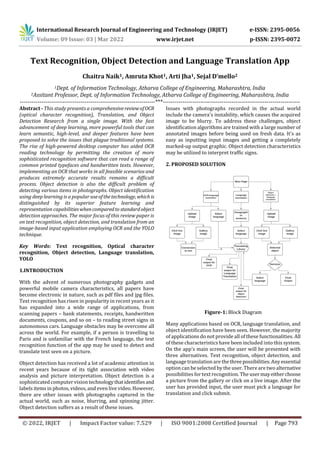
Figure-1: Block Diagram
Many applications based on OCR, language translation, and
object identification have been seen. However, the majority
of applications do not provide all of these functionalities. All
of these characteristics have been included into this system.
On the app's main screen, the user will be presented with
three alternatives. Text recognition, object detection, and
language translation are thethreepossibilities.Anyessential
option can be selected by the user. There are two alternative
possibilities for text recognition. The usermayeitherchoose
a picture from the gallery or click on a live image. After the
user has provided input, the user must pick a language for
translation and click submit.
International Research Journal of Engineering and Technology (IRJET) e-ISSN: 2395-0056
Volume: 09 Issue: 03 | Mar 2022 www.irjet.net p-ISSN: 2395-0072
© 2022, IRJET | Impact Factor value: 7.529 | ISO 9001:2008 Certified Journal | Page 794
Object detection is the app's second feature. The user is
given two alternatives here as well. The user can either
choose a picture for the gallery or click on a live image. After
the object has been discovered, the user may translate the
object's name into whatever language they like.
Only language translation is the last option, which requires
the user to compose a paragraph or sentence and pick a
language for translation.
3. METHODOLOGY
The three components of our project are OCR and language
translation, object detection and language translation, and
merely language translation. As a result, the user must first
choose one of the aforementionedpossibilities. WeusedOCR
for text recognition, which was imported via tesseract.
Tesseract employs a two-step process known as adaptive
recognition. Character recognition is the first phase, and
there are three sub-steps in this step as well. Image pre-
processing is the initial stage. Images are preprocessed in
this stage to increase thelikelihoodofsuccessful recognition.
Unwanted distortions are reduced, and certain visual
characteristics are accentuated in this stage. The next two
stages rely heavily on this phase. The actual recognition of
character is the second sub step. It is based on the feature
extraction idea. When the initial input is too vast to handle,
just a subset of features is chosen. The features that are not
picked are redundant, but the ones that are selected are
critical. The performance is improved by using the smaller
set of data instead of the initial huge one. The final sub step
is picture post-processing. It is another high-accuracy error
correcting approach. The tesseract's second step is to fill in
any missing letters with letters that fit the word or phrase
context. The text will be submitted to the language
translation library, which will be imported using
"googletrans" after it has been identified.
The YOLO method is used to detect objects in the second
section of the app. The YOLO algorithm's first step is to
partition the entire image into grids.Thereareseven vectors
connected with each of the grid cells. Probabilityoftheclass,
bounding box x, bounding box y, bounding box width,
bounding box height, and classes are the vectors. As a result,
anytime we come across an object grid cell at that moment,
we check for the centroid first. Even if parts of two separate
objects are present in a single grid, the centroid of whatever
item is present in that grid is linked with that picture. If each
grid is 4x4, for example, the real size of the grid becomes
4x4x7, where 4x4 is the grid size and each gridhas7vectors.
As a result, the train and test datasets are created. The
picture is present in the train dataset, whereas vectors are
present in the test dataset. We've made projectionsbased on
this. If the user desires to translate the object name into
another language after it has been identified, the user must
first pick a language for translation,whichwill behandled by
the “googletrans” library.
The app's last feature is languagetranslation,whichrequires
the user to compose a sentence or a paragraph in any
desired language and then pick a languagefortranslation via
the “googletrans” library.
4. RESULTS
Following are the screenshots of the interface and output of
the proposed system.
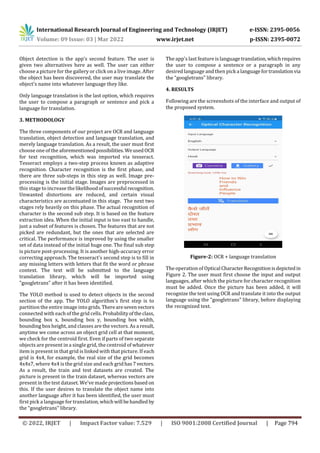
Figure-2: OCR + language translation
The operation of Optical CharacterRecognitionisdepictedin
Figure 2. The user must first choose the input and output
languages, after which the picture for character recognition
must be added. Once the picture has been added, it will
recognize the text using OCR and translate it into the output
language using the "googletrans" library, before displaying
the recognized text.
International Research Journal of Engineering and Technology (IRJET) e-ISSN: 2395-0056
Volume: 09 Issue: 03 | Mar 2022 www.irjet.net p-ISSN: 2395-0072
© 2022, IRJET | Impact Factor value: 7.529 | ISO 9001:2008 Certified Journal | Page 795
Figure-3: Object detection
Object detection is depicted in the above figure. We utilized
the COCO dataset, which comprises roughly328k photos,for
object detection. YOLOv4 has been utilized. Whencompared
to YOLOv3, YOLOv4 has a higher mAP (mean average
precision). The major motivation for employing this
approach was a 10% increase in mean average accuracy
(mAP). YOLOv4 has an average precision of 38 to 44, while
YOLOv3 has an average precision of 31 to 33.
Figure-4: Translation of detected object
The translated text of object detection is shown in the above
figure. The user is given the option of translating the text
that was found throughout the detection process. The user
must first pick a language and then click the Translate
button. The translation activity is started in the backendand
utilizes the “googletrans” library to translate the content.
International Research Journal of Engineering and Technology (IRJET) e-ISSN: 2395-0056
Volume: 09 Issue: 03 | Mar 2022 www.irjet.net p-ISSN: 2395-0072
© 2022, IRJET | Impact Factor value: 7.529 | ISO 9001:2008 Certified Journal | Page 796
Figure-5: Only language translation
Figure 5 depicts how Language Translation works. The user
must first choose the input and output languages before
adding the text to be translated. When text is entered, the
“googletrans” library is used to translate it. Finally, the
translated text is shown.
4. ADVANTAGES
1. The developed application is User-friendly.
2. The application includes text recognition, language
translation, and object detection, so the user may
get all of these functions in one application rather
than having to install separateappsfor eachfeature.
3. This application reduces the language barrier.
5. LIMITATIONS
When using the Text Recognition tool, theusermustprovide
the input language for the text that is contained intheimage.
6. CONCLUSION
For both characteristics, the created program can perform
text recognition, object identification, and language
translation into a chosen language with high accuracy. This
application may be improved to handle the issue of
translating pdfs and other documents from one language to
another.
7. FUTURE SCOPE
1. This project may be improved by converting
detected text to editable text, allowing the user to
amend the text that was identified from an image
before translating it.
2. The identified text may be turned into voice in a
variety of languages.
3. The project may be improved to deal with real-time
data instead of labels from a prepared dataset for
object detection.
REFERENCES
[1] Thakare, Sahil, et al. "Document Segmentation and
Language Translation Using Tesseract-OCR."2018IEEE
13th International Conference on Industrial and
Information Systems (ICIIS). IEEE, 2018.
[2] Li, Gaohe, Xinhao Li, and Bo Xu. "Numerical Simulation
Technology Study on Automatic Translation of Foreign
Language Images Based on Tesseract-ORC." 2019
International Conferenceon Robots&IntelligentSystem
(ICRIS). IEEE, 2019.
[3] Liu, Chengji, et al. "Object detection based on YOLO
network." 2018 IEEE 4th Information Technology and
Mechatronics Engineering Conference (ITOEC). IEEE,
2018.
[4] K. Elissa, Hiral Modi, M.C.parikh, “A Review On Optical
Character Recognition Techniques”, International
Journal of Computer Application,2017.
[5] Huang, Rachel, Jonathan Pedoeem, and Cuixian Chen.
"YOLO-LITE: a real-time object detection algorithm
optimized for non-GPU computers." 2018 IEEE
International Conference on Big Data (Big Data). IEEE,
2018.
[6] Memon, Jamshed, et al. "Handwritten optical character
recognition (OCR): A comprehensive systematic
literature review (SLR)." IEEE Access8(2020):142642-
142668.J.
[7] Du, Juan. "Understanding of object detection based on
CNN family and YOLO." Journal of Physics: Conference
Series. Vol. 1004. No. 1. IOP Publishing, 2018.
[8] Tao, Jing, et al. "An object detection system based on
YOLO in traffic scene." 2017 6th International
Conference on Computer Science and Network
Technology (ICCSNT). IEEE, 2017.
[9] Ahmad, Tanvir, et al. "Objectdetectionthrough modified
YOLO neural network." Scientific Programming 2020
(2020).

Text Recognition, Object Detection and Language Translation App

  • 1.
    International Research Journalof Engineering and Technology (IRJET) e-ISSN: 2395-0056 Volume: 09 Issue: 03 | Mar 2022 www.irjet.net p-ISSN: 2395-0072 © 2022, IRJET | Impact Factor value: 7.529 | ISO 9001:2008 Certified Journal | Page 793 Text Recognition, Object Detection and Language Translation App Chaitra Naik1, Amruta Khot1, Arti Jha1, Sejal D’mello2 1Dept. of Information Technology, Atharva College of Engineering, Maharashtra, India 2Assitant Professor, Dept. of Information Technology, Atharva College of Engineering, Maharashtra, India ---------------------------------------------------------------------***---------------------------------------------------------------------- Abstract - This study presents a comprehensivereviewofOCR (optical character recognition), Translation, and Object Detection Research from a single image. With the fast advancement of deep learning, more powerful tools that can learn semantic, high-level, and deeper features have been proposed to solve the issues that plague traditional systems. The rise of high-powered desktop computer has aided OCR reading technology by permitting the creation of more sophisticated recognition software that can read a range of common printed typefaces and handwritten texts. However, implementing an OCR that works in all feasible scenarios and produces extremely accurate results remains a difficult process. Object detection is also the difficult problem of detecting various items in photographs. Object identification using deep learning is a popular useofthetechnology, whichis distinguished by its superior feature learning and representation capabilitieswhencomparedtostandardobject detection approaches. The major focus of this review paper is on text recognition, object detection, and translation from an image-based input application employing OCR and the YOLO technique. Key Words: Text recognition, Optical character recognition, Object detection, Language translation, YOLO 1.INTRODUCTION With the advent of numerous photography gadgets and powerful mobile camera characteristics, all papers have become electronic in nature, such as pdf files and jpg files. Text recognition has risen in popularity in recent years as it has expanded into a wide range of applications, from scanning papers – bank statements, receipts, handwritten documents, coupons, and so on – to reading street signs in autonomous cars. Language obstacles may be overcome all across the world. For example, if a person is travelling to Paris and is unfamiliar with the French language, the text recognition function of the app may be used to detect and translate text seen on a picture. Object detection has received a lot of academic attention in recent years because of its tight association with video analysis and picture interpretation. Object detection is a sophisticated computer vision technologythatidentifiesand labels items in photos, videos, and even live video. However, there are other issues with photographs captured in the actual world, such as noise, blurring, and spinning jitter. Object detection suffers as a result of these issues. Issues with photographs recorded in the actual world include the camera's instability, which causes the acquired image to be blurry. To address these challenges, object identification algorithms are trained with a large number of annotated images before being used on fresh data. It's as easy as inputting input images and getting a completely marked-up output graphic. Object detection characteristics may be utilized to interpret traffic signs. 2. PROPOSED SOLUTION Figure-1: Block Diagram Many applications based on OCR, language translation, and object identification have been seen. However, the majority of applications do not provide all of these functionalities. All of these characteristics have been included into this system. On the app's main screen, the user will be presented with three alternatives. Text recognition, object detection, and language translation are thethreepossibilities.Anyessential option can be selected by the user. There are two alternative possibilities for text recognition. The usermayeitherchoose a picture from the gallery or click on a live image. After the user has provided input, the user must pick a language for translation and click submit.
  • 2.
    International Research Journalof Engineering and Technology (IRJET) e-ISSN: 2395-0056 Volume: 09 Issue: 03 | Mar 2022 www.irjet.net p-ISSN: 2395-0072 © 2022, IRJET | Impact Factor value: 7.529 | ISO 9001:2008 Certified Journal | Page 794 Object detection is the app's second feature. The user is given two alternatives here as well. The user can either choose a picture for the gallery or click on a live image. After the object has been discovered, the user may translate the object's name into whatever language they like. Only language translation is the last option, which requires the user to compose a paragraph or sentence and pick a language for translation. 3. METHODOLOGY The three components of our project are OCR and language translation, object detection and language translation, and merely language translation. As a result, the user must first choose one of the aforementionedpossibilities. WeusedOCR for text recognition, which was imported via tesseract. Tesseract employs a two-step process known as adaptive recognition. Character recognition is the first phase, and there are three sub-steps in this step as well. Image pre- processing is the initial stage. Images are preprocessed in this stage to increase thelikelihoodofsuccessful recognition. Unwanted distortions are reduced, and certain visual characteristics are accentuated in this stage. The next two stages rely heavily on this phase. The actual recognition of character is the second sub step. It is based on the feature extraction idea. When the initial input is too vast to handle, just a subset of features is chosen. The features that are not picked are redundant, but the ones that are selected are critical. The performance is improved by using the smaller set of data instead of the initial huge one. The final sub step is picture post-processing. It is another high-accuracy error correcting approach. The tesseract's second step is to fill in any missing letters with letters that fit the word or phrase context. The text will be submitted to the language translation library, which will be imported using "googletrans" after it has been identified. The YOLO method is used to detect objects in the second section of the app. The YOLO algorithm's first step is to partition the entire image into grids.Thereareseven vectors connected with each of the grid cells. Probabilityoftheclass, bounding box x, bounding box y, bounding box width, bounding box height, and classes are the vectors. As a result, anytime we come across an object grid cell at that moment, we check for the centroid first. Even if parts of two separate objects are present in a single grid, the centroid of whatever item is present in that grid is linked with that picture. If each grid is 4x4, for example, the real size of the grid becomes 4x4x7, where 4x4 is the grid size and each gridhas7vectors. As a result, the train and test datasets are created. The picture is present in the train dataset, whereas vectors are present in the test dataset. We've made projectionsbased on this. If the user desires to translate the object name into another language after it has been identified, the user must first pick a language for translation,whichwill behandled by the “googletrans” library. The app's last feature is languagetranslation,whichrequires the user to compose a sentence or a paragraph in any desired language and then pick a languagefortranslation via the “googletrans” library. 4. RESULTS Following are the screenshots of the interface and output of the proposed system. Figure-2: OCR + language translation The operation of Optical CharacterRecognitionisdepictedin Figure 2. The user must first choose the input and output languages, after which the picture for character recognition must be added. Once the picture has been added, it will recognize the text using OCR and translate it into the output language using the "googletrans" library, before displaying the recognized text.
  • 3.
    International Research Journalof Engineering and Technology (IRJET) e-ISSN: 2395-0056 Volume: 09 Issue: 03 | Mar 2022 www.irjet.net p-ISSN: 2395-0072 © 2022, IRJET | Impact Factor value: 7.529 | ISO 9001:2008 Certified Journal | Page 795 Figure-3: Object detection Object detection is depicted in the above figure. We utilized the COCO dataset, which comprises roughly328k photos,for object detection. YOLOv4 has been utilized. Whencompared to YOLOv3, YOLOv4 has a higher mAP (mean average precision). The major motivation for employing this approach was a 10% increase in mean average accuracy (mAP). YOLOv4 has an average precision of 38 to 44, while YOLOv3 has an average precision of 31 to 33. Figure-4: Translation of detected object The translated text of object detection is shown in the above figure. The user is given the option of translating the text that was found throughout the detection process. The user must first pick a language and then click the Translate button. The translation activity is started in the backendand utilizes the “googletrans” library to translate the content.
  • 4.
    International Research Journalof Engineering and Technology (IRJET) e-ISSN: 2395-0056 Volume: 09 Issue: 03 | Mar 2022 www.irjet.net p-ISSN: 2395-0072 © 2022, IRJET | Impact Factor value: 7.529 | ISO 9001:2008 Certified Journal | Page 796 Figure-5: Only language translation Figure 5 depicts how Language Translation works. The user must first choose the input and output languages before adding the text to be translated. When text is entered, the “googletrans” library is used to translate it. Finally, the translated text is shown. 4. ADVANTAGES 1. The developed application is User-friendly. 2. The application includes text recognition, language translation, and object detection, so the user may get all of these functions in one application rather than having to install separateappsfor eachfeature. 3. This application reduces the language barrier. 5. LIMITATIONS When using the Text Recognition tool, theusermustprovide the input language for the text that is contained intheimage. 6. CONCLUSION For both characteristics, the created program can perform text recognition, object identification, and language translation into a chosen language with high accuracy. This application may be improved to handle the issue of translating pdfs and other documents from one language to another. 7. FUTURE SCOPE 1. This project may be improved by converting detected text to editable text, allowing the user to amend the text that was identified from an image before translating it. 2. The identified text may be turned into voice in a variety of languages. 3. The project may be improved to deal with real-time data instead of labels from a prepared dataset for object detection. REFERENCES [1] Thakare, Sahil, et al. "Document Segmentation and Language Translation Using Tesseract-OCR."2018IEEE 13th International Conference on Industrial and Information Systems (ICIIS). IEEE, 2018. [2] Li, Gaohe, Xinhao Li, and Bo Xu. "Numerical Simulation Technology Study on Automatic Translation of Foreign Language Images Based on Tesseract-ORC." 2019 International Conferenceon Robots&IntelligentSystem (ICRIS). IEEE, 2019. [3] Liu, Chengji, et al. "Object detection based on YOLO network." 2018 IEEE 4th Information Technology and Mechatronics Engineering Conference (ITOEC). IEEE, 2018. [4] K. Elissa, Hiral Modi, M.C.parikh, “A Review On Optical Character Recognition Techniques”, International Journal of Computer Application,2017. [5] Huang, Rachel, Jonathan Pedoeem, and Cuixian Chen. "YOLO-LITE: a real-time object detection algorithm optimized for non-GPU computers." 2018 IEEE International Conference on Big Data (Big Data). IEEE, 2018. [6] Memon, Jamshed, et al. "Handwritten optical character recognition (OCR): A comprehensive systematic literature review (SLR)." IEEE Access8(2020):142642- 142668.J. [7] Du, Juan. "Understanding of object detection based on CNN family and YOLO." Journal of Physics: Conference Series. Vol. 1004. No. 1. IOP Publishing, 2018. [8] Tao, Jing, et al. "An object detection system based on YOLO in traffic scene." 2017 6th International Conference on Computer Science and Network Technology (ICCSNT). IEEE, 2017. [9] Ahmad, Tanvir, et al. "Objectdetectionthrough modified YOLO neural network." Scientific Programming 2020 (2020).