21st Century Literature from the Philippines
and the World
Introduction to Philippine Literature
Philippine literature is as rich and
diverse as the 7500 plus islands that
make up our archipelago. This is not
surprising considering that we have 183
living languages across 17 regions
comprised of 82 provinces.
The term literature is derived from the Latin
word "littera" which means "a letter of the
alphabet".
Literature is traditionally defined as body
of written works associated to imaginative
and creative works of POETRY and
PROSE and can be classified according to
variety of systems such as language,
national origin, historical period, genre and
subject matter.
Literature can either be in ORAL or WRITTEN form. The
oral literature handed down from one generation to
another, then later on transformed into written form. The
products of written literature are called literary text. A text
can be considered literary if it has the elements of
psychological characterization and chronology. Also,
literature uses literary devices such as metaphor and
symbolism. Reading for entertainment and learning is the
most common reason why people read literature
Simply, the best way to describe the
characteristics of literary text is that (1)
it narrates a story; (2) it expresses feelings,
thoughts, and ideas which can either be based
from the imagination or real life experiences of the
author or other people; and (3) it delivers
significant information and crosses boundaries of
time, places, cultures and languages.
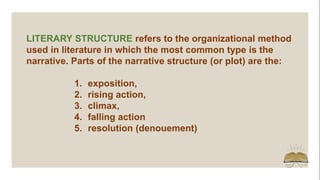
LITERARY STRUCTURE refers to the organizational method
used in literature in which the most common type is the
narrative. Parts of the narrative structure (or plot) are the:
1. exposition,
2. rising action,
3. climax,
4. falling action
5. resolution (denouement)
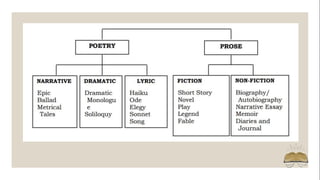
POETRY. This literary type is usually written
in lines and is characterized by having the
element of rhythm, sound, imagery, and form.
Its main purpose is to express feelings,
thoughts, and ideas. It can be divided into
three types: narrative, dramatic, and lyrical
poetry.
 Narrative Poetry. This poetry tells a story and has
the elements of a narrative such as characters,
setting, conflict, etc.
 Dramatic Poetry. This is an emotionally appealing
drama written in verse that tells a story and is
intended to be recited or sung in front of the
audience by a character speaking in poetry.
 Lyric Poetry. It is the most common type of poetry
that focuses on expressing feelings rather than
telling a story.
 Narrative Poetry. This poetry tells a story and has
the elements of a narrative such as characters,
setting, conflict, etc.
 Dramatic Poetry. This is an emotionally appealing
drama written in verse that tells a story and is
intended to be recited or sung in front of the
audience by a character speaking in poetry.
 Lyric Poetry. It is the most common type of poetry
that focuses on expressing feelings rather than
telling a story.
In contrast to poetry, this literary piece applies a
natural flow of speech and grammatical
structures which are mainly consisting of
complete sentences arranged logically and
sequentially in a paragraph form.
 FICTION. This serves as a product of the writer's wild imagination and
creative thinking where the characters react to the conflict and various
issues central to the main idea of a literary work. Its three types are:
short story, novel, and novella. The main genres are crime, fantasy,
romance, science fiction, western, inspirational, historical fiction and
horror.
 NON-FICTION. These are stories inspired by real events where the
writers aim to present, interpret, or describe experiences based on
facts. The judgments, opinions, and commentaries of the writers may
be presented in the form of essays, journals, diaries, feature articles,
editorials, and the like.
Genre refers to the forms of literature. The general ones
are oral and written. The main types are prose and poetry.
There are many other forms that have sprung through the
years. Specifically, it is defined in the curriculum guide as
something that “may be determined by literary technique,
tone, content, or even (as in the case of fiction) length.
GENERAL GENRES in literature are epic,
tragedy, comedy, and creative nonfiction.
They can all be in the form of prose or poetry.
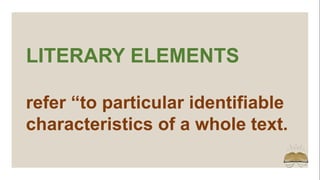
LITERARY ELEMENTS
refer “to particular identifiable
characteristics of a whole text.
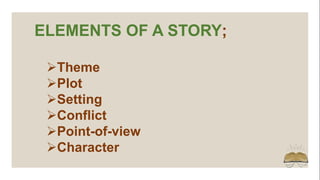
ELEMENTS OF A STORY;
Theme
Plot
Setting
Conflict
Point-of-view
Character
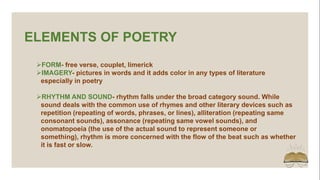
ELEMENTS OF POETRY
FORM- free verse, couplet, limerick
IMAGERY- pictures in words and it adds color in any types of literature
especially in poetry
RHYTHM AND SOUND- rhythm falls under the broad category sound. While
sound deals with the common use of rhymes and other literary devices such as
repetition (repeating of words, phrases, or lines), alliteration (repeating same
consonant sounds), assonance (repeating same vowel sounds), and
onomatopoeia (the use of the actual sound to represent someone or
something), rhythm is more concerned with the flow of the beat such as whether
it is fast or slow.
An Overview of
Philippine Literature
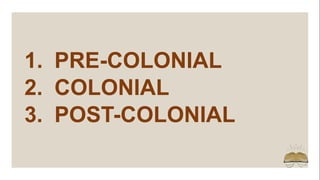
1. PRE-COLONIAL
2. COLONIAL
3. POST-COLONIAL
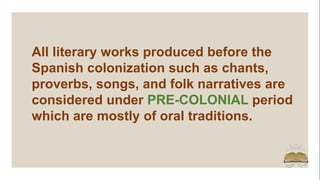
All literary works produced before the
Spanish colonization such as chants,
proverbs, songs, and folk narratives are
considered under PRE-COLONIAL period
which are mostly of oral traditions.
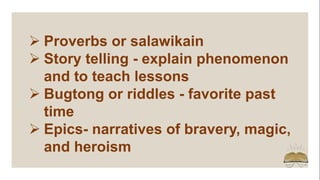
 Proverbs or salawikain
 Story telling - explain phenomenon
and to teach lessons
 Bugtong or riddles - favorite past
time
 Epics- narratives of bravery, magic,
and heroism
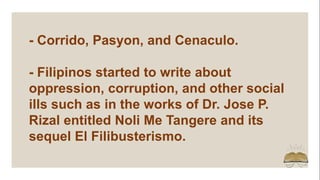
- Corrido, Pasyon, and Cenaculo.
- Filipinos started to write about
oppression, corruption, and other social
ills such as in the works of Dr. Jose P.
Rizal entitled Noli Me Tangere and its
sequel El Filibusterismo.
Post-colonial is the period after the rebirth
of freedom in the Philippines up to the
present. One of the most unforgotten and
controversial periods during this era is
having Martial Law during the Marcos
regime.
21st Century- Lesson 1-FINAL.pptx

21st Century- Lesson 1-FINAL.pptx

  • 1.
    21st Century Literaturefrom the Philippines and the World Introduction to Philippine Literature
  • 3.
    Philippine literature isas rich and diverse as the 7500 plus islands that make up our archipelago. This is not surprising considering that we have 183 living languages across 17 regions comprised of 82 provinces.
  • 4.
    The term literatureis derived from the Latin word "littera" which means "a letter of the alphabet". Literature is traditionally defined as body of written works associated to imaginative and creative works of POETRY and PROSE and can be classified according to variety of systems such as language, national origin, historical period, genre and subject matter.
  • 5.
    Literature can eitherbe in ORAL or WRITTEN form. The oral literature handed down from one generation to another, then later on transformed into written form. The products of written literature are called literary text. A text can be considered literary if it has the elements of psychological characterization and chronology. Also, literature uses literary devices such as metaphor and symbolism. Reading for entertainment and learning is the most common reason why people read literature
  • 6.
    Simply, the bestway to describe the characteristics of literary text is that (1) it narrates a story; (2) it expresses feelings, thoughts, and ideas which can either be based from the imagination or real life experiences of the author or other people; and (3) it delivers significant information and crosses boundaries of time, places, cultures and languages.
  • 7.
    LITERARY STRUCTURE refersto the organizational method used in literature in which the most common type is the narrative. Parts of the narrative structure (or plot) are the: 1. exposition, 2. rising action, 3. climax, 4. falling action 5. resolution (denouement)
  • 9.
    POETRY. This literarytype is usually written in lines and is characterized by having the element of rhythm, sound, imagery, and form. Its main purpose is to express feelings, thoughts, and ideas. It can be divided into three types: narrative, dramatic, and lyrical poetry.
  • 10.
     Narrative Poetry.This poetry tells a story and has the elements of a narrative such as characters, setting, conflict, etc.  Dramatic Poetry. This is an emotionally appealing drama written in verse that tells a story and is intended to be recited or sung in front of the audience by a character speaking in poetry.  Lyric Poetry. It is the most common type of poetry that focuses on expressing feelings rather than telling a story.
  • 11.
     Narrative Poetry.This poetry tells a story and has the elements of a narrative such as characters, setting, conflict, etc.  Dramatic Poetry. This is an emotionally appealing drama written in verse that tells a story and is intended to be recited or sung in front of the audience by a character speaking in poetry.  Lyric Poetry. It is the most common type of poetry that focuses on expressing feelings rather than telling a story.
  • 12.
    In contrast topoetry, this literary piece applies a natural flow of speech and grammatical structures which are mainly consisting of complete sentences arranged logically and sequentially in a paragraph form.
  • 13.
     FICTION. Thisserves as a product of the writer's wild imagination and creative thinking where the characters react to the conflict and various issues central to the main idea of a literary work. Its three types are: short story, novel, and novella. The main genres are crime, fantasy, romance, science fiction, western, inspirational, historical fiction and horror.  NON-FICTION. These are stories inspired by real events where the writers aim to present, interpret, or describe experiences based on facts. The judgments, opinions, and commentaries of the writers may be presented in the form of essays, journals, diaries, feature articles, editorials, and the like.
  • 15.
    Genre refers tothe forms of literature. The general ones are oral and written. The main types are prose and poetry. There are many other forms that have sprung through the years. Specifically, it is defined in the curriculum guide as something that “may be determined by literary technique, tone, content, or even (as in the case of fiction) length.
  • 16.
    GENERAL GENRES inliterature are epic, tragedy, comedy, and creative nonfiction. They can all be in the form of prose or poetry.
  • 17.
    LITERARY ELEMENTS refer “toparticular identifiable characteristics of a whole text.
  • 18.
    ELEMENTS OF ASTORY; Theme Plot Setting Conflict Point-of-view Character
  • 19.
    ELEMENTS OF POETRY FORM-free verse, couplet, limerick IMAGERY- pictures in words and it adds color in any types of literature especially in poetry RHYTHM AND SOUND- rhythm falls under the broad category sound. While sound deals with the common use of rhymes and other literary devices such as repetition (repeating of words, phrases, or lines), alliteration (repeating same consonant sounds), assonance (repeating same vowel sounds), and onomatopoeia (the use of the actual sound to represent someone or something), rhythm is more concerned with the flow of the beat such as whether it is fast or slow.
  • 20.
  • 21.
  • 22.
    All literary worksproduced before the Spanish colonization such as chants, proverbs, songs, and folk narratives are considered under PRE-COLONIAL period which are mostly of oral traditions.
  • 23.
     Proverbs orsalawikain  Story telling - explain phenomenon and to teach lessons  Bugtong or riddles - favorite past time  Epics- narratives of bravery, magic, and heroism
  • 24.
    - Corrido, Pasyon,and Cenaculo. - Filipinos started to write about oppression, corruption, and other social ills such as in the works of Dr. Jose P. Rizal entitled Noli Me Tangere and its sequel El Filibusterismo.
  • 25.
    Post-colonial is theperiod after the rebirth of freedom in the Philippines up to the present. One of the most unforgotten and controversial periods during this era is having Martial Law during the Marcos regime.