“Text Analytics on Shiksha
Reviews to Generate
Meaningful Performance
Indicators in Management
Education”
Shanmugapriya K
Student, PGDM 2019-21, ISME
Under the guidance of
Dr. Shampa Nandi (HOD – PGDM)
Professor Analytics and Marketing, ISME
Introduction
 The internet community in India has grown over 700
Million users in 2020 and is expected to grow in leaps
and bounds. Performing text analytics with
Educational data is very helpful in addressing issues,
analyzing suggestions and finding solutions to the
prevailing problems in the education sector. Feedback
from the students on faculty, infrastructure,
placement or management guide the institution to
create a better learning experience.
 The present study is designed to investigate the
learners’ feedback using Sentiment Analysis and
Classification model and use Shiksha reviews on
Management institutes of Bangalore.
Literature Review (1)
 “Sentiment Analysis for Education”: Sentiment Analysis is one of
the widely used application of NLP, computational linguistics and
text analytics which is also called as subjectivity analysis, opinion
mining, and appraisal extraction. (Altrabsheh, Medhat et al., 2018)
 “University Ranking Prediction System by Analyzing Influential
Global Performance Indicators”: This research paper built a data
model which predicts and ranks universities by considering global
university performance indicators as features. (Tabassum, Hasan, et
al., 2017)
 “Role Of Sentiment Analysis In Education Sector In The Era Of
Big Data: A Survey”: Even though big data analytics have been a
hot topic in today’s world, the adoption of them in education
sector has been slow. This paper discusses the different
applications in which big data can be used. (Rao& Baglodi, et al.,
2016 )
Literature Review (2)
 “Using Feedback Tags and Sentiment Analysis to Generate Sharable
Learning Resources”: Sentiment Analysis can also be used to find the
difference in perception of opinions and feedbacks from students. This
paper investigates the results received from sentiment analysis combined
with feedback tags. (Cummins, Burd, et al., 2010)
 “Do online reviews matter? — An empirical investigation of panel
data”: This research considers reviews to be both influencing and
influenced factors. Online reviews are endogenous in nature which
changes the analysis. (Duan, Gu, et al., 2008)
 “Short Text Classification in Twitter to Improve Information
Filtering”: As short texts do not provide sufficient word occurrences,
traditional classification methods such as “Bag-Of-Words” have limitations.
To address this problem, we propose to use a small set of domain-specific
features extracted from the author’s profile and text. (Bharath Sriram, et.al,
2010)
Objectives of the study are-
 Performing Sentiment Analysis on reviews from
shiksha.com and classifying the students’ reviews as
positive and negative.
 Matching ratings and reviews and validating the honesty
of the reviews.
 Predicting and building a ranking system of the
Management institutes based on learners’ feedback.
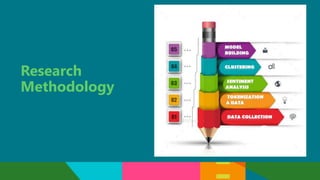
Research
Methodology
Analysis
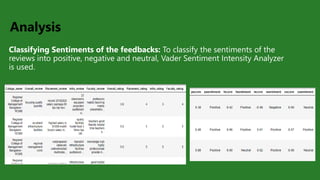
Classifying Sentiments of the feedbacks: To classify the sentiments of the
reviews into positive, negative and neutral, Vader Sentiment Intensity Analyzer
is used.
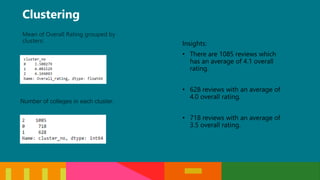
Clustering
Insights:
• There are 1085 reviews which
has an average of 4.1 overall
rating.
• 628 reviews with an average of
4.0 overall rating.
• 718 reviews with an average of
3.5 overall rating.
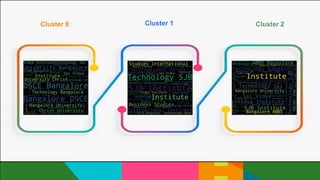
Top Performers: MBA
institutes (Colleges in the 2nd
Cluster)
• Regional College of
Management
• IIM Bangalore
• IBS Bangalore
• ISBR Bangalore
• WeSchool Bangalore
Third Best (Colleges present in the
0th Cluster)
• Presidency University, Bangalore
• DSCE Bangalore
• XIME Bangalore
• NMIMS SOM Bangalore
Second Best Institues (Colleges
present in the 1st Cluster)
• East Point Group of Institutions
• International Institute of Business
Studies
• SJB Institute of Technology
• Mount Carmel College
• ABBS Bangalore
Cluster 0 Cluster 1 Cluster 2
Limitations
 Sample size is quite small to build a ranking
system.
Conclusion
 A sentiment intensity analyser model is built to
classify the sentiments of the reviews.
 Clustering was done to group the colleges as Top
Performers, Second Best Institutes and Third
Best.

Text analytics on Shiksha Reviews

  • 1.
    “Text Analytics onShiksha Reviews to Generate Meaningful Performance Indicators in Management Education” Shanmugapriya K Student, PGDM 2019-21, ISME Under the guidance of Dr. Shampa Nandi (HOD – PGDM) Professor Analytics and Marketing, ISME
  • 2.
    Introduction  The internetcommunity in India has grown over 700 Million users in 2020 and is expected to grow in leaps and bounds. Performing text analytics with Educational data is very helpful in addressing issues, analyzing suggestions and finding solutions to the prevailing problems in the education sector. Feedback from the students on faculty, infrastructure, placement or management guide the institution to create a better learning experience.  The present study is designed to investigate the learners’ feedback using Sentiment Analysis and Classification model and use Shiksha reviews on Management institutes of Bangalore.
  • 3.
    Literature Review (1) “Sentiment Analysis for Education”: Sentiment Analysis is one of the widely used application of NLP, computational linguistics and text analytics which is also called as subjectivity analysis, opinion mining, and appraisal extraction. (Altrabsheh, Medhat et al., 2018)  “University Ranking Prediction System by Analyzing Influential Global Performance Indicators”: This research paper built a data model which predicts and ranks universities by considering global university performance indicators as features. (Tabassum, Hasan, et al., 2017)  “Role Of Sentiment Analysis In Education Sector In The Era Of Big Data: A Survey”: Even though big data analytics have been a hot topic in today’s world, the adoption of them in education sector has been slow. This paper discusses the different applications in which big data can be used. (Rao& Baglodi, et al., 2016 )
  • 4.
    Literature Review (2) “Using Feedback Tags and Sentiment Analysis to Generate Sharable Learning Resources”: Sentiment Analysis can also be used to find the difference in perception of opinions and feedbacks from students. This paper investigates the results received from sentiment analysis combined with feedback tags. (Cummins, Burd, et al., 2010)  “Do online reviews matter? — An empirical investigation of panel data”: This research considers reviews to be both influencing and influenced factors. Online reviews are endogenous in nature which changes the analysis. (Duan, Gu, et al., 2008)  “Short Text Classification in Twitter to Improve Information Filtering”: As short texts do not provide sufficient word occurrences, traditional classification methods such as “Bag-Of-Words” have limitations. To address this problem, we propose to use a small set of domain-specific features extracted from the author’s profile and text. (Bharath Sriram, et.al, 2010)
  • 5.
    Objectives of thestudy are-  Performing Sentiment Analysis on reviews from shiksha.com and classifying the students’ reviews as positive and negative.  Matching ratings and reviews and validating the honesty of the reviews.  Predicting and building a ranking system of the Management institutes based on learners’ feedback.
  • 6.
  • 7.
    Analysis Classifying Sentiments ofthe feedbacks: To classify the sentiments of the reviews into positive, negative and neutral, Vader Sentiment Intensity Analyzer is used.
  • 8.
    Clustering Insights: • There are1085 reviews which has an average of 4.1 overall rating. • 628 reviews with an average of 4.0 overall rating. • 718 reviews with an average of 3.5 overall rating.
  • 9.
    Top Performers: MBA institutes(Colleges in the 2nd Cluster) • Regional College of Management • IIM Bangalore • IBS Bangalore • ISBR Bangalore • WeSchool Bangalore Third Best (Colleges present in the 0th Cluster) • Presidency University, Bangalore • DSCE Bangalore • XIME Bangalore • NMIMS SOM Bangalore Second Best Institues (Colleges present in the 1st Cluster) • East Point Group of Institutions • International Institute of Business Studies • SJB Institute of Technology • Mount Carmel College • ABBS Bangalore
  • 10.
    Cluster 0 Cluster1 Cluster 2
  • 11.
    Limitations  Sample sizeis quite small to build a ranking system.
  • 12.
    Conclusion  A sentimentintensity analyser model is built to classify the sentiments of the reviews.  Clustering was done to group the colleges as Top Performers, Second Best Institutes and Third Best.