Tetanus
- Dr.Abhilash
MD Medicine
Tetanus is an acute disease induced by the
endotoxin of Clostridium tetani. It is clinically
characterized by muscular rigidity which persists
through out illness punctuated by painful
paroxysmal spasms of the voluntary muscles.
Especially the masseters (trismus or lock
jaw),the facial muscles (risus sardonicus), the
muscles of the back and neck (opisthotonus)
and those of the lower limbs and abdomen.
What is Tetanus?
The word tetanus is derived from Greek words
-“tetanos and teinein”, meaning rigid and
stretched, which describe the condition of the
muscles affected by the toxin,
tetanospasmin, produced by Clostridium
tetani .
Agent factors
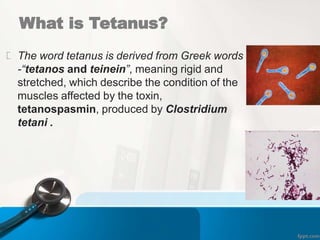
Clostridium tetani is a gram positive, anaerobic, spore
bearing organism, the spores are terminal and give
the organism a drum stick appearance.
Spores germinate under anaerobic conditions and
produce a potent exotoxin tetanospasmin.
Mode of transmission
• Infection is acquired by contamination of wounds
with tetanus spores.
The range of injuries and accidents which may lead
to tetanus comprise a trivial pin prick, skin
abrasion, puncture wounds, burns, human bites,
animal bites and sting, unsterile surgery, unsterile
division of umbilical cord, compound fractures
etc….
•
Incubation Period
• It is defined as the time from injury to the first
symptom.
The incubation period is usually 6 to 10 days.
However, it may be as short as one day or as long
as several months.
Long incubation is probably explained by the
spores lying dormant in the wounds. Incubation is
also prolonged by prophylaxis
•
•
•
Types of tetanus
•
•
•
•
•
TRAUMATIC PUERPERAL
OTOGENIC IDIOPATHIC
TETANUS NEONATORUM
Complications of tetanus
•
•
•
•
•
•
•
Laryngospasm
Fractures
Hypertension
Nosocomial infections
Pulmonary embolism
Aspiration
Death
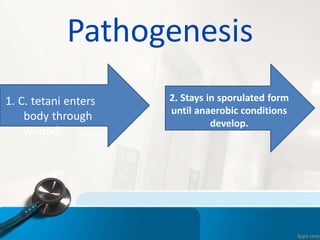
Pathogenesis
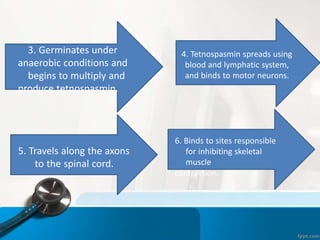
1. C. tetani enters
body through
wound.
2. Stays in sporulated form
until anaerobic conditions
develop.
3. Germinates under
anaerobic conditions and
begins to multiply and
produce tetnospasmin.
4. Tetnospasmin spreads using
blood and lymphatic system,
and binds to motor neurons.
5. Travels along the axons
to the spinal cord.
6. Binds to sites responsible
for inhibiting skeletal
muscle
contraction.
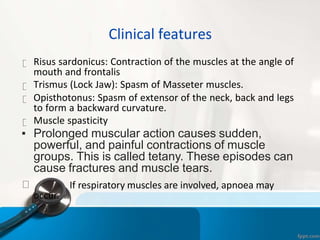
Clinical features
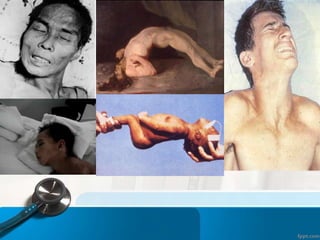
Risus sardonicus: Contraction of the muscles at the angle of
mouth and frontalis
Trismus (Lock Jaw): Spasm of Masseter muscles.
Opisthotonus: Spasm of extensor of the neck, back and legs
to form a backward curvature.
Muscle spasticity
▪ Prolonged muscular action causes sudden,
powerful, and painful contractions of muscle
groups. This is called tetany. These episodes can
cause fractures and muscle tears.
If respiratory muscles are involved, apnoea may
occur.
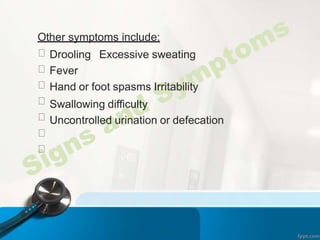
Other symptoms include:
Drooling Excessive sweating
Fever
Hand or foot spasms Irritability
Swallowing difficulty
Uncontrolled urination or defecation
Diagnosis
▪ There are currently no blood tests that can be
used to diagnose tetanus. Diagnosis is done
clinically.
Principle of Treatment
• 1.Neutralization of unbound toxin with Human
tetanus immunoglobulin
2.Prevention of further toxin production by
•
-Wound debridement
-Antibiotics (Metronidazole)
▪ 3. Control of spasm
- Nursing in quiet environment
- avoid unnecessary stimuli
- Protecting the airway
▪ 4. Supportive care
- Adequate hydration
- Nutrition
- Treatment of secondary infection
- prevention of bed sores.
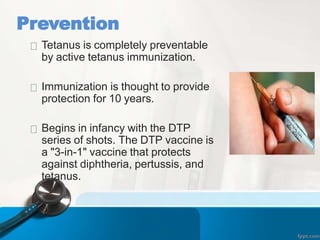
Prevention
Tetanus is completely preventable
by active tetanus immunization.
Immunization is thought to provide
protection for 10 years.
Begins in infancy with the DTP
series of shots. The DTP vaccine is
a "3-in-1" vaccine that protects
against diphtheria, pertussis, and
tetanus.
Prevention
▪ Can be achieved by active immunization by tetanus
toxoid (5 doses – 0 day, 1 month, 6 month, 1 year, 1
year).
▪ Older teenagers and adults who have
sustained injuries, especially puncture-type
wounds, should receive booster
immunization for tetanus if more than 10
years have passed since the last booster.
▪ Clinical tetanus does not produce immunity to further
attacks. Therefore, even after recovery, patients must
receive a full course of tetanus toxoid.
Case Presentation
▪ Name of the patient: Khushi
▪ Father’s name: Maruthi
▪ Age: 3 yrs.
▪ Sex: Male
▪ Address: Bidar Dist., Karnataka.
Chief complaints
▪ Unable to open mouth since 4 days.
▪ Stiffing of left side of the neck since 2 days.
▪ Spasm of both hands and both leg muscles since
2 days.
History of present illness
▪ Patient was asymptomatic 20 days back, then he
got injury on his left leg. He was given first aid.
▪ But 4 days back, the parents noticed that the child
was feeling difficulty in swallowing followed by
difficulty in opening mouth and stiffening of
muscles of left side of the neck.
▪ Then he was taken to Bidar institute of medical
sciences in Bidar, from where he was referred to Sir
Ronald Ross institute for tropical and communicable
diseases, Hyderabad.
Past medical history
▪ Patient had normally achieved his
developmental milestones.
▪ No H/O koch’s disease
▪ No H/O similar conditions
Family History
▪ Both the parents are healthy and alive.
He has two sisters, one elder and one younger,
and both are healthy and alive.
Differential Diagnosis
• Strychnine poisoning is the only condition that truly
mimics tetanus. However, a number of conditions
(eg, dental or other local infections, hysteria,
neoplasms, and encephalitis) may cause trismus,
and these must be differentiated these conditions
from tetanus
Final Diagnosis
▪ Tetanus.
Treatment
▪ Tetanus Immunoglobulin I.P. (Human) 2000 I.U.
▪ Metronidozole 100ml i.v.
▪ I.V. fluids
▪ Inj. Diazepam (slow i.v.)
tetanus by DR ABHILASH.ppt

tetanus by DR ABHILASH.ppt

  • 1.
  • 2.
    Tetanus is anacute disease induced by the endotoxin of Clostridium tetani. It is clinically characterized by muscular rigidity which persists through out illness punctuated by painful paroxysmal spasms of the voluntary muscles. Especially the masseters (trismus or lock jaw),the facial muscles (risus sardonicus), the muscles of the back and neck (opisthotonus) and those of the lower limbs and abdomen.
  • 3.
    What is Tetanus? Theword tetanus is derived from Greek words -“tetanos and teinein”, meaning rigid and stretched, which describe the condition of the muscles affected by the toxin, tetanospasmin, produced by Clostridium tetani .
  • 4.
    Agent factors Clostridium tetaniis a gram positive, anaerobic, spore bearing organism, the spores are terminal and give the organism a drum stick appearance. Spores germinate under anaerobic conditions and produce a potent exotoxin tetanospasmin.
  • 5.
    Mode of transmission •Infection is acquired by contamination of wounds with tetanus spores. The range of injuries and accidents which may lead to tetanus comprise a trivial pin prick, skin abrasion, puncture wounds, burns, human bites, animal bites and sting, unsterile surgery, unsterile division of umbilical cord, compound fractures etc…. •
  • 6.
    Incubation Period • Itis defined as the time from injury to the first symptom. The incubation period is usually 6 to 10 days. However, it may be as short as one day or as long as several months. Long incubation is probably explained by the spores lying dormant in the wounds. Incubation is also prolonged by prophylaxis • • •
  • 7.
    Types of tetanus • • • • • TRAUMATICPUERPERAL OTOGENIC IDIOPATHIC TETANUS NEONATORUM
  • 8.
  • 9.
    Pathogenesis 1. C. tetanienters body through wound. 2. Stays in sporulated form until anaerobic conditions develop.
  • 10.
    3. Germinates under anaerobicconditions and begins to multiply and produce tetnospasmin. 4. Tetnospasmin spreads using blood and lymphatic system, and binds to motor neurons. 5. Travels along the axons to the spinal cord. 6. Binds to sites responsible for inhibiting skeletal muscle contraction.
  • 11.
    Clinical features Risus sardonicus:Contraction of the muscles at the angle of mouth and frontalis Trismus (Lock Jaw): Spasm of Masseter muscles. Opisthotonus: Spasm of extensor of the neck, back and legs to form a backward curvature. Muscle spasticity ▪ Prolonged muscular action causes sudden, powerful, and painful contractions of muscle groups. This is called tetany. These episodes can cause fractures and muscle tears. If respiratory muscles are involved, apnoea may occur.
  • 13.
    Other symptoms include: DroolingExcessive sweating Fever Hand or foot spasms Irritability Swallowing difficulty Uncontrolled urination or defecation
  • 14.
    Diagnosis ▪ There arecurrently no blood tests that can be used to diagnose tetanus. Diagnosis is done clinically.
  • 15.
    Principle of Treatment •1.Neutralization of unbound toxin with Human tetanus immunoglobulin 2.Prevention of further toxin production by • -Wound debridement -Antibiotics (Metronidazole)
  • 16.
    ▪ 3. Controlof spasm - Nursing in quiet environment - avoid unnecessary stimuli - Protecting the airway ▪ 4. Supportive care - Adequate hydration - Nutrition - Treatment of secondary infection - prevention of bed sores.
  • 17.
    Prevention Tetanus is completelypreventable by active tetanus immunization. Immunization is thought to provide protection for 10 years. Begins in infancy with the DTP series of shots. The DTP vaccine is a "3-in-1" vaccine that protects against diphtheria, pertussis, and tetanus.
  • 18.
    Prevention ▪ Can beachieved by active immunization by tetanus toxoid (5 doses – 0 day, 1 month, 6 month, 1 year, 1 year). ▪ Older teenagers and adults who have sustained injuries, especially puncture-type wounds, should receive booster immunization for tetanus if more than 10 years have passed since the last booster. ▪ Clinical tetanus does not produce immunity to further attacks. Therefore, even after recovery, patients must receive a full course of tetanus toxoid.
  • 19.
    Case Presentation ▪ Nameof the patient: Khushi ▪ Father’s name: Maruthi ▪ Age: 3 yrs. ▪ Sex: Male ▪ Address: Bidar Dist., Karnataka.
  • 20.
    Chief complaints ▪ Unableto open mouth since 4 days. ▪ Stiffing of left side of the neck since 2 days. ▪ Spasm of both hands and both leg muscles since 2 days.
  • 21.
    History of presentillness ▪ Patient was asymptomatic 20 days back, then he got injury on his left leg. He was given first aid. ▪ But 4 days back, the parents noticed that the child was feeling difficulty in swallowing followed by difficulty in opening mouth and stiffening of muscles of left side of the neck. ▪ Then he was taken to Bidar institute of medical sciences in Bidar, from where he was referred to Sir Ronald Ross institute for tropical and communicable diseases, Hyderabad.
  • 22.
    Past medical history ▪Patient had normally achieved his developmental milestones. ▪ No H/O koch’s disease ▪ No H/O similar conditions
  • 23.
    Family History ▪ Boththe parents are healthy and alive. He has two sisters, one elder and one younger, and both are healthy and alive.
  • 24.
    Differential Diagnosis • Strychninepoisoning is the only condition that truly mimics tetanus. However, a number of conditions (eg, dental or other local infections, hysteria, neoplasms, and encephalitis) may cause trismus, and these must be differentiated these conditions from tetanus
  • 25.
  • 26.
    Treatment ▪ Tetanus ImmunoglobulinI.P. (Human) 2000 I.U. ▪ Metronidozole 100ml i.v. ▪ I.V. fluids ▪ Inj. Diazepam (slow i.v.)