Prepared By: Lerramie J. Bato
At the end of this lesson, you are expected to:
o Describe the different types of vocabulary
knowledge tests;
o Determine the appropriate use of a vocabulary
knowledge test, and
o Construct varied types of vocabulary knowledge
tests.
Assessing language learners' vocabulary is essential
as an adequate vocabulary can make the
language learners communicate better with others
and can lead them to better success in their
academic studies. It is important that learners
are taught how to accumulate a strong
vocabulary.
Experts (Madsen, 1983; Read, 2000; Hughes, 2003;
Nunan, 2015) mentioned that vocabulary assessment
determines the amount of words learners could
understand from what is either read or heard.
The following vocabulary tests address these
varied concerns:
1. Vocabulary Recognition Tests-These tests
measure the receptive vocabulary and the
vocabulary breadth of the learners.
2. Productive Tests- These types of tests
assess the productive vocabulary and
vocabulary depth of the learners.
1. Vocabulary Recognition Tests
a. Picture Cues
b. Finding the Odd One Out
c. Mother-Tongue Equivalents
d. Knowledge of Opposites
e. Prefix-Word Combination
f. Yes/No Questions
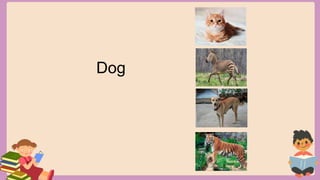
a. Picture Cues- refer to visual clues or hints
provided in the form of images or pictures to
aid understanding or recall of information.
Dog
b. Finding the Odd One Out- The learners study a
group of words, one of which is much different and
does NOT belong to the group. They either underline
or encircle the odd word.
Set of Items: Apple, Banana, Orange, Carrot
Criterion : Type of Food
 Apple, Banana, Orange (fruits)
 Carrot (vegetables)
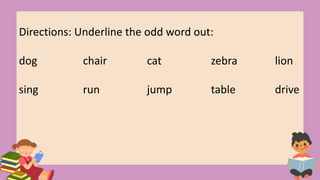
Directions: Underline the odd word out:
dog chair cat zebra lion
sing run jump table drive
c. Mother-Tongue Equivalents -The learners are
asked to give or write the English equivalent of
words in their mother tongue.
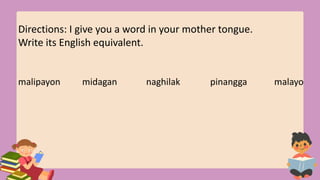
Directions: I give you a word in your mother tongue.
Write its English equivalent.
malipayon midagan naghilak pinangga malayo
d. Knowledge of Opposites -The learners are
challenged to connect lines that show words with the
opposite meaning.
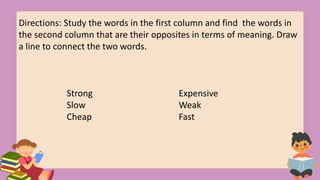
Directions: Study the words in the first column and find the words in
the second column that are their opposites in terms of meaning. Draw
a line to connect the two words.
Strong Expensive
Slow Weak
Cheap Fast
e. Prefix-Word Combination-The learners are asked to
combine the appropriate prefix to be connected to a
word to produce a new word.
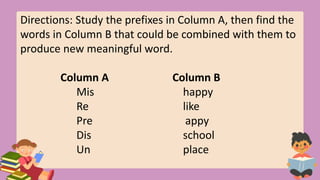
Directions: Study the prefixes in Column A, then find the
words in Column B that could be combined with them to
produce new meaningful word.
Column A Column B
Mis happy
Re like
Pre appy
Dis school
Un place
f. Yes/No Questions - This test requires the
learners to demonstrate appropriate knowledge of the
word. Two questions answerable by Yes or No are
asked to the learners. Both questions should be
correctly answered.
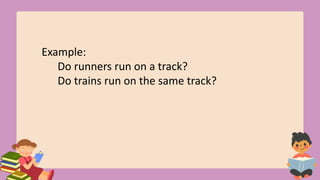
Example:
Do runners run on a track?
Do trains run on the same track?
2. Productive Tests
a. Word Associates
b. Sentence Completion
c. Definitions
d. Cloze Test
e. Getting the Meaning of Words through
Context Clues
a. Word Associates
This test measures the ability of the
learners to produce words that are
suggested by the descriptions used as
cues to the desired word.
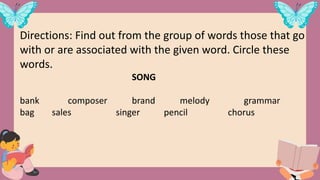
Directions: Find out from the group of words those that go
with or are associated with the given word. Circle these
words.
SONG
bank composer brand melody grammar
bag sales singer pencil chorus
b. Sentence Completion
This test requires the learners to
complete a sentence using ideas and
vocabulary that fit the context.
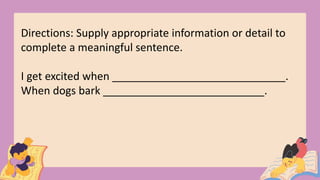
Directions: Supply appropriate information or detail to
complete a meaningful sentence.
I get excited when _____________________________.
When dogs bark ___________________________.
c. Definitions
Learners are tasked to define a term
or concept. The more details or
attributes they could give about it,
the richer is their vocabulary.
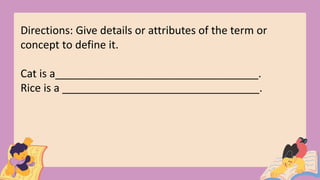
Directions: Give details or attributes of the term or
concept to define it.
Cat is a__________________________________.
Rice is a _________________________________.
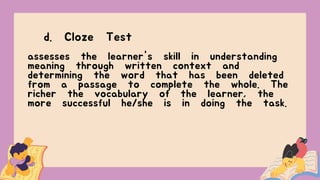
d. Cloze Test
assesses the learner's skill in understanding
meaning through written context and
determining the word that has been deleted
from a passage to complete the whole. The
richer the vocabulary of the learner, the
more successful he/she is in doing the task.
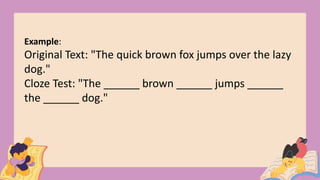
Example:
Original Text: "The quick brown fox jumps over the lazy
dog."
Cloze Test: "The ______ brown ______ jumps ______
the ______ dog."
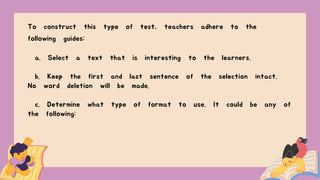
To construct this type of test, teachers adhere to the
following guides:
a. Select a text that is interesting to the learners.
b. Keep the first and last sentence of the selection intact.
No word deletion will be made.
c. Determine what type of format to use. It could be any of
the following:
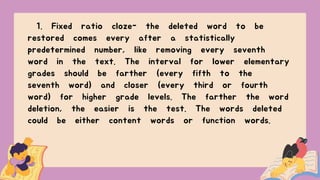
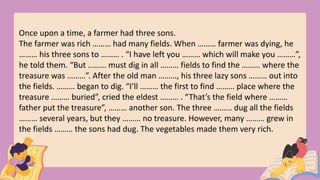
1. Fixed ratio cloze- the deleted word to be
restored comes every after a statistically
predetermined number, like removing every seventh
word in the text. The interval for lower elementary
grades should be farther (every fifth to the
seventh word) and closer (every third or fourth
word) for higher grade levels. The farther the word
deletion, the easier is the test. The words deleted
could be either content words or function words.
Once upon a time, a farmer had three sons.
The farmer was rich ……… had many fields. When ……… farmer was dying, he
……… his three sons to ……… . “I have left you ……… which will make you ………”,
he told them. “But ……… must dig in all ……… fields to find the ……… where the
treasure was ………”. After the old man ………, his three lazy sons ……… out into
the fields. ……… began to dig. “I’ll ……… the first to find ……… place where the
treasure ……… buried”, cried the eldest ……… . “That’s the field where ………
father put the treasure”, ……… another son. The three ……… dug all the fields
……… several years, but they ……… no treasure. However, many ……… grew in
the fields ……… the sons had dug. The vegetables made them very rich.
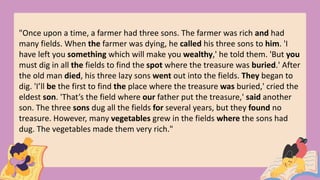
"Once upon a time, a farmer had three sons. The farmer was rich and had
many fields. When the farmer was dying, he called his three sons to him. 'I
have left you something which will make you wealthy,' he told them. 'But you
must dig in all the fields to find the spot where the treasure was buried.' After
the old man died, his three lazy sons went out into the fields. They began to
dig. 'I’ll be the first to find the place where the treasure was buried,' cried the
eldest son. 'That’s the field where our father put the treasure,' said another
son. The three sons dug all the fields for several years, but they found no
treasure. However, many vegetables grew in the fields where the sons had
dug. The vegetables made them very rich."
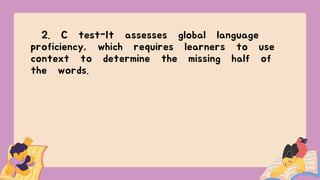
2. C test-It assesses global language
proficiency, which requires learners to use
context to determine the missing half of
the words.
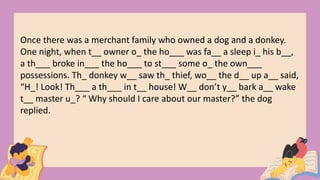
Once there was a merchant family who owned a dog and a donkey.
One night, when t__ owner o_ the ho___ was fa__ a sleep i_ his b__,
a th___ broke in___ the ho___ to st___ some o_ the own___
possessions. Th_ donkey w__ saw th_ thief, wo__ the d__ up a__ said,
“H_! Look! Th___ a th___ in t__ house! W__ don’t y__ bark a__ wake
t__ master u_? “ Why should I care about our master?” the dog
replied.
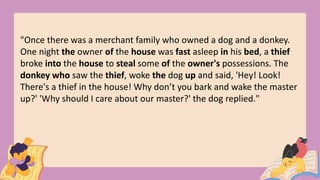
"Once there was a merchant family who owned a dog and a donkey.
One night the owner of the house was fast asleep in his bed, a thief
broke into the house to steal some of the owner's possessions. The
donkey who saw the thief, woke the dog up and said, 'Hey! Look!
There's a thief in the house! Why don’t you bark and wake the master
up?' 'Why should I care about our master?' the dog replied."
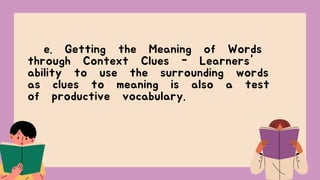
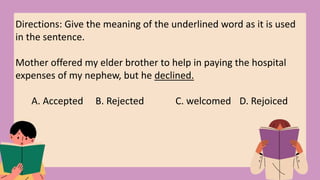
e. Getting the Meaning of Words
through Context Clues - Learners'
ability to use the surrounding words
as clues to meaning is also a test
of productive vocabulary.
Directions: Give the meaning of the underlined word as it is used
in the sentence.
Mother offered my elder brother to help in paying the hospital
expenses of my nephew, but he declined.
A. Accepted B. Rejected C. welcomed D. Rejoiced
ACTIVITY
Directions: With the knowledge you gained, perform the
following tasks.
1. Make two vocabulary recognition types of test, one for the
primary level and the other for intermediate grade level. Include
the directions and construct at least two items each type.
2. Construct two Productive vocabulary tests. Give the directions.

TESTING VOCABULARY KNOWLEDGE FOR DEMO.pptx

  • 1.
  • 3.
    At the endof this lesson, you are expected to: o Describe the different types of vocabulary knowledge tests; o Determine the appropriate use of a vocabulary knowledge test, and o Construct varied types of vocabulary knowledge tests.
  • 5.
    Assessing language learners'vocabulary is essential as an adequate vocabulary can make the language learners communicate better with others and can lead them to better success in their academic studies. It is important that learners are taught how to accumulate a strong vocabulary.
  • 6.
    Experts (Madsen, 1983;Read, 2000; Hughes, 2003; Nunan, 2015) mentioned that vocabulary assessment determines the amount of words learners could understand from what is either read or heard.
  • 7.
    The following vocabularytests address these varied concerns: 1. Vocabulary Recognition Tests-These tests measure the receptive vocabulary and the vocabulary breadth of the learners. 2. Productive Tests- These types of tests assess the productive vocabulary and vocabulary depth of the learners.
  • 8.
    1. Vocabulary RecognitionTests a. Picture Cues b. Finding the Odd One Out c. Mother-Tongue Equivalents d. Knowledge of Opposites e. Prefix-Word Combination f. Yes/No Questions
  • 9.
    a. Picture Cues-refer to visual clues or hints provided in the form of images or pictures to aid understanding or recall of information.
  • 10.
  • 11.
    b. Finding theOdd One Out- The learners study a group of words, one of which is much different and does NOT belong to the group. They either underline or encircle the odd word.
  • 12.
    Set of Items:Apple, Banana, Orange, Carrot Criterion : Type of Food  Apple, Banana, Orange (fruits)  Carrot (vegetables)
  • 13.
    Directions: Underline theodd word out: dog chair cat zebra lion sing run jump table drive
  • 14.
    c. Mother-Tongue Equivalents-The learners are asked to give or write the English equivalent of words in their mother tongue.
  • 15.
    Directions: I giveyou a word in your mother tongue. Write its English equivalent. malipayon midagan naghilak pinangga malayo
  • 16.
    d. Knowledge ofOpposites -The learners are challenged to connect lines that show words with the opposite meaning.
  • 17.
    Directions: Study thewords in the first column and find the words in the second column that are their opposites in terms of meaning. Draw a line to connect the two words. Strong Expensive Slow Weak Cheap Fast
  • 18.
    e. Prefix-Word Combination-Thelearners are asked to combine the appropriate prefix to be connected to a word to produce a new word.
  • 19.
    Directions: Study theprefixes in Column A, then find the words in Column B that could be combined with them to produce new meaningful word. Column A Column B Mis happy Re like Pre appy Dis school Un place
  • 20.
    f. Yes/No Questions- This test requires the learners to demonstrate appropriate knowledge of the word. Two questions answerable by Yes or No are asked to the learners. Both questions should be correctly answered.
  • 21.
    Example: Do runners runon a track? Do trains run on the same track?
  • 22.
    2. Productive Tests a.Word Associates b. Sentence Completion c. Definitions d. Cloze Test e. Getting the Meaning of Words through Context Clues
  • 23.
    a. Word Associates Thistest measures the ability of the learners to produce words that are suggested by the descriptions used as cues to the desired word.
  • 24.
    Directions: Find outfrom the group of words those that go with or are associated with the given word. Circle these words. SONG bank composer brand melody grammar bag sales singer pencil chorus
  • 25.
    b. Sentence Completion Thistest requires the learners to complete a sentence using ideas and vocabulary that fit the context.
  • 26.
    Directions: Supply appropriateinformation or detail to complete a meaningful sentence. I get excited when _____________________________. When dogs bark ___________________________.
  • 27.
    c. Definitions Learners aretasked to define a term or concept. The more details or attributes they could give about it, the richer is their vocabulary.
  • 28.
    Directions: Give detailsor attributes of the term or concept to define it. Cat is a__________________________________. Rice is a _________________________________.
  • 29.
    d. Cloze Test assessesthe learner's skill in understanding meaning through written context and determining the word that has been deleted from a passage to complete the whole. The richer the vocabulary of the learner, the more successful he/she is in doing the task.
  • 30.
    Example: Original Text: "Thequick brown fox jumps over the lazy dog." Cloze Test: "The ______ brown ______ jumps ______ the ______ dog."
  • 31.
    To construct thistype of test, teachers adhere to the following guides: a. Select a text that is interesting to the learners. b. Keep the first and last sentence of the selection intact. No word deletion will be made. c. Determine what type of format to use. It could be any of the following:
  • 32.
    1. Fixed ratiocloze- the deleted word to be restored comes every after a statistically predetermined number, like removing every seventh word in the text. The interval for lower elementary grades should be farther (every fifth to the seventh word) and closer (every third or fourth word) for higher grade levels. The farther the word deletion, the easier is the test. The words deleted could be either content words or function words.
  • 33.
    Once upon atime, a farmer had three sons. The farmer was rich ……… had many fields. When ……… farmer was dying, he ……… his three sons to ……… . “I have left you ……… which will make you ………”, he told them. “But ……… must dig in all ……… fields to find the ……… where the treasure was ………”. After the old man ………, his three lazy sons ……… out into the fields. ……… began to dig. “I’ll ……… the first to find ……… place where the treasure ……… buried”, cried the eldest ……… . “That’s the field where ……… father put the treasure”, ……… another son. The three ……… dug all the fields ……… several years, but they ……… no treasure. However, many ……… grew in the fields ……… the sons had dug. The vegetables made them very rich.
  • 34.
    "Once upon atime, a farmer had three sons. The farmer was rich and had many fields. When the farmer was dying, he called his three sons to him. 'I have left you something which will make you wealthy,' he told them. 'But you must dig in all the fields to find the spot where the treasure was buried.' After the old man died, his three lazy sons went out into the fields. They began to dig. 'I’ll be the first to find the place where the treasure was buried,' cried the eldest son. 'That’s the field where our father put the treasure,' said another son. The three sons dug all the fields for several years, but they found no treasure. However, many vegetables grew in the fields where the sons had dug. The vegetables made them very rich."
  • 35.
    2. C test-Itassesses global language proficiency, which requires learners to use context to determine the missing half of the words.
  • 36.
    Once there wasa merchant family who owned a dog and a donkey. One night, when t__ owner o_ the ho___ was fa__ a sleep i_ his b__, a th___ broke in___ the ho___ to st___ some o_ the own___ possessions. Th_ donkey w__ saw th_ thief, wo__ the d__ up a__ said, “H_! Look! Th___ a th___ in t__ house! W__ don’t y__ bark a__ wake t__ master u_? “ Why should I care about our master?” the dog replied.
  • 37.
    "Once there wasa merchant family who owned a dog and a donkey. One night the owner of the house was fast asleep in his bed, a thief broke into the house to steal some of the owner's possessions. The donkey who saw the thief, woke the dog up and said, 'Hey! Look! There's a thief in the house! Why don’t you bark and wake the master up?' 'Why should I care about our master?' the dog replied."
  • 38.
    e. Getting theMeaning of Words through Context Clues - Learners' ability to use the surrounding words as clues to meaning is also a test of productive vocabulary.
  • 39.
    Directions: Give themeaning of the underlined word as it is used in the sentence. Mother offered my elder brother to help in paying the hospital expenses of my nephew, but he declined. A. Accepted B. Rejected C. welcomed D. Rejoiced
  • 41.
    ACTIVITY Directions: With theknowledge you gained, perform the following tasks. 1. Make two vocabulary recognition types of test, one for the primary level and the other for intermediate grade level. Include the directions and construct at least two items each type. 2. Construct two Productive vocabulary tests. Give the directions.