Oleh :
• Achmad Harpin Asrori (11453101803)
• Program Studi S1 Sistem Informasi
Fakultas Sains dan Teknologi
Universitas Islam Negeri Sultan Syarif Kasim Riau
http://sif.uin-suska.ac.id/ http://fst.uin-suska.ac.id/ http://www.uin-suska.ac.id/
SOFTWARE DEVELOPMENT MODELS
➜ The development process adopted for
a project will depend on the project aims
and goals. There are numerous
development life cycles that have been
developed in order to achieve different
required objectives. These life cycles range
from lightweight and fast methodologies,
where time to market is of the essence,
through to fully controlled and documented
methodologies where quality and reliability
are key drivers.
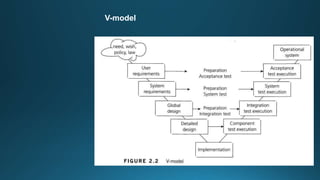
V-model
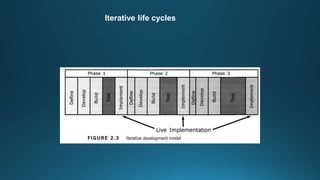
Iterative life cycles
TEST LEVELS
➜ The V-model for testing was introduced
This section looks in more detail at the various
test levels. The key characteristics for each test
level are discussed and defined to be able to
more clearly separate the various test levels. A
thorough understanding and definition of the
various test levels will identify missing areas
and prevent overlap and repetition. Sometimes
we may wish to introduce deliberate overlap to
address specific risks. Understanding whether
we want overlaps and removing the gaps will
make the test levels more complementary thus
leading to more effective and efficient testing.
Component testing
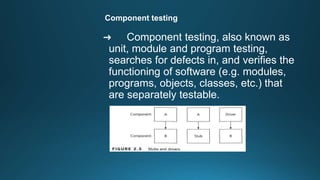
➜ Component testing, also known as
unit, module and program testing,
searches for defects in, and verifies the
functioning of software (e.g. modules,
programs, objects, classes, etc.) that
are separately testable.
Integration testing
➜Integration testing tests interfaces between components,
interactions to different parts of a system such as an operating
system, file system and hardware or interfaces between
systems.
➜ There may be more than one level of integration testing and
it may be carried out on test objects of varying size. For
example:
➜component integration testing tests the interactions between
software com ponents and is done after component testing;
➜system integration testing tests the interactions between
different systems and may be done after system testing. In this
case, the developing organiza tion may control only one side of
the interface, so changes may be destabilizing. Business
processes implemented as workflows may involve a series of
systems that can even run on different platforms.
System testing
➜ System testing is concerned with
the behavior of the whole
system/product as defined by the
scope of a development project or
product. It may include tests based on
risks and/or requirements specification,
business processes, use cases, or
other high level descriptions of system
behavior, interactions with the
operating system, and system
resources.
Acceptance testing
➜ When the development
organization has performed its system
test and has corrected all or most
defects, the system will be delivered to
the user or customer for acceptance
testing. The acceptance test should
answer questions such as: 'Can the
system be released?', 'What, if any, are
the outstanding (business) risks?' and
'Has development met their
obligations?'.
TEST TYPES: THE TARGETS OF TESTING
➜ Test types are introduced as a means
of clearly defining the objective of a certain
test level for a programme or project. We
need to think about different types of
testing because testing the functionality of
the component or system may not be
sufficient at each level to meet the overall
test objectives. Focusing the testing on a
specific test objective and, therefore,
selecting the appropriate type of test helps
making and communicating decisions
against test objectives easier.
Testing of function (functional testing)
➜ Functional testing considers the
specified behavior and is often also
referred to as black-box testing. This is
not entirely true, since black-box testing
also includes non-functional testing.
Testing of software product characteristics (non-
functional testing)
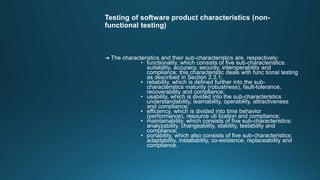
➜ The characteristics and their sub-characteristics are, respectively:
• functionality, which consists of five sub-characteristics:
suitability, accuracy, security, interoperability and
compliance; this characteristic deals with func tional testing
as described in Section 2.3.1;
• reliability, which is defined further into the sub-
characteristics maturity (robustness), fault-tolerance,
recoverability and compliance;
• usability, which is divided into the sub-characteristics
understandability, learnability, operability, attractiveness
and compliance;
• efficiency, which is divided into time behavior
(performance), resource uti lization and compliance;
• maintainability, which consists of five sub-characteristics:
analyzability, changeability, stability, testability and
compliance;
• portability, which also consists of five sub-characteristics:
adaptability, installability, co-existence, replaceability and
compliance.
Testing of software structure/architecture (structural
testing)
➜ The third target of testing is the
structure of the system or component.
If we are talking about the structure of a
system, we may call it the system
architecture. Structural testing is often
referred to as 'white-box' or 'glass-box'
because we are interested in what is
happening 'inside the box'.
Testing related to changes (confirmation and regression
testing)
➜Confirmation testing (re-testing)
➜ When doing confirmation testing, it is
important to ensure that the test is executed in
exactly the same way as it was the first time,
using the same inputs, data and environment.
➜Regression testing
➜ The term 'regression testing' is something
of a misnomer. It would be better if it were
called 'anti-regression' testing because we are
executing tests with the intent of checking that
the system has not regressed (that is, it does
not now have more defects in it as a result of
some change).
MAINTENANCE TESTING
➜ The development and test process
applicable to new developments does not
change fundamentally for maintenance
purposes. The same test process steps will
apply and, depending on the size and risk of
the changes made, several levels of testing are
carried out: a component test, an integration
test, a system test and an acceptance test. A
maintenance test process usually begins with
the receipt of an application for a change or a
release plan. The test manager will use this as
a basis for producing a test plan. On receipt of
the new or changed specifications,
corresponding test cases are specified or
adapted.
Impact analysis and regression testing
➜Usually maintenance testing will consist of
two parts:
➜testing the changes
➜regression tests to show that the rest of
the system has not been affected by the
maintenance work.
➜In addition to testing what has been
changed, maintenance testing includes
extensive regression testing to parts of the
system that have not been changed. A
major and important activity within
maintenance testing is impact analysis.
Triggers for maintenance testing
➜ As stated maintenance testing is done on
an existing operational system. It is triggered by
modifications, migration, or retirement of the
system. Modifications include planned
enhancement changes (e.g. release-based),
corrective and emergency changes, and
changes of environment, such as planned
operating system or database upgrades, or
patches to newly exposed or discovered
vulnerabilities of the operating system.
Maintenance testing for migration (e.g. from
one platform to another) should include
operational testing of the new environment, as
well as the changed software.
Thanks!

Testing throughout the software life cycle

  • 1.
    Oleh : • AchmadHarpin Asrori (11453101803) • Program Studi S1 Sistem Informasi Fakultas Sains dan Teknologi Universitas Islam Negeri Sultan Syarif Kasim Riau http://sif.uin-suska.ac.id/ http://fst.uin-suska.ac.id/ http://www.uin-suska.ac.id/
  • 3.
    SOFTWARE DEVELOPMENT MODELS ➜The development process adopted for a project will depend on the project aims and goals. There are numerous development life cycles that have been developed in order to achieve different required objectives. These life cycles range from lightweight and fast methodologies, where time to market is of the essence, through to fully controlled and documented methodologies where quality and reliability are key drivers.
  • 5.
  • 7.
  • 9.
    TEST LEVELS ➜ TheV-model for testing was introduced This section looks in more detail at the various test levels. The key characteristics for each test level are discussed and defined to be able to more clearly separate the various test levels. A thorough understanding and definition of the various test levels will identify missing areas and prevent overlap and repetition. Sometimes we may wish to introduce deliberate overlap to address specific risks. Understanding whether we want overlaps and removing the gaps will make the test levels more complementary thus leading to more effective and efficient testing.
  • 11.
    Component testing ➜ Componenttesting, also known as unit, module and program testing, searches for defects in, and verifies the functioning of software (e.g. modules, programs, objects, classes, etc.) that are separately testable.
  • 13.
    Integration testing ➜Integration testingtests interfaces between components, interactions to different parts of a system such as an operating system, file system and hardware or interfaces between systems. ➜ There may be more than one level of integration testing and it may be carried out on test objects of varying size. For example: ➜component integration testing tests the interactions between software com ponents and is done after component testing; ➜system integration testing tests the interactions between different systems and may be done after system testing. In this case, the developing organiza tion may control only one side of the interface, so changes may be destabilizing. Business processes implemented as workflows may involve a series of systems that can even run on different platforms.
  • 15.
    System testing ➜ Systemtesting is concerned with the behavior of the whole system/product as defined by the scope of a development project or product. It may include tests based on risks and/or requirements specification, business processes, use cases, or other high level descriptions of system behavior, interactions with the operating system, and system resources.
  • 17.
    Acceptance testing ➜ Whenthe development organization has performed its system test and has corrected all or most defects, the system will be delivered to the user or customer for acceptance testing. The acceptance test should answer questions such as: 'Can the system be released?', 'What, if any, are the outstanding (business) risks?' and 'Has development met their obligations?'.

  • 19.
    TEST TYPES: THETARGETS OF TESTING ➜ Test types are introduced as a means of clearly defining the objective of a certain test level for a programme or project. We need to think about different types of testing because testing the functionality of the component or system may not be sufficient at each level to meet the overall test objectives. Focusing the testing on a specific test objective and, therefore, selecting the appropriate type of test helps making and communicating decisions against test objectives easier.
  • 21.
    Testing of function(functional testing) ➜ Functional testing considers the specified behavior and is often also referred to as black-box testing. This is not entirely true, since black-box testing also includes non-functional testing.
  • 23.
    Testing of softwareproduct characteristics (non- functional testing) ➜ The characteristics and their sub-characteristics are, respectively: • functionality, which consists of five sub-characteristics: suitability, accuracy, security, interoperability and compliance; this characteristic deals with func tional testing as described in Section 2.3.1; • reliability, which is defined further into the sub- characteristics maturity (robustness), fault-tolerance, recoverability and compliance; • usability, which is divided into the sub-characteristics understandability, learnability, operability, attractiveness and compliance; • efficiency, which is divided into time behavior (performance), resource uti lization and compliance; • maintainability, which consists of five sub-characteristics: analyzability, changeability, stability, testability and compliance; • portability, which also consists of five sub-characteristics: adaptability, installability, co-existence, replaceability and compliance.
  • 25.
    Testing of softwarestructure/architecture (structural testing) ➜ The third target of testing is the structure of the system or component. If we are talking about the structure of a system, we may call it the system architecture. Structural testing is often referred to as 'white-box' or 'glass-box' because we are interested in what is happening 'inside the box'.
  • 27.
    Testing related tochanges (confirmation and regression testing) ➜Confirmation testing (re-testing) ➜ When doing confirmation testing, it is important to ensure that the test is executed in exactly the same way as it was the first time, using the same inputs, data and environment. ➜Regression testing ➜ The term 'regression testing' is something of a misnomer. It would be better if it were called 'anti-regression' testing because we are executing tests with the intent of checking that the system has not regressed (that is, it does not now have more defects in it as a result of some change).
  • 29.
    MAINTENANCE TESTING ➜ Thedevelopment and test process applicable to new developments does not change fundamentally for maintenance purposes. The same test process steps will apply and, depending on the size and risk of the changes made, several levels of testing are carried out: a component test, an integration test, a system test and an acceptance test. A maintenance test process usually begins with the receipt of an application for a change or a release plan. The test manager will use this as a basis for producing a test plan. On receipt of the new or changed specifications, corresponding test cases are specified or adapted.
  • 31.
    Impact analysis andregression testing ➜Usually maintenance testing will consist of two parts: ➜testing the changes ➜regression tests to show that the rest of the system has not been affected by the maintenance work. ➜In addition to testing what has been changed, maintenance testing includes extensive regression testing to parts of the system that have not been changed. A major and important activity within maintenance testing is impact analysis.
  • 33.
    Triggers for maintenancetesting ➜ As stated maintenance testing is done on an existing operational system. It is triggered by modifications, migration, or retirement of the system. Modifications include planned enhancement changes (e.g. release-based), corrective and emergency changes, and changes of environment, such as planned operating system or database upgrades, or patches to newly exposed or discovered vulnerabilities of the operating system. Maintenance testing for migration (e.g. from one platform to another) should include operational testing of the new environment, as well as the changed software.
  • 34.