TESTING THROUGHOUT THE SOFTWARE LIFE CYCLE
GRAHAM ET.AL (2006)
Presented by
Riski Indra Hilman
11453101775
Information System
Faculty of Science and Technology
State Islamic University Sultan Syarif
Kasim Riau
2017
Testing and Implementation
1. SOFTWARE DEVELOPMENT MODELS
• In every development life cycle, a part of testing is focused on
verification testing and a part is focused on validation testing.
Verification is concerned with evaluating a work product,
component or system to determine whether it meets the
requirements set. In fact, verification focuses on the question
'Is the deliverable built according to the specification?'.
CONT…
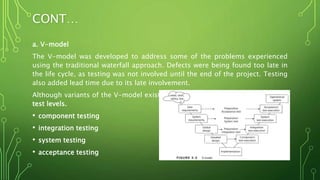
a. V-model
The V-model was developed to address some of the problems experienced
using the traditional waterfall approach. Defects were being found too late in
the life cycle, as testing was not involved until the end of the project. Testing
also added lead time due to its late involvement.
Although variants of the V-model exist, a common type of V-model uses four
test levels.
• component testing
• integration testing
• system testing
• acceptance testing
CONT…
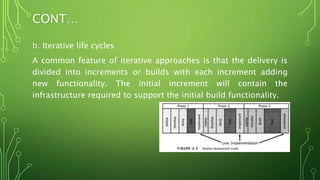
b. Iterative life cycles
A common feature of iterative approaches is that the delivery is
divided into increments or builds with each increment adding
new functionality. The initial increment will contain the
infrastructure required to support the initial build functionality.
CONT…
c. Testing within a life cycle model
• In summary, whichever life cycle model is being used, there are
several characteristics of good testing:
• for every development activity there is a corresponding testing
activity;
• each test level has test objectives specific to that level;
• the analysis and design of tests for a given test level should
begin during the corresponding development activity;
• testers should be involved in reviewing documents as soon as
drafts are avail able in the development cycle.
2. TEST LEVELS
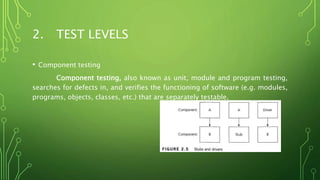
• Component testing
Component testing, also known as unit, module and program testing,
searches for defects in, and verifies the functioning of software (e.g. modules,
programs, objects, classes, etc.) that are separately testable.
CONT…
• Integration testing
Integration testing tests interfaces between components,
interactions to different parts of a system such as an operating
system, file system and hardware or interfaces between systems.
Note that integration testing should be differentiated from other
integration activities. Integration testing is often carried out by
the integrator, but preferably by a specific integration tester or
test team.
CONT…
• System testing
System testing is concerned with the behavior of the whole
system/product as defined by the scope of a development
project or product. It may include tests based on risks and/or
requirements specification, business processes, use cases, or
other high level descriptions of system behavior, interactions
with the operating system, and system resources.
CONT…
• Acceptance testing
When the development organization has performed its
system test and has corrected all or most defects, the system will
be delivered to the user or customer for acceptance testing. The
acceptance test should answer questions such as: 'Can the
system be released?', 'What, if any, are the outstanding
(business) risks?' and 'Has development met their obligations?'.
Acceptance testing is most often the responsibility of the user or
customer, although other stakeholders may be involved as well.
3. TEST TYPES: THE TARGETS OF TESTING
1. Testing of function (functional testing)
The function of a system (or component) is 'what it does'. This is
typically described in a requirements specification, a functional
specification, or in use cases. There may be some functions that are
'assumed' to be provided that are not documented that are also part of
the requirement for a system, though it is difficult to test against
undocumented and implicit requirements. Functional tests are based
on these functions, described in documents or understood by the
testers and may be performed at all test levels (e.g. test for
components may be based on a component specification).
CONT…
2. Testing of software product characteristics (non-functional
testing)
A second target for testing is the testing of the quality
characteristics, or non-functional attributes of the system (or
component or integration group). Here we are interested in how
well or how fast something is done. We are testing something
that we need to measure on a scale of measurement, for
example time to respond.
CONT…
3. Testing of software structure/architecture (structural testing)
The third target of testing is the structure of the system or
component. If we are talking about the structure of a system, we
may call it the system architecture. Structural testing is often
referred to as 'white-box' or 'glass-box' because we are
interested in what is happening 'inside the box'.
CONT…
4. Testing related to changes (confirmation and regression
testing)
The final target of testing is the testing of changes. This category
is slightly different to the others because if you have made a
change to the software, you will have changed the way it
functions, the way it performs (or both) and its structure.
However we are looking here at the specific types of tests
relating to changes, even though they may include all of the
other test types.
VISIT OUR CAMPUS
 https://sif.uin-suska.ac.id/
 https://fst.uin-suska.ac.id/
 https://uin-suska.ac.id/

Testing throughout the software life cycle

  • 1.
    TESTING THROUGHOUT THESOFTWARE LIFE CYCLE GRAHAM ET.AL (2006) Presented by Riski Indra Hilman 11453101775 Information System Faculty of Science and Technology State Islamic University Sultan Syarif Kasim Riau 2017 Testing and Implementation
  • 2.
    1. SOFTWARE DEVELOPMENTMODELS • In every development life cycle, a part of testing is focused on verification testing and a part is focused on validation testing. Verification is concerned with evaluating a work product, component or system to determine whether it meets the requirements set. In fact, verification focuses on the question 'Is the deliverable built according to the specification?'.
  • 3.
    CONT… a. V-model The V-modelwas developed to address some of the problems experienced using the traditional waterfall approach. Defects were being found too late in the life cycle, as testing was not involved until the end of the project. Testing also added lead time due to its late involvement. Although variants of the V-model exist, a common type of V-model uses four test levels. • component testing • integration testing • system testing • acceptance testing
  • 4.
    CONT… b. Iterative lifecycles A common feature of iterative approaches is that the delivery is divided into increments or builds with each increment adding new functionality. The initial increment will contain the infrastructure required to support the initial build functionality.
  • 5.
    CONT… c. Testing withina life cycle model • In summary, whichever life cycle model is being used, there are several characteristics of good testing: • for every development activity there is a corresponding testing activity; • each test level has test objectives specific to that level; • the analysis and design of tests for a given test level should begin during the corresponding development activity; • testers should be involved in reviewing documents as soon as drafts are avail able in the development cycle.
  • 6.
    2. TEST LEVELS •Component testing Component testing, also known as unit, module and program testing, searches for defects in, and verifies the functioning of software (e.g. modules, programs, objects, classes, etc.) that are separately testable.
  • 7.
    CONT… • Integration testing Integrationtesting tests interfaces between components, interactions to different parts of a system such as an operating system, file system and hardware or interfaces between systems. Note that integration testing should be differentiated from other integration activities. Integration testing is often carried out by the integrator, but preferably by a specific integration tester or test team.
  • 8.
    CONT… • System testing Systemtesting is concerned with the behavior of the whole system/product as defined by the scope of a development project or product. It may include tests based on risks and/or requirements specification, business processes, use cases, or other high level descriptions of system behavior, interactions with the operating system, and system resources.
  • 9.
    CONT… • Acceptance testing Whenthe development organization has performed its system test and has corrected all or most defects, the system will be delivered to the user or customer for acceptance testing. The acceptance test should answer questions such as: 'Can the system be released?', 'What, if any, are the outstanding (business) risks?' and 'Has development met their obligations?'. Acceptance testing is most often the responsibility of the user or customer, although other stakeholders may be involved as well.
  • 10.
    3. TEST TYPES:THE TARGETS OF TESTING 1. Testing of function (functional testing) The function of a system (or component) is 'what it does'. This is typically described in a requirements specification, a functional specification, or in use cases. There may be some functions that are 'assumed' to be provided that are not documented that are also part of the requirement for a system, though it is difficult to test against undocumented and implicit requirements. Functional tests are based on these functions, described in documents or understood by the testers and may be performed at all test levels (e.g. test for components may be based on a component specification).
  • 11.
    CONT… 2. Testing ofsoftware product characteristics (non-functional testing) A second target for testing is the testing of the quality characteristics, or non-functional attributes of the system (or component or integration group). Here we are interested in how well or how fast something is done. We are testing something that we need to measure on a scale of measurement, for example time to respond.
  • 12.
    CONT… 3. Testing ofsoftware structure/architecture (structural testing) The third target of testing is the structure of the system or component. If we are talking about the structure of a system, we may call it the system architecture. Structural testing is often referred to as 'white-box' or 'glass-box' because we are interested in what is happening 'inside the box'.
  • 13.
    CONT… 4. Testing relatedto changes (confirmation and regression testing) The final target of testing is the testing of changes. This category is slightly different to the others because if you have made a change to the software, you will have changed the way it functions, the way it performs (or both) and its structure. However we are looking here at the specific types of tests relating to changes, even though they may include all of the other test types.
  • 14.
    VISIT OUR CAMPUS https://sif.uin-suska.ac.id/  https://fst.uin-suska.ac.id/  https://uin-suska.ac.id/