Testing Dan Implementasi Sistem
Chapter 2
Testing Throughout The Software Life Cycle
UIN SUSKA RIAU
SISTEM INFORMASI
Riauly Putra
12/11/2017
Software Development Models
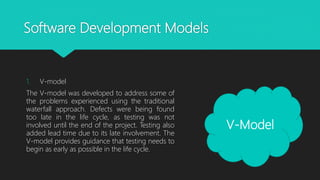
1. V-model
The V-model was developed to address some of
the problems experienced using the traditional
waterfall approach. Defects were being found
too late in the life cycle, as testing was not
involved until the end of the project. Testing also
added lead time due to its late involvement. The
V-model provides guidance that testing needs to
begin as early as possible in the life cycle.
V-Model
Software Development Models,…
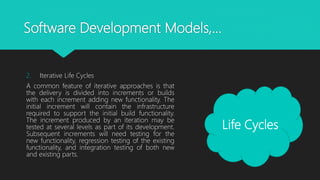
2. Iterative Life Cycles
A common feature of iterative approaches is that
the delivery is divided into increments or builds
with each increment adding new functionality. The
initial increment will contain the infrastructure
required to support the initial build functionality.
The increment produced by an iteration may be
tested at several levels as part of its development.
Subsequent increments will need testing for the
new functionality, regression testing of the existing
functionality, and integration testing of both new
and existing parts.
Life Cycles
Lanj,…
3. Testing Within a Life Cycle Model
a. In summary, whichever life cycle model is being used, there are several characteristics
of good testing:
b. for every development activity there is a corresponding testing activity;
c. each test level has test objectives specific to that level;
d. the analysis and design of tests for a given test level should begin during the
corresponding development activity;
e. testers should be involved in reviewing documents as soon as drafts are avail able in
the development cycle.
TEST LEVELS
1. Component Testing
Component testing, also known as unit, module and program testing, searches
for defects in, and verifies the functioning of software (e.g. modules, programs,
objects, classes, etc.) that are separately testable Component testing may be
done in isolation from the rest of the system depending on the context of the
development life cycle and the system.
2. Integration Testing
Integration testing is often carried out by the integrator, but preferably by a
specific integration tester or test team.There may be more than one level of
integration testing and it may be carried out on test objects of varying size.
TEST LEVELS,…
3. System Testing
System testing is concerned with the behavior of the whole system/product as
defined by the scope of a development project or product. It may include tests
based on risks and/or requirements specification, business processes, use
cases, or other high level descriptions of system behavior, interactions with the
operating system, and system resources.
4. Acceptance Testing
The goal of acceptance testing is to establish confidence in the system, part of
the system or specific non-functional characteristics, e.g. usability, of the
system.
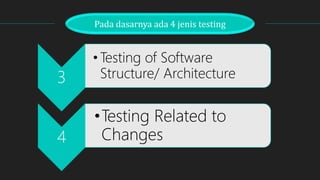
Pada dasarnya ada 4 jenis testing
1
•Testing of Function
(Fuctional Testing)
2
•Testing of Software
Product Characteristics
Pada dasarnya ada 4 jenis testing
3
•Testing of Software
Structure/ Architecture
4
•Testing Related to
Changes
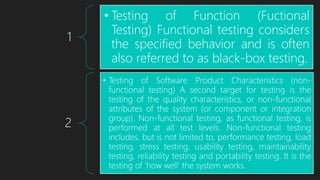
1
• Testing of Function (Fuctional
Testing) Functional testing considers
the specified behavior and is often
also referred to as black-box testing.
2
• Testing of Software Product Characteristics (non-
functional testing) A second target for testing is the
testing of the quality characteristics, or non-functional
attributes of the system (or component or integration
group). Non-functional testing, as functional testing, is
performed at all test levels. Non-functional testing
includes, but is not limited to, performance testing, load
testing, stress testing, usability testing, maintainability
testing, reliability testing and portability testing. It is the
testing of 'how well' the system works.
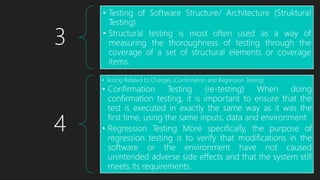
3
• Testing of Software Structure/ Architecture (Struktural
Testing)
• Structural testing is most often used as a way of
measuring the thoroughness of testing through the
coverage of a set of structural elements or coverage
items.
4
• Testing Related to Changes (Confirmation and Regression Testing)
• Confirmation Testing (re-testing) When doing
confirmation testing, it is important to ensure that the
test is executed in exactly the same way as it was the
first time, using the same inputs, data and environment
• Regression Testing More specifically, the purpose of
regression testing is to verify that modifications in the
software or the environment have not caused
unintended adverse side effects and that the system still
meets its requirements.
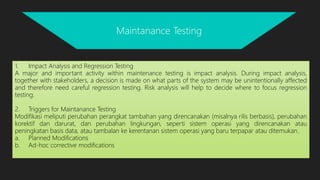
1. Impact Analysis and Regression Testing
A major and important activity within maintenance testing is impact analysis. During impact analysis,
together with stakeholders, a decision is made on what parts of the system may be unintentionally affected
and therefore need careful regression testing. Risk analysis will help to decide where to focus regression
testing.
2. Triggers for Maintanance Testing
Modifikasi meliputi perubahan perangkat tambahan yang direncanakan (misalnya rilis berbasis), perubahan
korektif dan darurat, dan perubahan lingkungan, seperti sistem operasi yang direncanakan atau
peningkatan basis data, atau tambalan ke kerentanan sistem operasi yang baru terpapar atau ditemukan.
a. Planned Modifications
b. Ad-hoc corrective modifications
Maintanance Testing
Reference
Graham, D., et al.2006.Foundations of Software Testing : ISTQB
Certification.London, UK :International Thomson Business Press
Link
http://sif.uin-suska.ac.id/
https://fst.uin-suska.ac.id/
http://www.uin-suska.ac.id/
End of Presentation
Thankyou for your attention
Giving your question 
Slide by Riauly Putra
Testing Dan implementasi kelas E 2017
Sistem Informasi UIN SUSKA RIAU
Lecture : M.Jazman S.Kom, M.Infosys

Bab ii testing throughout the software life cycle

  • 1.
    Testing Dan ImplementasiSistem Chapter 2 Testing Throughout The Software Life Cycle UIN SUSKA RIAU SISTEM INFORMASI Riauly Putra 12/11/2017
  • 2.
    Software Development Models 1.V-model The V-model was developed to address some of the problems experienced using the traditional waterfall approach. Defects were being found too late in the life cycle, as testing was not involved until the end of the project. Testing also added lead time due to its late involvement. The V-model provides guidance that testing needs to begin as early as possible in the life cycle. V-Model
  • 3.
    Software Development Models,… 2.Iterative Life Cycles A common feature of iterative approaches is that the delivery is divided into increments or builds with each increment adding new functionality. The initial increment will contain the infrastructure required to support the initial build functionality. The increment produced by an iteration may be tested at several levels as part of its development. Subsequent increments will need testing for the new functionality, regression testing of the existing functionality, and integration testing of both new and existing parts. Life Cycles
  • 4.
    Lanj,… 3. Testing Withina Life Cycle Model a. In summary, whichever life cycle model is being used, there are several characteristics of good testing: b. for every development activity there is a corresponding testing activity; c. each test level has test objectives specific to that level; d. the analysis and design of tests for a given test level should begin during the corresponding development activity; e. testers should be involved in reviewing documents as soon as drafts are avail able in the development cycle.
  • 5.
    TEST LEVELS 1. ComponentTesting Component testing, also known as unit, module and program testing, searches for defects in, and verifies the functioning of software (e.g. modules, programs, objects, classes, etc.) that are separately testable Component testing may be done in isolation from the rest of the system depending on the context of the development life cycle and the system. 2. Integration Testing Integration testing is often carried out by the integrator, but preferably by a specific integration tester or test team.There may be more than one level of integration testing and it may be carried out on test objects of varying size.
  • 6.
    TEST LEVELS,… 3. SystemTesting System testing is concerned with the behavior of the whole system/product as defined by the scope of a development project or product. It may include tests based on risks and/or requirements specification, business processes, use cases, or other high level descriptions of system behavior, interactions with the operating system, and system resources. 4. Acceptance Testing The goal of acceptance testing is to establish confidence in the system, part of the system or specific non-functional characteristics, e.g. usability, of the system.
  • 7.
    Pada dasarnya ada4 jenis testing 1 •Testing of Function (Fuctional Testing) 2 •Testing of Software Product Characteristics
  • 8.
    Pada dasarnya ada4 jenis testing 3 •Testing of Software Structure/ Architecture 4 •Testing Related to Changes
  • 9.
    1 • Testing ofFunction (Fuctional Testing) Functional testing considers the specified behavior and is often also referred to as black-box testing. 2 • Testing of Software Product Characteristics (non- functional testing) A second target for testing is the testing of the quality characteristics, or non-functional attributes of the system (or component or integration group). Non-functional testing, as functional testing, is performed at all test levels. Non-functional testing includes, but is not limited to, performance testing, load testing, stress testing, usability testing, maintainability testing, reliability testing and portability testing. It is the testing of 'how well' the system works.
  • 10.
    3 • Testing ofSoftware Structure/ Architecture (Struktural Testing) • Structural testing is most often used as a way of measuring the thoroughness of testing through the coverage of a set of structural elements or coverage items. 4 • Testing Related to Changes (Confirmation and Regression Testing) • Confirmation Testing (re-testing) When doing confirmation testing, it is important to ensure that the test is executed in exactly the same way as it was the first time, using the same inputs, data and environment • Regression Testing More specifically, the purpose of regression testing is to verify that modifications in the software or the environment have not caused unintended adverse side effects and that the system still meets its requirements.
  • 11.
    1. Impact Analysisand Regression Testing A major and important activity within maintenance testing is impact analysis. During impact analysis, together with stakeholders, a decision is made on what parts of the system may be unintentionally affected and therefore need careful regression testing. Risk analysis will help to decide where to focus regression testing. 2. Triggers for Maintanance Testing Modifikasi meliputi perubahan perangkat tambahan yang direncanakan (misalnya rilis berbasis), perubahan korektif dan darurat, dan perubahan lingkungan, seperti sistem operasi yang direncanakan atau peningkatan basis data, atau tambalan ke kerentanan sistem operasi yang baru terpapar atau ditemukan. a. Planned Modifications b. Ad-hoc corrective modifications Maintanance Testing
  • 12.
    Reference Graham, D., etal.2006.Foundations of Software Testing : ISTQB Certification.London, UK :International Thomson Business Press
  • 13.
  • 14.
    End of Presentation Thankyoufor your attention Giving your question  Slide by Riauly Putra Testing Dan implementasi kelas E 2017 Sistem Informasi UIN SUSKA RIAU Lecture : M.Jazman S.Kom, M.Infosys