System testing is performed to verify that an implemented system meets its specified requirements. There are several types of system testing that should be performed including: 1) System acceptance testing to determine if the system satisfies acceptance criteria, 2) Installation testing to ensure the system can be installed and configured properly, 3) Performance testing to measure the system's performance under different conditions such as load and stress. Proper system testing is important to ensure the system is error-free, works as intended, and is acceptable to stakeholders.
Presented by
Group A
GroupLeader: Abdullah-Al-
Mahmud
4th Year(honors)
Dept. of Information Science & Library Management
University of Rajshahi
1st September, 2016
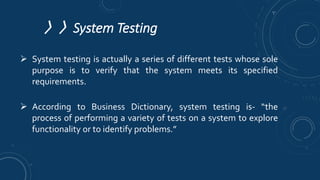
〉〉System Testing
Systemtesting is actually a series of different tests whose sole
purpose is to verify that the system meets its specified
requirements.
According to Business Dictionary, system testing is- “the
process of performing a variety of tests on a system to explore
functionality or to identify problems.”
5.

〉〉Example
Take a webapplication as example. Suppose we are doing testing on a web application of a
school and in this web application there are many modules like Teacher Module, Staff
Module, Parent Module, Student Module, and Admin Module and so on. Now we have to do
System Testing on this web application by maintaining certain steps.
6.
〉〉Example (cont.)
Testingthe GUI related issues - font size, alignment, display
images should work properly on all the modules.
Checking that the requirements of client have been met or not.
User friendly or not - proper error message should be displayed
on screen.
7.
• Functional testing
•Non- functional testing
- Performance
- Load & Stress related issues
System testing Criteria DIFFERS (from system to system)
________________________________________________________________________________________
Source: http://testingbasicinterviewquestions.blogspot.com/2015/03/system-testing-example-complete-
guide.html
〉〉Importance of SystemTesting?
To check whether the system meets organizational, functional
and end-users requirements or not.
To ensure an error-free system.
To increase workability, supportability & integration of the
system.
Minimize after-development troubleshooting.
10.
〉〉Importance (cont.)
Totest, validate and verify both the Application Architecture
and Business requirements.
The System is tested in such an environment that particularly
resembles the effective production environment where the
application/software will be lastly deployed. Thus it works as a
pilot project before getting operational.
________________________________________________________________________________________
Sources:
http://staffsite.gunadarma.ac.id/mkusuma
http://www.softwaretestingclass.com/system-testing-what-why-how/
How wouldwe test an
implemented system?
Presenter #3
13.
〉〉How would wetest an implemented
system?
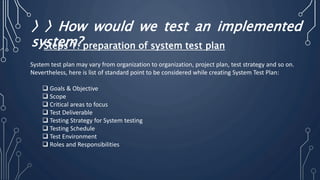
System test plan may vary from organization to organization, project plan, test strategy and so on.
Nevertheless, here is list of standard point to be considered while creating System Test Plan:
Goals & Objective
Scope
Critical areas to focus
Test Deliverable
Testing Strategy for System testing
Testing Schedule
Test Environment
Roles and Responsibilities
Steps 1: preparation of system test plan
14.
It isvery much similar functional test case writing. In test case writing different
scenario and cases of different types of test has to be written.
Different types of testing has to be considered here, like – functional testing, usability
testing, error handling testing, verification testing, validation testing, audit testing,
compatibility testing, scalability testing, security testing, capacity testing, recovery
testing etc.
While writing test case it is needed to ensure that test cases are covering all
functional, non-functional, technical and user requirements.
Steps 2: Creation of Test Cases
15.
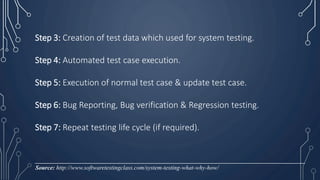
Step 3: Creationof test data which used for system testing.
Step 4: Automated test case execution.
Step 5: Execution of normal test case & update test case.
Step 6: Bug Reporting, Bug verification & Regression testing.
Step 7: Repeat testing life cycle (if required).
__________________________________________________________________________________________
Source: http://www.softwaretestingclass.com/system-testing-what-why-how/
16.
Types ofSystem Testing
1. System Acceptance Testing
Presenter #4
17.
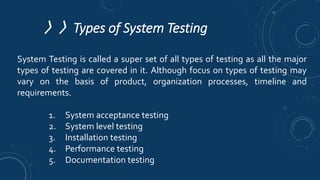
〉〉Types of SystemTesting
System Testing is called a super set of all types of testing as all the major
types of testing are covered in it. Although focus on types of testing may
vary on the basis of product, organization processes, timeline and
requirements.
1. System acceptance testing
2. System level testing
3. Installation testing
4. Performance testing
5. Documentation testing
18.
System Testing
Documentation TestingPerformanceTestingInstallation TestingSystem Level TestingSystem Acceptance Testing
1.Verification Testing
2.Validation Testing
3. Audit Testing
1. Sub testing
2.Unit testing/
program testing
3. System Testing
1.Functionality Testing
2. Recoverability Testing
3.Interoperability Testing
4. Robustness Testing
1. Scalability testing
2. Reliability Testing
3. Regression Testing
4. Stress testing
5. Load and stability Testing
1. Security Testing
2. Usability Testing
3. Regulatory Testing
4. Safety Assurance
Figure: Types of System Testing
19.
1. System AcceptanceTesting
System Acceptance Testing conducted to determine whether or not a system
satisfies its acceptance criteria and to enable the customer to determine whether or
not to accept the system. The system acceptance is a final opportunity for end user,
management and information system operations management to accept or reject
system. It is an extensive test that addresses the following levels of accepting
testing.
a. Verification Testing:
Procedures that attempt to determine that the product of each phase of the
development process is an implementation of a previous phase. Each verification
activity is a phase of the testing life cycle. In this testing the system runs in a
simulated environment using simulated data. The simulated test is primarily looking
for errors and omissions regarding end user and design specification that were
specified in the earlier phase but not fulfilled during construction. This is sometimes
20.
b. Validation Testing:
Validationis the process of evaluating a system or component during or at the
the development process to determine whether it satisfies specified requirements.
this testing the system runs in a live environment using real data. This is
called Beta Testing. During this validation a number of items are testing, like-
• System performance: Is the throughput and response time for processing
adequate to meet a normal processing workload?
• Peak workload processing performance: Can the system handle the workload
during peak processing period?
21.
• Methods andprocedures testing: During conversion, methods and
procedures for the new system will be put to their first real test.
• Backup and recovery testing: We have full sized computer files and
databases with real data, we should test all backup and recovery
We should simulate a data lost disaster and test the time required to recover
from that disaster.
c. Audit Testing:
Audit testing certifies that the system is free of errors and is ready to be placed
operation.
2. System LevelTesting
There are three levels of testing to be performed. Such as –
a. Sub testing:
It is the test performed on individual events or modules of a program. In other
words, it is the testing of an isolated subset of program.
b. Unit Testing/ program testing:
Unit testing is performed at an extremely low level of system development. As a
result it is rarely observed by clients and so doesn’t get appropriate recognition
of its importance. In this test all events and modules that have been coded and
sub tested for a program are tested as an integrated unit. It is the testing of an
entire program.
24.
c. System Testing:
Itensures that application programs written and tested in isolation work
when they are integrated into the total system. The process of testing an
hardware and software system to verify that the system meets its specified
requirements. This testing process is conducted by the testing teams in both
development and target environment.
Just because a single program works properly doesn’t mean that it works
with other programs. The integrated set of programs should be run through a
system test to make sure one program properly accepts, as input, the output of
other programs.
3. Installation Testing
Tomake sure that product / software can be installed on specific or support
defined system, can be configured and can be brought into an operational
mode.
a. Functionality Testing:
It provide comprehensive testing over the full range of the requirements, within
the capabilities of the system. To make sure that functionality of product are
working as per the requirements defined, within the capabilities of the system.
Functionality testing may involves communication system testing, module
testing, Graphical User Interface testing, security testing, feature testing etc.
27.
b. Recoverability Testing:
Tomake sure how well the system recovers from various input errors and other
failure situations.
c. Interoperability Testing:
To make sure whether the system can operate well with third party products or
Another kind of inter-operability tests is called (backward) compatibility tests.
• Compatibility tests verify that the system works the same way across
different platforms, operating systems, data base management
• Backward compatibility tests verify that the current software build
flawlessly works with older version of platforms.
28.
d. Robustness Testing:
Robustnesstesting is designed to verify how sensitive a system
towards an error input or how the system behave in error situations
in a changed operational environment.
4. Performance Testing
Tomeasure the performance characteristics of the system, e .g. throughput and
response time, under various conditions.
a. Scalability testing:
To make sure system’s scaling abilities in various terms like user scaling,
geographic scaling and resource scaling.
• Tests are designed to verify that the system can scale up to its
engineering limits.
• Scaling tests are conducted to ensure that the system response time
remains the same, or increases by a small amount, as the number of users
are increased.
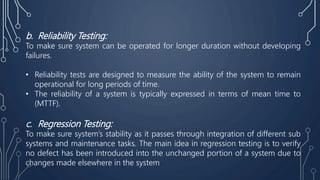
b. Reliability Testing:
Tomake sure system can be operated for longer duration without developing
failures.
• Reliability tests are designed to measure the ability of the system to remain
operational for long periods of time.
• The reliability of a system is typically expressed in terms of mean time to
(MTTF).
c. Regression Testing:
To make sure system’s stability as it passes through integration of different sub
systems and maintenance tasks. The main idea in regression testing is to verify
no defect has been introduced into the unchanged portion of a system due to
changes made elsewhere in the system
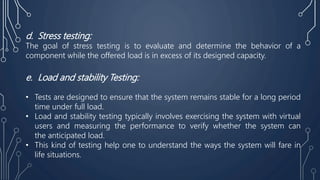
d. Stress testing:
Thegoal of stress testing is to evaluate and determine the behavior of a
component while the offered load is in excess of its designed capacity.
e. Load and stability Testing:
• Tests are designed to ensure that the system remains stable for a long period
time under full load.
• Load and stability testing typically involves exercising the system with virtual
users and measuring the performance to verify whether the system can
the anticipated load.
• This kind of testing help one to understand the ways the system will fare in
life situations.
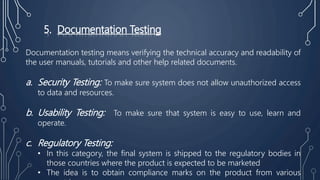
5. Documentation Testing
Documentationtesting means verifying the technical accuracy and readability of
the user manuals, tutorials and other help related documents.
a. Security Testing: To make sure system does not allow unauthorized access
to data and resources.
b. Usability Testing: To make sure that system is easy to use, learn and
operate.
c. Regulatory Testing:
• In this category, the final system is shipped to the regulatory bodies in
those countries where the product is expected to be marketed
• The idea is to obtain compliance marks on the product from various
37.
d. Safety Assurance:
Thereare two basic tasks performed by a safety assurance engineering team:
• Provide methods for identifying, tracking, evaluating, and eliminating
hazards associated with a system.
• Ensure that safety is embedded into the design and implementation in a
timely and cost effective manner, such that the risk created by the
user/operator error is minimized.
____________________________________________________________________________________
Source: System Analysis and Design Methods by Jeffreyl Whitten, Lonnie B. Bentley and Kevin C. Dittman.