TESTING THROUGHOUT THE
SOFTWARE LIFE CYCLE
ADITYA RAMADHAN
INFORMATION SYSTEMS
STATE UNIVERSITY OF SULTAN SYARIF KASIM RIAU
TESTING THROUGHOUT THE
SOFTWARE LIFE CYCLE
Testing is not a stand-alone activity. It has its place within a
software development life cycle model and therefore the life cycle
applied will largely determine how testing is organized.
There are many different forms of testing. Because several
disciplines, often with different interests, are involved in the
development life cycle, it is important to clearly understand and
define the various test levels and types. This chapter discusses
the most commonly applied software development models, test
levels and test types. Maintenance can be seen as a specific
instance of a development process. The way maintenance
influences the test process, levels and types and how testing can
be organized is described in the last section of this chapter.
SOFTWARE DEVELOPMENT MODE
The development process adopted for a project will
depend on the project aims and goals. There are
numerous development life cycles that have been
developed in order to achieve different required
objectives
These life cycles range from lightweight and fast
methodologies, where time to market is of the
essence, through to fully controlled and documented
methodologies where quality and reliability are key
drivers.
Each of these methodologies has its place in modern
software development and the most appropriate
development process should be applied to each
project. Themodels specify the various stages of the
process and the order in which they are carried out
V-model
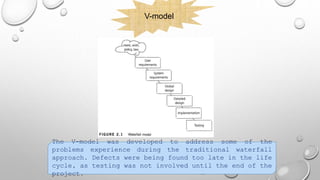
The V-model was developed to address some of the
problems experience during the traditional waterfall
approach. Defects were being found too late in the life
cycle, as testing was not involved until the end of the
project.
1. “Component
testing”
Searches for
defects in and
verifies the
functioning of
software components
(e.g. Modules,
programs, objects,
classes etc.) That
are separately
testable;
2. Integration
testing"
Tests interfaces
between components,
interactions to
different parts of
a system such as an
operating system,
file system and
hardware or
interfaces between
systems;
3. “System
testing
Concerned with
the behavior of
the whole
system/product as
defined by the
scope of a
development
project or
product. The main
focus of system
testing is
verification
• V-MODEL
5
Although variants of the V-model exist, a common type
of V-model uses four test levels. The four test
levels used, each with their own objectives, are:
4. “Acceptance
Testing”
Validation
testing with
respect to
user needs,
requirements,
and business
processes
conducted to
determine
whether or not
to accept the
system
6 6
• ITERATIVE LIFE CYCLES
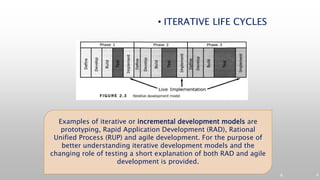
Examples of iterative or incremental development models are
prototyping, Rapid Application Development (RAD), Rational
Unified Process (RUP) and agile development. For the purpose of
better understanding iterative development models and the
changing role of testing a short explanation of both RAD and agile
development is provided.
It promotes
the generation
of business
stories to
define the
functionality.
It demands an
on-site
customer for
continual
feedback and
to define and
carry out
functional
acceptance
testing.
It promotes
pair
programming
and shared
code ownership
amongst the
developers.
It states that
component test
scripts shall
be written
before the
code is
written and
that those
tests should
be automated.
It states that
integration
and testing of
the code shall
happen several
time sa day.
7
Extreme Programming (XP) is currently one of the most well-known
agile development life cycle models. (See [agile] for ideas
behind this approach.)The methodology claims to be more human
friendly than traditional development methods. Some
characteristics of XP are:
5
Agile development
Testing within a life cycle model
In summary, whichever life cycle model is being used, there are
several characteristics of good testing:
1. for every development activity there is a
corresponding testing activity;
2. each test level has test objectives specific
to that level;
3. the analysis and design of tests for a given
test level should begin during the corresponding
development activity;
4. testers should be involved in reviewing
documents as soon as drafts are available in the
development cycle.
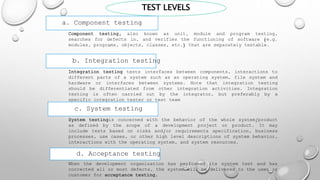
TEST LEVELS
a. Component testing
Component testing, also known as unit, module and program testing,
searches for defects in, and verifies the functioning of software (e.g.
modules, programs, objects, classes, etc.) that are separately testable.
b. Integration testing
Integration testing tests interfaces between components, interactions to
different parts of a system such as an operating system, file system and
hardware or interfaces between systems. Note that integration testing
should be differentiated from other integration activities. Integration
testing is often carried out by the integrator, but preferably by a
specific integration tester or test team
c. System testing
System testingis concerned with the behavior of the whole system/product
as defined by the scope of a development project or product. It may
include tests based on risks and/or requirements specification, business
processes, use cases, or other high level descriptions of system behavior,
interactions with the operating system, and system resources.
d. Acceptance testing
When the development organization has performed its system test and has
corrected all or most defects, the system will be delivered to the user or
customer for acceptance testing.
Neal Creative | click & Learn moreNeal Creative ©
REFERENCE:
GRAHAM ET.AL (2011)
POWERFUL
PRESENTATIONS!

Testing throughout the software life cycle

  • 1.
    TESTING THROUGHOUT THE SOFTWARELIFE CYCLE ADITYA RAMADHAN INFORMATION SYSTEMS STATE UNIVERSITY OF SULTAN SYARIF KASIM RIAU
  • 2.
    TESTING THROUGHOUT THE SOFTWARELIFE CYCLE Testing is not a stand-alone activity. It has its place within a software development life cycle model and therefore the life cycle applied will largely determine how testing is organized. There are many different forms of testing. Because several disciplines, often with different interests, are involved in the development life cycle, it is important to clearly understand and define the various test levels and types. This chapter discusses the most commonly applied software development models, test levels and test types. Maintenance can be seen as a specific instance of a development process. The way maintenance influences the test process, levels and types and how testing can be organized is described in the last section of this chapter.
  • 3.
    SOFTWARE DEVELOPMENT MODE Thedevelopment process adopted for a project will depend on the project aims and goals. There are numerous development life cycles that have been developed in order to achieve different required objectives These life cycles range from lightweight and fast methodologies, where time to market is of the essence, through to fully controlled and documented methodologies where quality and reliability are key drivers. Each of these methodologies has its place in modern software development and the most appropriate development process should be applied to each project. Themodels specify the various stages of the process and the order in which they are carried out
  • 4.
    V-model The V-model wasdeveloped to address some of the problems experience during the traditional waterfall approach. Defects were being found too late in the life cycle, as testing was not involved until the end of the project.
  • 5.
    1. “Component testing” Searches for defectsin and verifies the functioning of software components (e.g. Modules, programs, objects, classes etc.) That are separately testable; 2. Integration testing" Tests interfaces between components, interactions to different parts of a system such as an operating system, file system and hardware or interfaces between systems; 3. “System testing Concerned with the behavior of the whole system/product as defined by the scope of a development project or product. The main focus of system testing is verification • V-MODEL 5 Although variants of the V-model exist, a common type of V-model uses four test levels. The four test levels used, each with their own objectives, are: 4. “Acceptance Testing” Validation testing with respect to user needs, requirements, and business processes conducted to determine whether or not to accept the system
  • 6.
    6 6 • ITERATIVELIFE CYCLES Examples of iterative or incremental development models are prototyping, Rapid Application Development (RAD), Rational Unified Process (RUP) and agile development. For the purpose of better understanding iterative development models and the changing role of testing a short explanation of both RAD and agile development is provided.
  • 7.
    It promotes the generation ofbusiness stories to define the functionality. It demands an on-site customer for continual feedback and to define and carry out functional acceptance testing. It promotes pair programming and shared code ownership amongst the developers. It states that component test scripts shall be written before the code is written and that those tests should be automated. It states that integration and testing of the code shall happen several time sa day. 7 Extreme Programming (XP) is currently one of the most well-known agile development life cycle models. (See [agile] for ideas behind this approach.)The methodology claims to be more human friendly than traditional development methods. Some characteristics of XP are: 5 Agile development
  • 8.
    Testing within alife cycle model In summary, whichever life cycle model is being used, there are several characteristics of good testing: 1. for every development activity there is a corresponding testing activity; 2. each test level has test objectives specific to that level; 3. the analysis and design of tests for a given test level should begin during the corresponding development activity; 4. testers should be involved in reviewing documents as soon as drafts are available in the development cycle.
  • 9.
    TEST LEVELS a. Componenttesting Component testing, also known as unit, module and program testing, searches for defects in, and verifies the functioning of software (e.g. modules, programs, objects, classes, etc.) that are separately testable. b. Integration testing Integration testing tests interfaces between components, interactions to different parts of a system such as an operating system, file system and hardware or interfaces between systems. Note that integration testing should be differentiated from other integration activities. Integration testing is often carried out by the integrator, but preferably by a specific integration tester or test team c. System testing System testingis concerned with the behavior of the whole system/product as defined by the scope of a development project or product. It may include tests based on risks and/or requirements specification, business processes, use cases, or other high level descriptions of system behavior, interactions with the operating system, and system resources. d. Acceptance testing When the development organization has performed its system test and has corrected all or most defects, the system will be delivered to the user or customer for acceptance testing.
  • 10.
    Neal Creative |click & Learn moreNeal Creative © REFERENCE: GRAHAM ET.AL (2011) POWERFUL PRESENTATIONS!