TABLE OF
CONTENTS
• Natureof Reading Skills
• Specific Skills Involved in Reading
• Initial Stages of Reading (Word & Sentence Matching
Test)
• Pictures and Sentence Matching
• Intermediate and Advanced Stages of Reading
• True or False Reading Test
• Multiple Choice Items (Type A & B)
3.
TABLE OF
CONTENTS
• CompletionItems
• Rearrangement Items
• Cloze Procedure
• Open-ended and Miscellaneous Items
• Cursory Reading
4.
NATURE OF READING
SKILLS
Thereare numerous ways of testing reading comprehension, ranging
from multiple-choice items to open-ended questions (i.e. questions
which require students to write an answer in a sentence of their own).
Although multiple-choice items are sometimes the most suitable
instruments for testing reading comprehension, they should not be
overused. Frequently, other item types are far more interesting and
useful. The text itself should always determine the types of questions
which are constructed.
5.
SPECIFIC SKILLS
INVOLVED
• recognisewords and word groups, associating sounds
with their corresponding graphic symbols;
• deduce the meaning of words by
• understand explicitly stated information
• understand relations within the sentence,
• understand relations between parts of a text through
both lexical devices
• perceive temporal and spatial relationships, and also
sequences of ideas:
6.
SPECIFIC SKILLS
INVOLVED
• anticipateand predict what will come next in the text:
• identify the main idea and other salient features in a text;
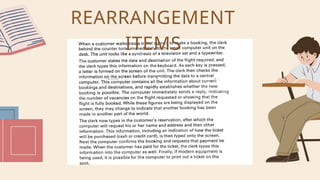
• generalise and draw conclusions:
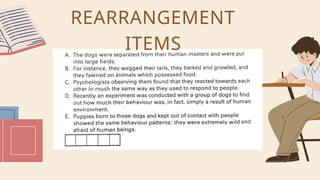
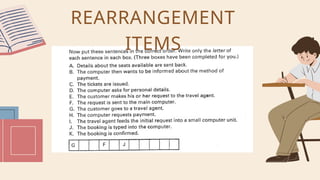
• understand information not explicitly stated
• skim and scan (looking for the general meaning and reading
for specific information);
• read critically;
• adopt a flexible approach and vary reading strategies
according to the type of material being read and the purpose
for which it is being read.
7.
INITIAL STAGES OF
READING
Thetests described in the first half of this section are concerned purely with word and
sentence recognition. They test students' ability to discriminate visually between words which
are spelt in fairly similar ways.
If used in exercise material and progress tests, these test items will assist in developing word
recognition speed. Though not administered as speed tests in the strict sense in the very early
stages, word and sentence matching items should be covered by the students as quickly as
possible.
Once the students have gained familiarity and confidence with this type of test, their
performances should be timed so that they are forced to read under some pressure. At first, it
is advisable to confine the words used in the items to those already encountered orally; later a
number of words not encountered orally should be introduced.
8.
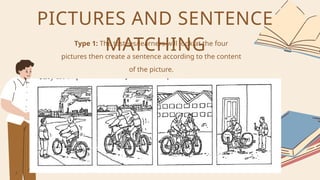
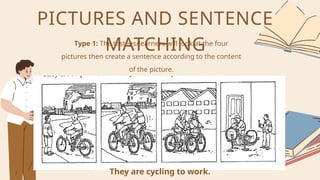
Type 1: Thetestees/learners will look at the four
pictures then create a sentence according to the content
of the picture.
PICTURES AND SENTENCE
MATCHING
9.
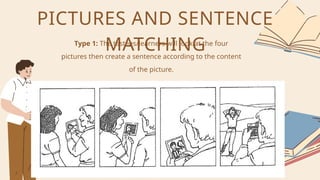
Type 1: Thetestees/learners will look at the four
pictures then create a sentence according to the content
of the picture.
PICTURES AND SENTENCE
MATCHING
They are cycling to work.
10.
Type 1: Thetestees/learners will look at the four
pictures then create a sentence according to the content
of the picture.
PICTURES AND SENTENCE
MATCHING
11.
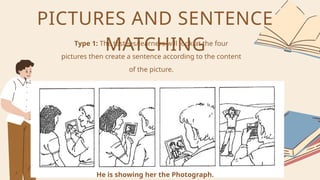
Type 1: Thetestees/learners will look at the four
pictures then create a sentence according to the content
of the picture.
PICTURES AND SENTENCE
MATCHING
He is showing her the Photograph.
12.
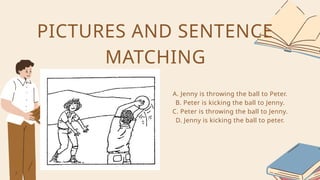
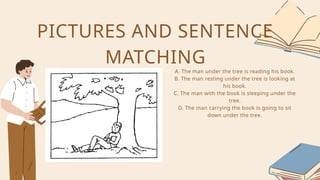
Type 2: Thistype is similar to previous one but is much
more economical in that only one picture is required for
each item. The testees/ learners look at a picture and
read four sentences, only one of the which is about the
picture, then they have to select the correct answer.
PICTURES AND SENTENCE
MATCHING
13.
PICTURES AND SENTENCE
MATCHING
A.Jenny is throwing the ball to Peter.
B. Peter is kicking the ball to Jenny.
C. Peter is throwing the ball to Jenny.
D. Jenny is kicking the ball to peter.
14.
PICTURES AND SENTENCE
MATCHING
A.The man under the tree is reading his book.
B. The man resting under the tree is looking at
his book.
C. The man with the book is sleeping under the
tree.
D. The man carrying the book is going to sit
down under the tree.
15.
PICTURES AND SENTENCE
MATCHING
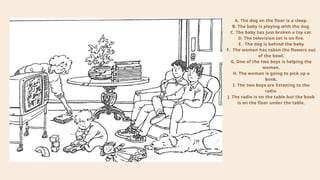
Type3: This item is referred to as a matching item,
it could equally well take the form of a true/false
item (in which the testees write T or F at the side
of each sentence according to whether or not the
sentence agrees with the content of the picture.
(In this particular instance, testees have to select
the four sentences which match the picture.
16.
A. The dogon the floor is a sleep.
B. The baby is playing with the dog.
C. The baby has just broken a toy car.
D. The television set is on fire.
E. The dog is behind the baby
F. The women has taken the flowers out
of the bowl.
G. One of the two boys is helping the
women.
H. The woman is going to pick up a
book.
I. The two boys are listening to the
radio
J. The radio is on the table but the book
is on the floor under the table.
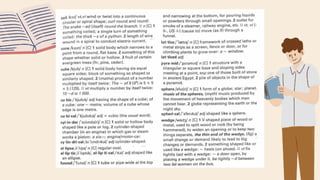
17.
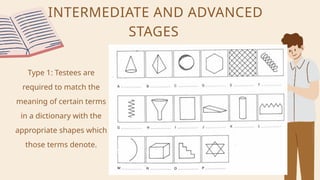
Type 1: Testeesare
required to match the
meaning of certain terms
in a dictionary with the
appropriate shapes which
those terms denote.
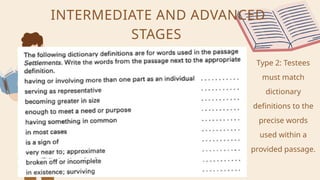
INTERMEDIATE AND ADVANCED
STAGES
INTERMEDIATE AND ADVANCED
STAGES
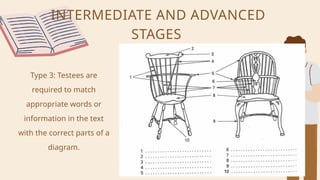
Type3: Testees are
required to match
appropriate words or
information in the text
with the correct parts of a
diagram.
21.
INTERMEDIATE AND ADVANCED
STAGES
Type4: This item type involves the matching of a paraphrase
of phrases and sentences in a text with the original words in
the text, each item starting with ‘Instead of …’. Although of
use occasionally in achievement and proficiency tests, this
type of item is more suited to teaching than to testing as it
can be used to help students to increase their
understanding of a text.
22.
It is importantfor each student to obtain at regular intervals a rough idea of his or her progress. How
are goals being achieved week by week? Methods of continuous assessment of students’ work are
replacing examinations – or parts of examinations – on certain courses. There are still doubts about
the advantages of continuous assessment if the learning process but, if applied with care and
discretion, continuous assessment can be a far more valuable means of accessingstandards than an
examination. Provided that methods of continuous assessment do not impart a feeling of tension and
strain, they can be used to guide students in their work and to inform them of the progress they are
making. If no means of continuous assessment is available, students should attempt to evaluate and
summarise their progress very briefly week by week .Clearly, such an attempt is more difficult in a
subject which teaches skills (e. glearning a language, playing a musical instrument) than in a content
subject (e.g. history, chemistry). Even as far as skills are concerned, however, it is a simple matter for
students to go back to an old exercise and do it again. The ease with which they can do what
previously seemed a difficult exerciseisoften quite remarkable.
23.
1.Instead of talkingabout using such methods carefully and wisely, the writer
talks about applying them ……………………
2.Instead of saying that it is harder for the students to assess progress made in
learning a language than in history, the writer says that ……………………
3.Instead of referring to ways of measuringstudents’ progress at regular
intervals, the writer uses the phrase ……………………
4.Instead of saying that students should try to assess and report briefly on their
progress every week, the writer says that ……………………
5.Instead of saying that continuous assessment is useful unless it makes students
feel upset and worried, the writer says that it is useful ……………………
24.
A presentation isa formal or informal communication
method that involves conveying information, ideas, or a
message to an audience. It often employs visual aids
such as slides, charts, graphs, or multimedia elements
to support and enhance the spoken content.
TRUE OR FALSE READING
TEST
25.
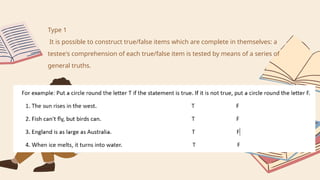
Type 1
It ispossible to construct true/false items which are complete in themselves: a
testee's comprehension of each true/false item is tested by means of a series of
general truths.
26.
Type 2
True/false readingtests are commonly used at both elementary and advanced levels. In this
format, test items are based on a reading passage and require students to determine
whether each statement is true, false, or cannot be concluded from the text. An example
about eye contact illustrates how statements can test deeper comprehension. The text
explains the significance of eye contact in communication, such as how gazing can indicate
affection, dominance, or threat, and how abnormal patterns may suggest mental disorders.
The statements that follow vary in difficulty and are designed to test the reader’s
understanding of nuanced information. It is also noted that the language in the passage
can be harder or easier than the statements, depending on the test design.
27.
Type 1: Thequestions in this section are more like
vocabulary tests than reading comprehension tests.
They are included here because understanding the
meaning of words in context is important. The focus is
mainly on understanding how the words fit within the
text.
Multiple Choice Items (Type A);
Short text
28.
Examples:
Elementary
1. The eyesare wonderful teachers - even musicians, who deal with
sound, learn as much by (doing, playing, watching, practising) as by
listening.
Intermediate
2. The housewife who could not afford to buy clothes would spend
hours at her spinning wheel, spinning her wool into yarn - a job
which took little skill but required a lot of (ability, patience, talent,
wisdom) and was done by the fireside during the long winter
evenings.
29.
Advance
3. Two-thirds ofthe country's (fuel, endeavour, industry,
energy) comes from imported oil, while the remaining
one-third comes from coal. Moreover, soon the country
will have its first nuclear power station.
30.
Type 2. Thetestees are required to identify the correct
paraphrase of a statement from a choice of four or five.
They are told in the rubric that the (four) statements may
refer to the entire sentence or only part of the sentence.
31.
Examples:
1. John isnot as tall as Sally but he's a little taller than Rick.
A. Sally is taller than John and Rick.
B. John is not as tall as Rick.
C. Sally is taller than John but not as tall as Rick.
D. Rick is taller than John and Sally.
2. In spite of the loud music, I soon managed to fall asleep.
A. The loud music soon helped me to fall asleep.
B. I soon fell asleep as a result of the loud music.
C. I soon fell asleep even though the music was loud.
D. The loud music made me unable to fall asleep soon.
32.
Type 3. Thisitem type consists of a very short reading extract of
only a few sentences (or sometimes only one sentence). The
testees are required to answer only one comprehension test item
on each reading passage. The actual construction of multiple-
choice reading comprehension items based on a reading extract
will be treated in greater detail in the next section.
33.
Type 3. Thisitem type consists of a very short reading extract of
only a few sentences (or sometimes only one sentence). The
testees are required to answer only one comprehension test item
on each reading passage. The actual construction of multiple-
choice reading comprehension items based on a reading extract
will be treated in greater detail in the next section.
34.
Example:
The president wastalking to a young woman in the crowd when
Tim suddenly caught sight of a man standing several yards behind
her. The man had something in his hand: it was a short stick. What
made Tim notice the man in the crowd?
A. He was very close to Tim.
B. The president was talking to him.
C. He was standing in front of the woman.
D. He was carrying a stick.
35.
The multiple-choice testoffers a useful way to test
reading comprehension. It aims to measure how well
students understand a text, not just vocabulary.
MULTIPLE CHOICE ITEMS (TYPE B)
LONGER TEXT
36.
Text Selection:
The readingpassage chosen for a test should align with the
broader goals of language teaching. Many tests focus too much on
literary English, but if students are learning English for specific
purposes (like reading technical journals), the texts should match
those needs. In proficiency or achievement tests, passages should
reflect the kind of material students usually encounter, especially if
other subjects are taught in English.
How to constructitems:
The length of a reading passage should match its difficulty. Harder texts should be
shorter, and the difficulty should be similar to what students read outside the test.
When making test questions, it's best to create more than needed. After review,
some questions might need to be changed or removed.
Unlike grammar tests, reading tests are harder to fix because changing one item
might mean changing the whole passage. That’s why choosing the right text from
the start and preparing extra questions is important to save time later.
39.
How to constructitems:
The length of a reading passage should match its difficulty. Harder texts should be
shorter, and the difficulty should be similar to what students read outside the test.
When making test questions, it's best to create more than needed. After review,
some questions might need to be changed or removed.
Unlike grammar tests, reading tests are harder to fix because changing one item
might mean changing the whole passage. That’s why choosing the right text from
the start and preparing extra questions is important to save time later.
40.
Study the followingpassage and then answer the questions set on it.
The Captiveisa strange but sincere and tender film, as indeed one
would expect from a director of the calibre of Marcel Lyne. In addition
to his keen sensitivity, Lyrne has a strong feeling for historical
atmosphere, so apparent in his earlier film Under the Shadow of the
Guillotine, in which the events of the French Revolution are depicted
with surprising realism and vitality.
41.
Captive Lyrne managesto evoke the atmosphere of an English town in the
early part of the nineteenth century, not so much through the more obvious
devices of stage-coaches, old inns, and thatched cottages as through minute
attention to details of speech, dress, customs, and mannerisms. Similar in
theme to Adam Brown, The Captive is distinguished by a sincerity which the
former lacks and which helps to transform this moving tragedy. Especially
unforgettable is the farewell scene at Plymouth, when squalid ship which is
waiting to take him to Australia. Robson breaks loose from his captora
Catherine. 'I'll prove my innocence,' he cries vehemently as he shakes his fist
at Catherine's cousin.
42.
For each ofthe following statements choose the word or
phrase that best completes the statement according to
the information contained in the passage. Write the
number of the question and the answer you have
chosen in your answer book.
(i) The Captive was directed by
A. Jonathan Brown.
B. Adam Brown.
C. Marcel Lyme.
D. Catherine Winsome.
43.
(ii) In TheCaptive Marcel Lyme conveys the atmosphere of the
nineteenth century chiefly through
A. close attention to small details.
B. the use of conventional scenery.
C. stage-coaches, old inns, and thatched cottages.
D. depicting dramatic events of the time.
(iii) The passage implies that Adam Brown was
A. a very moving film.
B. a realistic and vital film.
C. an ordinary adventure film.
D. a sincere film.
44.
(b) Each ofthe following words and phrases can be used to replace
one word in the passage. Find the words and write them in your
answer book. Number your answers.
(i) dragged
(ii) conquered
(iii) troubles and misfortunes
(iv) very brief
(v) finally
45.
requires students tocomplete a statement
by providing a missing word, phrase,
number, or symbol. It's a relatively simple
type of assessment that focuses on
recalling specific facts or knowledge.
COMPLETION
ITEMS
46.
These two itemtypes are particularly useful for testing the ability to understand a
sequence of steps in a process or events in a narrative. While in an exercise for
classroom practice, the students will often be required to rewrite the jumbled
sentences in their correct sequence, it is obviously preferable for testing purposes
to instruct them to write simply the numbers or letters of the jumbled sentences.
It is also advisable to provide them with one or two answers: if students start off
by putting the first two or three sentences in the wrong order, it may be
impossible for them to put the remaining sentences in the correct order. In other
words, one wrong answer will inevitably lead to a second wrong answer and
possibly a third. and so on. This weakness must be borne in mind when marking.
REARRANGEMENT
ITEMS
47.
Type 1: Thefirst of these items takes the form of
jumbled sentences which the students have to
'unscramble' and arrange in the correct order. The
students are instructed to rearrange the letters of the
sentences in the boxes below in their correct order.
REARRANGEMENT
ITEMS
Type 2: Thejumbled sentences in the second item are
based on a reading comprehension text and should
be unscrambled in light of the information contained
in the text. The students must write the letters of the
sentences in their correct order in the boxes at the
end of the item. Again, however, the fact that one
mistake inevitably results in another reduces the
item's reliability.
REARRANGEMENT
ITEMS
As in thecase of true/false type reading items, it is
possible to improve the reliability of the item by
introducing an additional feature: i.e. 'Don't know',
'Information not given', 'Not applicable'. The
following item' is based on an article contained in a
separate pull-out sheet using a newspaper format
(but not shown here).
REARRANGEMENT
ITEMS
53.
A cloze procedureis a reading comprehension
exercise where words are systematically deleted from
a passage, and students are tasked with filling in the
blanks to complete the text. This activity helps assess
reading comprehension, vocabulary, and grammar
skills by requiring students to use context clues to
determine the missing words
CLOZE
PROCEDURE
54.
A cursory readingmeans a quick and
superficial reading of something, often
without careful attention to detail. It's a brief
glance or scan to get a general understanding,
rather than a thorough and detailed
examination.
CURSORY
READING
55.
The Amazon rainforest,often referred to as the "lungs of the
Earth," produces around 20% of the world's oxygen. It is
home to millions of species of plants and animals, many of
which are found nowhere else. Recently, deforestation has
posed a serious threat to this vital ecosystem.
CURSORY
READING
56.
Cursory Reading Question:
Whatis the main topic of the passage?
A. Types of animals in the rainforest
B. The global economy
C. The importance and threat to the Amazon rainforest D.
How to plant trees in the Amazon
Answer: C
CURSORY
READING