

Test Design Techniques

co-sponsered by
smackstuff.com
In this presentation…..

Black Box Techniques
Equivalence Partioning
Boundary Value Analysis

White Box Techniques
Basis Path Testing
Control Structure Testing
Program Technique Testing
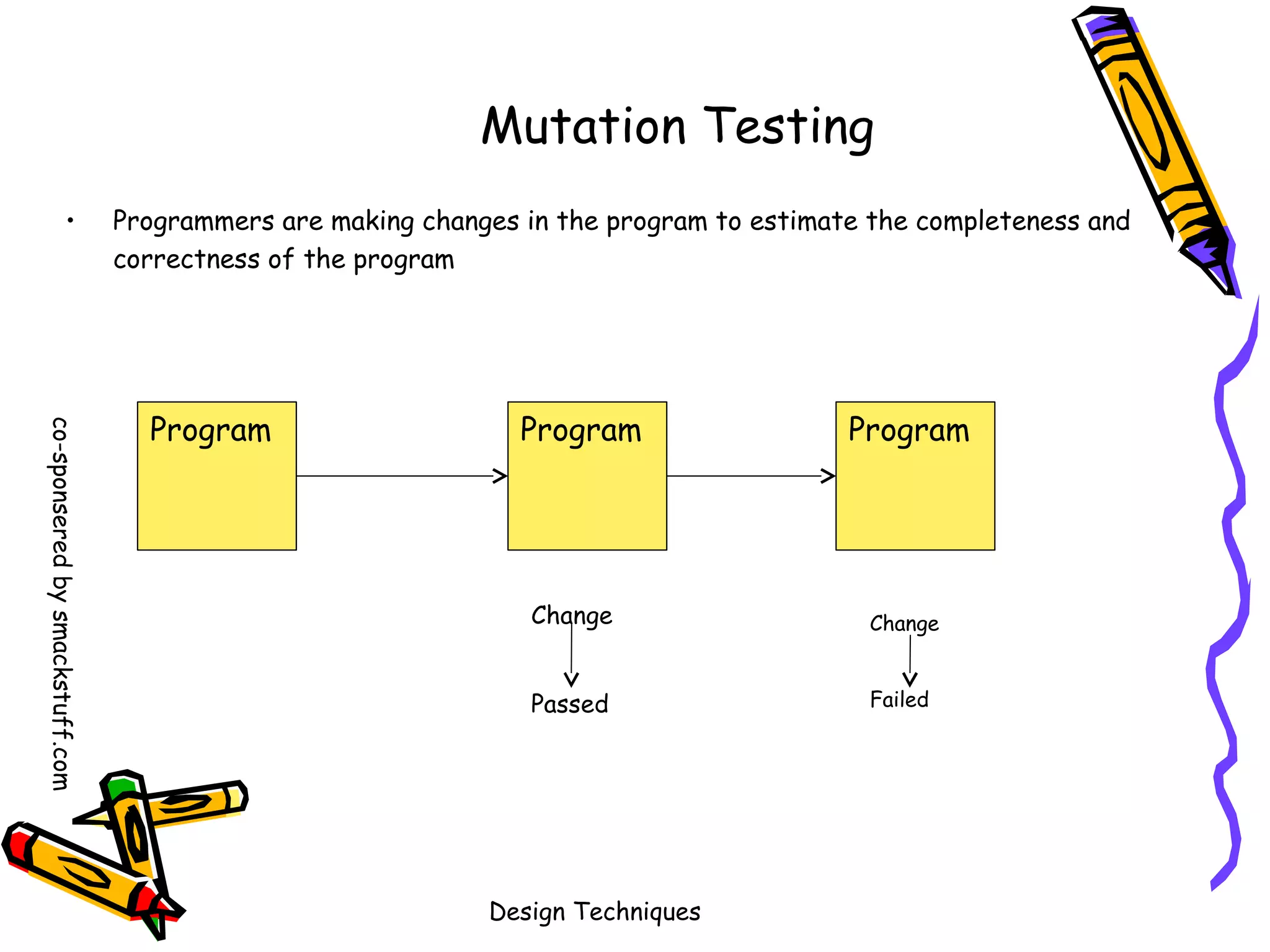
Mutation Testing

co-sponsered by smackstuff.com
Equivalence partitioning

•The input domain is usually too large for exhaustive
testing.
•It is therefore partitioned into a finite number of subdomains for the selection of test inputs.
•Each sub-domain is known as an equivalence class and
serves as a source of at least one test input.

co-sponsered by smackstuff.com
Equivalence partitioning
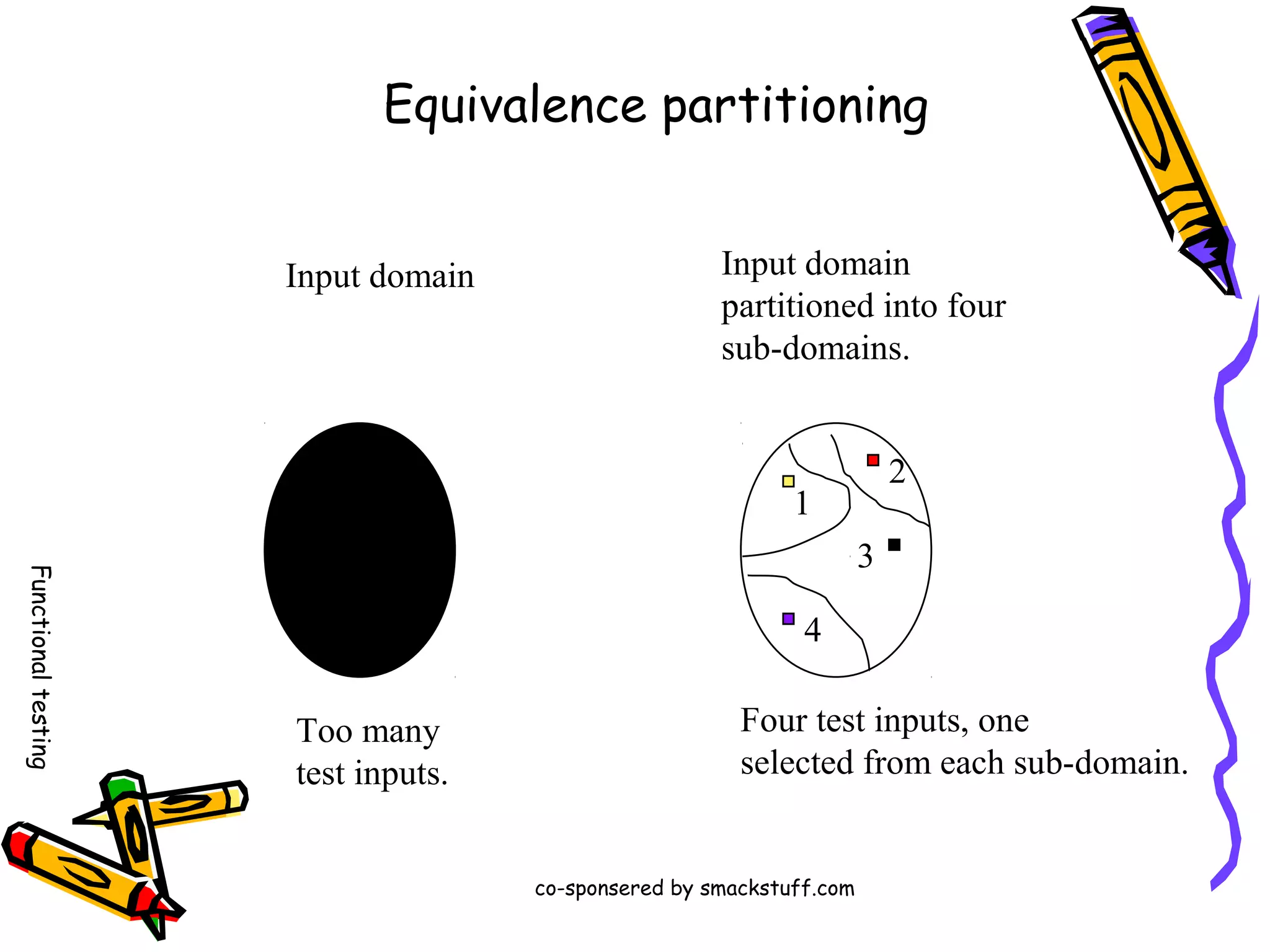
Input domain

Input domain
partitioned into four
sub-domains.
2

1
Functional testing

3
4
Too many
test inputs.

Four test inputs, one
selected from each sub-domain.

co-sponsered by smackstuff.com
How to partition?
•

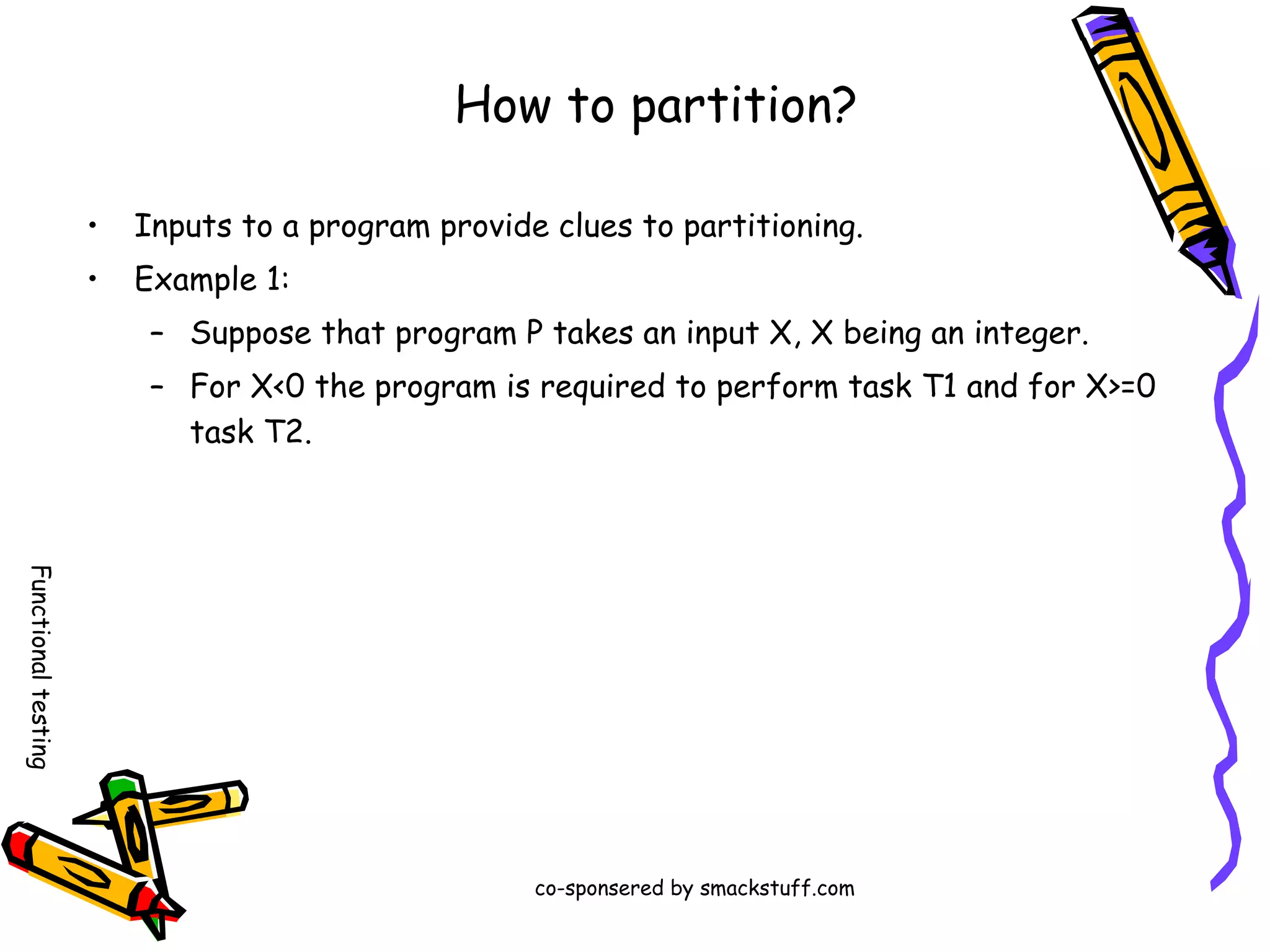
Inputs to a program provide clues to partitioning.

•

Example 1:
– Suppose that program P takes an input X, X being an integer.
– For X<0 the program is required to perform task T1 and for X>=0
task T2.

Functional testing
co-sponsered by smackstuff.com
How to partition?-continued
– The input domain is prohibitively large because X can assume a large
number of values.
– However, we expect P to behave the same way for all X<0.
– Similarly, we expect P to perform the same way for all values of
X>=0.
– We therefore partition the input domain of P into two sub-domains .

Functional testing
co-sponsered by smackstuff.com
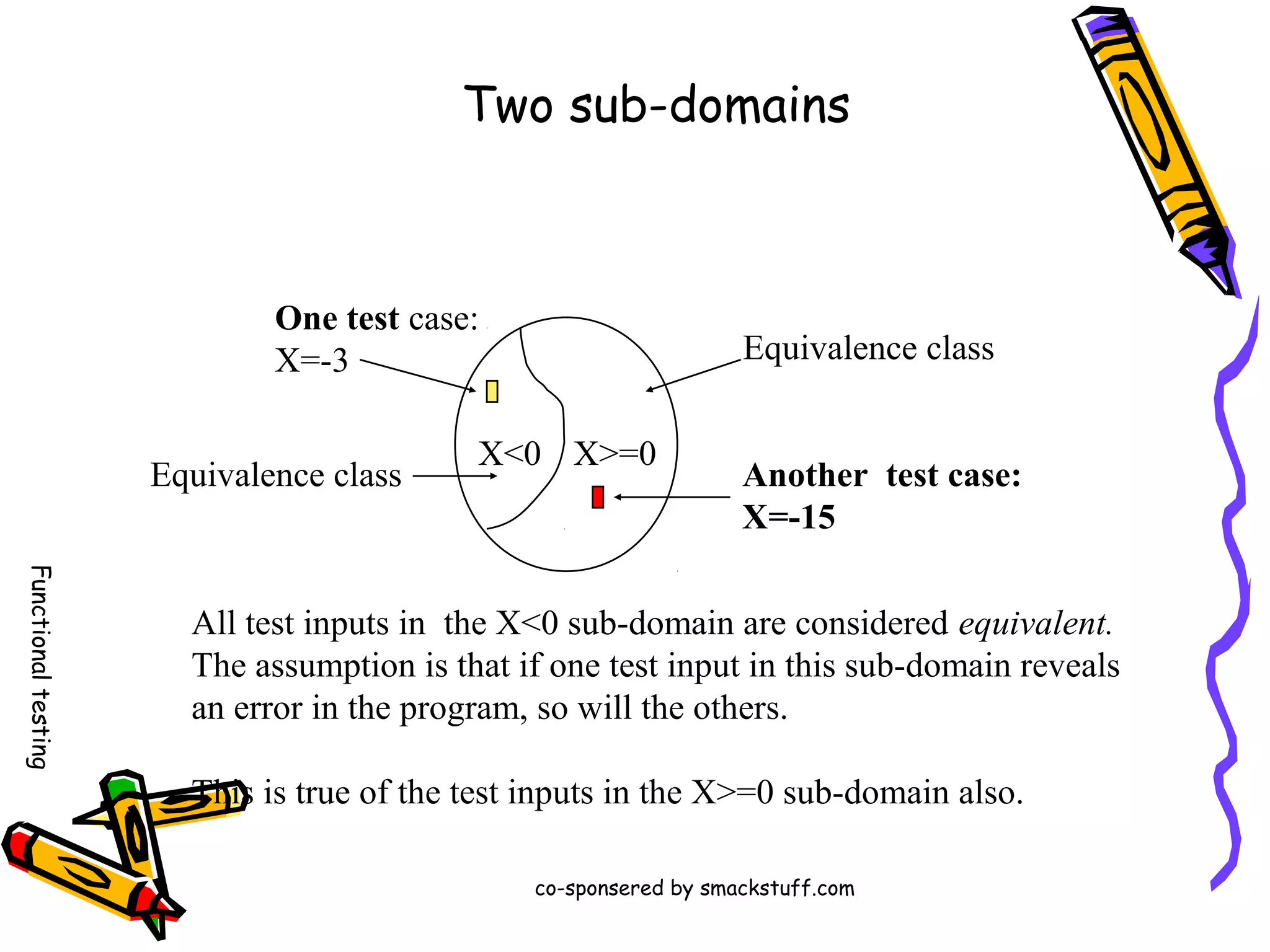
Two sub-domains

One test case:
X=-3
Equivalence class

Equivalence class

X<0 X>=0

Another test case:
X=-15

Functional testing

All test inputs in the X<0 sub-domain are considered equivalent.
The assumption is that if one test input in this sub-domain reveals
an error in the program, so will the others.
This is true of the test inputs in the X>=0 sub-domain also.
co-sponsered by smackstuff.com
Non-overlapping partitions
•

In the previous example, the two equivalence classes are non-overlapping.
In other words the two sub-domains are disjoint.

•

When the sub-domains are disjoint, it is sufficient to pick one test input
from each equivalence class to test the program .

•

An equivalence class is considered covered when at least one test has
been selected from it.

Functional testing

•

In partition testing our goal is to cover all equivalence classes.

co-sponsered by smackstuff.com
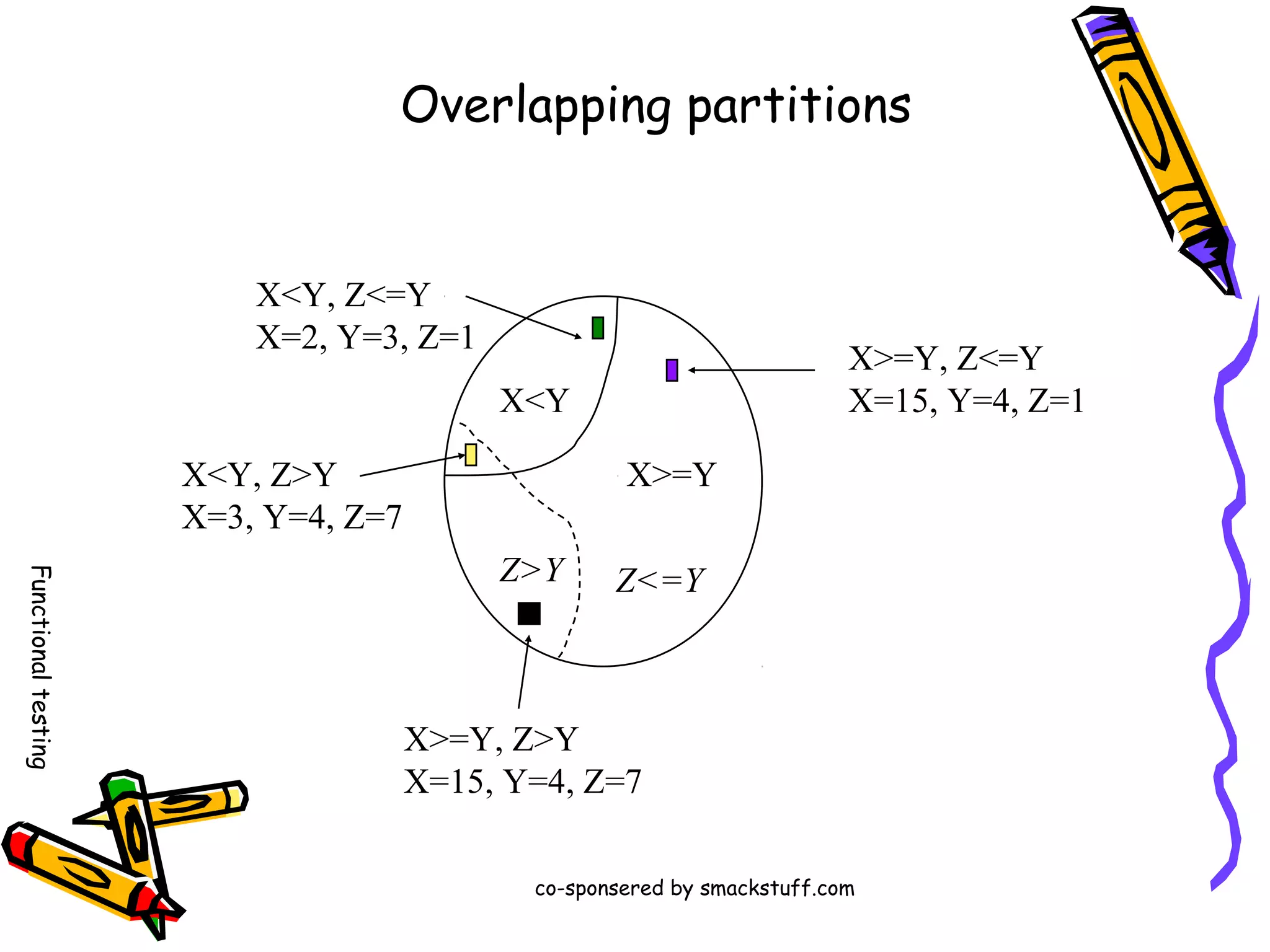
Overlapping partitions
•

Example 2:
– Suppose that program P takes three integers X, Y and Z. It is known
that:
• X<Y
• Z>Y

Functional testing
co-sponsered by smackstuff.com
Overlapping partitions

X<Y, Z<=Y
X=2, Y=3, Z=1

X>=Y, Z<=Y
X=15, Y=4, Z=1

X<Y
X<Y, Z>Y
X=3, Y=4, Z=7

X>=Y

Functional testing

Z>Y

Z<=Y

X>=Y, Z>Y
X=15, Y=4, Z=7
co-sponsered by smackstuff.com
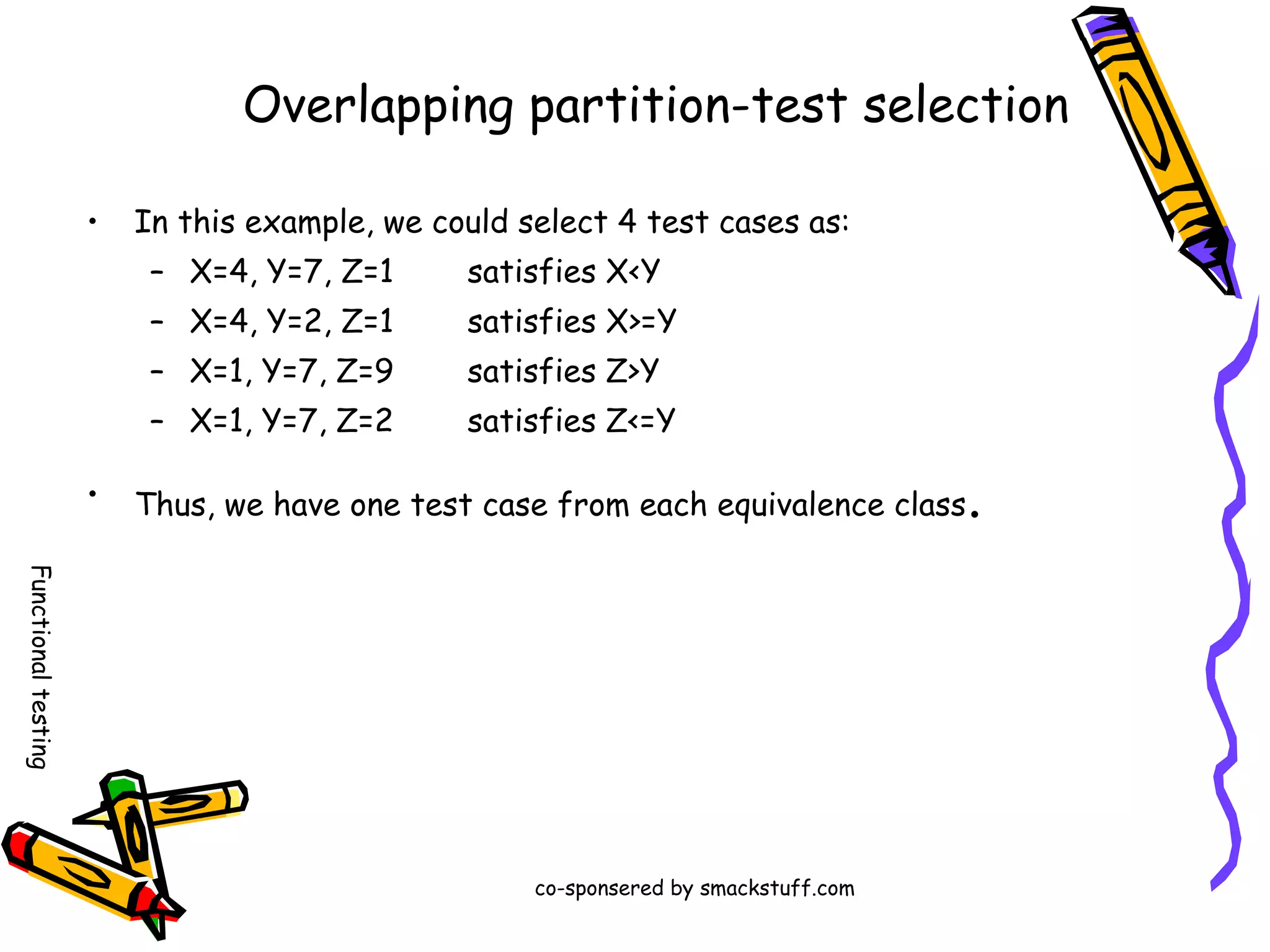
Overlapping partition-test selection
•

In this example, we could select 4 test cases as:
– X=4, Y=7, Z=1
– X=4, Y=2, Z=1

satisfies X>=Y

– X=1, Y=7, Z=9

satisfies Z>Y

– X=1, Y=7, Z=2
•

satisfies X<Y

satisfies Z<=Y

Thus, we have one test case from each equivalence class

Functional testing
co-sponsered by smackstuff.com

.
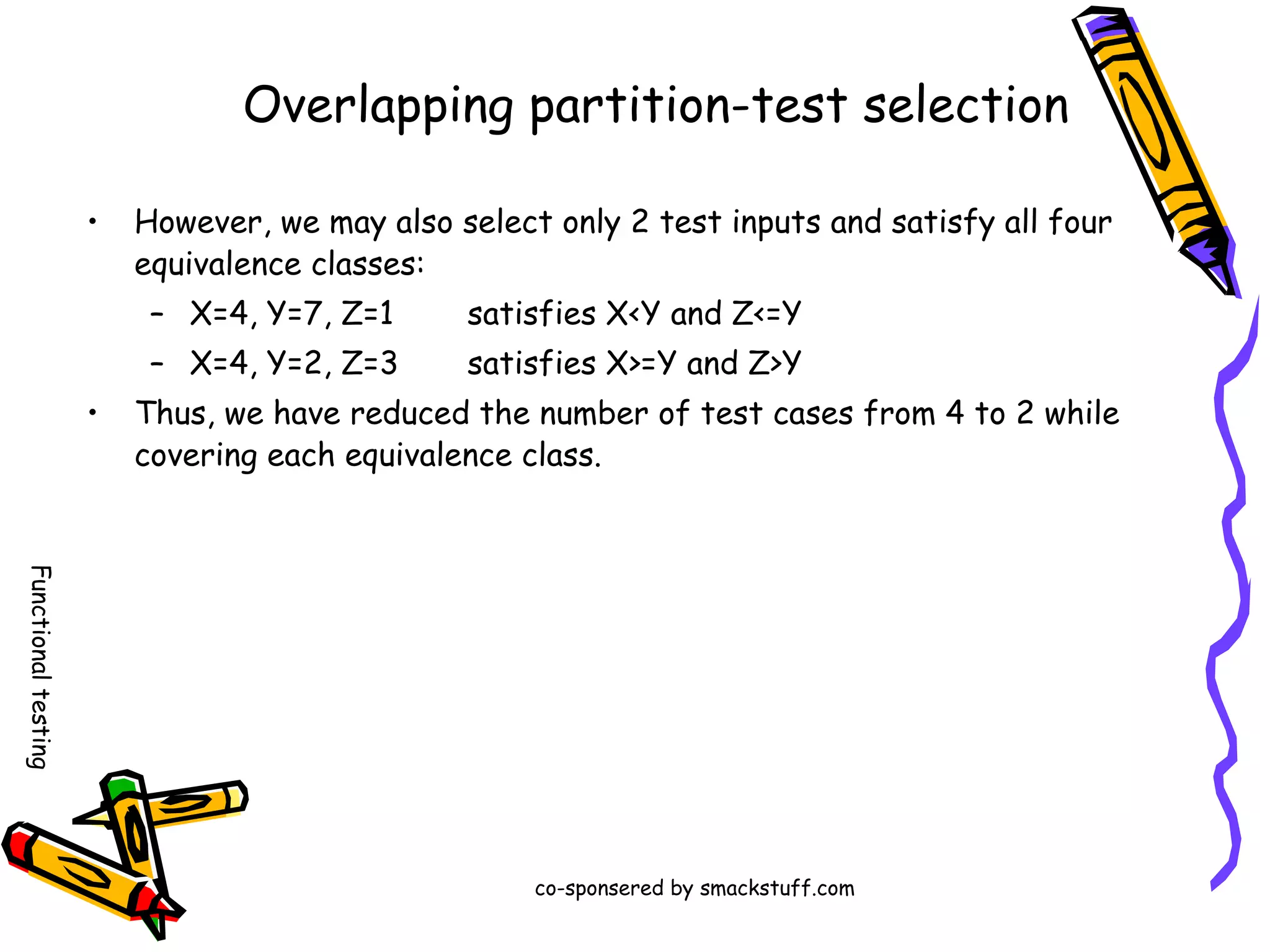
Overlapping partition-test selection
•

However, we may also select only 2 test inputs and satisfy all four
equivalence classes:
– X=4, Y=7, Z=1
– X=4, Y=2, Z=3

•

satisfies X<Y and Z<=Y
satisfies X>=Y and Z>Y

Thus, we have reduced the number of test cases from 4 to 2 while
covering each equivalence class.

Functional testing
co-sponsered by smackstuff.com
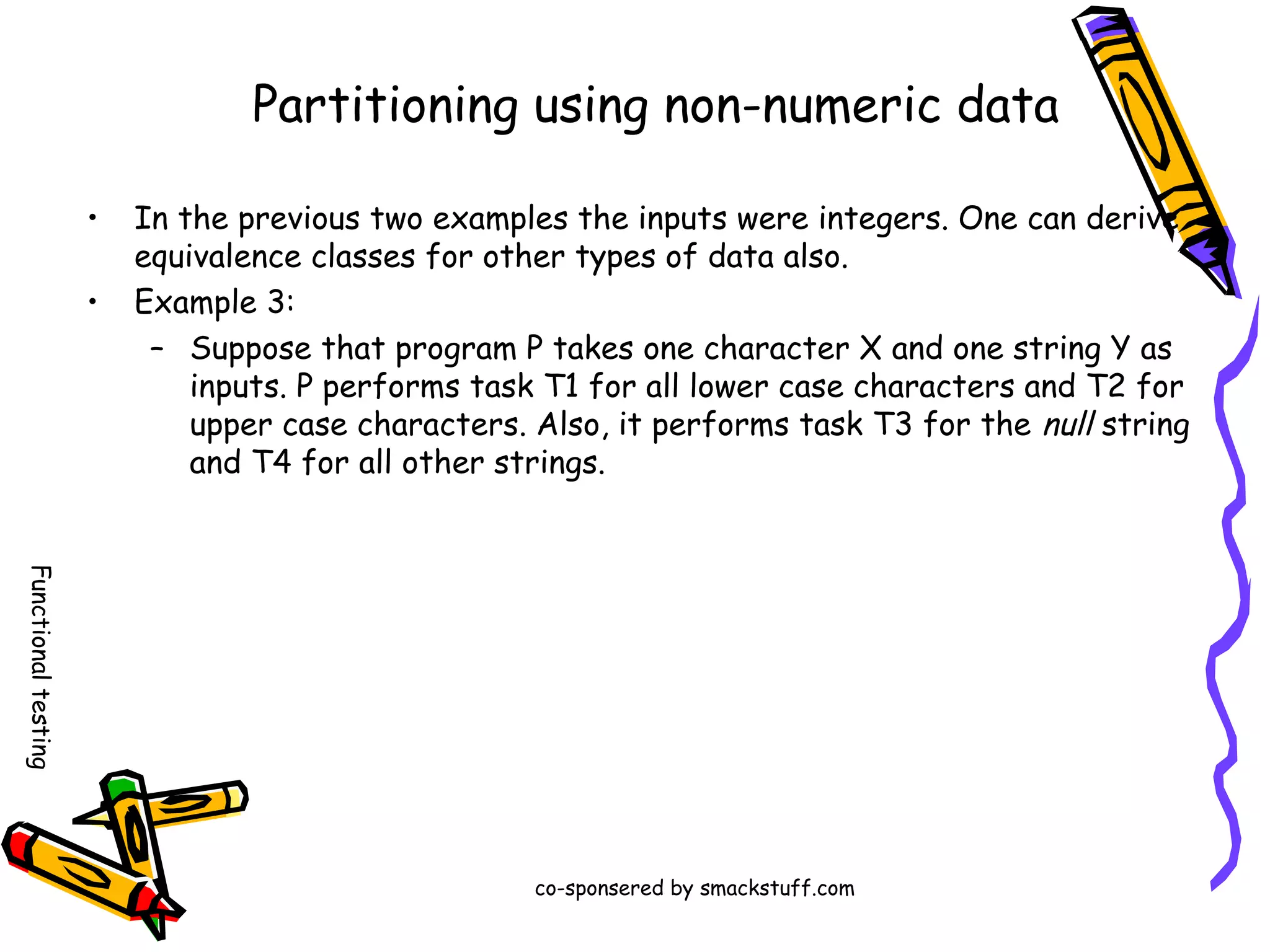
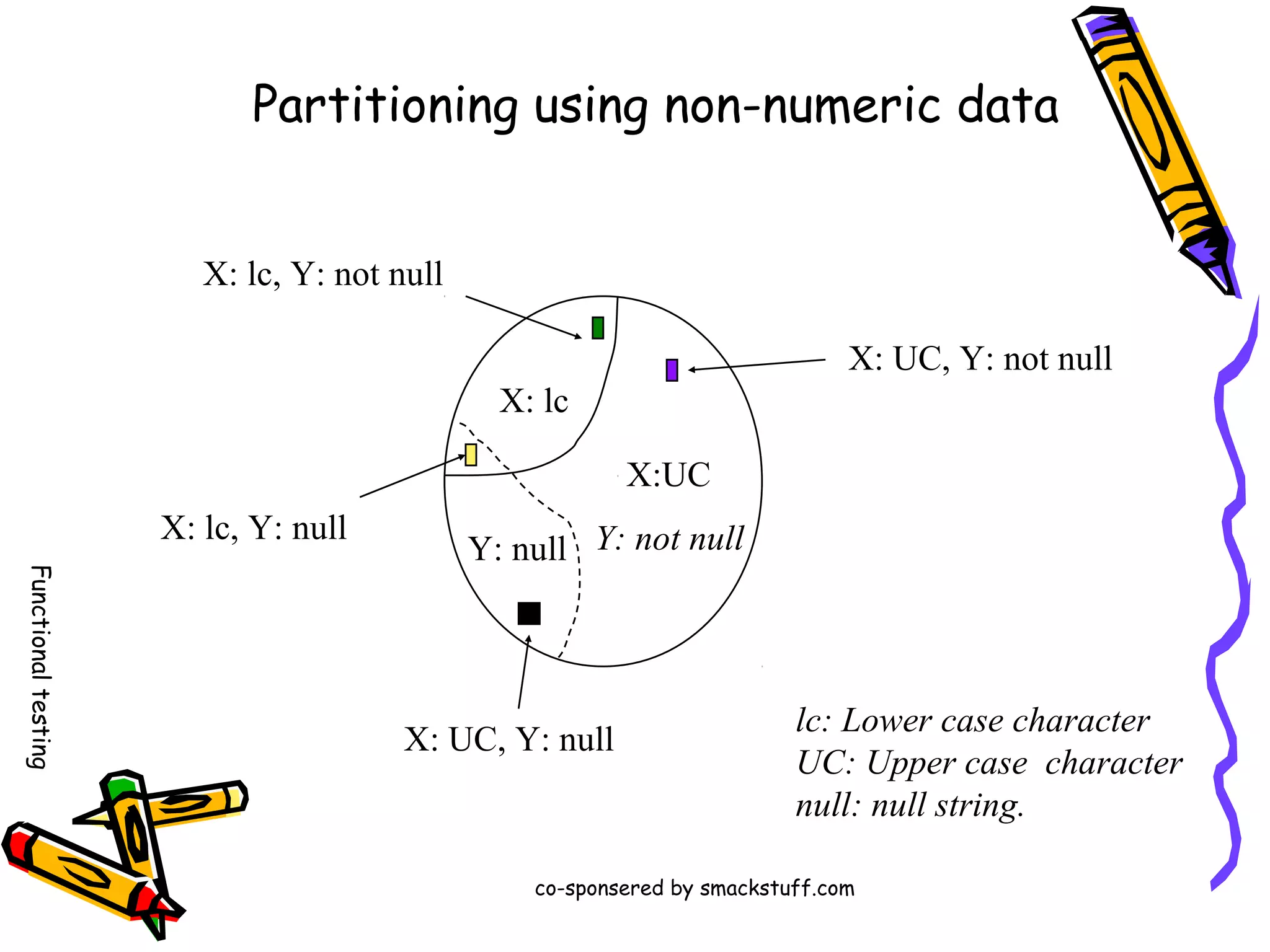
Partitioning using non-numeric data
•
•

In the previous two examples the inputs were integers. One can derive
equivalence classes for other types of data also.
Example 3:
– Suppose that program P takes one character X and one string Y as
inputs. P performs task T1 for all lower case characters and T2 for
upper case characters. Also, it performs task T3 for the null string
and T4 for all other strings.

Functional testing
co-sponsered by smackstuff.com
Partitioning using non-numeric data
X: lc, Y: not null
X: UC, Y: not null
X: lc
X:UC
X: lc, Y: null
Functional testing

Y: null Y: not null

X: UC, Y: null

lc: Lower case character
UC: Upper case character
null: null string.

co-sponsered by smackstuff.com
Non-numeric data
•
•

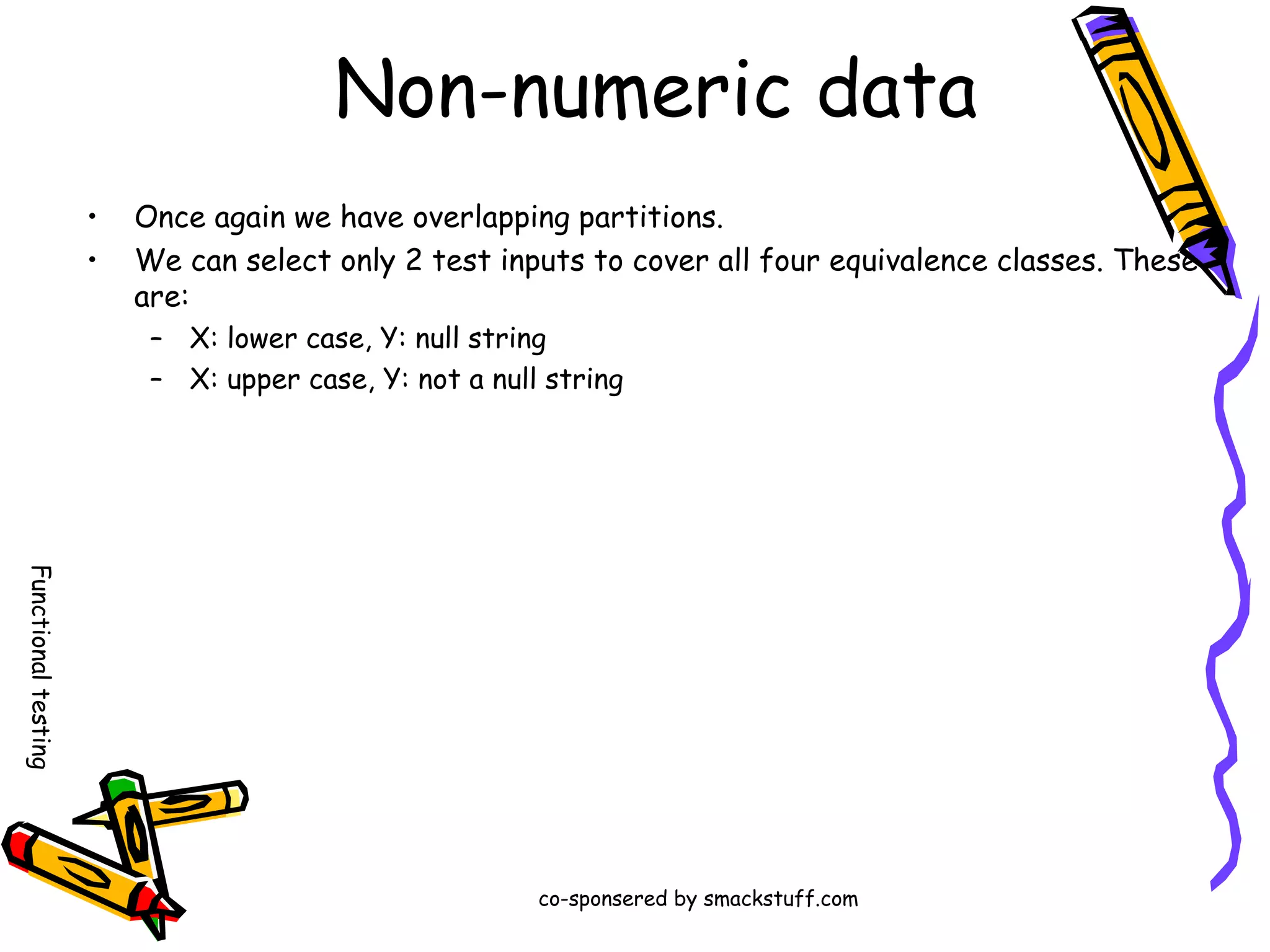
Once again we have overlapping partitions.
We can select only 2 test inputs to cover all four equivalence classes. These
are:
– X: lower case, Y: null string
– X: upper case, Y: not a null string

Functional testing
co-sponsered by smackstuff.com
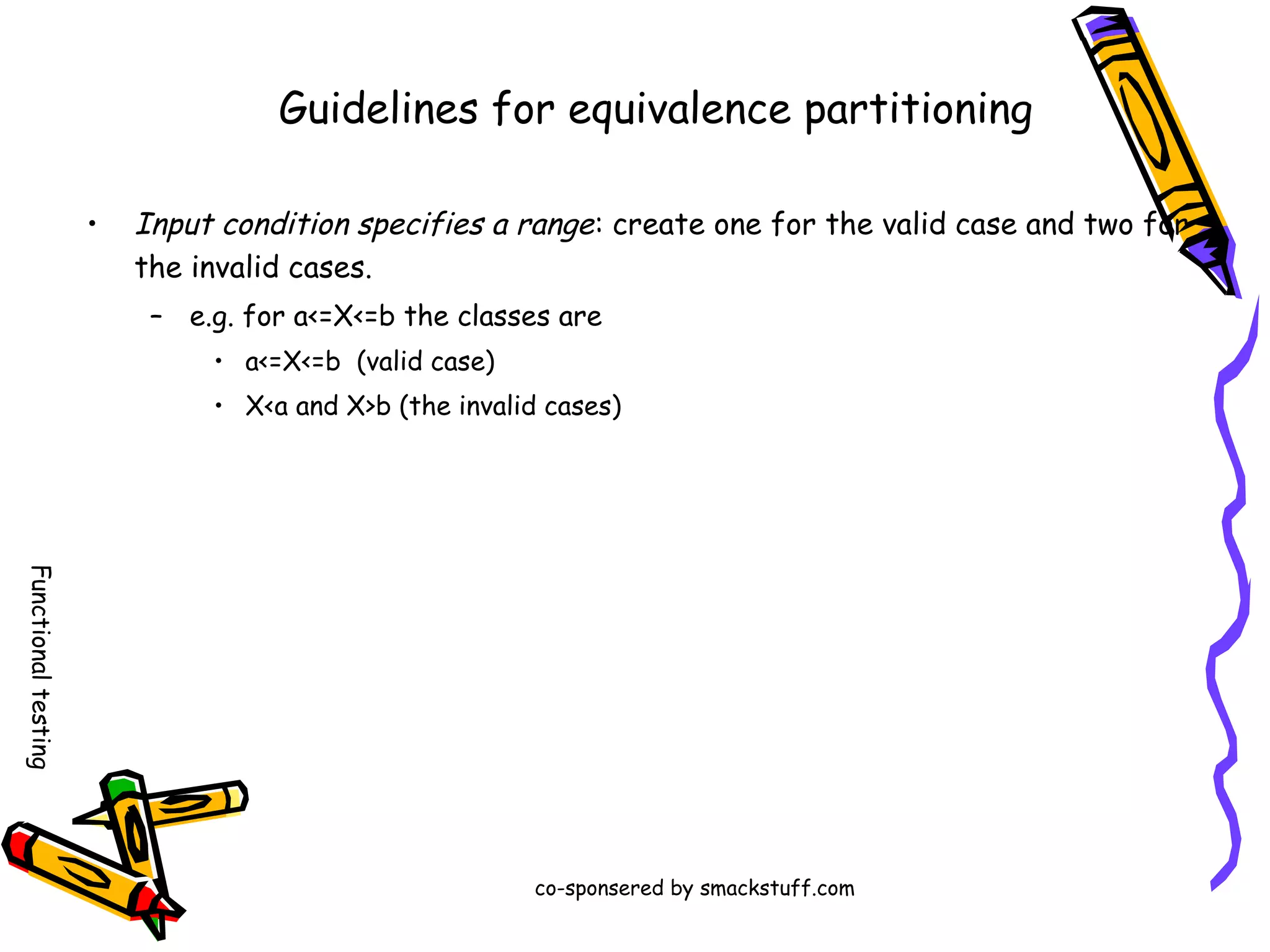
Guidelines for equivalence partitioning
•

Input condition specifies a range : create one for the valid case and two for
the invalid cases.
– e.g. for a<=X<=b the classes are
• a<=X<=b (valid case)
• X<a and X>b (the invalid cases)

Functional testing
co-sponsered by smackstuff.com
Guidelines-continued
•

Input condition specifies a value: create one for the valid value and two
for incorrect values (below and above the valid value). This may not be
possible for certain data types, e.g. for Boolean.

•

Input condition specifies a member of a set: create one for the valid

co-sponsered by smackstuff.com

value and one for the invalid (not in the set) value

Design Techniques.

.
Sufficiency of partitions
•
•
•

In the previous examples we derived equivalence classes based on the
conditions satisfied by the input data.
Then we selected just enough tests to cover each partition.
Think of the advantages and disadvantages of this approach !

co-sponsered by smackstuff.com
Design Techniques
Boundary value analysis (BVA)
•
•
•
co-sponsered by smackstuff.com

Another way to generate test cases is to look for boundary values.
Suppose a program takes an integer X as input.
In the absence of any information, we assume that X=0 is a boundary.
Inputs to the program might lie on the boundary or on either side of the
boundary.

Design Techniques
BVA: continued
•

This leads to 3 test inputs:
X=0, X=-20, and X=14.
Note that the values -20 and 14 are on either side of the boundary and are
chosen arbitrarily.

co-sponsered by smackstuff.com

•

Notice that using BVA we get 3 equivalence classes. One of these three
classes contains only one value (X=0), the other two are large

Design Techniques

!
BVA: continued
•

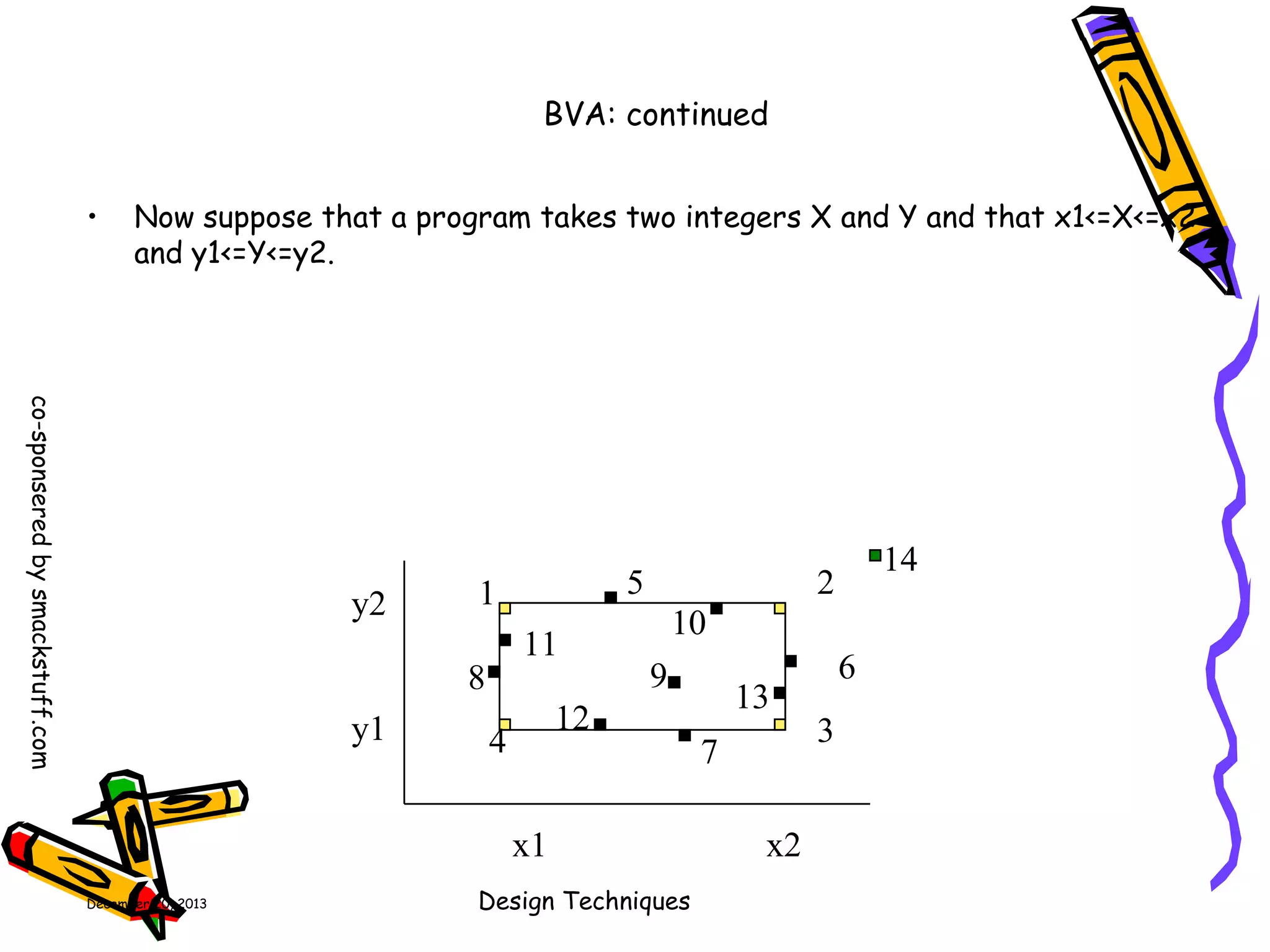
Now suppose that a program takes two integers X and Y and that x1<=X<=x2
and y1<=Y<=y2.

co-sponsered by smackstuff.com

y2

11

8
y1

5

1

2
10
9

12

4
x1

December 20, 2013

14

Design Techniques

13
7
x2

6
3
BVA-continued
•

In this case the four sides of the rectangle represent the boundary.

•

The heuristic for test selection in this case is:
Select one test at each corner (1, 2, 3, 4).

co-sponsered by smackstuff.com

Select one test just outside of each of the four sides of the boundary
(5, 6, 7, 8)

Design Techniques
BVA-continued
• Select one test just inside of each of the four sides of the boundary
(10, 11, 12, 13).
• Select one test case inside of the bounded region (9).
• Select one test case outside of the bounded region (14).
co-sponsered by smackstuff.com

How many equivalence classes do we get?

Design Techniques
BVA -continued
In the previous examples we considered only numeric data.
BVA can be done on any type of data.
For example, suppose that a program takes a string S and an integer X as inputs.
The constraints on inputs are:
co-sponsered by smackstuff.com

length(S)<=100 and a<=X<=b

Can you derive the test cases using BVA?

Design Techniques
BVA applied to output variables
Just as we applied BVA to input data, we can apply it to output data.
Doing so gives us equivalence classes for the output domain.
We then try to find test inputs that will cover each output equivalence class.
co-sponsered by smackstuff.com

Design Techniques
White Box Testing Techniques
It is also called as open box or clear box.
Basis Path Testing

•
co-sponsered by smackstuff.com

•

Control Structure Testing

•

Program Technique Testing

•

Mutation Testing

Design Techniques
Basis Path Testing
•

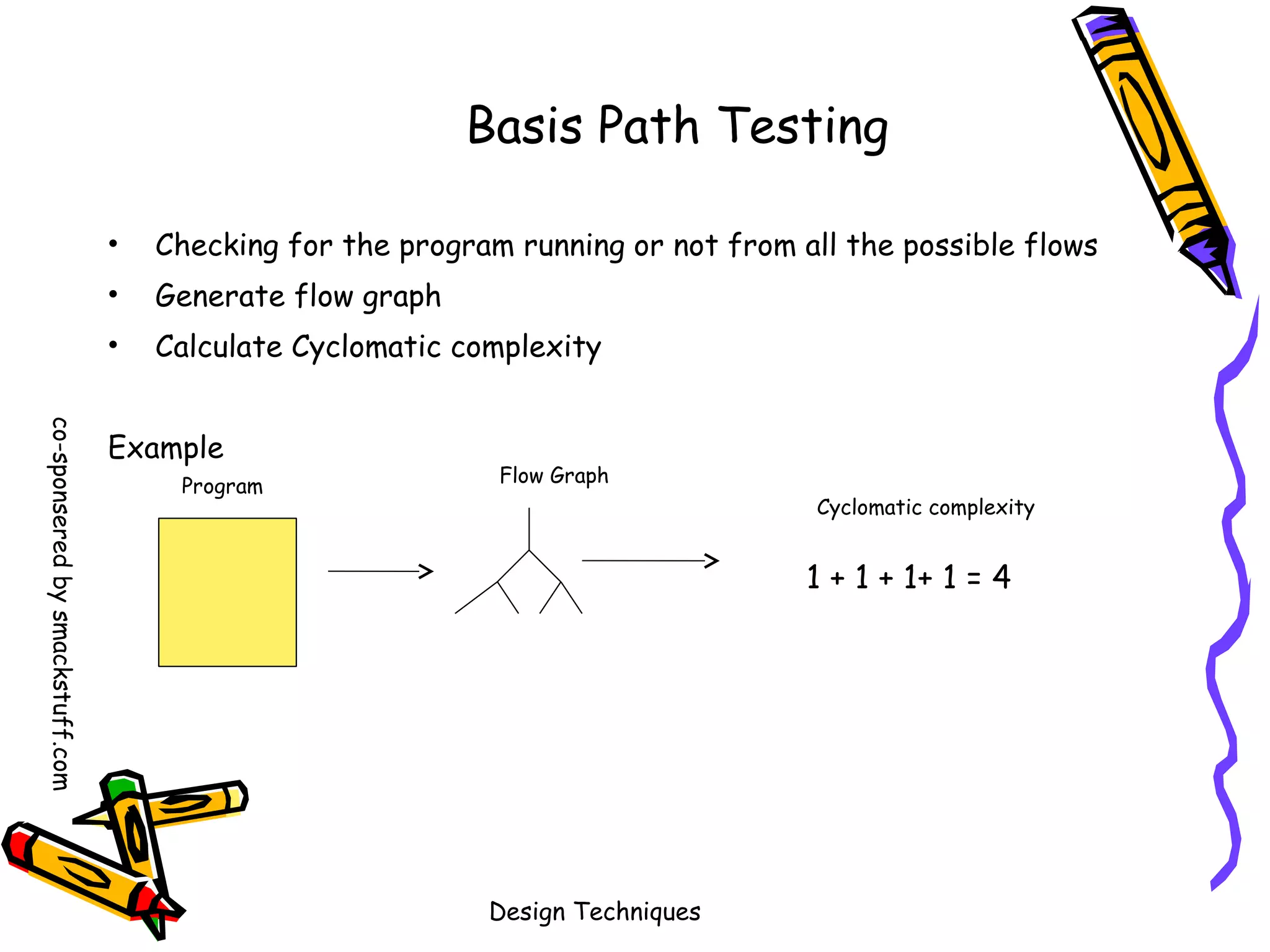
Checking for the program running or not from all the possible flows

•

Generate flow graph

•

Calculate Cyclomatic complexity

co-sponsered by smackstuff.com

Example
Program

Flow Graph
Cyclomatic complexity

1 + 1 + 1+ 1 = 4

Design Techniques
Basis Path Testing
Using this technique programmers can estimate the execution of the program without
any interruption.

•

Step1: Prepare a program with respect to program logic

•

Step2: Prepare Flow Graph of that program

•
co-sponsered by smackstuff.com

•

Step3: Calculate cyclomatic complexity

•

Step4: Run that program more than one time to cover all the independent paths

Design Techniques
Control Structure Testing
During this testing programmers validate the input and output correctness
Step1: Prepare the program according to the design logic
Step2: Execute the program
co-sponsered by smackstuff.com

Step3: Check the input given to the program in all possible ways
Step4: Check the output of the program

Design Techniques
Program Technique Testing
•

Using this technique programmers are testing the performance of the program with
different inputs

•

Step1: Prepare the program with respective design logic

•

Step2: Execute the program with different inputs

•

Step3: Calculate the process time

co-sponsered by smackstuff.com

•

Step4: If program execution time is not acceptable change the structure of the
program without disturbing the functionality

Design Techniques
Mutation Testing
•

Programmers are making changes in the program to estimate the completeness and
correctness of the program

co-sponsered by smackstuff.com

Program

Program

Program

Change

Change

Passed

Failed

Design Techniques
Smackstuff.com

co-sponsered by
smackstuff.com

Test design techniques

  • 1.
  • 2.
    In this presentation….. BlackBox Techniques Equivalence Partioning Boundary Value Analysis White Box Techniques Basis Path Testing Control Structure Testing Program Technique Testing Mutation Testing co-sponsered by smackstuff.com
  • 3.
    Equivalence partitioning •The inputdomain is usually too large for exhaustive testing. •It is therefore partitioned into a finite number of subdomains for the selection of test inputs. •Each sub-domain is known as an equivalence class and serves as a source of at least one test input. co-sponsered by smackstuff.com
  • 4.
    Equivalence partitioning Input domain Inputdomain partitioned into four sub-domains. 2 1 Functional testing 3 4 Too many test inputs. Four test inputs, one selected from each sub-domain. co-sponsered by smackstuff.com
  • 5.
    How to partition? • Inputsto a program provide clues to partitioning. • Example 1: – Suppose that program P takes an input X, X being an integer. – For X<0 the program is required to perform task T1 and for X>=0 task T2. Functional testing co-sponsered by smackstuff.com
  • 6.
    How to partition?-continued –The input domain is prohibitively large because X can assume a large number of values. – However, we expect P to behave the same way for all X<0. – Similarly, we expect P to perform the same way for all values of X>=0. – We therefore partition the input domain of P into two sub-domains . Functional testing co-sponsered by smackstuff.com
  • 7.
    Two sub-domains One testcase: X=-3 Equivalence class Equivalence class X<0 X>=0 Another test case: X=-15 Functional testing All test inputs in the X<0 sub-domain are considered equivalent. The assumption is that if one test input in this sub-domain reveals an error in the program, so will the others. This is true of the test inputs in the X>=0 sub-domain also. co-sponsered by smackstuff.com
  • 8.
    Non-overlapping partitions • In theprevious example, the two equivalence classes are non-overlapping. In other words the two sub-domains are disjoint. • When the sub-domains are disjoint, it is sufficient to pick one test input from each equivalence class to test the program . • An equivalence class is considered covered when at least one test has been selected from it. Functional testing • In partition testing our goal is to cover all equivalence classes. co-sponsered by smackstuff.com
  • 9.
    Overlapping partitions • Example 2: –Suppose that program P takes three integers X, Y and Z. It is known that: • X<Y • Z>Y Functional testing co-sponsered by smackstuff.com
  • 10.
    Overlapping partitions X<Y, Z<=Y X=2,Y=3, Z=1 X>=Y, Z<=Y X=15, Y=4, Z=1 X<Y X<Y, Z>Y X=3, Y=4, Z=7 X>=Y Functional testing Z>Y Z<=Y X>=Y, Z>Y X=15, Y=4, Z=7 co-sponsered by smackstuff.com
  • 11.
    Overlapping partition-test selection • Inthis example, we could select 4 test cases as: – X=4, Y=7, Z=1 – X=4, Y=2, Z=1 satisfies X>=Y – X=1, Y=7, Z=9 satisfies Z>Y – X=1, Y=7, Z=2 • satisfies X<Y satisfies Z<=Y Thus, we have one test case from each equivalence class Functional testing co-sponsered by smackstuff.com .
  • 12.
    Overlapping partition-test selection • However,we may also select only 2 test inputs and satisfy all four equivalence classes: – X=4, Y=7, Z=1 – X=4, Y=2, Z=3 • satisfies X<Y and Z<=Y satisfies X>=Y and Z>Y Thus, we have reduced the number of test cases from 4 to 2 while covering each equivalence class. Functional testing co-sponsered by smackstuff.com
  • 13.
    Partitioning using non-numericdata • • In the previous two examples the inputs were integers. One can derive equivalence classes for other types of data also. Example 3: – Suppose that program P takes one character X and one string Y as inputs. P performs task T1 for all lower case characters and T2 for upper case characters. Also, it performs task T3 for the null string and T4 for all other strings. Functional testing co-sponsered by smackstuff.com
  • 14.
    Partitioning using non-numericdata X: lc, Y: not null X: UC, Y: not null X: lc X:UC X: lc, Y: null Functional testing Y: null Y: not null X: UC, Y: null lc: Lower case character UC: Upper case character null: null string. co-sponsered by smackstuff.com
  • 15.
    Non-numeric data • • Once againwe have overlapping partitions. We can select only 2 test inputs to cover all four equivalence classes. These are: – X: lower case, Y: null string – X: upper case, Y: not a null string Functional testing co-sponsered by smackstuff.com
  • 16.
    Guidelines for equivalencepartitioning • Input condition specifies a range : create one for the valid case and two for the invalid cases. – e.g. for a<=X<=b the classes are • a<=X<=b (valid case) • X<a and X>b (the invalid cases) Functional testing co-sponsered by smackstuff.com
  • 17.
    Guidelines-continued • Input condition specifiesa value: create one for the valid value and two for incorrect values (below and above the valid value). This may not be possible for certain data types, e.g. for Boolean. • Input condition specifies a member of a set: create one for the valid co-sponsered by smackstuff.com value and one for the invalid (not in the set) value Design Techniques. .
  • 18.
    Sufficiency of partitions • • • Inthe previous examples we derived equivalence classes based on the conditions satisfied by the input data. Then we selected just enough tests to cover each partition. Think of the advantages and disadvantages of this approach ! co-sponsered by smackstuff.com Design Techniques
  • 19.
    Boundary value analysis(BVA) • • • co-sponsered by smackstuff.com Another way to generate test cases is to look for boundary values. Suppose a program takes an integer X as input. In the absence of any information, we assume that X=0 is a boundary. Inputs to the program might lie on the boundary or on either side of the boundary. Design Techniques
  • 20.
    BVA: continued • This leadsto 3 test inputs: X=0, X=-20, and X=14. Note that the values -20 and 14 are on either side of the boundary and are chosen arbitrarily. co-sponsered by smackstuff.com • Notice that using BVA we get 3 equivalence classes. One of these three classes contains only one value (X=0), the other two are large Design Techniques !
  • 21.
    BVA: continued • Now supposethat a program takes two integers X and Y and that x1<=X<=x2 and y1<=Y<=y2. co-sponsered by smackstuff.com y2 11 8 y1 5 1 2 10 9 12 4 x1 December 20, 2013 14 Design Techniques 13 7 x2 6 3
  • 22.
    BVA-continued • In this casethe four sides of the rectangle represent the boundary. • The heuristic for test selection in this case is: Select one test at each corner (1, 2, 3, 4). co-sponsered by smackstuff.com Select one test just outside of each of the four sides of the boundary (5, 6, 7, 8) Design Techniques
  • 23.
    BVA-continued • Select onetest just inside of each of the four sides of the boundary (10, 11, 12, 13). • Select one test case inside of the bounded region (9). • Select one test case outside of the bounded region (14). co-sponsered by smackstuff.com How many equivalence classes do we get? Design Techniques
  • 24.
    BVA -continued In theprevious examples we considered only numeric data. BVA can be done on any type of data. For example, suppose that a program takes a string S and an integer X as inputs. The constraints on inputs are: co-sponsered by smackstuff.com length(S)<=100 and a<=X<=b Can you derive the test cases using BVA? Design Techniques
  • 25.
    BVA applied tooutput variables Just as we applied BVA to input data, we can apply it to output data. Doing so gives us equivalence classes for the output domain. We then try to find test inputs that will cover each output equivalence class. co-sponsered by smackstuff.com Design Techniques
  • 26.
    White Box TestingTechniques It is also called as open box or clear box. Basis Path Testing • co-sponsered by smackstuff.com • Control Structure Testing • Program Technique Testing • Mutation Testing Design Techniques
  • 27.
    Basis Path Testing • Checkingfor the program running or not from all the possible flows • Generate flow graph • Calculate Cyclomatic complexity co-sponsered by smackstuff.com Example Program Flow Graph Cyclomatic complexity 1 + 1 + 1+ 1 = 4 Design Techniques
  • 28.
    Basis Path Testing Usingthis technique programmers can estimate the execution of the program without any interruption. • Step1: Prepare a program with respect to program logic • Step2: Prepare Flow Graph of that program • co-sponsered by smackstuff.com • Step3: Calculate cyclomatic complexity • Step4: Run that program more than one time to cover all the independent paths Design Techniques
  • 29.
    Control Structure Testing Duringthis testing programmers validate the input and output correctness Step1: Prepare the program according to the design logic Step2: Execute the program co-sponsered by smackstuff.com Step3: Check the input given to the program in all possible ways Step4: Check the output of the program Design Techniques
  • 30.
    Program Technique Testing • Usingthis technique programmers are testing the performance of the program with different inputs • Step1: Prepare the program with respective design logic • Step2: Execute the program with different inputs • Step3: Calculate the process time co-sponsered by smackstuff.com • Step4: If program execution time is not acceptable change the structure of the program without disturbing the functionality Design Techniques
  • 31.
    Mutation Testing • Programmers aremaking changes in the program to estimate the completeness and correctness of the program co-sponsered by smackstuff.com Program Program Program Change Change Passed Failed Design Techniques
  • 32.