TERMINOLOGIES
OF DERIVATIVES
HEINZ FINANCE CLUB – WORKSHOP
FEBRUARY 14, 2015
Corey Sattler and Mahesh Nair
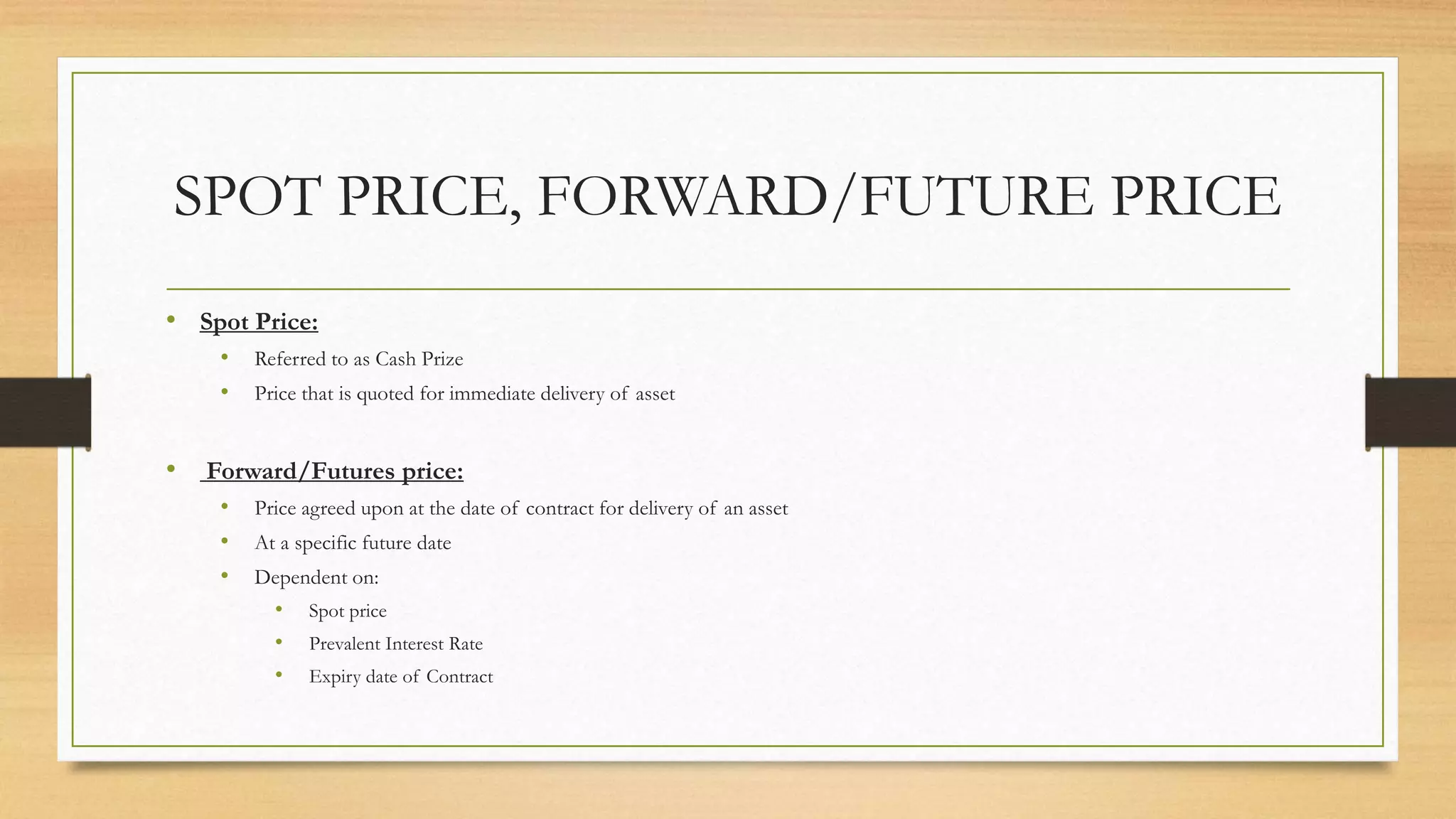
SPOT PRICE, FORWARD/FUTURE PRICE
• Spot Price:
• Referred to as Cash Prize
• Price that is quoted for immediate delivery of asset
• Forward/Futures price:
• Price agreed upon at the date of contract for delivery of an asset
• At a specific future date
• Dependent on:
• Spot price
• Prevalent Interest Rate
• Expiry date of Contract
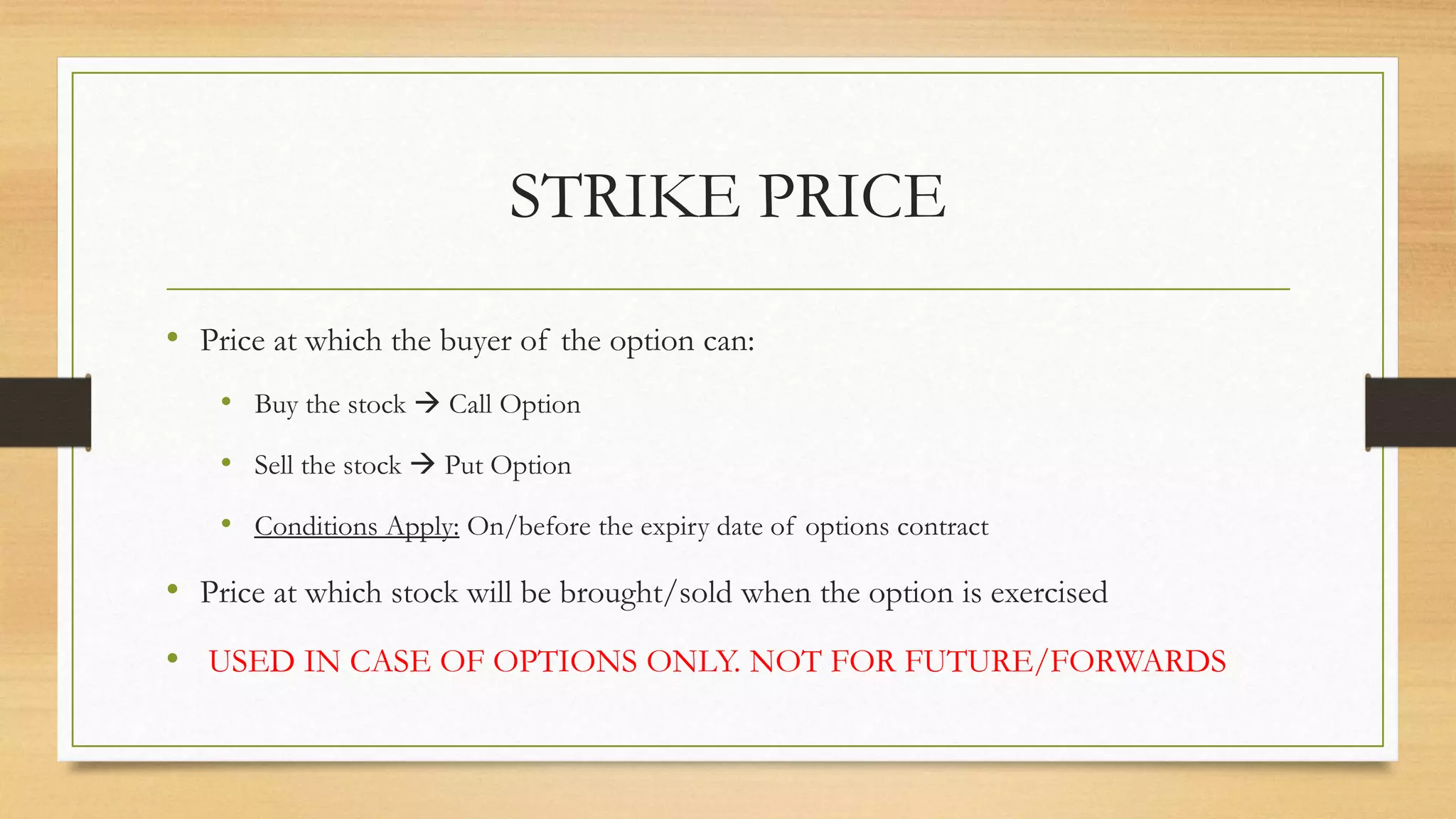
STRIKE PRICE
• Price at which the buyer of the option can:
• Buy the stock  Call Option
• Sell the stock  Put Option
• Conditions Apply: On/before the expiry date of options contract
• Price at which stock will be brought/sold when the option is exercised
• USED IN CASE OF OPTIONS ONLY. NOT FOR FUTURE/FORWARDS
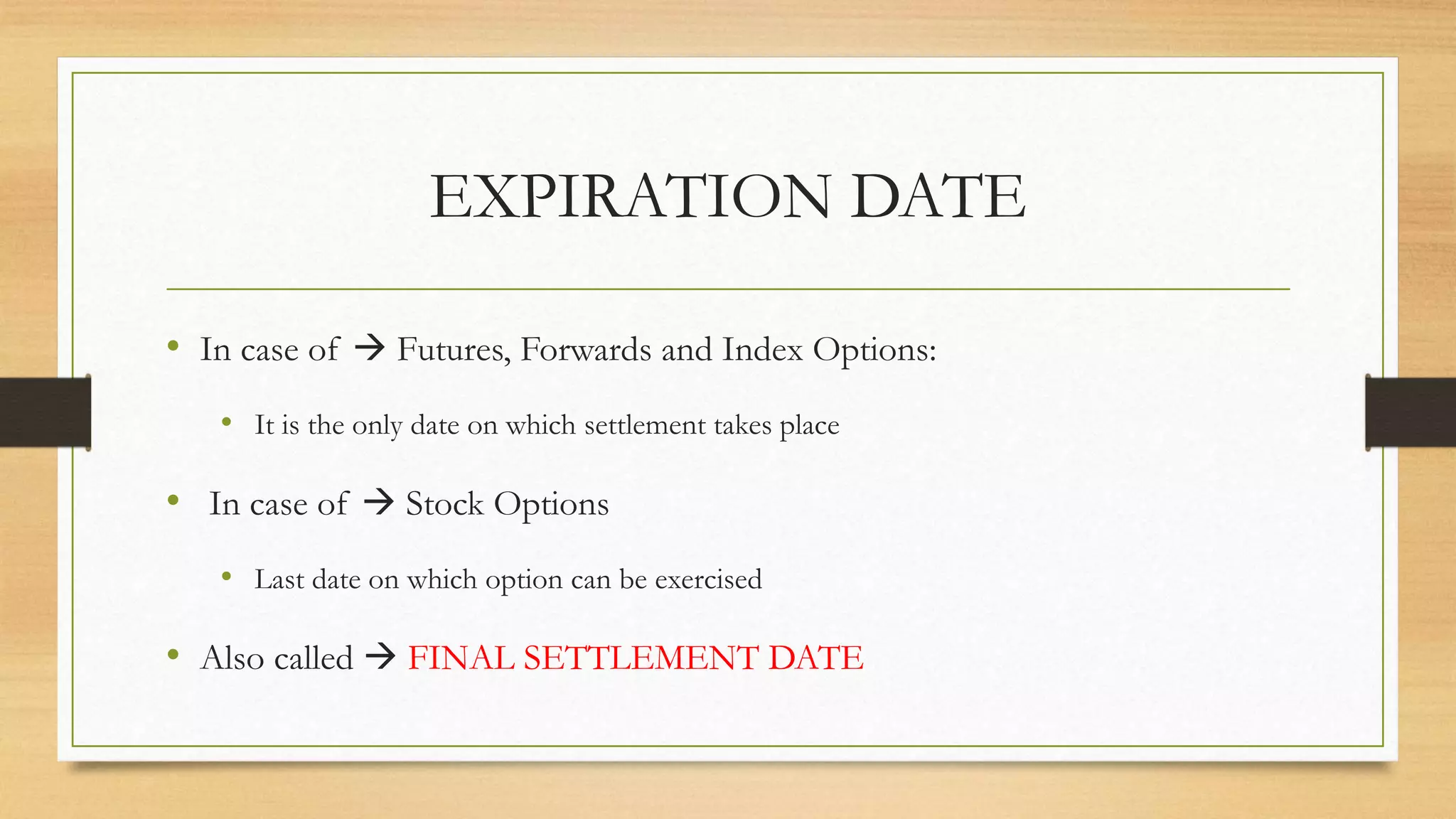
EXPIRATION DATE
• In case of  Futures, Forwards and Index Options:
• It is the only date on which settlement takes place
• In case of  Stock Options
• Last date on which option can be exercised
• Also called  FINAL SETTLEMENT DATE
TYPES OF OPTIONS
• DEPENDING UPON PRIMARY EXERCISE STYLE
• AMERICAN  Can be exercised on any day – on/before expiry date.
• Example: Stock Options.
• EUROPEAN  Can be exercised only on Expiration Date.
• Example: Index based option
CONTRACT SIZE AND VALUE
• CONTRACT SIZE: Represents certain number of shares of underlying
asset
• CONTRACT VALUE: Notional Value of transaction in case one transaction
is brought/sold
• Contract Value = (Contract Size) x (Price of Futures)
• Example: 1 futures contract of ABC consists of 300 shares trading at $2000
• Contract Size? Future Price? Contract Value?
TRADING FUTURES & PAY OFFS
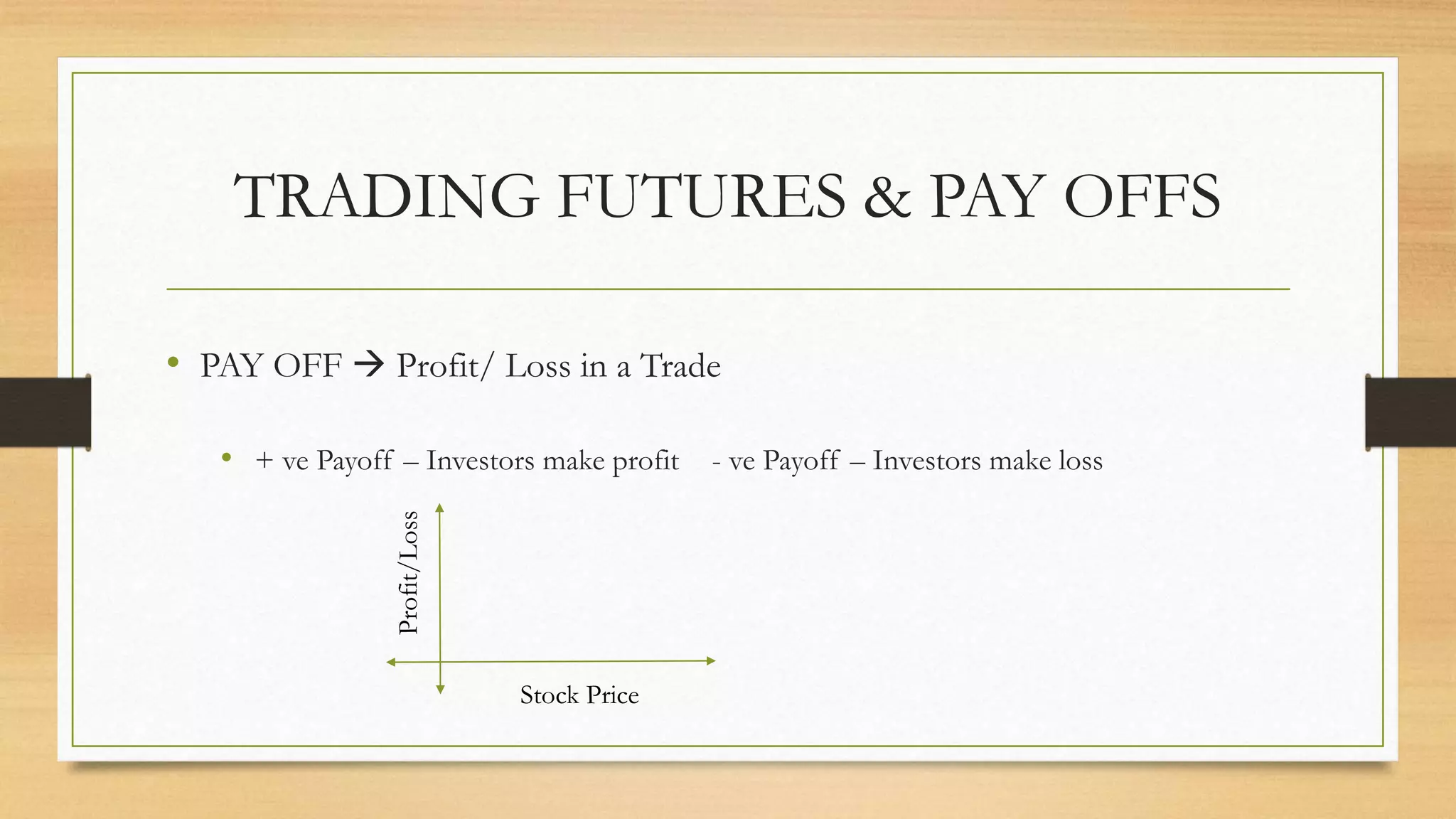
• PAY OFF  Profit/ Loss in a Trade
• + ve Payoff – Investors make profit - ve Payoff – Investors make loss
Stock Price
Profit/Loss
TRADING FUTURES & PAY OFFS
• Future Pay off on maturity depends on:
• Spot price of the underlying asset at the time of maturity (ST)
• Price at which the contract was initially traded (F)
POSITIONS TAKEN IN FUTURE
CONTRACT
• LONG: One who buys the asset at the Futures price (F)
• SHORT: One who sells the asset at Futures price (F)
LONG PAY OFF
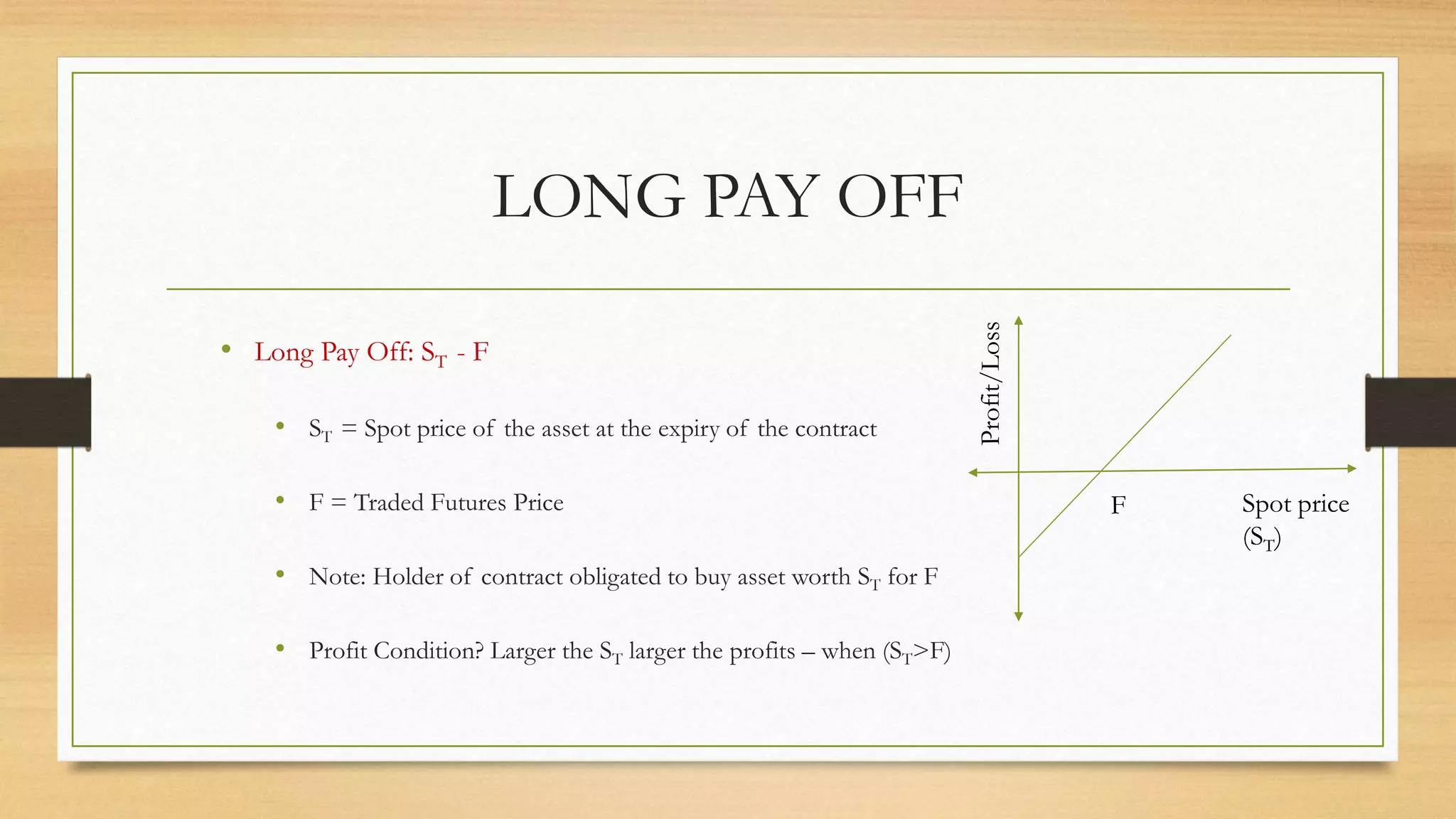
• Long Pay Off: ST - F
• ST = Spot price of the asset at the expiry of the contract
• F = Traded Futures Price
• Note: Holder of contract obligated to buy asset worth ST for F
• Profit Condition? Larger the ST larger the profits – when (ST>F)
Spot price
(ST)
Profit/Loss
F
SHORT PAY OFF
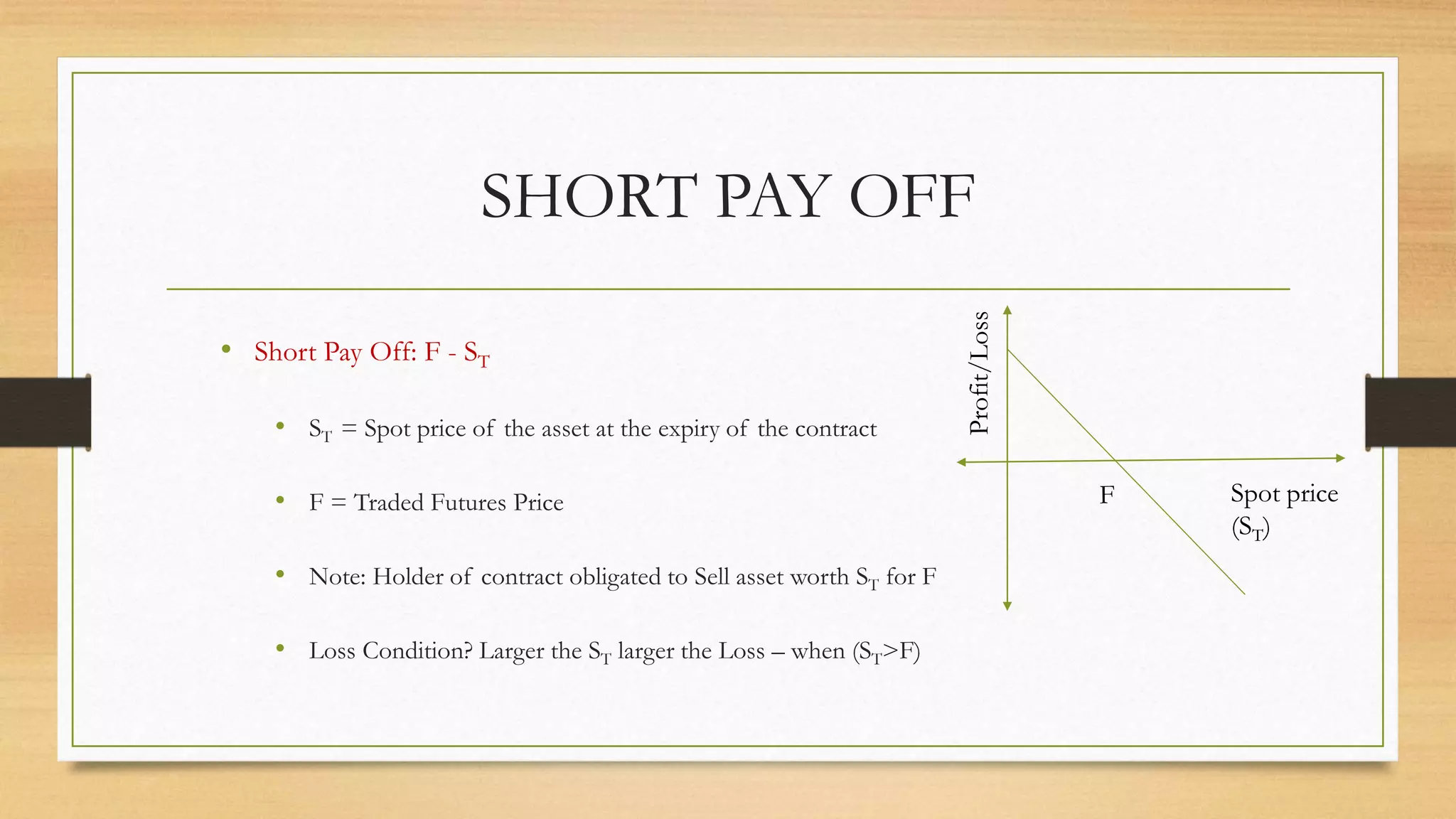
• Short Pay Off: F - ST
• ST = Spot price of the asset at the expiry of the contract
• F = Traded Futures Price
• Note: Holder of contract obligated to Sell asset worth ST for F
• Loss Condition? Larger the ST larger the Loss – when (ST>F)
Spot price
(ST)
Profit/Loss
F
TRADING OPTIONS
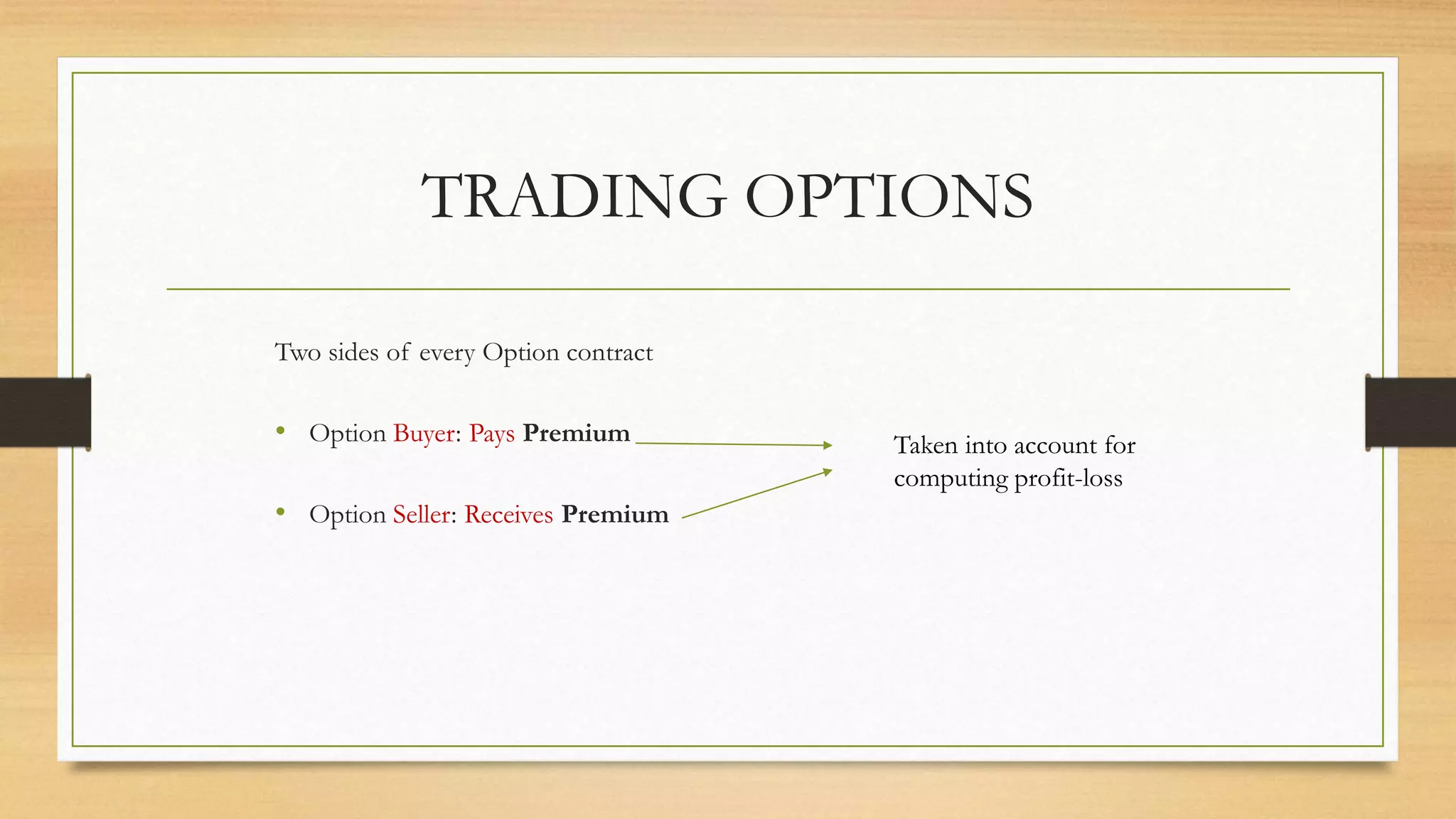
Two sides of every Option contract
• Option Buyer: Pays Premium
• Option Seller: Receives Premium
Taken into account for
computing profit-loss
TYPES OF OPTIONS (BASIC)
• LONG CALL
• LONG PUT
• SHORT CALL
• SHORT PUT
STRIKE PRICE (Revisited)
• Price at which the buyer of the option can:
• Buy the stock  Call Option
• Sell the stock  Put Option
• Conditions Apply: On/before the expiry date of options contract
• Price at which stock will be brought/sold when the option is exercised
• USED IN CASE OF OPTIONS ONLY. NOT FOR FUTURE/FORWARDS
LONG CALL
• An investor having Bullish (market will rise up) opinion on the underlying
asset can expect to have +ve return buying call options on that asset.
• When purchased: Holder exposed to stock performance in the spot
market without actually possessing the stock
• Cost incurred by call option = Option Premium
LONG PUT
• An investor having Bearish(market will fall) opinion on the underlying
asset can expect to have + ve return buying put options on that asset.
• When purchased: Holder/Buyer of option has the right to sell the
stock @ Strike price on or before expiry depending on underlying
price
SHORT CALL & SHORT PUT
• Short Call: An investor having Bearish(market will fall) can take advantage
of falling stock prices by selling a call option on the asset.
• Short Put: An investor having Bullish (market will rise) can take
advantage of rising stock prices by selling a put option on the asset.
Reference
Materials taken from Indian National Stock Exchange NCFMcertification
modules:
Equity Derivatives: Beginner’s Module
http://www.nseindia.com/education/content/module_ncfm.htm
THANK YOU

Terminologies of Derivatives

  • 1.
    TERMINOLOGIES OF DERIVATIVES HEINZ FINANCECLUB – WORKSHOP FEBRUARY 14, 2015 Corey Sattler and Mahesh Nair
  • 2.
    SPOT PRICE, FORWARD/FUTUREPRICE • Spot Price: • Referred to as Cash Prize • Price that is quoted for immediate delivery of asset • Forward/Futures price: • Price agreed upon at the date of contract for delivery of an asset • At a specific future date • Dependent on: • Spot price • Prevalent Interest Rate • Expiry date of Contract
  • 3.
    STRIKE PRICE • Priceat which the buyer of the option can: • Buy the stock  Call Option • Sell the stock  Put Option • Conditions Apply: On/before the expiry date of options contract • Price at which stock will be brought/sold when the option is exercised • USED IN CASE OF OPTIONS ONLY. NOT FOR FUTURE/FORWARDS
  • 4.
    EXPIRATION DATE • Incase of  Futures, Forwards and Index Options: • It is the only date on which settlement takes place • In case of  Stock Options • Last date on which option can be exercised • Also called  FINAL SETTLEMENT DATE
  • 5.
    TYPES OF OPTIONS •DEPENDING UPON PRIMARY EXERCISE STYLE • AMERICAN  Can be exercised on any day – on/before expiry date. • Example: Stock Options. • EUROPEAN  Can be exercised only on Expiration Date. • Example: Index based option
  • 6.
    CONTRACT SIZE ANDVALUE • CONTRACT SIZE: Represents certain number of shares of underlying asset • CONTRACT VALUE: Notional Value of transaction in case one transaction is brought/sold • Contract Value = (Contract Size) x (Price of Futures) • Example: 1 futures contract of ABC consists of 300 shares trading at $2000 • Contract Size? Future Price? Contract Value?
  • 7.
    TRADING FUTURES &PAY OFFS • PAY OFF  Profit/ Loss in a Trade • + ve Payoff – Investors make profit - ve Payoff – Investors make loss Stock Price Profit/Loss
  • 8.
    TRADING FUTURES &PAY OFFS • Future Pay off on maturity depends on: • Spot price of the underlying asset at the time of maturity (ST) • Price at which the contract was initially traded (F)
  • 9.
    POSITIONS TAKEN INFUTURE CONTRACT • LONG: One who buys the asset at the Futures price (F) • SHORT: One who sells the asset at Futures price (F)
  • 10.
    LONG PAY OFF •Long Pay Off: ST - F • ST = Spot price of the asset at the expiry of the contract • F = Traded Futures Price • Note: Holder of contract obligated to buy asset worth ST for F • Profit Condition? Larger the ST larger the profits – when (ST>F) Spot price (ST) Profit/Loss F
  • 11.
    SHORT PAY OFF •Short Pay Off: F - ST • ST = Spot price of the asset at the expiry of the contract • F = Traded Futures Price • Note: Holder of contract obligated to Sell asset worth ST for F • Loss Condition? Larger the ST larger the Loss – when (ST>F) Spot price (ST) Profit/Loss F
  • 12.
    TRADING OPTIONS Two sidesof every Option contract • Option Buyer: Pays Premium • Option Seller: Receives Premium Taken into account for computing profit-loss
  • 13.
    TYPES OF OPTIONS(BASIC) • LONG CALL • LONG PUT • SHORT CALL • SHORT PUT
  • 14.
    STRIKE PRICE (Revisited) •Price at which the buyer of the option can: • Buy the stock  Call Option • Sell the stock  Put Option • Conditions Apply: On/before the expiry date of options contract • Price at which stock will be brought/sold when the option is exercised • USED IN CASE OF OPTIONS ONLY. NOT FOR FUTURE/FORWARDS
  • 15.
    LONG CALL • Aninvestor having Bullish (market will rise up) opinion on the underlying asset can expect to have +ve return buying call options on that asset. • When purchased: Holder exposed to stock performance in the spot market without actually possessing the stock • Cost incurred by call option = Option Premium
  • 16.
    LONG PUT • Aninvestor having Bearish(market will fall) opinion on the underlying asset can expect to have + ve return buying put options on that asset. • When purchased: Holder/Buyer of option has the right to sell the stock @ Strike price on or before expiry depending on underlying price
  • 17.
    SHORT CALL &SHORT PUT • Short Call: An investor having Bearish(market will fall) can take advantage of falling stock prices by selling a call option on the asset. • Short Put: An investor having Bullish (market will rise) can take advantage of rising stock prices by selling a put option on the asset.
  • 18.
    Reference Materials taken fromIndian National Stock Exchange NCFMcertification modules: Equity Derivatives: Beginner’s Module http://www.nseindia.com/education/content/module_ncfm.htm
  • 19.