Teradata
Enterprise Data Warehouse
(EDW)
A Brief Presentation


                        Md. Ramijur Rahman Khan
                       Account Manager, Marketing
                        LEADS Corporation Limited
Topics Covered
   What is Teradata (TD) EDW?
   What Teradata Do?
   Why Teradata is obvious need for business
    houses to survive, compete & outpace
    competitors
   How does TD empower organizations
    create more value and maximize profit.
   Teradata success stories: Case study
What is Teradata EDW
   Teradata EDW is a relational database
    management system that is designed
    to extract different types of data from
    multiple sources and
    converts, integrates and stores large
    scale data in a single place and in a
    common format. TD’s data
    consolidation make data available for
    analysis.
What Does Teradata EDW Do?
1.    Teradata empowers organizations find business
      improvement opportunities (BIO) and grow...
2.    Teradata integrates customer’s discrete data from
      multiple departments and helps in analytics and new
      value generation
3.    Teradata keeps accurate data in a single source in a
      common format that enables organizations have a 360
      degree analysis of a customer to add new value to life.
    Teradata uses parallelism to process terabytes of data
     of sales, production, finance, supply-chain etc. and
     allows users get business-critical reports & statistics in
     short time. Thus it reduces cost and increases
     productivity & efficiency
Why Teradata is Obvious Need
for Corporations
 Growth of business produces high
  volume heterogeneous data that is
  unmanageable without integrated
  approach.
 Competition intensifies every
  hour, competitors go for R&D with
  existing data and open up new
  avenues of revenue, outpacing others.
 Business grows every day. Time
  leveraging is obvious for doing more
  works in same time. So, need a
  Technology Super Power! Teradata is
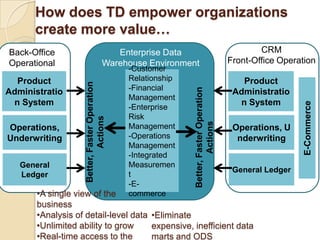
How does TD empower organizations
      create more value…
Back-Office                               Enterprise Data                                        CRM
Operational                            Warehouse Environment                             Front-Office Operation
                                               -Customer
  Product                                      Relationship                                 Product
                    Better, Faster Operation   -Financial


                                                              Better, Faster Operation
Administratio                                                                             Administratio
                                               Management
 n System                                                                                  n System


                                                                                                            E-Commerce
                                               -Enterprise
                                               Risk
                             Actions


                                                                       Actions
Operations,                                    Management                                 Operations, U
Underwriting                                   -Operations                                 nderwriting
                                               Management
                                               -Integrated
   General                                     Measuremen
                                                                                          General Ledger
   Ledger                                      t
                                               -E-
       •A single view of the                   commerce
       business
       •Analysis of detail-level data •Eliminate
       •Unlimited ability to grow     expensive, inefficient data
       •Real-time access to the       marts and ODS
Teradata success stories: Case study
   Mobilink:
    ◦ Pakistan’s leading telco operator (18 years)
    ◦ 31.6 million subscribers. Covered10,000 cities, towns and
      villages.
    ◦ 2004: Faced intense competition from 2 new player pulling
      ARPU down
    ◦ Need for new technology to retain leadership and outpace
      competitors
Mobilink Before Teradata:
Farid Ahmed, Director Business Analysis and Planning says,
“The problem was that in 2004, the only information we
had was a monthly summary of data from billing. A
  spreadsheet once a month; that was it. If we wanted to do
  something else, we had to ask the technical department and
  then extrapolate from their data. It was extremely limited.”
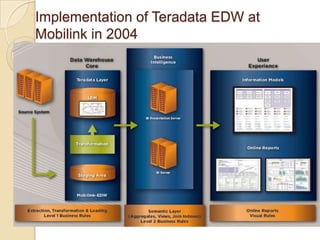
Implementation of Teradata EDW at
Mobilink in 2004
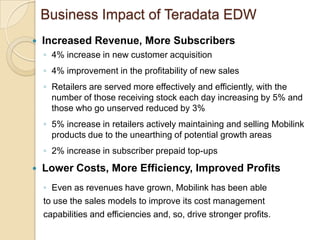
Business Impact of Teradata EDW
   Increased Revenue, More Subscribers
    ◦ 4% increase in new customer acquisition
    ◦ 4% improvement in the profitability of new sales
    ◦ Retailers are served more effectively and efficiently, with the
      number of those receiving stock each day increasing by 5% and
      those who go unserved reduced by 3%
    ◦ 5% increase in retailers actively maintaining and selling Mobilink
      products due to the unearthing of potential growth areas
    ◦ 2% increase in subscriber prepaid top-ups
   Lower Costs, More Efficiency, Improved Profits
    ◦ Even as revenues have grown, Mobilink has been able
    to use the sales models to improve its cost management
    capabilities and efficiencies and, so, drive stronger profits.
Business Impact of Teradata EDW
contd..
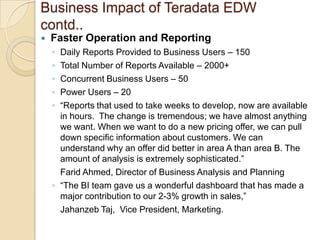
   Faster Operation and Reporting
    ◦ Daily Reports Provided to Business Users – 150
    ◦ Total Number of Reports Available – 2000+
    ◦ Concurrent Business Users – 50
    ◦ Power Users – 20
    ◦ “Reports that used to take weeks to develop, now are available
      in hours. The change is tremendous; we have almost anything
      we want. When we want to do a new pricing offer, we can pull
      down specific information about customers. We can
      understand why an offer did better in area A than area B. The
      amount of analysis is extremely sophisticated.”
      Farid Ahmed, Director of Business Analysis and Planning
    ◦ “The BI team gave us a wonderful dashboard that has made a
      major contribution to our 2-3% growth in sales,”
      Jahanzeb Taj, Vice President, Marketing.
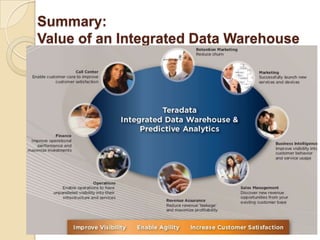
Summary:
Value of an Integrated Data Warehouse
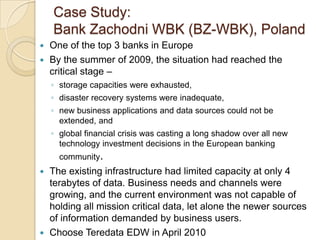
Case Study:
    Bank Zachodni WBK (BZ-WBK), Poland
 One of the top 3 banks in Europe
 By the summer of 2009, the situation had reached the
  critical stage –
    ◦ storage capacities were exhausted,
    ◦ disaster recovery systems were inadequate,
    ◦ new business applications and data sources could not be
      extended, and
    ◦ global financial crisis was casting a long shadow over all new
      technology investment decisions in the European banking
      community.
 The existing infrastructure had limited capacity at only 4
  terabytes of data. Business needs and channels were
  growing, and the current environment was not capable of
  holding all mission critical data, let alone the newer sources
  of information demanded by business users.
 Choose Teredata EDW in April 2010
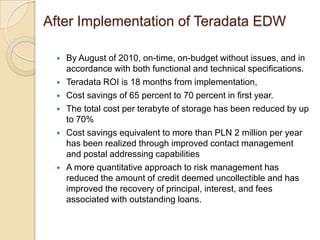
After Implementation of Teradata EDW

    By August of 2010, on-time, on-budget without issues, and in
     accordance with both functional and technical specifications.
    Teradata ROI is 18 months from implementation,
    Cost savings of 65 percent to 70 percent in first year.
    The total cost per terabyte of storage has been reduced by up
     to 70%
    Cost savings equivalent to more than PLN 2 million per year
     has been realized through improved contact management
     and postal addressing capabilities
    A more quantitative approach to risk management has
     reduced the amount of credit deemed uncollectible and has
     improved the recovery of principal, interest, and fees
     associated with outstanding loans.
Thank you

Teradata introduction

  • 1.
    Teradata Enterprise Data Warehouse (EDW) ABrief Presentation Md. Ramijur Rahman Khan Account Manager, Marketing LEADS Corporation Limited
  • 2.
    Topics Covered  What is Teradata (TD) EDW?  What Teradata Do?  Why Teradata is obvious need for business houses to survive, compete & outpace competitors  How does TD empower organizations create more value and maximize profit.  Teradata success stories: Case study
  • 3.
    What is TeradataEDW  Teradata EDW is a relational database management system that is designed to extract different types of data from multiple sources and converts, integrates and stores large scale data in a single place and in a common format. TD’s data consolidation make data available for analysis.
  • 4.
    What Does TeradataEDW Do? 1. Teradata empowers organizations find business improvement opportunities (BIO) and grow... 2. Teradata integrates customer’s discrete data from multiple departments and helps in analytics and new value generation 3. Teradata keeps accurate data in a single source in a common format that enables organizations have a 360 degree analysis of a customer to add new value to life.  Teradata uses parallelism to process terabytes of data of sales, production, finance, supply-chain etc. and allows users get business-critical reports & statistics in short time. Thus it reduces cost and increases productivity & efficiency
  • 5.
    Why Teradata isObvious Need for Corporations  Growth of business produces high volume heterogeneous data that is unmanageable without integrated approach.  Competition intensifies every hour, competitors go for R&D with existing data and open up new avenues of revenue, outpacing others.  Business grows every day. Time leveraging is obvious for doing more works in same time. So, need a Technology Super Power! Teradata is
  • 6.
    How does TDempower organizations create more value… Back-Office Enterprise Data CRM Operational Warehouse Environment Front-Office Operation -Customer Product Relationship Product Better, Faster Operation -Financial Better, Faster Operation Administratio Administratio Management n System n System E-Commerce -Enterprise Risk Actions Actions Operations, Management Operations, U Underwriting -Operations nderwriting Management -Integrated General Measuremen General Ledger Ledger t -E- •A single view of the commerce business •Analysis of detail-level data •Eliminate •Unlimited ability to grow expensive, inefficient data •Real-time access to the marts and ODS
  • 7.
    Teradata success stories:Case study  Mobilink: ◦ Pakistan’s leading telco operator (18 years) ◦ 31.6 million subscribers. Covered10,000 cities, towns and villages. ◦ 2004: Faced intense competition from 2 new player pulling ARPU down ◦ Need for new technology to retain leadership and outpace competitors Mobilink Before Teradata: Farid Ahmed, Director Business Analysis and Planning says, “The problem was that in 2004, the only information we had was a monthly summary of data from billing. A spreadsheet once a month; that was it. If we wanted to do something else, we had to ask the technical department and then extrapolate from their data. It was extremely limited.”
  • 8.
    Implementation of TeradataEDW at Mobilink in 2004
  • 9.
    Business Impact ofTeradata EDW  Increased Revenue, More Subscribers ◦ 4% increase in new customer acquisition ◦ 4% improvement in the profitability of new sales ◦ Retailers are served more effectively and efficiently, with the number of those receiving stock each day increasing by 5% and those who go unserved reduced by 3% ◦ 5% increase in retailers actively maintaining and selling Mobilink products due to the unearthing of potential growth areas ◦ 2% increase in subscriber prepaid top-ups  Lower Costs, More Efficiency, Improved Profits ◦ Even as revenues have grown, Mobilink has been able to use the sales models to improve its cost management capabilities and efficiencies and, so, drive stronger profits.
  • 10.
    Business Impact ofTeradata EDW contd..  Faster Operation and Reporting ◦ Daily Reports Provided to Business Users – 150 ◦ Total Number of Reports Available – 2000+ ◦ Concurrent Business Users – 50 ◦ Power Users – 20 ◦ “Reports that used to take weeks to develop, now are available in hours. The change is tremendous; we have almost anything we want. When we want to do a new pricing offer, we can pull down specific information about customers. We can understand why an offer did better in area A than area B. The amount of analysis is extremely sophisticated.” Farid Ahmed, Director of Business Analysis and Planning ◦ “The BI team gave us a wonderful dashboard that has made a major contribution to our 2-3% growth in sales,” Jahanzeb Taj, Vice President, Marketing.
  • 11.
    Summary: Value of anIntegrated Data Warehouse
  • 12.
    Case Study: Bank Zachodni WBK (BZ-WBK), Poland  One of the top 3 banks in Europe  By the summer of 2009, the situation had reached the critical stage – ◦ storage capacities were exhausted, ◦ disaster recovery systems were inadequate, ◦ new business applications and data sources could not be extended, and ◦ global financial crisis was casting a long shadow over all new technology investment decisions in the European banking community.  The existing infrastructure had limited capacity at only 4 terabytes of data. Business needs and channels were growing, and the current environment was not capable of holding all mission critical data, let alone the newer sources of information demanded by business users.  Choose Teredata EDW in April 2010
  • 13.
    After Implementation ofTeradata EDW  By August of 2010, on-time, on-budget without issues, and in accordance with both functional and technical specifications.  Teradata ROI is 18 months from implementation,  Cost savings of 65 percent to 70 percent in first year.  The total cost per terabyte of storage has been reduced by up to 70%  Cost savings equivalent to more than PLN 2 million per year has been realized through improved contact management and postal addressing capabilities  A more quantitative approach to risk management has reduced the amount of credit deemed uncollectible and has improved the recovery of principal, interest, and fees associated with outstanding loans.
  • 14.