English Verb Tense Review
Simple Present Tense
Otherwise known as the
Timeless Present
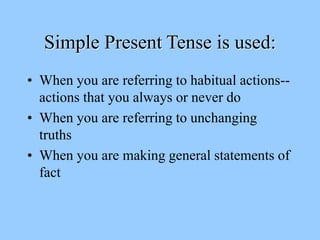
Simple Present Tense is used:
• When you are referring to habitual actions--
actions that you always or never do
• When you are referring to unchanging
truths
• When you are making general statements of
fact
simple present tense
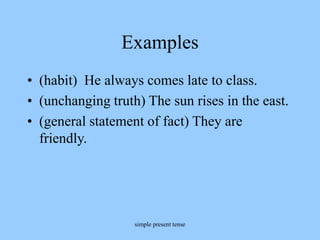
Examples
• (habit) He always comes late to class.
• (unchanging truth) The sun rises in the east.
• (general statement of fact) They are
friendly.
simple present tense
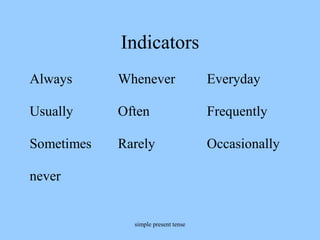
Indicators
Always Whenever Everyday
Usually Often Frequently
Sometimes Rarely Occasionally
never
simple present tense
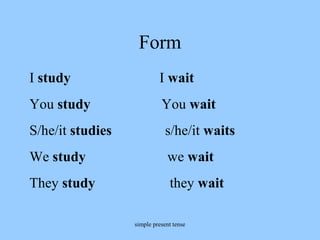
Form
I study I wait
You study You wait
S/he/it studies s/he/it waits
We study we wait
They study they wait
simple present tense
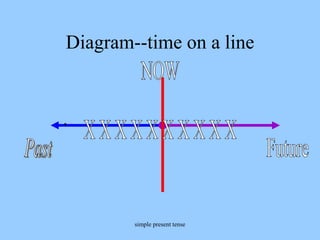
Diagram--time on a line
Simple Past Tense
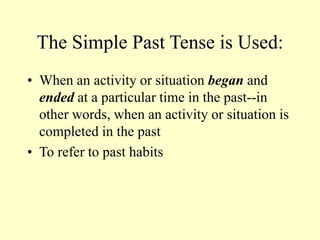
The Simple Past Tense is Used:
• When an activity or situation began and
ended at a particular time in the past--in
other words, when an activity or situation is
completed in the past
• To refer to past habits
Simple Past Tense
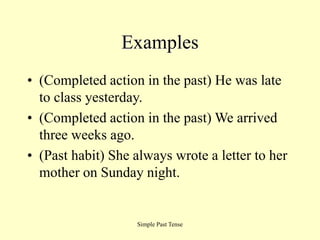
Examples
• (Completed action in the past) He was late
to class yesterday.
• (Completed action in the past) We arrived
three weeks ago.
• (Past habit) She always wrote a letter to her
mother on Sunday night.
Simple Past Tense
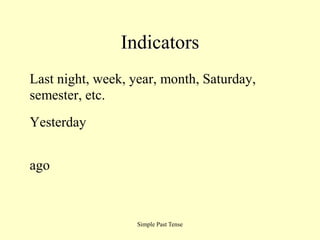
Indicators
Last night, week, year, month, Saturday,
semester, etc.
Yesterday
ago
Simple Past Tense
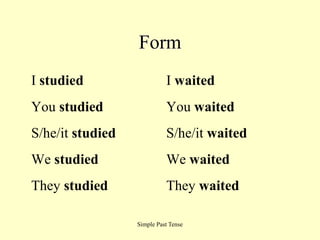
Form
I studied I waited
You studied You waited
S/he/it studied S/he/it waited
We studied We waited
They studied They waited
Simple Past Tense
Diagram--time on a line
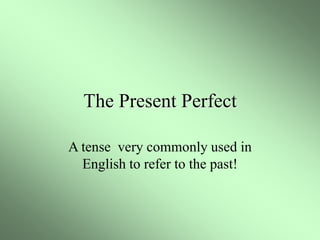
The Present Perfect
A tense very commonly used in
English to refer to the past!
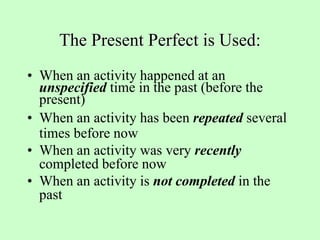
The Present Perfect is Used:
• When an activity happened at an
unspecified time in the past (before the
present)
• When an activity has been repeated several
times before now
• When an activity was very recently
completed before now
• When an activity is not completed in the
past
Present Perfect Tense
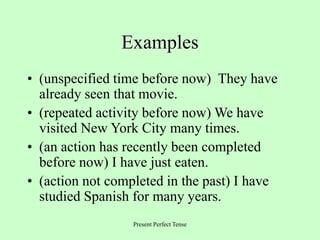
Examples
• (unspecified time before now) They have
already seen that movie.
• (repeated activity before now) We have
visited New York City many times.
• (an action has recently been completed
before now) I have just eaten.
• (action not completed in the past) I have
studied Spanish for many years.
Present Perfect Tense
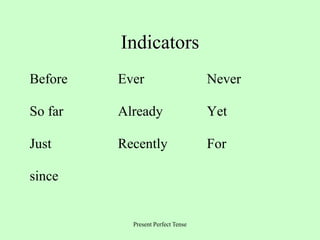
Indicators
Before Ever Never
So far Already Yet
Just Recently For
since
Present Perfect Tense
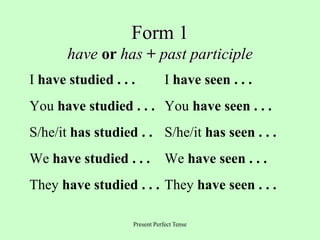
Form 1
have or has + past participle
I have studied . . . I have seen . . .
You have studied . . . You have seen . . .
S/he/it has studied . . S/he/it has seen . . .
We have studied . . . We have seen . . .
They have studied . . . They have seen . . .
Present Perfect Tense
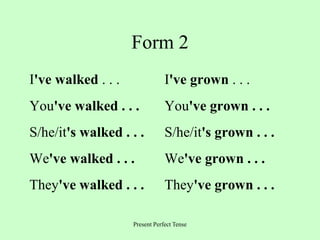
Form 2
I've walked . . . I've grown . . .
You've walked . . . You've grown . . .
S/he/it's walked . . . S/he/it's grown . . .
We've walked . . . We've grown . . .
They've walked . . . They've grown . . .
Present Perfect Tense
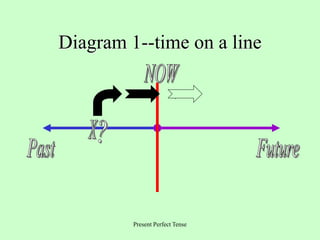
Diagram 1--time on a line
Present Perfect Tense
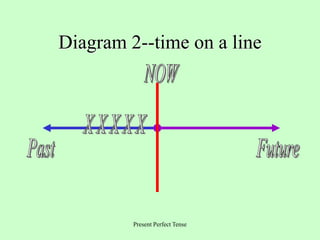
Diagram 2--time on a line
The Present Progressive Tense
Sometimes called the
Present Continuous Tense
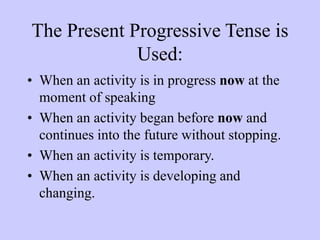
The Present Progressive Tense is
Used:
• When an activity is in progress now at the
moment of speaking
• When an activity began before now and
continues into the future without stopping.
• When an activity is temporary.
• When an activity is developing and
changing.
Present Progressive Tense
Examples
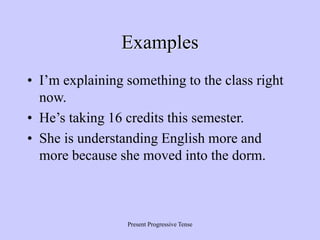
• I’m explaining something to the class right
now.
• He’s taking 16 credits this semester.
• She is understanding English more and
more because she moved into the dorm.
Present Progressive Tense
Indicators
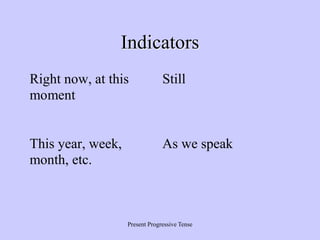
Right now, at this
moment
Still
This year, week,
month, etc.
As we speak
Present Progressive Tense
Form
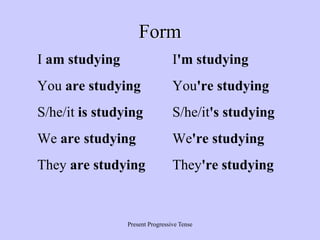
I am studying I'm studying
You are studying You're studying
S/he/it is studying S/he/it's studying
We are studying We're studying
They are studying They're studying
Present Progressive Tense
Diagram--time on a line
Future Tense
The Future Tense is Used:
• To indicate that an activity or event will
take place at a time in the future
Future
Examples
• When I’m retired, I’m going to travel.
• Next week, we will work on punctuation.
• He is going to get his car fixed tomorrow.
• Our plane departs at noon next Friday.
Future
Indicators
Tomorrow
Next Saturday, week, month, year, etc.
Future
Form 1
I will stay I'll stay
You will stay You'll stay
S/he/it will stay S/he/it'll stay
We will stay We'll stay
They will stay They'll stay
Future
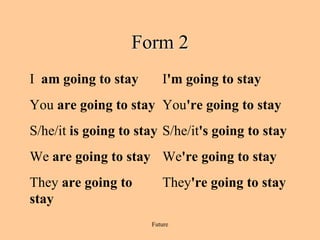
Form 2
I am going to stay I'm going to stay
You are going to stay You're going to stay
S/he/it is going to stay S/he/it's going to stay
We are going to stay We're going to stay
They are going to
stay
They're going to stay
Future Tense
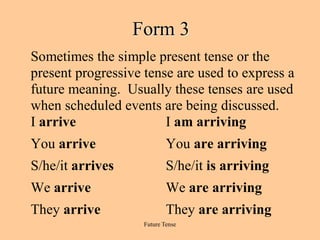
Form 3
Sometimes the simple present tense or the
present progressive tense are used to express a
future meaning. Usually these tenses are used
when scheduled events are being discussed.
I arrive I am arriving
You arrive You are arriving
S/he/it arrives S/he/it is arriving
We arrive We are arriving
They arrive They are arriving
Future
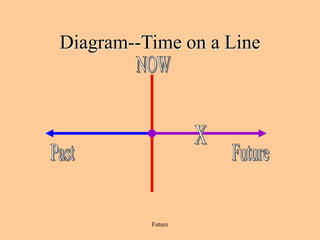
Diagram--Time on a Line
Other English Verb Tenses
These tenses are combinations of the
tenses we have just reviewed
Past Perfect
• This tense is not used a lot. It can often be
used interchangeably with the simple past
because these tenses do not differ much in
meaning. The past perfect tense refers to
activities that happened before a specific
time in the past.
• Example, He had visited her many times
before she died.
• Form: had + past participle
Past Progressive
• This tense is used to refer to activities
continuously in progress around a time in
the past.
• Example: They were eating when the taxi
arrived.
• Form: was or were + verbing
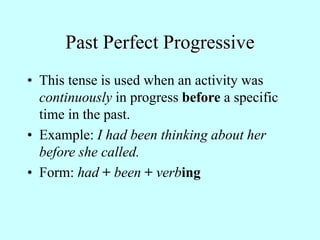
Past Perfect Progressive
• This tense is used when an activity was
continuously in progress before a specific
time in the past.
• Example: I had been thinking about her
before she called.
• Form: had + been + verbing
Present Perfect Progressive
• This tense is used to describe actions that
have been continuously in progress before
now. These actions are not completed.
• Example: I have been waiting here for the
last two hours.
• Form: have or has + been + verbing
Future Perfect
• The future perfect expresses the idea that an
activity will occur before some future time.
• Example: She will have finished dinner
before the game starts.
• Form: will + have + past participle
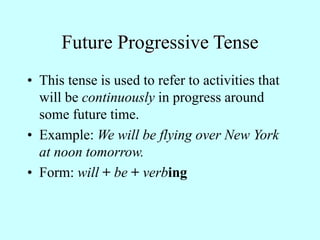
Future Progressive Tense
• This tense is used to refer to activities that
will be continuously in progress around
some future time.
• Example: We will be flying over New York
at noon tomorrow.
• Form: will + be + verbing
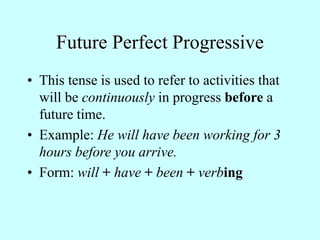
Future Perfect Progressive
• This tense is used to refer to activities that
will be continuously in progress before a
future time.
• Example: He will have been working for 3
hours before you arrive.
• Form: will + have + been + verbing
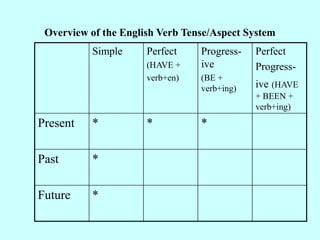
Overview of the English Verb Tense/Aspect System
Simple Perfect
(HAVE +
verb+en)
Progress-
ive
(BE +
verb+ing)
Perfect
Progress-
ive (HAVE
+ BEEN +
verb+ing)
Present * * *
Past *
Future *
Acknowledgments
• The charts in this presentation were adapted
from the work of Betty Schrampfer Azar.
She is the author of Understanding and
Using English Grammar and many other
useful ESL texts.
September 2000
The End

verb.ppt

  • 1.
  • 2.
    Simple Present Tense Otherwiseknown as the Timeless Present
  • 3.
    Simple Present Tenseis used: • When you are referring to habitual actions-- actions that you always or never do • When you are referring to unchanging truths • When you are making general statements of fact
  • 4.
    simple present tense Examples •(habit) He always comes late to class. • (unchanging truth) The sun rises in the east. • (general statement of fact) They are friendly.
  • 5.
    simple present tense Indicators AlwaysWhenever Everyday Usually Often Frequently Sometimes Rarely Occasionally never
  • 6.
    simple present tense Form Istudy I wait You study You wait S/he/it studies s/he/it waits We study we wait They study they wait
  • 7.
  • 8.
  • 9.
    The Simple PastTense is Used: • When an activity or situation began and ended at a particular time in the past--in other words, when an activity or situation is completed in the past • To refer to past habits
  • 10.
    Simple Past Tense Examples •(Completed action in the past) He was late to class yesterday. • (Completed action in the past) We arrived three weeks ago. • (Past habit) She always wrote a letter to her mother on Sunday night.
  • 11.
    Simple Past Tense Indicators Lastnight, week, year, month, Saturday, semester, etc. Yesterday ago
  • 12.
    Simple Past Tense Form Istudied I waited You studied You waited S/he/it studied S/he/it waited We studied We waited They studied They waited
  • 13.
  • 14.
    The Present Perfect Atense very commonly used in English to refer to the past!
  • 15.
    The Present Perfectis Used: • When an activity happened at an unspecified time in the past (before the present) • When an activity has been repeated several times before now • When an activity was very recently completed before now • When an activity is not completed in the past
  • 16.
    Present Perfect Tense Examples •(unspecified time before now) They have already seen that movie. • (repeated activity before now) We have visited New York City many times. • (an action has recently been completed before now) I have just eaten. • (action not completed in the past) I have studied Spanish for many years.
  • 17.
    Present Perfect Tense Indicators BeforeEver Never So far Already Yet Just Recently For since
  • 18.
    Present Perfect Tense Form1 have or has + past participle I have studied . . . I have seen . . . You have studied . . . You have seen . . . S/he/it has studied . . S/he/it has seen . . . We have studied . . . We have seen . . . They have studied . . . They have seen . . .
  • 19.
    Present Perfect Tense Form2 I've walked . . . I've grown . . . You've walked . . . You've grown . . . S/he/it's walked . . . S/he/it's grown . . . We've walked . . . We've grown . . . They've walked . . . They've grown . . .
  • 20.
  • 21.
  • 22.
    The Present ProgressiveTense Sometimes called the Present Continuous Tense
  • 23.
    The Present ProgressiveTense is Used: • When an activity is in progress now at the moment of speaking • When an activity began before now and continues into the future without stopping. • When an activity is temporary. • When an activity is developing and changing.
  • 24.
    Present Progressive Tense Examples •I’m explaining something to the class right now. • He’s taking 16 credits this semester. • She is understanding English more and more because she moved into the dorm.
  • 25.
    Present Progressive Tense Indicators Rightnow, at this moment Still This year, week, month, etc. As we speak
  • 26.
    Present Progressive Tense Form Iam studying I'm studying You are studying You're studying S/he/it is studying S/he/it's studying We are studying We're studying They are studying They're studying
  • 27.
  • 28.
  • 29.
    The Future Tenseis Used: • To indicate that an activity or event will take place at a time in the future
  • 30.
    Future Examples • When I’mretired, I’m going to travel. • Next week, we will work on punctuation. • He is going to get his car fixed tomorrow. • Our plane departs at noon next Friday.
  • 31.
  • 32.
    Future Form 1 I willstay I'll stay You will stay You'll stay S/he/it will stay S/he/it'll stay We will stay We'll stay They will stay They'll stay
  • 33.
    Future Form 2 I amgoing to stay I'm going to stay You are going to stay You're going to stay S/he/it is going to stay S/he/it's going to stay We are going to stay We're going to stay They are going to stay They're going to stay
  • 34.
    Future Tense Form 3 Sometimesthe simple present tense or the present progressive tense are used to express a future meaning. Usually these tenses are used when scheduled events are being discussed. I arrive I am arriving You arrive You are arriving S/he/it arrives S/he/it is arriving We arrive We are arriving They arrive They are arriving
  • 35.
  • 36.
    Other English VerbTenses These tenses are combinations of the tenses we have just reviewed
  • 37.
    Past Perfect • Thistense is not used a lot. It can often be used interchangeably with the simple past because these tenses do not differ much in meaning. The past perfect tense refers to activities that happened before a specific time in the past. • Example, He had visited her many times before she died. • Form: had + past participle
  • 38.
    Past Progressive • Thistense is used to refer to activities continuously in progress around a time in the past. • Example: They were eating when the taxi arrived. • Form: was or were + verbing
  • 39.
    Past Perfect Progressive •This tense is used when an activity was continuously in progress before a specific time in the past. • Example: I had been thinking about her before she called. • Form: had + been + verbing
  • 40.
    Present Perfect Progressive •This tense is used to describe actions that have been continuously in progress before now. These actions are not completed. • Example: I have been waiting here for the last two hours. • Form: have or has + been + verbing
  • 41.
    Future Perfect • Thefuture perfect expresses the idea that an activity will occur before some future time. • Example: She will have finished dinner before the game starts. • Form: will + have + past participle
  • 42.
    Future Progressive Tense •This tense is used to refer to activities that will be continuously in progress around some future time. • Example: We will be flying over New York at noon tomorrow. • Form: will + be + verbing
  • 43.
    Future Perfect Progressive •This tense is used to refer to activities that will be continuously in progress before a future time. • Example: He will have been working for 3 hours before you arrive. • Form: will + have + been + verbing
  • 44.
    Overview of theEnglish Verb Tense/Aspect System Simple Perfect (HAVE + verb+en) Progress- ive (BE + verb+ing) Perfect Progress- ive (HAVE + BEEN + verb+ing) Present * * * Past * Future *
  • 45.
    Acknowledgments • The chartsin this presentation were adapted from the work of Betty Schrampfer Azar. She is the author of Understanding and Using English Grammar and many other useful ESL texts.
  • 46.