TendenciesProf. J. Magdalena ArévaloDpto. De Idiomas-UNEFM
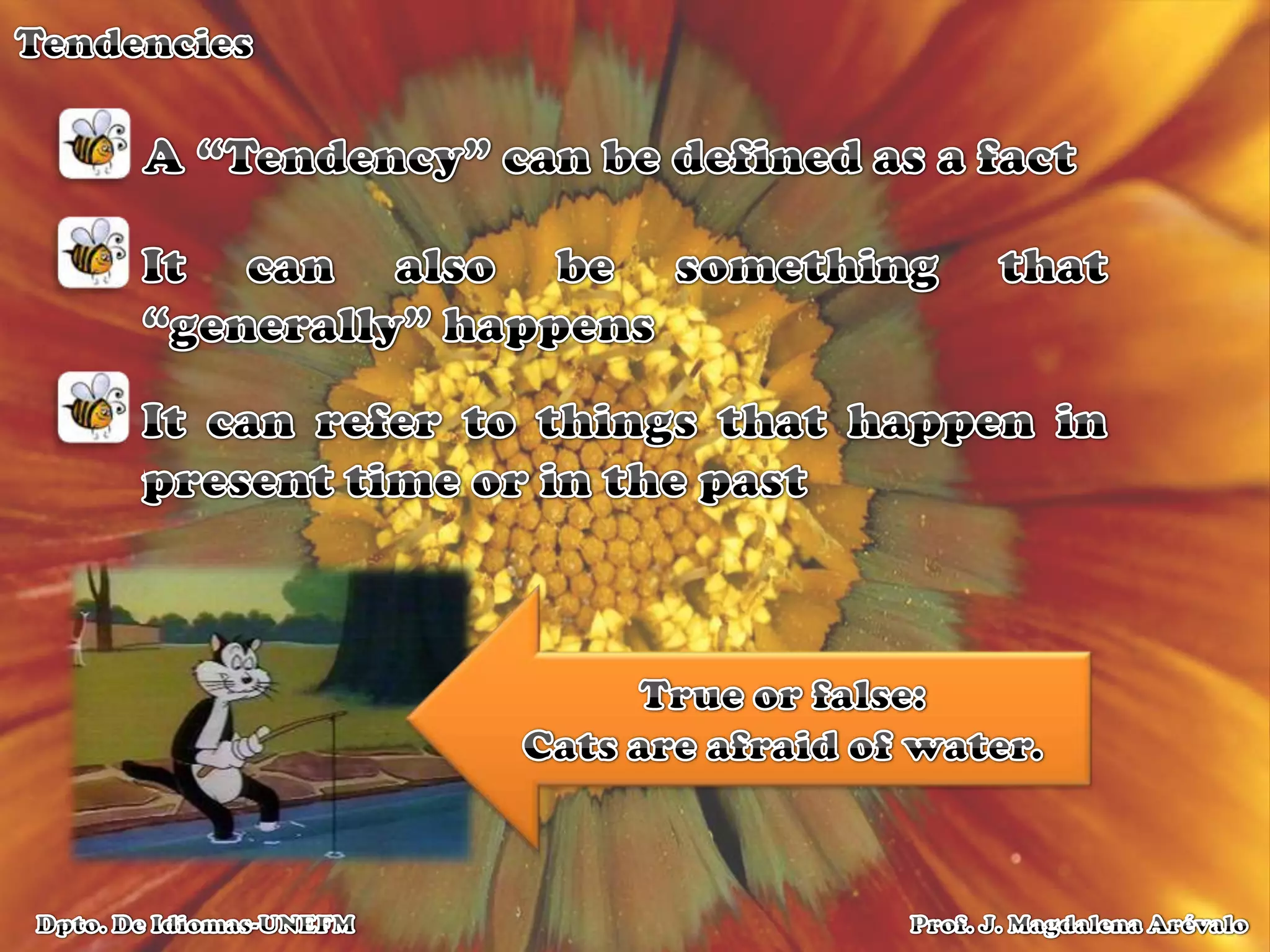
TendenciesA “Tendency” can be defined as a factIt can also be something that “generally” happensIt can refer to things that happen in present time or in the pastTrue or false: Cats are afraid of water. Prof. J. Magdalena ArévaloDpto. De Idiomas-UNEFM
TendenciesJones, Bastow & Hird, 2009General TendenciesWe can use the present tense to talk about facts that are “generally ” trueThe earth revolves around the sun.Reptiles are cold blooded animals.Irish people come from Ireland.Remember to add _s or _es at the end of the verb when using third person!Prof. J. Magdalena ArévaloDpto. De Idiomas-UNEFM
TendenciesJones, Bastow & Hird, 2009Parrot, 2000General TendenciesWhen talking about things that NOT ALWAYS happen we can use the modal auxiliary “Will”Men will often prefer to talk about sports, while women will talk about their feelings.  You can tell her now and the next minute she’ll forget.Use “Will” if your statement is based on typical or repeated behaviorProf. J. Magdalena ArévaloDpto. De Idiomas-UNEFM
TendenciesJones, Bastow & Hird, 2009Parrot, 2000Tendencies in the PastWe can use the modal auxiliary “Would” to talk about habits, characteristics or behaviors from the pastWhen I was a child I‘ddrink milk every dayOn Saturday evenings we‘d play cards togetherWe can also use “Would” to express hypothetical meaning, to speculate or to describe what we are imaginingProf. J. Magdalena ArévaloDpto. De Idiomas-UNEFM
TendenciesJones, Bastow & Hird, 2009Parrot, 2000Tendencies in the PastIf we want to talk about an specific event in the past we use the Simple Past. I watched cartoons yesterday with my babyI wentto the movies last SundayWe played cards last weekBe careful with regular and irregular verbs in past form!Prof. J. Magdalena ArévaloDpto. De Idiomas-UNEFM
To be continued….

Tendencies ss

  • 1.
    TendenciesProf. J. MagdalenaArévaloDpto. De Idiomas-UNEFM
  • 2.
    TendenciesA “Tendency” canbe defined as a factIt can also be something that “generally” happensIt can refer to things that happen in present time or in the pastTrue or false: Cats are afraid of water. Prof. J. Magdalena ArévaloDpto. De Idiomas-UNEFM
  • 3.
    TendenciesJones, Bastow &Hird, 2009General TendenciesWe can use the present tense to talk about facts that are “generally ” trueThe earth revolves around the sun.Reptiles are cold blooded animals.Irish people come from Ireland.Remember to add _s or _es at the end of the verb when using third person!Prof. J. Magdalena ArévaloDpto. De Idiomas-UNEFM
  • 4.
    TendenciesJones, Bastow &Hird, 2009Parrot, 2000General TendenciesWhen talking about things that NOT ALWAYS happen we can use the modal auxiliary “Will”Men will often prefer to talk about sports, while women will talk about their feelings. You can tell her now and the next minute she’ll forget.Use “Will” if your statement is based on typical or repeated behaviorProf. J. Magdalena ArévaloDpto. De Idiomas-UNEFM
  • 5.
    TendenciesJones, Bastow &Hird, 2009Parrot, 2000Tendencies in the PastWe can use the modal auxiliary “Would” to talk about habits, characteristics or behaviors from the pastWhen I was a child I‘ddrink milk every dayOn Saturday evenings we‘d play cards togetherWe can also use “Would” to express hypothetical meaning, to speculate or to describe what we are imaginingProf. J. Magdalena ArévaloDpto. De Idiomas-UNEFM
  • 6.
    TendenciesJones, Bastow &Hird, 2009Parrot, 2000Tendencies in the PastIf we want to talk about an specific event in the past we use the Simple Past. I watched cartoons yesterday with my babyI wentto the movies last SundayWe played cards last weekBe careful with regular and irregular verbs in past form!Prof. J. Magdalena ArévaloDpto. De Idiomas-UNEFM
  • 7.