Tenants for Going
at DevSecOps Speed
matt@defectdojo.com
matt.tesauro@owasp.org
https://www.linkedin.com/in/matttesauro/
Matt Tesauro
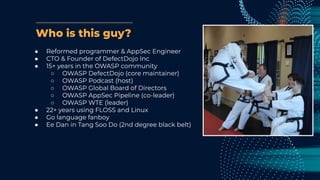
Who is this guy?
● Reformed programmer & AppSec Engineer
● CTO & Founder of DefectDojo Inc
● 15+ years in the OWASP community
○ OWASP DefectDojo (core maintainer)
○ OWASP Podcast (host)
○ OWASP Global Board of Directors
○ OWASP AppSec Pipeline (co-leader)
○ OWASP WTE (leader)
● 22+ years using FLOSS and Linux
● Go language fanboy
● Ee Dan in Tang Soo Do (2nd degree black belt)
01
2
Fundamental
Truths
The 4
What’s
Overview
02 03 04
Conclusion
Overview
01 Let’s start at the beginning
—Me (Matt Tesauro)
“Time to turn
chaos into calm
and
distress into success.”
Background
This talk was created from the perspective that:
● You’ve been dropped into a AppSec / DevSecOps /
Product Security team as it’s lead
● You need to “do AppSec”
● You have a limited team and budget
● You need:
“A simple system that adapts to complex situations”
The 6
things of
DevSecOps
2 Fundamental Truths
The 4 What’s
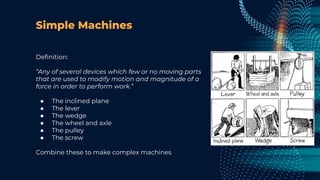
Simple Machines
Definition:
“Any of several devices which few or no moving parts
that are used to modify motion and magnitude of a
force in order to perform work.”
● The inclined plane
● The lever
● The wedge
● The wheel and axle
● The pulley
● The screw
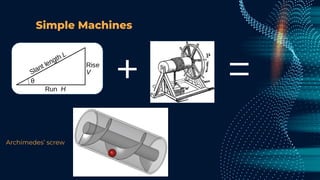
Combine these to make complex machines
Simple Machines
+ =
Archimedes’ screw
Let’s Define the
‘Simple Machines’
of DevSecOps
You can then mix and match them to
fit the context in which you work.

The 6
things of
simple machines
DevSecOps
2 Fundamental Truths
The 4 What’s
2 Fundamental Truths
02 The two things the rest depend on
The Ground Truth
Know where you’re starting from
The initial assessment
The Ground Truth
Know where you’re starting from
● Initial broad assessment
● Why?
○ Demonstrate progress
● Measure when you start and regularly re-measure
○ Can’t measure change till the 2nd measurement
○ Get an early measurement to show progress early
What the assessment will find
● Ranges from greenfield to scorched earth
● Nothing exists to a complete, validated list of all apps
within the company
● SaaS company with a single product
○ Warning “Product” is a charged term
○ Product != repo
○ Microservices, Web and Mobile versions, …
What is a Product?
● You need to figure out what this means in context
● Stick to the definition you established
● Maybe make a poster out of it
● Avoids incredible amounts of future confusion
and misunderstanding
● Product X was assessed
versus
A repo that is one of the 6 repos that
makes up Product X was assessed
Understand the scope of your work
● Hopefully covered clearly before you were hired
● There’s no standard
○ Write it down / define it
○ Another poster?
● Apps only, App and Infra, Containers, Cloud, …
● How much of the vulnerability lifecycle do you own?
○ Reporting, Mitigation, Remediation, Retesting?
● Who are your upstream & downstream stakeholders?
Where to get started?
There’s some good frameworks you can use to do an initial
assessment, but first:
● Decide how much time to spend
● Accuracy vs speed
● Iterative is the thing
● Solo vs collaborative
Things to use as a guide:
● OWASP SAMM (Software Assurance Maturity Model)
● OWASP ASVS (Application Security Verification Standard)
● OWASP DSOMM (DevSecOps Maturity Model)
Single Source of Truth
As you move forward, you need a
canonical representation of reality
Canonical Representation of Reality
● It’s very likely you won’t have a full picture
● You need something that adapts and grows over time
● Tool venders will have you log into 27 web consoles
● How to pick a single source of truth?
○ Ability to hold all the data you need flexibly
○ Ability to filter, sort, modify, combine the data
○ Differing views based on stakeholders
○ Dedup, False Positives, Grouping/Merging
I know what you’re thinking..
Current tool for 90% of Enterprise Vulnerability Management Programs
But WHY?
Might I suggest…
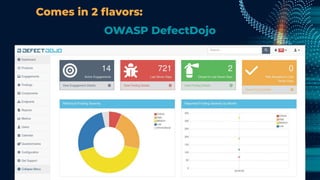
Comes in 2 flavors:
OWASP DefectDojo
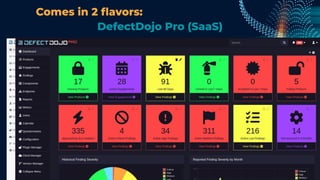
Comes in 2 flavors:
DefectDojo Pro (SaaS)
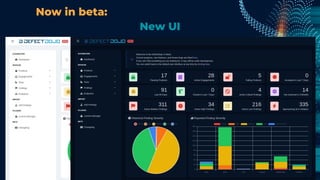
Now in beta:
New UI
DefectDojo - a single source of truth
DevSecOps tool created by DevSecOps professionals
for DevSecOps professionals.
● Manages the DevSecOps security program
● Application inventory with robust metadata
● Sort, filter, munge and export the data in multiple ways
● Engagement / assessment tracking
● Supports manual and automated security work
● Deduplication + false positive tracking of findings
● Custom report creation
● Tagging on multiple levels
● Calendar of security activities
● Historical knowledge of past assessments
Why was DefectDojo created?
DefectDojo was born from the frustrations of the product
security team at Rackspace with:
● Tracking manual testing efforts
● Combining output from multiple tools
● Tools having a snowflake way to represent issues
● De-duping and merging/grouping findings
● False-positive management
● Reporting on infra & app issues
● Logging into N vendor motherships
● The need to automate (REST API)
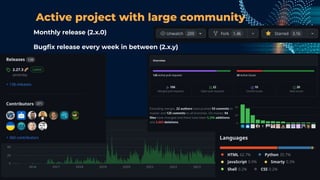
Active project with large community
Monthly release (2.x.0)
Bugfix release every week in between (2.x.y)
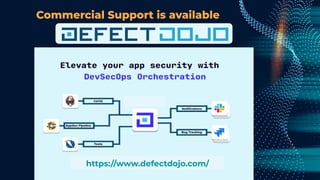
Commercial Support is available
https://www.defectdojo.com/
Where to get more info?
Search Youtube for “purple DefectDojo”
The 4 What’s
03 What needs to happen for DevSecOps
Starting
with the
Big Picture
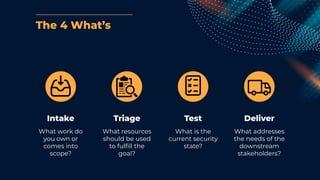
The 4 What’s
Intake
What work do
you own or
comes into
scope?
Triage
What resources
should be used
to fulfill the
goal?
Test
What is the
current security
state?
Deliver
What addresses
the needs of the
downstream
stakeholders?
Intake
What work do you own or comes into
your scope?
What #1 - Intake
What work do you own or comes into scope?
● Remember that initial assessment, you nailed down scope,
right?
● Be DRY when gathering data (Don’t Repeat Yourself)
● Several types of work can come in:
○ Event vs Calendar
○ Ad-hoc vs Planned
● Ideally, try to limit intake - tricky politically
○ Automated intake can help with this
Triage
What resources should you use to fulfill
the goal?
What #2 - Triage
What resources should be used to fulfill the goal?
● The intake request has a goal, right?
● Bucket level of effort based on:
○ Risk / Criticality of the target
○ Automation in place
○ Accuracy of the tool
● Reduce testing scope by ‘pre-calculating’ with automation
● Keep the bucketing as simple as possible
○ No leaky abstractions with items
falling between buckets
What #2 - Triage
What resources should be used to fulfill the goal?
● Wrong choice can be better than no choice
○ You have (and should) iterate over time
● Don’t start with 100% accuracy
○ It’s great if you can pull it off but very unlikely
○ Consistent ‘stick’ to measure distance
○ Accuracy can arrive over time (if needed)
○ Avoid early optimizations
Test
What is the current security state?
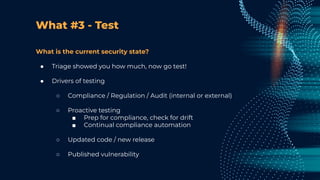
What #3 - Test
What is the current security state?
● Triage showed you how much, now go test!
● Drivers of testing
○ Compliance / Regulation / Audit (internal or external)
○ Proactive testing
■ Prep for compliance, check for drift
■ Continual compliance automation
○ Updated code / new release
○ Published vulnerability
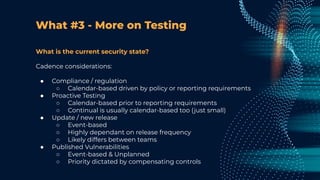
What #3 - More on Testing
What is the current security state?
Cadence considerations:
● Compliance / regulation
○ Calendar-based driven by policy or reporting requirements
● Proactive Testing
○ Calendar-based prior to reporting requirements
○ Continual is usually calendar-based too (just small)
● Update / new release
○ Event-based
○ Highly dependant on release frequency
○ Likely differs between teams
● Published Vulnerabilities
○ Event-based & Unplanned
○ Priority dictated by compensating controls
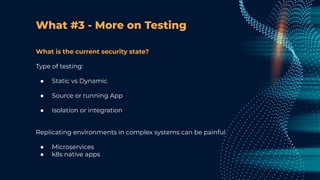
What #3 - More on Testing
What is the current security state?
Type of testing:
● Static vs Dynamic
● Source or running App
● Isolation or integration
Replicating environments in complex systems can be painful
● Microservices
● k8s native apps
What #3 - More on Testing
How far left can you go?
● Not everything to the left is “testable”
● Pick your battles, fast feedback loops are crucial
● If you “left test” one service of you 253 microservices-based
product
○ Have you really tested that product?
○ What about service to service interaction?
What #3 - More on Testing
CICD imperatives:
● Zero false positives
● Health checks vs scanning
● Specific issue tests
○ Ninja re-testing
● Long running tests vs quick tests
○ NOOP during test runs
○ Better eventually then not at all
Deliver
What addresses the needs of the
downstream stakeholders?
What #4 - Deliver
What addresses the needs of the downstream stakeholders?
● Where does your mandate stop in the finding life cycle?
○ Reporting
○ Remediation
○ Retesting
● Speak the native tongue
○ Issue trackers for devs
○ Summary data, charts & graphs for VPs and above
○ Dashboards for broader visibility
○ Engage pride as a lever
“The X team figured it out…”
Conclusion
04 Let’s wrap all this up
Putting it all together
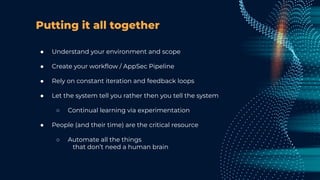
● Understand your environment and scope
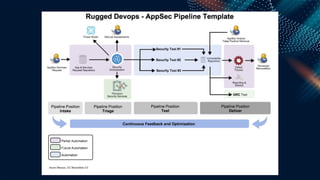
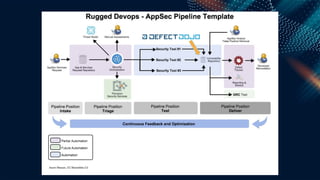
● Create your workflow / AppSec Pipeline
● Rely on constant iteration and feedback loops
● Let the system tell you rather then you tell the system
○ Continual learning via experimentation
● People (and their time) are the critical resource
○ Automate all the things
that don’t need a human brain
The 6
things of
simple machines
DevSecOps
2 Fundamental Truths
The 4 What’s
Simple Machines of DevSecOps
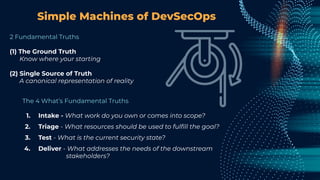
2 Fundamental Truths
(1) The Ground Truth
Know where your starting
(2) Single Source of Truth
A canonical representation of reality
The 4 What’s Fundamental Truths
1. Intake - What work do you own or comes into scope?
2. Triage - What resources should be used to fulfill the goal?
3. Test - What is the current security state?
4. Deliver - What addresses the needs of the downstream
stakeholders?
—Me (Matt Tesauro)
“Time to turn
chaos into calm
and
distress into success.”
CREDITS: This presentation template was
created by Slidesgo, including icons by Flaticon,
and infographics & images by Freepik.
THANKS!
Questions?
matt@defectdojo.com
matt.tesauro@owasp.org
defectdojo.com
https://www.linkedin.com/in/matttesauro/

Tenants for Going at DevSecOps Speed - LASCON 2023

  • 1.
    Tenants for Going atDevSecOps Speed matt@defectdojo.com matt.tesauro@owasp.org https://www.linkedin.com/in/matttesauro/ Matt Tesauro
  • 2.
    Who is thisguy? ● Reformed programmer & AppSec Engineer ● CTO & Founder of DefectDojo Inc ● 15+ years in the OWASP community ○ OWASP DefectDojo (core maintainer) ○ OWASP Podcast (host) ○ OWASP Global Board of Directors ○ OWASP AppSec Pipeline (co-leader) ○ OWASP WTE (leader) ● 22+ years using FLOSS and Linux ● Go language fanboy ● Ee Dan in Tang Soo Do (2nd degree black belt)
  • 3.
  • 4.
    Overview 01 Let’s startat the beginning
  • 5.
    —Me (Matt Tesauro) “Timeto turn chaos into calm and distress into success.”
  • 6.
    Background This talk wascreated from the perspective that: ● You’ve been dropped into a AppSec / DevSecOps / Product Security team as it’s lead ● You need to “do AppSec” ● You have a limited team and budget ● You need: “A simple system that adapts to complex situations”
  • 7.
    The 6 things of DevSecOps 2Fundamental Truths The 4 What’s
  • 8.
    Simple Machines Definition: “Any ofseveral devices which few or no moving parts that are used to modify motion and magnitude of a force in order to perform work.” ● The inclined plane ● The lever ● The wedge ● The wheel and axle ● The pulley ● The screw Combine these to make complex machines
  • 9.
  • 10.
    Let’s Define the ‘SimpleMachines’ of DevSecOps You can then mix and match them to fit the context in which you work.
  • 11.
    The 6 things of simplemachines DevSecOps 2 Fundamental Truths The 4 What’s
  • 12.
    2 Fundamental Truths 02The two things the rest depend on
  • 13.
    The Ground Truth Knowwhere you’re starting from The initial assessment
  • 14.
    The Ground Truth Knowwhere you’re starting from ● Initial broad assessment ● Why? ○ Demonstrate progress ● Measure when you start and regularly re-measure ○ Can’t measure change till the 2nd measurement ○ Get an early measurement to show progress early
  • 15.
    What the assessmentwill find ● Ranges from greenfield to scorched earth ● Nothing exists to a complete, validated list of all apps within the company ● SaaS company with a single product ○ Warning “Product” is a charged term ○ Product != repo ○ Microservices, Web and Mobile versions, …
  • 16.
    What is aProduct? ● You need to figure out what this means in context ● Stick to the definition you established ● Maybe make a poster out of it ● Avoids incredible amounts of future confusion and misunderstanding ● Product X was assessed versus A repo that is one of the 6 repos that makes up Product X was assessed
  • 17.
    Understand the scopeof your work ● Hopefully covered clearly before you were hired ● There’s no standard ○ Write it down / define it ○ Another poster? ● Apps only, App and Infra, Containers, Cloud, … ● How much of the vulnerability lifecycle do you own? ○ Reporting, Mitigation, Remediation, Retesting? ● Who are your upstream & downstream stakeholders?
  • 18.
    Where to getstarted? There’s some good frameworks you can use to do an initial assessment, but first: ● Decide how much time to spend ● Accuracy vs speed ● Iterative is the thing ● Solo vs collaborative Things to use as a guide: ● OWASP SAMM (Software Assurance Maturity Model) ● OWASP ASVS (Application Security Verification Standard) ● OWASP DSOMM (DevSecOps Maturity Model)
  • 19.
    Single Source ofTruth As you move forward, you need a canonical representation of reality
  • 20.
    Canonical Representation ofReality ● It’s very likely you won’t have a full picture ● You need something that adapts and grows over time ● Tool venders will have you log into 27 web consoles ● How to pick a single source of truth? ○ Ability to hold all the data you need flexibly ○ Ability to filter, sort, modify, combine the data ○ Differing views based on stakeholders ○ Dedup, False Positives, Grouping/Merging
  • 21.
    I know whatyou’re thinking.. Current tool for 90% of Enterprise Vulnerability Management Programs
  • 22.
  • 23.
  • 24.
    Comes in 2flavors: OWASP DefectDojo
  • 25.
    Comes in 2flavors: DefectDojo Pro (SaaS)
  • 26.
  • 27.
    DefectDojo - asingle source of truth DevSecOps tool created by DevSecOps professionals for DevSecOps professionals. ● Manages the DevSecOps security program ● Application inventory with robust metadata ● Sort, filter, munge and export the data in multiple ways ● Engagement / assessment tracking ● Supports manual and automated security work ● Deduplication + false positive tracking of findings ● Custom report creation ● Tagging on multiple levels ● Calendar of security activities ● Historical knowledge of past assessments
  • 28.
    Why was DefectDojocreated? DefectDojo was born from the frustrations of the product security team at Rackspace with: ● Tracking manual testing efforts ● Combining output from multiple tools ● Tools having a snowflake way to represent issues ● De-duping and merging/grouping findings ● False-positive management ● Reporting on infra & app issues ● Logging into N vendor motherships ● The need to automate (REST API)
  • 29.
    Active project withlarge community Monthly release (2.x.0) Bugfix release every week in between (2.x.y)
  • 30.
    Commercial Support isavailable https://www.defectdojo.com/
  • 31.
    Where to getmore info? Search Youtube for “purple DefectDojo”
  • 32.
    The 4 What’s 03What needs to happen for DevSecOps
  • 33.
  • 37.
    The 4 What’s Intake Whatwork do you own or comes into scope? Triage What resources should be used to fulfill the goal? Test What is the current security state? Deliver What addresses the needs of the downstream stakeholders?
  • 38.
    Intake What work doyou own or comes into your scope?
  • 39.
    What #1 -Intake What work do you own or comes into scope? ● Remember that initial assessment, you nailed down scope, right? ● Be DRY when gathering data (Don’t Repeat Yourself) ● Several types of work can come in: ○ Event vs Calendar ○ Ad-hoc vs Planned ● Ideally, try to limit intake - tricky politically ○ Automated intake can help with this
  • 40.
    Triage What resources shouldyou use to fulfill the goal?
  • 41.
    What #2 -Triage What resources should be used to fulfill the goal? ● The intake request has a goal, right? ● Bucket level of effort based on: ○ Risk / Criticality of the target ○ Automation in place ○ Accuracy of the tool ● Reduce testing scope by ‘pre-calculating’ with automation ● Keep the bucketing as simple as possible ○ No leaky abstractions with items falling between buckets
  • 42.
    What #2 -Triage What resources should be used to fulfill the goal? ● Wrong choice can be better than no choice ○ You have (and should) iterate over time ● Don’t start with 100% accuracy ○ It’s great if you can pull it off but very unlikely ○ Consistent ‘stick’ to measure distance ○ Accuracy can arrive over time (if needed) ○ Avoid early optimizations
  • 43.
    Test What is thecurrent security state?
  • 44.
    What #3 -Test What is the current security state? ● Triage showed you how much, now go test! ● Drivers of testing ○ Compliance / Regulation / Audit (internal or external) ○ Proactive testing ■ Prep for compliance, check for drift ■ Continual compliance automation ○ Updated code / new release ○ Published vulnerability
  • 45.
    What #3 -More on Testing What is the current security state? Cadence considerations: ● Compliance / regulation ○ Calendar-based driven by policy or reporting requirements ● Proactive Testing ○ Calendar-based prior to reporting requirements ○ Continual is usually calendar-based too (just small) ● Update / new release ○ Event-based ○ Highly dependant on release frequency ○ Likely differs between teams ● Published Vulnerabilities ○ Event-based & Unplanned ○ Priority dictated by compensating controls
  • 46.
    What #3 -More on Testing What is the current security state? Type of testing: ● Static vs Dynamic ● Source or running App ● Isolation or integration Replicating environments in complex systems can be painful ● Microservices ● k8s native apps
  • 47.
    What #3 -More on Testing How far left can you go? ● Not everything to the left is “testable” ● Pick your battles, fast feedback loops are crucial ● If you “left test” one service of you 253 microservices-based product ○ Have you really tested that product? ○ What about service to service interaction?
  • 48.
    What #3 -More on Testing CICD imperatives: ● Zero false positives ● Health checks vs scanning ● Specific issue tests ○ Ninja re-testing ● Long running tests vs quick tests ○ NOOP during test runs ○ Better eventually then not at all
  • 49.
    Deliver What addresses theneeds of the downstream stakeholders?
  • 50.
    What #4 -Deliver What addresses the needs of the downstream stakeholders? ● Where does your mandate stop in the finding life cycle? ○ Reporting ○ Remediation ○ Retesting ● Speak the native tongue ○ Issue trackers for devs ○ Summary data, charts & graphs for VPs and above ○ Dashboards for broader visibility ○ Engage pride as a lever “The X team figured it out…”
  • 51.
  • 52.
    Putting it alltogether ● Understand your environment and scope ● Create your workflow / AppSec Pipeline ● Rely on constant iteration and feedback loops ● Let the system tell you rather then you tell the system ○ Continual learning via experimentation ● People (and their time) are the critical resource ○ Automate all the things that don’t need a human brain
  • 53.
    The 6 things of simplemachines DevSecOps 2 Fundamental Truths The 4 What’s
  • 54.
    Simple Machines ofDevSecOps 2 Fundamental Truths (1) The Ground Truth Know where your starting (2) Single Source of Truth A canonical representation of reality The 4 What’s Fundamental Truths 1. Intake - What work do you own or comes into scope? 2. Triage - What resources should be used to fulfill the goal? 3. Test - What is the current security state? 4. Deliver - What addresses the needs of the downstream stakeholders?
  • 55.
    —Me (Matt Tesauro) “Timeto turn chaos into calm and distress into success.”
  • 56.
    CREDITS: This presentationtemplate was created by Slidesgo, including icons by Flaticon, and infographics & images by Freepik. THANKS! Questions? matt@defectdojo.com matt.tesauro@owasp.org defectdojo.com https://www.linkedin.com/in/matttesauro/