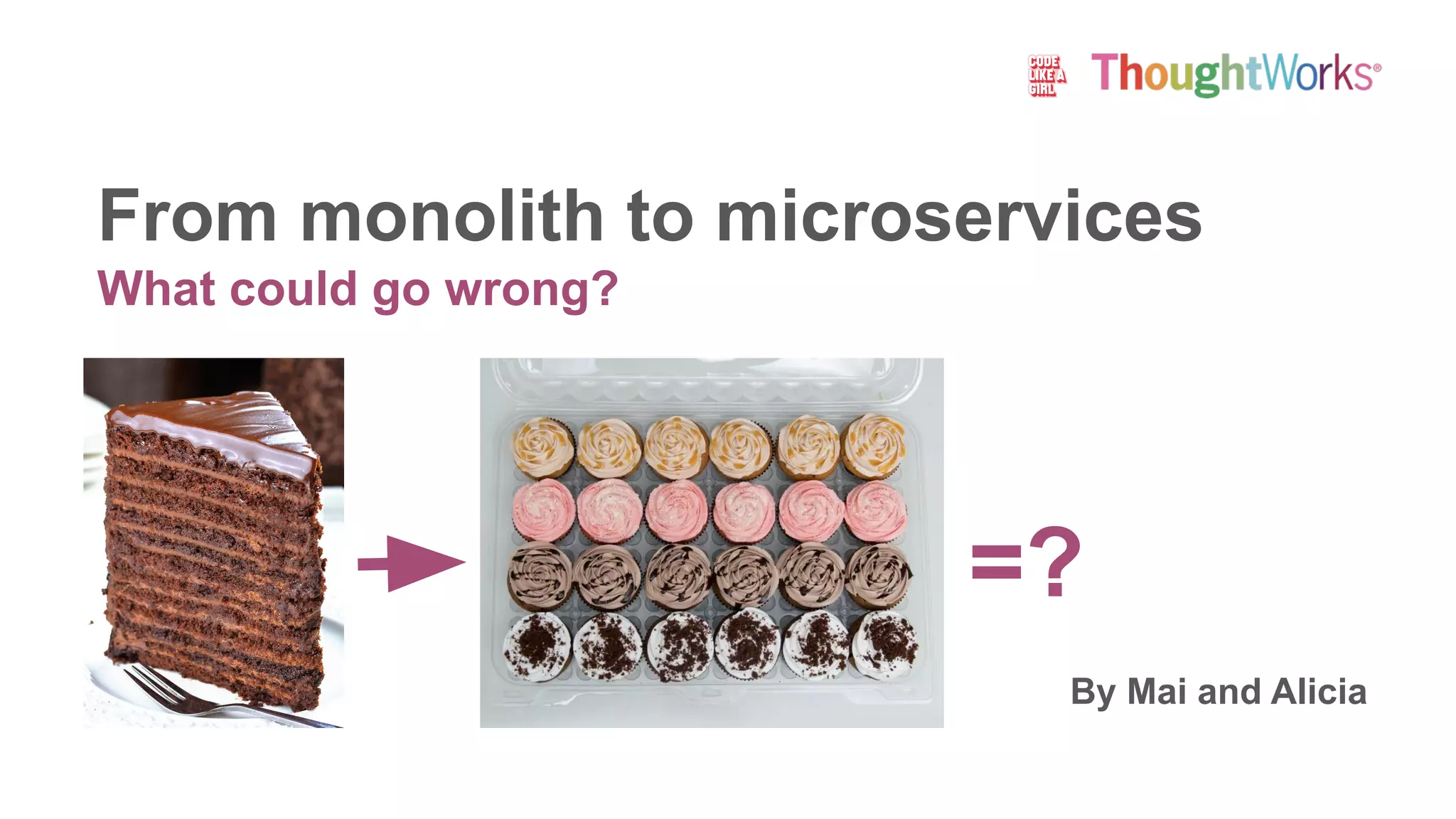
From monolith to microservices
What could go wrong?
By Mai and Alicia
=?
About us
Phuong Mai Nguyen
Consultant Developer at
ThoughtWorks
Code Like a Girl Member
Alicia Bong
Consultant Developer at
ThoughtWorks
Welcome to the
microservices
team retro!
In today’s retro, we will be addressing the
following:
1. What are microservices?
2. How did some of the migration from
monolith to microservices go?
3. What went wrong during the migration?
4. How to improve upon them?
5. Retro action points
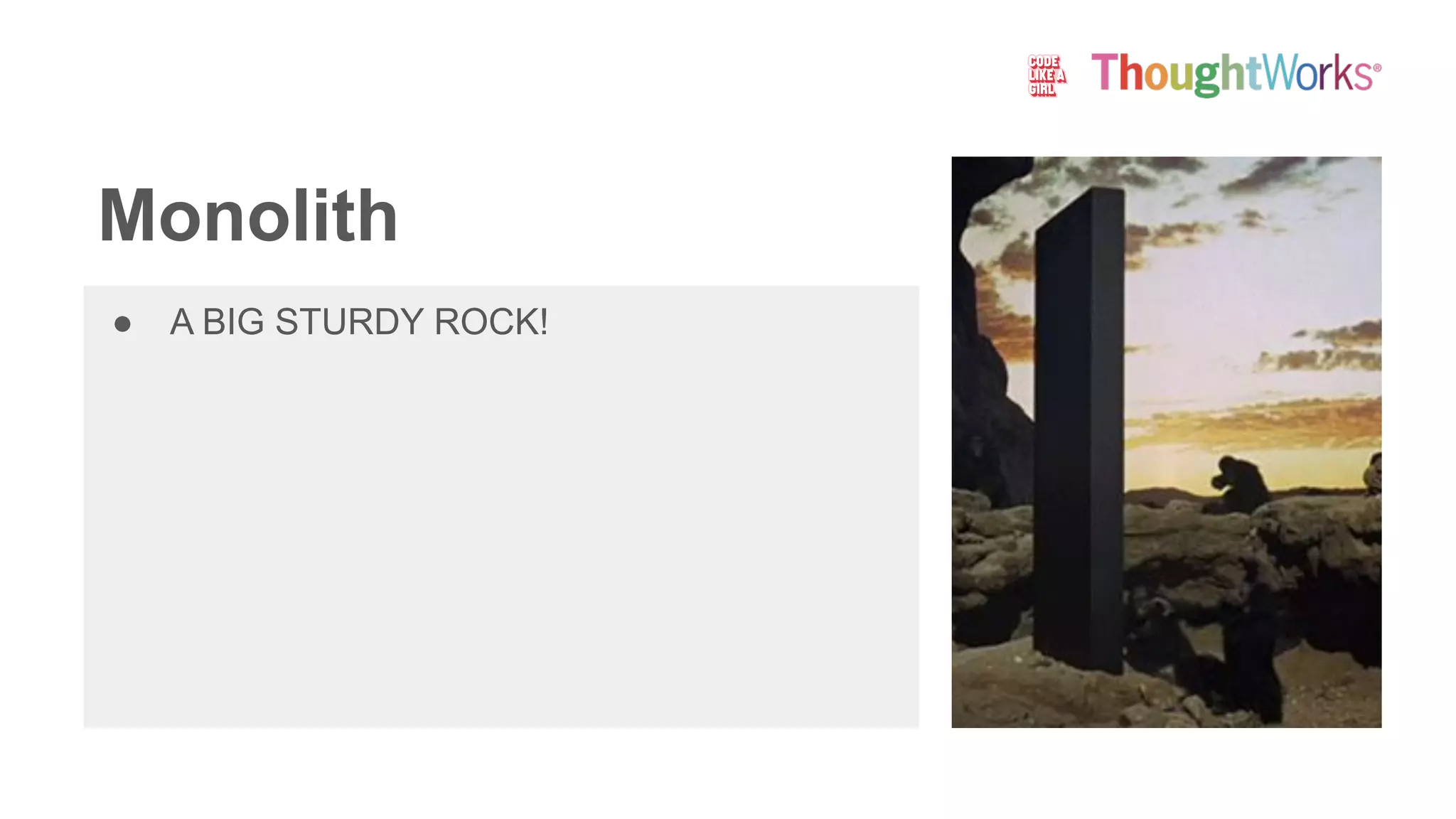
Monolith
● A BIG STURDY ROCK!
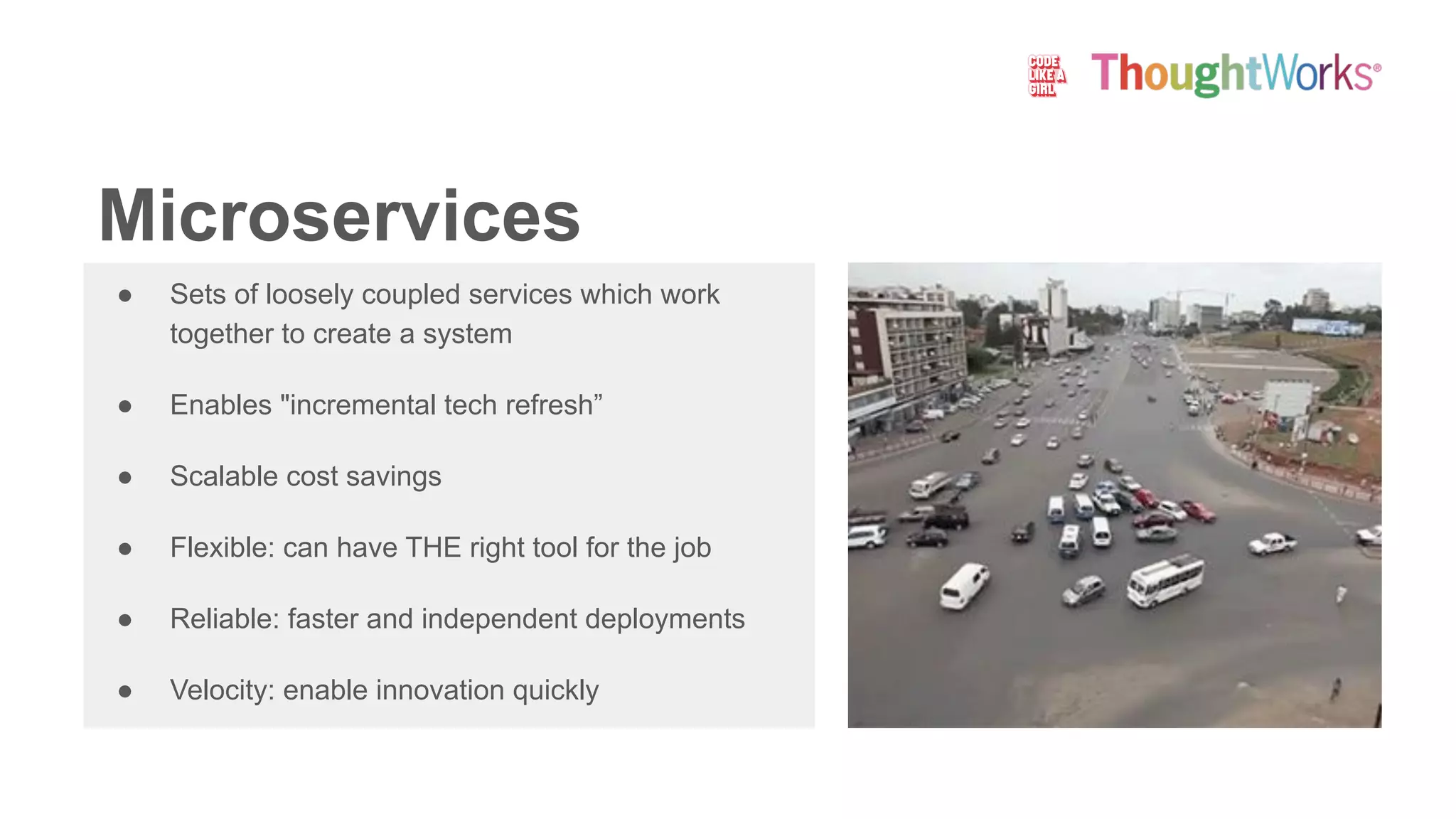
Microservices
● Sets of loosely coupled services which work
together to create a system
● Enables "incremental tech refresh”
● Scalable cost savings
● Flexible: can have THE right tool for the job
● Reliable: faster and independent deployments
● Velocity: enable innovation quickly
Migrating from monolith to
microservices
“You cannot learn without making
mistakes. Thankfully, there are others
who have made mistakes and we can
learn from them.”
Cool, so microservices
are awesome, let’s all
go today and change
our app to
microservice, shall
we?
It’s not as easy as it
sounds.
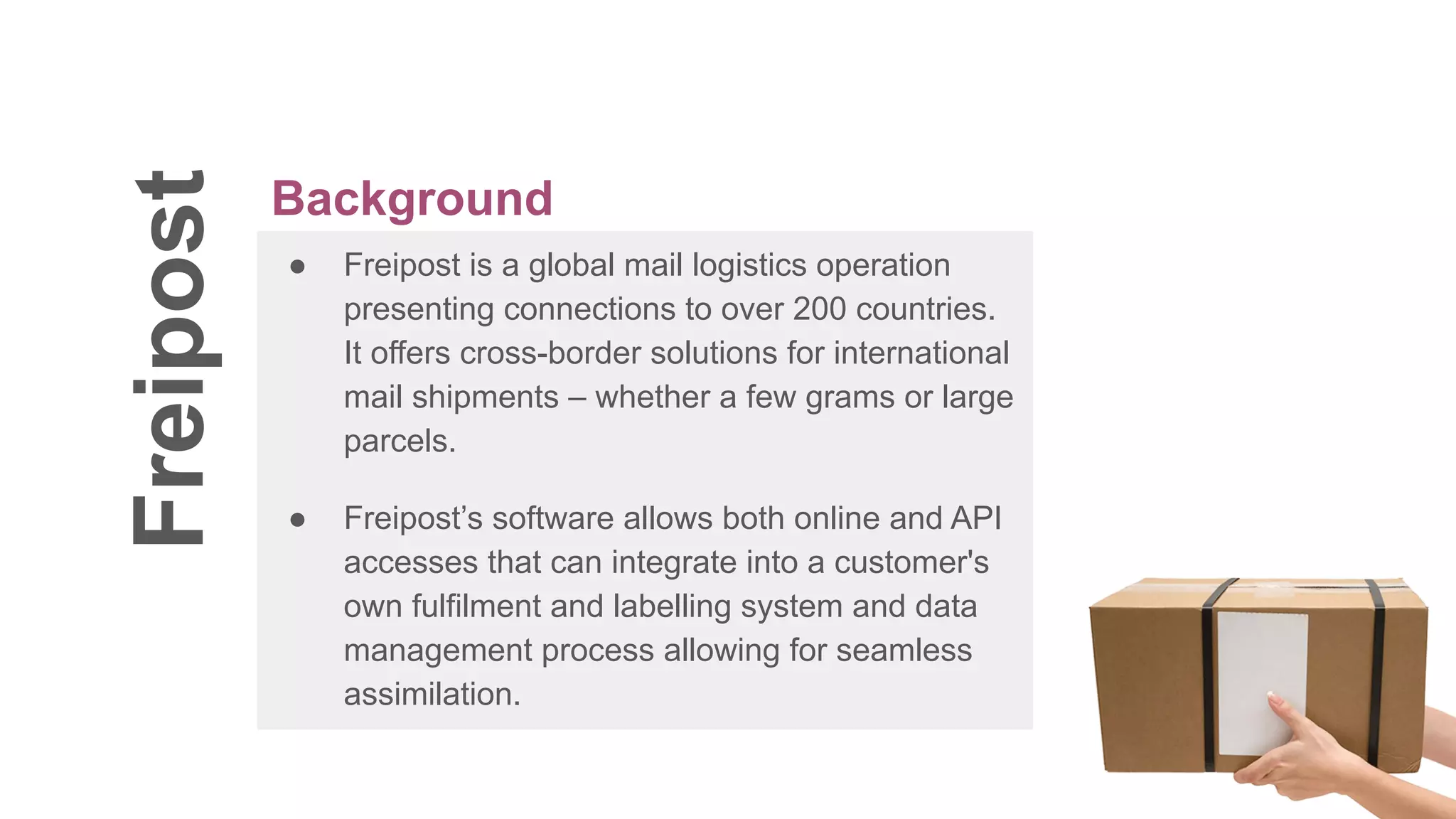
Freipost
● Freipost is a global mail logistics operation
presenting connections to over 200 countries.
It offers cross-border solutions for international
mail shipments – whether a few grams or large
parcels.
● Freipost’s software allows both online and API
accesses that can integrate into a customer's
own fulfilment and labelling system and data
management process allowing for seamless
assimilation.

Background
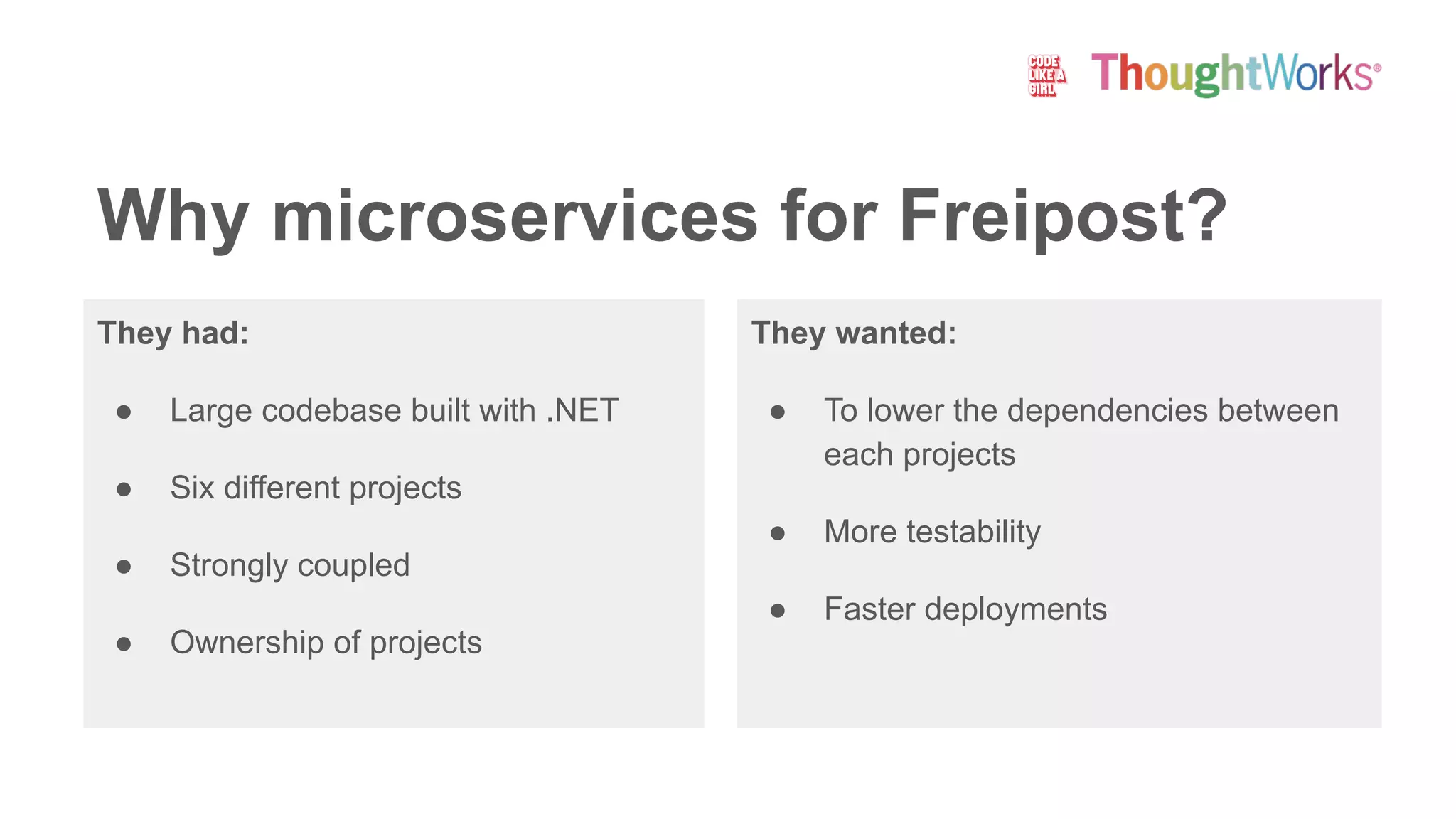
They had:
● Large codebase built with .NET
● Six different projects
● Strongly coupled
● Ownership of projects
They wanted:
● To lower the dependencies between
each projects
● More testability
● Faster deployments
Why microservices for Freipost?
1. BAU as a distractor
● Single team was tasked with dealing with both BAU and extracting monolith to
microservices.
● BAU is a never-ending rabbit hole
● Will you concentrate on BAU or try to finish extracting your microservices?
What went wrong
1. BAU as a distractor
● Single team was tasked with dealing with both BAU and extracting monolith to
microservices.
● BAU is a never-ending rabbit hole
● Will you concentrate on BAU or try to finish extracting your microservices?
What went wrong
Separate
responsibilities
● Have different teams and resources
that don't overlap with BAU and
developing new features.
● Again, one thing at a time.
How to improve
Don’t add new
features while extracting
What went wrong
2. Trying to be cool and take out the most
complicated first!
● Would you take the hardest, complex part and convert it to microservice?
● Would you take the least impactful part and convert?
● Would you take the most important part and convert first?
Start with a simple capability with fewer
dependencies
● “Do something you believe you can do in 3 months.” (Evan Bottcher)
● By starting small, your team will start shaking off patterns and potential issues in
the new architecture. Start defining a dev process, CI/CD and release cadence.
● Use Domain-Driven Design to help separate monolithic applications into multiple
standalone service applications or develop them separately from the beginning with
the help of bounded contexts.
How to improve
Carsales
● Australia’s number one online classifieds
network for cars, bikes, boats, industry
machinery and equipment. Anyone here
been to our website before?
● Around 200 developers, QA engineers,
DevOps engineers in total.
● Three main platforms - Desktop, Mobi and
App
Background
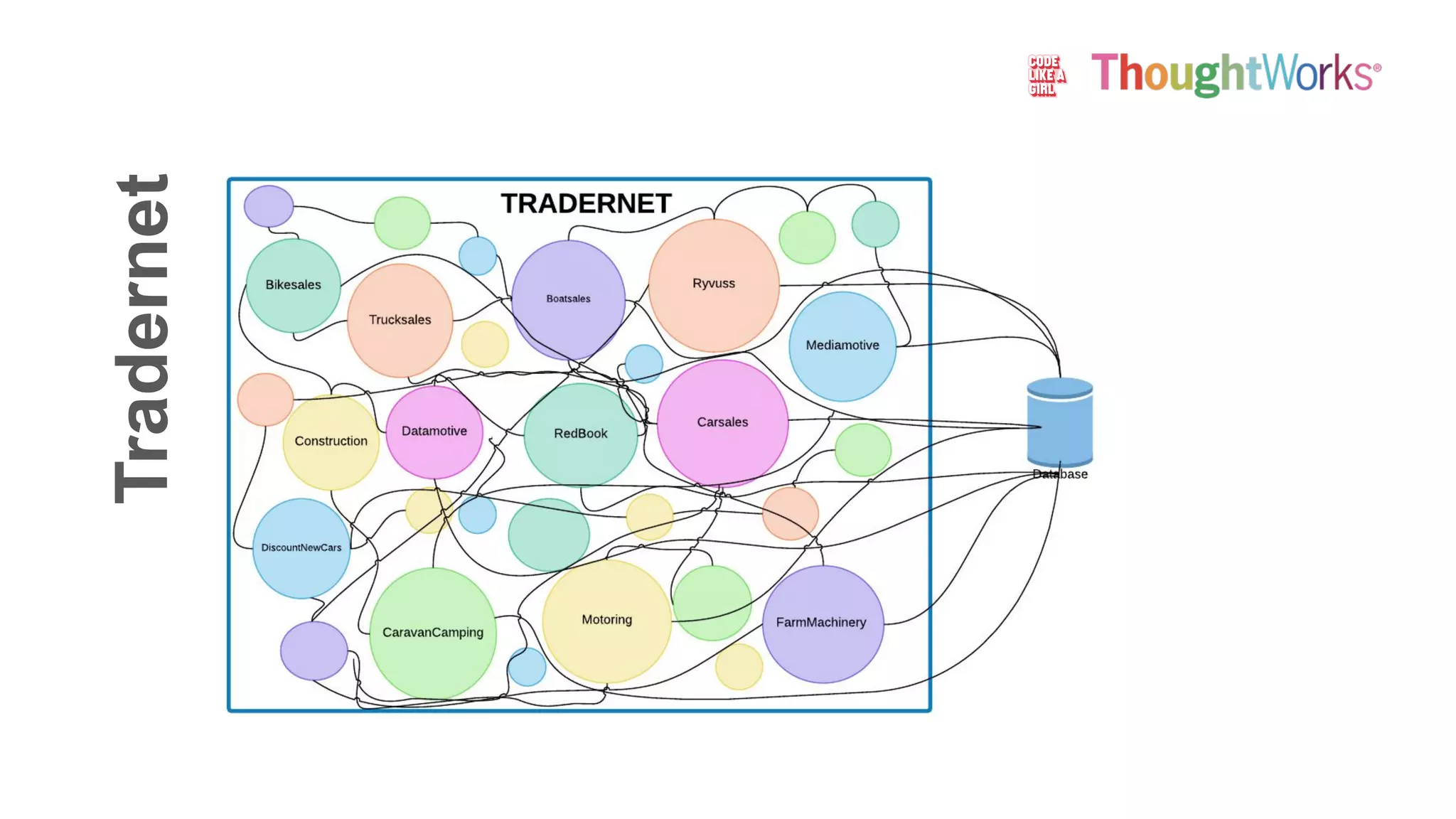
Tradernet
● Developers unhappy with the sheer size of code
● Release process took weeks to plan and test
● Deployments around 2am to get it on prod by 6am
● Rollbacks were similar too!
● Want a new feature? It may take some time (like a few months…)
Why microservices for Carsales?
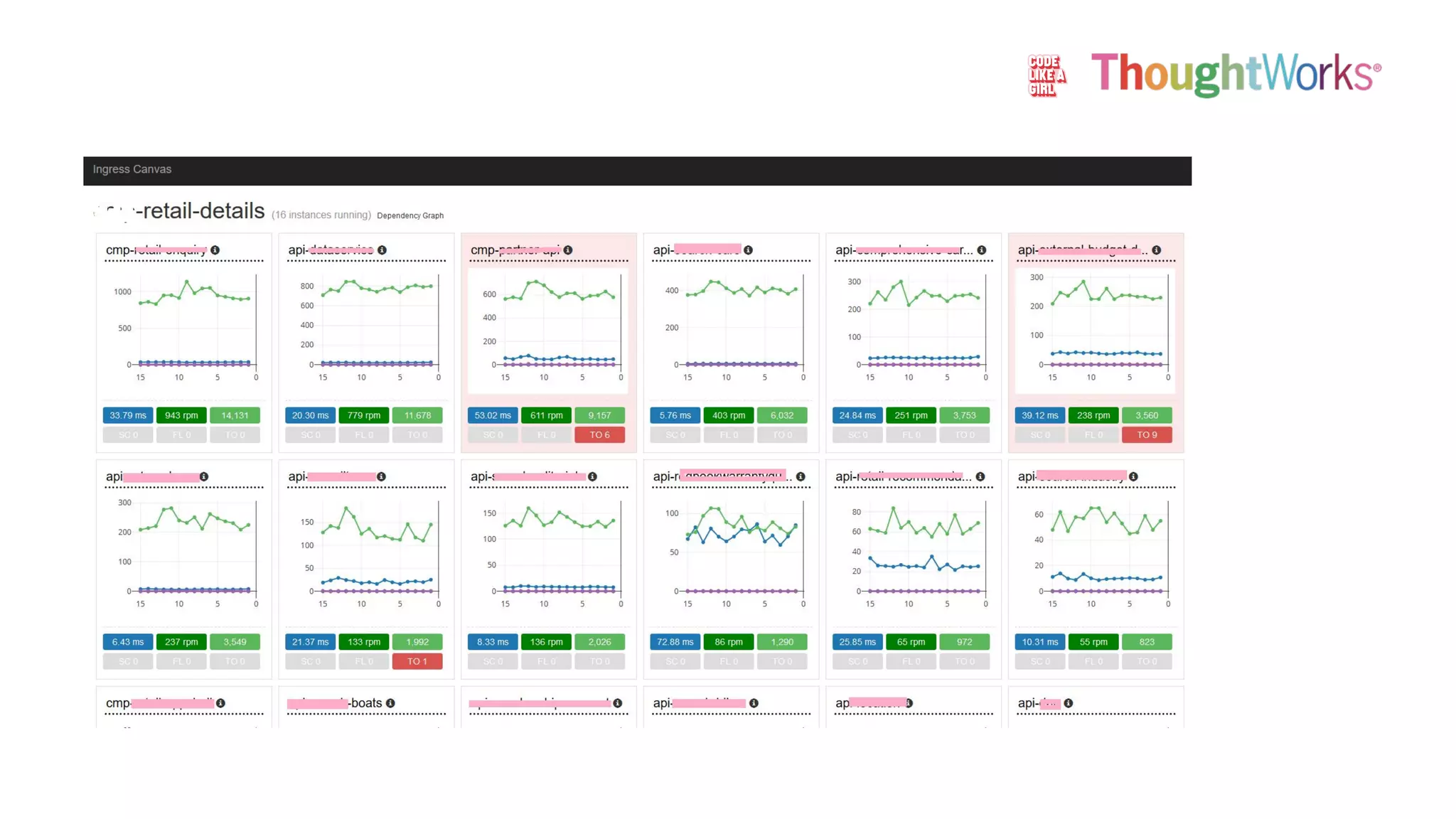
3. Lack of observability
What went wrong
● How do you know if your deployment was a success?
● How do you tell if something goes wrong among your few
hundred microservices?
● How do you debug the nature of issues with microservices?
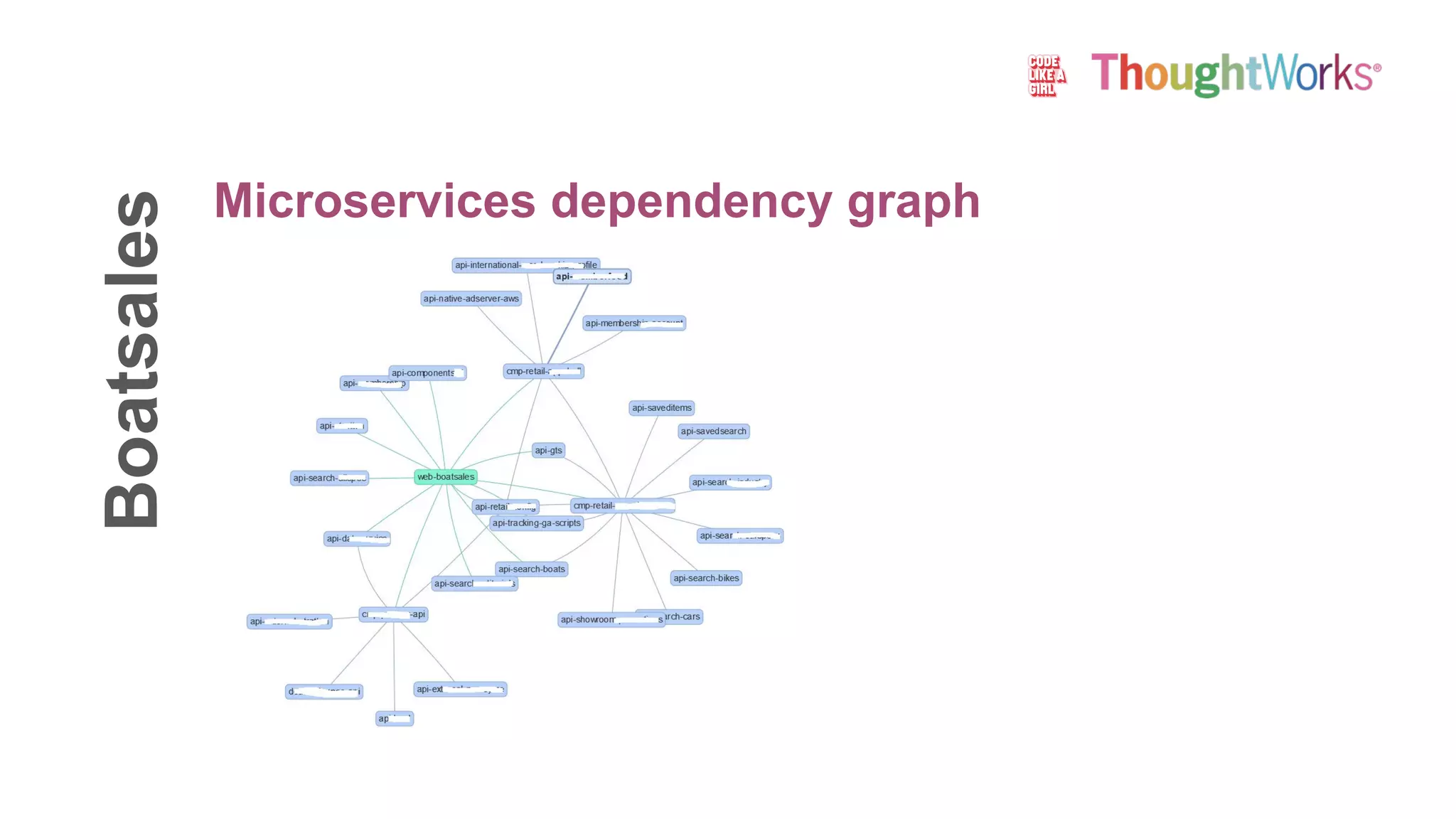
Boatsales
Microservices dependency graph
Monitoring and logging before everything else
How to improve
● Setup monitoring for each microservice and give each team
ownership of their apps
● Setup alerts and keep refining the metrics as the applications mature
● Log! Log! Log! Without logging, good luck fixing issues on cloud!
BankX
Background
● One of the biggest banks in Australia
● 30,000 employees
● 2500 developers
● Over 9 million customers around the
world
● The monolithic system has a lot of system dependencies. Whenever there is a new
release, the whole system will be tested. This requires a huge operational cost.
● This kind of setting also requires team members understand the whole system,
including all the dependencies. New team member will take a long time to
understand and contribute to the release.
● One of the main reasons going microservices was the need to speed up the
delivery time of features and leverage cloud technologies.
Why microservices for Bank X?
4. Semantic diffusion causes distributed
monoliths
● Chinese whispers equivalent of teams sharing what their idea of microservices are.
● Misconceptions
● Buzzwords or real use-case?
What went wrong
Understand before implementing
How to improve
● Understand not just what microservices are, but is it really for you?
● Do you have the capacity for it?
● Can your teams and management be re-arranged around new technology and
methodologies?
● Are you actually ready for it?
Let's talk about the two most enticing parts of microservices architecture:
● Ability to follow agile methodology and release at fast pace
● Fail fast, fix fast mantra
What went wrong
5. Not completely agile, not completely
waterfall
Now let's address two of the most important requirements for banks:
● Security
● Stability
What went wrong
5. Not completely agile, not completely
waterfall
Aren’t those points conflicting with each other?
● You bet!
What went wrong
5. Not completely agile, not completely
waterfall
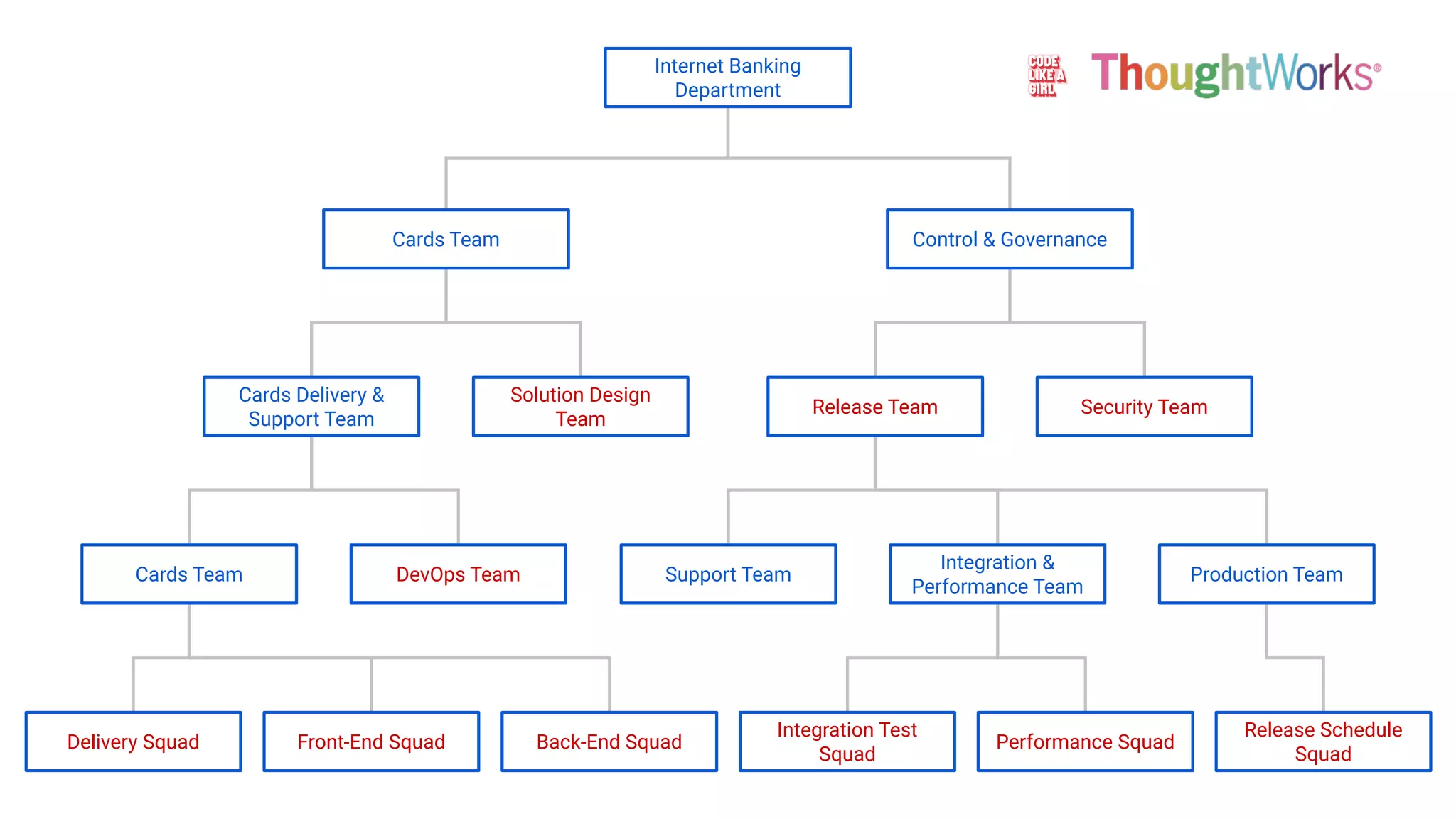
Internet Banking
Department
Cards Team Control & Governance
Security TeamRelease Team
Solution Design
Team
Cards Delivery &
Support Team
Integration &
Performance Team
Support TeamDevOps TeamCards Team Production Team
Integration Test
Squad
Back-End SquadFront-End SquadDelivery Squad Performance Squad
Release Schedule
Squad
Evolve your team to suit your architecture
● Conway's Law asserts that organizations are constrained to produce application
designs which are copies of their communication structures. This often leads to
unintended friction points.
● The 'Inverse Conway Maneuver' recommends evolving your team and
organizational structure to promote your desired architecture. Ideally your
technology architecture will display isomorphism with your business architecture.
How to improve
Evolve your team to suit your architecture
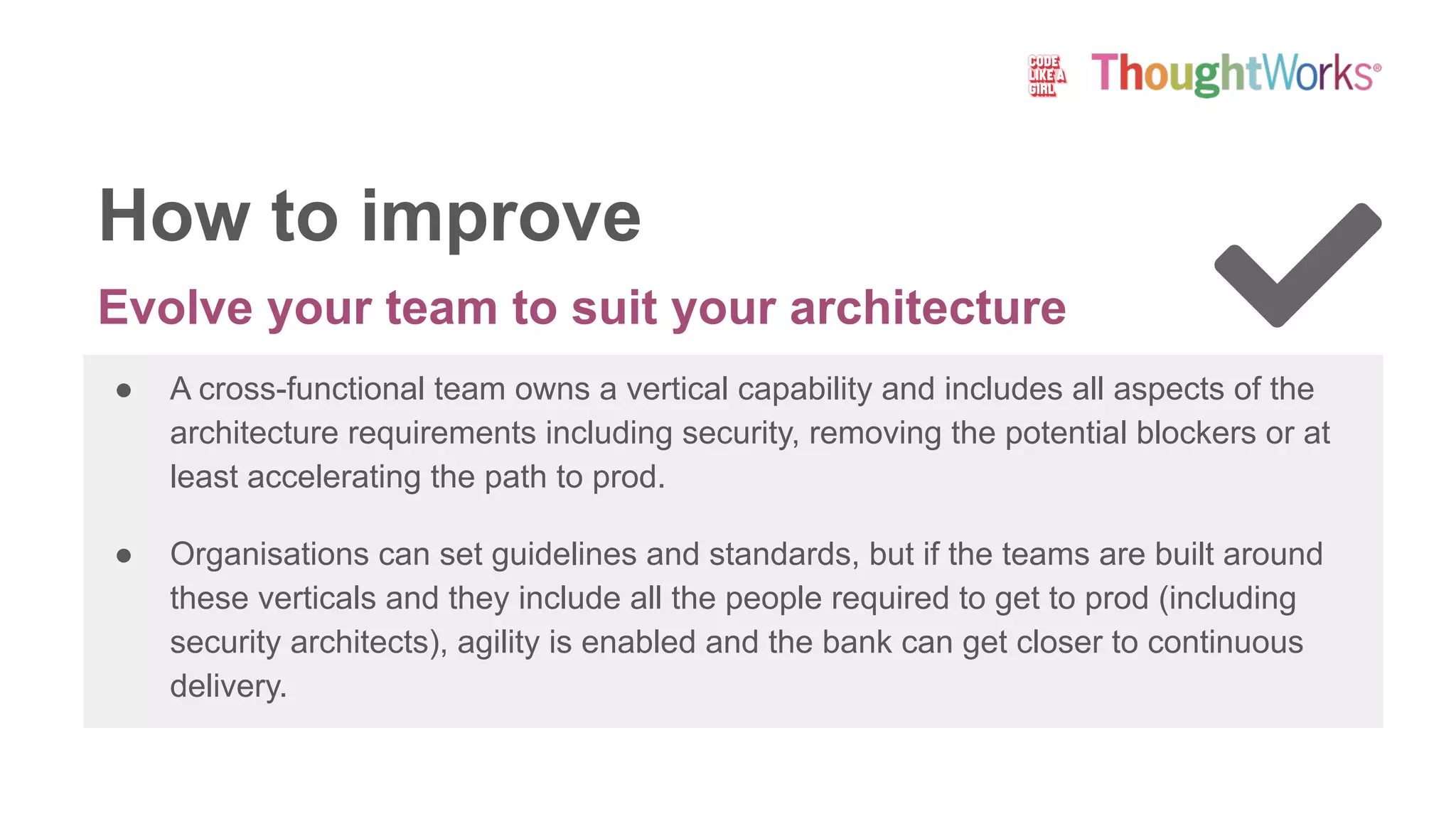
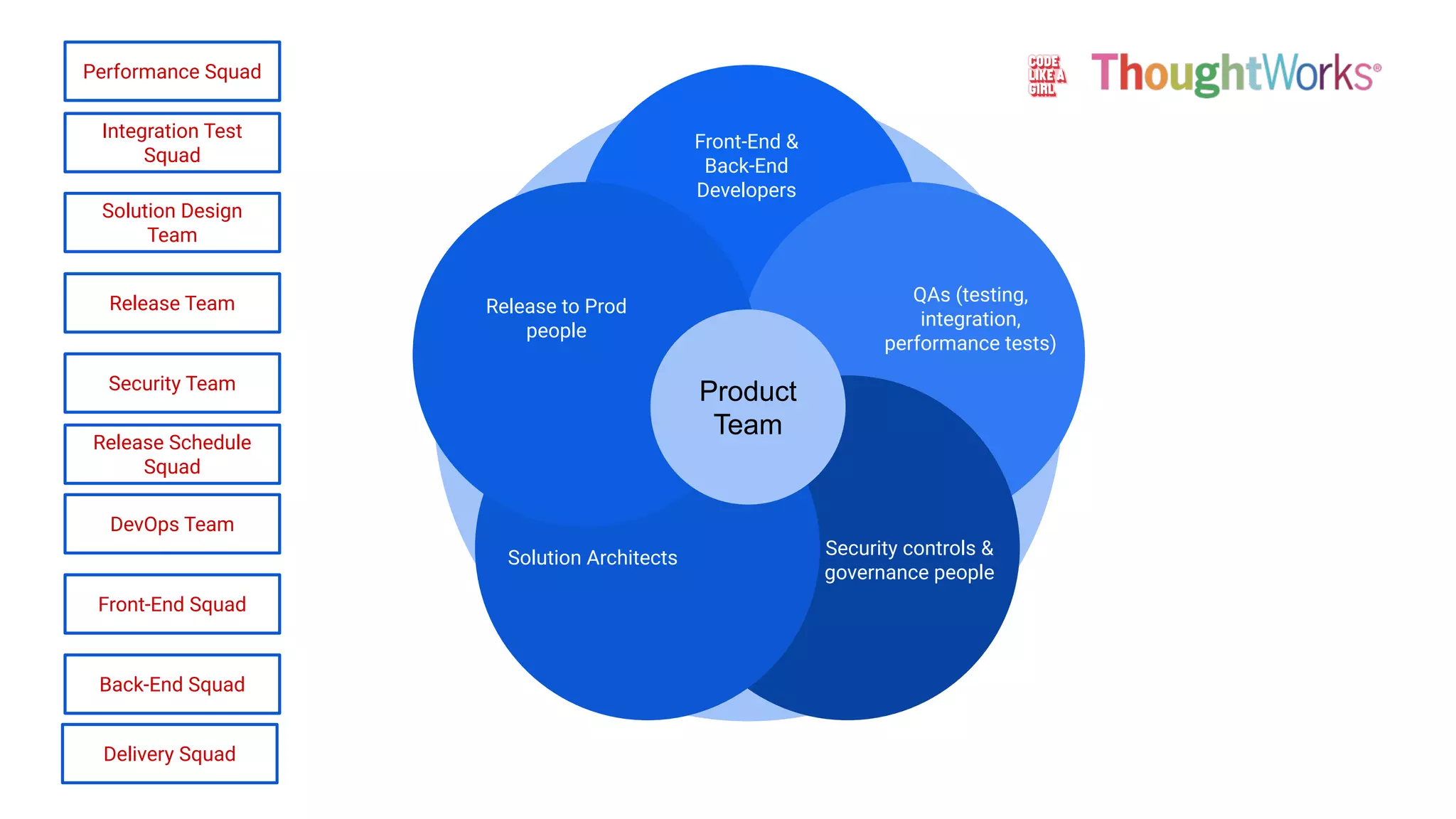
● A cross-functional team owns a vertical capability and includes all aspects of the
architecture requirements including security, removing the potential blockers or at
least accelerating the path to prod.
● Organisations can set guidelines and standards, but if the teams are built around
these verticals and they include all the people required to get to prod (including
security architects), agility is enabled and the bank can get closer to continuous
delivery.
How to improve
Security Team
Release Team
Solution Design
Team
DevOps Team
Integration Test
Squad
Back-End Squad
Front-End Squad
Delivery Squad
Performance Squad
Release Schedule
Squad
Front-End &
Back-End
Developers
QAs (testing,
integration,
performance tests)
Security controls &
governance people
Solution Architects
Release to Prod
people
Product
Team
Retro action points
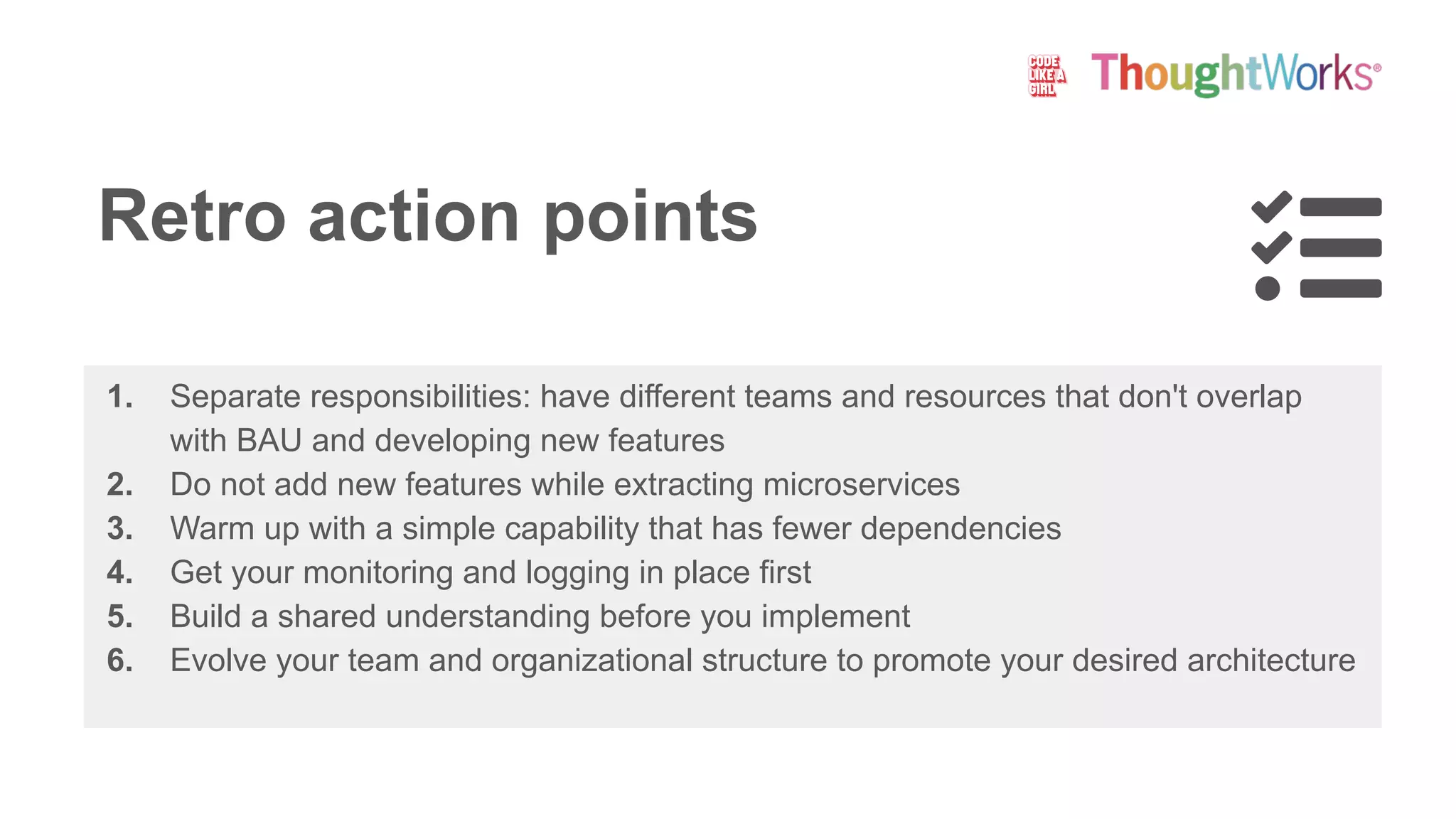
1. Separate responsibilities: have different teams and resources that don't overlap
with BAU and developing new features
2. Do not add new features while extracting microservices
3. Warm up with a simple capability that has fewer dependencies
4. Get your monitoring and logging in place first
5. Build a shared understanding before you implement
6. Evolve your team and organizational structure to promote your desired architecture
Two more points before
you start!
1. Identify your expectations with microservices
2. Make sure you are competent enough for microservices
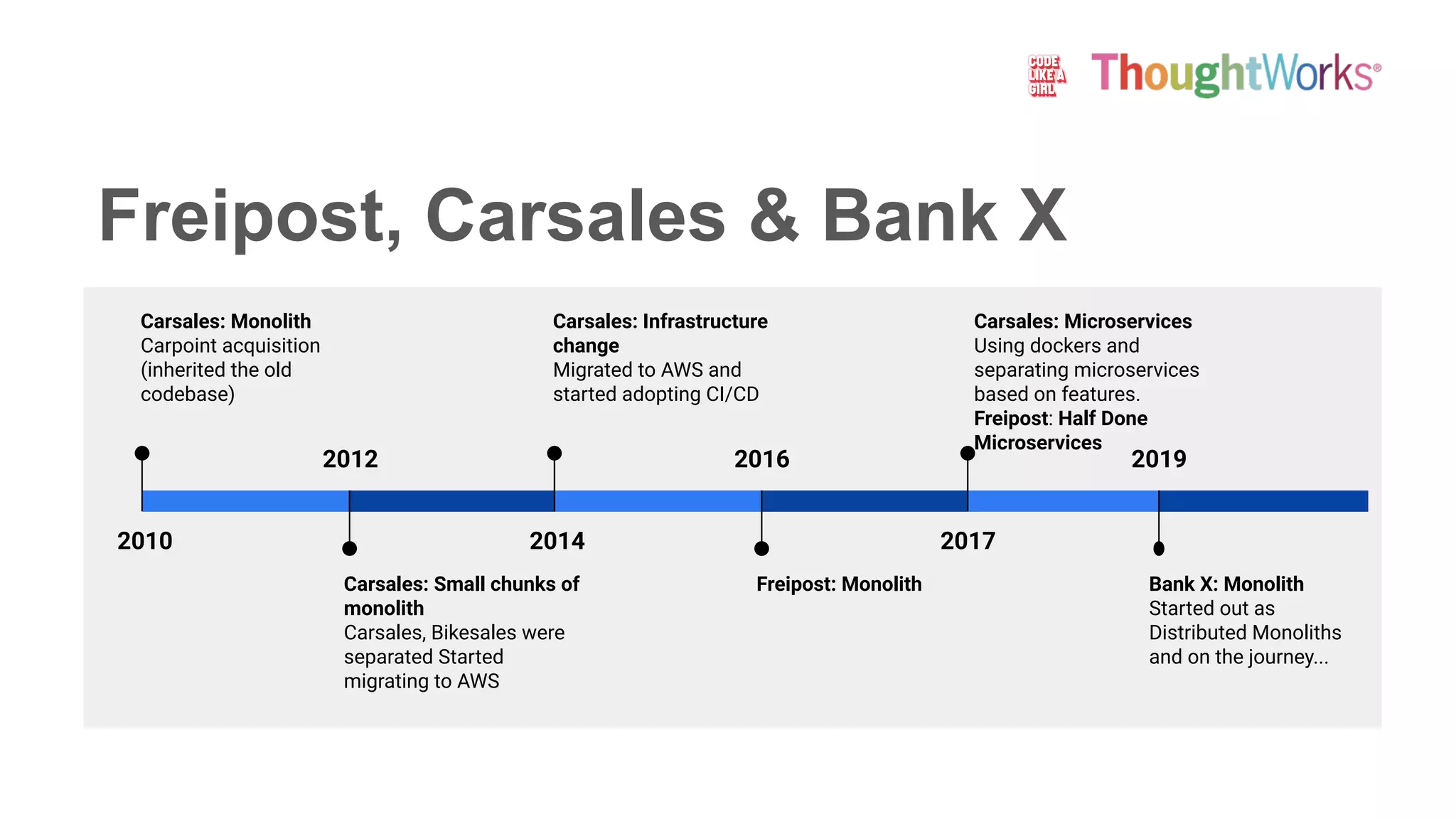
Freipost, Carsales & Bank X
2010
Carsales: Monolith
Carpoint acquisition
(inherited the old
codebase)
2012
Carsales: Small chunks of
monolith
Carsales, Bikesales were
separated Started
migrating to AWS
2014
Carsales: Infrastructure
change
Migrated to AWS and
started adopting CI/CD
2016
Freipost: Monolith
2017
Carsales: Microservices
Using dockers and
separating microservices
based on features.
Freipost: Half Done
Microservices
2019
Bank X: Monolith
Started out as
Distributed Monoliths
and on the journey...
Conclusion
● Going microservices is an EPIC journey
● You need stamina, perseverance, and grit!
● Be prepared for lots of trials and fails that could take years!
● You need to keep asking yourself: “WHY MICROSERVICES? Is it really for me?”
Thanks!
Follow us:
@mai_isthebest
https://www.linkedin.com/in/mai-isthebest/
https://www.linkedin.com/in/alicia-siau-jia-bong-91ab78116/

From Monolith to Microservices - What Could Go Wrong?

  • 1.
    From monolith tomicroservices What could go wrong? By Mai and Alicia =?
  • 2.
    About us Phuong MaiNguyen Consultant Developer at ThoughtWorks Code Like a Girl Member Alicia Bong Consultant Developer at ThoughtWorks
  • 3.
    Welcome to the microservices teamretro! In today’s retro, we will be addressing the following: 1. What are microservices? 2. How did some of the migration from monolith to microservices go? 3. What went wrong during the migration? 4. How to improve upon them? 5. Retro action points
  • 4.
    Monolith ● A BIGSTURDY ROCK!
  • 5.
    Microservices ● Sets ofloosely coupled services which work together to create a system ● Enables "incremental tech refresh” ● Scalable cost savings ● Flexible: can have THE right tool for the job ● Reliable: faster and independent deployments ● Velocity: enable innovation quickly
  • 6.
    Migrating from monolithto microservices “You cannot learn without making mistakes. Thankfully, there are others who have made mistakes and we can learn from them.” Cool, so microservices are awesome, let’s all go today and change our app to microservice, shall we? It’s not as easy as it sounds.
  • 7.
    Freipost ● Freipost isa global mail logistics operation presenting connections to over 200 countries. It offers cross-border solutions for international mail shipments – whether a few grams or large parcels. ● Freipost’s software allows both online and API accesses that can integrate into a customer's own fulfilment and labelling system and data management process allowing for seamless assimilation. Background

  • 8.
    They had: ● Largecodebase built with .NET ● Six different projects ● Strongly coupled ● Ownership of projects They wanted: ● To lower the dependencies between each projects ● More testability ● Faster deployments Why microservices for Freipost?
  • 9.
    1. BAU asa distractor ● Single team was tasked with dealing with both BAU and extracting monolith to microservices. ● BAU is a never-ending rabbit hole ● Will you concentrate on BAU or try to finish extracting your microservices? What went wrong
  • 10.
    1. BAU asa distractor ● Single team was tasked with dealing with both BAU and extracting monolith to microservices. ● BAU is a never-ending rabbit hole ● Will you concentrate on BAU or try to finish extracting your microservices? What went wrong
  • 11.
    Separate responsibilities ● Have differentteams and resources that don't overlap with BAU and developing new features. ● Again, one thing at a time. How to improve Don’t add new features while extracting
  • 12.
    What went wrong 2.Trying to be cool and take out the most complicated first! ● Would you take the hardest, complex part and convert it to microservice? ● Would you take the least impactful part and convert? ● Would you take the most important part and convert first?
  • 13.
    Start with asimple capability with fewer dependencies ● “Do something you believe you can do in 3 months.” (Evan Bottcher) ● By starting small, your team will start shaking off patterns and potential issues in the new architecture. Start defining a dev process, CI/CD and release cadence. ● Use Domain-Driven Design to help separate monolithic applications into multiple standalone service applications or develop them separately from the beginning with the help of bounded contexts. How to improve
  • 14.
    Carsales ● Australia’s numberone online classifieds network for cars, bikes, boats, industry machinery and equipment. Anyone here been to our website before? ● Around 200 developers, QA engineers, DevOps engineers in total. ● Three main platforms - Desktop, Mobi and App Background
  • 15.
  • 16.
    ● Developers unhappywith the sheer size of code ● Release process took weeks to plan and test ● Deployments around 2am to get it on prod by 6am ● Rollbacks were similar too! ● Want a new feature? It may take some time (like a few months…) Why microservices for Carsales?
  • 17.
    3. Lack ofobservability What went wrong ● How do you know if your deployment was a success? ● How do you tell if something goes wrong among your few hundred microservices? ● How do you debug the nature of issues with microservices?
  • 18.
  • 19.
    Monitoring and loggingbefore everything else How to improve ● Setup monitoring for each microservice and give each team ownership of their apps ● Setup alerts and keep refining the metrics as the applications mature ● Log! Log! Log! Without logging, good luck fixing issues on cloud!
  • 21.
    BankX Background ● One ofthe biggest banks in Australia ● 30,000 employees ● 2500 developers ● Over 9 million customers around the world
  • 22.
    ● The monolithicsystem has a lot of system dependencies. Whenever there is a new release, the whole system will be tested. This requires a huge operational cost. ● This kind of setting also requires team members understand the whole system, including all the dependencies. New team member will take a long time to understand and contribute to the release. ● One of the main reasons going microservices was the need to speed up the delivery time of features and leverage cloud technologies. Why microservices for Bank X?
  • 23.
    4. Semantic diffusioncauses distributed monoliths ● Chinese whispers equivalent of teams sharing what their idea of microservices are. ● Misconceptions ● Buzzwords or real use-case? What went wrong
  • 24.
    Understand before implementing Howto improve ● Understand not just what microservices are, but is it really for you? ● Do you have the capacity for it? ● Can your teams and management be re-arranged around new technology and methodologies? ● Are you actually ready for it?
  • 25.
    Let's talk aboutthe two most enticing parts of microservices architecture: ● Ability to follow agile methodology and release at fast pace ● Fail fast, fix fast mantra What went wrong 5. Not completely agile, not completely waterfall
  • 26.
    Now let's addresstwo of the most important requirements for banks: ● Security ● Stability What went wrong 5. Not completely agile, not completely waterfall
  • 27.
    Aren’t those pointsconflicting with each other? ● You bet! What went wrong 5. Not completely agile, not completely waterfall
  • 28.
    Internet Banking Department Cards TeamControl & Governance Security TeamRelease Team Solution Design Team Cards Delivery & Support Team Integration & Performance Team Support TeamDevOps TeamCards Team Production Team Integration Test Squad Back-End SquadFront-End SquadDelivery Squad Performance Squad Release Schedule Squad
  • 29.
    Evolve your teamto suit your architecture ● Conway's Law asserts that organizations are constrained to produce application designs which are copies of their communication structures. This often leads to unintended friction points. ● The 'Inverse Conway Maneuver' recommends evolving your team and organizational structure to promote your desired architecture. Ideally your technology architecture will display isomorphism with your business architecture. How to improve
  • 30.
    Evolve your teamto suit your architecture ● A cross-functional team owns a vertical capability and includes all aspects of the architecture requirements including security, removing the potential blockers or at least accelerating the path to prod. ● Organisations can set guidelines and standards, but if the teams are built around these verticals and they include all the people required to get to prod (including security architects), agility is enabled and the bank can get closer to continuous delivery. How to improve
  • 31.
    Security Team Release Team SolutionDesign Team DevOps Team Integration Test Squad Back-End Squad Front-End Squad Delivery Squad Performance Squad Release Schedule Squad Front-End & Back-End Developers QAs (testing, integration, performance tests) Security controls & governance people Solution Architects Release to Prod people Product Team
  • 32.
    Retro action points 1.Separate responsibilities: have different teams and resources that don't overlap with BAU and developing new features 2. Do not add new features while extracting microservices 3. Warm up with a simple capability that has fewer dependencies 4. Get your monitoring and logging in place first 5. Build a shared understanding before you implement 6. Evolve your team and organizational structure to promote your desired architecture
  • 33.
    Two more pointsbefore you start! 1. Identify your expectations with microservices 2. Make sure you are competent enough for microservices
  • 34.
    Freipost, Carsales &Bank X 2010 Carsales: Monolith Carpoint acquisition (inherited the old codebase) 2012 Carsales: Small chunks of monolith Carsales, Bikesales were separated Started migrating to AWS 2014 Carsales: Infrastructure change Migrated to AWS and started adopting CI/CD 2016 Freipost: Monolith 2017 Carsales: Microservices Using dockers and separating microservices based on features. Freipost: Half Done Microservices 2019 Bank X: Monolith Started out as Distributed Monoliths and on the journey...
  • 35.
    Conclusion ● Going microservicesis an EPIC journey ● You need stamina, perseverance, and grit! ● Be prepared for lots of trials and fails that could take years! ● You need to keep asking yourself: “WHY MICROSERVICES? Is it really for me?”
  • 36.