Recommended
PPTX
Pakistan-A-Tapestry-of-Communitides.pptx
PPTX
Land_and_People_of_Pakistan_Lecture2_2025 (1).pptx
PPTX
presentation on country: The Pakistan.pptx
PPT
Land and people of pakistan
PPTX
geo physical importance of pakistan
PPTX
geography of Pakistan.pptx
PPTX
Physical features of pakistan
DOCX
PDF
Cultural health and beliefs population and demography
PPT
Pakistan studies pak301 power point slides lecture 02
PDF
PPTX
Pakistani Society A Journey Through Time.pptx
PDF
Lec 11 Ideology and constitution of Pakistan.pdf
PPTX
GEO-political Significance of Pakistan.pptx
PPT
PPT
PPTX
Global challenges-A case study Pakistan
PPTX
Lec 1 Syllabus, Resource and Techniques.pptx
POTX
Geographyofpakistanfinal 140319145302-phpapp01
DOCX
DEVELOP VISION OF HISTORICAL PERSPECTIVE GOVERNMENT POLITICS CONTEMPORARY OF ...
DOCX
DEVELOP VISION OF HISTORICAL PERSPECTIVE GOVERNMENT POLITICS CONTEMPORARY OF ...
PPTX
Population crisis of pakistan
PDF
PDF
Pakistan Food and Agriculture Organization Country Profile Pakistan
PPTX
PDF
PDF
PPT
PDF
Rupin Banker_ Global Money Flows and Their Impact on Emerging Economies.pdf
PDF
Easily Keep Track of Your Vanilla Gift Card Balance (vanillagiftcardcheck.com)
More Related Content
PPTX
Pakistan-A-Tapestry-of-Communitides.pptx
PPTX
Land_and_People_of_Pakistan_Lecture2_2025 (1).pptx
PPTX
presentation on country: The Pakistan.pptx
PPT
Land and people of pakistan
PPTX
geo physical importance of pakistan
PPTX
geography of Pakistan.pptx
PPTX
Physical features of pakistan
DOCX
Similar to Land_and_People_of_Pakistan_Updated_2025.pptx
PDF
Cultural health and beliefs population and demography
PPT
Pakistan studies pak301 power point slides lecture 02
PDF
PPTX
Pakistani Society A Journey Through Time.pptx
PDF
Lec 11 Ideology and constitution of Pakistan.pdf
PPTX
GEO-political Significance of Pakistan.pptx
PPT
PPT
PPTX
Global challenges-A case study Pakistan
PPTX
Lec 1 Syllabus, Resource and Techniques.pptx
POTX
Geographyofpakistanfinal 140319145302-phpapp01
DOCX
DEVELOP VISION OF HISTORICAL PERSPECTIVE GOVERNMENT POLITICS CONTEMPORARY OF ...
DOCX
DEVELOP VISION OF HISTORICAL PERSPECTIVE GOVERNMENT POLITICS CONTEMPORARY OF ...
PPTX
Population crisis of pakistan
PDF
PDF
Pakistan Food and Agriculture Organization Country Profile Pakistan
PPTX
PDF
PDF
PPT
Recently uploaded
PDF
Rupin Banker_ Global Money Flows and Their Impact on Emerging Economies.pdf
PDF
Easily Keep Track of Your Vanilla Gift Card Balance (vanillagiftcardcheck.com)
PDF
Index Monitoring & Analysis – TASI, MT30 & Sukuk Report .pdf
PPTX
10x Your Gold & Forex Trading in 2026 with AI Algo Trading
PPTX
TRIPS Agreement: Objectives, Features and the Global Waiver Debate
PDF
PERSONAL INCOME CALCULATOR.pdf "Personal Income Calculator Sheet – Track Your...
PDF
EXPENSES TRACKER.pdf "Expenses Tracker – Organize and Manage Your Monthly Bud...
DOCX
Best 17 Sites to Buy Verified Coinbase Accounts With the New Year.docx
PDF
The Language of Trust_ Why Transparency Matters in Finance by Michael Christo...
PPTX
Teenagers Training Academy(TTA) Feasibility Study
PDF
The Ultimate Guide to Buying Verified PayPal Accounts Safely.pdf
PDF
EXFUSION - NEO.FX - english – Forex – Copy Trading – TAG Markets – Affiliate
PDF
GenerationAI Paris 2025 | How a CFO Can Get ROI with GenAI.pdf
DOCX
The Best Platforms to Buy Verified Chime Bank Accounts.docx
PPTX
Taxation on Alternate Investment Funds in India.pptx
DOCX
Buy Verified Venmo Accounts – Your Gateway to Seamless ....docx
PDF
Financial Inclusion of Selected SME Clusters: a Case study of Light Engineering
PDF
Class 12 economics project on disinvestment policy of the government (instagr...
PDF
606317613222222-Nep-2020-Final-Ppt-1.pdf
DOCX
Technical Audit Report: DIVEXA Infrastructure Analysis
Land_and_People_of_Pakistan_Updated_2025.pptx 1. Land and People of Pakistan
Updated University Lecture (2025)
By Bilal Saeed
2. Introduction
• • Definition and scope of the topic
• • Importance of geography and demography
in Pakistan
• • Relationship between land, resources, and
people
• • Relevance in contemporary issues (CPEC,
climate change, urbanization)
3. Physical Geography of Pakistan
• • Geostrategic position (South Asia, Central
Asia, Middle East)
• • Physiographic Divisions:
• - Northern Mountains (Karakoram,
Himalayas, Hindu Kush, K2)
• - Western Highlands (Sulaiman, Kirthar,
Balochistan Plateau)
• - Indus Plain (agricultural hub)
• - Coastal Areas (Karachi, Gwadar)
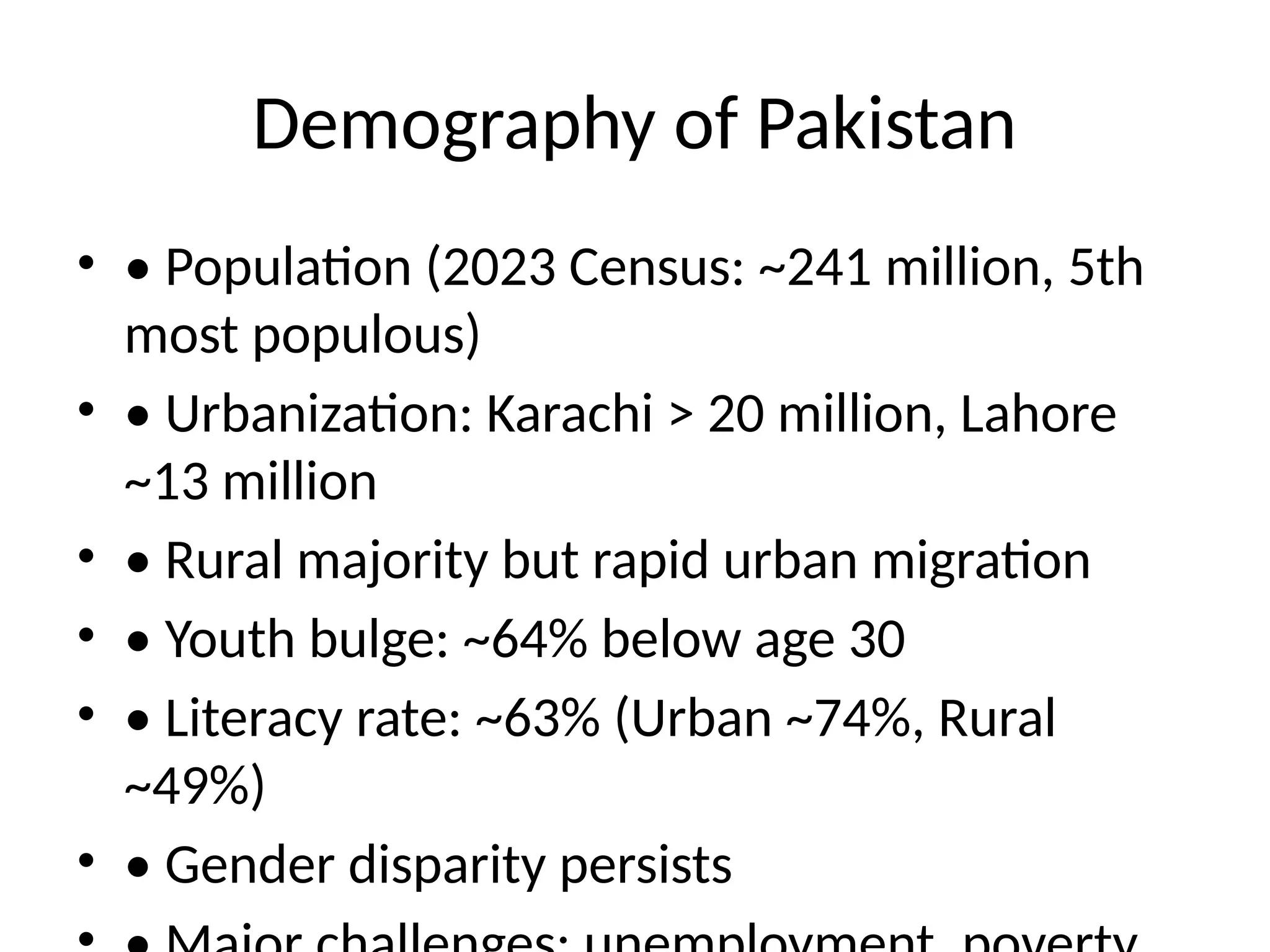
4. Demography of Pakistan
• • Population (2023 Census: ~241 million, 5th
most populous)
• • Urbanization: Karachi > 20 million, Lahore
~13 million
• • Rural majority but rapid urban migration
• • Youth bulge: ~64% below age 30
• • Literacy rate: ~63% (Urban ~74%, Rural
~49%)
• • Gender disparity persists
5. Ethnic, Linguistic, and Cultural
Diversity
• • Major Ethnic Groups:
• - Punjabis (44%), Pashtuns (15%), Sindhis
(14%), Saraikis (8%), Baloch (4%), Muhajirs
(7%)
• • Languages: Urdu (national), English (official),
Punjabi, Sindhi, Pashto, Balochi, Saraiki
• • Cultural heritage: Mohenjo-Daro, Taxila,
Lahore Fort, Makli Tombs
• • Folk traditions: music, poetry, crafts, cuisine
6. Historical Context
• • Indus Valley Civilization (Mohenjo-Daro,
Harappa)
• • Gandhara Civilization (Taxila, Buddhist
heritage)
• • Islamic conquests and Mughal culture
• • Colonial period: land revenue, migration,
urban centers
• • 1947 Partition: massive migration reshaping
demographics
7. Contemporary Issues
• • Geo-strategic importance (CPEC, Gwadar,
Afghan border)
• • Environmental challenges: floods (2022),
glacial melt, droughts
• • Population growth pressure
• • Ethnic diversity and integration challenges
• • Economic struggles: trade deficit, inflation,
IMF programs
8. Conclusion
• • Pakistan’s geography and people are sources
of both strength and challenge
• • Land shapes livelihoods; people shape
culture and politics
• • National unity depends on managing
diversity and resources
• • Future depends on sustainable
development, inclusive growth, and education