Early interventions with reno-
protective therapies in
Hypertension
Case-based discussion
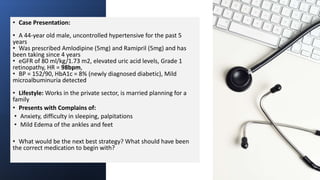
• Case Presentation:
• A 44-year old male, uncontrolled hypertensive for the past 5
years
• Was prescribed Amlodipine (5mg) and Ramipril (5mg) and has
been taking since 4 years
• eGFR of 80 ml/kg/1.73 m2, elevated uric acid levels, Grade 1
retinopathy, HR = 98bpm,
• BP = 152/90, HbA1c = 8% (newly diagnosed diabetic), Mild
microalbuminuria detected
• Lifestyle: Works in the private sector, is married planning for a
family
• Presents with Complains of:
• Anxiety, difficulty in sleeping, palpitations
• Mild Edema of the ankles and feet
• What would be the next best strategy? What should have been
the correct medication to begin with?
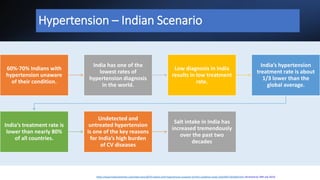
Hypertension – Indian Scenario
https://www.hindustantimes.com/india-news/6070-indians-with-hypertension-unaware-of-their-condition-study-101629971301949.html (Accessed on 29th July 2022)
60%-70% Indians with
hypertension unaware
of their condition.
India has one of the
lowest rates of
hypertension diagnosis
in the world.
Low diagnosis in India
results in low treatment
rate.
India’s hypertension
treatment rate is about
1/3 lower than the
global average.
India’s treatment rate is
lower than nearly 80%
of all countries.
Undetected and
untreated hypertension
is one of the key reasons
for India’s high burden
of CV diseases
Salt intake in India has
increased tremendously
over the past two
decades
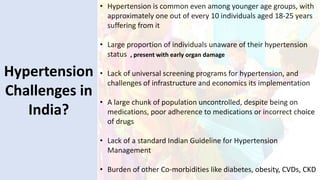
Hypertension
Challenges in
India?
• Hypertension is common even among younger age groups, with
approximately one out of every 10 individuals aged 18-25 years
suffering from it
• Large proportion of individuals unaware of their hypertension
status
• Lack of universal screening programs for hypertension, and
challenges of infrastructure and economics its implementation
• A large chunk of population uncontrolled, despite being on
medications, poor adherence to medications or incorrect choice
of drugs
• Lack of a standard Indian Guideline for Hypertension
Management
• Burden of other Co-morbidities like diabetes, obesity, CVDs, CKD
, present with early organ damage
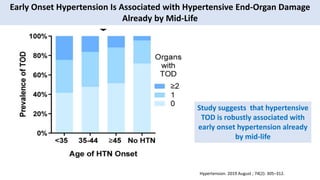
Hypertension. 2019 August ; 74(2): 305–312.
Study suggests that hypertensive
TOD is robustly associated with
early onset hypertension already
by mid-life
Early Onset Hypertension Is Associated with Hypertensive End-Organ Damage
Already by Mid-Life
Concerns in this case:
•Patient is: Uncontrolled Hypertensive (152/98 mmHg)
on ABPM despite being on 2 antihypertensives
[Lisinopril(5mg) and Amlodipine (5mg)]
•Grade 1 retinopathy – indicative of end-organ damage ,
also suggestive from eGFR and microalbuminuria
•Patient complains of: High HR, Anxiety, nervousness,
Palpitations – signs of sympathetic overdrive
•Elevated uric acid levels
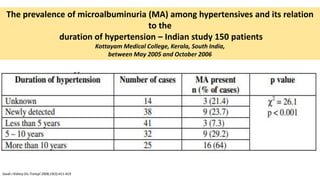
The prevalence of microalbuminuria (MA) among hypertensives and its relation
to the
duration of hypertension – Indian study 150 patients
Kottayam Medical College, Kerala, South India,
between May 2005 and October 2006
Saudi J Kidney Dis Transpl 2008;19(3):411-419
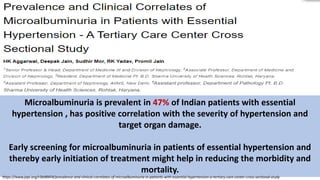
Microalbuminuria is prevalent in 47% of Indian patients with essential
hypertension , has positive correlation with the severity of hypertension and
target organ damage.
Early screening for microalbuminuria in patients of essential hypertension and
thereby early initiation of treatment might help in reducing the morbidity and
mortality.
https://www.japi.org/r2b48454/prevalence-and-clinical-correlates-of-microalbuminuria-in-patients-with-essential-hypertension-a-tertiary-care-center-cross-sectional-study
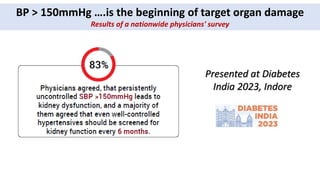
BP > 150mmHg ….is the beginning of target organ damage
Results of a nationwide physicians' survey
Presented at Diabetes
India 2023, Indore
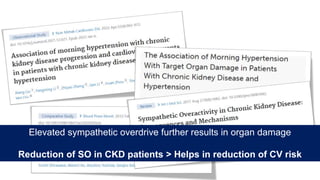
Elevated sympathetic overdrive further results in organ damage
Reduction of SO in CKD patients > Helps in reduction of CV risk
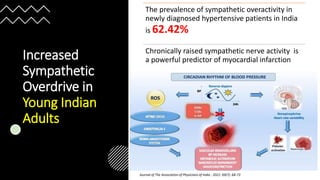
Increased
Sympathetic
Overdrive in
Young Indian
Adults
The prevalence of sympathetic overactivity in
newly diagnosed hypertensive patients in India
is 62.42%
Chronically raised sympathetic nerve activity is
a powerful predictor of myocardial infarction
Journal of The Association of Physicians of India : 2021: 69(7): 68-73
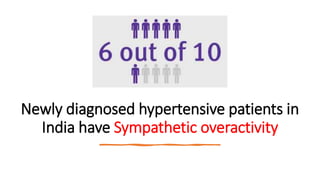
Newly diagnosed hypertensive patients in
India have Sympathetic overactivity
Reno-protective therapies for Organ Protection in
Hypertension
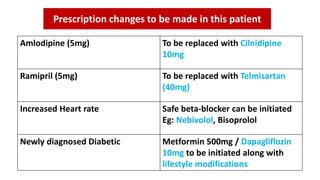
Amlodipine (5mg) To be replaced with Cilnidipine
10mg
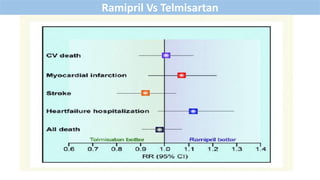
Ramipril (5mg) To be replaced with Telmisartan
(40mg)
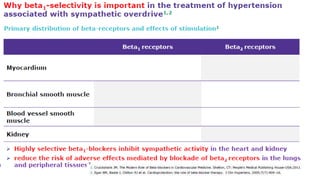
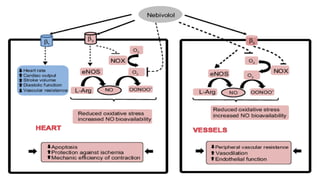
Increased Heart rate Safe beta-blocker can be initiated
Eg: Nebivolol, Bisoprolol
Newly diagnosed Diabetic Metformin 500mg / Dapagliflozin
10mg to be initiated along with
lifestyle modifications
Prescription changes to be made in this patient
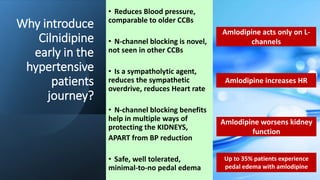
Why introduce
Cilnidipine
early in the
hypertensive
patients
journey?
• Reduces Blood pressure,
comparable to older CCBs
• N-channel blocking is novel,
not seen in other CCBs
• Is a sympatholytic agent,
reduces the sympathetic
overdrive, reduces Heart rate
• N-channel blocking benefits
help in multiple ways of
protecting the KIDNEYS,
APART from BP reduction
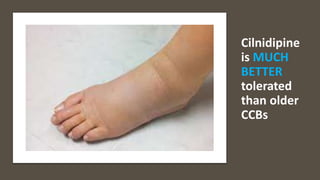
• Safe, well tolerated,
minimal-to-no pedal edema
Amlodipine increases HR
Amlodipine acts only on L-
channels
Amlodipine worsens kidney
function
Up to 35% patients experience
pedal edema with amlodipine
16
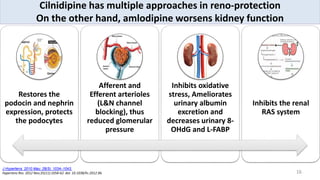
Restores the
podocin and nephrin
expression, protects
the podocytes
Afferent and
Efferent arterioles
(L&N channel
blocking), thus
reduced glomerular
pressure
Inhibits oxidative
stress, Ameliorates
urinary albumin
excretion and
decreases urinary 8-
OHdG and L-FABP
Inhibits the renal
RAS system
Cilnidipine has multiple approaches in reno-protection
On the other hand, amlodipine worsens kidney function
J Hypertens. 2010 May; 28(5): 1034–1043.
Hypertens Res. 2012 Nov;35(11):1058-62. doi: 10.1038/hr.2012.96.
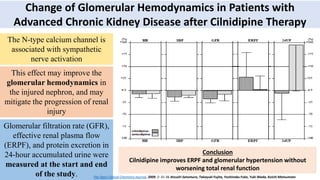
Change of Glomerular Hemodynamics in Patients with
Advanced Chronic Kidney Disease after Cilnidipine Therapy
The N-type calcium channel is
associated with sympathetic
nerve activation
This effect may improve the
glomerular hemodynamics in
the injured nephron, and may
mitigate the progression of renal
injury
Glomerular filtration rate (GFR),
effective renal plasma flow
(ERPF), and protein excretion in
24-hour accumulated urine were
measured at the start and end
of the study.
Systolic blood pressure 
from 80 % from baseline
ERPF  to 127 % of the level
at baseline
Glomerular capillary
pressure on single nephron
was  to 90 %
Renal vascular resistance
ratio (RA/RE) on single
nephron improved to 120 %
Total GFR  within the non-
statistical range
Conclusion
Cilnidipine improves ERPF and glomerular hypertension without
worsening total renal function
The Open Clinical Chemistry Journal, 2009, 2: 31-36 Atsushi Satomura, Takayuki Fujita, Yoshinobu Fuke, Yuki Wada, Koichi Matsumoto
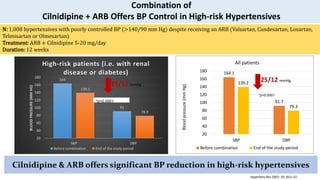
164
91
139.1
78.9
20
40
60
80
100
120
140
160
180
SBP DBP
BLOOD
PRESSURE
(MM
HG)
High-risk patients (i.e. with renal
disease or diabetes)
Before combination End of the study period
164.1
91.7
139.2
79.3
20
40
60
80
100
120
140
160
180
SBP DBP
Blood
pressure
(mm
Hg)
All patients
Before combination End of the study period
*p<0.0001
*p<0.0001
Hypertens Res 2007; 30: 815–22
N: 1,008 hypertensives with poorly controlled BP (>140/90 mm Hg) despite receiving an ARB (Valsartan, Candesartan, Losartan,
Telmisartan or Olmesartan)
Treatment: ARB + Cilnidipine 5-20 mg/day
Duration: 12 weeks
Cilnidipine & ARB offers significant BP reduction in high-risk hypertensives
25/12 mmHg
25/12 mmHg
Combination of
Cilnidipine + ARB Offers BP Control in High-risk Hypertensives
Cilnidipine
is MUCH
BETTER
tolerated
than older
CCBs
20
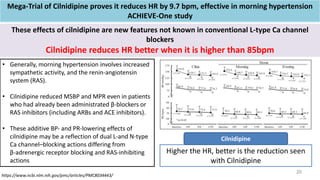
Mega-Trial of Cilnidipine proves it reduces HR by 9.7 bpm, effective in morning hypertension
ACHIEVE-One study
These effects of cilnidipine are new features not known in conventional L‐type Ca channel
blockers
Cilnidipine reduces HR better when it is higher than 85bpm
• Generally, morning hypertension involves increased
sympathetic activity, and the renin‐angiotensin
system (RAS).
• Cilnidipine reduced MSBP and MPR even in patients
who had already been administrated β‐blockers or
RAS inhibitors (including ARBs and ACE inhibitors).
• These additive BP‐ and PR‐lowering effects of
cilnidipine may be a reflection of dual L‐and N‐type
Ca channel–blocking actions differing from
β‐adrenergic receptor blocking and RAS‐inhibiting
actions
Higher the HR, better is the reduction seen
with Cilnidipine
Cilnidipine
https://www.ncbi.nlm.nih.gov/pmc/articles/PMC8034443/
21
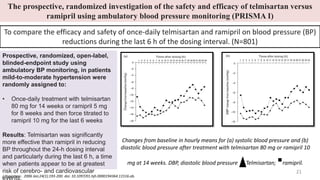
The prospective, randomized investigation of the safety and efficacy of telmisartan versus
ramipril using ambulatory blood pressure monitoring (PRISMA I)
To compare the efficacy and safety of once-daily telmisartan and ramipril on blood pressure (BP)
reductions during the last 6 h of the dosing interval. (N=801)
Prospective, randomized, open-label,
blinded-endpoint study using
ambulatory BP monitoring, in patients
mild-to-moderate hypertension were
randomly assigned to:
• Once-daily treatment with telmisartan
80 mg for 14 weeks or ramipril 5 mg
for 8 weeks and then force titrated to
ramipril 10 mg for the last 6 weeks
Results: Telmisartan was significantly
more effective than ramipril in reducing
BP throughout the 24-h dosing interval
and particularly during the last 6 h, a time
when patients appear to be at greatest
risk of cerebro- and cardiovascular
events.
Changes from baseline in hourly means for (a) systolic blood pressure and (b)
diastolic blood pressure after treatment with telmisartan 80 mg or ramipril 10
mg at 14 weeks. DBP, diastolic blood pressure Telmisartan; ▪ramipril.
J Hypertens . 2006 Jan;24(1):193-200. doi: 10.1097/01.hjh.0000194364.11516.ab.
Ramipril Vs Telmisartan
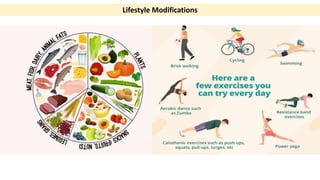
Lifestyle Modifications
26

Cilnidipine in Renoprotection.pptx

  • 1.
    Early interventions withreno- protective therapies in Hypertension Case-based discussion
  • 2.
    • Case Presentation: •A 44-year old male, uncontrolled hypertensive for the past 5 years • Was prescribed Amlodipine (5mg) and Ramipril (5mg) and has been taking since 4 years • eGFR of 80 ml/kg/1.73 m2, elevated uric acid levels, Grade 1 retinopathy, HR = 98bpm, • BP = 152/90, HbA1c = 8% (newly diagnosed diabetic), Mild microalbuminuria detected • Lifestyle: Works in the private sector, is married planning for a family • Presents with Complains of: • Anxiety, difficulty in sleeping, palpitations • Mild Edema of the ankles and feet • What would be the next best strategy? What should have been the correct medication to begin with?
  • 3.
    Hypertension – IndianScenario https://www.hindustantimes.com/india-news/6070-indians-with-hypertension-unaware-of-their-condition-study-101629971301949.html (Accessed on 29th July 2022) 60%-70% Indians with hypertension unaware of their condition. India has one of the lowest rates of hypertension diagnosis in the world. Low diagnosis in India results in low treatment rate. India’s hypertension treatment rate is about 1/3 lower than the global average. India’s treatment rate is lower than nearly 80% of all countries. Undetected and untreated hypertension is one of the key reasons for India’s high burden of CV diseases Salt intake in India has increased tremendously over the past two decades
  • 4.
    Hypertension Challenges in India? • Hypertensionis common even among younger age groups, with approximately one out of every 10 individuals aged 18-25 years suffering from it • Large proportion of individuals unaware of their hypertension status • Lack of universal screening programs for hypertension, and challenges of infrastructure and economics its implementation • A large chunk of population uncontrolled, despite being on medications, poor adherence to medications or incorrect choice of drugs • Lack of a standard Indian Guideline for Hypertension Management • Burden of other Co-morbidities like diabetes, obesity, CVDs, CKD , present with early organ damage
  • 5.
    Hypertension. 2019 August; 74(2): 305–312. Study suggests that hypertensive TOD is robustly associated with early onset hypertension already by mid-life Early Onset Hypertension Is Associated with Hypertensive End-Organ Damage Already by Mid-Life
  • 6.
    Concerns in thiscase: •Patient is: Uncontrolled Hypertensive (152/98 mmHg) on ABPM despite being on 2 antihypertensives [Lisinopril(5mg) and Amlodipine (5mg)] •Grade 1 retinopathy – indicative of end-organ damage , also suggestive from eGFR and microalbuminuria •Patient complains of: High HR, Anxiety, nervousness, Palpitations – signs of sympathetic overdrive •Elevated uric acid levels
  • 7.
    The prevalence ofmicroalbuminuria (MA) among hypertensives and its relation to the duration of hypertension – Indian study 150 patients Kottayam Medical College, Kerala, South India, between May 2005 and October 2006 Saudi J Kidney Dis Transpl 2008;19(3):411-419
  • 8.
    Microalbuminuria is prevalentin 47% of Indian patients with essential hypertension , has positive correlation with the severity of hypertension and target organ damage. Early screening for microalbuminuria in patients of essential hypertension and thereby early initiation of treatment might help in reducing the morbidity and mortality. https://www.japi.org/r2b48454/prevalence-and-clinical-correlates-of-microalbuminuria-in-patients-with-essential-hypertension-a-tertiary-care-center-cross-sectional-study
  • 9.
    BP > 150mmHg….is the beginning of target organ damage Results of a nationwide physicians' survey Presented at Diabetes India 2023, Indore
  • 10.
    Elevated sympathetic overdrivefurther results in organ damage Reduction of SO in CKD patients > Helps in reduction of CV risk
  • 11.
    Increased Sympathetic Overdrive in Young Indian Adults Theprevalence of sympathetic overactivity in newly diagnosed hypertensive patients in India is 62.42% Chronically raised sympathetic nerve activity is a powerful predictor of myocardial infarction Journal of The Association of Physicians of India : 2021: 69(7): 68-73
  • 12.
    Newly diagnosed hypertensivepatients in India have Sympathetic overactivity
  • 13.
    Reno-protective therapies forOrgan Protection in Hypertension
  • 14.
    Amlodipine (5mg) Tobe replaced with Cilnidipine 10mg Ramipril (5mg) To be replaced with Telmisartan (40mg) Increased Heart rate Safe beta-blocker can be initiated Eg: Nebivolol, Bisoprolol Newly diagnosed Diabetic Metformin 500mg / Dapagliflozin 10mg to be initiated along with lifestyle modifications Prescription changes to be made in this patient
  • 15.
    Why introduce Cilnidipine early inthe hypertensive patients journey? • Reduces Blood pressure, comparable to older CCBs • N-channel blocking is novel, not seen in other CCBs • Is a sympatholytic agent, reduces the sympathetic overdrive, reduces Heart rate • N-channel blocking benefits help in multiple ways of protecting the KIDNEYS, APART from BP reduction • Safe, well tolerated, minimal-to-no pedal edema Amlodipine increases HR Amlodipine acts only on L- channels Amlodipine worsens kidney function Up to 35% patients experience pedal edema with amlodipine
  • 16.
    16 Restores the podocin andnephrin expression, protects the podocytes Afferent and Efferent arterioles (L&N channel blocking), thus reduced glomerular pressure Inhibits oxidative stress, Ameliorates urinary albumin excretion and decreases urinary 8- OHdG and L-FABP Inhibits the renal RAS system Cilnidipine has multiple approaches in reno-protection On the other hand, amlodipine worsens kidney function J Hypertens. 2010 May; 28(5): 1034–1043. Hypertens Res. 2012 Nov;35(11):1058-62. doi: 10.1038/hr.2012.96.
  • 17.
    Change of GlomerularHemodynamics in Patients with Advanced Chronic Kidney Disease after Cilnidipine Therapy The N-type calcium channel is associated with sympathetic nerve activation This effect may improve the glomerular hemodynamics in the injured nephron, and may mitigate the progression of renal injury Glomerular filtration rate (GFR), effective renal plasma flow (ERPF), and protein excretion in 24-hour accumulated urine were measured at the start and end of the study. Systolic blood pressure  from 80 % from baseline ERPF  to 127 % of the level at baseline Glomerular capillary pressure on single nephron was  to 90 % Renal vascular resistance ratio (RA/RE) on single nephron improved to 120 % Total GFR  within the non- statistical range Conclusion Cilnidipine improves ERPF and glomerular hypertension without worsening total renal function The Open Clinical Chemistry Journal, 2009, 2: 31-36 Atsushi Satomura, Takayuki Fujita, Yoshinobu Fuke, Yuki Wada, Koichi Matsumoto
  • 18.
    164 91 139.1 78.9 20 40 60 80 100 120 140 160 180 SBP DBP BLOOD PRESSURE (MM HG) High-risk patients(i.e. with renal disease or diabetes) Before combination End of the study period 164.1 91.7 139.2 79.3 20 40 60 80 100 120 140 160 180 SBP DBP Blood pressure (mm Hg) All patients Before combination End of the study period *p<0.0001 *p<0.0001 Hypertens Res 2007; 30: 815–22 N: 1,008 hypertensives with poorly controlled BP (>140/90 mm Hg) despite receiving an ARB (Valsartan, Candesartan, Losartan, Telmisartan or Olmesartan) Treatment: ARB + Cilnidipine 5-20 mg/day Duration: 12 weeks Cilnidipine & ARB offers significant BP reduction in high-risk hypertensives 25/12 mmHg 25/12 mmHg Combination of Cilnidipine + ARB Offers BP Control in High-risk Hypertensives
  • 19.
  • 20.
    20 Mega-Trial of Cilnidipineproves it reduces HR by 9.7 bpm, effective in morning hypertension ACHIEVE-One study These effects of cilnidipine are new features not known in conventional L‐type Ca channel blockers Cilnidipine reduces HR better when it is higher than 85bpm • Generally, morning hypertension involves increased sympathetic activity, and the renin‐angiotensin system (RAS). • Cilnidipine reduced MSBP and MPR even in patients who had already been administrated β‐blockers or RAS inhibitors (including ARBs and ACE inhibitors). • These additive BP‐ and PR‐lowering effects of cilnidipine may be a reflection of dual L‐and N‐type Ca channel–blocking actions differing from β‐adrenergic receptor blocking and RAS‐inhibiting actions Higher the HR, better is the reduction seen with Cilnidipine Cilnidipine https://www.ncbi.nlm.nih.gov/pmc/articles/PMC8034443/
  • 21.
    21 The prospective, randomizedinvestigation of the safety and efficacy of telmisartan versus ramipril using ambulatory blood pressure monitoring (PRISMA I) To compare the efficacy and safety of once-daily telmisartan and ramipril on blood pressure (BP) reductions during the last 6 h of the dosing interval. (N=801) Prospective, randomized, open-label, blinded-endpoint study using ambulatory BP monitoring, in patients mild-to-moderate hypertension were randomly assigned to: • Once-daily treatment with telmisartan 80 mg for 14 weeks or ramipril 5 mg for 8 weeks and then force titrated to ramipril 10 mg for the last 6 weeks Results: Telmisartan was significantly more effective than ramipril in reducing BP throughout the 24-h dosing interval and particularly during the last 6 h, a time when patients appear to be at greatest risk of cerebro- and cardiovascular events. Changes from baseline in hourly means for (a) systolic blood pressure and (b) diastolic blood pressure after treatment with telmisartan 80 mg or ramipril 10 mg at 14 weeks. DBP, diastolic blood pressure Telmisartan; ▪ramipril. J Hypertens . 2006 Jan;24(1):193-200. doi: 10.1097/01.hjh.0000194364.11516.ab.
  • 22.
  • 25.
  • 26.

Editor's Notes

  • #12 Journal of The Association of Physicians of India : 2021: 69(7): 68-73