1
Unlocking the Secrets
Of the Telomere:
The First Step to Reversing Aging
Dr. Al Sears, MD
“Unlocking the telomere is the
MOST important event in the
history of anti-aging medicine”
True“Age-Reversing Therapy”
• My own theory.
• The link between telomeres and aging.
• Shortened telomeres and age-related loss.
The “Tipping Point” that Will Change
Life on This Planet Forever
• 30 years ago, no one understood HOW or WHY
we age... or believed that we ever would.
• As the field of Gerontology advanced, so did the
number of theories.
• In light of telomere biology, we realize the
“causes” of aging are really the “consequences” of
aging.
Theories on Why We Age:
 Disposable Soma Theory – We just temporarily house our Genes.
 Oxidative Stress Theory – Free radicals cause damage to cells.
 Vital Substance Theory – A vital substance is limiting.
 Genetic Mutation Theory – Accumulation of mutations cause aging.
 Reproductive Exhaustion Theory – After reproduction we die
rapidly.
 Aging by Design Theory – Aging is programmed.
 Mitochondrial Dysfunction Theory – Mitochondria become
altered.
 The Neuroendrocrine Theory – Changes in hormone regulation.
 Wear and Tear Theory – Self explanatory
 The Rate of Living Theory – Similar to the Vital Substance Theory
 The Waste Product Accumulation Theory – Self explanatory
 The Cross-Linking Theory – Proteins such as collagen crosslink.
 The Immune System Theory – Decreased immune function.
 Errors and Repairs Theory – Inaccurate repair of damage.
 The Order to Disorder Theory – Decreased maintenance of order.
 Telomere Theory of Aging – Telomere length controls aging.
What Really Causes Aging?
Leonard Hayflick:
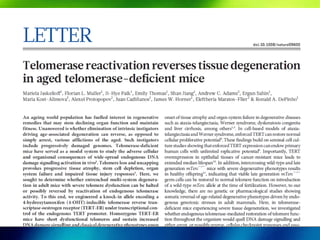
Cell division is a finite biological function and is inexorably tied
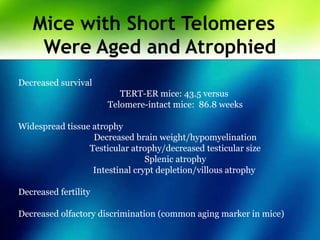
to the aging process
“Hayflick Limit” describes the number of times a cell can divide
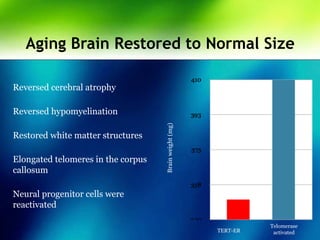
Hayflick was the first to suggest the relationship between cell
division and mortality, but did not know the connection to
telomeres.
What are Telomeres?
First described in 1975 by Elizabeth Blackburn, who recently
earned a Nobel Prize for her discovery.
Telomeres are found at the end of all eukaryotic
chromosomes.
The telomeres protect the chromosome from the
replication-related loss of vital genetic information.
Telomeres
How Do We Know?
From “Hayflick’s Limit,” we know that human cell lines have
a “built-in mortality.” That means there’s an internal
“authority” that sets the limit on cell division and shuts
down the cell line causing death when the limit is reached.
Today we know that mechanism or “authority” is the
telomere.
Once we understood the role of the telomere, the next
observation revealed younger cells have longer
telomeres, and older cells have shorter telomeres.
Young Cells Have Long Telomeres...
Old Cells Have Short Telomeres
2 Studies Published in the Journal
“Nature” in 1990 Provide the Evidence:
Telomeres get shorter with age, with losses ranging from between 30
and 150 nucleotide pairs per replication, depending on cell type.
Cell division/telomere shortening continues until a critical telomere
length is reached, at which point the cell is forced into senescence
(death) and can no longer replicate.
Cell death prevents replication of incomplete or damaged DNA.
Harley CB, Futcher AB, Greider CW (1990) Telomeres shorten during ageing of human fibroblasts. Nature 345:458–460
Vaziri H, Schachter F, Uchida I, Wei L, Zhu X, Effros R, Cohen D, Harley CB (1993) Loss of telomeric DNA during aging of normal and
trisomy 21 human lymphocytes. Am J Hum Genet 52:661–667
Can You Make a Cell Older By
Shortening Its Telomeres?
The next step was to see what would happen if you
took a young cell with long telomeres and artificially
shortened them.
If you could make a cell age faster than normal by
shortening its telomeres, that would be the next link
in proving the “age” of the cell is dependent on the
length of the telomere.
And that’s exactly what happened.
Artificially Shortening the Long
Telomeres of Young Cells ACCELERATES Aging
Artificially Shortening the Long
Telomeres of Young Cells ACCELERATES Aging
In a groundbreaking study, researchers discovered that when they shortened
the telomeres of young, healthy mice, they triggered a host of problems we
associated with old age.
In short, by making their telomeres shorter and therefore “dysfunctional,” they
were able to artificially create signs of aging. And they made these
changes to mice who were otherwise enjoying the vitality of youth.
So then we knew there was some causal relationship.
There’s a cause and effect between short telomeres and aging that we can
prove. In addition, we found that we can create the signs of aging simply by
shortening the telomere artificially.
Telomeres Tell Cells
How Old They Are
Telomeric mediation of gene expression may explain
the relationship between telomere length and aging.
Cells with longer telomeres behave like younger
cells.
Cells with shorter telomeres behave like older cells.
Diseases Affected By
Telomere Shortening
• Cardiovascular
• Cancer
• COPD
• Degenerative Disc
Disease
• Alzheimer’s
• Osteoarthritis
• Rheumatoid Arthritis
• Osteoporosis
• General Immunity
• Skin Aging
• Macular Degeneration
• Liver Cirrhosis
• Muscular Dystrophy
• Cell & Tissue Transplants
• AIDS
• Progeria
• Dyskeratosis Congenita
• Idiopathic Pulmonary
Fibrosis
• Cri du Chat syndrome
• Down’s Syndrome
• Fanconi’s Anemia
• Tuberous Sclerosis
• Werner’s Syndrome
• And, Aging Itself???????
Length of the Telomere as
Controlling Mechanism of Aging
Hundreds of published, peer-reviewed studies show the
relationship between telomere length and markers of
disease, life span and quality of life.
Telomere Length and
All-Cause Mortality
Telomere length was assessed in 143 healthy men and
women >60 years of age
Individuals with the shortest telomeres had significantly
decreased survival rates:
3 times greater risk of dying from
heart disease
8.5 times greater risk of dying from
infectious disease
Cawthon RM, Smith KR, O'Brien E, Sivatchenko A, Kerber RA. Association between telomere length in blood and
mortality in people aged 60 years or older. Lancet. 2003 Feb 1;361(9355):393-5.
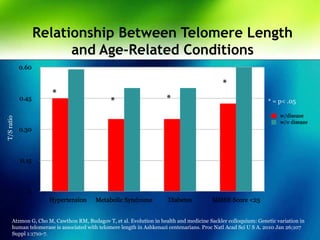
Relationship Between Telomere Length
and Age-Related Conditions
* *
*
T/Sratio
*
* = p< .05
Atzmon G, Cho M, Cawthon RM, Budagov T, et al. Evolution in health and medicine Sackler colloquium: Genetic variation in
human telomerase is associated with telomere length in Ashkenazi centenarians. Proc Natl Acad Sci U S A. 2010 Jan 26;107
Suppl 1:1710-7.
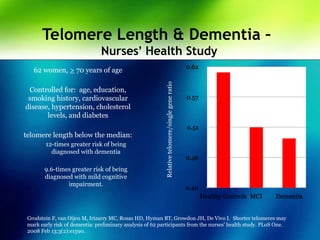
Telomere Length & Dementia –
Nurses’ Health Study
62 women, > 70 years of age
Controlled for: age, education,
smoking history, cardiovascular
disease, hypertension, cholesterol
levels, and diabetes
telomere length below the median:
12-times greater risk of being
diagnosed with dementia
9.6-times greater risk of being
diagnosed with mild cognitive
impairment.
Grodstein F, van Oijen M, Irizarry MC, Rosas HD, Hyman BT, Growdon JH, De Vivo I. Shorter telomeres may
mark early risk of dementia: preliminary analysis of 62 participants from the nurses' health study. PLoS One.
2008 Feb 13;3(2):e1590.
Relativetelomere/singlegeneratio
Telomere Length &
Cardiovascular Disease
674 Caucasian males
Measured mean telomere repeat
copy number to single gene copy
number (T/S ratio)
Found that decreased T/S ratio
was significantly associated with
risk of MI loge-transformedT/Sratios
Zee RY, Michaud SE, Germer S, Ridker PM. Association of shorter mean telomere length with risk of incident myocardial
infarction: a prospective, nested case-control approach. Clin Chim Acta. 2009 May;403(1-2):139-41.
M/I No M/I
Telomere Length: A Crucial Indicator of
Health and Longevity
Telomere length is:
A marker for cell age
A predictor of longevity
A predictor of age-related disease
How Do We Slow the
Loss of the Telomere?
Factors that accelerate telomere shortening
Homocysteine
Inflammation
Oxidation
Depression
Emotional Stress
Physical Trauma
Factors that slow telomere shortening
Telomerase activators
Stop Accelerated Telomere Loss by
Lowering Homocysteine
Multiple studies have shown that elevated homocysteine
levels are associated with short telomeres.
In one study, elevated homocysteine tripled the rate of
shortening.
Bull CF, O'Callaghan NJ, Mayrhofer G, Fenech MF. Telomere length in lymphocytes of older South Australian
men may be inversely associated with plasma homocysteine. Rejuvenation Res. 2009 Oct;12(5):341-9.
Richards JB, Valdes AM, Gardner JP, Kato BS, et al. Homocysteine levels and leukocyte telomere length.
Atherosclerosis. 2008 Oct;200(2):271-7.
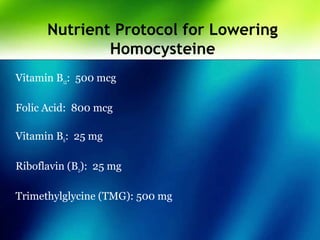
Nutrient Protocol for Lowering
Homocysteine
Vitamin B12: 500 mcg
Folic Acid: 800 mcg
Vitamin B6: 25 mg
Riboflavin (B2): 25 mg
Trimethylglycine (TMG): 500 mg
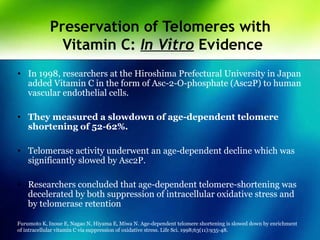
Preservation of Telomeres with
Vitamin C: In Vitro Evidence
• In 1998, researchers at the Hiroshima Prefectural University in Japan
added Vitamin C in the form of Asc-2-O-phosphate (Asc2P) to human
vascular endothelial cells.
• They measured a slowdown of age-dependent telomere
shortening of 52-62%.
• Telomerase activity underwent an age-dependent decline which was
significantly slowed by Asc2P.
• Researchers concluded that age-dependent telomere-shortening was
decelerated by both suppression of intracellular oxidative stress and
by telomerase retention
Furumoto K, Inoue E, Nagao N, Hiyama E, Miwa N. Age-dependent telomere shortening is slowed down by enrichment
of intracellular vitamin C via suppression of oxidative stress. Life Sci. 1998;63(11):935-48.
Preserve Telomere Length with Vitamin C:
In Vivo Evidence
Vitamin levels were assessed in
586 women aged 35-74
Analysis controlled for age, overall
health, BMI, smoking, stress level,
cardiovascular disease, and
diabetes.
Women in the 4th quartile of
vitamin C intake had significantly
longer telomeres relative to
women in the 1st
quartile.
1st
Quartile 4th Quartile
MeanTelomereLength(BP)
Xu Q, Parks CG, DeRoo LA, Cawthon RM, Sandler DP, Chen H. Multivitamin use and telomere length in women. Am J
Clin Nutr. 2009 Jun;89(6):1857-63.
Stress in the Workplace Causes
Shortening of the Telomere
1st
Quartile 4th Quartile
Damjanovic, et al., J Immunol. 2007 Sep 15;179(6):4249-54
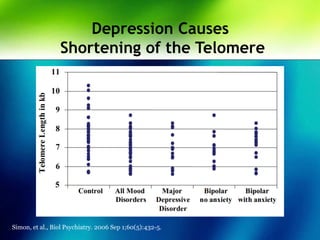
Depression Causes
Shortening of the Telomere
Simon, et al., Biol Psychiatry. 2006 Sep 1;60(5):432-5.
Reducing Stress Slows the
Loss of the Telomere
Chronic stress has been shown to
accelerate telomere shortening.
After adjusting for age and various
health/behavioral factors, women
with the highest stress levels had the
shortest telomeres.
The degree of telomere shortening
correlated to a minimum of a full
decade of again
AverageT/SRatio
High Stress Low Stress
Epel ES, Blackburn EH, Lin J, Dhabhar FS, Adler NE, Morrow JD, Cawthon RM. Accelerated telomere shortening in
response to life stress. Proc Natl Acad Sci U S A. 2004 Dec 7;101(49):17312-5.
Superoxide Dismutase (SOD)
Slows Telomere Shortening
Superoxide dismutase is a naturally occurring cellular
antioxidant that aids the immune system cells in killing or
deactivating invading microorganisms.
In human fibroblasts with low antioxidant capacity,
increasing cellular superoxide dismutase activity slowed
telomere shortening and increased the life span of the cells.
Serra V, von Zglinicki T, Lorenz M, Saretzki G. Extracellular superoxide dismutase is a major antioxidant in human
fibroblasts and slows telomere shortening. J Biol Chem. 2003 Feb 28;278(9):6824-30.
Maintain Telomere Length with Omega-
3 Fatty Acids
Farzaneh-Far R, Lin J, Epel ES, Harris WS, Blackburn EH, Whooley MA. Association of marine
omega-3 fatty acid levels with telomeric aging in patients with coronary heart disease. JAMA. 2010
Jan 20;303(3):250-7.
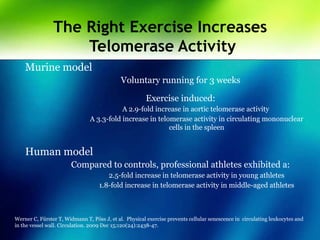
The Right Exercise Increases
Telomerase Activity
Murine model
Voluntary running for 3 weeks
Exercise induced:
A 2.9-fold increase in aortic telomerase activity
A 3.3-fold increase in telomerase activity in circulating mononuclear
cells in the spleen
Human model
Compared to controls, professional athletes exhibited a:
2.5-fold increase in telomerase activity in young athletes
1.8-fold increase in telomerase activity in middle-aged athletes
Werner C, Fürster T, Widmann T, Pöss J, et al. Physical exercise prevents cellular senescence in circulating leukocytes and
in the vessel wall. Circulation. 2009 Dec 15;120(24):2438-47.
Keeping Telomeres Long
 Right Exercise
 Anti-Oxidants
 Omega 3’s
 Vitamin D3
 Don’t Smoke
 Weight Management
 Reduce Stress
 Reduce Depression
 Reduce Pessimism
 Be Happy!
The History-Making
Story of Telomerase
Telomerase is the enzyme responsible for re-building
telomeres.
Telomerase activity is observed in fetal tissue, adult germ
cells, and tumor cells.
Telomerase is “turned off” in all other cells.
Activation of Telomerase
Has Been Shown To:
1. Immortalize cells
2. Reverse the age of tissue
3. Reverse aging in whole organisms
Telomerase Can
“Immortalize” Cells
Study published in the journal Science:
Human cells were encoded with the human telomerase gene
(hTERT).
Control cells showed telomere shortening, as well a marker of cell
death.
Telomerase+ cells had longer telomeres.
By the time the study was published, the telomerase+ cells had
exceeded their expected lifespan by 20+ replications.
Bodnar AG, Ouellette M, Frolkis M, Holt SE, et al. Extension of life-span by introduction of
telomerase into normal human cells. Science. 1998 Jan 16;279(5349):349-52.
Telomerase Restores Youthful
Markers in Live Tissue
Normal human dermal fibroblasts were transfected with hTERT and
then grafted onto mouse skin.
Mice grafted with telomerase-negative control cells exhibited
phenotypic signs of senescence (increased fragility, reduced levels of
collagen I and III, and subepidermal blistering).
Mice grafted with telomerase+ cells exhibited a youthful
phenotype, despite the same number of replications.
Funk WD, Wang CK, Shelton DN, Harley CB, Pagon GD, Hoeffler WK. Telomerase expression restores
dermal integrity to in vitro-aged fibroblasts in a reconstituted skin model. Exp Cell Res. 2000 Aug
1;258(2):270-8.
“The results were strikingly unequivocal. The
telomeres in cells with hTRT lengthened, and the
cells themselves kept on multiplying, through the
Hayflick limit and well beyond.
At the time the papers were submitted they had made
20 or more extra divisions, yet they looked young,
vigorous and essentially normal.”
Bodnar AG, Ouellette M, Frolkis M, Holt SE, Chiu CP, Morin GB, Harley CB, Shay JW, Lichtsteiner S, Wright WE.
Extension of life-span by introduction of telomerase into normal human cells. Science. 1998 Jan 16;279(5349):349-52.
Can You REVERSE the Signs of Aging by
Artificially Lengthening the Telomere?
Markers in Live Tissue
After establishing:
Young cells have long telomeres and old cells have short telomeres;
And proving you can accelerate the signs of aging by artificially shortening
the telomere...
The next step was showing that if we turn on the telomerase, the enzyme that
REBUILDS the telomere, we can slow the shortening of telomeres in a cell. And
in some cases make them longer.
If the theory help up, that would mean you could actually REVERSE the signs of
aging by artificially lengthening the telomere.
And that’s what happened during a recent Harvard study.
Harvard Researchers Demonstrate How
Telomerase can Reverse Aging
In a Whole Organism
Harvard Researchers Demonstrate How
Telomerase can Reverse Aging
In a Whole Organism
A Groundbreaking Study...
Harvard Medical School Professor, Ronald DePinho,
used the TERT-ER mouse to demonstrate the profound
effect of telomerase activation on age management.
TERT-ER mice have short dysfunctional telomeres and are
deficient in telomerase.
4-hydroxytamoxifen (4-OTH) is used to induce telomerase
in TERT-ER mice.
Jaskelioff M, Muller FL, Paik JH, Thomas E, et al. Telomerase reactivation reverses tissue
degeneration in aged telomerase-deficient mice. Nature. 2010 Nov 28
Mice with Short Telomeres
Were Aged and Atrophied
Decreased survival
TERT-ER mice: 43.5 versus
Telomere-intact mice: 86.8 weeks
Widespread tissue atrophy
Decreased brain weight/hypomyelination
Testicular atrophy/decreased testicular size
Splenic atrophy
Intestinal crypt depletion/villous atrophy
Decreased fertility
Decreased olfactory discrimination (common aging marker in mice)
Aging Brain Restored to Normal Size
Reversed cerebral atrophy
Reversed hypomyelination
Restored white matter structures
Elongated telomeres in the corpus
callosum
Neural progenitor cells were
reactivated
TERT-ER
Telomerase
activated
Brainweight(mg)
P=0.02
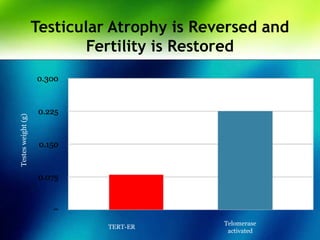
Testicular Atrophy is Reversed and
Fertility is Restored
P=0.0001
TERT-ER
Telomerase
activated
Testesweight(g)
Other Organs Were Also
Restored
Similar results were seen in the spleen and the intestines.
Performance on olfactory discrimination tasks was restored
to youthful levels.
“When we flipped the telomerase switch on and looked a
month later, the brains had largely returned to normal.”
-- Dr. Ronald DePinho commenting on his groundbreaking Harvard study
Telomerase Activity Predicts
Longevity in Humans
Multi-generational study of Ashkenazi Jews with exceptional longevity
Parent group (n = 86; average age of 97 years)
Offspring group (n = 175)
Control group (n = 93)
Found that the population exhibited abnormally high telomerase
activity, mediated by a mutation of hTERT – a catalytic subunit of
telomerase.
Results link human longevity with telomerase activity
Atzmon G, Cho M, Cawthon RM, Budagov T, et al. Evolution in health and medicine Sackler colloquium: Genetic variation in
human telomerase is associated with telomere length in Ashkenazi centenarians. Proc Natl Acad Sci U S A. 2010 Jan 26;107
Suppl 1:1710-7.
Telomerase Activity Has Positive
Impact On Adult Stem Cells
“The real targets for [Telomerase Activators] are the
adult stem cells scattered throughout our body, which are
required for regenerating and repairing our organs and
tissues.
Activating telomerase in populations of adult stem cells can
extend their function and help promote organ
repair and regeneration.”
--Bryant Villeponteau, PhD. [ex-Geron Corporation, ex-Sierra Sciences] on-line post to Dr. Stephen
Coles and the Gerontology Research Group 1/16/11
Telomerase Activity Has Positive
Impact On Adult Stem Cells
“The real targets for [Telomerase Activators] are the
adult stem cells scattered throughout our body, which are
required for regenerating and repairing our organs and
tissues.
Activating telomerase in populations of adult stem cells can
extend their function and help promote organ
repair and regeneration.”
--Bryant Villeponteau, PhD. [ex-Geron Corporation, ex-Sierra Sciences] on-line post to Dr. Stephen
Coles and the Gerontology Research Group 1/16/11
How to Activate
Telomerase Now...
Assessment of Telomere
Length
Repeat Diagnostics: First and only CLIA Certified
laboratory in the world to provide cell type specific telomere
length measurements. www.repeatdiagnostics.com
Spectracell: Uses “whole blood” sample. Does not
differentiate between lymphocytes and granulocytes.
www.spectracell.com
Life Length: Founded by Dr. Maria Blasco, Director of
the Spanish National Cancer Institute. First to measure
percentage of critically short telomeres.
www.lifelength.com
The Search for the First
Telomerase Activator
Back in the early 1990s, an entrepreneur named Michael
West heard about the amazing breakthroughs in telomere
biology at an anti-aging conference.
Convinced of its effectiveness and place in history, Michael
started the Geron Corporation with the vision of
bringing the first commercially available telomerase
activator to the public.
Geron Corporation
Discovered a process to extract a very rare molecule that is
found in tiny amounts in the Chinese herb Astragalus and
they named the molecule TA-65.
Patented the sequence of the telomerase genome and
granted license to TA-Sciences to sell TA-65.
Dr. Bill Andrews: As Director of Molecular Biology at the
Geron Corporation from 1992 to 1997, he was one of the
principal discoverers of the components of human
telomerase.
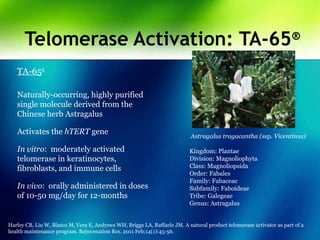
Telomerase Activation: TA-65®
TA-65®
Naturally-occurring, highly purified
single molecule derived from the
Chinese herb Astragalus
Activates the hTERT gene
In vitro: moderately activated
telomerase in keratinocytes,
fibroblasts, and immune cells
In vivo: orally administered in doses
of 10-50 mg/day for 12-months
Harley CB, Liu W, Blasco M, Vera E, Andrews WH, Briggs LA, Raffaele JM. A natural product telomerase activator as part of a
health maintenance program. Rejuvenation Res. 2011 Feb;14(1):45-56.
Astragalus tragacantha (ssp. Vicentinus)
Kingdom: Plantae
Division: Magnoliophyta
Class: Magnoliopsida
Order: Fabales
Family: Fabaceae
Subfamily: Faboideae
Tribe: Galegeae
Genus: Astragalus
Results of TA-65®
Following 1-year on TA-65®
, we
observed a significant decrease in
the percent of critically-short
telomeres.
TA-65®
Reduces Number of
Damaged Immune Cells
A study published in the September 7, 2010 issue of the
journal Rejuvenation Research, showed TA-65
significantly reduced...
Senescent cytotoxic T cells and natural killer cells...
With a significant reduction in the number of cells with
short telomeres (<4kbp; p=0.037).     
Harley, C., Weimin L., et al, “A Natural Product Telomerase Activator As Part of a Health
Maintenance Program,” Rejuvenation Research 2010
By Activating Telomerase
TA-65®
Produces Younger Cells
Researchers at TA Sciences tested a group of people and
measured the number of white blood cells that looked old,
and the number that looked young. Then the people
started taking TA-65®
.
After three months, they were found to have a
ratio of young-looking cells to old-looking cells
that someone would have if they were 20 YEARS
YOUNGER.
Harley, C., Weimin L., et al, “A Natural Product Telomerase Activator As Part of a Health
Maintenance Program,” Rejuvenation Research 2010
TA-65®
in My Own Practice
First doctor licensed to administer TA-65.
53 patients following TA-65 protocol since
August 2008.
Assessment of
Telomere Length
Repeat Diagnostics: First and only CLIA Certified
laboratory in the world to provide cell type specific telomere
length measurements. www.repeatdiagnostics.com
Spectracell: Uses “whole blood” sample. Does not
differentiate between lymphocytes and granulocytes.
www.spectracell.com
Life Length: Founded by Dr. Maria Blasco, Director of
the Spanish National Cancer Institute. First to measure
percentage of critically short telomeres.
www.lifelength.com
Case Study: Michael
Michael recently turned 62 but has the clinically
documented “pulmonary age” of a 24-year old.
Michael’s “neurological age,” is only 44, a sign he has the
brainpower of a much younger man.
Michael had other remarkable changes including better
eyesight, lower cholesterol and dramatically higher
testosterone.
Case Study: Michael
All that extra energy helped him win at the recent North
American Grappling Association Championship. In the
space of one hour, Michael won two first place titles against
men who were twenty years his junior.
In Michael’s own words:
“With TA-65 I lost 20 pounds, increased my muscle mass
and flexibility, eliminated joint pain I’ve had for years and
miraculously made the inside of my body younger.”
New Breakthroughs
in Telomerase Activation
New research uncovered at least 123 nutrients,
vitamins and other natural compounds that have the
ability to “turn on” telomerase in the human genome.
Not only are these nutrients proven effective, they’re more
affordable than TA-65.
Today, telomerase therapy is more accessible than ever
before.
Silymarin Boosts Telomerase
Activity by 300%
This herbal extract is effective for detoxification but was
recently discovered to activate telomerase.
Published in the Journal of Cardiovascular
Pharmacology, researchers discovered Silymarin:
Increased telomerase activity 3-fold;
Reduced the number of senescent cells, and
Increased the activity of endothelial progenitor cells by up
to 64%
Parzonko, Andrzej MSc; Naruszewicz, Marek PhD. Silymarin Inhibits Endothelial Progenitor Cells' Senescence and Protects Against the
Antiproliferative Activity of Rapamycin: Preliminary Study. Journal of Cardiovascular Pharmacology: December 2010. Volume 56, Issue 6. pp
610-618
N-Acetyl Cysteine (NAC)
This potent amino acid is a building block of your body’s
primary antioxidant called glutathione (GSH).
Published in the journal Mechanisms of Ageing and
Development, researchers discovered NAC turns on the
human telomerase gene.
“Chronic exposure to NAC can delay senescence of diseased
endothelial cells via hTERT activation and transient
telomere stabilization...”
Guillaume V, et al. Chronic treatment with N-acetyl-cysteine delays cellular senescence in endothelial cells isolated from a subgroup of
Gamma Tocotrienol
One of the four lesser-known forms of vitamin E, gamma
tocotrienol can, “modulate the length of the telomere
possibly via telomerase.”
From their study published in Oxidative Medicine and
Cellular Longevity, the researchers concluded that after
being exposed to gamma tocotrienol for just 24 hours...
“...telomere lengths of treated cells appear to have been
roughly 16% longer than controls after only this very
short period of exposure.”
Suzana Makpol, et al. Gamma-Tocotrienol prevents oxidative stress-induced telomere shortening in human fibroblasts derived from different aged individuals.
Oxidative Medicine and Cellular Longevity, 3(1); Jan-Feb 2010.
Resveratrol
By activating telomerase, this well-known anti-aging
nutrient from red wine increases the number of endothelial
progenitor cells. These vital cells make repairs to damaged
blood vessels.
According to the lead researcher from the study published
in the British Journal of Pharmacology:
“Resveratrol significantly increased
telomerase activity...”
Xia, L. Wang XX, et al. Resveratrol reduces endothelial progenitor cells senescence through augmentation of telomerase activity by Akt-
dependent mechanisms. Br J Pharmacol. 2008 October; 155(3): 387–394.
Green Tea Extract (EGCG)
The extract of green tea, EGCG, has a powerful effect on
telomeres.
In a study published in the British Journal of
Nutrition, the telomeres of green tea drinkers were about
0.46 kilobases longer.
This average difference in the telomere length corresponds
to, “approximately a difference of five years of
life.”
Chjan R, Woo J, Suen E, Leung, Tang N. Chinese tea consumption is associated with longer telomere length in elderly Chinese men. Br. J Nutr.
2010 Jan;103(1):107-13. Epub 2009 Aug 12.
Ginkgo Biloba Extract
Originally known as a brain booster because it helps open up
blood vessels, there’s new evidence from a study published
in the Journal of Cardiovascular Pharmacology
that:
“...ginkgo biloba extract significantly increased
telomerase activity...”
Ginkgo helps prevent the loss of the telomere by activating
telomerase in the sensitive cells that line your blood vessels
known as the endothelium.
Dong, X, et al. Ginkgo Biloba reduces endothelial progenitor cell senescence through augmentation of Telomerase activity. Journal of
Cardiovascular Pharmacology. Feb 2007, vol.49, issue 2, pp. 111-115.
Vitamin D3 and Folic Acid
Famous for it’s ability to increase immune function and prevent cancer, vitamin
D also activates telomerase.
One very recent study from the International Journal of Obesity showed
vitamin D increased telomerase activity by 19.2%.
Folic acid is one of the B vitamins I prescribe to help stop the loss of your
telomeres. And it’s one of five nutrients used to get rid of excess homocysteine
that builds up in your blood stream when you’re antioxidant levels start to drop.
A study from the Journal of Nutrition suggests folic acid stimulates the
activation of telomerase.
Zhu H, Guo D, Li K, Pedersen-White J, Stallmann-Jorgensen IS, Huang Y, Parikh S, Liu K, Dong Y. Increased telomerase activity and vitamin D
supplementation in overweight African Americans. Int J Obes (Lond). 2012 Jun;36(6):805-9.
Paul L, et al. Telomere length in peripheral blood mononuclear cells is associated with folate status in men. J Nutr. 2009 Jul;139(7):1273-8.
Dr. Al Sears, MD
Wellness Research Foundation
11903 Southern Blvd., Ste. 208
Royal Palm Beach, FL 33411
866-792-1035
www.alsearsmd.com

Telomere seminar dec2012_new

  • 1.
    1 Unlocking the Secrets Ofthe Telomere: The First Step to Reversing Aging Dr. Al Sears, MD
  • 2.
    “Unlocking the telomereis the MOST important event in the history of anti-aging medicine”
  • 3.
    True“Age-Reversing Therapy” • Myown theory. • The link between telomeres and aging. • Shortened telomeres and age-related loss.
  • 4.
    The “Tipping Point”that Will Change Life on This Planet Forever • 30 years ago, no one understood HOW or WHY we age... or believed that we ever would. • As the field of Gerontology advanced, so did the number of theories. • In light of telomere biology, we realize the “causes” of aging are really the “consequences” of aging.
  • 5.
    Theories on WhyWe Age:  Disposable Soma Theory – We just temporarily house our Genes.  Oxidative Stress Theory – Free radicals cause damage to cells.  Vital Substance Theory – A vital substance is limiting.  Genetic Mutation Theory – Accumulation of mutations cause aging.  Reproductive Exhaustion Theory – After reproduction we die rapidly.  Aging by Design Theory – Aging is programmed.  Mitochondrial Dysfunction Theory – Mitochondria become altered.  The Neuroendrocrine Theory – Changes in hormone regulation.  Wear and Tear Theory – Self explanatory  The Rate of Living Theory – Similar to the Vital Substance Theory  The Waste Product Accumulation Theory – Self explanatory  The Cross-Linking Theory – Proteins such as collagen crosslink.  The Immune System Theory – Decreased immune function.  Errors and Repairs Theory – Inaccurate repair of damage.  The Order to Disorder Theory – Decreased maintenance of order.  Telomere Theory of Aging – Telomere length controls aging.
  • 6.
    What Really CausesAging? Leonard Hayflick: Cell division is a finite biological function and is inexorably tied to the aging process “Hayflick Limit” describes the number of times a cell can divide Hayflick was the first to suggest the relationship between cell division and mortality, but did not know the connection to telomeres.
  • 7.
    What are Telomeres? Firstdescribed in 1975 by Elizabeth Blackburn, who recently earned a Nobel Prize for her discovery. Telomeres are found at the end of all eukaryotic chromosomes. The telomeres protect the chromosome from the replication-related loss of vital genetic information.
  • 8.
  • 9.
    How Do WeKnow? From “Hayflick’s Limit,” we know that human cell lines have a “built-in mortality.” That means there’s an internal “authority” that sets the limit on cell division and shuts down the cell line causing death when the limit is reached. Today we know that mechanism or “authority” is the telomere. Once we understood the role of the telomere, the next observation revealed younger cells have longer telomeres, and older cells have shorter telomeres.
  • 10.
    Young Cells HaveLong Telomeres... Old Cells Have Short Telomeres 2 Studies Published in the Journal “Nature” in 1990 Provide the Evidence: Telomeres get shorter with age, with losses ranging from between 30 and 150 nucleotide pairs per replication, depending on cell type. Cell division/telomere shortening continues until a critical telomere length is reached, at which point the cell is forced into senescence (death) and can no longer replicate. Cell death prevents replication of incomplete or damaged DNA. Harley CB, Futcher AB, Greider CW (1990) Telomeres shorten during ageing of human fibroblasts. Nature 345:458–460 Vaziri H, Schachter F, Uchida I, Wei L, Zhu X, Effros R, Cohen D, Harley CB (1993) Loss of telomeric DNA during aging of normal and trisomy 21 human lymphocytes. Am J Hum Genet 52:661–667
  • 11.
    Can You Makea Cell Older By Shortening Its Telomeres? The next step was to see what would happen if you took a young cell with long telomeres and artificially shortened them. If you could make a cell age faster than normal by shortening its telomeres, that would be the next link in proving the “age” of the cell is dependent on the length of the telomere. And that’s exactly what happened.
  • 12.
    Artificially Shortening theLong Telomeres of Young Cells ACCELERATES Aging
  • 13.
    Artificially Shortening theLong Telomeres of Young Cells ACCELERATES Aging In a groundbreaking study, researchers discovered that when they shortened the telomeres of young, healthy mice, they triggered a host of problems we associated with old age. In short, by making their telomeres shorter and therefore “dysfunctional,” they were able to artificially create signs of aging. And they made these changes to mice who were otherwise enjoying the vitality of youth. So then we knew there was some causal relationship. There’s a cause and effect between short telomeres and aging that we can prove. In addition, we found that we can create the signs of aging simply by shortening the telomere artificially.
  • 14.
    Telomeres Tell Cells HowOld They Are Telomeric mediation of gene expression may explain the relationship between telomere length and aging. Cells with longer telomeres behave like younger cells. Cells with shorter telomeres behave like older cells.
  • 15.
    Diseases Affected By TelomereShortening • Cardiovascular • Cancer • COPD • Degenerative Disc Disease • Alzheimer’s • Osteoarthritis • Rheumatoid Arthritis • Osteoporosis • General Immunity • Skin Aging • Macular Degeneration • Liver Cirrhosis • Muscular Dystrophy • Cell & Tissue Transplants • AIDS • Progeria • Dyskeratosis Congenita • Idiopathic Pulmonary Fibrosis • Cri du Chat syndrome • Down’s Syndrome • Fanconi’s Anemia • Tuberous Sclerosis • Werner’s Syndrome • And, Aging Itself???????
  • 16.
    Length of theTelomere as Controlling Mechanism of Aging Hundreds of published, peer-reviewed studies show the relationship between telomere length and markers of disease, life span and quality of life.
  • 17.
    Telomere Length and All-CauseMortality Telomere length was assessed in 143 healthy men and women >60 years of age Individuals with the shortest telomeres had significantly decreased survival rates: 3 times greater risk of dying from heart disease 8.5 times greater risk of dying from infectious disease Cawthon RM, Smith KR, O'Brien E, Sivatchenko A, Kerber RA. Association between telomere length in blood and mortality in people aged 60 years or older. Lancet. 2003 Feb 1;361(9355):393-5.
  • 18.
    Relationship Between TelomereLength and Age-Related Conditions * * * T/Sratio * * = p< .05 Atzmon G, Cho M, Cawthon RM, Budagov T, et al. Evolution in health and medicine Sackler colloquium: Genetic variation in human telomerase is associated with telomere length in Ashkenazi centenarians. Proc Natl Acad Sci U S A. 2010 Jan 26;107 Suppl 1:1710-7.
  • 19.
    Telomere Length &Dementia – Nurses’ Health Study 62 women, > 70 years of age Controlled for: age, education, smoking history, cardiovascular disease, hypertension, cholesterol levels, and diabetes telomere length below the median: 12-times greater risk of being diagnosed with dementia 9.6-times greater risk of being diagnosed with mild cognitive impairment. Grodstein F, van Oijen M, Irizarry MC, Rosas HD, Hyman BT, Growdon JH, De Vivo I. Shorter telomeres may mark early risk of dementia: preliminary analysis of 62 participants from the nurses' health study. PLoS One. 2008 Feb 13;3(2):e1590. Relativetelomere/singlegeneratio
  • 20.
    Telomere Length & CardiovascularDisease 674 Caucasian males Measured mean telomere repeat copy number to single gene copy number (T/S ratio) Found that decreased T/S ratio was significantly associated with risk of MI loge-transformedT/Sratios Zee RY, Michaud SE, Germer S, Ridker PM. Association of shorter mean telomere length with risk of incident myocardial infarction: a prospective, nested case-control approach. Clin Chim Acta. 2009 May;403(1-2):139-41. M/I No M/I
  • 21.
    Telomere Length: ACrucial Indicator of Health and Longevity Telomere length is: A marker for cell age A predictor of longevity A predictor of age-related disease
  • 22.
    How Do WeSlow the Loss of the Telomere? Factors that accelerate telomere shortening Homocysteine Inflammation Oxidation Depression Emotional Stress Physical Trauma Factors that slow telomere shortening Telomerase activators
  • 23.
    Stop Accelerated TelomereLoss by Lowering Homocysteine Multiple studies have shown that elevated homocysteine levels are associated with short telomeres. In one study, elevated homocysteine tripled the rate of shortening. Bull CF, O'Callaghan NJ, Mayrhofer G, Fenech MF. Telomere length in lymphocytes of older South Australian men may be inversely associated with plasma homocysteine. Rejuvenation Res. 2009 Oct;12(5):341-9. Richards JB, Valdes AM, Gardner JP, Kato BS, et al. Homocysteine levels and leukocyte telomere length. Atherosclerosis. 2008 Oct;200(2):271-7.
  • 24.
    Nutrient Protocol forLowering Homocysteine Vitamin B12: 500 mcg Folic Acid: 800 mcg Vitamin B6: 25 mg Riboflavin (B2): 25 mg Trimethylglycine (TMG): 500 mg
  • 25.
    Preservation of Telomereswith Vitamin C: In Vitro Evidence • In 1998, researchers at the Hiroshima Prefectural University in Japan added Vitamin C in the form of Asc-2-O-phosphate (Asc2P) to human vascular endothelial cells. • They measured a slowdown of age-dependent telomere shortening of 52-62%. • Telomerase activity underwent an age-dependent decline which was significantly slowed by Asc2P. • Researchers concluded that age-dependent telomere-shortening was decelerated by both suppression of intracellular oxidative stress and by telomerase retention Furumoto K, Inoue E, Nagao N, Hiyama E, Miwa N. Age-dependent telomere shortening is slowed down by enrichment of intracellular vitamin C via suppression of oxidative stress. Life Sci. 1998;63(11):935-48.
  • 26.
    Preserve Telomere Lengthwith Vitamin C: In Vivo Evidence Vitamin levels were assessed in 586 women aged 35-74 Analysis controlled for age, overall health, BMI, smoking, stress level, cardiovascular disease, and diabetes. Women in the 4th quartile of vitamin C intake had significantly longer telomeres relative to women in the 1st quartile. 1st Quartile 4th Quartile MeanTelomereLength(BP) Xu Q, Parks CG, DeRoo LA, Cawthon RM, Sandler DP, Chen H. Multivitamin use and telomere length in women. Am J Clin Nutr. 2009 Jun;89(6):1857-63.
  • 27.
    Stress in theWorkplace Causes Shortening of the Telomere 1st Quartile 4th Quartile Damjanovic, et al., J Immunol. 2007 Sep 15;179(6):4249-54
  • 28.
    Depression Causes Shortening ofthe Telomere Simon, et al., Biol Psychiatry. 2006 Sep 1;60(5):432-5.
  • 29.
    Reducing Stress Slowsthe Loss of the Telomere Chronic stress has been shown to accelerate telomere shortening. After adjusting for age and various health/behavioral factors, women with the highest stress levels had the shortest telomeres. The degree of telomere shortening correlated to a minimum of a full decade of again AverageT/SRatio High Stress Low Stress Epel ES, Blackburn EH, Lin J, Dhabhar FS, Adler NE, Morrow JD, Cawthon RM. Accelerated telomere shortening in response to life stress. Proc Natl Acad Sci U S A. 2004 Dec 7;101(49):17312-5.
  • 30.
    Superoxide Dismutase (SOD) SlowsTelomere Shortening Superoxide dismutase is a naturally occurring cellular antioxidant that aids the immune system cells in killing or deactivating invading microorganisms. In human fibroblasts with low antioxidant capacity, increasing cellular superoxide dismutase activity slowed telomere shortening and increased the life span of the cells. Serra V, von Zglinicki T, Lorenz M, Saretzki G. Extracellular superoxide dismutase is a major antioxidant in human fibroblasts and slows telomere shortening. J Biol Chem. 2003 Feb 28;278(9):6824-30.
  • 31.
    Maintain Telomere Lengthwith Omega- 3 Fatty Acids Farzaneh-Far R, Lin J, Epel ES, Harris WS, Blackburn EH, Whooley MA. Association of marine omega-3 fatty acid levels with telomeric aging in patients with coronary heart disease. JAMA. 2010 Jan 20;303(3):250-7.
  • 32.
    The Right ExerciseIncreases Telomerase Activity Murine model Voluntary running for 3 weeks Exercise induced: A 2.9-fold increase in aortic telomerase activity A 3.3-fold increase in telomerase activity in circulating mononuclear cells in the spleen Human model Compared to controls, professional athletes exhibited a: 2.5-fold increase in telomerase activity in young athletes 1.8-fold increase in telomerase activity in middle-aged athletes Werner C, Fürster T, Widmann T, Pöss J, et al. Physical exercise prevents cellular senescence in circulating leukocytes and in the vessel wall. Circulation. 2009 Dec 15;120(24):2438-47.
  • 33.
    Keeping Telomeres Long Right Exercise  Anti-Oxidants  Omega 3’s  Vitamin D3  Don’t Smoke  Weight Management  Reduce Stress  Reduce Depression  Reduce Pessimism  Be Happy!
  • 34.
    The History-Making Story ofTelomerase Telomerase is the enzyme responsible for re-building telomeres. Telomerase activity is observed in fetal tissue, adult germ cells, and tumor cells. Telomerase is “turned off” in all other cells.
  • 35.
    Activation of Telomerase HasBeen Shown To: 1. Immortalize cells 2. Reverse the age of tissue 3. Reverse aging in whole organisms
  • 36.
    Telomerase Can “Immortalize” Cells Studypublished in the journal Science: Human cells were encoded with the human telomerase gene (hTERT). Control cells showed telomere shortening, as well a marker of cell death. Telomerase+ cells had longer telomeres. By the time the study was published, the telomerase+ cells had exceeded their expected lifespan by 20+ replications. Bodnar AG, Ouellette M, Frolkis M, Holt SE, et al. Extension of life-span by introduction of telomerase into normal human cells. Science. 1998 Jan 16;279(5349):349-52.
  • 37.
    Telomerase Restores Youthful Markersin Live Tissue Normal human dermal fibroblasts were transfected with hTERT and then grafted onto mouse skin. Mice grafted with telomerase-negative control cells exhibited phenotypic signs of senescence (increased fragility, reduced levels of collagen I and III, and subepidermal blistering). Mice grafted with telomerase+ cells exhibited a youthful phenotype, despite the same number of replications. Funk WD, Wang CK, Shelton DN, Harley CB, Pagon GD, Hoeffler WK. Telomerase expression restores dermal integrity to in vitro-aged fibroblasts in a reconstituted skin model. Exp Cell Res. 2000 Aug 1;258(2):270-8.
  • 38.
    “The results werestrikingly unequivocal. The telomeres in cells with hTRT lengthened, and the cells themselves kept on multiplying, through the Hayflick limit and well beyond. At the time the papers were submitted they had made 20 or more extra divisions, yet they looked young, vigorous and essentially normal.” Bodnar AG, Ouellette M, Frolkis M, Holt SE, Chiu CP, Morin GB, Harley CB, Shay JW, Lichtsteiner S, Wright WE. Extension of life-span by introduction of telomerase into normal human cells. Science. 1998 Jan 16;279(5349):349-52.
  • 39.
    Can You REVERSEthe Signs of Aging by Artificially Lengthening the Telomere? Markers in Live Tissue After establishing: Young cells have long telomeres and old cells have short telomeres; And proving you can accelerate the signs of aging by artificially shortening the telomere... The next step was showing that if we turn on the telomerase, the enzyme that REBUILDS the telomere, we can slow the shortening of telomeres in a cell. And in some cases make them longer. If the theory help up, that would mean you could actually REVERSE the signs of aging by artificially lengthening the telomere. And that’s what happened during a recent Harvard study.
  • 40.
    Harvard Researchers DemonstrateHow Telomerase can Reverse Aging In a Whole Organism
  • 41.
    Harvard Researchers DemonstrateHow Telomerase can Reverse Aging In a Whole Organism
  • 42.
    A Groundbreaking Study... HarvardMedical School Professor, Ronald DePinho, used the TERT-ER mouse to demonstrate the profound effect of telomerase activation on age management. TERT-ER mice have short dysfunctional telomeres and are deficient in telomerase. 4-hydroxytamoxifen (4-OTH) is used to induce telomerase in TERT-ER mice. Jaskelioff M, Muller FL, Paik JH, Thomas E, et al. Telomerase reactivation reverses tissue degeneration in aged telomerase-deficient mice. Nature. 2010 Nov 28
  • 43.
    Mice with ShortTelomeres Were Aged and Atrophied Decreased survival TERT-ER mice: 43.5 versus Telomere-intact mice: 86.8 weeks Widespread tissue atrophy Decreased brain weight/hypomyelination Testicular atrophy/decreased testicular size Splenic atrophy Intestinal crypt depletion/villous atrophy Decreased fertility Decreased olfactory discrimination (common aging marker in mice)
  • 45.
    Aging Brain Restoredto Normal Size Reversed cerebral atrophy Reversed hypomyelination Restored white matter structures Elongated telomeres in the corpus callosum Neural progenitor cells were reactivated TERT-ER Telomerase activated Brainweight(mg) P=0.02
  • 46.
    Testicular Atrophy isReversed and Fertility is Restored P=0.0001 TERT-ER Telomerase activated Testesweight(g)
  • 47.
    Other Organs WereAlso Restored Similar results were seen in the spleen and the intestines. Performance on olfactory discrimination tasks was restored to youthful levels. “When we flipped the telomerase switch on and looked a month later, the brains had largely returned to normal.” -- Dr. Ronald DePinho commenting on his groundbreaking Harvard study
  • 49.
    Telomerase Activity Predicts Longevityin Humans Multi-generational study of Ashkenazi Jews with exceptional longevity Parent group (n = 86; average age of 97 years) Offspring group (n = 175) Control group (n = 93) Found that the population exhibited abnormally high telomerase activity, mediated by a mutation of hTERT – a catalytic subunit of telomerase. Results link human longevity with telomerase activity Atzmon G, Cho M, Cawthon RM, Budagov T, et al. Evolution in health and medicine Sackler colloquium: Genetic variation in human telomerase is associated with telomere length in Ashkenazi centenarians. Proc Natl Acad Sci U S A. 2010 Jan 26;107 Suppl 1:1710-7.
  • 50.
    Telomerase Activity HasPositive Impact On Adult Stem Cells “The real targets for [Telomerase Activators] are the adult stem cells scattered throughout our body, which are required for regenerating and repairing our organs and tissues. Activating telomerase in populations of adult stem cells can extend their function and help promote organ repair and regeneration.” --Bryant Villeponteau, PhD. [ex-Geron Corporation, ex-Sierra Sciences] on-line post to Dr. Stephen Coles and the Gerontology Research Group 1/16/11
  • 51.
    Telomerase Activity HasPositive Impact On Adult Stem Cells “The real targets for [Telomerase Activators] are the adult stem cells scattered throughout our body, which are required for regenerating and repairing our organs and tissues. Activating telomerase in populations of adult stem cells can extend their function and help promote organ repair and regeneration.” --Bryant Villeponteau, PhD. [ex-Geron Corporation, ex-Sierra Sciences] on-line post to Dr. Stephen Coles and the Gerontology Research Group 1/16/11
  • 53.
  • 54.
    Assessment of Telomere Length RepeatDiagnostics: First and only CLIA Certified laboratory in the world to provide cell type specific telomere length measurements. www.repeatdiagnostics.com Spectracell: Uses “whole blood” sample. Does not differentiate between lymphocytes and granulocytes. www.spectracell.com Life Length: Founded by Dr. Maria Blasco, Director of the Spanish National Cancer Institute. First to measure percentage of critically short telomeres. www.lifelength.com
  • 55.
    The Search forthe First Telomerase Activator Back in the early 1990s, an entrepreneur named Michael West heard about the amazing breakthroughs in telomere biology at an anti-aging conference. Convinced of its effectiveness and place in history, Michael started the Geron Corporation with the vision of bringing the first commercially available telomerase activator to the public.
  • 56.
    Geron Corporation Discovered aprocess to extract a very rare molecule that is found in tiny amounts in the Chinese herb Astragalus and they named the molecule TA-65. Patented the sequence of the telomerase genome and granted license to TA-Sciences to sell TA-65. Dr. Bill Andrews: As Director of Molecular Biology at the Geron Corporation from 1992 to 1997, he was one of the principal discoverers of the components of human telomerase.
  • 57.
    Telomerase Activation: TA-65® TA-65® Naturally-occurring,highly purified single molecule derived from the Chinese herb Astragalus Activates the hTERT gene In vitro: moderately activated telomerase in keratinocytes, fibroblasts, and immune cells In vivo: orally administered in doses of 10-50 mg/day for 12-months Harley CB, Liu W, Blasco M, Vera E, Andrews WH, Briggs LA, Raffaele JM. A natural product telomerase activator as part of a health maintenance program. Rejuvenation Res. 2011 Feb;14(1):45-56. Astragalus tragacantha (ssp. Vicentinus) Kingdom: Plantae Division: Magnoliophyta Class: Magnoliopsida Order: Fabales Family: Fabaceae Subfamily: Faboideae Tribe: Galegeae Genus: Astragalus
  • 58.
    Results of TA-65® Following1-year on TA-65® , we observed a significant decrease in the percent of critically-short telomeres.
  • 59.
    TA-65® Reduces Number of DamagedImmune Cells A study published in the September 7, 2010 issue of the journal Rejuvenation Research, showed TA-65 significantly reduced... Senescent cytotoxic T cells and natural killer cells... With a significant reduction in the number of cells with short telomeres (<4kbp; p=0.037).      Harley, C., Weimin L., et al, “A Natural Product Telomerase Activator As Part of a Health Maintenance Program,” Rejuvenation Research 2010
  • 60.
    By Activating Telomerase TA-65® ProducesYounger Cells Researchers at TA Sciences tested a group of people and measured the number of white blood cells that looked old, and the number that looked young. Then the people started taking TA-65® . After three months, they were found to have a ratio of young-looking cells to old-looking cells that someone would have if they were 20 YEARS YOUNGER. Harley, C., Weimin L., et al, “A Natural Product Telomerase Activator As Part of a Health Maintenance Program,” Rejuvenation Research 2010
  • 61.
    TA-65® in My OwnPractice First doctor licensed to administer TA-65. 53 patients following TA-65 protocol since August 2008.
  • 62.
    Assessment of Telomere Length RepeatDiagnostics: First and only CLIA Certified laboratory in the world to provide cell type specific telomere length measurements. www.repeatdiagnostics.com Spectracell: Uses “whole blood” sample. Does not differentiate between lymphocytes and granulocytes. www.spectracell.com Life Length: Founded by Dr. Maria Blasco, Director of the Spanish National Cancer Institute. First to measure percentage of critically short telomeres. www.lifelength.com
  • 63.
    Case Study: Michael Michaelrecently turned 62 but has the clinically documented “pulmonary age” of a 24-year old. Michael’s “neurological age,” is only 44, a sign he has the brainpower of a much younger man. Michael had other remarkable changes including better eyesight, lower cholesterol and dramatically higher testosterone.
  • 64.
    Case Study: Michael Allthat extra energy helped him win at the recent North American Grappling Association Championship. In the space of one hour, Michael won two first place titles against men who were twenty years his junior. In Michael’s own words: “With TA-65 I lost 20 pounds, increased my muscle mass and flexibility, eliminated joint pain I’ve had for years and miraculously made the inside of my body younger.”
  • 65.
    New Breakthroughs in TelomeraseActivation New research uncovered at least 123 nutrients, vitamins and other natural compounds that have the ability to “turn on” telomerase in the human genome. Not only are these nutrients proven effective, they’re more affordable than TA-65. Today, telomerase therapy is more accessible than ever before.
  • 66.
    Silymarin Boosts Telomerase Activityby 300% This herbal extract is effective for detoxification but was recently discovered to activate telomerase. Published in the Journal of Cardiovascular Pharmacology, researchers discovered Silymarin: Increased telomerase activity 3-fold; Reduced the number of senescent cells, and Increased the activity of endothelial progenitor cells by up to 64% Parzonko, Andrzej MSc; Naruszewicz, Marek PhD. Silymarin Inhibits Endothelial Progenitor Cells' Senescence and Protects Against the Antiproliferative Activity of Rapamycin: Preliminary Study. Journal of Cardiovascular Pharmacology: December 2010. Volume 56, Issue 6. pp 610-618
  • 67.
    N-Acetyl Cysteine (NAC) Thispotent amino acid is a building block of your body’s primary antioxidant called glutathione (GSH). Published in the journal Mechanisms of Ageing and Development, researchers discovered NAC turns on the human telomerase gene. “Chronic exposure to NAC can delay senescence of diseased endothelial cells via hTERT activation and transient telomere stabilization...” Guillaume V, et al. Chronic treatment with N-acetyl-cysteine delays cellular senescence in endothelial cells isolated from a subgroup of
  • 68.
    Gamma Tocotrienol One ofthe four lesser-known forms of vitamin E, gamma tocotrienol can, “modulate the length of the telomere possibly via telomerase.” From their study published in Oxidative Medicine and Cellular Longevity, the researchers concluded that after being exposed to gamma tocotrienol for just 24 hours... “...telomere lengths of treated cells appear to have been roughly 16% longer than controls after only this very short period of exposure.” Suzana Makpol, et al. Gamma-Tocotrienol prevents oxidative stress-induced telomere shortening in human fibroblasts derived from different aged individuals. Oxidative Medicine and Cellular Longevity, 3(1); Jan-Feb 2010.
  • 69.
    Resveratrol By activating telomerase,this well-known anti-aging nutrient from red wine increases the number of endothelial progenitor cells. These vital cells make repairs to damaged blood vessels. According to the lead researcher from the study published in the British Journal of Pharmacology: “Resveratrol significantly increased telomerase activity...” Xia, L. Wang XX, et al. Resveratrol reduces endothelial progenitor cells senescence through augmentation of telomerase activity by Akt- dependent mechanisms. Br J Pharmacol. 2008 October; 155(3): 387–394.
  • 70.
    Green Tea Extract(EGCG) The extract of green tea, EGCG, has a powerful effect on telomeres. In a study published in the British Journal of Nutrition, the telomeres of green tea drinkers were about 0.46 kilobases longer. This average difference in the telomere length corresponds to, “approximately a difference of five years of life.” Chjan R, Woo J, Suen E, Leung, Tang N. Chinese tea consumption is associated with longer telomere length in elderly Chinese men. Br. J Nutr. 2010 Jan;103(1):107-13. Epub 2009 Aug 12.
  • 71.
    Ginkgo Biloba Extract Originallyknown as a brain booster because it helps open up blood vessels, there’s new evidence from a study published in the Journal of Cardiovascular Pharmacology that: “...ginkgo biloba extract significantly increased telomerase activity...” Ginkgo helps prevent the loss of the telomere by activating telomerase in the sensitive cells that line your blood vessels known as the endothelium. Dong, X, et al. Ginkgo Biloba reduces endothelial progenitor cell senescence through augmentation of Telomerase activity. Journal of Cardiovascular Pharmacology. Feb 2007, vol.49, issue 2, pp. 111-115.
  • 72.
    Vitamin D3 andFolic Acid Famous for it’s ability to increase immune function and prevent cancer, vitamin D also activates telomerase. One very recent study from the International Journal of Obesity showed vitamin D increased telomerase activity by 19.2%. Folic acid is one of the B vitamins I prescribe to help stop the loss of your telomeres. And it’s one of five nutrients used to get rid of excess homocysteine that builds up in your blood stream when you’re antioxidant levels start to drop. A study from the Journal of Nutrition suggests folic acid stimulates the activation of telomerase. Zhu H, Guo D, Li K, Pedersen-White J, Stallmann-Jorgensen IS, Huang Y, Parikh S, Liu K, Dong Y. Increased telomerase activity and vitamin D supplementation in overweight African Americans. Int J Obes (Lond). 2012 Jun;36(6):805-9. Paul L, et al. Telomere length in peripheral blood mononuclear cells is associated with folate status in men. J Nutr. 2009 Jul;139(7):1273-8.
  • 73.
    Dr. Al Sears,MD Wellness Research Foundation 11903 Southern Blvd., Ste. 208 Royal Palm Beach, FL 33411 866-792-1035 www.alsearsmd.com

Editor's Notes

  • #4 What we’re going to cover today…..
  • #5 What we’re going to cover today…..
  • #6 What we’re going to cover today…..
  • #37 Nicholson IP, Gault EA, Foote CG, Nasir L, Bennett D. Human telomerase reverse transcriptase (hTERT) extends the lifespan of canine chondrocytes in vitro without inducing neoplastic transformation. Vet J. 2007 Nov;174(3):570-6. Alvero AB, Fishman DA, Qumsiyeh MB, Garg M, Kacinski BM, Sapi E. Telomerase prolongs the lifespan of normal human ovarian surface epithelial cells without inducing neoplastic phenotype. J Soc Gynecol Investig. 2004 Dec;11(8):553-61. Chung SA, Wei AQ, Connor DE, Webb GC, Molloy T, Pajic M, Diwan AD. Nucleus pulposus cellular longevity by telomerase gene therapy. Spine (Phila Pa 1976). 2007 May 15;32(11):1188-96.